Use Case Explorer
Explore the possibilities, methods, and challenges of applying artificial intelligence across disciplines.
The Use Case Explorer starts with the field that interests you, then guides you to problems, application areas, concrete industry workflows, and related PRIMO.ai concepts. It is organized by where AI is applied, rather than by algorithm, model, or vendor. Each field branch opens with a question, explains what AI does in each application area, and ends with a checkpoint that tests whether an application would deliver real value. The second half of the page gathers the evidence from real deployments: how organizations choose use cases, what production AI has actually delivered, and where to find documented case studies. The destinations are alternatives and references, not a mandatory reading sequence.
Start: Which Field Interests You?
| Field | What you will find | Explore |
|---|---|---|
| Business, finance, and commercial operations | Forecasting, customer insight, fraud detection, and operations, plus industry workflows from insurance and real estate to hospitality, fashion, and sports. | A. Business and Finance |
| Medicine, biology, and the life sciences | Medical assessment, genomics, drug and protein discovery, mental health, and research tools, with guidance on separating research from clinical use. | B. Healthcare and Life Sciences |
| Earth, environment, and natural sciences | Weather, geology, agriculture, energy, animal behavior, and species identification, where models work from measurements, images, or simulations. | C. Environment and Natural Sciences |
| Transportation, infrastructure, and physical systems | Robots, vehicles, drones, connected sensors, buildings, and cities, where a system may observe, recommend, or act in the physical world. | D. Physical Systems and Infrastructure |
| Government, defense, and cybersecurity | Cybersecurity, intelligence, public services, emergency response, defense acquisition, and screening, where legal authority and civil liberties shape every choice. | E. Government and Security |
| Education, society, and human behavior | Learning, jobs, language, psychology, culture, history, and negotiation, where the goal is to support people without losing sight of the whole human outcome. | F. People and Society |
| Space, astronomy, and advanced research | Astronomy, satellites, aerospace, quantum technology, materials, and fusion energy, ranging from established tools to speculative research. | G. Space and Scientific Exploration |
| Starting or growing an AI venture | Turning an idea into a product: finding a real user problem, analyzing requirements, building a competitive advantage, and learning from example startup builds. | H. Venture Design and Adoption |
If you are unsure, begin with the first branch and state the outcome you need before selecting a method or tool.
Looking for documented results rather than a field? Go to Case Studies: Evidence from Real Deployments for use-case selection frameworks, research findings on what AI has delivered, and libraries of named deployments.
A. Business and Finance
Question: Which business activity are you exploring?
Start with a measurable decision your organization already makes, such as how much stock to order, which claims to review, or how to staff a shift. Identify the information that decision needs, how well it is made today (the baseline), and the person accountable for the outcome. Then compare AI with the best non-AI alternative, such as better reporting or a simple rule, before investing.
- Forecasting demand or financial outcomes: Models learn from past sales, prices, and economic signals to estimate future demand, revenue, cash flow, or risk. Explore: Predictive Analytics → Forecasting → Finance & Accounting
- Understanding customers and markets: AI groups customers with similar needs and behavior so that products, prices, and messages can be tailored to each group. Explore: Marketing → Analytics → Clustering
- Identifying suspicious activity: Models learn what normal transactions look like and flag unusual ones that may signal fraud or money laundering. Explore: Banking → Fraud Detection → Anomaly Detection
- Optimizing operations: Prescriptive models recommend the best plan, such as inventory levels, delivery routes, or maintenance schedules, within real-world limits. Explore: Prescriptive Analytics → Supply Chain → Operations & Maintenance
- Supporting investment decisions: AI analyzes market and economic data to inform trading and investment, where separating real causes from coincidental patterns is essential. Explore: Market Trading → Economics → Causation vs. Correlation
- Improving business processes: Generative AI helps analysts document and redesign workflows, and robotic process automation carries out repetitive steps in software. Explore: Generative AI for Business Analysis → Robotic Process Automation (RPA)
- Building and modernizing software: AI coding assistants and agents write, test, and translate code, with the largest gains on well-defined tasks and smaller or even negative gains on large, unfamiliar codebases. Explore: AI Software Engineering
- Recommending products and content: Recommendation systems learn from what people view and buy to suggest the next product, song, or article. Explore: Recommendation → Marketing
- Getting everyday work done faster: AI assistants help individuals research, write, analyze, and schedule, handing results back for review. Explore: Personal Productivity → Scheduling → Email
- Delegating multi-step work to agents: AI agents carry out tasks across websites and applications, connecting to other software through standards such as the Model Context Protocol and frameworks such as LangChain. Explore: Agents/Assistants → Web Automation → Model Context Protocol (MCP) → LangChain
- Analyzing budgets, tracking results, or comparing scenarios: AI features in spreadsheet tools can write formulas, clean data, and summarize trends. Explore: Spreadsheets
- Preparing reports, proposals, or operating procedures: AI writing tools help draft, edit, and check business documents. Explore: Documents
- Presenting findings, plans, or recommendations: AI presentation tools turn outlines and data into slide decks with speaker notes. Explore: Slides
Industry workflows:
- Client Engagement ... Videos on using AI to understand clients and keep them engaged, from personalized outreach to service.
- Count Customers ... A video on using computer vision to count the people entering or moving through a store or venue.
- Fabrics & Textiles ... Videos on AI in textile design and manufacturing, such as pattern generation and automated quality inspection.
- Fashion ... How AI supports clothing design, visual search, personalized recommendations, virtual try-on, and manufacturing in a fast-changing, highly visual industry.
- Hospitality, Food, and Spirits ... How hotels, restaurants, food makers, and breweries use AI to forecast demand, run facilities, develop products, and reduce waste.
- Improper Payments ... Videos on using machine learning to catch erroneous or fraudulent payments, such as those made under the CARES Act pandemic relief program.
- Insurance ... How insurers use machine learning to price policies, process claims, and detect fraud, including data from connected devices.
- Procuring ... Buyer's guides and government guidelines for purchasing AI products and services responsibly.
- Real Estate ... How AI values properties, supports lending and investment, and manages buildings, including automated valuation models.
- Recipes ... Research such as Pic2Recipe and the Recipe1M+ dataset, which predict a recipe and its ingredients from a photo of a dish.
- Scheduling ... AI scheduling assistants that book meetings and appointments, send reminders, and plan staff shifts.
- Sports ... How AI helps athletes train, coaches plan strategy, officials make calls, teams scout talent, and fans follow the game.
- Sports Prediction ... Statistical and machine-learning models that forecast sporting results for competition, fantasy leagues, and betting, along with betting-integrity monitoring.
- Logistics, Warehousing, and Retail ... How AI plans the movement and storage of goods, coordinates warehouse robots and inventory, and connects stores and online channels with customer demand.
- Travel & Tourism ... How AI personalizes trip planning, predicts demand, and automates services in travel, aviation, and transit.
Next question: What kind of outcome do you need?
- An estimate or forecast: A model predicts a number or category, such as next month's sales or the chance that a customer leaves. Explore predictive methods →
- A recommended decision: A model searches for the best choice under constraints, such as the cheapest delivery schedule that meets every deadline. Explore optimization approaches →
- A redesigned business workflow: The work itself changes, which calls for planning around people, processes, and governance as well as technology. Explore adoption strategy →
Checkpoint: Name the business metric that would show the application creates value, and the best non-AI alternative it must beat.
- Yes, I can do this: Compare an alternative, test the choice, or continue through the related trees below.
- Not yet: Revisit the relevant explanation or choose a simpler baseline.
- Choose another field →
B. Healthcare and Life Sciences
Question: Which biological or medical problem interests you?
Health and life-science applications range from exploratory research, where a wrong answer costs time, to clinical use, where a wrong answer can harm a patient. Explore the domain articles first, then decide which of those two situations you are in. Anything that will influence diagnosis or treatment needs validation on representative patients, review by domain experts, and often regulatory approval before anyone relies on it.
- Medical assessment and disease research: AI reads medical images, tissue slides, and records to flag disease, estimate risk, and support research. Explore: Healthcare → Pathology
- Genomes and biological information: Models find patterns in DNA, RNA, and protein sequences, such as genetic variants linked to disease. Explore: Bioinformatics → Genome
- Protein and molecular discovery: AI predicts protein structures and designs new molecules, work recognized by the 2024 Nobel Prize in Chemistry. Explore: Protein Folding & Discovery → Chemistry
- Drug research and pharmaceuticals: AI screens candidate compounds, predicts side effects, and helps design clinical trials. Explore: Pharmaceuticals → Life Sciences
- Microorganisms and microbiome research: Machine learning identifies the microbes in a sample from their genetic material and links microbial communities to health and the environment. Explore: Microbiome and Metagenome Analysis
- Mental health and behavior: AI supports screening, therapy tools, and research into how the brain produces behavior, with special care for privacy and safety. Explore: Psychology - Mental Health → Neuroscience
- Scientific literature and knowledge discovery: AI reads large bodies of research papers to suggest new hypotheses and connections between findings. Explore: Contextual Literature-Based Discovery (C-LBD)
Industry workflows:
- COVID-19 ... How AI and robotics supported the pandemic response, from mining research papers and building shared datasets to managing the spread of the virus.
- Genealogy ... Practical AI tools for family-history research, such as reading old handwriting and analyzing DNA matches, and how to verify their output against original records.
Next question: Is the goal discovery, analysis, or a consequential clinical decision?
- Scientific discovery: Use modeling, simulation, and research methods to generate and test new hypotheses, treating results as provisional until experiments confirm them.
- Data analysis: Describe patterns and trends in existing health or biological data. Continue to Data & Knowledge Navigator.
- Clinical decision support: Tools that influence diagnosis or treatment need a domain-specific safety and governance assessment. Start it through AI Trust & Evaluation.
Checkpoint: Distinguish exploratory research findings from clinically validated applications, and identify the evidence and expert review required before relying on a result.
- Yes, I can do this: Compare an alternative, test the choice, or continue through the related trees below.
- Not yet: Revisit the relevant explanation or choose a simpler baseline.
- Choose another field →
C. Environment and Natural Sciences
Question: Which environment or natural system interests you?
Start by specifying the physical process you care about, the measurements available, and what happens if a prediction is wrong. Environmental AI usually works from measurements recorded over time, images from cameras or satellites, or simulations of complex systems, and the best approach depends on which you have. Compare results with a physical model and with historical records, because a forecast that cannot beat last year's pattern or a standard physics model adds little.
- Weather and atmospheric conditions: AI weather models now rival traditional physics-based forecasts at a fraction of the computing cost. Explore: Meteorology → Forecasting
- Earthquakes and geological activity: Machine learning detects small earthquakes in seismic records and helps locate minerals, oil, and gas. Explore: Seismology → Geology: Mining, Oil & Gas
- Agriculture and biological resources: AI monitors crops and soil, predicts yields, and targets water, fertilizer, and pesticides where they are needed. Explore: Agriculture → Environmental Science
- Environmental observations and damage: Computer vision assesses damage from fires, floods, earthquakes, and accidents using photos and aerial images. Explore: Assessing Damage → Vision
- Animal behavior and communication: Researchers use AI to study how animal groups coordinate without a leader and to decode the sounds and signals animals use to communicate. Explore: Collective Animal Intelligence → Animal Ecology → Animal Language
- Identification of species: Image and sound recognition identifies birds and other species from photos or recordings. Explore: Bird Identification → Vision
- Resource management and infrastructure: Predictive models anticipate equipment failures and demand in water, power, and other resource systems. Explore: Operations & Maintenance → Predictive Analytics
Industry workflows:
- Energy ... AI both consumes energy, through the data centers that run it, and helps manage energy, by forecasting wind and solar output, balancing electric grids, and cutting cooling costs.
- Power (Management) ... Using AI to manage energy, such as DeepMind's system that cut the energy Google's data centers use for cooling by up to 40 percent.
- Sun/Solar ... AI and the Sun, from studying solar activity to solar power, covered in a section of the Astronomy article.
- Bioenergy ... How AI improves the conversion of wood, crop waste, manure, and other organic material into electricity, heat, and fuels, for example by tuning anaerobic digesters.
- Fossil Energy ... How AI supports coal, oil, and gas operations, from geological exploration and autonomous drilling to optimizing production from reservoirs.
- Resources & Utilities ... Videos on AI in utilities and natural-resource management.
Next question: Does the application primarily use measurements, images, or simulation?
- Measurements over time: Sensor readings, prices, or other values recorded at regular intervals point to forecasting methods. Explore Forecasting.
- Visual observations: Photos, video, or satellite images point to computer vision. Explore Vision.
- Complex interactions: Systems with many interacting parts, such as climate or ecosystems, are best studied with simulations and learned models of how the world behaves. Explore Simulation and World Models.
Checkpoint: Compare predictions or actions with an appropriate physical and historical baseline.
- Yes, I can do this: Compare an alternative, test the choice, or continue through the related trees below.
- Not yet: Revisit the relevant explanation or choose a simpler baseline.
- Choose another field →
D. Physical Systems and Infrastructure
Question: Which kind of system is involved?
Physical systems differ in how much authority the AI has. A system that only observes needs accurate, reliable measurements; one that recommends also needs clear explanations for the people who decide; and one that acts directly also needs safe control, a way for people to stop it, and a plan for recovering from failures. Identify which of these you are building before choosing a technology.
- Robots interacting with physical environments: Robots use AI to perceive their surroundings and plan movements, increasingly learning skills from demonstrations and practice. Explore: Robotics → Embodied AI
- Autonomous transportation: Self-driving cars, trucks, and shuttles combine cameras, radar, and maps to perceive the road and decide how to drive. Explore: Vehicles → Vision
- Drones and remote platforms: AI lets drones navigate, inspect structures, and survey land with little human piloting. Explore: Drones → Robotics
- Equipment reliability: Predictive maintenance spots early signs of wear in sensor data so that machines can be repaired before they fail. Explore: Operations & Maintenance → Predictive Analytics
- Connected sensors and devices: Networks of sensors feed live data into digital twins, virtual replicas of physical assets used to monitor them and test changes safely. Explore: Internet of Things (IoT) → Digital Twin
- Communications infrastructure: AI manages traffic, predicts faults, and tunes performance in telephone, internet, and satellite networks. Explore: Telecommunications → Computer Networks
- Urban infrastructure: Cities use AI and digital twins to manage traffic, utilities, and public services. Explore: Smart Cities → Digital Twin
Industry workflows:
- Architecture and Interior Design ... Generative tools that produce building concepts and redesign rooms from a photo, such as Midjourney for architecture and roomGPT for interiors.
- Construction ... Videos on how AI is changing construction projects and building sites.
Next question: Does the system only observe, or can it take actions?
- Observe and analyze: The system measures and reports but leaves decisions to people, so data quality matters most. Continue to Data & Knowledge Navigator.
- Recommend actions: The system suggests what to do and a person decides, so choosing a sound method matters most. Continue to AI Solver.
- Act on the physical world: The system acts directly, so safety, oversight, and recovery come first. Continue to AI Trust & Evaluation.
Checkpoint: Identify the consequences of inaccurate perception or incorrect control, who can stop the system, and what happens when sensing or control fails.
- Yes, I can do this: Compare an alternative, test the choice, or continue through the related trees below.
- Not yet: Revisit the relevant explanation or choose a simpler baseline.
- Choose another field →
E. Government and Security
Question: Which public-sector or security activity interests you?
Public-sector and security uses are shaped by law, by the authority of the agency involved, and by their effects on the people they serve. Before selecting a technical method, identify the responsible authority, the intended beneficiaries, and anyone who could be harmed, such as people wrongly flagged by a screening system. Accountability, privacy, and civil liberties belong in the design from the start, not in a final review.
- Threat detection and cybersecurity: AI spots malicious activity in networks and software, while attackers use AI and adversarial techniques against both defenders and models. Explore: Cybersecurity → Offense - Adversarial Threats/Attacks
- Publicly available intelligence: Open-source intelligence (OSINT) uses AI to sift public information such as news, social media, and satellite images. Explore: Open-Source Intelligence - OSINT
- Public services and administration: Governments use AI to answer citizens' questions, process applications, and detect errors in benefit payments. Explore: Government Services
- Law enforcement and investigations: AI analyzes evidence and records for investigations, a use that raises serious concerns about bias, surveillance, and due process. Explore: Law Enforcement
- Defense applications: Militaries apply AI to intelligence analysis, logistics, autonomous systems, and decision support. Explore: Defense
- Security screening: Deep learning helps screen passengers, luggage, and cargo, including through body scanners and biometric identification. Explore: Screening; Passenger, Luggage, & Cargo
- Security frameworks and standards: Government standards, such as NIST's AI Risk Management Framework and established cybersecurity frameworks, guide how organizations manage AI risk. Explore: National Institute of Standards and Technology (NIST) → Cybersecurity Frameworks, Architectures & Roadmaps
Industry workflows:
- First Responder ... How AI, drones, and robots help firefighters, police, and emergency medical teams, including research programs at the DHS Science and Technology Directorate.
- Joint Capabilities Integration and Development System (JCIDS) ... The U.S. Department of Defense process for identifying military capability needs, with the Adaptive Acquisition Framework pathways used to buy new systems, including software.
- Lie Detection ... Research on detecting deception from facial micro-expressions and other cues, including the controversial iBorderCtrl border-screening trial.
- Risk, Safety, Compliance and Regulation ... Guardrails, safety practices, and regulations that keep AI systems within acceptable limits, with examples of AI behaving in unexpected ways.
- U.S. Department of Homeland Security (DHS) ... The U.S. Department of Homeland Security's work on cybersecurity and on resilient positioning, navigation, and timing.
Next question: Does the use affect privacy, civil liberties, or public safety?
- Yes: Review Privacy, Ethics, Law, and AI Governance before evaluating technical options, because these constraints may rule some designs out.
- No direct high-stakes impact identified: Continue with the relevant technical application while documenting your assumptions, so that they can be revisited if the use expands.
Checkpoint: Identify the applicable legal authority, accountability requirements, privacy protections, and safeguards.
- Yes, I can do this: Compare an alternative, test the choice, or continue through the related trees below.
- Not yet: Revisit the relevant explanation or choose a simpler baseline.
- Choose another field →
F. People and Society
Question: Which human activity interests you?
Describe who will use the system, who else it affects, and what a good outcome looks like for them. Human outcomes such as learning, wellbeing, and fairness are hard to measure, so applications often optimize a convenient stand-in, such as test scores or time spent in an app, that captures only part of what matters. Decide in advance how you will notice unintended effects, such as overreliance, bias, or loss of skills.
- Learning and education: AI tutors adapt lessons to each learner, and game-based learning uses play to build skills. Explore: Education → Game-Based Learning (GBL)
- Jobs and employment: AI changes which tasks jobs involve and how people are hired, raising questions about skills, wages, and entry-level work. Explore: Human Resources (HR) → Help Wanted
- Human communication and language: Natural language processing powers translation, summarization, and conversation across languages. Explore: Natural Language Processing (NLP) → Language Translation
- Psychology and human cognition: AI helps researchers study how people think and feel and supports mental health tools, while research on the brain informs AI design. Explore: Psychology - Mental Health → Neuroscience
- Social systems and behavior: Social network analysis and related methods map how people connect, share information, and influence each other. Explore: Social Science → Social Network Analysis (SNA)
- Politics and society: AI affects elections, public debate, and policy, from targeted messaging to misinformation, raising ethical questions. Explore: Politics → Ethics
- Creative and cultural production: Generative AI assists storytellers and artists, and the Creatives page profiles the people who have shaped AI. Explore: Storytelling → Art → Creatives
Industry workflows:
- Archaeology ... How AI finds ancient sites in lidar and satellite data, classifies artifacts, and analyzes ancient DNA.
- Gaming ... Milestones in game-playing AI, from poker and Diplomacy to swarms of AI agents organizing themselves inside Minecraft.
- Journalism ... How newsrooms use AI to analyze data, spot trends, and produce stories, along with AI news aggregators and tools.
- Music ... AI tools such as Suno, Udio, and Stable Audio that generate songs and audio from text prompts.
- Negotiation ... Software agents that bargain on someone's behalf, from coaching human negotiators to closing deals with other AI agents.
- Paleontology ... How AI analyzes fossils and ancient DNA to shed light on the evolutionary history of life.
- Personal Companions ... AI systems built for ongoing companionship, coaching, and emotional support, and research on how these relationships affect people.
- Photography ... How AI powers modern cameras and photo-editing software, and the debates it raises, such as an AI-generated image winning a photography prize.
- Religion ... How religious communities use AI, from translating scripture to chatbot preachers, and how faith traditions are responding to it.
- Rewriting Past, Shape our Future ... The risks and opportunities of using AI to represent history, including distorted artifacts and AI-generated accounts of the past.
- Television (TV) ... How AI is changing television, from AI-enhanced picture quality in TV sets to AI-generated broadcast content.
- Toys ... AI-powered toys that listen, respond, and adapt, plus kits and free tools that teach children how AI works.
- Transhumanism ... The movement exploring how technology, including AI and brain-computer interfaces, might extend human abilities beyond their biological limits.
- Video/Image ... AI tools such as DALL-E, Midjourney, Stable Diffusion, and Firefly that create images from written descriptions.
- Writing/Publishing ... AI writing assistants, grammar checkers, and publishing tools that help draft, edit, and improve text.
Next question: Are you studying human behavior or designing an AI-enabled service?
- Studying behavior: Research into how people act or think calls for careful data collection, informed consent, and sound research methods.
- Creating a service: Building an AI-enabled product or service for people requires planning around users, value, and governance. Continue to AI Strategy & Adoption.
- Designing interactive experiences: Games, stories, and other interactive experiences combine AI with design techniques. Continue to AI Creativity & Game Design.
Checkpoint: Define the benefit to users and a way to detect unintended effects.
- Yes, I can do this: Compare an alternative, test the choice, or continue through the related trees below.
- Not yet: Revisit the relevant explanation or choose a simpler baseline.
- Choose another field →
G. Space and Scientific Exploration
Question: Which frontier of scientific application interests you?
Scientific applications range from established tools used every day to experiments whose value is still unproven. For each one, ask whether the AI is analyzing existing data, helping discover something new, or being deployed to run equipment or missions, because each carries different standards of evidence. State how mature the evidence is and what result would change your conclusion.
- Astronomical analysis: AI classifies galaxies, finds exoplanets, and filters signals in the enormous data streams from modern telescopes. Explore: Astronomy → Physics
- Earth observation from space: Models analyze satellite images to track crops, forests, disasters, and urban growth. Explore: Satellite → Satellite Imagery
- Aerospace systems: AI helps design aircraft and spacecraft, and simulation tests them before they fly. Explore: Aerospace → Simulation
- Space navigation and timing: Positioning, navigation, and timing systems such as GPS underpin navigation on Earth and in space, and AI helps make them more resilient. Explore: Positioning, Navigation and Timing
- Autonomous exploration: Rovers and probes use AI to navigate and choose scientific targets when signals from Earth take too long to arrive. Explore: Robotics → Embodied AI
- Quantum-enabled technologies: Quantum computing and communications may speed up certain calculations and secure data transmission, though most uses remain experimental. Explore: Quantum → Quantum Communications
- Advanced materials research: AI predicts the properties of new materials and suggests promising candidates for batteries, chips, and catalysts. Explore: Materials → Chemistry
Industry workflows:
- Nuclear Fusion ... How AI helps control the superheated plasma inside fusion reactors, from simulations and instability forecasts to learned control systems.
Next question: Is the technology established, experimental, or speculative?
- Established: Proven tools with real-world track records, so investigate practical methods and current case studies.
- Experimental: Promising research results that have not yet been widely replicated, so review the evidence and its limitations.
- Speculative: Ideas about what may become possible, which call for a different kind of evaluation. Continue to AI Frontiers Explorer.
Checkpoint: State the maturity of the evidence and what would change the conclusion.
- Yes, I can do this: Compare an alternative, test the choice, or continue through the related trees below.
- Not yet: Revisit the relevant explanation or choose a simpler baseline.
- Choose another field →
H. Venture Design and Adoption
Question: Do you have a user problem, evidence of demand, and a viable implementation path?
An AI venture succeeds when it solves a real problem for identifiable users better than the alternatives they already have. Start by writing down the problem, the evidence that people want it solved, and how you would build and run the solution, including ongoing costs such as model fees and maintenance. Treat the startup walkthroughs below as case material for learning, not as validated business plans, and compare differentiation, delivery effort, and ongoing costs.
Plan and analyze:
- How can I leverage Artificial Intelligence (AI)? ... A starting point for using AI to get more from your work, skills, or business, through AI tools, AI-powered products, or AI-related careers.
- Generative AI for Business Analysis ... How generative AI helps business analysts gather requirements, write user stories, and draft documentation.
- Diagrams for Business Analysis ... Using ChatGPT and similar tools to generate use cases, data models, and diagrams such as sequence and state diagrams.
- Enterprise Portfolio Management (EPM) ... Videos on enterprise portfolio management, the practice of choosing and balancing an organization's projects and investments.
- Project Check-in ... Prompts for reviewing a project's status, interfaces, and risks with the help of AI.
- Email ... AI email assistants that sort, summarize, and draft messages, and how to build your own.
- Moat ... The competitive advantages, or moats, that an AI business can build, such as proprietary data, network effects, and switching costs.
- Project Management ... How AI helps estimate, schedule, and track projects and product roadmaps, and measure their return on investment.
- Requirements Management ... Using language processing to gather, organize, and check project requirements, and how the business analyst's role is changing.
- Enterprise Architecture (EA) ... How enterprise architects fit AI into an organization's systems, using frameworks such as TOGAF, DoDAF, and Zachman.
- Business Strategy/Consulting ... How AI supports business strategy and consulting, alongside related topics such as leadership, best practices, and evaluation.
Learn from example builds:
- Watch me Build a Cybersecurity Startup ... A walkthrough of a fraud-detection app that uses machine learning to flag and remove fake accounts on a business's website.
- Watch me Build a Finance Startup ... A walkthrough of Artificial Advisor, an app that categorizes bank transactions, builds a monthly budget, and answers questions about spending.
- Watch me Build a Healthcare Startup ... A walkthrough of Dr Source, an open-source medical question-answering app built on the BioBERT language model.
- Watch me Build a Marketing Startup ... A walkthrough of VectorFunnel, an app that automatically scores sales leads using TensorFlow.js.
- Watch me Build a Retail Startup ... A walkthrough of SmartSneaks, a demo app that turns a song or image into a generated shoe design.
Checkpoint: Write a testable value proposition, baseline economics, and a stop-or-continue decision.
- Yes, I can do this: Compare an alternative, test the choice, or continue through the related trees below.
- Not yet: Revisit the relevant explanation or choose a simpler baseline.
- Choose another field →
From Application to Implementation
Once you have selected a field and a use case, work through these steps in order:
- Define the desired outcome. State in measurable terms what should change, for whom, and by how much.
- Identify relevant data and domain expertise. Confirm that the data you need exists and can legally be used, and involve people who understand the field.
- Assess whether AI is appropriate. Compare AI with simpler options, such as rules, better reporting, or process changes, and choose AI only if it clearly does better; the three-gate test below helps.
- Compare technical approaches. Use AI Solver to weigh methods, from predictive models to generative AI and agents.
- Evaluate benefits, consequences, and constraints. Weigh value against cost, risk, and effects on people, using AI Trust & Evaluation for high-stakes uses.
Case Studies: Evidence from Real Deployments
This section indexes real-world deployments of artificial intelligence: what organizations actually built, what it cost them, how they engineered around operational bottlenecks, and what measurable economic or scientific value it returned. An AI case study records how an algorithm, foundation model, or autonomous agent system moves from a controlled laboratory benchmark into live operation. Whereas academic benchmarks such as MMLU, ImageNet, or SWE-bench measure isolated model capabilities on static test sets, a case study evaluates the whole socio-technical system, including data pipelines, retrieval, latency and compute limits, safety guardrails, compliance under Risk, Safety, Compliance and Regulation, and redesigned human workflows. Use the frameworks below to choose use cases, the research findings to calibrate expectations, and the libraries to find documented deployments in your field.
What Case Studies Reveal
The analytical frameworks governing how organizations select, deploy, and measure AI use cases were established by researchers across computer science, management science, and macroeconomics. Foundational contributions include task-based automation models developed by Daron Acemoglu and Pascual Restrepo at MIT; the Productivity J-Curve and Turing Trap frameworks formulated by Erik Brynjolfsson, Daniel Rock, and Chad Syverson at the Stanford Digital Economy Lab; empirical field experiments on the Jagged Technological Frontier led by Fabrizio Dell'Acqua, Ethan Mollick, and Karim Lakhani at Harvard Business School and Wharton; and engineering deployment heuristics popularized by Andrew Ng at Stanford and Landing AI. Institutional tracking is maintained by the Stanford Institute for Human-Centered AI (HAI), the National Institute of Standards and Technology (NIST), the OECD.AI Policy Observatory, the RAND Corporation, and major cloud providers including Google, Microsoft, and AWS.
The central problem addressed by rigorous case-study analysis is the pilot-to-production chasm (often called "pilot purgatory"). While 88% of surveyed global enterprises reported using AI in at least one business function by 2025/2026, empirical audits by the RAND Corporation, Deloitte, and McKinsey consistently show that between 60% and 80% of enterprise AI proofs-of-concept fail to scale into production or generate measurable earnings before interest and taxes (EBIT). Models rarely fail in the enterprise because their neural architectures lack representational capacity. Instead, projects fail when probabilistic models collide with fragmented legacy data, uncalibrated confidence thresholds, compounding multi-step error rates, unclear business ownership, and unadapted human workflows.
Over the past decade, real-world AI deployments have moved through three distinct engineering eras. Each era added new capabilities without retiring the one before, so most organizations now run all three side by side:
- Software 1.0 (Rule-Based and Expert Systems): Engineers explicitly programmed deterministic logic to automate structured, predictable processes, as in traditional Robotic Process Automation (RPA).
- Software 2.0 (Predictive and Discriminative Machine Learning): Organizations trained domain-specific supervised and unsupervised models on historical input-output pairs to estimate probabilities, classify defects through Anomaly Detection, optimize Supply Chain inventory through Forecasting, and power Recommendation engines.
- Generative and Agentic Systems (Foundation Models and Closed-Loop Autonomy): Beginning with large language models (LLMs) and multimodal transformers, deployments shifted toward open-ended synthesis, natural-language reasoning over unstructured enterprise documents, and multi-agent orchestration capable of executing multi-step actions across external software APIs and physical Robotics.
If a typical person can do a mental task with less than one second of thought, we can automate it using supervised AI; and where modern generative and agentic systems extend that reach to multi-step cognitive workflows, durable production return on investment depends on pairing foundation models with proprietary data grounding, deterministic verification gates, and redesigned human-in-the-loop processes.
Understanding the empirical mechanics of AI case studies matters because how organizations implement AI determines whether the technology generates broadly shared economic value or expensive operational failures. Four findings recur across the research:
- Navigating the Jagged Technological Frontier: Field experiments by Harvard Business School, Wharton, and MIT Sloan demonstrate that AI capabilities do not expand uniformly like a rising tide. Instead, they form an invisible, highly uneven boundary known as the Jagged Technological Frontier. Two business tasks that appear equally complex to a human professional (for instance, drafting a persuasive strategic marketing memo versus synthesizing conflicting quantitative trends across spreadsheets and qualitative interview notes) can sit on opposite sides of the frontier. On tasks inside the frontier, AI substantially increases human speed and quality; on tasks just outside it, AI produces fluent, highly confident, yet factually flawed reasoning. When workers do not know where the frontier lies and fail to apply rigorous domain verification, AI usage actively degrades performance compared to working without AI.
- Skill Compression vs. Power-Law Amplification: Across documented customer service, consulting, and writing deployments, generative AI consistently exhibits a skill-leveling effect on standardized tasks: bottom-quintile and novice workers experience the largest productivity gains (often 30% to 43%) because the model transfers tacit best practices learned from top performers. Conversely, in complex engineering, scientific research, and multi-agent orchestration, AI acts as an amplifier that follows a power law. Domain experts who possess deep mental models of the underlying physics, codebase, or business logic can formulate precise questions, catch subtle model hallucinations, and direct fleets of agents to achieve 10x output, whereas uncritical operators amplify errors and accumulate technical debt faster than ever before.
- Avoiding the Turing Trap: As Erik Brynjolfsson warns, when technologists and executives focus exclusively on building human-like AI designed to substitute directly for existing human labor, they fall into the Turing Trap. Pure substitution caps an organization's ambition at replicating existing products at lower labor cost, while eroding worker bargaining power and shrinking entry-level career pipelines. In contrast, case studies focused on human-AI complementarity (or "centaur" architectures) use machine intelligence to solve previously intractable problems, such as predicting 3D structures for 200 million proteins in Protein Folding & Discovery, monitoring real-time supply-chain ESG risks across thousands of sub-tier suppliers, or running closed-loop defect prevention on legacy factory floors.
- What Remains Uncertain: Key unresolved questions include how organizations will train the next generation of senior domain experts (who must verify AI outputs) if entry-level "grunt work" roles are automated away. It is also unclear how liability and insurance frameworks under Law and Insurance will allocate fault when autonomous multi-agent systems execute erroneous cross-company transactions, and whether synthetic training data and domain-specific fine-tuning can overcome data scarcity in specialized physical industries.
Identifying AI Use Cases
Good use cases usually reuse a familiar pattern, match a decision someone already makes, and rest on data that already exists. Start with the pattern catalog below, then test each candidate against the three gates and the verification checklist in this section. Candidates that fail a gate are not necessarily bad ideas, but they need groundwork, such as data collection or a funded owner, before AI can help.
- Example Patterns to Leverage ... The small set of proven patterns that most successful deployments combine with domain-specific data, rather than inventing an entirely new kind of computation.
If a typical person can do a mental task with less than one second of thought, we can automate it using AI ... - Andrew Ng
Portfolio Selection and Production Readiness Frameworks
To avoid the "experimentation trap" (running dozens of disconnected $20,000 pilots that lack a path to production funding), mature organizations evaluate candidate use cases using a structured Three-Gate Selection Protocol before writing code:
- Gate 1: Business Fit and Single-P&L Ownership (Should we do it?): Every candidate use case must pass the funding truth test: "If this pilot meets its target metrics in 90 days, which specific P&L owner has committed budget to fund full production deployment?" In industrial and enterprise settings, projects that span multiple organizational silos (such as trying to automate feedback from factory-floor manufacturing realization all the way back to upstream CAD product design without a single accountable executive) routinely fail. High-survival projects start inside a single accountable ownership domain (Design, Realize, or Optimize) tied to a concrete KPI such as scrap reduction, mean time to repair (MTTR), or quote turnaround speed.
- Gate 2: Data and Human-Baseline Feasibility (Can we do it?): Before adopting AI for a workflow, organizations apply the Existing Human Team Test: does a human team or department already collect and use the underlying data to perform this task today, even if the current process is slow, manual, and scattered across PDFs, emails, and ERP screens?
- If humans already gather the inputs and produce a verified output (such as an engineering bill-of-materials quote or a compliance audit), the data foundation exists and an AI system can be trained to ingest, standardize, and accelerate that workflow, using the human team's historical outputs as a ground-truth evaluation rubric.
- Conversely, if the required data does not exist even for human experts (for example, unconnected legacy machines with no sensor telemetry, or conflicting ERP/MES master data where departments argue over which number is correct), the organization does not have an AI use case yet; it has a data-modernization and instrumentation prerequisite.
- Gate 3: Upfront Scaling Economics (What will it take to operate in production?): Rather than deferring operational requirements until after a flashy demo, teams estimate the "below-the-waterline iceberg" costs upfront: API integration into legacy software versions, cybersecurity and data-privacy clearance, edge hardware retrofitting, workforce change management, and ongoing verification labor. Candidate use cases that survive all three gates are then stacked into a balanced portfolio combining quick operational wins with 1 or 2 strategic differentiators built on proprietary company data. Relying solely on off-the-shelf foundation models with no proprietary data customization provides no durable advantage over competitors using the exact same models.
| Layer | Verification Component | Testable in Pilot? | Operational Function in Production |
|---|---|---|---|
| 1. Retrieval Grounding | Snippet-level document parsing and citation binding | Yes | Ensures responses and extracted parameters come strictly from supplied enterprise schematics, SOPs, and logs rather than generic pre-training weights. |
| 2. Domain Fine-Tuning | Post-training adaptation on proprietary historical workflows | No (Requires production data volume) | Aligns model terminology, formatting, and edge-case reasoning with organization-specific standards once live system connectors are active. |
| 3. Deterministic Checks | Hard-coded software rules, schema validators, and math bounds | Yes | Combines probabilistic LLM extraction with classical software engineering (if/else bounds, physical tolerances, pricing formulas) where 100% precision is mandatory. |
| 4. Verifier Pass & Calibration | Secondary critic models and uncertainty abstention flags | Yes | Trains the system to stop and flag ambiguous or out-of-distribution inputs for a human engineer rather than guessing with high confidence. |
| 5. Continuous Evals & Human Gate | Automated regression testing on live production traces + human sign-off | Partial (Human gate in pilot; Continuous Evals in production) | Periodically samples live production outputs against expert rubrics to detect model drift, while preserving clear human accountability for final sign-off. |
Business Value & Outcome Taxonomy
What challenge(s) can your AI investment solve?
Before selecting a model architecture or vendor, anchor every proposed use case to a specific, quantifiable operational outcome. The outcome categories below cover most enterprise investments, and the table that follows shows how each major business function turns them into production results. Each row also names the most common trap, the failure that most often stops a promising pilot.
- Increase revenue and conversion: AI lifts sales through targeted marketing, dynamic pricing, personalized outreach, and automated quoting for made-to-order products.
- Build strategic competitive capabilities: Ambitious, long-horizon projects (moonshots), new product formulations, and models tuned on proprietary data create advantages that competitors cannot easily copy.
- Increase operational performance and throughput: AI detects manufacturing defects, drives closed-loop automation, and speeds scientific discovery in fields such as astronomy.
- Reduce operating and capital costs: Precision agriculture trims inputs, predictive maintenance cuts unplanned downtime, and demand forecasting reduces inventory carrying costs.
- Compress R&D and cycle times: AI shortens target identification in drug discovery, predicts molecular structures through protein folding, and automates code refactoring.
- Deliver real-time personalization at scale: Recommendation systems tailor e-commerce, media streaming, and adaptive education to each person.
- Mitigate regulatory, legal, and security exposure: AI helps organizations avoid non-compliance, keep automated audit trails, and contain cybersecurity threats in real time.
- Improve human-machine and cross-language communication: Multimodal interfaces, natural-language understanding, real-time translation, and telecommunications network optimization help people and machines understand one another.
- Achieve broader physical-digital system integration: Connected sensors retrofit older brownfield machinery, digital twins mirror physical assets, and coordinated smart-city infrastructure links them together.
- Target domain-specific outcomes: The field branches at the top of this page, starting at Start: Which Field Interests You?, list outcomes specific to each industry.
| Business Function / Outcome | Primary Technical Mechanism | Required Data Foundation | Documented Production Impact & Failure Trap |
|---|---|---|---|
| Customer Service & Contact Centers (Client Engagement) | RAG-grounded real-time agent assist (Ring 2) and bounded self-service resolution agents (Ring 3) | Historical call transcripts, CRM customer records, up-to-date policy/SOP knowledge bases | +14% to +34% issues resolved per hour (highest gains among novices); reduced agent turnover. Trap: Deploying ungrounded chatbots that hallucinate refund or compliance policies. |
| Software Engineering & IT Modernization (AI Software Engineering) | Repository-indexed code completion, automated unit-test generation, and legacy COBOL/Java migration agents | Version-controlled source repositories, CI/CD automated test suites, strict type-checking and linting gates | +11% to +55% speedup on well-scoped greenfield and boilerplate tasks. Trap: 19% slowdown on complex brownfield repositories when verification and regression-testing overhead exceeds generation speed. |
| Industrial Manufacturing & Plant Operations (Operations & Maintenance, Robotics) | Multi-sensor time-series Anomaly Detection, machine-vision defect inspection, and LLM synthesis of operator maintenance logs | PLC/MQTT sensor telemetry, high-frame-rate optical camera feeds, digitized maintenance manuals and ERP part catalogs | 15% to 40% reduction in unplanned downtime and scrap rates; automated root-cause diagnosis. Trap: Attempting closed-loop actuation on uncalibrated models or across unstandardized ERP/MES part schemas. |
| Supply Chain, Logistics & Retail (Supply Chain, Forecasting) | Probabilistic demand forecasting, multi-tier supplier ESG risk monitoring, and computer-vision shelf planogram auditing | POS daily sales streams, warehouse inventory ledgers, carrier telemetry, global supplier news/regulatory feeds | 10% to 30% reduction in stockouts and excess inventory carrying costs; faster disruption rerouting. Trap: Semantic gaps where ERP, warehouse, and retail channels define stock availability differently. |
| Healthcare & Life Sciences (Healthcare, Pharmaceuticals) | Deep learning medical imaging triage (CNN/ViT), ambient clinical scribe summarization, and biomolecular structure prediction (Protein Folding & Discovery) | Curated PACS imaging archives (DICOM), EHR clinical notes (FHIR), genomic and proteomic assay databases | 1,357 FDA-authorized AI medical devices (76.6% in radiology); 50%+ reduction in physician EHR documentation time. Trap: Distribution shift across hospital scanner hardware or demographic cohorts without local calibration. |
| Finance, Banking & Legal Compliance (Finance & Accounting, Banking, Law) | Graph neural networks for real-time fraud detection, RAG contract clause risk scoring, and automated financial close reconciliation | Transaction ledgers, KYC/AML watchlists, executed legal contract repositories, general ledger ERP schemas | 40% to 75% reduction in contract review and audit preparation time; sub-100ms payment fraud interception. Trap: Diffusion of legal accountability when human reviewers rubber-stamp plausible AI legal citations or financial figures. |
Consumer Products
Unlike enterprise software deployments that run on centralized cloud clusters, consumer product AI case studies frequently rely on edge inference: running quantized neural networks directly on low-power microcontrollers, smartphones, or dedicated Neural Processing Units (NPUs). Running models on the device preserves battery life, keeps response times under about 10 milliseconds, and protects privacy because personal data does not have to leave the device. The examples below show how this pattern appears in personal-care hardware, health wearables, and home robots.
- Connected Oral and Personal Care Hardware: Early consumer edge-AI deployments integrated 6-axis inertial measurement units (accelerometers and gyroscopes) with localized position-tracking algorithms inside electric toothbrushes to map brushing coverage across 16 dental zones in real time, guiding users via companion apps to reduce missed plaque zones.
- A revolutionary toothbrush with artificial intelligence | British Dental Journal - Nature, 2019 Clinical and product overview of position-detection sensor fusion and real-time behavioral feedback in consumer dental hardware.
- A revolutionary toothbrush with artificial intelligence | British Dental Journal - Nature, 2019 Clinical and product overview of position-detection sensor fusion and real-time behavioral feedback in consumer dental hardware.
- FDA-Cleared Wearable Physiological Monitoring: Consumer smartwatches and biometric rings from Apple, Google (Fitbit), and specialized health-tech vendors deploy deep convolutional and recurrent neural networks on photoplethysmography (PPG) optical sensor streams and single-lead electrocardiograms (ECG). These on-device models detect irregular heart rhythms (such as atrial fibrillation), estimate sleep apnea respiratory disturbances, and flag gait instability, operating under high-specificity calibration thresholds designed to minimize false-positive clinical alerts.
- On-Device Multimodal Assistants and Smart Home Robotics: Modern smartphones and consumer Robotics (such as autonomous robotic vacuums and lawnmowers) combine Simultaneous Localization and Mapping (SLAM) with compact vision-language models. Rather than streaming continuous interior home video to cloud servers, on-device object-recognition models classify floor obstacles (such as cables, pet waste, or socks) locally in real time, while on-device NPUs execute voice transcription, live Language Translation, and photographic computational imaging without network dependency.
Recent Developments
Research published between 2024 and 2026 has replaced early anecdotal hype with large-scale randomized controlled trials (RCTs), administrative payroll analyses, and multi-thousand-organization audits. Together, these studies clarify where AI delivers verified return on investment and where structural bottlenecks persist. The subsections below summarize the most widely cited results.
Global Enterprise Adoption vs. Financial Impact (2025 to 2026)
The ninth edition of the Stanford HAI AI Index Report (2026) and McKinsey's 2026 Global AI Survey (covering 1,719 participants across 97 nations) establish a sharp distinction between tool access and production value. While 88% of surveyed organizations reported using AI in at least one business function (up from 78% in 2024) and between 70% and 79% used generative AI, only 44% reported scaling AI across the enterprise, and only 37% attributed any measurable EBIT impact to their AI deployments. Scale correlates strongly with organizational size: 54% of enterprises with over $1 billion in annual revenue reported enterprise-wide scaling, compared to roughly one-third of smaller firms. Similarly, Deloitte's State of AI in the Enterprise (surveying 3,235 leaders at AI-forward organizations) found that while worker access to sanctioned AI tools jumped from under 40% to roughly 60%, only 25% of organizations had successfully transitioned 40% or more of their AI pilots into live production.
In regulated clinical and scientific domains, deployment velocity accelerated sharply: the U.S. Food and Drug Administration (FDA) authorized a record 258 AI-enabled medical devices in a single year, bringing cumulative FDA approvals to 1,357, with radiology accounting for 76.6% of all cleared devices. At the same time, operational failures rose alongside deployment volume, and the AI Incident Database recorded 362 AI-related incidents in 2025, up from 233 in 2024. A 26-model factual accuracy benchmark highlighted in the 2026 AI Index showed that when leading models were required to separate objective facts from a user's false presuppositions, accuracy dropped steeply, with GPT-4o falling from 98.2% to 64.4% and DeepSeek R1 dropping from over 90% to 14.4%.
- The 2026 AI Index Report | Stanford Institute for Human-Centered AI (HAI) Comprehensive 400+ page empirical assessment of global AI R&D, technical benchmarks, enterprise adoption rates, medical device approvals, and safety incidents.
- The Simple Macroeconomics of AI | Daron Acemoglu, MIT Department of Economics (Economic Policy, 2024/2025) Task-based macroeconomic evaluation demonstrating why microeconomic task speedups translate into a more modest 0.93% to 1.16% cumulative U.S. GDP boost over 10 years unless AI creates new high-productivity tasks.
Field Experiments on Knowledge Work and Customer Operations
Two landmark peer-reviewed field studies established the empirical baseline for generative AI in knowledge work and service operations:
- Consulting Knowledge Work (Dell'Acqua et al., Organization Science, March 2026): Researchers from Harvard Business School, Wharton, MIT Sloan, and the Boston Consulting Group conducted a pre-registered randomized controlled trial with 758 management consultants (~7% of BCG's individual contributor cohort). After completing a baseline task, consultants were randomly assigned to no AI, GPT-4 access, or GPT-4 access with prompt engineering overview across 18 realistic business tasks. For tasks inside the AI capability frontier, AI-assisted consultants completed 12.2% more tasks on average, completed tasks 25.1% faster, and produced outputs rated 40% higher in quality by blinded human evaluators. Bottom-half performers saw a 43% quality jump, while top-half performers gained 17%. However, on a problem-solving task deliberately designed to sit outside the frontier (where quantitative spreadsheet data subtly contradicted qualitative interview narratives), AI-assisted consultants were 19 percentage points less likely to find the correct answer than unassisted consultants. The study also identified two effective human workflows: "Centaurs" (who strategically divide sub-tasks between human and machine based on comparative advantage) and "Cyborgs" (who tightly interleave human judgment and machine generation at every step).
- Contact Center Operations (Brynjolfsson, Li, & Raymond, Quarterly Journal of Economics, 2025): Analyzing staggered deployment of a GPT-based conversational assistant across 5,179 customer support agents at an enterprise software firm, researchers documented a 14% average increase in issues resolved per hour. Novice and low-skill workers improved by 34%, reaching the productivity level of 6-month veterans within just 2 months, whereas top-quintile experienced agents saw near-zero speed gains. Crucially, exploiting random system outages as a natural experiment, the authors demonstrated that workers who had used the AI assistant maintained significantly higher productivity even when the AI crashed, showing that real-time AI suggestions facilitated durable human skill learning rather than mere dependency. Customer sentiment rose and agent attrition declined significantly, particularly among newer hires.
- Navigating the Jagged Technological Frontier: Field Experimental Evidence of the Effects of Artificial Intelligence on Knowledge Worker Productivity and Quality | Fabrizio Dell'Acqua, Ethan Mollick, Karim R. Lakhani et al. (Organization Science, Vol. 37, No. 2, March 2026) Pre-registered field experiment with 758 BCG consultants demonstrating both large productivity/quality gains inside the frontier and performance degradation outside the frontier.
- Generative AI at Work | Erik Brynjolfsson, Danielle Li, and Lindsey R. Raymond (Quarterly Journal of Economics, Vol. 140, No. 2, 2025) Empirical evaluation of 5,179 customer support agents establishing skill compression, durable worker learning during outages, and reduced employee turnover.
Software Engineering RCTs: Synthetic Benchmarks vs. Brownfield Codebases
AI Software Engineering has seen the fastest adoption of autonomous coding agents, with frontier models advancing from roughly 60% to near-human baselines on the SWE-bench Verified benchmark between 2024 and 2026. Early controlled trials on isolated coding tasks (such as Peng et al.'s GitHub Copilot experiment) showed 55.8% faster task completion on self-contained greenfield problems. However, recent field trials on complex, brownfield codebases revealed critical qualifications:
- The METR Open-Source Maintainer Trial (2025 to 2026): Model Evaluation & Threat Research (METR) conducted a randomized controlled trial with 16 experienced open-source software developers completing 246 real maintenance and feature tasks on large, mature repositories where the developers already possessed years of deep architectural context. When randomly assigned to allow frontier AI coding assistants (primarily Cursor Pro with Claude 3.5/3.7 Sonnet), developers actually took 19% longer to complete tasks than when working without AI, even though the developers subjectively believed AI had sped them up by 20%. The slowdown stemmed from time spent prompting, reviewing plausible but subtly flawed multi-file code diffs, and fixing edge-case regressions that violated undocumented repository invariants. A February 2026 METR follow-up using late-2025 agentic models showed improved results (point estimates of -18% and -4% completion time across sub-cohorts), but confidence intervals crossed zero, confirming that in high-context expert engineering, verification overhead can offset raw code-generation speed unless test harnesses and codebase indexing are tightly integrated.
- Observational Selection Bias in Corporate Studies: As Erik Brynjolfsson noted in 2026 audits of corporate software teams, companies measuring AI coding ROI frequently mistake observational correlation for causation. In one enterprise audit, an apparent 41% productivity advantage among AI tool users shrank to 11% after controlling for selection bias, because the company's most productive "super-users" had disproportionately opted into the AI tools first.
Labor Market Administrative Data: "Canaries in the Coal Mine"
To resolve the debate over whether enterprise AI deployments are displacing workers or augmenting them, Erik Brynjolfsson, Bharat Chandar, and Ruyu Chen at Stanford's Digital Economy Lab analyzed millions of monthly, individual-level administrative payroll records from ADP (the largest U.S. payroll processor) through 2025 and 2026. Their study, Canaries in the Coal Mine? Six Facts about the Recent Employment Effects of Artificial Intelligence, established that:
- Aggregate U.S. employment across the economy remains stable, with macro slowdowns largely driven by non-AI cyclical factors.
- However, when disaggregated by age and task exposure, early-career workers (ages 22 to 25) in the top quintile of AI-exposed occupations (such as software engineering and customer support) experienced a 13% to 20% relative decline in employment compared to mid-career and senior workers in the exact same occupations, whose employment remained stable or grew.
- Labor market adjustments occurred primarily through reduced entry-level hiring (transforming traditional corporate staffing pyramids into "diamonds") rather than wage cuts or mass layoffs of experienced staff.
- Crucially, when the researchers separated occupations and firms by how AI was deployed, employment declines were heavily concentrated in workflows where AI was used purely to automate existing routine tasks, whereas workflows that used AI to augment workers and unlock new tasks experienced expanding employment alongside productivity growth.
- Canaries in the Coal Mine? Six Facts about the Recent Employment Effects of Artificial Intelligence | Erik Brynjolfsson, Bharat Chandar, and Ruyu Chen, Stanford Digital Economy Lab (2025/2026) High-frequency administrative payroll analysis of millions of U.S. workers tracking entry-level hiring shifts and the divergence between automation and augmentation strategies.
Root Causes of Enterprise Project Failure and Governance Audits
To investigate why up to 80% of AI projects fail to reach production, the RAND Corporation published a primary root-cause investigation (Report RRA2680-1) based on structured technical interviews with 65 experienced data scientists and engineers across industry, government, and academia. RAND found that AI failures almost never stem from a lack of mathematical sophistication in the model. Instead, they trace to five operational root causes:
- Misunderstanding Problem Intent (Leadership-Driven Failure): Executives mandate vague "AI initiatives" without defining the exact operational decision or metric to optimize, or shift priorities before a model can be validated (which typically requires at least a one-year commitment).
- Insufficient Data Readiness and Semantic Fragmentation: Organizations underestimate the time and capital required to collect, label, and reconcile balanced, high-quality operational data across siloed systems.
- Technology-First Thinking ("Bottom-Up" Over-Abstraction): Engineering teams chase complex, fashionable multi-agent frameworks or frontier models for their own sake rather than choosing transparent, maintainable architectures suited to the business problem. Production engineering teams (such as software-testing startup Octomind) have documented that stripping out overly abstracted orchestration wrappers in favor of direct, transparent API control significantly reduced hidden LLM call costs and debugging failures.
- Underinvestment in Deployment Infrastructure: Firms fund model experimentation while neglecting MLOps/LLMOps pipelines, continuous evaluation harnesses, cybersecurity controls, and edge connectivity.
- Applying AI Beyond Current Calibration Limits: Teams attempt to deploy general-purpose models into zero-tolerance closed-loop environments without domain fine-tuning or deterministic safety boundaries.
Parallel findings emerged from the U.S. Federal Agency AI Use Case Inventory, audited under Office of Management and Budget (OMB) governance directives. Across 3,611 documented federal AI use cases, agencies retired 314 projects (8.7%) due to pilot sprawl or lack of mission return, while only 787 use cases recorded a formal Authority to Operate (ATO) and 2,069 left the authorization field blank. These figures underscore that governance and security clearance remain the primary gatekeepers between pilot experimentation and production scale.
- The Root Causes of Failure for Artificial Intelligence Projects and How They Can Succeed | James Ryseff, Brandon De Bruhl, and Sydne J. Newberry, RAND Corporation (RRA2680-1, August 2024) Primary empirical study of 65 experienced AI practitioners detailing the five structural causes of enterprise AI project failure and five corrective principles.
- A Repository of Real-World AI Governance | Stanford / MIT / NIST Collaborative Study (arXiv:2508.14119, August 2025) Empirical analysis mapping operational AI governance structures across autonomous and human-in-the-loop deployments in high-stakes and low-risk domains.
Case Study Libraries
The collections below document named-organization deployments, architectural blueprints, and government use-case registries. Start with Best Practice AI for the broadest independent coverage, then use the cloud providers' libraries for technical blueprints and the government registries for public-sector examples. Vendor libraries showcase successes, so read them alongside the research findings above.
- AI Use Case & Case Study Library | Best Practice AI The largest independent curated collection of its kind, with 1,171+ case studies and 972+ validated use cases filterable by 40+ industries and 18+ business functions; each case study links to the generalized use-case pattern, business challenge, and reported ROI behind it. Start here.
- Browse by industry | Best Practice AI The same library organized by sector, useful for finding deployments in your own industry.
- Browse by business function | Best Practice AI The same library organized by function, such as finance, marketing, or operations, useful for comparing how different industries solve a similar problem.
- Browse by industry | Best Practice AI The same library organized by sector, useful for finding deployments in your own industry.
- Real-world gen AI use cases from the world's leading organizations | Google Cloud Named-customer production deployments organized by 11 major industry groups and six agent types (Customer, Employee, Creative, Code, Data, and Security). First published in April 2024 with 101 cases, it expanded to 601 cases in April 2025 and past 1,001 documented enterprise deployments by late 2025/2026; check the "last updated" stamp, as the repository grows with each Cloud Next cycle.
- 101 real-world gen AI use cases with technical blueprints | Google Cloud The engineering companion to the Google Cloud library above, with detailed architectural patterns, data-flow sequences, and reference technology stacks (such as Vertex AI, BigQuery, Google Kubernetes Engine, and Apigee) for each enterprise scenario across 10 industry groups.
- AI-powered success: more than 1,000 stories of customer transformation and innovation | Microsoft Cloud Blog Over 1,000 named enterprise deployments across financial services, healthcare, manufacturing, retail, and telecommunications, detailing production metrics for Azure AI Foundry, GitHub Copilot, and Microsoft 365 Copilot implementations.
- Generative AI Use Cases and Customer Stories Explorer | Amazon Web Services (AWS) A searchable directory of enterprise case studies, Well-Architected Responsible AI Lens patterns, and production deployments built on Amazon Bedrock, SageMaker AI, and agentic orchestration frameworks.
- U.S. Federal Agency AI Use Case Inventory | Office of Management and Budget (OMB) / CIO.gov A public dataset documenting more than 3,600 real-world AI use cases across U.S. federal agencies, including deployment stage, custom versus commercial procurement status, high-impact risk classification, and Authority to Operate (ATO) governance records.
- Catalogue of Tools & Metrics for Trustworthy AI | OECD.AI Policy Observatory An intergovernmental repository of validated AI deployment tools, technical risk-management metrics, and documented governance use cases across OECD member nations.
- AI Tools Use Cases | TopAI.tools 333 task-level themes across business, personal, and digital categories. It is a tool directory rather than a case-study library, useful for identifying "what commercial software targets this task" rather than "who deployed it in production and what happened."
- Applications of Artificial Intelligence | Wikipedia A broad, well-cited survey of application domains across science, engineering, and commerce.
Research & Benchmarks
These sources report macroeconomic adoption rates, investment figures, labor-market impacts, and controlled experimental outcomes rather than single-vendor case studies. They are the best check on claims made in vendor libraries.
- The 2026 AI Index Report | Stanford HAI The ninth edition, 400+ pages across nine chapters (R&D, Technical Performance, Responsible AI, Economy, Science, Medicine, Education, Policy, and Public Opinion), and the standard neutral reference for global AI adoption, compute scaling, and economic-impact data.
- The Productivity J-Curve: How Intangibles Complement General Purpose Technologies | Erik Brynjolfsson, Daniel Rock, and Chad Syverson (American Economic Journal: Macroeconomics, 2021) The foundational econometric framework explaining why general-purpose technologies require unmeasured intangible organizational investments before productivity gains appear on financial statements.
- The Artificial Intelligence Database | Wired Ongoing investigative journalism on real-world AI deployments, algorithmic accountability, and their operational consequences.
Historical (pre-generative AI)
These sources are retained for their analytical frameworks, problem-type taxonomies, and portfolio matrices, which hold up far better than their period-specific software examples. Treat the company examples as historical baseline documents from the supervised deep-learning era (Software 2.0).
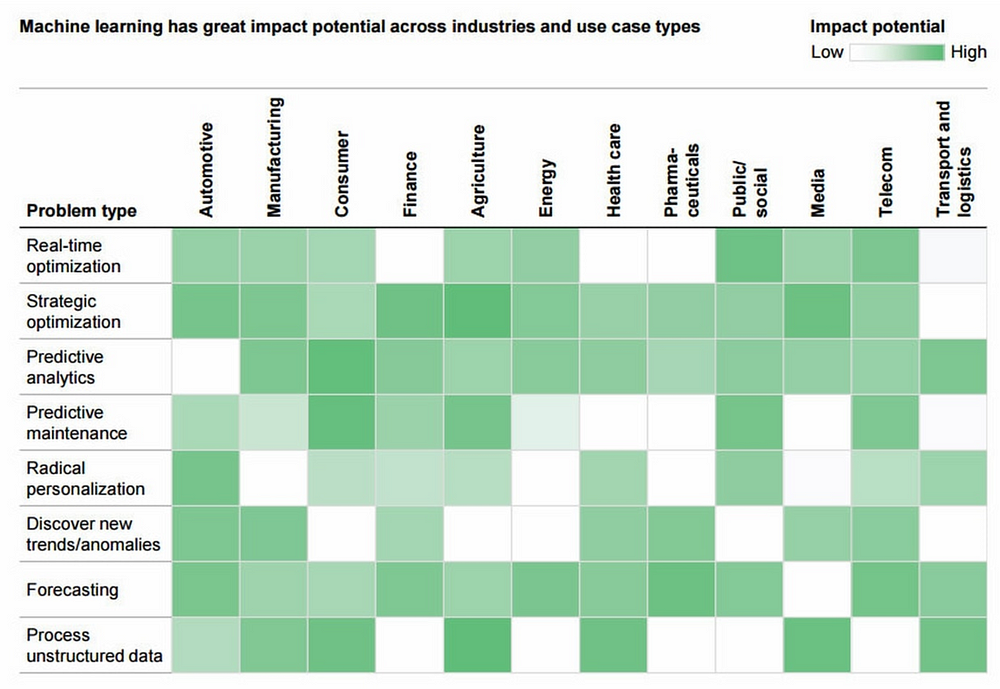
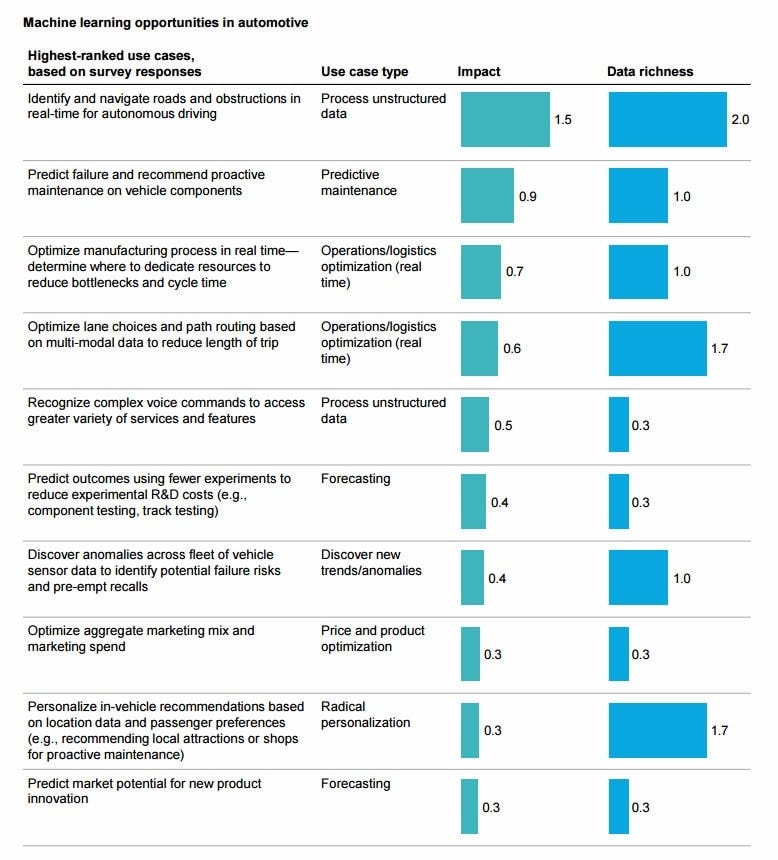
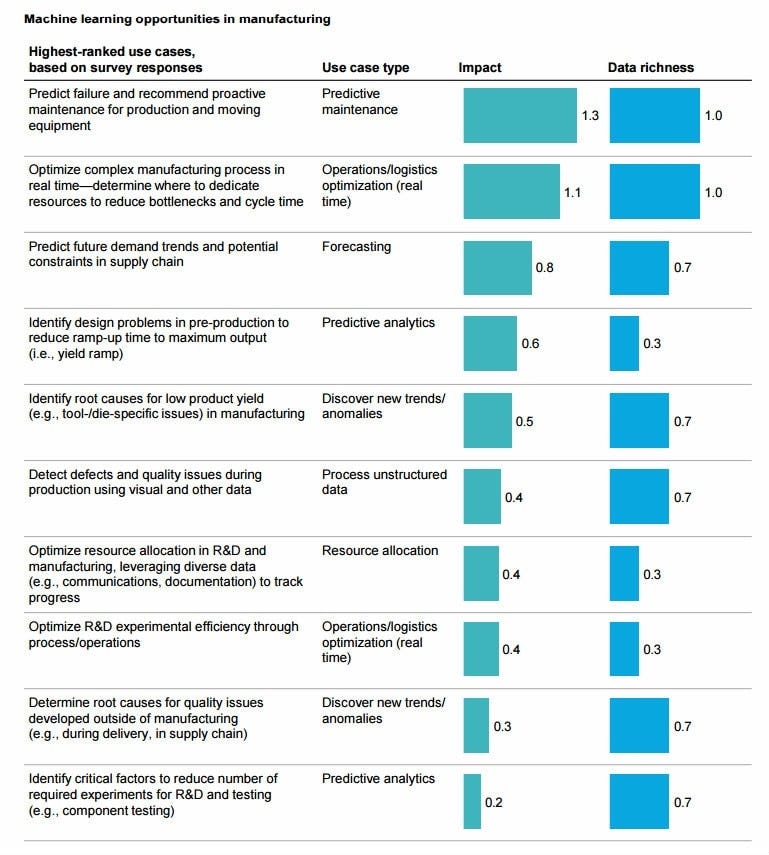
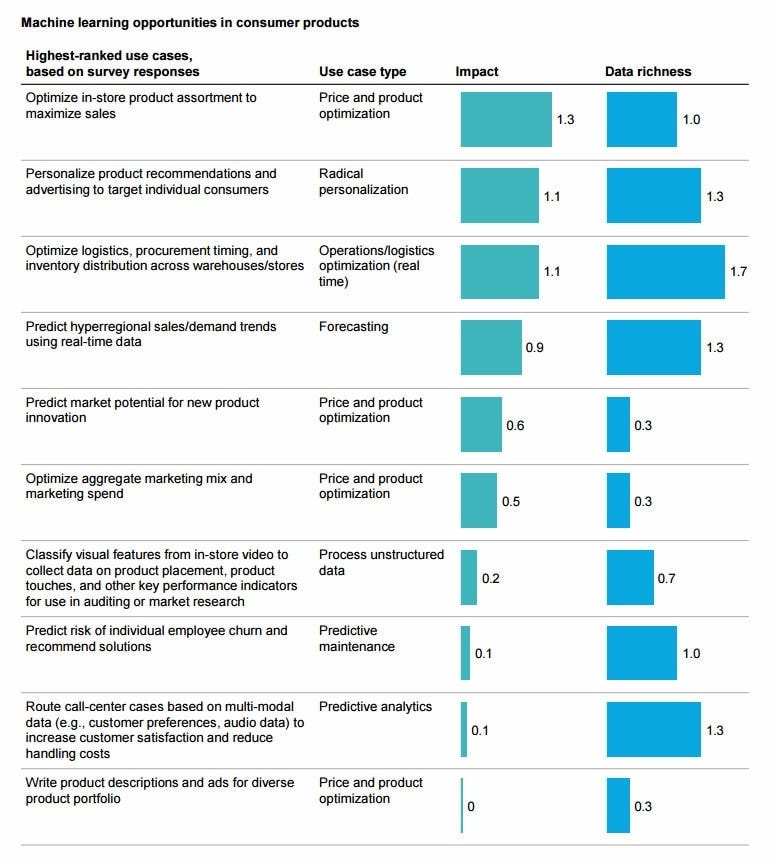
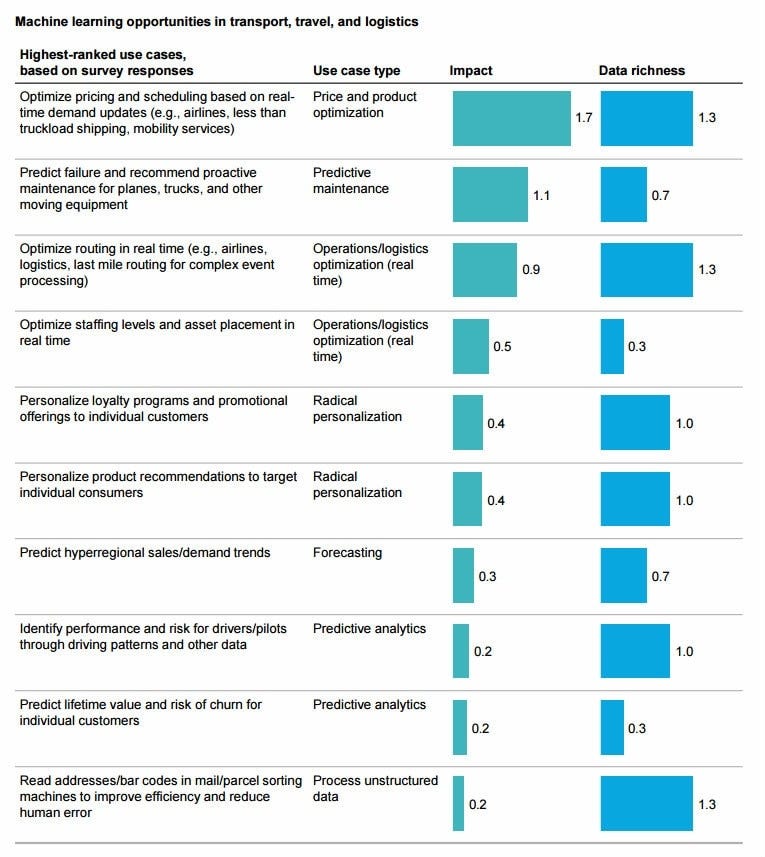
- Notes from the AI frontier: Applications and value of deep learning | McKinsey Global Institute, April 2018 Maps traditional machine learning and deep learning techniques to eight core problem types (classification, continuous estimation, clustering, optimization, anomaly detection, ranking, recommendations, and data generation) across 400+ use cases in 19 industries and nine business functions. The eight-problem-type taxonomy remains an essential diagnostic tool for deciding whether a problem actually requires generative AI or is better solved by classical predictive machine learning.
- Deep Learning, Machine Learning & AI Use Cases | Chris Nicholson, Pathmind A.I. Wiki A concise mapping of supervised and reinforcement learning capabilities to industrial and commercial sectors; the site is an archived static resource, last updated in 2023.
- 15 Business Applications For Artificial Intelligence And Machine Learning | Forbes Technology Council, September 2018 Early practitioner accounts from 15 CIOs and CTOs on predictive analytics, chatbots, and process automation; Forbes Technology Council is fee-based executive membership commentary rather than peer-reviewed or editorial reporting.
Analysts' Lists
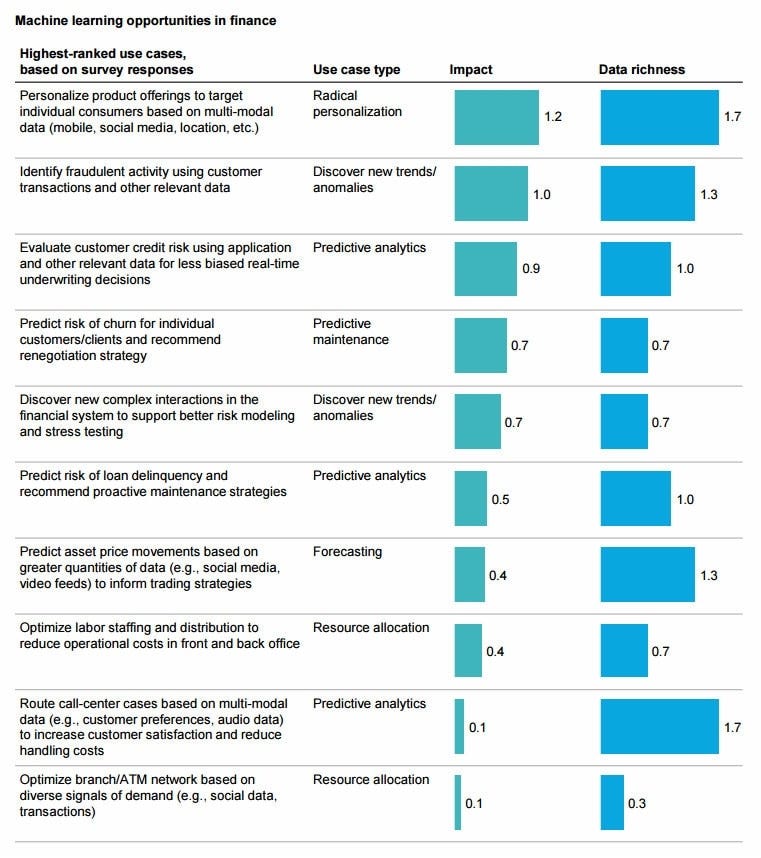
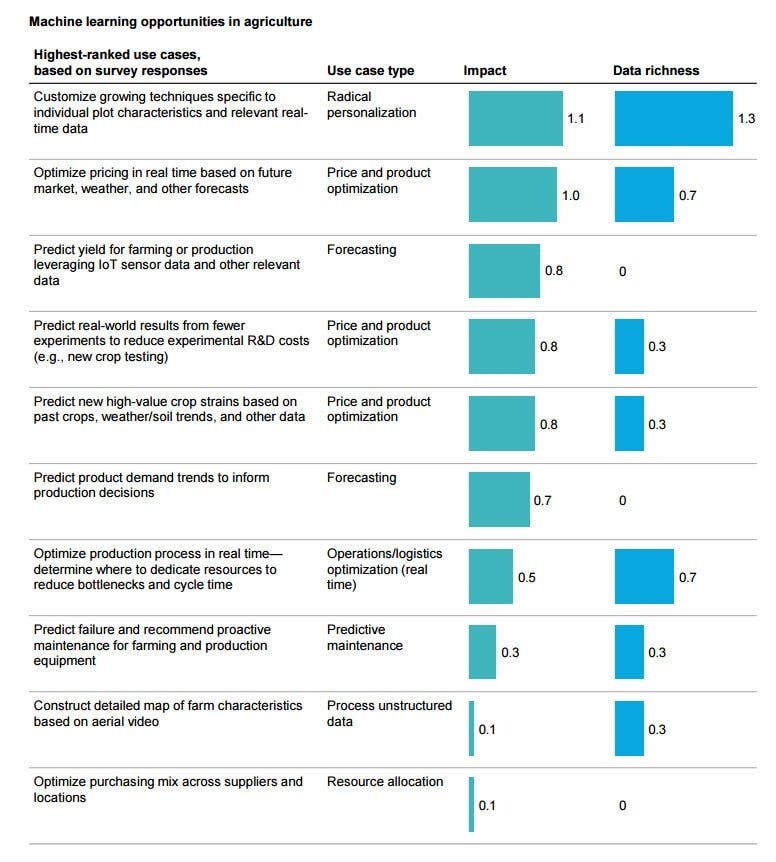
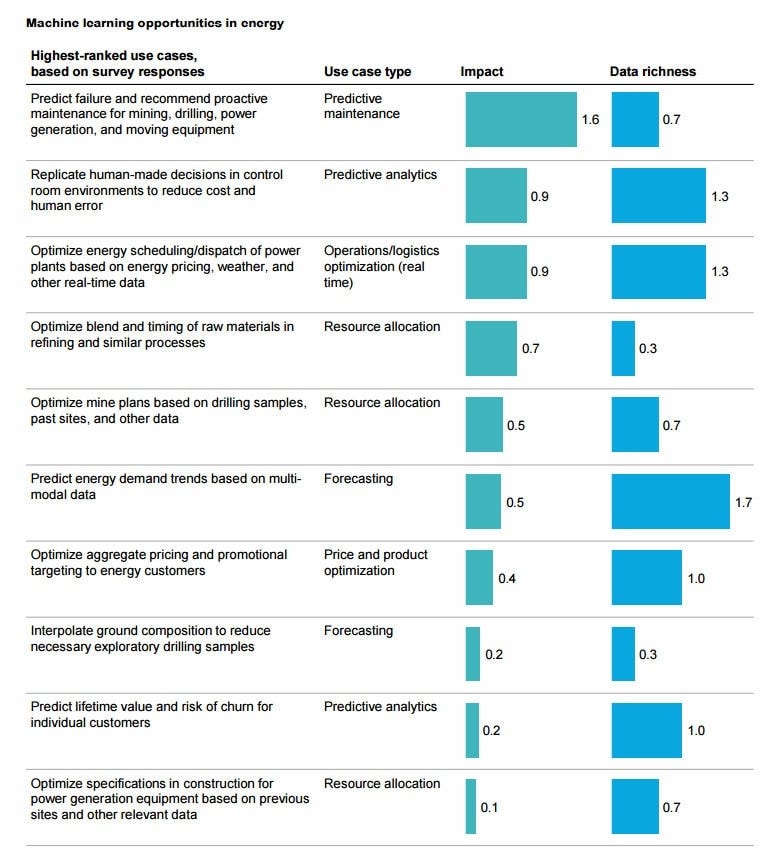
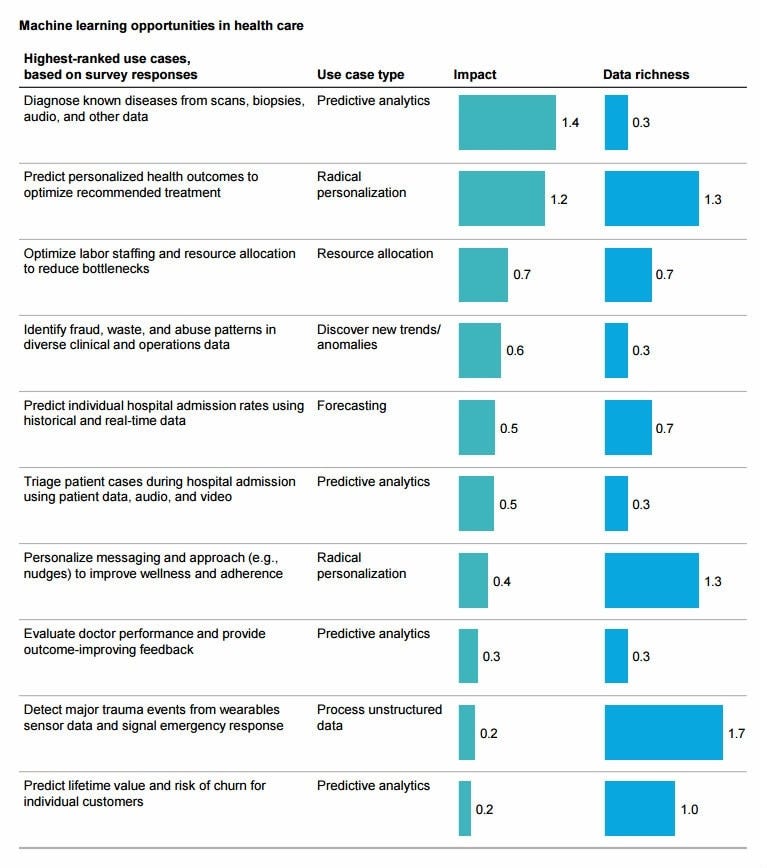
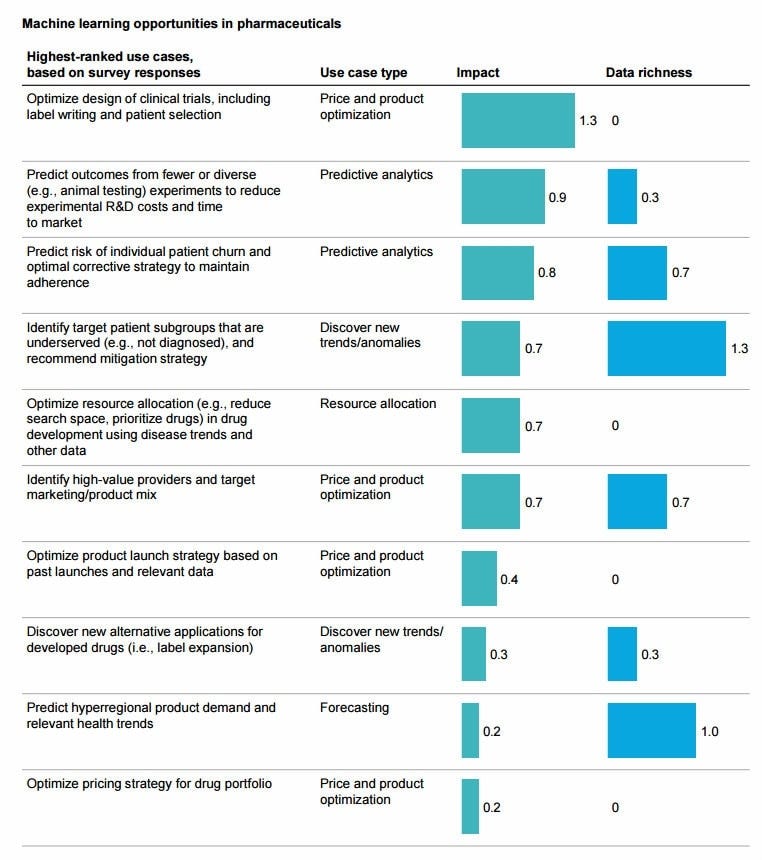
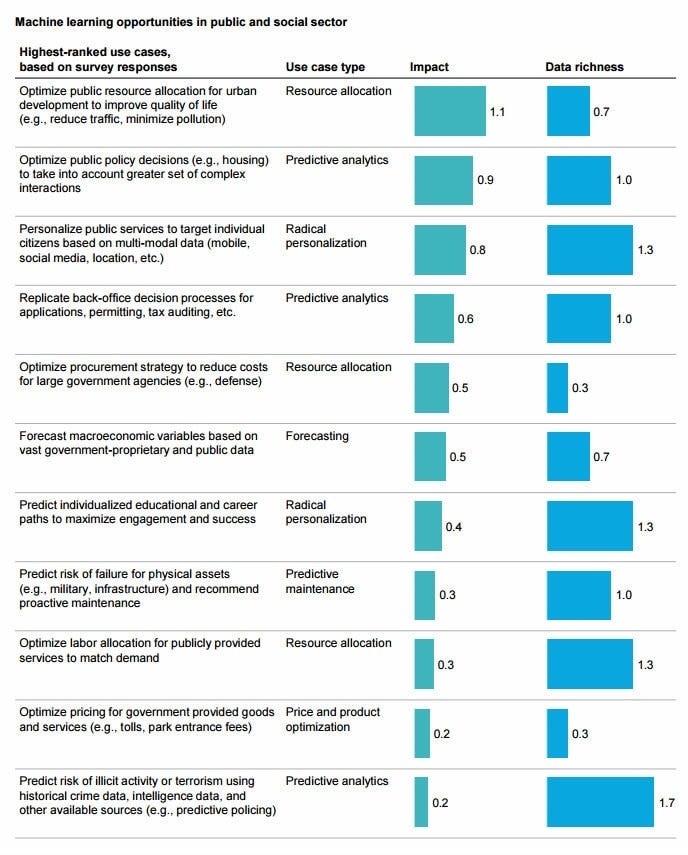
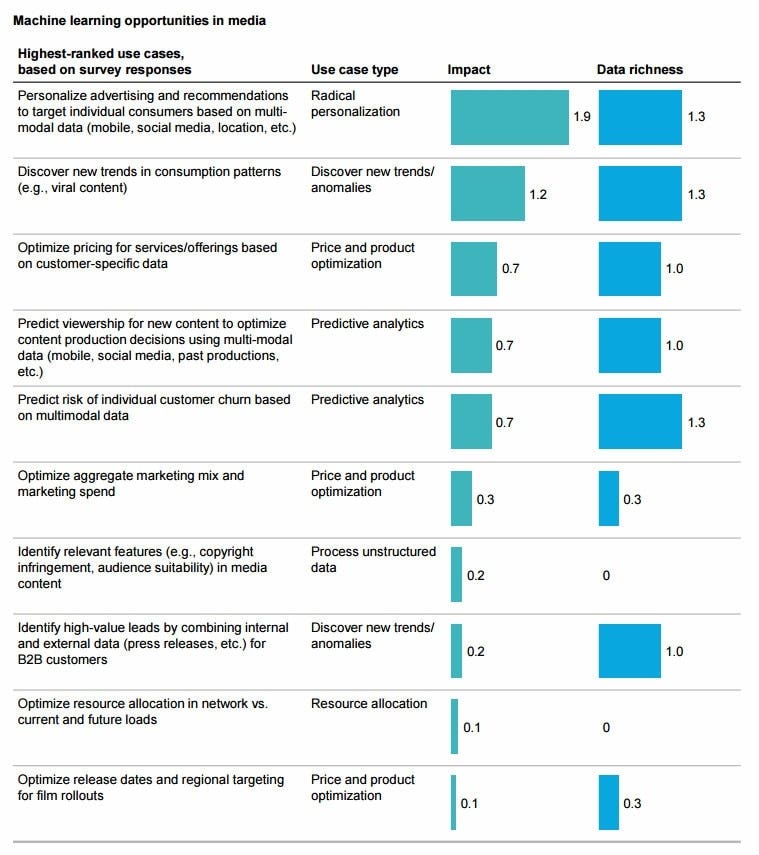
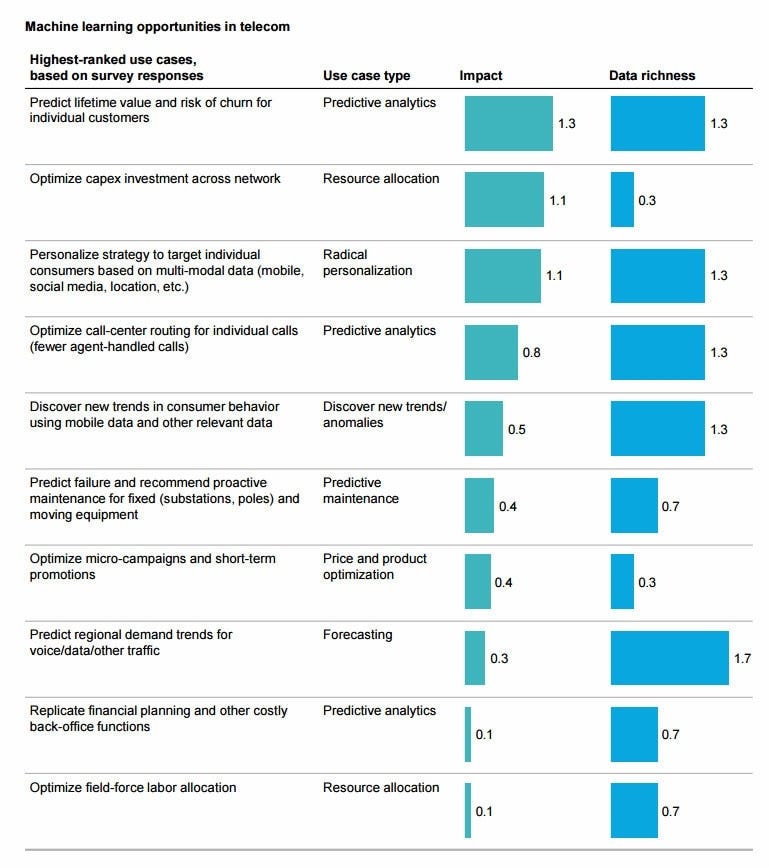
Management consultancies, market-intelligence firms, and industry analysts regularly publish visual taxonomies that map AI use cases across two axes: business value (revenue uplift, cost reduction, or strategic differentiation) and implementation feasibility (data readiness, technical maturity, and organizational friction). While these matrices are useful for initial executive brainstorming during portfolio discovery, practitioners should treat generic industry heatmaps as starting hypotheses rather than turnkey roadmaps. A use case rated "high feasibility" in an analyst report may still stall in a specific enterprise if local ERP and MES data schemas are unaligned.

Additional Viewing
The first four videos examine the economics of AI deployment and the move from pilot to production, drawing on the research summarized above. The earlier practitioner seminars that follow, most recorded between 2018 and 2020, predate generative AI. Their methods for matching problems to AI, checking data readiness, and prioritizing use cases still apply.
Erik Brynjolfsson | The Economics of Getting AI Right (Siemens Knowledge Hub, 49 minutes, July 2026). Stanford economist Erik Brynjolfsson explains why enterprise productivity often lags behind AI capabilities along the Productivity J-Curve, and how breaking jobs into individual tasks reveals the highest-value opportunities. He also argues that managers must use causal methods rather than simple correlations to measure AI's effect, and describes people as the managers of fleets of AI agents who frame questions and verify results. Watch on YouTube
SIEPR Economic Summit 2026 | AI & the Economy (Stanford Institute for Economic Policy Research, 55 minutes, March 2026). Economists Erik Brynjolfsson and Chad Jones and former Bureau of Labor Statistics Commissioner Erika McEntarfer weigh the evidence on how AI is affecting productivity and jobs. They contrast forecasts of explosive growth with the slower spread of past general-purpose technologies, and present payroll data from the Canaries in the Coal Mine study on entry-level hiring. Watch on YouTube
The AI Awakening: Implications for Business and the Economy (Wharton Human-AI Research, 59 minutes, October 2024). Brynjolfsson traces computing from hand-coded rules to machine learning and generative AI, and presents his contact-center study, which found 14 percent average and 34 percent novice productivity gains that persisted during system outages. He also explains the "Turing Trap," the argument that AI built to complement people creates more value than AI built to replace them. Watch on YouTube
From Industrial AI Ambition to Operational Reality: Choosing the Right Use Cases (IIoT World, 69 minutes, September 2026). Moderator Yash Titus and panelists from Strategy of Things, the Siemens CTO Office, Cumulocity, and NeoAI explain how to move industrial AI from pilot to production in existing factories. They walk through a multi-agent visual quality-inspection system and the five-layer verification and three-gate funding frameworks summarized in Portfolio Selection and Production Readiness Frameworks above. Watch on YouTube
MIT Bootcamps: How to identify business opportunities with AI (MIT Bootcamps). This business-skills seminar explains how AI generates revenue, how to identify and develop AI use cases in your own organization, and how to reduce the risks of new AI initiatives. It teaches concepts such as training data, machine learning, and deep learning for use in customer conversations and proposals, without technical training. Watch on YouTube
How To Identify AI/ML Use Cases (Gradient Group). The video suggests three places to look for opportunities: internal products and business processes, consumer software and hardware products, and business-to-business products and consulting. It aims to build the intuition needed to assess AI opportunities, including for people pursuing non-technical careers in AI. Watch on YouTube
Applying AI to Real World Use Cases - MIT AI Conference 2019 (MIT Club of Northern California). Julie Choi, Intel's Vice President of AI Products and Research Marketing, describes how innovators were using AI to create new use cases and better outcomes across industries. The talk was part of the 2019 MIT AI Conference, which focused on the future of computing. Watch on YouTube
Identifying Machine Learning Use Cases (AIEngineering). The video explains how to spot good candidates for machine learning, starting from the principle that problems solvable with simple rules or statistics should be solved that way. It then describes when those simpler techniques become ineffective or hard to maintain as data grows and changes. Watch on YouTube
AI Simplified: What Makes a Good Machine Learning Use Case? (DataRobot). Jake Shaver, DataRobot's Director of Strategic Initiatives, walks through a checklist for deciding whether a problem is a good fit for machine learning in your organization. It works as a quick screen to apply before committing data and staff to a project. Watch on YouTube
MFML 003: Advice for finding AI use cases (Cassie Kozyrkov). In this episode of her Making Friends with Machine Learning course, Cassie Kozyrkov, then Google's Chief Decision Scientist, offers a practical rule of thumb for finding AI use cases. The course is designed for everyone, not only engineers. Watch on YouTube
AI Use Cases Pattern Across Industries (EmergenTeck). Responding to a project manager's question about how to find AI use cases, the video argues that the easiest way is to look for patterns that recur across industries. It pairs well with Example Patterns to Leverage in Identifying AI Use Cases above. Watch on YouTube