Robotics
YouTube ... Quora ...Google search ...Google News ...Bing News
- Robotics ... Vehicles ... Drones ... 3D Model ... Point Cloud
- Simulation ... Simulated Environment Learning ... World Models ... Minecraft: Voyager ... Embodied AI
- Case Studies
- Cybersecurity ... OSINT ... Frameworks ... References ... Offense ... NIST ... DHS ... Screening ... Law Enforcement ... Government ... Defense ... Lifecycle Integration ... Products ... Evaluating
- Social Robots
- Symbiotic Intelligence ... Bio-inspired Computing ... Neuroscience ... Connecting Brains ... Nanobots ... Molecular ... Neuromorphic ... Animal Language
- Immersive Reality ... Metaverse ... Omniverse ... Transhumanism ... Religion ... Versions of Yourself
- Artificial Intelligence (AI) ... Generative AI ... Machine Learning (ML) ... Deep Learning ... Neural Network ... Reinforcement ... Learning Techniques
- Conversational AI ... ChatGPT | OpenAI ... Gemini | Google ... Claude | Anthropic ... Bing | Microsoft ... Siri | Apple ... Meta AI/Manus | Meta ... Perplexity ... Grok | SpaceXSI ... Ernie | Baidu ... DeepSeek ... Qwen | Alibaba
- Agents/Assistants ... Agent Catalog ... Personal Companions ... Negotiation ... Productivity ... Email ... Web Automation ... Robotic Process Automation (RPA) ... LangChain
- Autonomous Bag
- Robots for Healthcare
Robotics is the interdisciplinary branch of engineering and computer science dedicated to designing, constructing, operating, and programming physical machines that perceive, reason about, and apply forces to the real world. While Artificial Intelligence (AI) focuses on computational systems that interpret data, recognize patterns, and generate decisions in digital space, robotics gives those algorithms a physical body equipped with sensors and actuators. This convergence is known as Embodied AI (or "Physical AI"): intelligence that learns from and acts directly upon physical matter rather than operating solely on text, code, or pixels.
Modern robotics evolved through four distinct technical eras:
- Deterministic Industrial Automation (1961 to 1980s): Initiated by inventor George Devol and entrepreneur Joseph Engelberger, who deployed the first programmable hydraulic industrial manipulator, Unimate, at a General Motors die-casting plant in 1961. Early mobile autonomy began at the Stanford Research Institute (SRI) between 1966 and 1972 with Shakey the Robot, which introduced the classical Sense-Plan-Act (SPA) paradigm and the A* search algorithm, but required minutes of off-board computation just to move across a simplified room.
- Behavior-Based and Dynamic Legged Robotics (1980s to 2000s): MIT researcher Rodney Brooks challenged the slow symbolic planning of Shakey with his Subsumption Architecture, demonstrating that fast, layered reactive behaviors coupled directly to sensor inputs could navigate real rooms without explicit world models. Concurrently, Marc Raibert founded the Leg Lab at Carnegie Mellon University (1980) and MIT (1986), proving that legged machines could achieve animal-like agility by treating walking and running as dynamic, spring-loaded bouncing cycles rather than slow, statically stable table-like postures.
- Model Predictive Control and Sim-to-Real Locomotion (2010s): Accelerated by the 2012 to 2015 DARPA Robotics Challenge and researchers such as Russ Tedrake (MIT) and Marco Hutter (ETH Zurich), roboticists combined real-time convex optimization, Model Predictive Control (MPC), and deep Reinforcement Learning (RL) trained in physics simulators to master bipedal and quadrupedal balance over mud, stairs, snow, and rubble.
- Generalist Robot Foundation Models (2020s to Present): Led by researchers including Sergey Levine (UC Berkeley and Physical Intelligence), Chelsea Finn (Stanford and Physical Intelligence), Ken Goldberg (UC Berkeley), Dieter Fox (NVIDIA), and Kanishka Rao (Google DeepMind), modern robotics merges pre-trained multimodal vision-language models with continuous diffusion and flow-matching motor decoders. Instead of hand-coding inverse kinematics and task state machines for a single factory fixture, engineers train generalist Vision-Language-Action (VLA) models and Large Behavior Models (LBMs) on thousands of hours of cross-embodiment human teleoperation, synthetic Simulation trajectories, and real-world reinforcement learning.
This shift resolves a long-standing barrier in computer science known as Moravec's Paradox: the observation by roboticist Hans Moravec in the 1980s that high-level abstract reasoning (such as playing Go, proving theorems, or writing software) requires comparatively little computation, whereas low-level sensorimotor skills that a two-year-old child performs effortlessly (such as picking a key out of a pocket, folding a crumpled towel, or peeling a banana) require immense, tightly coupled physical intelligence.
By uniting multimodal foundation models with continuous motor control and physical feedback, modern robotics transforms digital intelligence from a passive advisor into an active physical worker capable of navigating and manipulating unstructured human environments.
- Mechanisms: Modern AI-driven robots operate through a hierarchical, multi-frequency perception-reasoning-action loop that bridges slow semantic reasoning with fast physical reflex control:
- Multimodal Sensory Perception: The robot ingests spatial, visual, and mechanical state data through heterogeneous sensors. Global scene cameras and wrist-mounted or palm-mounted RGB-D cameras capture visual context and close-range contact geometry without occlusion from the robot's own fingers. Spinning or solid-state LiDAR units and stereo depth cameras generate a 3D Point Cloud for obstacle avoidance and Simultaneous Localization and Mapping (SLAM). Proprioceptive sensors (rotary optical or magnetic joint encoders, motor current sensors, and 6-axis Inertial Measurement Units) track the robot's internal joint angles, velocities, and body orientation, while 6-axis force-torque wrists and cutaneous fingertip sensors measure normal and shear contact forces.
- Hierarchical Three-Tier Control Architecture (System 2, System 1, and System 0): Because physical stability requires control updates orders of magnitude faster than large transformer inference, modern embodied architectures separate decision-making by frequency. At the top tier (System 2, running at 0.5 to 5 Hz), a multi-billion-parameter Vision-Language Model (VLM) processes camera frames and natural-language prompts, using embodied chain-of-thought reasoning to identify object affordances, localize targets in 3D space, and decompose long-horizon instructions ("clean the kitchen") into sequential sub-goals ("close the microwave, grasp the plate, wipe the plate, place it on the rack"). At the middle tier (System 1, running at 50 to 200 Hz), a lightweight Visuomotor Action Expert (typically a 100M to 400M parameter transformer or diffusion head conditioned on the VLM's internal latent representations) outputs continuous "action chunks": short trajectories of target joint positions, velocities, or end-effector poses over the next 0.5 to 1.0 seconds. At the lowest tier (System 0, running at 500 to 1,000+ Hz on dedicated real-time microcontrollers), a whole-body Model Predictive Controller (MPC) or operational-space impedance controller converts those target trajectories into motor phase currents and joint torques while maintaining dynamic balance and enforcing force limits.
- Three-Stage Training Pipeline: Building a generalist robotic policy follows a training recipe analogous to large language models, adapted for physical interaction. First, during Pre-Training, the model trains on massive, heterogeneous datasets combining web-scale vision-language data with 10,000 to 100,000+ hours of multi-robot teleoperation (such as the Open X-Embodiment and DROID datasets) and millions of synthetic trajectories generated in GPU-accelerated physics simulators. This teaches broad visual common sense and recovery behaviors across diverse morphologies. Second, during Supervised Post-Training (SFT), the model fine-tunes on tens of hours of curated, high-consistency demonstrations on the target robot hardware to establish fluent, task-specific strategies. Third, during Offline-to-Online Reinforcement Learning, the robot executes tasks autonomously in the real world while a learned VLM value function critiques its actions, allowing the policy to double its speed and push task reliability from ~80% toward industrial standards.
- Dependencies and Remaining Uncertainties: This pipeline depends on low-latency edge compute, accurate camera-to-robot extrinsic calibration, and high-quality teleoperation interfaces (such as VR headsets and leader-follower kinematic arms) that match the human demonstrator's observation space one-to-one with the robot's sensors. Major uncertainties remain around how to represent high-dimensional tactile feedback in foundation models, how to learn directly from uncalibrated human ego-videos when human eye gaze diverges from hand action, and how to guarantee safety when non-deterministic neural networks encounter out-of-distribution edge cases.
- The Physics: Unlike digital software agents that manipulate discrete symbols in a deterministic operating system, a physical robot is governed by continuous Newtonian mechanics, thermodynamics, electromagnetism, and contact physics:
- Rigid-Body and Multi-Body Dynamics: A robot with <math>n</math> degrees of freedom (such as a 6-DoF industrial arm or a 56-DoF humanoid) obeys the Euler-Lagrange equations of motion in joint space:
- <math>\mathbf{M}(\mathbf{q})\ddot{\mathbf{q}} + \mathbf{C}(\mathbf{q}, \dot{\mathbf{q}})\dot{\mathbf{q}} + \mathbf{g}(\mathbf{q}) = \boldsymbol{\tau} + \mathbf{J}^T(\mathbf{q})\mathbf{F}_{\text{ext}}</math>
- where <math>\mathbf{q}, \dot{\mathbf{q}}, \ddot{\mathbf{q}} \in \mathbb{R}^n</math> are the joint position, velocity, and acceleration vectors; <math>\mathbf{M}(\mathbf{q})</math> is the symmetric positive-definite mass/inertia matrix; <math>\mathbf{C}(\mathbf{q}, \dot{\mathbf{q}})\dot{\mathbf{q}}</math> represents Coriolis and centrifugal forces; <math>\mathbf{g}(\mathbf{q})</math> is the gravitational torque vector; <math>\boldsymbol{\tau}</math> is the vector of internal actuator torques; and <math>\mathbf{J}^T(\mathbf{q})\mathbf{F}_{\text{ext}}</math> maps external contact forces and wrenches <math>\mathbf{F}_{\text{ext}}</math> at the feet or hands back into joint space via the manipulator Jacobian transpose <math>\mathbf{J}^T(\mathbf{q})</math>.
- Underactuated Legged Locomotion and Dynamic Balance: A wheeled factory robot bolted to a track is fully actuated, whereas a bipedal humanoid or quadruped is underactuated: its base is not bolted to the floor, meaning it can only accelerate its Center of Mass (CoM) by pushing against the ground through unilateral contact points that can push but cannot pull. Using the Linear Inverted Pendulum Model (LIPM), when a robot's Center of Mass is at height <math>z_c</math> above the ground under gravity <math>g</math>, its horizontal acceleration <math>\ddot{x}</math> depends on the distance between the CoM <math>x</math> and the Center of Pressure (or Zero-Moment Point, <math>x_{\text{ZMP}}</math>) on the support foot:
- <math>\ddot{x} = \frac{g}{z_c}(x - x_{\text{ZMP}})</math>
- To prevent falling during walking, running, or carrying heavy loads, the controller computes the instantaneous Capture Point <math>\mathbf{x}_{\text{CP}} = \mathbf{x} + \frac{\dot{\mathbf{x}}}{\sqrt{g / z_c}}</math>: the exact point on the ground where the robot must step to bring its orbital energy to zero. In aerial phases (hopping or somersaulting), angular momentum <math>\mathbf{L} = \mathbf{I}\boldsymbol{\omega}</math> is strictly conserved while airborne, meaning the robot can only adjust its rotation rate <math>\boldsymbol{\omega}</math> to stick a landing by tucking or extending its limbs to change its moment of inertia <math>\mathbf{I}</math>.
- Contact Mechanics, Friction Cones, and Deformable Matter: Every manipulation or footstep is constrained by the Coulomb friction cone: tangential shear force <math>|F_t|</math> cannot exceed the coefficient of static friction <math>\mu</math> multiplied by the normal force <math>F_n</math> (<math>|F_t| \le \mu F_n</math>), or the foot slips and the grasped object drops. While rigid-body contact is approximated via complementarity constraints, real-world manipulation involves deformable objects (cloth, cables, food, biological tissue) governed by infinite-dimensional continuum mechanics and nonlinear viscoelasticity. Because simulating sub-millimeter skin compression and cloth self-collision is computationally expensive and prone to numerical stiffness, learning dexterous manipulation purely in simulation remains significantly harder than learning locomotion.
- Actuator Energetics, Compliance, and Negative Work: Actuators convert electrical or hydraulic power into mechanical work <math>W = \int \tau \, d\theta</math>. When an actuator decelerates a limb upon landing or absorbs an external impact, the joint velocity <math>\dot{\theta}</math> and torque <math>\tau</math> have opposite signs (<math>P = \tau \dot{\theta} < 0</math>), performing negative work. Without mechanical springs (passive compliance) or regenerative motor drives to store and recirculate that elastic energy, negative work dissipates as Joule heating (<math>P_{\text{heat}} = I^2 R</math>) in motor windings or across hydraulic throttling valves. Modern humanoid design therefore centers on high-torque-density brushless DC (BLDC) Quasi-Direct-Drive (QDD) actuators paired with low-ratio planetary or cycloidal gears that remain backdrivable, allowing the robot to sense external impacts through motor current alone without snapping gear teeth.
- Continuous Action Generation via Flow Matching: In information-theoretic terms, first-generation VLA models discretized continuous robot actions into 256 text-like bins per dimension, causing quantization jitter and slow autoregressive decoding. Second-generation VLAs (such as pi0 and GR00T) model the continuous action chunk <math>\mathbf{A}_t = [\mathbf{a}_t, \mathbf{a}_{t+1}, \dots, \mathbf{a}_{t+H}]</math> using conditional Flow Matching. Starting from Gaussian noise <math>\mathbf{A}^0 \sim \mathcal{N}(\mathbf{0}, \mathbf{I})</math>, the action expert neural network <math>\mathbf{v}_\theta(\mathbf{A}^\tau, \tau \mid \mathbf{o}_t)</math> integrates an ordinary differential equation (ODE) from flow time <math>\tau = 0</math> to <math>\tau = 1</math> (typically in 5 to 10 forward Euler steps) to transport the noise distribution directly onto the smooth multimodal distribution of physical motor trajectories.
- Why This Matters: The maturation of generalist Embodied AI alters industrial economics, scientific discovery, and human labor:
- Breaking the Rigid-Fixture Bottleneck: Conventional industrial robots require structured cages, precision jigs, and millions of dollars in systems integration, making them economical only for high-volume, low-mix production (such as automotive body welding). Generalist VLA-driven robots adapt to unstructured environments designed for humans (narrow aisles, stairs, doorknobs, commercial kitchens, and hospital wards) using existing human tools and variable parts without facility retrofits.
- Mitigating Demographic and Labor Shortages: Aging populations across North America, Europe, and East Asia face acute worker shortages in logistics warehousing, eldercare, construction, agriculture, and manufacturing. Autonomous mobile manipulators and humanoids take over ergonomically punishing jobs, such as unloading 50 to 60 lb boxes inside 100°F shipping trailers or conducting thousands of repetitive daily thermal and acoustic safety inspections in chemical plants.
- Scientific Discovery Beyond Human Artifacts: As UC Berkeley roboticist Sergey Levine notes, digital AI agents that write code or browse the web learn exclusively from human-created artifacts; they can only rearrange knowledge that humans have already discovered and recorded. An embodied physical agent that conducts autonomous experiments in the real world (whether a robotic chemist synthesizing 600 novel compounds a week or a manipulation policy discovering physical affordances through trial and error) interacts directly with the laws of nature, generating empirical data that transcends existing human knowledge.
- Critical Limitations and Open Questions: Despite rapid progress, generalist robots in 2026 are still 5 to 10 years away from widespread, unsupervised domestic deployment. Zero-shot task success rates in unfamiliar homes plateau near 80% to 85% without task-specific reinforcement learning, far below the <math>1 - 10^{-8}</math> dependability required for high-stakes safety. Resolving hardware durability in cutaneous tactile skins, preventing catastrophic heavy-tail errors around humans, and establishing clear legal frameworks for autonomous negligence remain urgent engineering priorities.
Recent Developments
Between 2024 and 2026, the focal point of robotics research shifted from isolated mechanical stunts to scalable foundation models, cross-embodiment data infrastructure, real-world reinforcement learning, and commercial humanoid deployment.
Architectural Evolution of Vision-Language-Action (VLA) Models
According to the State of Robotics 2026 Report, Vision-Language-Action (VLA) model adoption tripled between 2025 and 2026, powering 40% of all new commercial robot deployments as the global robotics market expanded 34% year-over-year to $38 billion. Researchers divide these architectures into two distinct generations:
- First-Generation Token-Based VLAs (RT-2 and OpenVLA): Introduced by Google DeepMind with RT-2 (55B parameters) and democratized in June 2024 by researchers from Stanford, UC Berkeley, and the Toyota Research Institute with OpenVLA (an open-source 7B-parameter model built on a Llama 2 language backbone fused with DINOv2 and SigLIP visual encoders, trained on 970,000 real-world robot episodes). These models treat physical movement like text generation, mapping continuous robot actions into 256 discrete integer bins and overwriting rarely used tokens in the language model's vocabulary. While OpenVLA outperformed the 55B RT-2-X by 16.5% in absolute task success across 29 evaluation tasks using 7x fewer parameters, token-based autoregression limits control frequency (typically 3 to 5 Hz) and struggles with high-frequency, dexterous bimanual motion.
- Second-Generation Continuous Flow-Matching VLAs (pi0, pi0.5, Gemini Robotics, GR00T, and SmolVLA): Introduced in late 2024 and expanded throughout 2025 and 2026, second-generation architectures retain a pre-trained VLM as a semantic backbone ("visual and language cortex") but attach a dedicated continuous action expert ("virtual motor cortex") trained via conditional flow matching or denoising diffusion.
- Physical Intelligence (pi0, pi0.5, and openpi): Unveiled in October 2024 and open-sourced via the openpi repository in February 2025, pi0 pairs a 2.6B-parameter PaliGemma VLM backbone with a 300M-parameter flow-matching action expert in a Mixture-of-Transformers architecture, outputting 50 Hz continuous action chunks across 7 different robot configurations and 68 dexterous tasks (such as folding laundry from a dryer, bussing tables, and bagging groceries). In April 2025, pi0.5 introduced unified co-training across heterogeneous embodiments and web data, interleave-training the model to generate intermediate high-level semantic subtask plans before decoding low-level continuous motor trajectories.
- Google DeepMind (Gemini Robotics 1.5, 2.0, and On-Device): Building on Gemini 2.0, Google DeepMind introduced Gemini Robotics in March 2025, followed by Gemini Robotics On-Device in June 2025 (optimized to run locally on the robot without cloud connectivity and adapt to new tasks from just 50 to 100 demonstrations) and Gemini Robotics 1.5 in late 2025. Gemini Robotics interleaves explicit "thinking tokens" in natural language and spatial coordinates directly before physical action tokens, allowing the robot to reason through dynamic perturbations in real time (such as realizing it must shift a laundry bin closer before grasping a white cloth, or folding intricate origami using only visual feedback from wrist cameras).
- NVIDIA (Isaac GR00T N1 and N1.7): Announced in March 2025 and updated through 2026, NVIDIA's open humanoid foundation model GR00T N1 uses a dual-system architecture inspired by human cognition: a System 2 vision-language model (built on NVIDIA-Eagle with SmolLM2) that interprets the environment and task instructions at 10 Hz, coupled with a System 1 diffusion transformer that generates continuous 120 Hz whole-body motor actions.
- Hugging Face (SmolVLA and LeRobot): In 2025, Hugging Face's open-source LeRobot initiative (led by former Tesla AI scientist Remi Cadene) released SmolVLA, a compact 450-million-parameter flow-matching VLA model that uses layer skipping and visual token compression to run at real-time speeds on consumer GPUs and edge devices while matching models 10x its size.
| Model / Architecture | Organization | Parameter Scale | Backbone & Action Decoder | Control Frequency | Primary Training Data & Key Innovation |
|---|---|---|---|---|---|
| RT-2 / RT-X | Google DeepMind & Academic Consortium | 55B (PaLI-X) / 12B (PaLM-E) | VLM with discrete 256-bin autoregressive action tokens | 1 - 5 Hz | Web VQA + Open X-Embodiment (22 robot embodiments); proved web semantic concepts transfer zero-shot to physical actions. |
| OpenVLA | Stanford, UC Berkeley, TRI | 7B | Llama 2 + DINOv2 + SigLIP; discrete action tokenization | 5 - 10 Hz | 970k real-world episodes from Open X-Embodiment; open-source baseline supporting LoRA fine-tuning on single consumer GPUs. |
| pi0 / pi0.5 / pi*0.6 | Physical Intelligence | ~3.3B (2.6B VLM + 300M Action Expert) | Mixture-of-Transformers with conditional flow-matching action head | 50 Hz (action chunks) | 10,000 to 100,000+ hrs cross-embodiment teleoperation + VLM value-function RL post-training (pi*0.6); open-sourced in openpi. |
| Gemini Robotics 1.5 & On-Device | Google DeepMind | Multimodal Frontier + Edge Variant | Gemini backbone + interleaved physical thinking tokens + local motor decoder | 50 Hz | Web multimodal data + ALOHA/bi-manual/Apollo/Atlas demonstrations; steerable physical chain-of-thought trace. |
| Isaac GR00T N1 / N1.7 | NVIDIA | ~2B - 3B | Eagle VLM (System 2) + Diffusion Transformer (System 1) | 10 Hz (S2) / 120 Hz (S1) | Real humanoid teleoperation + 780,000 synthetic trajectories generated in 11 hours via Isaac Lab and Omniverse. |
| Helix 02 | Figure AI | 7B (S2) + 80M (S1) + S0 Controller | Tri-level: VLM (S2) + Visuomotor Transformer (S1) + Whole-Body Balance (S0) | 7-9 Hz (S2) / 200 Hz (S1) / 1,000 Hz (S0) | High-rate coordinated control of full 35+ DoF upper body, dual 16-DoF hands, palm cameras, and 3g tactile sensors on Figure 03. |
| TRI / Boston Dynamics LBM | Toyota Research Institute & Boston Dynamics | Large Diffusion Transformer | Unified Large Behavior Model (vision, proprioception, language) | 30 - 100 Hz whole-body | Single neural policy controlling the 56-DoF electric Atlas across walking, squatting, and bimanual manipulation simultaneously. |
| SmolVLA | Hugging Face (LeRobot) | 450M | SmolVLM-2 + lightweight flow-matching action expert | 30 - 60 Hz on edge | Open-source community datasets on Hugging Face Hub; designed for low-cost hardware (SO-100/SO-101 arms) and single-GPU inference. |
Embodied Chain-of-Thought (ECoT) and Asynchronous Test-Time Compute
A major breakthrough in 2025 and 2026 was adapting test-time reasoning ("thinking before acting") from large language models to physical control. In standard reactive VLAs, the policy maps camera pixels directly to motor actions like unconscious muscle memory, which fails when the robot encounters an unfamiliar spatial arrangement. Researchers at UC Berkeley, Stanford, and Physical Intelligence introduced Embodied Chain-of-Thought (ECoT) and Steerable VLA Policies. Before outputting motor commands, the model autoregressively generates intermediate textual and spatial representations:
- Task decomposition (breaking "make the blue block the only object on the plate" into "remove existing objects from the plate, then grasp the blue block and place it on the plate").
- Spatial grounding and 2D/3D bounding boxes (explicitly outputting pixel coordinates of target objects, obstacles, and the robot's own end-effector).
- Low-level geometric movement vectors (translating semantic intent into grounded coordinate deltas such as "move gripper from <math>(x_1, y_1)</math> to <math>(x_2, y_2)</math>").
In controlled evaluations presented by Sergey Levine in 2026, adding Embodied Chain-of-Thought to the 7B-parameter OpenVLA model increased absolute success rates by over 20%, allowing the 7B open-source model to outperform Google's 55B-parameter RT-2-X model. Furthermore, Google DeepMind demonstrated that exposing the model's physical thinking trace makes the robot steerable and interpretable at runtime: if a robot's thought trace reads "I am close enough to close my hand on the bottle," an engineer or supervisory module can edit the thought trace in flight to "I am not close enough; I need to move lower," and the conditioned action expert immediately lowers the arm instead of closing the gripper prematurely.
To prevent test-time reasoning latency from freezing the robot's physical movement, modern deployments run asynchronous dual-copy inference: one instance of the model runs at 0.5 Hz (generating a new high-level thought trace every 2 seconds), while a second instance consumes the most recent thought trace and outputs continuous 50 Hz motor action chunks every 150 milliseconds. Notably, ablation studies on Physical Intelligence's pi0.5 model revealed two counterintuitive findings:
- Verbal Coaching Outperforms Pure Teleoperation: Coaching a robot verbally through substeps during training (talking to the robot as a human teacher would, without touching the joysticks) provides massive performance gains, and the resulting autonomous model ultimately outperforms direct step-by-step human verbal guidance at test time.
- Training to Think Improves Reflexes: Simply training a VLA to generate intermediate reasoning traces during training significantly improves its physical task success even if test-time thinking is completely turned off during deployment, because the auxiliary reasoning loss forces the vision-language backbone to learn superior spatial representations.
Closing the Reliability Gap with Real-World Reinforcement Learning (pi*0.6)
While pre-trained and supervised fine-tuned (SFT) VLAs generalize across many tasks, their zero-shot and SFT success rates typically plateau around 70% to 85%, which is insufficient for commercial production. Applying standard LLM reinforcement learning algorithms such as Proximal Policy Optimization (PPO) or Group Relative Policy Optimization (GRPO) directly to physical robots is impractical because on-policy algorithms require millions of fresh trial-and-error rollouts, and physical robots move in real time and suffer mechanical wear.
In late 2025 and 2026, Physical Intelligence introduced pi*0.6 (pronounced "pi-star-zero-point-six"), an offline-to-online reinforcement learning framework designed specifically for large VLA foundation models:
- VLM Value Function and Advantage Conditioning: Instead of using policy gradients directly on the 3B-parameter VLA, researchers train a separate VLM-based Value Function on all historical autonomous and teleoperated episodes to predict the probability and time-to-completion from any visual state. For example, if a robot crumples a sleeve while folding a T-shirt or tips over a water filter while removing it from a refrigerator, the value function's predicted score drops sharply; when it successfully opens the fridge door, the value jumps.
- Iterative Real-World Practice: This value function computes the advantage of candidate actions (indicating whether an action moves closer to or further from success). The VLA policy is then trained with an additional optimality indicator input conditioned on high-advantage actions.
- Experimental Results: Deployed on physical bimanual robots, pi*0.6 operated an industrial espresso machine continuously for 13 hours straight (grinding beans, tamping the portafilter with precise vertical force, locking the portafilter into the grouphead, monitoring liquid extraction visually, steaming and pouring milk, and wiping the counter) and assembled folded cardboard boxes with adhesive labels at Dandelion Chocolate in San Francisco. Across these contact-rich tasks, reinforcement learning post-training doubled task throughput (2x successes per hour) compared to supervised fine-tuning (SFT) and reduced fatal unrecoverable errors to near zero.
Cross-Embodiment Scaling Laws and the 100-Home Saturation Discovery
A foundational question in robot learning is whether data collected on one robot hardware platform helps a completely different robot learn, and how many distinct physical environments are needed before a robot generalizes to any unseen building:
- Cross-Embodiment Positive Transfer: In the Open X-Embodiment (RT-X) study across more than 30 academic robotics labs worldwide, pooling heterogeneous manipulation data from 22 different robot types into a single generalist model improved task performance by 50% on average compared to each laboratory's best custom-tuned specialist model tested on its own hardware. Extending this principle, Physical Intelligence demonstrated with pi0.5 that when training a mobile household robot to clean kitchens and bedrooms, only 3% of the training dataset needed to come from mobile robots; the remaining 97% came from stationary tabletop arms and web data, yet the mobile manipulators successfully inherited the bimanual motor skills.
- Environmental Scaling Saturation: To measure how many real-world homes are needed to train a generalist domestic robot, researchers trained pi0.5 across subsets of a dataset collected in roughly 100 distinct real-world houses and evaluated the robot in completely unseen kitchens and bedrooms. Performance scaled rapidly from 1 to 50 homes and saturated at approximately 100 distinct training homes (matching the environmental generalization ceiling at ~84% task progress). However, omitting cross-embodiment pre-training caused performance in unseen homes to collapse below a model trained on only 10 homes. This proves two critical scaling laws: (1) roughly 100 diverse physical environments are sufficient for a pre-trained VLA to generalize visually and semantically to new homes, and (2) closing the remaining gap from 84% to 100% cannot be achieved simply by collecting data in thousands of additional houses; it requires online reinforcement learning and closed-loop tactile feedback.
The Data Infrastructure Debate: Sim-to-Real vs. Embodied Teleoperation
The robotics community in 2025 and 2026 is divided over the optimal data strategy for scaling physical intelligence:
- Synthetic Trajectory Generation and Sim-to-Real: Proponents of Simulation, led by NVIDIA, argue that human teleoperation is too slow and expensive to match the trillion-token scale of internet text. In March 2025, NVIDIA demonstrated that using Isaac Lab and Omniverse combined with its Cosmos World Models, a few human demonstrations could be multiplied into 780,000 synthetic trajectories in just 11 hours (equivalent to 6,500 hours or 3+ human work-years of continuous physical teleoperation). Co-training GR00T N1 on this synthetic data alongside real data improved real-robot manipulation performance by 40%. Independent 2026 benchmarks from Carnegie Mellon University and Stanford University confirmed that VLA policies trained on a 40% synthetic and 60% real data blend matched the accuracy of policies trained on 100% real-world demonstrations while cutting data collection costs by 60%.
- Embodied VR Teleoperation and the Ego-Video Gaze Problem: Conversely, researchers at Google DeepMind, Boston Dynamics, and Physical Intelligence emphasize that while rigid-body locomotion and basic pick-and-place transfer cleanly from simulation, contact-rich dexterity (routing deformable wire harnesses, turning a screwdriver with proper torque, or untangling wet laundry) fails in simulators because numerical engines cannot accurately model micro-slip, cloth friction, and soft-tissue compression at high speeds. Therefore, high-fidelity VR teleoperation (where a human pilot wears a head-mounted display streaming the robot's exact eye/wrist camera feeds so the pilot cannot rely on external visual cues unavailable to the robot) remains indispensable. Furthermore, Boston Dynamics Head of Robotics Behavior Alberto Rodriguez reported in 2026 that attempting to pre-train manipulation models on cheap, large-scale human ego-videos (people wearing forehead cameras during daily life) hits a biological bottleneck: humans do not look at their hands while manipulating objects. Human eyes glance at an object for a fraction of a second to lock in the grasp and immediately look ahead to the next task while the hands finish the manipulation blind, guided entirely by cutaneous touch and proprioception.
Commercialization of Electric Humanoids and Tactile Hardware
Between 2024 and 2026, full-scale humanoid robots transitioned from hydraulic research prototypes to mass-manufacturable electric platforms:
- Boston Dynamics Electric Atlas and Large Behavior Models: In April 2024, Boston Dynamics retired its famous hydraulic Atlas (HD Atlas) and unveiled a completely redesigned, fully electric Atlas. Designed for mass manufacturing in partnership with majority owner Hyundai, the sixth-generation production electric Atlas (unveiled at CES in January 2026) features 56 degrees of freedom, full 360-degree rotating joints capable of superhuman range of motion, tactile sensors across its hands, a 50 kg (110 lb) instant lift payload (30 kg sustained), water resistance, and autonomous 4-hour battery swapping. In August 2025, Boston Dynamics and the Toyota Research Institute (TRI) demonstrated a single unified Large Behavior Model (LBM) controlling electric Atlas across complex whole-body tasks (walking, squatting, picking, and sorting parts) simultaneously without separate locomotion and manipulation state machines. In early 2026, Boston Dynamics also partnered with Google DeepMind to integrate Gemini Robotics VLA models into Atlas for automotive factory sequencing trials.
- Figure 03 and Helix 02: After completing 11 months of commercial trials with Figure 02 on BMW's Spartanburg, South Carolina assembly line, Figure AI unveiled Figure 03 in October 2025. Standing 5 ft 6 in (1.68 m) and weighing 60 kg (132 lbs) with a 20 kg payload, Figure 03 was engineered from the ground up for high-volume manufacturing (replacing CNC-machined parts with die-cast, injection-molded, and stamped components at its BotQ facility, targeting up to 12,000 units per year). To solve the manipulation occlusion and tactile bottlenecks, each 16-DoF hand on Figure 03 embeds an integrated wide-angle palm camera for continuous close-range visual servoing even when the head cameras are blocked, alongside custom durable fingertip tactile sensors capable of detecting 3 grams of normal force (sensitive enough to feel the weight of a paperclip). Figure 03 also introduces 2 kW wireless inductive charging coils in its feet and washable, soft-foam textile cladding to prevent pinch points in home and commercial environments.
Embodied AI Safety, V-Model Breakdown, and Legal Negligence
As end-to-end neural policies move out of caged factory cells into human spaces, system safety engineers have raised fundamental objections to current deployment practices. In a landmark October 2025 keynote and accompanying treatise on Embodied AI Safety, Carnegie Mellon University Professor Emeritus Phil Koopman identified four structural challenges:
- Machine Learning Breaks the Systems Engineering V-Model: Traditional safety standards (such as IEC 61508, ISO 26262 in automotive, and DO-178C in aviation) rely on the V-Model, where high-level safety requirements trace deterministically down to software source code on the left side of the V, and verification tests validate each requirement on the right side. Because Machine Learning (ML) replaces explicit logic with statistical correlations learned from empirical training data, the left side of the V-Model is broken: training data does not constitute a formal requirement specification. Because brute-force field testing cannot statistically prove high safety integrity levels (such as <math>10^{-8}</math> failure rates, or 1 fatality per 100 million operating hours) when neural networks behave non-deterministically, engineers must stitch the V-Model back together using structured scenario catalogs and deterministic hardware safety envelopes.
- Heavy-Tail Edge Cases and Incomplete Training: Statistical models only interpolate within their training distribution. In open-world environments, rare, high-severity "heavy-tail" edge cases (such as an autonomous vehicle encountering a 60-foot articulated bus when trained only on 40-foot buses, driving through yellow police tape and downed municipal power lines, or a domestic robot encountering a pet or child in an unusual posture) dominate actual safety risk. Because training data will always be incomplete in an changing world, safe embodied architectures must include explicit out-of-distribution uncertainty detection that triggers a safe fallback state rather than guessing.
- The Ironies of Automation and Perception Response Time (PRT): Relying on a human operator to supervise an autonomous robot and press an emergency stop fails due to human cognitive psychology. Humans exhibit a non-zero Perception Response Time (PRT) (requiring several seconds to notice an anomaly, orient to the scene, formulate a plan, and act) combined with automation complacency and automation bias. Ironically, the more reliable an automation system becomes (working flawlessly 499 times in a row), the worse a human supervisor becomes at maintaining attention and intervening on the 500th trial when the robot suddenly errs. Using a human supervisor merely as a legal "moral crumple zone" to absorb blame when the machine fails does not produce a safe system.
- Multi-Constraint Safety (UL 4600) and Computer "Duty of Care": Aggregate statistical claims (arguing that a robot fleet causes fewer total accidents on average than humans) do not excuse specific negligent behaviors, such as blocking firehouse driveways or violating basic physical safety rules. Under autonomous systems standards like UL 4600, safety requires satisfying multiple stakeholder constraints simultaneously rather than optimizing a single loss metric. Legally, Koopman argues that because proving a software "design defect" inside a billion-parameter neural network under product liability law is prohibitively complex, courts and regulators must apply human tort negligence and "duty of care" standards directly to autonomous computer behaviors, holding the manufacturer accountable whenever an embodied AI commits an avoidable act that a reasonable human operator would not commit.
Additional Viewing
- Physical AI: the new era of robotics | Google for Developers (38 minutes, May 2026). Kanishka Rao (Head of Robotics at Google DeepMind) and Alberto Rodriguez (Head of Robotics Behavior at Boston Dynamics) detail their partnership integrating Gemini Robotics Vision-Language-Action models onto the production electric Atlas humanoid. They explain why fine bimanual dexterity and cutaneous touch remain much harder than bipedal balance, why human wearable-camera videos suffer from gaze-hand mismatch, and how interleaving "thinking tokens" with continuous action tokens enables real-time reasoning during laundry sorting and origami folding.
- Prof. Sergey Levine: Robotic Foundation Models | AI Agent Frontier (60 minutes, March 2026). UC Berkeley Professor and Physical Intelligence co-founder Sergey Levine explains the architectural evolution from first-generation autoregressive VLAs (RT-2, OpenVLA) to second-generation flow-matching models (pi0, pi0.5, and pi*0.6). Levine presents experimental data on Embodied Chain-of-Thought reasoning, the 100-home environmental scaling saturation curve, cross-embodiment transfer (where mobile robots learn from 97% non-mobile data), and how real-world reinforcement learning with VLM value functions doubles task throughput on complex 13-hour espresso-making and factory box-assembly deployments.
- L202 Embodied AI Safety Keynote | Phil Koopman (54 minutes, October 2025). Carnegie Mellon University Professor Emeritus Phil Koopman delivers a comprehensive engineering and legal analysis of Embodied AI safety across four required competencies: system safety engineering, Cybersecurity (focusing on safety integrity and availability against physical tampering), Machine Learning (ML) limitations, and human-computer interaction. Using real-world robo-taxi and autonomous system mishaps, he demonstrates how machine learning breaks the classical V-Model, why human supervisors fall victim to automation complacency and Perception Response Time limits, and how UL 4600 and legal "duty of care" negligence standards reframe accountability.
- Marc Raibert: Boston Dynamics and the Future of Robotics | Lex Fridman Podcast #412 (103 minutes, February 2024). Boston Dynamics founder and Robotics and AI Institute Executive Director Marc Raibert traces over 40 years of legged robotics history, from his early 1D and 3D pneumatic hopping machines at Carnegie Mellon and the MIT Leg Lab to BigDog, LS3, Wildcat, Spot, Stretch, and Atlas. Raibert explains the physics of dynamic balance, passive mechanical dynamics, custom hydraulic versus electric actuation, and his framework for uniting "athletic intelligence" (model predictive control and agile whole-body mechanics) with "cognitive intelligence" (learning to watch, understand, and repair physical equipment).
Opportunity
The integration of Artificial Intelligence (AI) and Robotics represents one of the largest technological and economic transitions of the 21st century. While digital software transformed information processing, commerce, and media, roughly three-quarters of global economic GDP still involves moving, assembling, growing, transporting, or maintaining physical atoms. By equipping physical machines with multimodal perception, semantic reasoning, and adaptive motor control, intelligent robots move out of bolted factory cages to work alongside humans across every physical industry.
AI technologies serve as the nervous system of modern robotic platforms across three interconnected operational layers:
- Multimodal Perception and World Modeling: Robots fuse inputs from RGB-D stereo cameras, 3D LiDAR Point Cloud scanners, ultrasonic rangefinders, microphone arrays, joint torque sensors, and tactile skins. Deep Learning and World Models convert these noisy, high-dimensional streams into semantic 3D maps that track moving humans, identify deformable materials, and estimate physical properties such as mass, friction, and fragility.
- Cognitive Planning and Task Reasoning: Pre-trained Vision-Language Models (VLMs) allow robots to accept open-ended spoken or written instructions from non-technical workers, reason about object affordances (for example, recognizing that a heavy rigid container can serve as a counterweight or that a fragile glass must be grasped gently by its rim), and replan dynamically when an environment changes mid-task.
- Closed-Loop Whole-Body Motor Control: Continuous diffusion/flow-matching action decoders and real-time Model Predictive Control (MPC) coordinate dozens of actuators simultaneously, allowing a bipedal or wheeled-legged robot to walk across uneven ground while stabilizing a payload in its hands.
Major commercial and societal deployment sectors include:
- Manufacturing and Industrial Sequencing: Moving beyond fixed-path spot welding and painting, VLA-powered humanoids and bimanual cobots perform complex sub-assembly, flexible cable routing, power-tool fastening, random bin picking, and line-side kitting in automotive, aerospace, and electronics plants.
- Supply Chain, Warehousing, and Logistics: Autonomous Mobile Robots (AMRs) and specialized manipulators such as Boston Dynamics' Stretch and Amazon's robotic fulfillment fleets unload unpalletized shipping trailers, sort heterogeneous parcels, depalletize mixed skids, and automate micro-fulfillment centers.
- Healthcare, Surgery, and Eldercare (Robots for Healthcare): Robotic surgical platforms (such as the da Vinci system and autonomous suturing research platforms) enhance surgeon dexterity with sub-millimeter tremor filtration and 3D visual augmentation. In hospitals and aging-in-place residences, assistive mobile manipulators and brain-computer-interfaced robots (such as MIT's Ddog) fetch medication, transport lab specimens, assist patients with mobility impairments, and reduce physical lifting injuries among nursing staff.
- Autonomous Transportation and Aerial Systems (Vehicles and Drones): Self-driving passenger fleets, autonomous long-haul freight trucks, agricultural harvesters, and autonomous aerial or underwater inspection drones rely on the same core sensor-fusion, SLAM, and safety-verification pipelines as indoor service robots.
- Hazardous Environments, Space Exploration, and Defense: Legged quadrupeds, snake robots, and dexterous humanoids inspect radiation zones in nuclear decommissioning sites, monitor high-voltage offshore substations, clear unexploded ordnance, and conduct autonomous planetary surface operations where communication latency precludes real-time human teleoperation.
Despite these opportunities, scaling AI robotics into everyday human spaces requires overcoming four engineering and societal hurdles:
- Physical Safety and Dependability: Unlike a chatbot whose hallucination produces incorrect text, a 60 kg robot whose policy hallucinates a motor command can cause severe physical injury or property damage. Achieving verifiable safety envelopes around children, pets, and bystanders in unstructured spaces remains a primary deployment gate.
- Hardware Cost, Energy Density, and Mechanical Reliability: High-precision harmonic drives, brushless actuators, force-torque sensors, and lithium-ion batteries remain expensive and subject to mechanical wear, thermal throttling, and limited 2-to-4-hour runtimes under heavy payloads.
- Workforce Transition and Economic Displacement: Automating manual material handling, food preparation, and assembly tasks raises significant labor-market challenges, requiring proactive retraining programs and updated workplace regulations.
- Privacy, Cybersecurity, and Legal Liability: Mobile robots operating in homes, hospitals, and factories continuously capture video, audio, and spatial maps. Securing these platforms against remote hijacking or physical tampering (preserving safety integrity and availability) and establishing clear legal liability for autonomous mishaps are mandatory prerequisites for public trust.
Blackwell, Nemo, Nvidia AI Foundry, Omniverse, and Isaac Robotics

NVIDIA has positioned itself as the foundational compute and simulation infrastructure provider for the global robotics industry through what CEO Jensen Huang terms the "Three-Computer Architecture" for Physical AI. Because training, validating, and deploying generalist robots requires distinct computational workloads at each stage of the lifecycle, NVIDIA's stack integrates hardware and software across three interconnected platforms:
- Computer 1: AI Training Supercomputers (Blackwell, NeMo, and NVIDIA AI Foundry): Training multi-billion-parameter Vision-Language-Action (VLA) models, video World Models (such as NVIDIA Cosmos), and Project GR00T (Generalist Robot 00 Technology) takes place on NVIDIA DGX systems powered by the Blackwell GPU architecture (such as the B200 and GB200 NVL72 rack-scale systems). Using NVIDIA NeMo and the NVIDIA AI Foundry, robotics developers curate massive multimodal datasets, pre-train custom vision-language backbones, and run distributed reinforcement learning and flow-matching training pipelines.
- Computer 2: Digital Twin and Physics Simulation (Omniverse, Isaac Sim, and Isaac Lab): Before a neural policy ever touches physical metal, it must practice millions of hours of locomotion and manipulation inside a physically accurate virtual world. Built on the OpenUSD (Universal Scene Description) framework, NVIDIA Omniverse and Isaac Sim combine real-time ray-traced photorealistic sensor rendering (simulating RGB cameras, depth sensors, fisheye lenses, and solid-state LiDAR) with GPU-accelerated multi-body, rigid, and deformable physics powered by PhysX 5. On top of Isaac Sim, Isaac Lab provides an open-source modular framework for massively parallel Reinforcement Learning (RL), imitation learning, and motion planning, allowing a single workstation or server node to simulate thousands of humanoid or quadruped robots simultaneously. To solve the data scarcity problem in manipulation, the GR00T-Mimic and GR00T-Gen workflows inside Omniverse take a handful of human teleoperated demonstrations and automatically generate hundreds of thousands of synthetically varied, physically valid motion trajectories across randomized lighting, textures, and object layouts.
- Computer 3: On-Robot Edge Compute (Jetson Thor and Isaac ROS): Once trained and verified in simulation, the foundation model deploys directly onto the physical robot using NVIDIA Jetson Thor, a robotics computer-on-module powered by a Blackwell GPU and a dedicated safety-certified real-time processor cluster delivering up to 800 teraflops of 8-bit floating-point AI performance at the edge. Jetson Thor executes high-bandwidth sensor processing via Isaac ROS (hardware-accelerated Robot Operating System 2 packages for visual odometry, cuVSLAM, 3D scene reconstruction via nvblox, and collision-free motion planning via cuMotion) alongside real-time inference for humanoid VLA models like GR00T N1.
Major humanoid and industrial robotics manufacturers adopting the NVIDIA Isaac, Omniverse, and GR00T ecosystem include Boston Dynamics, Figure AI, Agility Robotics, Apptronik, Sanctuary AI, Unitree, XPENG Robotics, 1X Technologies, and Mentee Robotics.
Boston Dynamics
YouTube ... Quora ...Google search ...Google News ...Bing News
Founded in 1992 as an MIT spin-off by Marc Raibert, Boston Dynamics pioneered the engineering of dynamically balanced, agile legged machines. Prior to founding the company, Raibert established the Leg Lab at Carnegie Mellon University (1980 to 1986) and MIT (1986 to 1995), where he rejected the prevailing robotics orthodoxy of slow, statically stable multi-legged walkers (which always kept at least three feet on the ground like a moving table). Inspired by animal biomechanics, Raibert built 1D and 3D pneumatic pogo-stick hopping machines, planar bipeds capable of mid-air tucked somersaults, and dynamic quadrupeds. He demonstrated that complex legged locomotion could be decomposed into three simple feedback loops: (1) regulating hop height by injecting mechanical energy into a compliant leg spring during ground contact, (2) regulating forward velocity by positioning the foot relative to the center of mass upon landing (analogous to a pole vaulter), and (3) regulating body attitude by applying hip torque while the foot is planted.
Initially operating as a physics-based 3D simulation company (building surgical anastomosis trainers with force feedback and dynamic simulation tools for the U.S. Navy and Sony's AIBO and QRIO robots), Boston Dynamics transitioned to full-scale physical robotics in the early 2000s under DARPA funding. Across three ownership eras (acquired by Google X in 2013, SoftBank Group in 2017, and majority-acquired by Hyundai Motor Group in 2021), the company evolved from a government R&D lab into a commercial industrial robotics manufacturer and established the Robotics and AI Institute (formerly the Boston Dynamics AI Institute, led by Raibert) to unite "athletic intelligence" with "cognitive intelligence."
Boston Dynamics' major historical and commercial platforms include:
- BigDog, LS3 (Legged Squad Support System), and Wildcat: Developed for DARPA and the U.S. Marine Corps, BigDog (2005) was the first rough-terrain quadruped to integrate onboard power, sensing, and hydraulic actuation in a self-contained platform capable of hiking muddy trails at Marine Corps Base Quantico and recovering from lateral kicks on sheet ice. Its larger successor, LS3, carried 400 lbs (and up to 1,000 lbs in overload tests) over 20-mile marches powered by an internal combustion engine driving hydraulic pumps, while Wildcat achieved 19 mph (30 km/h) galloping speeds on flat terrain.
- Atlas (Hydraulic HD Atlas to Commercial Electric Atlas): Originally unveiled in 2013 for the DARPA Robotics Challenge and refined into the next-generation hydraulic HD Atlas, the platform pushed the limits of whole-body Model Predictive Control (MPC), executing parkour vaults, balance-beam routines, and backflips using a custom 3D-printed titanium structure and a football-sized 5 kg, 5 kW hydraulic power unit. In April 2024, Boston Dynamics retired the hydraulic Atlas and unveiled a completely new fully electric Atlas. Unveiled in commercial production form at CES in January 2026, the sixth-generation electric Atlas features 56 degrees of freedom, high-torque custom electric actuators with 360-degree rotating joints (allowing it to turn its torso and limbs backward without turning its feet, eliminating wasted human-like stepping steps in tight factory aisles), a 50 kg (110 lb) instant lift capacity, tactile hand sensing, and autonomous 4-hour battery swapping. Through partnerships with the Toyota Research Institute (TRI) and Google DeepMind, electric Atlas combines whole-body reinforcement learning with Large Behavior Models (LBMs) and Gemini Robotics VLA policies for autonomous automotive part sequencing.
- Spot: Inspired by a suggestion from Google co-founder Larry Page to build a smaller, 60-lb (27 kg) all-electric quadruped that would not intimidate people indoors, Spot became Boston Dynamics' flagship commercial product (base price: $74,500). With over 1,500 units deployed worldwide, Spot autonomously patrols industrial facilities, power plants, construction sites, and hazardous environments. Equipped with thermal cameras, acoustic ultrasonic leak detectors, pan-tilt-zoom optical payloads, and the optional Spot Arm (a 6-DoF manipulator with a gripper capable of opening doors, turning valves, and grasping tools), Spot executes thousands of repeatable daily gauge-reading and anomaly-detection inspections.
- Stretch: Introduced in 2021 for commercial logistics and warehousing, Stretch is a purpose-built mobile robot featuring a compact omnidirectional wheeled base, a counterbalanced high-reach mast, a perception mast with computer-vision cameras, and a custom 7-DoF industrial arm tipped with a smart vacuum-suction gripper array. Stretch autonomously unloads floor-loaded shipping trailers and freight containers, handling boxes weighing up to 50 lbs (23 kg) at high throughput even inside unconditioned trailers exceeding 100°F (38°C).
- Handle: A research prototype combining the rough-terrain versatility of legs with the flat-floor efficiency of wheels, utilizing dynamic balance and a vacuum manipulation arm to move pallets and sort boxes in warehouse environments.
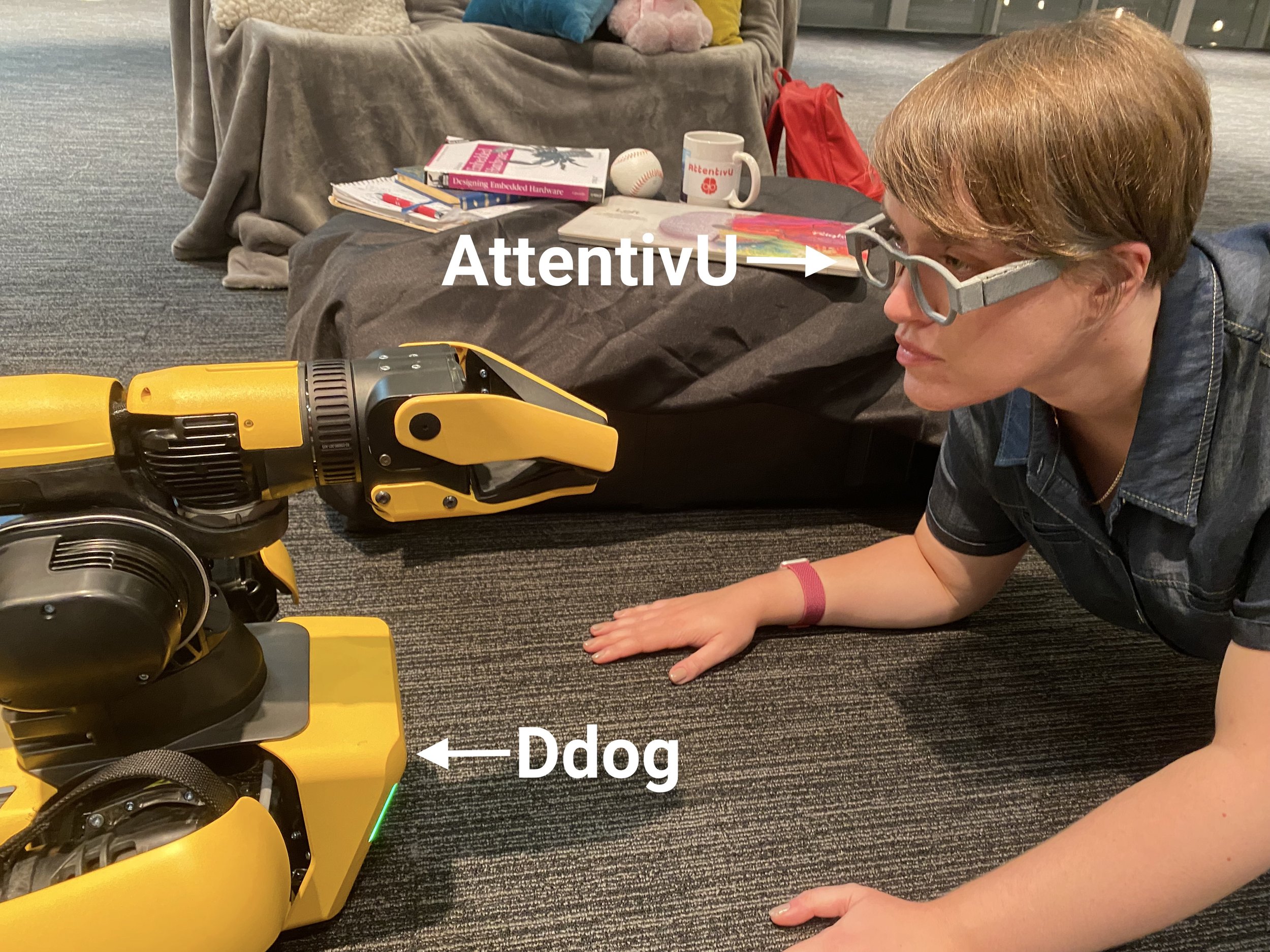
Ddog
Developed at the MIT Media Lab under project lead Nataliya Kosmyna, Ph.D., the Ddog project integrates a Boston Dynamics Spot quadruped (equipped with the Spot Arm manipulator) with a non-invasive, wireless Brain-Computer Interface (BCI) powered by AttentivU: a pair of wearable smart glasses that measure a user's real-time Electroencephalography (EEG, capturing electrical brain activity) and Electrooculography (EOG, capturing eye movements and blink patterns) signals through dry electrodes built into the frame.
Ddog extends the MIT Media Lab's Brain Switch application, a real-time, closed-loop BCI system designed to allow patients with severe motor impairments, such as Amyotrophic Lateral Sclerosis (ALS), Cerebral Palsy (CP), and Spinal Cord Injury (SCI), to communicate essential needs non-verbally to caretakers. While stationary BCIs restrict users to a bedside screen, Ddog introduces physical autonomy and manipulation into the user's living environment:
- Zero-Backpack Wireless Architecture: Using the same software stack as Brain Switch, Ddog runs entirely on two standard iPhones without requiring wet conductive gels, sticky scalp electrodes, or heavy compute backpacks.
- Assistive Manipulation: By focusing visual attention and triggering neural/ocular commands through the AttentivU glasses, a paralyzed user can command Spot to navigate across a home or clinic and use its 6-DoF robotic arm to fetch groceries, bring a chair, pick up a dropped book or toy, or deliver water.
- Research Significance: In the featured interviews below, Dr. Kosmyna details why an agile legged platform like Spot was chosen over wheeled robots (to traverse household thresholds, stairs, and cluttered rooms), the signal-processing pipeline that filters motion artifacts from dry-electrode EEG/EOG data, and how portable neural interfaces can restore physical agency to patients with locked-in or severe motor syndromes.
Disney Research
YouTube ... Quora ...Google search ...Google News ...Bing News
All our dreams can come true, if we have the courage to pursue them - Walt Disney
While industrial robotics prioritizes payload, cycle speed, and sub-millimeter repeatability, Disney Research (operating laboratories in Zurich, Switzerland, and Los Angeles, California, in collaboration with Walt Disney Imagineering) pioneers expressive character robotics, dynamic stunt animatronics, and safe physical human-robot interaction. Because theme park guests immediately notice if an animatronic character moves stiffly or makes unnatural eye contact, Disney Research solves problems at the intersection of biomechanics, character animation, and Reinforcement Learning (RL):
- Reinforcement-Learned Bipedal Character Walkers: Traditionally, translating a digital animator's expressive character walk (such as a swagger, waddle, or tip-toe) onto a physical robot required months of manual control tuning and often failed because animated keyframes violate real-world gravity and friction constraints. In 2023 and 2024, Disney Research Zurich unveiled a compact, 3D-printed bipedal robot (featuring a 5-DoF hip/leg design and a 4-DoF expressive head with ear/antenna actuators) trained via deep reinforcement learning in Simulation. The policy ingests raw artist animation curves and translates them in real time into dynamically balanced motor commands on uneven terrain, rocks, and external shoves while preserving the exact emotional posture and head-tilt timing of the animator's design.
- Realistic Gaze, Micro-Saccades, and Social Presence: To cross the Uncanny Valley in humanoid audio-animatronics, Disney researchers developed chest-mounted RGB-D perception pipelines coupled with high-speed animatronic eye mechanisms that simulate biological human gaze behaviors: rapid saccadic eye movements, micro-saccades during fixation, natural blink rate modulation linked to cognitive load, head-eye coordination (vestibulo-ocular reflex), and subtle breathing chest motions.
- Stunttronics and Aerial Trajectory Control: For high-flying acrobatic characters (such as the Spider-Man Stuntronic deployed at Disney California Adventure), Disney engineered autonomous aerial robots launched via high-speed cables at 60 ft in the air. Using onboard inertial measurement units (IMUs) and laser rangefinders, the robot calculates its ballistic parabola in mid-air and tucks or extends its limbs (conserving and redistributing angular momentum) to execute precise somersaults, twists, and superhero poses before landing safely on a deceleration net.
- Soft Robotics and Hydrostatic Transmission: To build robots that are safe enough to hug a child, Disney Research pioneered hybrid hydrostatic (water- and air-filled) fluidic transmissions and compliant cable-driven mechanisms that isolate heavy electric motors in the base while giving the robot's arms and torso natural, pillow-soft mechanical compliance.
Home
YouTube ... Quora ...Google search ...Google News ...Bing News
- Artificial Intelligence in Home Robots: Current and Future Use-Cases | Insights
- DIY Artificial Intelligence Robot | NOVA - Robotics
- Smartibot kit turns any household object into an AI-enhanced robot | Dezeen
- Machine learning made easy with two SparkFun AI kits | Electronic Products
- Robots, Parts, & Custom Solutions | SuperDroid Robots
- Be a STEM Hero | Revolution Robotics
- 20 Best Robot Kits 2019: From Lego to Arduino - Top 20 DIY Robot Kits Available Right Now | Luca Robotics
- The Best Robotics Kits for Beginners | Signe Brewster - Wirecutter
- Top 10 Programmable Robot Kits for Adults | Makeblock
- NOVA DIY Artificial Intelligence Robot | Creoqode
Domestic robotics is often regarded by researchers as the "final boss" of physical AI. Unlike a factory floor with painted lanes, standardized bins, and trained technicians, a private home is a dynamic, unstructured environment filled with stairs, thick rugs, pets, children, fragile glassware, and deformable clutter that changes position every hour.
Home robotics has evolved through three technical tiers:
- Single-Purpose Autonomous Surface Cleaners: The most commercially successful domestic robots to date are autonomous vacuum cleaners, floor mops, robotic lawnmowers, pool scrubbers, and window cleaners. Modern robotic vacuums rely on solid-state or spinning 2D/3D LiDAR, Visual Simultaneous Localization and Mapping (vSLAM), structured-light 3D obstacle sensors, and onboard convolutional neural networks trained to recognize and route around specific household hazards (such as pet waste, charging cables, socks, and shoes) while docking at self-emptying, mop-washing base stations.
- Social Companions, Security Patrols, and STEM Educational Kits: A second tier encompasses Social Robots, mobile smart-home hubs, and programmable DIY maker platforms (built on Arduino, Raspberry Pi, NVIDIA Jetson Nano, and ROS 2). Consumer social robots and mobile security sentries use computer vision, microphone beamforming, and Conversational AI to patrol rooms, monitor elderly residents for falls, take vital readings, and act as mobile Assistants that set reminders and control Matter/IoT smart-home appliances.
- General-Purpose Domestic Mobile Manipulators and Humanoids: The frontier of home robotics in 2025 and 2026 centers on wheeled and bipedal bimanual robots (such as Figure 03, 1X NEO, Stanford's Mobile ALOHA, and Physical Intelligence's pi0.5/pi*0.6 testbeds) designed to perform open-ended household chores. Powered by Vision-Language-Action (VLA) foundation models, these systems tackle complex multi-step domestic routines: unloading clothes from a dryer and folding them neatly on a table, clearing dirty plates from a dining table, wiping spills with a sponge, placing dishes into a dishwasher rack, and sorting groceries into cabinets.
As Google DeepMind and Boston Dynamics researchers noted in 2026, widespread mass-market adoption of general-purpose humanoid assistants in private homes is still an estimated 5 to 10 years away due to three remaining barriers: (1) solving fine tactile dexterity (such as fishing keys out of a pocket or zipping a jacket), (2) guaranteeing intrinsic mechanical and software safety around toddlers and pets (using low-inertia compliant actuators, soft textile exteriors, and certified fall-mitigation controllers), and (3) reducing bill-of-materials hardware costs below the price of a compact economy car.
Kitchen / Restaurant
YouTube ... Quora ...Google search ...Google News ...Bing News
Commercial kitchens and quick-service restaurants (QSRs) represent a high-growth proving ground for robotic manipulation and automated food processing. Driven by persistent hospitality labor shortages, high staff turnover (often exceeding 100% annually in fast food), and workplace hazards around 350°F (177°C) deep fryers and flat-top grills, food-service chains including Chipotle, White Castle, Sweetgreen, Wing Zone, and Panda Express have deployed specialized and generalist kitchen robotics.
Engineering robots for culinary environments requires solving distinct physical and regulatory challenges:
- Deformable and Variable Biological Ingredients: Unlike stamped metal car parts, every avocado, tomato, chicken breast, and lettuce leaf varies in size, ripeness, moisture, and geometry. Kitchen robots rely on RGB-D computer vision, spectral/thermal imaging, and force-controlled grippers to slice, peel, portion, and plate ingredients without crushing them.
- Food-Grade Hygiene and Thermal Resilience: Robotic arms and sensors operating over fryers and steam tables must meet strict National Sanitation Foundation (NSF) food-contact standards and IP65 to IP69K ingress protection ratings so they can withstand grease aerosols, steam, and daily high-pressure chemical washdowns.
- Closed-Loop Thermal and Timing Orchestration: AI kitchen management software integrates directly with point-of-sale (POS) and mobile delivery ordering queues, tracking individual food items via overhead vision cameras to adjust cooking times, prevent cross-contamination, reduce food waste, and ensure consistent food safety temperatures.
Notable commercial deployments and categories include:
- Autonomous Fry and Grill Stations: Miso Robotics' Flippy (deployed at White Castle and other QSR chains) uses an overhead rail-mounted or floor-mounted 6-DoF industrial arm paired with thermal and optical vision to identify frozen food items, load fry baskets, agitate and submerge baskets in hot oil for exact durations, and dispense cooked food into warming trays.
- Automated Makelines and Bowl Assembly: Sweetgreen's Infinite Kitchen and Hyphen's automated makelines (backed by Chipotle) use precision auger, vibrancy, and pneumatic portioning dispensers beneath conveyor tracks to assemble up to 400 to 500 customized salads or grain bowls per hour with exact macro-nutrient portion accuracy. Chipotle has also trialed Autocado (co-developed with Vebu), a specialized robot that cuts, cores, and scoops ripe avocados for guacamole prep.
- Beverage, Barista, and Dexterous Prep Robots: Automated espresso bars, boba tea makers, and cocktail bartenders combine fluid-dispensing manifolds with 6-DoF arms. At the research frontier, generalist VLA models such as Physical Intelligence's pi*0.6 have demonstrated end-to-end operation of standard commercial manual espresso machines for 13 continuous hours without custom fixtures, executing bean dosing, precision tamping, high-torque portafilter locking, visual shot-extraction monitoring, milk steaming, and cup serving.
Ai-Da
- Typos and shutdowns: robot 'gives evidence' to Lords committee | Alex Hern - The Guardian ... Ai-Da, described as 'world's first ultra-realistic robot artist', struggles at times to answer peers' questions
- Policy ... Policy vs Plan ... Constitutional AI ... Process Supervision ... Trust Region Policy Optimization (TRPO) ... Policy Gradient (PG) ... Proximal Policy Optimization (PPO)
Ai-Da is an ultra-realistic humanoid robot artist designed to draw, paint, sculpt, and participate in public discourse on the intersection of Generative AI, robotics, and human creativity. Conceived in 2019 by Oxford gallerist Aidan Meller and built in collaboration with Cornish humanoid robotics manufacturer Engineered Arts (utilizing their Mesmer animatronic head technology) along with AI researchers at the University of Oxford and engineers at the University of Leeds, the robot is named in tribute to Ada Lovelace, the 19th-century mathematician recognized as the world's first computer programmer.
From a technical standpoint, Ai-Da operates as a modular composite system rather than a single monolithic intelligence:
- Visual Perception and Facial Feature Extraction: Dual CMOS cameras embedded inside Ai-Da's eyeballs capture live images of a human subject or still-life arrangement. Computer vision algorithms extract key facial landmarks, contours, and tonal gradients, converting the visual scene into vector coordinate paths.
- Generative AI Interpretation and Path Planning: Rather than acting as a mechanical plotter or photographic copier, Ai-Da's software passes the extracted visual features through custom neural network algorithms and generative models that alter, abstract, and stylize the composition. As a result, no two portraits or paintings of the same subject are identical.
- Kinematic Robotic Arm Execution: The stylized vector trajectories are converted into joint-space motion plans for Ai-Da's robotic arms (designed and programmed by engineers Salaheldin Al Abd and Ziad Abass at the University of Leeds), allowing the robot to hold pencils, charcoal, or paintbrushes, dip brushes into a palette, and apply layered strokes onto canvas.
- Conversational Language Model and Expressive Animatronics: For spoken interviews and parliamentary testimony, Ai-Da uses a custom large language model coupled with speech synthesis and synchronized pneumatic/electric facial actuators inside a silicone skin face to generate lip-synced speech, head tilts, and eye contact.
In October 2022, Ai-Da became the first humanoid robot to give formal evidence before the UK Parliament's House of Lords Communications and Digital Committee during an inquiry into the future of the creative industries. In November 2024, Ai-Da's portrait of computer scientist Alan Turing, titled A.I. God. Portrait of Alan Turing, became the first artwork by a humanoid robot sold at a major auction house (Sotheby's), fetching over $1 million and sparking debate among artists, legal scholars, and policymakers over authorship, copyright law, and the role of Embodied AI in fine art.
Cognitive Architecture
In Robotics, a cognitive architecture is the overarching computational blueprint that organizes how an embodied agent perceives its environment, stores working and long-term memory, formulates plans, executes physical motor actions, and learns from experience. Because physical robots must simultaneously reason over long time horizons (minutes or hours) and react to physical disturbances in milliseconds, robotic cognitive architectures have evolved through four major paradigms:
- Classical Deliberative / Sense-Plan-Act (SPA) Architectures (1960s to 1980s): Pioneered on Shakey the Robot using the STRIPS automated planner, the SPA paradigm processes information in a strictly serial pipeline: sensors build a symbolic internal world model, a logical planner searches for a sequence of actions to reach a goal, and the execution module carries out the plan. While mathematically clean, pure SPA fails in dynamic real-world environments because building a complete symbolic world model is slow, sensor noise corrupts symbolic predicates, and the physical world often changes while the robot is still computing its plan.
- Behavior-Based and Subsumption Architectures (1986 to 1990s): Introduced by Rodney Brooks at MIT, the Subsumption Architecture eliminated the centralized symbolic world model entirely, declaring that "the world is its own best model." Instead of horizontal Sense-Plan-Act stages, intelligence is built from vertical layers of parallel finite-state machines (for example: Layer 0 avoids collisions, Layer 1 wanders, Layer 2 explores corridors). Higher layers can inhibit or "subsume" the outputs of lower layers, yielding fast, insect-like survival reflexes, though pure reactive architectures struggle with complex multi-step semantic tasks (such as assembling furniture or cooking a recipe).
- Three-Layer Hybrid and Classical Cognitive Architectures (1990s to 2010s): To combine the speed of reactive control with the foresight of symbolic planning, roboticists adopted Three-Layer Architectures (such as Erann Gat's Atlantis and NASA's 3T architecture) alongside general cognitive frameworks like SOAR (State, Operator, and Result, developed by Allen Newell and John Laird) and ACT-R (Adaptive Control of Thought-Rational, developed by John Anderson). A Three-Layer Architecture separates:
- The Deliberative Layer (top): Runs slow, asynchronous task and path planners over seconds or minutes.
- The Executive / Sequencer Layer (middle): Translates high-level plans into context-dependent behavior sequences, monitors task progress, and handles exception recovery.
- The Functional / Reactive Skill Layer (bottom): Runs hard real-time sensorimotor feedback loops at 100 to 1,000 Hz.
- Modern Dual-System / Tri-Level Embodied Foundation Architectures (2024 to Present): Contemporary generalist robots (such as Figure AI's Helix 02, NVIDIA's GR00T N1, Google DeepMind's Gemini Robotics, and Physical Intelligence's pi0.5/pi*0.6) replace hand-engineered symbolic planners with end-to-end trainable neural hierarchies modeled after Daniel Kahneman's dual-process theory of human psychology:
- System 2 (Slow Semantic and Spatial Reasoning, 0.5 to 10 Hz): A multi-billion-parameter Vision-Language Model (VLM) pre-trained on internet-scale text, images, and video. It maintains semantic memory, parses spoken instructions, identifies novel objects, and outputs latent representations or explicit Embodied Chain-of-Thought (ECoT) plans.
- System 1 (Fast Visuomotor Policy / Action Expert, 50 to 200 Hz): A compact transformer or continuous flow-matching/diffusion decoder that attends directly to System 2's latent embeddings while ingesting high-frame-rate wrist/palm camera images and joint proprioception to output smooth multi-step action chunks.
- System 0 (Reflexive Whole-Body Stabilizer, 500 to 1,000+ Hz): A high-frequency reinforcement-learned locomotion policy or Model Predictive Controller (MPC) that maintains bipedal balance, regulates contact impedance, and enforces hardware safety limits regardless of what System 1 or System 2 commands.
Uncanny Valley
The Uncanny Valley is a psychophysical and aesthetic phenomenon first hypothesized in 1970 by Japanese roboticist Masahiro Mori (then a professor at the Tokyo Institute of Technology) in his essay Bukimi no Tani Gensho. The concept describes the nonlinear relationship between an artificial object's degree of physical and behavioral resemblance to a human being and the emotional affinity (comfort or empathy) it evokes in a human observer.
As a robot's appearance becomes progressively more human-like, human emotional response follows a distinct curve:
- Rising Affinity (Industrial to Toy Robots): An industrial welding robot arm has almost no human resemblance and evokes near-zero emotional affinity. As designers add simplified anthropomorphic cues (such as a head, two eyes, and bipedal proportions in a toy robot like Honda's ASIMO or Sony's QRIO), human empathy and comfort rise steadily.
- The Valley (Near-Human Realism with Subtle Flaws): When a robot, android, prosthetic hand, or 3D digital avatar reaches roughly 80% to 95% human realism (featuring silicone skin, glass eyes, and hair) but exhibits subtle imperfections, human affinity plunges sharply into a deep trough of revulsion, eeriness, anxiety, or dread. Mori noted that a healthy human corpse sits at the bottom of the static uncanny valley, and movement amplifies the slope of the curve: a moving android with jerky kinematics or mistimed facial twitches falls even deeper into the valley (evoking the visceral discomfort of a reanimated corpse or zombie).
- Recovery to Human Empathy: Only when visual appearance, skin micro-texture, gaze dynamics, and motion fluidity become virtually indistinguishable from a healthy biological human does emotional affinity climb back out of the valley to reach full human-to-human comfort.
Cognitive scientists and Neuroscience researchers attribute the Uncanny Valley effect to three overlapping perceptual mechanisms:
- Perceptual Mismatch and Predictive Coding Error: When the human brain sees photorealistic human skin, the visual cortex activates specialized neural pathways (such as the fusiform face area) with strict expectations for biological motion, voice synchronization, and micro-expressions. If the android's voice lacks natural prosody or its eyes move with mechanical latency, the brain generates a large prediction error between conflicting sensory cues, triggering cognitive dissonance.
- Pathogen and Threat Avoidance: From an evolutionary standpoint, an entity that looks human but moves with jerky asymmetry, pallid skin tone, or glassy gaze resembles a person afflicted with a contagious neurological disease or a corpse, triggering an automatic amygdala-driven disgust and avoidance response.
- Categorization Ambiguity: Discomfort peaks precisely at the categorical boundary where the observer's brain struggles to classify the entity as "inanimate machine" versus "living social agent."
Because individual sensitivity to the Uncanny Valley varies widely with age, cultural background, and familiarity, modern robotics engineers employ deliberate industrial design strategies to navigate it:
- Purposeful Stylization and Utilitarian Abstraction: Rather than attempting silicone human faces, virtually all leading industrial and commercial humanoid manufacturers in 2025 and 2026 avoid the valley entirely by choosing clean, non-threatening mechanical or stylized heads. For example, Boston Dynamics' electric Atlas uses a circular illuminated ring light head with no facial features; Figure 03 uses a sleek dark visor screen; and consumer social robots use large, cartoon-like animated eyes that sit comfortably at the first peak of Mori's curve.
- High-Frequency Biological Fidelity (When Realism is Required): In domains that deliberately target realistic humanoids (such as theme park animatronics at Disney Research, or art/research androids like Ai-Da and Engineered Arts' Ameca), engineers bridge the valley by synchronizing high-speed eye saccades, subtle chest breathing motions, micro-expressions, and low-latency audio-to-lip actuation.
Robotic Benchmarks
YouTube ... Quora ...Google search ...Google News ...Bing News
Unlike natural language processing or computer vision, where researchers can evaluate any model on identical static datasets (such as ImageNet or MMLU) in minutes, benchmarking in Robotics is notoriously difficult because every laboratory uses different physical hardware, lighting, camera placements, table heights, and target objects. To establish reproducible scientific comparisons across both physical hardware and Simulation, the robotics community relies on standardized benchmark suites:
- ALFRED; Action Learning From Realistic Environments and Directives: Introduced by researchers at the University of Washington and the Allen Institute for AI (AI2), ALFRED is a benchmark for connecting human natural-language instructions and egocentric vision to physical action sequences inside the AI2-THOR interactive household environment. Comprising 25,743 natural-language directives across 120 indoor scenes, ALFRED requires embodied agents to perform long-horizon, irreversible state changes (such as rinsing a mug in a sink, placing a potato in a microwave, or slicing an apple) rather than simple point-to-point navigation.
- CoBRA (Composable Benchmark for Robotics Applications): Developed at the Technical University of Munich, CoBRA provides a standardized, composable JSON specification for defining robot kinematics, dynamic parameters, obstacle environments, and task goals (such as reachability, cycle time, and energy minimization). It is particularly valuable for modular and reconfigurable robots, where the benchmark simultaneously evaluates both the robot's physical joint morphology and its motion-planning controller.
- ROBEL (Robotics Benchmarks for Learning with Low-Cost Robots): Created by researchers at Google Brain and UC Berkeley, ROBEL is an open-source hardware and software benchmark suite designed to democratize real-world Reinforcement Learning (RL) on physical hardware that resists breakage during trial-and-error training. It centers on two low-cost, Dynamixel-actuated platforms: D'Claw (a three-fingered 9-DoF dexterous manipulation hand that learns valve turning and screw rotation) and D'Kitty (a 12-DoF quadruped that learns walking and orientation recovery).
- SIMPLER (Simulated Manipulation Policy Evaluation for Real Robot Setups): Introduced in 2024 by a multi-institution consortium (Stanford, UC Berkeley, Google DeepMind, UCSD, and MIT), SIMPLER addresses the high cost of evaluating generalist Vision-Language-Action (VLA) models on physical arms. By carefully matching visual textures (via green-screen real-to-sim overlays) and contact dynamics for WidowX and Google Robot hardware, SIMPLER achieves a strong rank-order correlation between simulated benchmark scores and actual real-world hardware success rates for models like RT-1, RT-2-X, Octo, and OpenVLA.
- LIBERO, RLBench, and Meta-World: Standardized multi-task manipulation benchmarks used to evaluate lifelong learning, skill transfer, and multi-task VLA policies. LIBERO tests knowledge transfer across spatial, object, and goal variations across 130 manipulation tasks; RLBench provides 100 vision-guided manipulation tasks ranging from stacking blocks to opening wine bottles; and Meta-World evaluates meta-reinforcement learning across 50 distinct robotic arm tasks.
- BEHAVIOR-1K (Benchmark for Everyday Household Activities in Virtual, Interactive, and Ecological Environments): Developed at Stanford University under Fei-Fei Li and Silvio Savarese using the OmniGibson simulator (built on NVIDIA Omniverse), BEHAVIOR-1K benchmarks mobile manipulators across 1,000 everyday household chores grounded in human time-use surveys, requiring realistic physics for rigid bodies, deformable cloth, fluids, heat, and dirt cleaning.
References
- pi0: A Vision-Language-Action Flow Model for General Robot Control | Kevin Black, Noah Brown, Danny Driess, Adnan Esmail, Michael Equi, Chelsea Finn, Niccolo Fusai, Lachy Groom, Karol Hausman, Brian Ichter, Szymon Jakubczak, Tim Jones, Liyiming Ke, Sergey Levine et al. - Physical Intelligence (2024) Foundational technical report introducing the pi0 Mixture-of-Transformers architecture combining a pre-trained VLM with a continuous flow-matching action expert trained across 7 robot platforms and 68 dexterous tasks.
- pi0.5: A Vision-Language-Action Model with Open-World Generalization | Physical Intelligence (2025) Research report detailing hierarchical semantic-and-motor co-training, cross-embodiment transfer to mobile manipulators, and zero-shot generalization evaluations across 100 real-world homes.
- pi*0.6: A VLA That Learns From Experience | Physical Intelligence (2025) Technical paper and experimental evaluation demonstrating how VLM value functions and offline-to-online reinforcement learning double VLA throughput and enable 13-hour continuous espresso making and factory box assembly.
- OpenVLA: An Open-Source Vision-Language-Action Model | Moo Jin Kim, Karl Pertsch, Siddharth Karamcheti, Ted Xiao, Ashwin Balakrishna, Suraj Nair, Rafael Rafailov, Ethan Foster, Grace Lam, Pannag Sanketi, Quan Vuong, Thomas Kollar, Benjamin Burchfiel, Russ Tedrake, Dorsa Sadigh, Sergey Levine, Percy Liang, Chelsea Finn - Stanford, UC Berkeley, TRI (2024) Peer-reviewed paper presenting the 7B-parameter open-source VLA trained on 970k Open X-Embodiment episodes that outperforms the 55B RT-2-X model.
- Robotic Control via Embodied Chain-of-Thought Reasoning | Michał Zawalski, William Chen, Karl Pertsch, Oier Mees, Chelsea Finn, Sergey Levine - UC Berkeley & Stanford (2024) Primary research paper proving that training VLAs to generate intermediate spatial bounding boxes, gripper positions, and subtask plans before outputting motor actions substantially improves generalization and steerability.
- Open X-Embodiment: Robotic Learning Datasets and RT-X Models | Open X-Embodiment Collaboration (2023/2024) Landmark multi-institutional study across 30+ robotics laboratories pooling data from 22 robot embodiments and demonstrating a 50% average performance gain over specialized in-domain models.
- Gemini Robotics Brings AI into the Physical World | Google DeepMind (2025) Official technical overview of the Gemini Robotics and Gemini Robotics On-Device Vision-Language-Action models, highlighting physical reasoning traces, dexterous manipulation, and rapid 50-demonstration adaptation.
- NVIDIA Announces Isaac GR00T N1: The World's First Open Humanoid Robot Foundation Model | NVIDIA (2025) Technical specification of the dual-system GR00T N1 architecture and synthetic trajectory generation using Isaac Lab, Omniverse, and Cosmos world models.
- State of Robotics 2026 Report | Robotics Center (2026) Comprehensive 2026 industry analysis covering the $38B global robotics market, the tripling of Vision-Language-Action (VLA) model deployments, synthetic-to-real training ratios, and commercial humanoid adoption.
- VLA Architecture: GR00T N1.7 vs Gemini Robotics 1.5 vs pi0.5 | Pebblous Research (2026) Technical architecture comparison examining how NVIDIA, Google DeepMind, and Physical Intelligence design vision, language, and continuous motor control pipelines for physical AI.
- Vision-language-action (VLA) models in 2026 | Marcin Kowalczyk - Firecrux (2026) Analysis of how VLAs learn from teleoperated demonstrations, cross-embodiment datasets, synthetic trajectories, and dual-system reasoning architectures.
- Vision-Language-Action Models Explained: How Robots Learn to See, Understand, and Act | DataCamp Overview of autoregressive action tokenization versus continuous flow-matching decoding across OpenVLA, pi0, pi0.5, pi*0.6, Gemini Robotics 1.5, and Hugging Face's SmolVLA.
- AI-Powered Robot by Boston Dynamics and Toyota Research Institute Takes a Key Step Towards General-Purpose Humanoids | Toyota Research Institute (2025) Announcement and technical overview of unified Large Behavior Models (LBMs) controlling the electric Atlas humanoid across whole-body manipulation and locomotion tasks without hand-programmed state machines.
- Atlas Humanoid Robot Specifications and Commercial Overview | Boston Dynamics (2026) Enterprise specifications and deployment roadmap for the 56-degree-of-freedom, 50 kg payload fully electric Atlas humanoid robot.
- Introducing Figure 03 | Figure AI (2025) Technical release detailing the third-generation Figure 03 humanoid, the Helix VLA architecture, 3-gram tactile fingertip sensors, palm cameras, wireless foot charging, and high-volume manufacturing at BotQ.
- Figure 03 Review: Capabilities, Price & Availability | Anton Robots In-depth engineering evaluation of Figure 03, the tri-level Helix 02 controller (System 2, System 1, and System 0), and lessons learned from BMW factory deployments.
- Philip Koopman: Embodied AI Safety, Autonomous Systems, and UL 4600 Research | Carnegie Mellon University (2025) Academic publications and safety engineering standards guidance on V-Model verification breakdown, heavy-tail edge cases, human Perception Response Time, and computer duty of care.
- Evaluating Real-World Robot Manipulation Policies in Simulation (SIMPLER) | Xuanlin Li, Kyle Hsu, Jiayuan Gu, Karl Pertsch, Oier Mees, Homer Rich Walke, Chuyuan Fu, Ishikaa Lunawat, Isabel Sieh, Sean Kirmani, Sergey Levine, Jiajun Wu, Chelsea Finn, Hao Su, Quan Vuong, Ted Xiao (2024) Multi-institutional paper introducing the SIMPLER real-to-sim benchmark for reproducible evaluation of generalist manipulation policies.
- The Uncanny Valley (Bukimi no Tani) | Masahiro Mori, translated by Karl F. MacDorman and Norri Kageki - IEEE Robotics & Automation Magazine (1970 / 2012) The foundational primary source by Masahiro Mori establishing the mathematical and perceptual curve of the Uncanny Valley in robotics and prosthetics.
- Neuroscience News - Robotics | Neuroscience News Ongoing research updates covering bio-inspired robotics, neural interfaces, and embodied cognition.
- Keeping track of what AI can do and where it is being applied | DeepIndex Curated index tracking real-world artificial intelligence applications across industrial and service robotics.
- News | Mobile Robot Guide Industry news and deployment tracking for autonomous mobile robots (AMRs) and automated guided vehicles.
- This Robotic Chemist Does Over 600 Experiments a Week and Learns From Its Own Work | Edd Gent - SingularityHub Report on autonomous mobile laboratory robots at the University of Liverpool capable of conducting over 600 chemical synthesis experiments per week.
- Zumi! | Robolink Educational AI and autonomous driving robot kit platform.
- White Castle To Introduce Kitchen Robotic Assistant Flippy | Heard on All Things Considered - NPR
- The Advent of AI / Robotics in the Welding Industry | Philadelphia Technician Training Institute Overview of machine vision and adaptive robotic automation in industrial welding.
- Hugging Face launching robotics project with former Tesla scientist | Maria Diaz - ZDNet The open-source platform joins the robotics race with the LeRobot open-source library, SmolVLA, and low-cost hardware initiatives.
- Mitsubishi robot solves puzzle cube in a blink of an eye, sets world record | Bojan Stojkovski - Interesting Engineering Mitsubishi Electric's TOKUI Fast Accurate Synchronized Motion Testing Robot solved a puzzle cube in 0.305 seconds, matching the speed of a human eye blink (0.1 to 0.3 seconds).
- One-third of U.S. military could be robotic, Milley predicts | Colin Demarest - AXIOS Retired Army Gen. Mark Milley discusses how autonomous and robotic systems are reshaping defense strategy and armed conflict.
```