Cybersecurity Frameworks, Architectures & Roadmaps
- Cybersecurity ... OSINT ... Frameworks ... References ... Offense ... NIST ... DHS ... Screening ... Law Enforcement ... Government ... Defense ... Lifecycle Integration ... Products ... Evaluating
- Risk, Safety, Compliance and Regulation ... Ethics ... Privacy ... Law ... AI Governance ... AI Verification and Validation
- Telecommunications ... Computer Networks ... 5G ... Satellite Communications ... Quantum Communications ... Smart Cities ... Digital Twin ... Internet of Things (IoT) ... Space-based Data Centers
- Artificial General Intelligence (AGI) to Singularity ... Curiosity ... Emergence ... Moonshots ... Explainable AI ... Automated Learning
- Libraries & Frameworks Overview ... Libraries & Frameworks ... Git - GitHub and GitLab ... Other Coding options
- Development ... Notebooks ... AI Pair Programming ... Codeless ... Hugging Face ... AIOps/MLOps ... AIaaS/MLaaS
- MITRE ATT&CK™
- 23 Top Cybersecurity Frameworks | CyberExperts.com
- Align to a Framework: Plan a Cybersecurity Roadmap's Route | CIS
- CIS Controls ... current version is v8.1 (June 2024): 18 Controls and 153 Safeguards
- CIS Cybersecurity Roadmap
- FedRAMP | ... security for the cloud; run by the General Services Administration and built on NIST SP 800-53 controls. The FedRAMP 20x initiative (launched 2025) is moving authorizations toward automated, machine-readable evidence.
- NIST Cybersecurity Framework| NIST - consists of standards, guidelines, and best practices to manage cybersecurity-related risk. Current version: CSF 2.0 (February 2024).
- Introduction to the Framework Roadmap | NIST ... historical roadmap for CSF 1.1; its work items fed into CSF 2.0
- FIPS 140-2 and FIPS 140-3 Security Requirements for Cryptographic Modules| NIST ... all remaining FIPS 140-2 certificates moved to the CMVP Historical list on September 21, 2026; FIPS 140-3 is the active standard
- ISO/IEC 27001 ... current edition ISO/IEC 27001:2022; 2013 certificates expired October 31, 2025
- ISO/IEC 15408-1 ISO/IEC Information Technology Task Force (ITTF) ... the Common Criteria; this 2009 edition has been superseded by ISO/IEC 15408:2022 (CC:2022)
- SABSA
- TOGAF ... TOGAF 9 documentation; the current release is the TOGAF Standard, 10th Edition
- Microsoft Cybersecurity Reference Architectures (MCRA) - Security| Microsoft ... updated April 2025, now including AI and Zero Trust standards mapping
- Zero Trust Rapid Modernization Plan| Microsoft
- Cybersecurity Reference Architecture | Microsoft ... Microsoft Virtual Academy has been retired; link kept for reference
- United States Computer Emergency Readiness Team (US-CERT) ... US-CERT was folded into CISA and the address now redirects to cisa.gov
- OASIS Cyber Threat Intelligence (CTI) TC OpenC2
- Using the Cybersecurity Framework | DHS
- How STIX, TAXII and CybOX Can Help With Standardizing Threat Information ... CybOX has since been merged into STIX 2.x as Cyber-observable Objects; STIX 2.1 and TAXII 2.1 are the current OASIS standards
Security programs fail in predictable ways. Teams buy tools before they know what they are protecting. Leaders cannot tell whether last year's spending reduced risk. Auditors, insurers, regulators, and customers each ask for evidence in a different format. Cybersecurity frameworks, architectures, and roadmaps exist to fix those problems. They are three different kinds of tools, and most confusion comes from treating them as interchangeable.
- A framework describes what outcomes a security program should achieve and gives everyone a shared vocabulary for them. The NIST Cybersecurity Framework (CSF), ISO/IEC 27001, and the CIS Critical Security Controls are the most widely used examples.
- An architecture describes how the pieces fit together: where identity is checked, where policy is enforced, where telemetry flows, and how products integrate. NIST SP 800-207 (Zero Trust Architecture), SABSA, TOGAF, and the Microsoft Cybersecurity Reference Architectures (MCRA) live here.
- A roadmap describes in what order to make changes, given limited money, people, and time. CIS Implementation Groups, Microsoft's Zero Trust Rapid Modernization Plan (RaMP), the Department of Defense zero trust target levels, and the federal post-quantum migration schedule are all roadmaps.
The core architects are a mix of government laboratories, standards bodies, and practitioners. NIST built the CSF after a 2013 executive order and released version 2.0 in February 2024. ISO/IEC JTC 1/SC 27 maintains the ISO 27000 series. The Center for Internet Security (CIS) curates the CIS Controls from practitioner attack data, a lineage that began as the SANS Top 20. John Sherwood, Andy Clark, and David Lynas created SABSA, and The Open Group maintains TOGAF. CISA, the DoD Chief Information Officer, and the Defense Information Systems Agency (DISA) turned zero trust into maturity models and production programs. MITRE's ATT&CK knowledge base supplies the adversary behavior data that lets all of these be tested against real attacks.
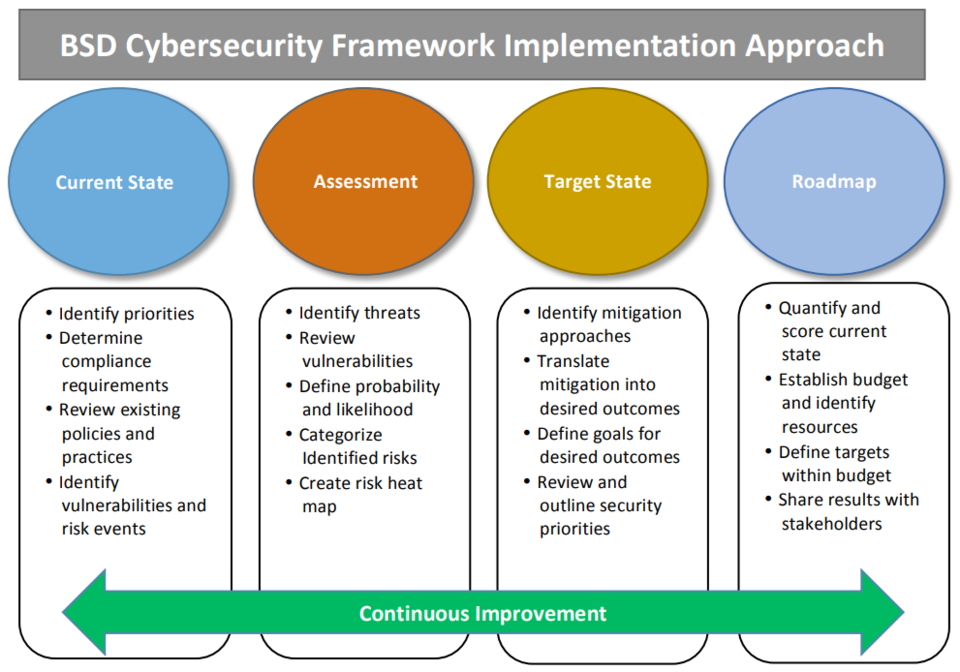
The central mechanism is a loop: understand context and risk appetite, describe the current state, describe a target state, close the gap in a prioritized order, and measure whether the change actually reduced risk. What has shifted over the last decade is where that loop puts its weight:
- From perimeter to identity. "Inside the firewall" no longer means trusted, which is the core idea behind Zero Trust.
- From technical checklist to governance. CSF 2.0 added a sixth function, Govern, and CIS Controls v8.1 followed, because most failures trace back to unclear ownership and priorities rather than missing products.
- From generic best practice to threat-informed prioritization. Data from MITRE ATT&CK, breach reports, and insurance claims increasingly decides which controls go first.
- From documents to machine-readable content. CSF 2.0, SP 800-53, and ATT&CK are published as structured data (JSON, STIX, and NIST's OSCAL format) so tools can map, assess, and report automatically.
- From voluntary to obligatory. The EU Cyber Resilience Act and NIS2, the U.S. CMMC program, and federal post-quantum mandates now turn framework outcomes into legal or contractual requirements.
Artificial intelligence adds two pressures at once. Organizations need frameworks for securing AI systems themselves (models, training data, prompts, and agents with tool permissions), and they need to plan for attackers and defenders who both use AI. NIST's draft Cyber AI Profile, the OWASP Top 10 lists for LLM and agentic applications, and the AI techniques added in MITRE ATT&CK v20 are the first serious attempts to bring AI into the same governance loop as everything else. See AI Governance and AI Verification and Validation for the broader governance picture.
A framework tells you what good looks like, an architecture shows how the pieces fit, and a roadmap decides what to do first. None of them secures anything until it changes how systems are actually built, operated, and verified.
How Frameworks, Architectures and Roadmaps Work
The Mechanism
Mature programs run roughly the same sequence regardless of which framework they cite.
- Set context and governance. Leadership defines the mission, risk appetite, legal and contractual obligations, and who owns which decisions. In CSF 2.0 this is the Govern function (GV), which covers organizational context, risk management strategy, roles and responsibilities, policy, oversight, and cybersecurity supply chain risk management.
- Build an inventory. You cannot protect what you do not know you have. Hardware, software, data, identities (including service accounts and AI agents), and suppliers have to be listed before anything else works. CIS Controls 1 and 2 exist for this reason, and the 2026 Verizon Data Breach Investigations Report (DBIR) again pointed to asset visibility as a foundational gap.
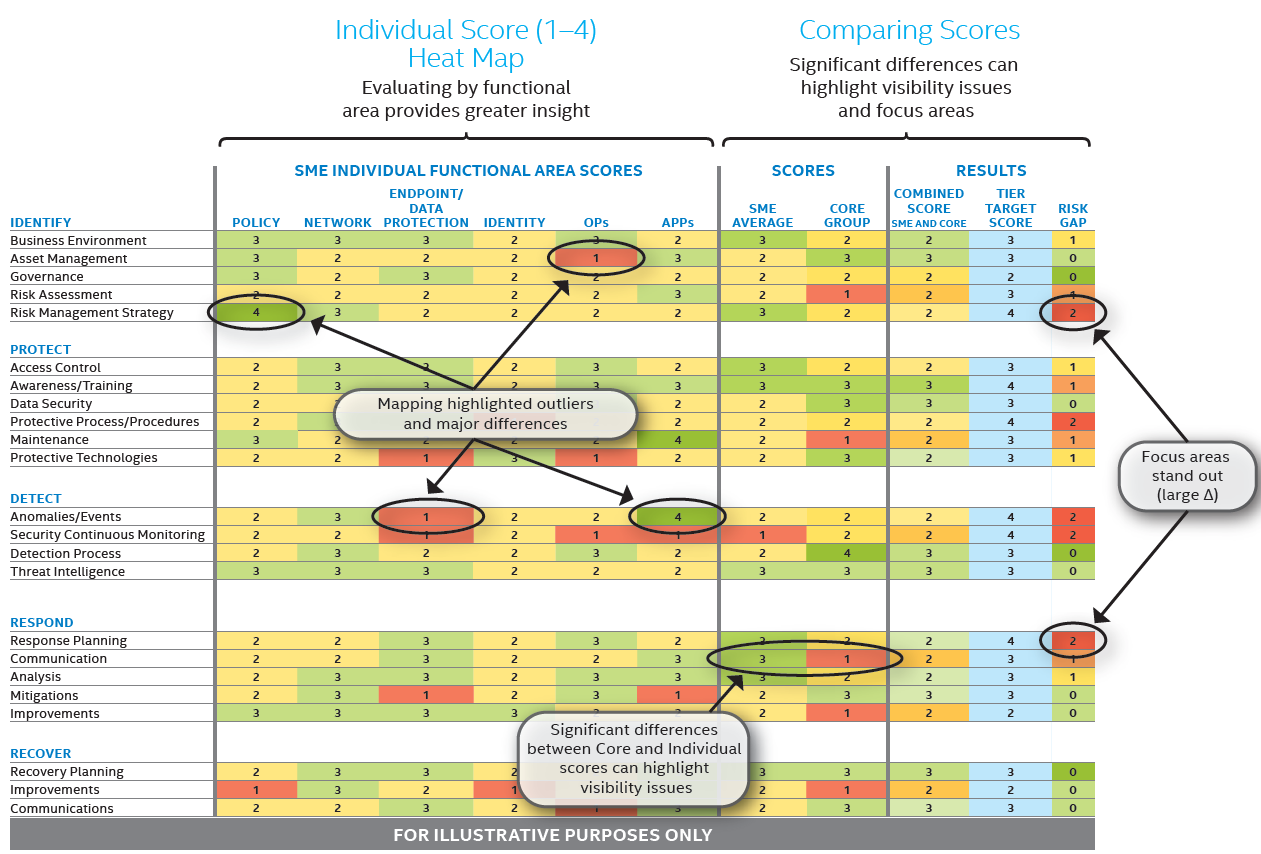
- Describe the current state. Score the organization against the framework's outcomes. In CSF language this is a Current Profile. ISO 27001 uses a Statement of Applicability. CIS uses Safeguard implementation rates per Implementation Group.
- Describe the target state. A Target Profile selects and prioritizes the outcomes the organization actually needs, often starting from a Community Profile written for a sector or threat (manufacturing, financial services, ransomware, semiconductor manufacturing, and now AI).
- Map outcomes to controls. Frameworks are deliberately outcome-based, so organizations pick concrete controls from catalogs such as NIST SP 800-53 Rev. 5, ISO/IEC 27002:2022, or the CIS Safeguards. NIST's Online Informative References (OLIR) program and Cybersecurity and Privacy Reference Tool (CPRT) publish machine-readable crosswalks so one control can satisfy several frameworks.
- Place controls in an architecture. An architecture decides where each control lives: identity provider, policy decision and enforcement points, endpoint agents, network segments, logging pipeline, key management, and backup systems. This is where SABSA's layered traceability, TOGAF's Architecture Development Method, and reference architectures such as MCRA and SP 800-207 do their work.
- Sequence the work into a roadmap. Gaps are ordered by risk reduction per unit of cost and by dependency: inventory before vulnerability management, MFA before conditional access, cryptographic inventory before post-quantum migration.
- Measure, validate, and repeat. Assessments, metrics, red teaming, breach and attack simulation, and ATT&CK-based coverage analysis test whether controls work against the techniques attackers actually use. Results feed the next cycle.
| Layer | Question it answers | Representative examples | Typical owner |
|---|---|---|---|
| Governance and risk framework | What outcomes do we need, and who is accountable? | NIST CSF 2.0, ISO/IEC 27001:2022 clauses 4 to 10, NIST Risk Management Framework (SP 800-37), COBIT | CISO, risk committee, board |
| Control catalog | Which specific safeguards achieve those outcomes? | NIST SP 800-53 Rev. 5, ISO/IEC 27002:2022, CIS Controls v8.1, NIST SP 800-171 Rev. 3 | Security engineering, compliance |
| Reference architecture | Where do controls live and how do they integrate? | NIST SP 800-207 and SP 1800-35, MCRA, SABSA, TOGAF, CISA TIC 3.0 | Enterprise and security architects |
| Maturity model or roadmap | What do we do first, and how do we know we progressed? | CIS Implementation Groups, CISA Zero Trust Maturity Model 2.0, DoD zero trust target and advanced levels, Microsoft RaMP, OMB M-26-15 | Program management office |
| Threat knowledge base | Which attacker behaviors must controls stop or detect? | MITRE ATT&CK, MITRE ATLAS, MITRE D3FEND, CISA Known Exploited Vulnerabilities catalog | Threat intelligence, detection engineering |
| Product and module assurance | Can we trust the components themselves? | FIPS 140-3 (CMVP), Common Criteria (ISO/IEC 15408:2022), FedRAMP | Procurement, vendors |
Dependencies and conditions. The loop only works when a few preconditions hold: an accurate inventory, a working identity system, telemetry that reaches someone who acts on it, executive sponsorship with budget authority, and a way to measure outcomes rather than activity. Frameworks rarely fail for lack of content. They fail when these preconditions are missing and the program degrades into documentation.
Where uncertainty remains.
- Crosswalks are approximate. Mapping an ISO control to a CSF subcategory says the two are related, not that implementing one fully satisfies the other. Auditors and regulators can and do disagree on equivalence.
- Maturity is easier to score than to verify. Self-assessed claims such as "CSF Tier 3" or "CIS IG2" are rarely validated by independent technical testing.
- Outcome measurement is immature. Few organizations can show a causal link between a framework improvement and fewer or smaller incidents. Most published evidence (summarized under Recent Developments) is correlational.
The Physics: The Quantitative Science of Cyber Risk
Cybersecurity has no conservation laws, but it does have quantitative relationships that explain why frameworks prioritize what they do.
1. Risk as expected loss. The classic formulation is Risk = Likelihood × Impact. Quantitative practitioners use annualized loss expectancy, ALE = SLE × ARO (single loss expectancy times annual rate of occurrence), or the FAIR model, which decomposes risk into Loss Event Frequency (how often a threat event happens, times the probability it succeeds) and Loss Magnitude. Because inputs are uncertain, FAIR-style analyses run Monte Carlo simulations and report a loss distribution rather than one number. Cyber losses are heavy-tailed: a few catastrophic events dominate total cost, so averages mislead and tail measures (for example, the 95th percentile annual loss) are more useful for decisions. CSF 2.0's Govern function and NIST's IR 8286 series on integrating cybersecurity with enterprise risk management exist to connect these estimates to business choices.
2. Defense in depth and correlated failure. If an attack must defeat n independent layers, each bypassed with probability pi, the chance of full compromise is the product p1 × p2 × ... × pn. Three layers that each stop 90 percent of attempts let through only 0.1 percent (0.1 × 0.1 × 0.1 = 0.001). The catch is independence. When layers share a dependency (one identity provider, one stolen administrator credential, one vendor with access to everything), they fail together and the real probability approaches that of the weakest shared component. This is the quantitative reason zero trust separates policy decisions from enforcement, insists on phishing-resistant authentication, and limits standing privilege, and why frameworks now treat third-party access as a first-order risk.
3. Time-based security. Winn Schwartau's time-based security model says protection is adequate when the time an attacker needs to defeat it (P) exceeds the time to detect (D) plus the time to respond (R): P > D + R. When it does not, the exposure window is E = (D + R) - P. This is why frameworks weight Detect, Respond, and Recover as heavily as Protect, and why dwell time and patch latency have become board-level metrics. The 2026 DBIR found that exploitation of vulnerabilities was the leading initial access vector (31 percent of breaches) and that only about a quarter of CISA Known Exploited Vulnerabilities were fully remediated during 2025. That is the P > D + R inequality failing at scale.
4. Network topology and lateral movement. In a flat network of n hosts, every host can potentially reach every other, giving on the order of n(n - 1)/2 host-to-host paths. Splitting the network into k equal zones with controlled gateways cuts direct paths by roughly a factor of k and forces lateral movement through inspection points. Microsegmentation, software-defined perimeters, and per-request authorization push this toward the limit where every request is its own trust decision. Attack-graph analysis, used in exposure management tools, formalizes the idea by computing shortest paths from internet-facing assets to critical systems.
5. Cryptographic work factors and the quantum clock. Security strength is measured in bits: an n-bit key needs on the order of 2n classical operations to brute-force. Shor's algorithm would let a large fault-tolerant quantum computer break RSA and elliptic-curve cryptography in polynomial time, collapsing their effective strength. Grover's algorithm gives only a quadratic speedup against symmetric ciphers and hashes (roughly halving bit strength in theory, and less in practice because it parallelizes poorly), which is why AES and SHA-2 survive with adequate parameters while public-key algorithms must be replaced. Michele Mosca's inequality frames the roadmap problem: if x is how long data must stay secret, y is how long migration takes, and z is the time until a cryptographically relevant quantum computer exists, then x + y > z means you are already exposed, because adversaries can harvest encrypted traffic now and decrypt it later. The 2030 and 2035 dates in NIST IR 8547 and OMB M-26-15 are policy estimates of z minus a migration margin, not measurements. Related reading: Quantum Communications.
6. Assurance latency. Product assurance has its own clock. Vendor analyses report that FIPS 140-3 validations have averaged well over a year in the NIST queue (one estimate put the CMVP portion at roughly 540 days, versus about 370 days under FIPS 140-2). Any roadmap that depends on validated cryptography, including post-quantum modules, therefore has to start procurement years before its deadline.
Experimental constraints. Unlike physics, cybersecurity cannot run controlled experiments on real organizations. Evidence comes from breach datasets (biased toward reported incidents and contributing organizations), insurance claims (biased toward insured firms), red team exercises (small samples), and simulation. Treat any single "control X reduces breaches by Y percent" figure as an estimate with wide error bars.
Why This Matters
A common language across the organization. Frameworks let a board, an auditor, an engineer, and an insurer talk about the same thing. CSF 2.0's Govern function was added because the hardest problems are rarely technical: unclear ownership, unfunded mandates, and risk decisions made by default.
Frameworks are now load-bearing in law and contracts. Defense contractors must meet NIST SP 800-171 through CMMC. Manufacturers selling in the EU face Cyber Resilience Act reporting deadlines. Federal agencies must follow TIC 3.0, zero trust memoranda, FIPS 140-3, and post-quantum mandates. Cyber insurers increasingly reference the CIS Controls in underwriting. Choosing a framework is therefore also a legal and commercial decision; see Risk, Safety, Compliance and Regulation and Law.
They decide where money goes. With third parties involved in nearly half of breaches analyzed in the 2026 DBIR, and exploitation of unpatched systems leading initial access, prioritization schemes such as CIS IG1, claims-linked control rankings from insurers, and ATT&CK prevalence data help organizations fund the controls with the largest measurable effect first.
Architecture determines whether controls reinforce each other. Good products in the wrong arrangement produce shared points of failure, the correlated-failure problem described above. Reference architectures exist so identity, endpoint, network, data, and operations controls back each other up rather than all depending on one thing.
AI raises the stakes. AI systems introduce new assets (models, training data, prompts, vector stores), new identities (agents with tool permissions), and new attack paths (prompt injection, data poisoning, AI-enabled exfiltration). The same technology also speeds up attackers. Organizations that already run a mature framework loop can absorb AI as new profile entries and controls. Organizations without one tend to bolt AI security on as a separate silo.
Limitations worth stating plainly.
- Compliance is not security. Certified organizations still get breached. The 2013 Target breach (linked under Other Cybersecurity) began with credentials stolen from an HVAC vendor at a retailer that had recently passed a PCI DSS assessment. Frameworks describe necessary conditions, not sufficient ones.
- Framework fatigue. Large organizations may map to a dozen overlapping frameworks, and evidence collection can crowd out actual risk reduction. Crosswalks and machine-readable controls help but do not remove the overhead.
- Small organizations are underserved. Most frameworks assume dedicated security staff. CIS IG1 and NIST's small business quick-start guides exist because full control catalogs are unrealistic for a 20-person firm.
- The evidence base is thin. The best data links specific controls to lower claim or breach rates, but self-reported control status and confounding (well-run firms do many things well) limit causal conclusions.
If this works as intended, organizations get fewer catastrophic single points of failure, faster detection and recovery, budgets tied to measured risk, and portable evidence that satisfies several regulators at once. What remains uncertain is whether continuous, machine-readable compliance actually reduces incidents or mostly reduces audit cost, and how to measure the security of AI agents whose behavior is probabilistic.
Recent Developments
The two years leading up to October 2026 brought more structural change to the framework landscape than the previous decade. The developments below are grouped by theme, and each notes what it does and does not establish.
NIST CSF 2.0 becomes the hub
NIST published CSF 2.0 on February 26, 2024, the first major revision since the framework's 2014 debut.
- Broader scope. The title changed from "Framework for Improving Critical Infrastructure Cybersecurity" to simply "The Cybersecurity Framework," explicitly aimed at organizations of any size or sector.
- Six functions instead of five. Govern joins Identify, Protect, Detect, Respond, and Recover. It gathers organizational context, risk strategy, roles, policy, oversight, and supply chain risk management that were previously scattered across the other functions.
- A leaner core. The core now has 22 categories and 106 subcategories. Implementation Examples and Informative References are published separately so they can be updated faster than the core.
- Profiles as the unit of work. Organizational Profiles (current and target) and Community Profiles now drive implementation. Community profiles exist or are in draft for manufacturing, ransomware, semiconductor manufacturing, financial services, telecommunications, and AI.
- Production tooling. The CSF 2.0 Reference Tool in NIST's CPRT, which this page previously described as a draft, now exports the final core in JSON and Excel.
What it establishes: a widely adopted outcome taxonomy that other frameworks map to. What it does not: CSF is voluntary and NIST does not certify conformance, so "CSF compliant" claims are self-attestations.
CIS Controls v8.1 and the governance turn
CIS released v8.1 in June 2024 as an iterative update to v8 (May 2021). Version 8 had already consolidated the long-running "Top 20" into 18 Controls organized by activity rather than by who manages a device, and replaced Sub-Controls with 153 Safeguards. Version 8.1 kept the 18 Controls, the 153 Safeguards, and the Implementation Groups, aligned Safeguards with CSF 2.0 (including a new Govern security function label), added Documentation as an asset class, and tightened wording. CIS has said it is working on ideas for Version 9. In June 2025 the MS-ISAC moved to fee-based membership after federal support for its state and local programs ended, a reminder that roadmaps for small public entities depend on funding as much as guidance.
ISO/IEC 27001:2022 transition closes
The three-year transition from ISO/IEC 27001:2013 ended on October 31, 2025, and all 2013 certificates expired. Annex A now holds 93 controls (down from 114) in four themes: Organizational (37), People (8), Physical (14), and Technological (34). Eleven controls are new, including threat intelligence, information security for cloud services, ICT readiness for business continuity, configuration management, data masking, data leakage prevention, web filtering, and secure coding. A 2024 amendment added climate change considerations to the context clauses. ISO/IEC 42001:2023, the certifiable AI management system standard, uses the same management system structure so organizations can integrate it with an existing 27001 program.
Zero trust moves from strategy to reference implementations
- NIST SP 1800-35 (final, June 2025). The NIST National Cybersecurity Center of Excellence worked with 24 vendors for four years to build 19 example zero trust architectures from commercial products, mapped to CSF and SP 800-53. It complements the conceptual SP 800-207. Its blunt lesson is that every zero trust architecture is a custom build, and real deployments contain multiple policy decision and enforcement points that attackers can try to bypass.
- Department of Defense. The 2022 DoD Zero Trust Strategy requires all components to reach "target level" (91 activities) by the end of fiscal 2027, with "advanced level" requiring 152. The Navy's Flank Speed was first to hit target level; DISA's Thunderdome and Flank Speed were later validated at advanced level, and Dell's Project Fort Zero at target level, according to DoD CIO testimony. Department-wide progress is slower: one industry assessment cited only 14 percent of target-level activities complete across DoD components as of early 2025.
- CISA guidance. CISA's "Journey to Zero Trust" series added microsegmentation guidance and then guidance on Secure Access Service Edge (SASE) to help agencies move from TIC 2.0 to TIC 3.0. Details are in the TIC and Zero Trust sections below.
Frameworks for securing AI
The first AI-specific security frameworks arrived in quick succession: NIST's Cyber AI Profile (preliminary draft, December 2025), NIST's SP 800-53 Control Overlays for Securing AI Systems (COSAiS), the OWASP Top 10 for Agentic Applications (December 2025) and the 2026 OWASP Top 10 for LLM Applications (August 2026), and AI-focused techniques in MITRE ATT&CK v20 (October 2026). These are covered in detail in the AI and Cybersecurity Frameworks section.
Threat-informed defense: ATT&CK v18 to v20
MITRE ATT&CK, the shared vocabulary for adversary behavior, changed faster than at any time in its history (see also MITRE ATT&CK™).
- v18 (October 2025) overhauled the defensive side, introducing Detection Strategies and Analytics in place of the older data-source model. MITRE warned ahead of the release that the change was likely to break products that parse ATT&CK content.
- v19 (April 28, 2026) split the overloaded Defense Evasion tactic into Stealth (TA0005) and Defense Impairment (TA0112), added Sub-Techniques to ICS ATT&CK, and began Mobile detection strategies. Enterprise ATT&CK now has 15 tactics, 222 techniques, and 475 sub-techniques.
- v19.2 (August 2026) was the first "agile" release, adding threat groups and software between the twice-yearly versions.
- v20 (October 13, 2026) added AI-focused techniques: Direct Prompt Injection (T1699), Indirect Prompt Injection (T1698), AI-Enabled Exfiltration (T1700), AI Result Poisoning (T1608.007), and Impair Autonomous Defenses (T1685.007). It also documented an AI-assisted breach of Mexican government infrastructure that crossed from IT into OT, campaigns against U.S. water utilities, and MFA bypass through stolen application-specific passwords.
Practical implication: ATT&CK versions are now operational change events. Detection rules, coverage dashboards, and board reports keyed to tactic names need version control, just like any other production dependency.
Cryptographic roadmaps: FIPS 140-3 and post-quantum migration
- FIPS 140-2 sunset. On September 21, 2026, every remaining FIPS 140-2 certificate moved to the CMVP Historical list. NIST still supports using these modules in existing systems until replacements exist, but new federal acquisitions should use FIPS 140-3 modules, and CMMC Level 2 assessors check certificate status on the day of assessment.
- Post-quantum standards. NIST finalized FIPS 203 (ML-KEM, key establishment), FIPS 204 (ML-DSA, signatures), and FIPS 205 (SLH-DSA, hash-based signatures) in August 2024, selected HQC in March 2025 as a backup key-encapsulation mechanism, and is still developing FN-DSA as FIPS 206.
- Transition timeline. NIST IR 8547 (initial public draft, November 2024) proposes deprecating 112-bit quantum-vulnerable algorithms such as RSA-2048 and P-256 after 2030 and disallowing quantum-vulnerable public-key algorithms after 2035. It is still a draft.
- From guidance to mandate. Executive Order 14412, "Securing the Nation Against Advanced Cryptographic Attacks" (June 22, 2026), and OMB Memorandum M-26-15 (June 24, 2026) made migration binding for federal civilian agencies. For high-value assets and high-impact systems, key establishment must be quantum-resistant by the end of 2030 and digital signatures by the end of 2031. M-26-15 lays out a five-phase schedule through 2035, requires agency PQC migration plans within 120 days (October 2026), describes hybrid key exchange and dual signatures, emphasizes crypto-agility, and tells agencies to settle migration responsibilities with FedRAMP cloud providers. National security systems follow separate rules (CNSS policy and NSA's CNSA 2.0).
- Europe. The EU's coordinated roadmap asks member states to begin transitioning by the end of 2026, protect critical infrastructure by 2030, and convert as many systems as practical by 2035.
- Common Criteria. New certifications have used CC:2022 (ISO/IEC 15408:2022) since July 2024; Security Targets that claim older CC v3.1 Protection Profiles are accepted until December 31, 2027.
What it establishes: fixed dates that drive budgets and procurement. What it does not: nobody knows when a cryptographically relevant quantum computer will exist, so the dates are risk-management choices.
Regulation turns frameworks into obligations
- EU Cyber Resilience Act. Regulation (EU) 2024/2847 entered into force December 10, 2024. Its Article 14 reporting obligations became binding on September 11, 2026, the same day ENISA launched its Single Reporting Platform. Manufacturers must send an early warning within 24 hours of becoming aware of an actively exploited vulnerability or severe incident, a fuller notification within 72 hours, and a final report later. Obligations cover products already on the market; full product requirements apply from December 11, 2027, with fines up to 15 million euros or 2.5 percent of worldwide turnover.
- NIS2 and DORA. The NIS2 Directive's transposition deadline was October 17, 2024, extending risk management and incident reporting duties to many more EU sectors. The Digital Operational Resilience Act has applied to EU financial entities and their critical ICT providers since January 17, 2025.
- CMMC. DoD's program rule took effect in December 2024 and the DFARS contract clause on November 10, 2025. Phase 2, which requires third-party Level 2 certification for many contracts, starts November 10, 2026. Assessments still use NIST SP 800-171 Rev. 2, even though Rev. 3 was published in May 2024.
- CIRCIA. CISA missed the statutory deadline for its critical infrastructure incident reporting rule (72 hours for covered incidents, 24 hours for ransom payments). After rescheduled town halls in June 2026, the federal regulatory agenda pointed to a final rule around September 2026, with CISA committed to narrowing a proposed scope of more than 300,000 entities.
- SEC. Since December 2023, U.S. public companies must disclose material cybersecurity incidents on Form 8-K within four business days of determining materiality and describe risk management and governance annually.
- Control catalogs. In August 2025 NIST issued SP 800-53 Release 5.2.0, adding controls focused on secure software updates and patch deployment.
What the evidence says about effectiveness
- Insurance claims data. Marsh McLennan's 2023 study paired claims with control self-assessments and assigned each control a "signal strength." Automated hardening techniques showed the strongest association with fewer successful attacks. MFA only showed a strong effect when deployed for all critical data, all remote access, and all administrator accounts. A 2025 follow-up from Marsh's Cyber Risk Intelligence Center ranked incident response planning near the top, found EDR in blocking mode outperformed detection-only deployments, and found phishing-resistant MFA everywhere beat basic MFA, which is now so common it no longer differentiates firms.
- Breach data. The 2026 DBIR (released May 19, 2026; more than 31,000 incidents and 22,000 confirmed breaches across 145 countries) found that vulnerability exploitation (31 percent) overtook credential abuse (13 percent) as the top initial access vector for the first time in the report's history, and that third-party involvement rose to 48 percent of breaches from 30 percent the year before.
- Interpretation. Both datasets point to the same priorities CIS IG1 and CSF 2.0 emphasize: inventory, hardening, fast patching, MFA everywhere, tested recovery, and supply chain governance. Both are correlational, drawn from non-random samples, and cannot prove that adopting a framework causes fewer breaches.
Open questions
- Can outcome-based frameworks keep up with AI agents whose behavior changes with prompts, context, and tool access?
- Will machine-readable, continuous compliance (OSCAL, FedRAMP 20x) improve security outcomes or mainly lower audit costs?
- How will organizations reconcile overlapping incident-reporting regimes (CRA, NIS2, DORA, CIRCIA, SEC, sector rules) that use different triggers and clocks?
- Are the 2030 and 2035 post-quantum dates too early, too late, or about right, and how much legacy infrastructure will miss them?
- Can zero trust maturity be measured by outcomes such as blast radius and dwell time instead of by activities completed?
Important Tools
Cybersecurity frameworks, architectures and roadmaps are important tools for organizations to improve their security posture and manage cyber risks. Here is what each one is, with current examples.
Cybersecurity Frameworks
A cybersecurity framework is a set of standards, guidelines and best practices that help organizations to assess and improve their ability to prevent, detect and respond to cyber threats. A cybersecurity framework can help organizations to:
- Define their current and desired security state
- Identify and prioritize gaps and risks
- Align security activities with business goals and requirements
- Communicate and collaborate with internal and external stakeholders
- Demonstrate compliance with regulations and industry standards
Some examples of cybersecurity frameworks are:
- NIST Cybersecurity Framework (CSF): A voluntary framework developed by the National Institute of Standards and Technology (NIST), originally for U.S. critical infrastructure and now explicitly intended for organizations of any size, sector, or country. Version 2.0 (February 2024) has six core functions: Govern, Identify, Protect, Detect, Respond and Recover. Each function has categories and subcategories describing security outcomes, plus separately maintained implementation examples and informative references. Organizations describe themselves with Current and Target Profiles and use four Tiers (Partial, Risk Informed, Repeatable, Adaptive) to characterize the rigor of their risk management.
- NIST Cybersecurity Framework 2.0 Reference Tool | NIST ... lets users explore the CSF 2.0 Core (Functions, Categories, Subcategories, Implementation Examples) in human and machine-readable form (JSON and Excel) and export portions of the Core using key search terms. When this page was first written the tool covered the draft core; it now serves the final CSF 2.0 Core and links to Informative References through NIST's Cybersecurity and Privacy Reference Tool.
- ISO/IEC 27001: An international standard for information security management systems (ISMS) that specifies the requirements for establishing, implementing, maintaining and improving an ISMS. The standard covers risk assessment, policies, procedures, controls, monitoring, auditing and improvement, and provides a certification scheme for organizations that want to demonstrate conformance. The current edition is ISO/IEC 27001:2022, whose Annex A lists 93 controls in four themes (Organizational, People, Physical, Technological), with implementation guidance in ISO/IEC 27002:2022.
- CIS Controls: A prioritized and actionable set of security controls developed by the Center for Internet Security (CIS) from practices observed to stop real-world attacks. Earlier versions had 20 controls; since version 8 (2021) there are 18 Controls containing 153 Safeguards, and version 8.1 (June 2024) aligned them with CSF 2.0's Govern function. The CIS Controls cover both technical and organizational aspects of security, such as inventory, configuration, vulnerability management, access control, data recovery, incident response and awareness training. Implementation Groups (IG1, IG2, IG3) scale the guidance for small businesses, enterprises and high-risk organizations, and CIS publishes companion guides for cloud environments.
- NIST SP 800-53 Rev. 5 and the Risk Management Framework: The U.S. federal control catalog, with 20 control families and more than a thousand controls and enhancements. Baselines (low, moderate, high) are in SP 800-53B, and the Risk Management Framework (SP 800-37 Rev. 2) defines how systems are categorized, assessed, authorized, and monitored. It underpins FISMA and FedRAMP and is the basis for NIST's emerging AI control overlays.
- NIST SP 800-171 and CMMC: Requirements for protecting Controlled Unclassified Information in contractor systems. Revision 3 was published in May 2024; DoD's Cybersecurity Maturity Model Certification currently assesses against Revision 2.
| Framework | Maintainer | Current version (October 2026) | Structure | Certification |
|---|---|---|---|---|
| NIST CSF | NIST | 2.0 (February 2024) | 6 functions, 22 categories, 106 subcategories; profiles and tiers | None; self-assessed |
| ISO/IEC 27001 | ISO/IEC JTC 1/SC 27 | 2022, with 2024 amendment | ISMS clauses 4 to 10 plus Annex A (93 controls, 4 themes) | Accredited third-party certification |
| CIS Controls | Center for Internet Security | v8.1 (June 2024) | 18 Controls, 153 Safeguards, IG1 to IG3 | No formal certification; referenced by insurers and contracts |
| NIST SP 800-53 | NIST | Rev. 5, Release 5.2.0 (August 2025) | 20 control families; baselines in SP 800-53B | Used in FISMA and FedRAMP authorizations |
| NIST SP 800-171 | NIST | Rev. 3 (May 2024) | Requirements for protecting CUI in nonfederal systems | Assessed through CMMC (currently against Rev. 2) |
| ISO/IEC 42001 | ISO/IEC JTC 1/SC 42 | 2023 | AI management system, same structure as ISO 27001 | Accredited third-party certification |
Cybersecurity Architectures
A cybersecurity architecture is a design or blueprint that describes how security components and processes are organized, integrated and configured to protect an organization's assets, data and operations from cyber threats. A cybersecurity architecture can help organizations to:
- Define the scope and boundaries of their security domain
- Identify and classify their assets, data and operations
- Select and implement appropriate security controls and technologies
- Define roles and responsibilities for security management and operations
- Establish security policies, standards and procedures
- Monitor and measure security performance and effectiveness
Some examples of cybersecurity architectures are:
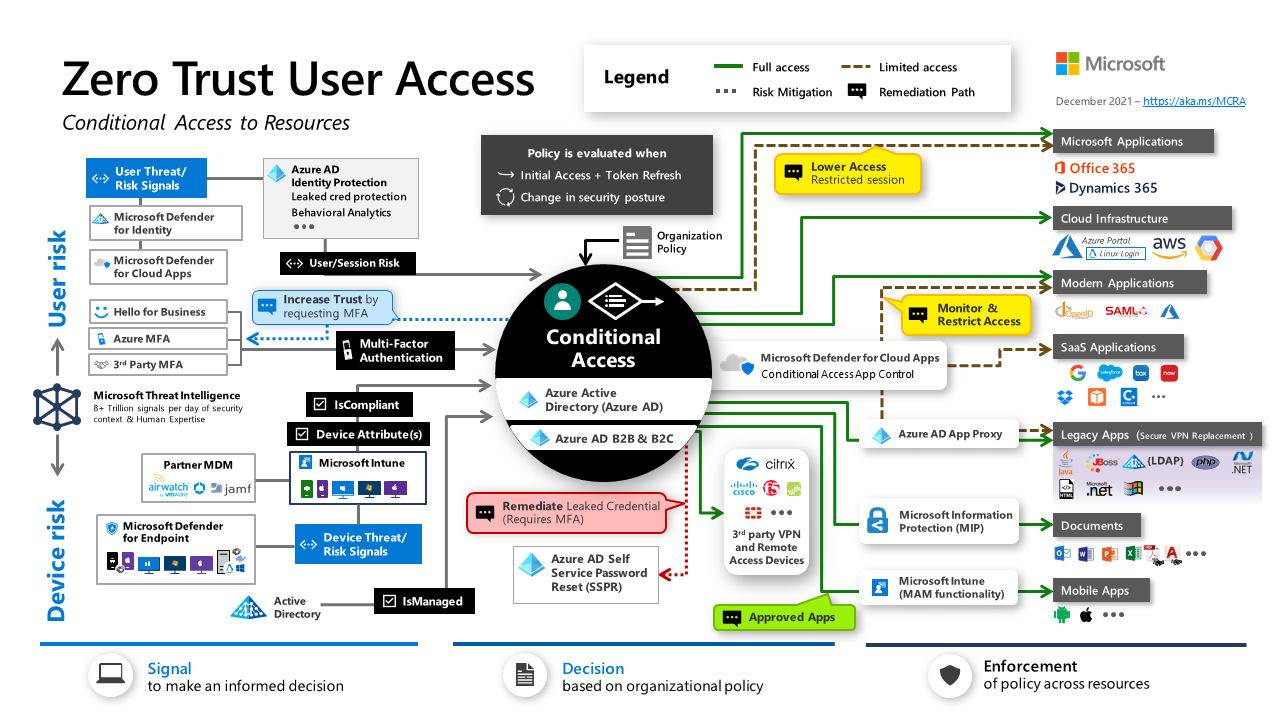
- Microsoft Cybersecurity Reference Architectures (MCRA): A set of detailed technical diagrams that describe Microsoft's cybersecurity capabilities and how they integrate with Microsoft platforms and third-party platforms, such as Microsoft 365, Azure, ServiceNow, Salesforce, AWS and GCP. The MCRA covers zero trust user access, security operations, operational technology (OT), multi-cloud and cross-platform capabilities, attack chain coverage, infrastructure and development security, and security organizational functions. The April 2025 update added an AI section, showed Microsoft Security Copilot as a broad capability, replaced Secure Score references with Exposure Management, and added a standards mapping section based on The Open Group's draft Zero Trust Reference Model. MCRA is part of Microsoft's broader Security Adoption Framework.
- SABSA: A framework and methodology for developing business-driven, risk-based and architecture-led security solutions. SABSA stands for Sherwood Applied Business Security Architecture and was created by John Sherwood with Andy Clark and David Lynas in the mid-1990s. The model has six layers, each a different viewpoint: contextual (business), conceptual (architect), logical (designer), physical (builder), component (tradesman), and service management (the operational layer, which spans the other five). Each layer answers the same six questions (what, why, how, who, where, when), and the SABSA Attributes Profile traces every control back to a business requirement, which is its main strength in audits and board discussions.
- TOGAF: A framework for enterprise architecture that provides a comprehensive approach to planning, designing, implementing and governing an organization's information technology. TOGAF stands for The Open Group Architecture Framework. It works across four architecture domains: business (strategy), data (information), application (system) and technology (infrastructure), developed through the Architecture Development Method (ADM) that guides the architecture development process. The current TOGAF Standard, 10th Edition (2022), splits content into a stable fundamental core and modular series guides, including guidance on security architecture. See also Enterprise Architecture (EA).
- NIST SP 800-207 and SP 1800-35: The vendor-neutral reference model for zero trust (2020) and its companion practice guide with 19 working implementations (2025). Covered in the Zero Trust section below.
- CISA Trusted Internet Connections (TIC) 3.0: A federal network security reference architecture built around security capabilities and use cases rather than fixed network chokepoints. Covered in the TIC section below.
Cybersecurity Roadmaps
A cybersecurity roadmap is a plan or strategy that outlines the steps and actions that an organization needs to take to achieve its security goals and objectives. A cybersecurity roadmap can help organizations to:
- Align their security initiatives with their business vision and mission
- Communicate their security vision and direction to stakeholders
- Prioritize their security investments and resources
- Track their progress and performance against their targets
- Adapt to changing threats, technologies and business needs
Some examples of cybersecurity roadmaps are:
- NIST Cybersecurity Framework Roadmap: A companion document to the NIST CSF that identified key activities planned for improving and enhancing the CSF, focused on high-priority areas for development, alignment and collaboration. Version 1.1 of the roadmap (2019) listed areas such as confidence mechanisms, the cyberattack lifecycle, cybersecurity workforce, cyber supply chain risk management, federal agency cybersecurity alignment, and governance and enterprise risk management. Much of that agenda landed in CSF 2.0 (supply chain and governance moved into the new Govern function). Today NIST's practical roadmap material for CSF users is its set of Quick Start Guides, Community Profiles, and the CSF 2.0 webinar series.
- Zero Trust Rapid Modernization Plan (RaMP): Part of the MCRA, RaMP gives a practical, checklist-driven path to zero trust. It is organized by initiatives rather than phases. The top-priority initiatives are user access and productivity (starting with explicitly validating trust for every access request), data compliance and governance, and modernizing security operations. Additional initiatives apply as needed for OT and IoT, datacenter and DevOps security, and security hygiene. Each initiative lists deployment objectives with accountable roles (for example, identity architect, IT implementer, security operations), so it doubles as a project plan and a RACI chart.
- CIS Cybersecurity Roadmap: A guide for small and medium-sized businesses to improve their cybersecurity posture using the CIS Controls. Older versions grouped controls into basic, foundational and organizational categories; since v7.1 and v8 the roadmap is built on Implementation Groups. IG1 (56 Safeguards) is defined as essential cyber hygiene for every organization, IG2 adds 74 Safeguards for organizations with more complex environments or sensitive data, and IG3 adds the final 23 for organizations facing sophisticated attackers. CIS also provides a free self-assessment tool and mappings to other frameworks.
- DoD Zero Trust Strategy and Roadmap: Seven pillars, 45 capabilities, and 152 activities, with target level (91 activities) due across the department by the end of fiscal 2027 and advanced level after that.
- CISA Zero Trust Maturity Model 2.0: A four-stage model (Traditional, Initial, Advanced, Optimal) across five pillars, used by federal civilian agencies to plan and report progress.
- Federal Post-Quantum Migration Roadmap (OMB M-26-15): A five-phase schedule from 2026 through 2035, beginning with cryptographic inventory and migration plans and requiring quantum-resistant key establishment (2030) and signatures (2031) for the highest-value federal systems.
Making Sense
|
|
|
|
|
|
Trusted Internet Connections (TIC) 3
- Trusted Internet Connections | Cybersecurity & Infrastructure Security Agency, Department of Homeland Security (DHS)
The Trusted Internet Connections initiative began in 2007 (OMB M-08-05) to cut the number of federal internet connections and route them through approved access points monitored by EINSTEIN sensors. That model worked for data centers but forced cloud and remote-user traffic to "hairpin" back through agency networks, adding latency and cost, and it became a recognized barrier to cloud adoption.
OMB Memorandum M-19-26 (September 2019) launched TIC 3.0, which replaces fixed chokepoints with security capabilities applied at policy enforcement points wherever they make sense: in the agency network, at a branch office, in a cloud service, or on the user's device. The guidance comes in five volumes (Program Guidebook, Reference Architecture, Security Capabilities Catalog, Use Case Handbook, and Overlay Handbook). It uses trust zones (low, medium, high) and "policy enforcement point security capabilities" rather than prescribing specific appliances.
Current status:
- Four final use cases. Traditional TIC, Branch Office, Remote User, and Cloud. The Cloud Use Case, covering IaaS, PaaS, SaaS, and email-as-a-service, was finalized in 2024 alongside Security Capabilities Catalog version 3.0 and updated Branch Office and Remote User use cases, satisfying the use-case requirements of M-19-26.
- Program Guidebook version 1.2 was published in July 2025.
- Zero trust alignment. CISA's "Journey to Zero Trust" series added guidance on adopting SASE as a way to retire TIC 2.0 architectures, improve visibility, and share telemetry with CISA services. In practice, TIC 3.0 is now the network and telemetry layer of federal zero trust.
- Compliance validations. CISA's older TIC Compliance Validations are deprecated; agencies map vendor capabilities to the TIC 3.0 capability catalog and overlays instead.
|
|
Zero Trust
YouTube ... Quora ...Google search ...Google News ...Bing News
- Perspective ... Context ... In-Context Learning (ICL) ... Transfer Learning ... Out-of-Distribution (OOD) Generalization
- Causation vs. Correlation ... Autocorrelation ...Convolution vs. Cross-Correlation (Autocorrelation) ... Signal Processing
- Policy ... Policy vs Plan ... Constitutional AI ... Process Supervision ... Trust Region Policy Optimization (TRPO) ... Policy Gradient (PG) ... Proximal Policy Optimization (PPO)
- Architectures for AI ... Enterprise Architecture (EA) ... Enterprise Portfolio Management (EPM) ... Architecture and Interior Design
- Immersive Reality ... Metaverse ... Omniverse ... Transhumanism ... Religion ... Versions of Yourself
- Telecommunications ... Computer Networks ... 5G ... Satellite Communications ... Quantum Communications ... Smart Cities ... Digital Twin ... Internet of Things (IoT) ... Space-based Data Centers
- Risk, Safety, Compliance and Regulation ... Ethics ... Privacy ... Law ... AI Governance ... AI Verification and Validation
- Cybersecurity ... OSINT ... Frameworks ... References ... Offense ... NIST ... DHS ... Screening ... Law Enforcement ... Government ... Defense ... Lifecycle Integration ... Products ... Evaluating
- Zero Trust Architecture | NIST
- Conditional Access design principles and dependencies | Microsoft
- Zero trust security model | Wikipedia
Zero Trust architecture is a cybersecurity approach that assumes breaches will occur and uses risk-based access controls to limit the damage from an attack. Instead of only guarding an organization’s perimeter, Zero Trust architecture protects each file, email, and network by authenticating every identity and device. Rather than just securing one network, Zero Trust architecture also helps secure remote access, personal devices, and third-party apps. Microsoft summarizes the principles as Verify explicitly, Use least privileged access, and Assume breach; many programs, including the DoD data pillar, add Require end-to-end encryption as a fourth.
Zero trust is not a product. It is a set of design rules applied to identity, devices, networks, applications, and data, and every serious model expresses it a little differently:
- NIST SP 800-207 (2020) defines seven tenets: all data sources and computing services are resources; all communication is secured regardless of network location; access is granted per session; access is decided by dynamic policy using identity, device state, and behavioral and environmental attributes; the organization monitors the integrity and posture of all assets; authentication and authorization are dynamic and strictly enforced before access; and the organization collects as much information as possible to improve its posture. Its logical model separates the Policy Engine and Policy Administrator (together the Policy Decision Point) from the Policy Enforcement Point, fed by data sources such as identity management, PKI, threat intelligence, activity logs, and SIEM. Deployment approaches include enhanced identity governance, microsegmentation, and software-defined perimeters.
- NIST SP 1800-35 (2025) shows 19 working builds of that model from commercial products and maps each to CSF and SP 800-53.
- CISA Zero Trust Maturity Model 2.0 (2023) uses five pillars (Identity, Devices, Networks, Applications and Workloads, Data), three cross-cutting capabilities (Visibility and Analytics, Automation and Orchestration, Governance), and four maturity stages (Traditional, Initial, Advanced, Optimal).
- DoD Zero Trust Strategy (2022) uses seven pillars (User, Device, Application and Workload, Data, Network and Environment, Automation and Orchestration, Visibility and Analytics), 45 capabilities, and 152 activities, with target level due by the end of fiscal 2027.
- OMB M-22-09 (2022) set the first federal civilian zero trust goals, with a deadline at the end of fiscal 2024. OMB's 2026 post-quantum memorandum now treats crypto-agility and PQC as part of the same zero trust program.
Never trust, always verify, and keep verifying for every request
Part of... software-defined networking (SD-WAN) and Secure Access Service Edge (SASE). SASE delivers wide-area networking with cybersecurity both on-site and in the cloud as DoD expands its reliance on cloud data storage. One of the key tenets of zero trust involves identity. Thunderdome uses identity verification, including public key infrastructure (PKI), which uses a certificate to validate data being sent from one point to another, and identity credentialing and access management (ICAM). ICAM verifies a person’s identity and links them to their allowed access privileges. - Thunderdome hits its targets, DISA moves to next phase of zero trust | Alexandra Lohr - Federal New Network
Since that 2023 report, Thunderdome moved from prototype to production under a follow-on agreement with Booz Allen Hamilton, began replacing functions of DISA's Joint Regional Security Stacks, and was validated at the DoD's advanced zero trust level (all 152 activities), two years ahead of the department's fiscal 2027 deadline for target level.
- Software-defined networking (SD-WAN)
- What Is Secure Access Service Edge (SASE)? | CISCO ... a network architecture that combines VPN and SD-WAN capabilities with cloud-native security functions such as secure web gateways, cloud access security brokers, firewalls, and zero-trust network access. These functions are delivered from the cloud and provided as a service by the SASE vendor.
- Identity credentialing and access management (ICAM) ... ensure that the right person with the right privileges can access the right information at the right time
- Thunderdome is a network architecture program; laying a zero-trust technology foundation
- US Defense Information Systems Agency (DISA)
Zero Trust for AI Agents and Non-Human Identities
AI agents act with delegated authority: they read mail, call APIs, run code, and change production systems. That makes each agent an identity, and zero trust rules apply to it just as they do to people.
- Per-request authorization. Each tool call should be evaluated by policy, not granted once at session start.
- Least privilege becomes "least agency." The OWASP Top 10 for Agentic Applications recommends giving agents only the minimum autonomy needed for a bounded task, with human approval for high-impact actions.
- Short-lived, scoped credentials for agents and service accounts, plus inventories of which agents can reach which data.
- Treat content as untrusted input. Indirect prompt injection (ATT&CK T1698) arrives through documents, web pages, and tool outputs, so agents must not treat retrieved content as instructions.
- Log and monitor agent actions with the same rigor as privileged human sessions; ATT&CK v20's AI-Enabled Exfiltration technique (T1700) describes adversaries directing enterprise agents to move data out.
|
|
|
|
|
|
|
|
AI and Cybersecurity Frameworks
AI security frameworks do three overlapping jobs, which NIST's Cyber AI Profile names directly: Secure (protect AI systems and their supply chains), Defend (use AI to improve cyber defense), and Thwart (build resilience against AI-enabled attacks). Most of the resources below cover only one or two of these, so organizations usually combine several. For adversarial attack techniques against models, see Offense; for model transparency, see Explainable AI.
| Resource | Owner | Status (October 2026) | What it does |
|---|---|---|---|
| Cyber AI Profile (NIST IR 8596) | NIST NCCoE with MITRE | Preliminary draft December 16, 2025; comments closed January 30, 2026; initial public draft expected in 2026 | Applies CSF 2.0 outcomes to the Secure, Defend, and Thwart focus areas across all six functions |
| COSAiS (NIST IR 8605 series) | NIST | Concept paper August 2025; discussion drafts of the overview (8605) and predictive AI overlay (8605A); generative AI, AI-specific controls, and agentic AI overlays planned | SP 800-53 control overlays tailored to specific AI use cases |
| AI RMF 1.0 and Generative AI Profile (NIST AI 600-1) | NIST | Final (2023 and 2024) | Trustworthy AI risk management (Govern, Map, Measure, Manage) |
| Adversarial Machine Learning taxonomy (NIST AI 100-2 E2025) | NIST | Final (March 2025) | Shared vocabulary for evasion, poisoning, privacy, and misuse attacks |
| ISO/IEC 42001:2023 | ISO/IEC | Final, certifiable | AI management system that integrates with ISO 27001 |
| OWASP Top 10 for LLM Applications | OWASP GenAI Security Project | 2026 edition (August 2026) | Application-level LLM risks such as prompt injection, sensitive information disclosure, and excessive agency |
| OWASP Top 10 for Agentic Applications | OWASP GenAI Security Project | 2026 edition (December 2025) | Agent risks ASI01 to ASI10, including goal hijacking, tool misuse, identity and privilege abuse, supply chain, and cascading multi-agent failures |
| MITRE ATLAS and ATT&CK v20 | MITRE | Ongoing; ATT&CK v20 released October 13, 2026 | Adversary techniques against and with AI; v20 adds prompt injection, AI-enabled exfiltration, and AI result poisoning to Enterprise ATT&CK |
| AI Controls Matrix (AICM) | Cloud Security Alliance | v1.0 (2025) | Vendor-neutral control set for cloud-hosted and cloud-delivered AI |
| Secure AI Framework (SAIF) | Published 2023 | Conceptual framework for securing AI across its lifecycle |
How the NIST pieces fit together. CSF 2.0 states general security outcomes. The AI RMF addresses broader trustworthiness (fairness, validity, transparency) beyond security. The Cyber AI Profile is the bridge: it takes CSF outcomes and says which ones become priorities when AI enters the environment. COSAiS sits underneath as the implementation layer, giving specific SP 800-53 controls for each AI use case. NIST held Cyber AI Profile workshops in April 2025 and January 2026 and working sessions in spring 2026 to refine the content.
Practical steps that every framework agrees on.
- Add AI to the asset inventory: models, datasets, prompts and system instructions, vector stores, plugins and tool connectors, and agents.
- Extend identity governance to agents and service accounts (see Zero Trust for AI Agents above).
- Manage the AI supply chain: model provenance, dataset integrity, third-party model APIs, and tool servers.
- Red team AI applications for prompt injection, data leakage, and excessive agency before and after deployment, and map findings to ATLAS or ATT&CK.
- Log prompts, tool calls, and outputs where privacy rules allow, so incidents can be investigated.
Regulatory context. The EU AI Act requires high-risk AI systems to meet accuracy, robustness, and cybersecurity requirements (Article 15). Under the EU's 2026 Digital Omnibus changes, obligations for stand-alone high-risk systems now apply from December 2027 rather than August 2026.
What remains uncertain. Prompt injection has no complete fix; current controls reduce likelihood and blast radius rather than eliminate the risk. Methods for evaluating AI system security are young, benchmarks change quickly, and none of the AI-specific frameworks above has outcome data yet showing that adopting it reduces incidents.
Other Cybersecurity
- Increasing International Cooperation in Cybersecurity and Adapting Cyber Norms ... Council on Foreign Relations report on international cyber norms and cooperation
- Cybersecurity Systems Security | MIT ... MIT OpenCourseWare lecture series on computer systems security
- 11 Steps Attackers Took to Crack Target - stolen credentials of an HVAC vendor | CIO ... the 2013 Target breach, still a standard case study in third-party access risk and in why compliance certification is not the same as security
Further Viewing and Sources
Additional Viewing
Understanding the 2024 Updates to the NIST Cybersecurity Framework (SANS webcast, December 4, 2024). James Tarala walks through CSF 1.1 versus CSF 2.0 in detail, including the new Govern function, reorganized categories, stronger supply chain expectations, and secure software development. It is a practical companion to the Recent Developments section for anyone migrating an existing CSF 1.1 program. Watch on YouTube
Microsoft Cybersecurity Reference Architectures (MCRA) walkthrough (Microsoft). This is the prerecorded presentation Microsoft links from its official MCRA page, covering the capabilities diagram, zero trust user access, security operations, multicloud, and OT reference diagrams. It is useful for seeing how a vendor reference architecture translates zero trust principles into specific integration points. Watch on YouTube
MITRE ATT&CK Updates: State of the ATT&CK (Adam Pennington, MITRE, ATT&CKcon 6.0, October 2025). The ATT&CK lead explains recent changes to the framework and what was coming next, including the defensive overhaul in v18 and the planned split of Defense Evasion that shipped in v19. Watch it before updating detection mappings or coverage reports to a new ATT&CK version. Watch on YouTube
The Never-evolving Threat Landscape: Forever Techniques and the Illusion of Change (Brian Donohue, Red Canary, ATT&CKcon 6.0, October 2025). Using operational detection data and historical examples, Donohue argues that adversaries keep relying on a small, stable set of ATT&CK techniques and identifies which ones organizations should prioritize. It is a strong data-driven case for threat-informed roadmaps over chasing novelty. Watch on YouTube
Assess and Address Practical Limitations of ATT&CK and ATLAS in AI Risk Management (Emily Soward and Trey Blalock, Applied Threat Intelligence Group, ATT&CKcon 6.0, October 2025). The speakers place ATT&CK and its AI-focused derivative ATLAS alongside current risk management frameworks and show where they fall short for AI attacks today, with suggested workarounds. It pairs directly with the AI and Cybersecurity Frameworks section. Watch on YouTube
Key Sources
Frameworks and control catalogs
- The NIST Cybersecurity Framework (CSF) 2.0 | NIST Primary document for CSF 2.0 (February 2024), defining the six functions, profiles, and tiers.
- The Ongoing Evolution of the CIS Critical Security Controls | Center for Internet Security History from version 6 through v8.1, including Implementation Groups and the move from 20 to 18 Controls.
- Navigating the ISO/IEC 27001:2022 Transition | ISACA Journal Summary of the 2022 revision, the reduction from 114 to 93 controls, and the October 31, 2025 transition deadline.
- Transition Policy to CC:2022 and CEM:2022 | Common Criteria Recognition Arrangement Official dates for moving from CC v3.1 to CC:2022.
Zero trust and federal architecture
- Implementing a Zero Trust Architecture: NIST Publishes SP 1800-35 | NIST NCCoE Final practice guide (June 2025) with 19 example implementations from 24 vendors.
- Implementing a Zero Trust Architecture: Full Document | NIST Complete technical detail for each SP 1800-35 build.
- Thunderdome Reaches Advanced Zero Trust Compliance | MeriTalk Reporting on DISA Thunderdome and the 91 target and 152 advanced activities in the DoD strategy.
- DoD CIO Testimony on Digital Modernization | House Armed Services Committee Status of Flank Speed, Thunderdome, and Fort Zero, plus CMMC implementation.
- Pentagon's Zero Trust Push Faces a 2027 Reality Check | ISMG Independent assessment of department-wide progress.
- TIC 3.0 Program Guidebook v1.2 | CISA Current TIC 3.0 program guidance (July 2025).
- Final Version of TIC Use Cases Covering Cloud Services | CISA Cloud Use Case and Security Capabilities Catalog v3.0.
- Zero Trust Rapid Modernization Plan | Microsoft Initiative-based structure of RaMP.
- Microsoft Cybersecurity Reference Architectures | Microsoft April 2025 MCRA update and change list.
AI security frameworks and threat knowledge
- NIST IR 8596 Cyber AI Profile (Initial Preliminary Draft) | NIST The CSF 2.0 community profile for AI with Secure, Defend, and Thwart focus areas.
- COSAiS Predictive AI Annotated Outline | NIST Plan for the IR 8605 series of SP 800-53 overlays for AI.
- Cyber AI Workshop #2 | NIST January 2026 workshop materials on the Cyber AI Profile and COSAiS.
- OWASP GenAI Security Project | OWASP Home of the Top 10 for LLM Applications and the Top 10 for Agentic Applications.
- OWASP's 2026 LLM Top 10 and New Agent Control Standard | Cloud Security Alliance Analysis of the August 2026 edition and its links to the agentic list.
- ATT&CK v20: Critical Infrastructure Campaigns, Adversary Use and Abuse of AI | MITRE ATT&CK Official v20 release post (October 2026) describing new AI techniques.
- ATT&CK v19 Release Notes | MITRE Defense Evasion split into Stealth and Defense Impairment.
Cryptography and post-quantum migration
- Executive Order 14412: Securing the Nation Against Advanced Cryptographic Attacks | The White House June 2026 order mandating federal PQC migration.
- OMB M-26-15: Execution of the Migration to Post-Quantum Cryptography | OMB Implementation memorandum with phased schedule and plan requirements.
- Post-Quantum Cryptography: From Guidance to Mandate | Cloud Security Alliance Summary of the 2030 and 2031 deadlines and the EU roadmap.
- NIST IR 8547: Transition to Post-Quantum Cryptography Standards | NIST Proposed 2030 deprecation and 2035 disallowance timeline.
- NIST PQC Standardization Project | Dustin Moody, NIST Status of FIPS 203 to 205, HQC selection, and migration guidance (September 2025).
- FIPS 140-2 Goes Historical | PostQuantum.com What the September 21, 2026 CMVP transition does and does not change.
Regulation
- ENISA Launched the CRA Single Reporting Platform | Help Net Security CRA reporting obligations and platform launch on September 11, 2026.
- EU Cyber Resilience Act: 24-Hour Reporting Duties | Jones Day European Commission guidance, scope, and penalties.
- CISA Plans to Finalize Cyber Incident Reporting Regulations | Hunton Andrews Kurth CIRCIA rulemaking timeline through 2026.
- Cybersecurity Maturity Model Certification | DoD CIO Official CMMC program information and phased rollout.
Evidence on what works
- Marsh McLennan Research Links Key Cybersecurity Controls to Reduced Cyber Risk | Marsh McLennan Claims-based control effectiveness study (2023).
- Cybersecurity Signals: Connecting Controls and Incident Outcomes | Help Net Security 2025 follow-up from Marsh's Cyber Risk Intelligence Center.
- New Verizon Report Reveals the Security Gap Attackers Are Exploiting Most | TechRepublic Key findings of the 2026 Verizon DBIR.