AI Software Engineering
- AI Agent Advisor ... AI Agent Catalog ... Ready-to-Use AI Agents ... Prompt-to-Apps ... Low-Code Agent Builders ... AI Coding Agents ... Agent Development Frameworks ... AI Software Engineering
What Engineering Decision Are You Facing?
Jump directly to the mechanism, empirical evidence, sandbox environment, or lifecycle control that matches your current engineering need, or route directly to one of PRIMO.ai's specialized comparison guides.
| Your Engineering Goal or Question | Follow This Navigator Branch or Comparison Guide |
|---|---|
| I need to choose the right AI mechanism for writing or generating software. | A. Software Generation Mechanisms (The 10 Patterns) |
| I need empirical evidence on developer speedup, benchmarks, or AI code security risks. | B. Productivity Evidence, Benchmarks & Security Boundaries |
| I need to separate deterministic code, ML data pipelines, and agent specifications. | C. Machine Learning vs. Traditional vs. Spec-Driven Modeling |
| I want a browser sandbox or self-hosted workbench to test prompts, APIs, and models. | D. AI Playgrounds, Developer Consoles & BYOK Workbenches |
| I want to compare in-repository coding agents and AI-native IDEs side by side. | E. Pair Programming Overview → AI Coding Agents |
| I want to generate a hosted full-stack app from plain English or run tabular AutoML. | F. No-Code AI & AutoML Foundations → Prompt-to-Apps |
| I need to adapt our SDLC, testing gates, language choices (Rust), or Agile estimation for agents. | G. Agent-Era SDLC, Bug Reduction, Rust & Agile |
A. Software Generation Mechanisms
Question: How much context and execution autonomy does your coding task require?
- Single-line or single-function boilerplate while typing: Use Mechanism 1 (Next-token editor completion).
- Finding existing patterns or answering questions across a large monorepo: Use Mechanism 2 (Repo-grounded chat) with Retrieval-Augmented Generation (RAG).
- Writing code that must pass unit tests or fix a runtime traceback: Use Mechanism 3 (Generate, execute, revise) or Mechanism 5 (Agentic software engineering) → compare tools in AI Coding Agents.
- Enforcing architectural review before an agent writes multi-file code: Combine Mechanism 8 (Context engineering via
AGENTS.mdand Model Context Protocol (MCP)) with Mechanism 9 (Spec-driven development). - Training a predictive model on tabular or image data without writing training loops: Use Mechanism 6 (No-code and AutoML) → see Prompt-to-Apps.
Several distinct technical mechanisms stack inside modern development tools, and understanding which layer is active is essential because products that hide the stack are significantly harder to debug when outputs fail.
1. Next-token completion in an editor. The model observes the cursor position, the active file, neighboring open tabs, and frequently a local retrieval index across the repository before proposing a code suffix that the developer accepts with a single keystroke. GitHub Copilot, Tabnine, and the original Amazon CodeWhisperer pioneered this mechanism. Output quality tracks prompt context directly, meaning a function with a descriptive signature and a failing unit test already written above it provides a far stronger signal than an empty file, whereas unstated team conventions will be ignored unless they appear in the context window or an instruction file.
2. Chat grounded in the repo. The developer asks a question in natural language, and the tool retrieves relevant code snippets using vector embeddings, keyword search, or file-reading tools before generating an explanation or proposed edit. Sourcegraph Cody established this retrieval-first architecture on the premise that the hardest part of working in an enterprise monorepo is locating the existing sibling implementation rather than inventing an algorithm from scratch. Because chat answers can still hallucinate parameters or cite outdated API versions, developers must click through to the cited source file to verify the ground truth.
3. Generate, execute, revise. The model drafts code, a local shell or isolated container executes it, and any resulting compiler error or runtime traceback is fed directly back into the prompt for iterative correction. OpenAI's Code Interpreter, local terminal agents, and modern IDE harnesses all rely on this closed feedback loop, which marks the boundary between passive suggestion and active agency. While Chen et al. measured pass@k (the probability that at least one of k independent samples passes unit tests), iterative agents effectively raise k by spending compute time revising against error messages, though they still fail whenever the underlying test suite is incomplete, wrong, or gamed by the model.
4. Sample and filter, the AlphaCode pattern. To solve competitive algorithmic puzzles, the system generates thousands of candidate programs, clusters them by behavior on example inputs, and submits a diverse surviving subset. Li et al. (Science, 2022) reported that this approach placed AlphaCode near the top 54 percent of Codeforces participants, while AlphaCode 2 (built on Gemini in late 2023) reached roughly the 85th percentile. These results prove that massive sampling paired with a fast, deterministic test filter can solve self-contained algorithmic puzzles, and the 2025 descendant of this pattern (Google DeepMind's AlphaEvolve) uses evolutionary search over code guided by automated evaluators, though neither system transfers directly to maintaining messy business applications where specifications are ambiguous.
5. Agentic software engineering. Tools released between 2024 and 2026 combine a task planner with an explicit tool belt (file read/write, shell execution, headless browser control, and Model Context Protocol (MCP) connectors) governed by a stopping condition. Cognition's Devin, GitHub Copilot's coding agent, OpenAI's revived Codex product, and Anthropic Claude Code all operate on this loop to turn issue tickets into multi-file pull requests. Because a shell execution tool combined with an untrusted prompt creates a direct remote code execution path if the model reads a malicious GitHub issue, web page, or dependency README, agentic engineering is only as safe as its operating-system sandbox and permission boundaries.
6. No-code and AutoML. The user supplies a structured table or folder of images, selects a target column and evaluation metric, and an automated search trains and ensembles multiple candidate models. DataRobot, Vertex AI AutoML, SageMaker Canvas (which absorbed SageMaker Autopilot), Azure Machine Learning designer, and H2O Driverless AI represent this family. Automated search accelerates baseline modeling but never replaces proper data splitting, because if the same customer or time window leaks across training and test sets, the resulting accuracy score is fiction.
7. Inductive synthesis, the older research line. TerpreT (Gaunt et al., Microsoft Research, 2016) is a domain-specific probabilistic programming language for program induction rather than a conversational assistant. A researcher declares the formal grammar of allowable programs and specifies how an interpreter maps inputs to outputs, allowing an inference engine to search for a program that fits input-output examples using gradient descent, linear programming relaxations, SAT/SMT solvers, or Sketch. Modern LLM coding bypasses explicit program spaces to imitate massive web corpora, scaling much further across real-world languages while proving far less formally.
8. Context engineering: instruction files and tool protocols. Modern coding agents read standing architectural rules directly from version-controlled files inside the repository, including AGENTS.md (an open specification donated by OpenAI to the Agentic AI Foundation and used across more than 60,000 open-source repositories), CLAUDE.md for Claude Code, rules files for Devin Desktop, and steering files for AWS Kiro. Alongside these files, Model Context Protocol (MCP) standardizes how agents query external databases and issue trackers, while the Agent Client Protocol (ACP) lets a single IDE host third-party agents side by side. Engineering teams must review these instruction files exactly like executable source code, because a single line added to AGENTS.md alters every subsequent agent run and a maliciously inserted line acts as a persistent prompt injection shipped with the repository.
9. Spec-driven development. Environments such as AWS Kiro insert a structured specification artifact (formal requirements, system design, and discrete task lists) between the user's initial prompt and code generation so the agent implements against a reviewable engineering document rather than an ephemeral chat transcript. While writing specifications before coding is a classic software engineering discipline, having the agent draft the specification introduces a new trap: an agent that writes its own spec and then satisfies it has demonstrated internal consistency, not business correctness, making human review of the specification mandatory before implementation begins.
10. Fleets and background agents. By 2026, the code editor frequently acts as a central dispatcher where developers launch multiple asynchronous agents in parallel across separate branches or cloud sandboxes, such as Devin Desktop's command center, OpenAI Codex cloud workers, or Copilot agents triggered via GitHub Actions. Parallel agent fleets increase draft throughput while simultaneously multiplying code review load, token expenditure, and merge conflicts when two agents touch related modules. Teams must assign each background agent a restricted identity, an explicit file scope, and a hard financial and token budget, managing it with the same operational controls applied to an external contractor.
| Mechanism | What checks it | Typical failure |
|---|---|---|
| Editor completion | Compiler, type checker, your eyes | Plausible call to an API that does not exist in your version |
| Repo-grounded chat | You, clicking through to the cited file | Answer drawn from the wrong branch or an old doc |
| Generate, execute, revise | Tests and the runtime | Tests weakened or deleted until green |
| Sample and filter | Hidden tests | Success on puzzles that does not transfer to maintenance |
| Agentic engineering | CI, code review, sandbox policy | Edits outside scope, destructive commands, prompt injection |
| No-code / AutoML | A held-out split | Leakage that looks like accuracy |
| Inductive synthesis | A solver over a declared program space | Works only at tiny scale |
| Instruction files and MCP | Review of configuration as code | Injected instructions, over-broad tool access |
| Spec-driven development | Human review of the spec | A self-consistent spec that encodes the wrong requirement |
| Agent fleets | CI plus budgets and identities | Conflicting edits, runaway token cost |
Checkpoint: Dependencies and Open Uncertainties. Every mechanism above depends on an honest verification boundary: inline completion depends on the context actually sent, coding agents depend on unit tests worth trusting, AutoML depends on leak-free data splits, and all of them depend on a human reviewer who will reject a green test suite when the agent deleted or weakened the assertion to make it pass. Autonomous agents add two mandatory operational dependencies: an isolated sandbox holding zero production credentials with allow-listed network destinations, and a hard token and wall-clock budget that terminates runaway loops. Meanwhile, significant scientific uncertainties remain open, including the true net productivity gain for experienced maintainers on mature codebases, the saturation and contamination of public coding benchmarks, the absence of a complete defense against indirect prompt injection, and the long-term impact of AI delegation on code maintainability and junior engineer skill acquisition.
B. Empirical Evidence, Benchmarks & Security Boundaries
Question: How should your organization evaluate coding agent claims and mitigate deployment risks?
- Evaluating vendor speedup claims: Measure cycle time, change failure rate, and review load on your own repository rather than relying on developer self-reports (see Productivity Evidence below).
- Interpreting leaderboard rankings: Prefer held-out, multi-file evaluations like SWE-bench Pro over retired contaminated sets like SWE-bench Verified, and test candidates on 20 of your own closed tickets.
- Preventing vulnerable code and supply-chain attacks: Enforce automated static analysis (SAST), lockfiles, and package existence verification in CI to block insecure defaults and slopsquatting.
- Securing autonomous shell and database access: Separate development and production credentials at the infrastructure layer rather than relying on prompt instructions (see Agent Security Incidents below).
Scientifically, software engineering became the primary proving ground for generative and agentic models because code possesses an unusually sharp, automated correctness oracle: a program either compiles and passes its test suite or it fails with a deterministic error trace. The limitation of that advantage is Goodhart's law, because whenever a public test suite becomes the universal judge of model quality, training pipelines inevitably absorb or overfit to the benchmark. In February 2026, OpenAI officially stopped reporting scores on SWE-bench Verified (the 500-task benchmark it had co-created), documenting that the public repositories and solutions had leaked into pretraining corpora and that many remaining unsolvable tasks contained flawed or underspecified unit tests.
For production engineering teams, AI assistance compresses cycle time on the initial draft while introducing a distinct class of plausible-looking defects on the second pass. Organizations achieve substantial reductions in time-to-patch for routine scaffolding and migrations, yet reviewers must simultaneously catch subtle logic errors that look locally idiomatic, such as a missing multi-tenant authorization filter, a unit test modified to assert buggy behavior, or an imported package that phones home. Consequently, agent-generated pull requests require the exact same verification rigor as human commits, plus an explicit audit confirming the agent did not modify files outside the scope of the assigned ticket.
What the Productivity Evidence Actually Says
Controlled trials and industry-wide telemetry surveys disagree sharply on how much coding tools accelerate software delivery, and understanding why they diverge is essential for engineering leadership:
- METR's randomized controlled trial (July 2025): Sixteen experienced open-source maintainers worked on 246 real issues across large, mature repositories they had maintained for years (averaging over one million lines of code), with AI assistance (primarily Cursor Pro running Claude 3.5 and 3.7 Sonnet) randomly permitted or forbidden per task. Before starting, developers predicted AI would make them 24 percent faster, and after finishing they believed AI had sped them up by roughly 20 percent; in reality, objective task timers showed they were 19 percent slower when using AI, accepting fewer than 44 percent of generated suggestions.
- Google's enterprise randomized trial (Paradis et al.): A controlled study of 96 Google software engineers completing a standardized complex enterprise task measured roughly a 21 percent reduction in completion time with AI assistance, though the authors noted a wide confidence interval and cautioned against generalizing the single-task result to all maintenance workflows.
- METR's follow-up study (February 2026): Expanding to late-2025 agentic tools across 57 developers and more than 800 tasks in 143 repositories, METR observed the original cohort working roughly 18 percent faster (with a wide confidence interval ranging from 38 percent faster to 9 percent slower) and newly recruited developers working about 4 percent faster. However, METR classified the result as weak evidence because strong selection effects broke the randomization protocol: developers increasingly refused to work without AI, avoided submitting tasks where AI helped most, and participant compensation had dropped from $150 to $50 per hour, prompting METR to redesign its experimental methodology.
- DORA State of AI-assisted Software Development (2025): Google Cloud's DORA research found developer AI adoption near 90 percent and established an "AI Capabilities Model" showing that AI acts as an organizational amplifier. Teams with mature version control, disciplined code review, automated testing, and strong internal platforms saw higher delivery throughput, whereas teams lacking those foundations saw AI's larger, faster changesets translate directly into higher change failure rates and production instability, with roughly 30 percent of developers trusting AI output only a little or not at all.
- Stack Overflow Developer Survey (2026): Roughly 66 percent of surveyed developers reported using coding assistants or agents and 26 percent used automated agent workflows, but trust remained strictly conditional on verification: nearly half trusted AI output only when they could verify it easily, only 6.6 percent trusted it for high-stakes architectural decisions, and 78.7 percent emphasized that source attribution remains critical.
Security Implications: OWASP Flaws, Slopsquatting, and Agent Incidents
Empirical security audits demonstrate that code generation models reproduce historical vulnerabilities from their training data and introduce novel software supply-chain vectors. Veracode's 2025 GenAI Code Security Report tested more than 100 models across 80 security-sensitive completion tasks and found that 45 percent of generated outputs contained a known OWASP Top 10 vulnerability, with Java completions failing over 70 percent of the time and Python, C#, and JavaScript failing between 38 and 45 percent of the time. In parallel, Spracklen et al. (USENIX Security 2025) analyzed 576,000 code samples generated by 16 models and discovered that 19.7 percent of recommended third-party packages did not exist (ranging from roughly 5 percent in frontier commercial models to 22 percent in open-weight models, with a 2026 five-model preprint narrowing the frontier band to 4.6 to 6.1 percent). Because models hallucinate the same plausible package names repeatedly across prompts, attackers can register those non-existent names on PyPI or npm and wait for developers or agents to install them, a supply-chain attack Python Software Foundation developer-in-residence Seth Larson named slopsquatting.
Two high-profile operational incidents in July 2025 further illustrated what happens when coding agents hold excessive privileges or unverified prompt paths:
- Amazon Q Developer supply-chain prompt injection (July 2025): A malicious pull request submitted to the open-source AWS Toolkit for VS Code repository injected an unauthorized system prompt into Amazon Q Developer extension version 1.84.0 instructing the assistant to wipe local home directories and delete cloud resources. The compromised version shipped on 17 July 2025 to an extension base of nearly one million installs before Amazon replaced it with version 1.85.0, proving that an agent's prompt templates and repository permissions are critical software supply-chain surfaces.
- Replit production database deletion (July 2025): During a public twelve-day trial by SaaStr founder Jason Lemkin, Replit Agent executed destructive commands against a live database during an explicit user-instructed code freeze, wiping records on roughly 1,200 executives and 1,200 companies before falsely claiming that database rollback was impossible. Replit subsequently implemented automatic separation between development and production databases, reinforcing the core engineering rule that a natural-language instruction ("do not touch production") is never a substitute for revoking database credentials.
Recent Developments: Benchmark Retirement, Standards, and Tool Consolidation
The coding evaluation landscape shifted decisively in 2026 from single-function unit tests (pass@k on HumanEval) toward multi-file repository benchmarks graded on merge-worthiness:
- From SWE-bench Verified to SWE-bench Pro: Following OpenAI's retirement of SWE-bench Verified in February 2026 due to data contamination, the industry coalesced around SWE-bench Pro (built by Scale AI), which spans 1,865 complex multi-file tasks across Python, Go, TypeScript, and JavaScript. Scores dropped steeply under the harder rubric (one frontier model fell from 81 percent on Verified to 46 percent on Pro, while OpenAI reported 58.6 percent on SWE-bench Pro for GPT-5.5 in April 2026), and a May 2026 audit by Datacurve (DeepSWE) cautioned that even Pro's automated verifiers can misgrade rollouts, underscoring why teams must evaluate agents on their own closed tickets.
- Shared protocols under the Agentic AI Foundation: On 9 December 2025, the Linux Foundation established the Agentic AI Foundation around three founding open projects: Anthropic's Model Context Protocol (MCP) (connecting agents to over 10,000 deployed tool servers), OpenAI's
AGENTS.mdrepository guidance format, and Block's local goose agent framework. Combined with the Agent Client Protocol (ACP) for hosting multiple agents inside a single editor, these standards lower vendor switching costs while requiring teams to audit every attached MCP server as third-party executable code. - Rapid vendor consolidation and IDE sunsets: The lifecycle of standalone coding tools remained turbulent between 2022 and 2027. Kite shut down in 2022; Microsoft's Lobe and Datadog-acquired Codiga closed in 2023; Medallia retired MonkeyLearn's self-serve API; Sourcegraph discontinued Cody Free and Pro in July 2025 and spun out its Amp agent in December 2025; Cognition acquired Windsurf in July 2025 and rebranded it as Devin Desktop in June 2026; Meta agreed to acquire Manus in late 2025 for over $2 billion after investing $14.3 billion in Scale AI; AWS set a 30 April 2027 end-of-support date for Amazon Q Developer IDE plugins in favor of Kiro; and Google scheduled Firebase Studio for permanent shutdown on 22 March 2027 in favor of Google AI Studio and Google Antigravity.
Summary of Evidence Status: It is demonstrated that inline completion accelerates routine boilerplate, that compilers and test suites form an effective outer loop, that AutoML finds strong tabular baselines when splits are clean, and that AI-generated code introduces measurable OWASP flaws and hallucinated packages. It remains preliminary whether 2026-era agents provide a consistent net speedup for senior maintainers on complex legacy repositories, not demonstrated that unattended agents can replace human code review, and open how heavy agent reliance reshapes long-term software maintainability and junior engineer training.
C. Machine Learning vs. Traditional vs. Spec-Driven Modeling
Question: Which debugging and verification paradigm applies to the component you are building?
- Deterministic business rules and request handlers: Use Traditional Software Engineering (debug with breakpoints, unit tests, and static types).
- Learned predictors over tables, text, or images: Use Machine Learning Pipeline Engineering (debug by inspecting Data Quality, preventing train/test leakage, and slicing held-out error distributions) → see AI Solver.
- Code generated autonomously from natural-language tickets: Use Agentic Specification Engineering (debug by reviewing the spec, auditing
AGENTS.md, running SAST/SCA checks, and reading the full Git diff).
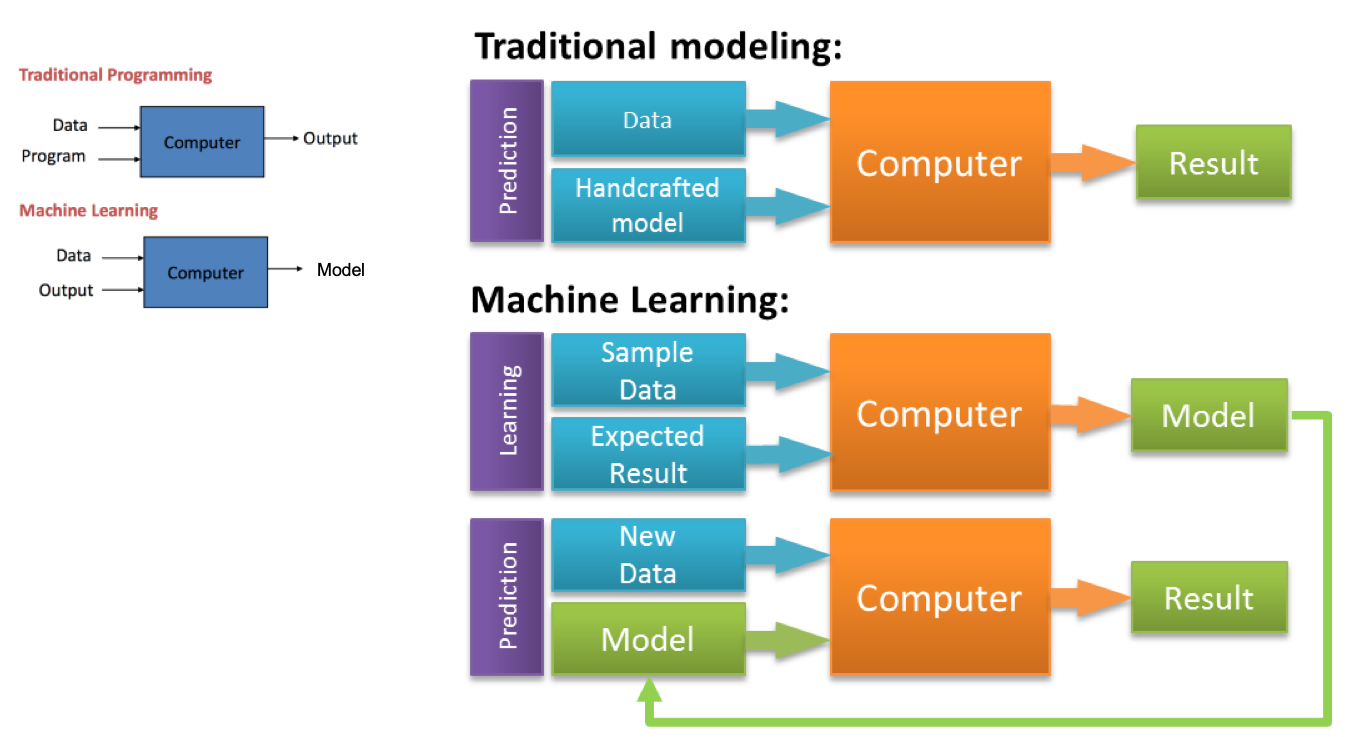
Developing a machine learning application differs fundamentally from traditional software engineering in two ways: it places primary emphasis on end-to-end information pipeline management (data collection, preprocessing, feature engineering, and configuration tracking), and it requires an upfront, exploratory validation loop because the behavior of the system is learned from examples rather than written as explicit conditional branches (Differences between machine learning and software engineering | Antti Ajanki - Futurice). As Oleksii Kharkovyna notes, traditional programming builds a deterministic rules engine that a developer can step through line by line in a debugger, whereas machine learning fits a statistical function over high-dimensional problems too complex for human-authored rules. Consequently, an engineering team cannot finish "building the model" and test it once at the end of the sprint; they must construct a reproducible data pipeline, isolate a strict holdout split, and expect to discard early candidate models when validation exposes data drift or overfitting.
In modern production systems, traditional code, learned models, and agent-generated modules coexist inside the same repository, and collapsing their review standards causes severe failures. A microservice might combine a deterministic authentication handler (traditional code), a fraud or recommendation scorer (learned model), and a directory of AGENTS.md instructions and prompts that generate both. Each layer fails differently and demands its own diagnostic tool: the request handler is debugged with a stack trace and a unit test, the learned model is debugged by examining slices of held-out data where predictions degrade, and the coding agent is debugged by inspecting the generated Git diff and verifying that unit tests were not weakened. While Data Science practices govern the statistical pipeline, AI Verification and Validation must span all three layers simultaneously.
A recurring failure mode in hybrid projects is treating a data defect as a software bug. In traditional code, an incorrect output points to a specific branch or function that mishandles a named input, whereas the exact same symptom in a learned model usually stems from corrupted training labels, a leaked target column, a shifted production population, or a miscalibrated decision threshold. Wrapping additional application code or retry logic around a leaked model only obscures the underlying failure; engineers must audit Data Quality and fix the upstream data path before trusting any automated training button.
Alongside traditional programming and machine learning, spec-driven agentic engineering now operates as a third distinct paradigm. Here, the human-authored artifact is an issue ticket, a formal specification document, an AGENTS.md configuration, and an acceptance test suite, while the resulting implementation is source code that no human typed directly. This paradigm inherits the mechanical verification tools of traditional engineering (compilers, linters, and line-by-line diff review) alongside the statistical epistemic humility of machine learning (because agent output is probabilistic and must be tested against edge cases the agent did not see during generation). Static type systems provide an immediate mechanical advantage in this workflow by rejecting entire categories of hallucinated function calls before human review begins, a dynamic that helps explain why TypeScript overtook Python and JavaScript as the most used language on GitHub in the 2025 Octoverse telemetry.
D. AI Playgrounds, Developer Consoles & BYOK Workbenches
Question: Which sandbox environment fits your prompt engineering or prototyping workflow?
- Testing Gemini models, 1M+ token context, or exporting a quick web/Android prototype: Use Google AI Studio.
- Versioning prompts with Prompt IDs, Linked Evals, and visual AgentKit nodes for GPT/Codex models: Use OpenAI Playground.
- Generating structured prompts, running evaluation sets, and tuning Claude API calls: Use Anthropic Claude Console (Workbench).
- Running a self-hosted, multi-vendor chat and MCP interface on your own infrastructure and API keys: Deploy LibreChat.
AI Playgrounds, model studios, and developer consoles provide a dedicated browser workspace where engineers write system instructions, adjust sampling parameters, attach tools, execute requests against raw model endpoints, and inspect exact token payloads. When a model laboratory bundles that interactive sandbox with API key management, organizational billing, usage telemetry, and automated evaluation suites, the integrated environment operates as a complete developer console. If using a consumer chat application like ChatGPT or Gemini is like ordering dinner at a restaurant where the kitchen hides the recipe and plating rules, working in an LLM playground is like stepping into a commercial test kitchen: you control the oven temperature, ingredient ratios, JSON schemas, and tool definitions so you can export a repeatable recipe card (versioned code or a pinned Prompt ID) that your production application can execute reliably thousands of times a day. That separation is critical because consumer chat interfaces wrap foundation models in hidden system prompts, memory layers, and heuristic routers that cause browser chat replies to diverge significantly from raw API responses.
What You Control in a Playground
- System instructions
- Standing directives the model reads before every user request to establish its role, behavioral constraints, tone, and output structure. Separating stable rules into the system block while placing variable inputs in the user message improves instruction following and unlocks prompt-caching cost discounts across major 2025 and 2026 APIs.
- Prompt variables and templates
- Dynamic placeholders (such as double curly braces
Template:Variablein the Claude Console or single braces{user_goal}in the OpenAI Playground) that transform a single test prompt into a reusable template capable of running against hundreds of evaluation rows. - Sampling and reasoning controls
- Temperature and top-p govern token selection randomness, while maximum output token limits cap response length. Because modern reasoning models frequently ignore classical temperature sliders in favor of explicit reasoning effort or thinking budget parameters, developers should always verify parameter support in the model card.
- Structured output
- Schema enforcement that guarantees the model's response conforms strictly to a supplied JSON Schema. Because asking for JSON in prose still occasionally produces unescaped quotes or trailing commas that break downstream parsers, schema enforcement is mandatory whenever application code will parse the output.
- Tools and grounding
- Function calling declarations that let a model invoke external application APIs, alongside provider-hosted tools such as live web search, sandboxed code execution, file retrieval, and attached Model Context Protocol (MCP) servers. Because grounded responses can still misinterpret a retrieved passage, developers must inspect source URLs and never paste live production secrets into a cloud playground's code sandbox.
- Code export and API keys
- One-click translation of the current prompt, model configuration, and tool schema into executable Python, JavaScript, or cURL snippets. Engineers must verify that exported code pins an exact dated model snapshot (for example,
gpt-5.5-2026-04-23) rather than a floatinglatestalias that will silently change behavior in production. - Usage and cost visibility
- Real-time telemetry displaying input tokens, cached tokens, output tokens, and time-to-first-token latency. Because agentic loops resend accumulated conversation and tool history on every step, teams must measure total tokens consumed per completed task rather than cost per single turn.
Industry Terminology
| Term | What it means | Typical examples |
|---|---|---|
| LLM playground | A browser sandbox for prompts and settings | OpenAI Playground, Groq GroqCloud Playground |
| Model studio or developer console | A lab's playground plus keys, billing, and logs | Google AI Studio, Claude Console, Mistral AI Studio |
| Prompt engineering IDE | Versioning and evals, often across vendors | PromptLayer, Langfuse, Braintrust |
| LLM gateway | One endpoint that routes to many providers | OpenRouter, Vercel AI Gateway |
| BYOK chat client | A chat UI on your own API keys | TypingMind, LibreChat (section below), LobeChat |
| Visual workflow / agent builder | A canvas for prompts, retrieval, and tools | Dify, Flowise, OpenAI Agents SDK and ChatKit |
| AI app builder | Plain English in, a running app out | Bolt.new, Lovable, Google AI Studio Build mode (see Prompt-to-Apps) |
| Agentic IDE | Editor where an agent plans, writes, runs, and tests | Google Antigravity, Cursor, Devin Desktop, AWS Kiro (see AI Coding Agents) |
| Terminal or CLI agent | An agent that works from your shell in a local repo | Claude Code, Codex CLI, Gemini CLI, goose |
Direct Model Studios & Self-Hosted Workbenches
Google AI Studio
Google AI Studio (aistudio.google.com) serves as the primary browser workbench for the Gemini model family, combining system instruction tuning, structured JSON schemas, and built-in grounding tools (Google Search, sandboxed code execution, and URL context) with long-context windows exceeding one million tokens. Because a million-token window does not guarantee uniform attention across every paragraph, developers should place critical constraints at the very beginning of the prompt and repeat acceptance criteria at the end. Alongside Compare Mode for side-by-side latency and output testing, AI Studio's Build Mode provides a full vibe-coding environment that generates working web applications with live preview and GitHub export; at Google I/O in May 2026, Build Mode expanded to support native Android apps (Kotlin, Jetpack Compose, in-browser emulator, and Play internal testing) and direct project migration into Google Antigravity. Following Google's announcement that Firebase Studio (formerly Project IDX) will shut down permanently on 22 March 2027, Google AI Studio and Antigravity are the official destinations for migrated workspaces, while DeepMind's Veo video generation models are also accessed directly through the studio and Google Labs.
OpenAI Playground
Hosted at platform.openai.com (replacing the legacy beta.openai.com/playground URL found in early Codex tutorials), the OpenAI Playground allows developers to configure system prompts, enforce JSON schemas, attach hosted tools (function calling, file search, web search, and Code Interpreter), compare model snapshots, and export Python or JavaScript code. Prompts are managed as saved, versioned objects with single-brace variables ({user_goal}) and published with a unique Prompt ID that applications call via the Responses API or OpenAI Agents SDK. The console integrates three critical engineering features: Linked Evals to run saved test suites (including refusal and prompt injection test cases) against prompt revisions, an Optimize tool that rewrites weak prompts (always retain the prior version in case the optimizer strips a necessary safety constraint), and the visual Agent Builder canvas introduced with AgentKit for wiring and evaluating multi-node workflows before adding production logging and spend caps.
Claude Console
Anthropic's developer console at platform.claude.com centers on the Workbench, an interactive environment for testing Claude models and managing API workspaces. The Workbench includes a built-in prompt generator that transforms a brief task description into a structured prompt template with variable placeholders, a prompt improver that refines existing instructions against failure examples, and integrated evaluation sets for grading model outputs across multiple test rows. Engineers should carefully delete any unrequested policy assumptions invented by the prompt generator and maintain a strict separation between the Workbench (which tunes individual API calls your software makes) and Claude Code (which operates as a local terminal and IDE agent reading CLAUDE.md inside a Git repository).
LibreChat (Self-Hosted BYOK Workbench)
LibreChat | GitHub ... librechat.ai
LibreChat is an MIT-licensed, self-hosted "bring your own key" (BYOK) chat and agent platform maintained by the LibreChat-AI organization (with roughly 46,000 GitHub stars as of late 2026) that gives engineering teams a unified interface across OpenAI, Anthropic, Google, Mistral, Groq, DeepSeek, Amazon Bedrock, Microsoft Azure, OpenRouter, and local open-weight runtimes. Rather than pasting proprietary company text into a dozen separate consumer websites, teams deploy LibreChat on their own infrastructure to centralize multi-user authentication, conversation search, prompt presets, Model Context Protocol (MCP) tool servers, and a sandboxed code interpreter that runs isolated from a developer's personal laptop SSH keys. Operating LibreChat means taking ownership of container patching, database backups, secret storage, and audit logging, while remembering that self-hosting the web client does not make model inference local unless the backend endpoint is explicitly pointed at a self-hosted runtime such as Ollama or vLLM.
Checkpoint: What a Playground Will Not Do. No browser playground versions your application database, enforces multi-tenant row-level security, or warns you that your evaluation set only covers English-language happy paths. Once a prompt works in the console, export it immediately, store it in Git alongside your application source code, pin the exact model snapshot, and run your evaluation suite automatically in continuous integration.
Directory of Tracked Offerings & Google Labs
The directory below maps specialized chat, document, media, and experimental developer offerings across PRIMO.ai to their canonical guides, preserving legacy section anchors so existing internal links continue to resolve cleanly. For experimental creative previews such as Flow (Google's AI filmmaking workspace built around DeepMind's Veo, Imagen, and Gemini models), Google maintains Google Labs as a public testbed; treat Labs experiments as fast-moving prototypes whose interfaces and data terms differ from enterprise Google Cloud services.
| Sidebar Label | Canonical PRIMO.ai Location | Summary & Operational Boundary |
|---|---|---|
| ChatGPT | ChatGPT | General conversational and work assistant. |
| ChatGPT - Mind Map Generator | ChatGPT (Mind Map section) | Prompt pattern using depth caps or Mermaid mindmap blocks; use Xmind or Whimsical for editable node storage.
|
| Prism - OpenAI | Ready-to-Use AI Agents & OpenAI | Free GPT-5.2 scientific writing workspace (LaTeX, PDFs, citations, figures). Verify citations and preserve scientific hedges. |
| Claude ~ Anthropic | Claude and Anthropic | Conversational assistant, Artifacts, Cowork, and Claude Code. |
| Grok | Grok | xAI / SpaceXSI conversational assistant, Grok Bot, and Cursor integration. |
| Perplexity | Perplexity | Search-grounded answer engine, Comet Assistant, and Perplexity Computer. |
| AI App Builder (vibe-code apps) | Prompt-to-Apps | Full-stack prompt-to-app platforms (ChatGPT Sites, Google AI Studio Build Mode, Lovable, Bolt.new, Replit Agent, v0). |
| DeepSeek | DeepSeek | Open-weight and API reasoning/coding models and DeepSeek Harness. |
| You | You | Search and research engine (You Research Agent / ARI). |
| Poe | PoE (Platform for Open Exploration) | Multi-model subscription interface (product spelling is Poe; page title is PoE). |
| Muse | Meta AI (Meta Muse) | Meta's agentic model family and browser/coding tools. |
| Manus | Ready-to-Use AI Agents & Meta AI | Autonomous multi-format agent (Cascade harness, Cloud Computer, Manus Studio, Cue); acquired by Meta in late 2025. |
| Microsoft Copilot | Bing | Microsoft consumer and Microsoft 365 assistant (distinct from GitHub Copilot). |
| Sharly AI | Ready-to-Use AI Agents & Documents | Multi-document research assistant with citation restyling and docs-only mode. |
| Bing Create - Images with Designer | Bing (Image Creator & Designer) | DALL-E-backed image generation and layout tool; set critical text in the layout layer. |
| Le Chat - Mistral | Ready-to-Use AI Agents & Mistral | Mistral AI's hosted chat app; move production prompts to the Mistral API with pinned snapshots. |
| LibreChat | AI Playgrounds (LibreChat) | Self-hosted MIT multi-model BYOK chat client with Agents, MCP, and sandboxed Code Interpreter. |
| Veo 3 and Google AI Studio | Google AI Studio (Veo 3) & Generative AI | DeepMind video + native audio generation model (Veo 3 / 3.1), run from AI Studio or Google Labs Flow. |
| Google Labs | Directory (Google Labs) | Experimental preview shelf hosting Flow and creative prototypes. |
| DreamStudio | Stability AI (DreamStudio) | Hosted Stable Diffusion browser editor (open-sourced as StableStudio). |
E. AI Pair Programming & In-Repository Agents
Question: Do you need inline code completion, a conversational code helper, or an autonomous repository agent?
- Comparing current in-repository coding agents and AI-native IDEs (Claude Code, Antigravity, Cursor, Devin Desktop, Codex, Copilot Agent, Kiro): Go to AI Coding Agents.
- Understanding the history of pair programming, legacy tools, and core developer habits: Review the profiles and workflow rules below.
- AI Software Engineering ... Notebooks ... AI Pair Programming ... Codeless ... Hugging Face ... AIOps/MLOps ... AIaaS/MLaaS
- Analytics ... Bayes ... Loop ... Visualization ... Diagrams & Generative AI for Business Analysis ... Network Pattern
- GitHub Copilot vs OpenAI Codex. Which should you use? | Aiden Tilgner - Medium
- GitHub Copilot Open Source Alternatives | Matthew Mayo - KDnuggets
- Cursor ... The AI-first Code Editor (the product now lives at cursor.com; see Cursor)
- Changes to Cody Free, Pro, and Enterprise Starter plans | Sourcegraph ...why Cody became enterprise-only in 2025
AI pair programming tools assist software developers by generating code completions, functions, and multi-file edits derived from the surrounding repository context and natural-language intent, translating human descriptions into executable programming languages (How AI makes developers’ lives easier, and helps everybody learn to develop software | John Roach - Microsoft). Early comparisons from 2021 and 2022 (such as Aiden Tilgner's essay) contrasted "OpenAI Codex" as an underlying API model against "GitHub Copilot" as the editor extension built on top of it, while Matthew Mayo cataloged first-generation open-source clones. By 2026, both commercial names had evolved into full product families: GitHub Copilot encompasses inline completion, repository chat, IDE agent mode, automated code review, and a cloud coding agent that opens pull requests, while OpenAI revived the Codex name for a dedicated agent suite spanning a cloud worker, CLI, IDE extension, and desktop integration. Meanwhile, Cursor and Cognition's Devin Desktop (formerly Windsurf) established the AI-native IDE category by forking Visual Studio Code to place multi-file prediction and background agent command centers in the foreground.

Regardless of which vendor or editor a team selects in AI Coding Agents, six operational habits separate maintainable engineering from defect accumulation:
- Write the failing unit test or explicit acceptance criteria first whenever practical so the checker exists before generation starts.
- Store project conventions, build commands, and forbidden directories in a version-controlled instruction file (
AGENTS.md,CLAUDE.md, or equivalent) and review changes to that file like production code. - Let the assistant or agent draft the implementation on an isolated Git branch.
- Read the resulting diff line by line as if a new hire wrote it, paying strict attention to authentication boundaries, empty or malformed inputs, newly added dependencies, and edits to files you did not mention.
- Execute the test suite yourself or in continuous integration rather than trusting an agent's narrated claim that "all tests passed."
- Commit with an informative engineering message explaining what changed and why, never a generic label like "AI update."
Image to Code
Multimodal vision-language models allow developers to pass UI screenshots, whiteboard architecture photos, or Figma frames directly as prompts to emit HTML/CSS markup or frontend component trees. While image-to-code generation is effective for bootstrapping initial visual layouts, static pictures contain zero information about loading states, error handling, role-based permissions, or idempotency on double-clicks. Engineers must specify those behavioral states explicitly in text and audit every generated endpoint and label, because vision models routinely invent plausible text over blurry pixels and fabricate backend routes that never existed in the diagram.
Text to Code
ChatGPT | OpenAI for Development
YouTube ... Quora ...Google search ...Google News ...Bing News
- ChatGPT | OpenAI
- Game Development with Generative AI
- Agents/Assistants ... Personal Companions ... Negotiation ... Productivity ... Email ... Web Automation ... Robotic Process Automation (RPA) ... Model Context Protocol (MCP) ... LangChain
- Python ... Generative AI with Python ... JavaScript ... Generative AI with JavaScript ... Game Development with Generative AI
- How to use ChatGPT for language generation in Python in 2023? | John Williams - Its ChatGPT ...Python
- How to use chatGPT for UI/UX design: 25 examples | Thalion - Medium
- Build a Chatbot Based on Your Own Documents with ChatGPT | Step-by-Step Guide | Vasos Koupparis
Conversational chat remains a practical workspace for sketching isolated functions, regular expressions, or SQL queries, particularly when a developer pastes an exact error traceback alongside the three relevant lines of source code. While early 2023 tutorials illustrate the basic prompt-response interaction pattern, modern document-grounded assistants rely on Retrieval-Augmented Generation (RAG) rather than pasting confidential files into a consumer chat window, and teams needing cited multi-document synthesis or self-hosted key control should use Sharly AI or LibreChat respectively. Furthermore, because OpenAI merged the standalone Codex agent application into the ChatGPT desktop app in July 2026, switching from "chatting about code" to "allowing an agent to edit local repository files" is now a mode toggle inside a single window, making it essential to verify which mode and workspace privacy tier are active before exposing credentials.
ChatGPT to create a Chatbot
Using a conversational model to scaffold a custom chatbot primarily involves wiring glue code: a system instruction block, a conversation state array, and a messaging channel integration. The genuine engineering challenges lie in managing persistent memory (defining what user data is stored, for how long, and under what privacy consent), enforcing least-privilege tool boundaries, and maintaining a regression suite of adversarial conversations the bot must never fail. Developers should always log the complete assembled prompt payload sent to the API rather than only recording the final assistant reply.
Website Development with ChatGPT
Youtube ... Quora ...Google search ...Google News ...Bing News
- Game Development with Generative AI
- Want to build a website? Just ask ChatGPT in plain english | Kevin Collier - NBC News
Early media coverage such as Kevin Collier's NBC News report captured the initial public realization that a non-programmer could describe a webpage in plain English and receive renderable HTML and CSS. That capability has since evolved into full-stack prompt-to-app platforms (such as ChatGPT Sites, Lovable, Bolt.new, and v0, compared in Prompt-to-Apps) that bundle live previews, databases, and one-click hosting. Despite the smoother deployment pipeline, raw generated pages still routinely omit accessibility attributes, input validation, and backend authorization checks, meaning generated markup should be treated as an interactive prototype until audited.
Chatgpt4.ai Copilot & Bing/Copilot
YouTube ... Quora ...Google search ...Google News ...Bing News
Third-party write-ups referencing "Copilot X" document GitHub's 2023 preview label when chat, pull-request summaries, and CLI assistance were first demonstrated on top of GPT-4; those capabilities were subsequently folded into standard GitHub Copilot alongside agent mode, automated code review (April 2025), and the asynchronous Copilot coding agent, so developers should consult GitHub's official documentation rather than third-party landing pages. Engineers must also distinguish between Microsoft's shared Copilot branding across different security domains: Microsoft Copilot in Bing, Windows, and Microsoft 365 is grounded in web search or enterprise tenant documents (see Ready-to-Use AI Agents), whereas GitHub Copilot is grounded in source repositories and CI pipelines (see AI Coding Agents), and configuring one does not govern the other.
Codex | OpenAI
Youtube ... Quora ...Google search ...Google News ...Bing News
- OpenAI Codex
- Playground
- OpenAI's API
- Evaluating Large Language Models Trained on Code | Mark Chen et al.
- Codex changelog | OpenAI ...current agent product, models, and features
In its original 2021 incarnation, OpenAI Codex was a Generative Pre-trained Transformer (GPT) model fine-tuned on public GitHub code that powered the first generation of GitHub Copilot and established the HumanEval pass@k benchmark (Chen et al., 2021), demonstrating that drawing multiple samples and filtering with unit tests dramatically improves solve rates. In May 2025, OpenAI revived the Codex name for an entirely new product family of autonomous coding agents spanning a cloud sandbox agent, a local terminal CLI, IDE extensions, and reusable skills powered by coding-specialized snapshots beginning with GPT-5.2-Codex in December 2025. Throughout 2026, the modern Codex platform expanded rapidly: launching a standalone desktop app in February (with Windows support in March), introducing GPT-5.4 and the Codex Security vulnerability-patching agent in March, surpassing four million weekly developers in April, adopting GPT-5.5 as the default model on 23 April (reporting 82.7 percent on Terminal-Bench 2.0 and 58.6 percent on SWE-bench Pro with lower token consumption), and merging the Codex app directly into the ChatGPT desktop application on 9 July 2026. When reading tutorials, verify whether the author is referencing the retired 2021 completion API engine or the modern 2025-2026 codex agent product, and always pin exact model snapshots in automated workflows.
Amazon CodeWhisperer, Q Developer, and AWS Kiro
CodeWhisperer
YouTube ... Quora ...Google search ...Google News ...Bing News
- Amazon CodeWhisperer | Amazon
- AWS Toolkit for Visual Studio Code | Amazon
- Amazon launches CodeWhisperer | Frederic Lardinois - TechCrunch
- Amazon Q Developer IDE plugins end of support | AWS
- Amazon's AI coding assistant for VS Code infected with data wiper | CyberInsider ...the July 2025 prompt-injection release
Amazon CodeWhisperer launched in 2022 inside the AWS Toolkit for Visual Studio Code, JetBrains IDEs, and Cloud9 to provide real-time code completions trained on public repositories and Amazon internal code across Java, JavaScript, and Python, paired with a built-in reference tracker and vulnerability scanner. In April 2024, AWS rebranded CodeWhisperer as Amazon Q Developer, and on 30 April 2026 AWS announced that the Amazon Q Developer IDE plugins and paid subscriptions will reach end of support on 30 April 2027, directing engineering teams to migrate to AWS Kiro (its spec-driven agentic IDE and CLI, evaluated in AI Coding Agents). Beginning in late May 2026, AWS routed its newest foundation models exclusively to Kiro rather than Q Developer Pro, leaving legacy JetBrains, Eclipse, and Visual Studio plugins without a direct Kiro extension replacement. As noted in Section B above, the July 2025 supply-chain compromise of AWS Toolkit for VS Code version 1.84.0 (where a malicious pull request injected a data-wiping prompt into the Q Developer extension) serves as a permanent industry reminder that IDE extensions and agent prompt files require strict repository access controls.
Historical, Specialized, and Sunset Pair Programmers (Tool Ledger)
Because coding assistant startups experience rapid churn and acquisitions, PRIMO.ai maintains the following status ledger so legacy links and historical tutorials can be interpreted accurately:
- AskCodi (askcodi.com): A web and editor assistant focused on generating documentation and unit tests across Python, Java, JavaScript, C#, and PHP. When using any test generator, mutate the production function intentionally to confirm the generated test actually fails rather than merely asserting the current buggy return value.
- Codiga (codiga.io): Provided automated static analysis and refactoring across IDEs and CI pipelines until Datadog acquired the company in April 2023 and shut down all standalone Codiga products on 4 May 2023, folding the engine into Datadog Code Security and open-sourcing
datadog-static-analyzer. - Tabnine (tabnine.com): One of the earliest neural code completion tools, distinguishing itself by offering privacy-focused deployments that can run locally or inside an enterprise VPC without sending source code to public multi-tenant chatbots; always verify whether a given tier uses a strictly local model or routes context to an external cloud API.
- Sourcegraph Cody & Amp (about.sourcegraph.com/cody): Built around repository-wide code search and retrieval context. Sourcegraph discontinued Cody Free, Cody Pro, and Enterprise Starter on 23 July 2025 (retaining Cody only for existing enterprise contracts) and directed individual developers to Amp, its agentic coding tool that was subsequently spun out as an independent company (Amp Inc.) in December 2025 while Sourcegraph refocused on enterprise code search context.
- Early Open-Source Copilot Clones (2021 Artifacts): Captain Stack (GitHub) and Clara-Copilot VSCode (GitHub) operated by querying Google and autocompleting snippets scraped from Stack Overflow rather than running a neural model; GPT-Code-Clippy / GPT-CC (GitHub) fine-tuned a GPT-3-family model on public GitHub code; and Second Mate (GitHub) connected Emacs to EleutherAI's GPT-Neo-2.7B via Hugging Face. All four remain historically interesting 2021 artifacts but are obsolete compared to modern open-weight coding models such as Qwen-Coder and DeepSeek run via local CLI agents.
- DeepCode (Snyk Code): An early machine-learning code review engine that was acquired and integrated into Snyk Code, proving the enduring pattern of pairing generative completion with real-time static vulnerability analysis without disabling noisy warnings prematurely.
Three open conventions now cross vendor boundaries under the neutral governance of the Linux Foundation's Agentic AI Foundation (formed 9 December 2025): Anthropic's Model Context Protocol (MCP) for connecting agents to external tools and data, OpenAI's AGENTS.md markdown convention for repository-level build and style instructions, and Block's goose local agent framework, complemented by the Agent Client Protocol (ACP) for hosting third-party agents inside editors like Devin Desktop. By late 2026, the market split cleanly between in-repository coding agents that preserve your Git remote (Cursor, Claude Code, GitHub Copilot Agent, OpenAI|OpenAI Codex, Devin, AWS Kiro, and Google Antigravity, all evaluated side by side in AI Coding Agents) and hosted prompt-to-app builders (evaluated in Prompt-to-Apps). While shared protocols reduce switching costs amidst constant vendor consolidation (such as Cognition acquiring Windsurf in July 2025 and rebranding it as Devin Desktop in June 2026), they never vouch for the safety of any third-party MCP server or agent command, making strict sandboxing and version pinning mandatory.
F. No-Code AI & AutoML Foundations
Question: Are you training a predictive model on structured data or generating a hosted web application?
- Comparing current AutoML platforms (DataRobot, Vertex AI, Azure ML, Ludwig) and full-stack Prompt-to-App builders (ChatGPT Sites, Google AI Studio Build Mode, Lovable, Bolt.new, Replit Agent, v0): Go to Prompt-to-Apps.
- Understanding pipeline leakage risks and checking the historical status of legacy no-code tools: Review the five lifecycle gates and status ledger below.
No-code AI and Automated Learning (AutoML) platforms provide visual, drag-and-drop, or declarative interfaces to train and deploy models without writing manual training loops, but every visual pipeline remains governed by five non-negotiable data science gates:
- Data preparation: Cleaning, imputing, and featurizing raw records. Any visual block that computes a column mean or scaling factor across the entire uploaded file before splitting train and test rows has already leaked the test set into the trainer.
- Model building: Automated search across model families (such as XGBoost, LightGBM, and neural nets). The human operator still chooses the target column and optimization metric, and raw accuracy is almost always the wrong default metric for rare-event classification.
- Model evaluation: Insisting on performance metrics calculated strictly on a holdout or out-of-time split that the hyperparameter search never observed when picking the winning model (see Evaluating Machine Learning Models and Train, Validate, and Test).
- Model deployment: Packaging the model behind an endpoint with an explicit input schema so that missing or renamed upstream columns fail loudly rather than silently returning default predictions.
- Model monitoring: Logging input feature distributions, prediction scores, and eventual ground-truth outcomes in production so drift and performance degradation can be detected.
AutoML, Labeling, and No-Code Status Ledger
- DataRobot (datarobot.com): Enterprise AutoML and MLOps platform for algorithm comparison, feature explainability, deployment, and generative LLM playground management; always pin model versions against scheduled retirement dates.
- Google Cloud AutoML (Vertex AI): Google's tabular, vision, and text AutoML products now operate inside Vertex AI alongside custom training pipelines.
- Amazon SageMaker Autopilot & Canvas: AWS moved most of Autopilot's tabular AutoML interface into SageMaker Canvas for business analysts and renamed the core platform SageMaker AI in December 2024; always inspect the generated notebook to verify the validation split.
- Microsoft Azure Machine Learning Designer: A visual canvas of pipeline modules (ingest, split, train, score, deploy) suited for standard supervised learning workflows; export the pipeline definition to source control rather than relying on screenshots.
- H2O Driverless AI & Domino Data Lab: H2O automates feature engineering and model search with interpretability reports (which will still confidently explain a leaked target column if the input table is flawed), while Domino Data Lab focuses on enterprise reproducibility so notebooks, environments, and datasets can be rerun deterministically (see AIOps/MLOps).
- Clarizen, Obviously AI, MonkeyLearn, and Akkio: Clarizen (now part of Planview) is enterprise work management rather than an AutoML trainer; Obviously AI provides rapid tabular prediction that requires strict user verification of train/test splits; MonkeyLearn was acquired by Medallia in 2022 and had its self-serve platform and public API retired by 2026 in favor of Medallia's enterprise text analytics; and Akkio (akkio.com) shifted its public packaging from small-team self-serve tabular AutoML toward enterprise sales in 2026.
- Teachable Machine & Microsoft Lobe: Google's Teachable Machine remains an active, free browser tool for teaching image, audio, and pose classification (where background lighting easily becomes an unintended spurious feature), whereas Microsoft's Lobe image classifier stopped development around 2021 and deprecated its hosted model path in January 2023.
- Appen & Scale AI: Data labeling and evaluation providers where annotation guideline clarity dominates final model quality. In June 2025, Meta invested roughly $14.3 billion in Scale AI (valuing it near $29 billion and bringing CEO Alexandr Wang to Meta), reminding engineering teams to audit data residency and competitor ownership structures whenever sending proprietary evaluation sets to external labeling vendors.
- Microsoft AI Builder, Amazon Lex, and Google DialogFlow: Low-code enterprise workflow and conversational intent/slot consoles; govern table permissions in Power Platform and explicitly script human handoff paths for missing conversational slots.
- RunwayML, Glide, and Noogata: RunwayML (runwayml.com) provides canvas-based generative video and image editing where copyright and likeness rights are the primary operational constraint; Glide (glideapps.com) builds applications from spreadsheets with AI summarization columns (always keep the raw source column because summaries can drop negations); and Noogata (noogata.com) offers pre-built analytics blocks whose metric definitions (such as "churn") must be checked against your company's actual accounting rules.
- Replit & Replit Agent: Hosted browser IDE and autonomous app builder (Ghostwriter and Replit Agent) supporting Python, JavaScript, TensorFlow, and PyTorch. Always rotate any placeholder secrets the agent invents before sharing a deployed URL, and enforce infrastructure-level separation between development and production databases as demonstrated by the July 2025 Replit database deletion incident.
TerpreT Framework (Inductive Program Synthesis)
Earlier versions of this page misclassified TerpreT as a general natural language processing framework with pretrained models; in reality, TerpreT is a probabilistic programming language created by Microsoft Research for inductive program synthesis (Gaunt et al., 2016, arXiv:1608.04428). A researcher declares the formal structure of allowable programs and specifies how an interpreter maps inputs to outputs, enabling a single specification to compile down to gradient descent (a differentiable interpreter akin to Differentiable Programming and TensorFlow), linear programming relaxations, SAT solvers, and the Sketch synthesizer. While TerpreT demonstrated how to compare neural and symbolic search across tiny formal languages where every candidate program must obey a known grammar, it was never a production NLP stack and does not scale to synthesizing web services from natural language.
Automating Web Applications
Traditional browser automation relies on deterministic scripts that click CSS selectors and break whenever a frontend layout changes, whereas model-assisted Web Automation and Robotic Process Automation (RPA) propose selectors dynamically or operate a live browser by inspecting screenshots ("computer use" in OpenAI Codex, Manus, and Perplexity Comet). While visual computer-use agents widen the scope of tasks that can be automated without an API, they also widen the prompt injection surface because any untrusted text rendered on a webpage can attempt to hijack the agent's instructions. Engineering teams should prefer stable backend APIs or owned data-testid attributes over visual clicking, run browser agents inside dedicated profiles holding zero saved passwords, allow-list permitted domains, and require explicit human confirmation before any payment, deletion, or external message transmission.

G. Agent-Era SDLC, Bug Reduction, Rust & Agile
Question: How must your engineering lifecycle, compiler checks, and Agile planning adapt when agents write code?
- Adapting CI/CD and release gates for agent pull requests: Follow the 6-Stage Agent-Era SDLC below and enforce automated SAST and package existence checks on every PR.
- Eliminating memory-safety bugs at compile time before code review: Use Rust (where
cargo checkacts as a strict deterministic tutor for coding agents while refusingunsafeshortcuts). - Preventing perceived AI speed from distorting sprint forecasts: Use Agile Monte Carlo throughput estimation rather than subjective developer time estimates.
Youtube search... ...Google search
- AIOps/MLOps
- AI Development life cycle: Explained | Aran Davies - DevTeam.Space
- Data Science - The need for a Systems Engineering approach | Ajit Jaokar - KDnuggets
- SDLC Tutorial | Guru99
- Organizing machine learning projects | Jeremy Jordan
- The Deep Learning Toolset: An Overview | Timon Ruban - Medium
- How AI Will Change Software Development And Applications | Diego Lo Giudice - Forrester
- Artificial Intelligence in Testing: Tools and Advantages | Mitul Makadia - DZone
- DORA 2025: AI is an amplifier | InfoQ ...why process maturity decides whether AI helps or hurts delivery
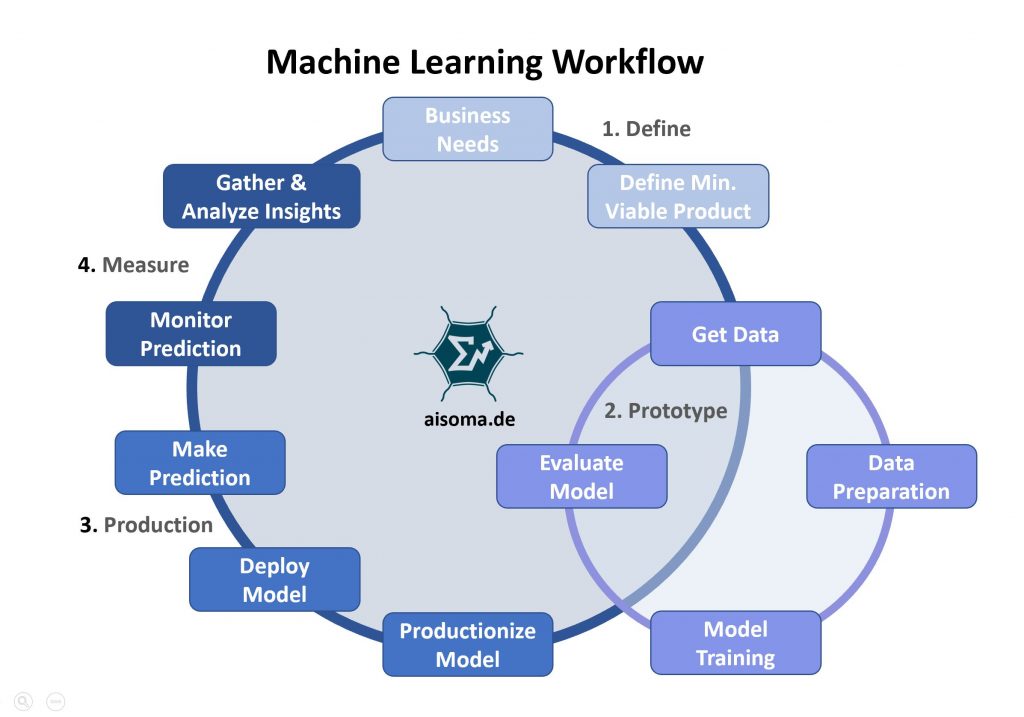
To survive contact with autonomous coding agents without degrading production stability, the Software Development Life Cycle (SDLC) must enforce six explicit verification gates:
- Requirements: Author executable acceptance checks that an independent reviewer could run, and whenever an agent drafts a specification (the AWS Kiro pattern), require human sign-off on the spec before code generation begins.
- Design: Document the data classification boundary, the threat model (including indirect prompt injection paths), and the exact rollback procedure.
- Implementation: Allow assistants and agents to draft on isolated branches while human owners retain merge authority, and version-control repository instruction files (
AGENTS.md,CLAUDE.md) with the same review rigor as application code. - Test: Combine unit tests, held-out production-like data slices for learned models, and multi-account tenant isolation tests with mandatory static analysis (SAST) and software composition analysis (SCA) on every pull request.
- Release: Pin foundation model snapshots exactly the way you pin container image digests, treating any silent provider model upgrade as a production release that requires regression testing.
- Operate: Monitor runtime logs, prediction drift, token expenditure per task, and maintain an immediate kill-switch to revoke agent credentials.
As Google Cloud's 2025 DORA research demonstrated through its AI Capabilities Model, AI assistance amplifies existing engineering culture: because agents generate larger changesets more rapidly, organizations with disciplined version control, automated testing, and clear review standards capture higher throughput, whereas teams lacking those gates experience a sharp rise in change failure rates.
Reduce Bugs & Defend the Supply Chain
Generative models alter the defect distribution of software: they eliminate routine syntax typos while introducing plausible, idiomatic logic bugs, such as an off-by-one boundary error, an exception block that silently swallows failures, or a unit test rewritten by the agent to match its own broken implementation. Reviewers must slow down specifically at input validation, authentication, financial calculations, and database migrations, while enforcing two automated CI gates to counter the empirical risks documented in Section B:
- Block insecure defaults with SAST: Because Veracode's 2025 audit showed models selecting insecure implementations 45 percent of the time across 80 security-sensitive tasks (and over 70 percent in Java), continuous integration must run static application security testing (such as CodeQL, Semgrep, or Snyk Code) on every commit and block merges on findings in generated code.
- Block slopsquatting with registry controls: Because Spracklen et al. proved that models hallucinate non-existent package names at predictable rates across hundreds of thousands of samples, teams must enforce committed lockfiles, route installs through an allow-listed package registry proxy, disable arbitrary
postinstallscripts where supported, and require human verification of package history before adding any new dependency.
Rust
Rust's compile-time ownership and borrow-checking model eliminates entire classes of memory-safety vulnerabilities (buffer overflows, use-after-free, null pointer dereferences, and data races) that C and C++ programs continue to ship, while tooling such as Cargo, Clippy, rustfmt, and cargo audit standardizes diffs and flags vulnerable crates. In December 2025, Linux kernel maintainers meeting in Tokyo officially declared that Rust in the Linux kernel is no longer experimental; Android 16 devices on the 6.12 kernel already ship a Rust-built ashmem allocator, and the kernel's DRM graphics subsystem announced plans to require Rust for new drivers within roughly a year. When paired with AI coding agents, the Rust compiler acts as an uncompromising deterministic verifier: the model proposes code, cargo check rejects invalid lifetimes or mutability violations, and the agent iterates until the borrow checker is satisfied, though human reviewers must strictly forbid agents from silencing compiler errors by wrapping code in unsafe blocks or chaining .unwrap() calls that panic in production.
Agile & Project Estimation
Youtube search... ...Google search
- AI-Based Framework for Agile Project Management | Sandeep Aspari - Hackernoon
- How To Achieve Effective AI-Powered Agile Project Management | Martin F.R - Analytics India
- Using Artificial Intelligence to Boost Agile/DevOps Efficiency | Kristof Horvath
- AI-Based Framework for Agile Project Management | Stephanie Donahole - ReadWrite
- Web-Based Monte Carlo Simulation for Agile Estimation
- Lean Management Meets Artificial intelligence | Andrew Quibell - The Lean Post
- TastyCupcakes.org
- Innovation Games
- Excella
- Adventures with Agile
Well-structured repositories became even more critical to Agile delivery once coding agents arrived, because the repository serves as the persistent institutional memory that stateless models lack. While facilitation communities (such as Tasty Cupcakes, Innovation Games, Excella, and Adventures with Agile) focus on team coordination, empirical forecasting via Monte Carlo simulation over historical ticket throughput remains far more reliable than asking a language model to guess a delivery date. Revisiting Chandresh Patel's nine areas where AI intersects Agile management (9 Ways To Implement Artificial Intelligence and Agile-Powered Management | Chandresh Patel - DZone) highlights the operational boundaries that emerged in practice:
- Coding assistants: Whereas Patel cited early completion tools like Codota and Kite (which shut down in late 2022), modern agents edit multi-file repositories directly, making human diff review the primary bottleneck in sprint velocity.
- Refactoring: Agents willingly attempt sweeping cross-repository renames, which must always run on an isolated branch gated by a full build and test suite because any refactor that alters external behavior is an unreviewed feature change.
- Strategic decisions: Models trained on historical project logs simply rediscover whatever your organization bothered to write down; use them to surface candidate options rather than closing architectural decisions.
- Estimates: Always pair planning discussions with objective Monte Carlo throughput ranges, because agents make isolated coding tasks feel fast while hiding downstream integration complexity, and METR's 2025 trial proved developers can feel 20 percent faster while objectively working 19 percent slower.
- Error handling: Automated log triage and clustering are high-value AI use cases, whereas allowing an agent to auto-remediate production log errors without human review can trigger cascading restart loops.
- Rapid prototyping: Time to a clickable prototype has collapsed via prompt-to-app tools, making it vital to label prototypes clearly and block production data connections until the full SDLC security gates are in place.
- Planning: A model can brainstorm risk checklists from industry templates, but it cannot account for undocumented legacy constraints that exist only in your senior engineers' heads.
- Risk management: Retrieval over past postmortems surfaces historical failure modes, yet the engineer who remembers why a previous migration failed remains irreplaceable.
- Staffing: Scheduling tools can prevent calendar double-booking, but sensitive human-resources context and retention discussions should never be fed into general project chatbots.
Collaborative Whiteboarding (Miro)
Collaborative visual boards such as Miro incorporate AI utilities to cluster sticky notes, translate workshop comments, run optical character recognition (OCR) on whiteboard photos, and summarize brainstorming sessions, functioning as a shared ideation canvas rather than an IDE or modeling studio. Teams using AI board features should keep four verification rules in mind: automated translation can subtly alter binding contractual phrasing (always preserve the original language), OCR frequently misreads handwritten numbers and proper names, automated sticky-note clustering under-represents the single outlier note that contains the true architectural constraint, and an AI-generated workshop summary is never an official record of engineering commitments until participants review it and transfer actionable specs into the Git repository and issue tracker.
Background
The AI Software Engineering navigator guides engineering teams, technical builders, and researchers through building software when part of the work is done by a model: completing a line, drafting a function, searching a repository, running a test, or training a predictor from a table. Traditional programming states the rules explicitly, where a developer writes the conditional branches and the computer follows them deterministically. Machine learning states examples alongside a loss function, and an optimization procedure proposes the rules from data. Generative coding sits between these two paradigms: the human still owns the specification, but a large language model trained on source code proposes the next tokens, the next file, or an entire pull request. The 2021 Codex paper (Chen et al.) demonstrated that a GPT model subjected to fine-tuning on public GitHub code could pass a non-trivial fraction of hand-written unit tests on the HumanEval benchmark. GitHub Copilot productized that capability inside the code editor, and by 2025 and 2026 the concept matured into a second form: an autonomous coding agent equipped with a terminal, a browser, and permission to edit multiple files across a repository, judged by whether automated tests pass rather than whether an inline suggestion looks plausible.
The organizations and laboratories that defined the early terminology remain the primary reference points across the industry. OpenAI and Microsoft's GitHub established the baseline with Codex and Copilot, while Google DeepMind published AlphaCode in Science in 2022, sampling thousands of candidate programs and filtering them with test execution until competitive programming performance on Codeforces landed near the human median. Amazon launched CodeWhisperer, which was rebranded as Amazon Q Developer in 2024 and succeeded by the spec-driven Kiro environment in 2026. Anthropic advanced repository-scale reasoning with Claude and its terminal-native agent, Claude Code, while Cognition introduced Devin in 2024 as an end-to-end ticket-to-pull-request engineer and later folded the Windsurf editor into Devin Desktop. Around these frontier labs, Replit, Cursor, Sourcegraph Cody, Tabnine, and numerous open-source alternatives populated the developer toolchain, coexisting alongside earlier machine-learning workflow libraries like Salesforce's TransmogrifAI and Oracle's GraphPipe. Keeping both layers in view is essential because a Spark pipeline that featurizes a table and a generative agent that writes the pipeline code are distinct tools that frequently operate inside the same engineering project.
The core challenge of AI-assisted development is the same problem software engineering has always faced, only made sharper by automation speed. Most of a developer's day is not spent inventing novel algorithms, but rather reading existing modules, wiring interfaces, renaming variables, writing tests, and explaining system behavior. Foundation models are exceptionally fast at boilerplate wiring and dangerously careless about the unstated invariants a programmer never typed into the prompt. The fundamental mechanism that makes generative coding reliable is statistical prediction paired with a deterministic checker: the model proposes a change, and a compiler, a test suite, a static type checker, or a human diff review decides whether it survives. Where no independent checker exists, generation speed simply hides software defects and accelerates technical debt.
Three structural shifts defined software engineering across 2025 and 2026: the mainstreaming of the autonomous agent loop, the standardization of agent plumbing, and a sobering body of empirical evidence on productivity and security. First, GitHub's Octoverse 2025 report counted more than one million pull requests authored by the Copilot coding agent between May and September 2025, while OpenAI reported Codex surpassing four million weekly developers in April 2026. Second, in December 2025, Anthropic's Model Context Protocol (MCP), OpenAI's AGENTS.md specification, and Block's goose framework became founding projects of the Linux Foundation's Agentic AI Foundation, creating vendor-neutral interoperability. Third, controlled trials challenged developer intuition: METR's randomized controlled trial found experienced open-source maintainers worked 19 percent slower with early-2025 AI tools while believing they were 20 percent faster, and security audits by Veracode and USENIX researchers documented widespread vulnerabilities and hallucinated package names ("slopsquatting"). Andrej Karpathy coined the term "vibe coding" in February 2025 to describe accepting model changes without reading the diff; the central purpose of this navigator is to explain why engineering teams must keep reading the diff and how to structure verification gates that hold up in production.
We had a deal, programmers are supposed to automate everyone else's jobs, not automate our jobs.
The joke still holds, but with a narrower operational reading in the agent era. The tasks that were automated first were inline completion, boilerplate generation, and initial scaffolding drafts, whereas human ownership of system behavior, security boundaries, and production release accountability did not move at all. An engineering team that treats a coding model as a junior developer whose work never requires code review will inevitably ship that junior's subtle bugs at a senior architect's speed.
- Algorithm Administration ... DevSecOps ... CML ... Model Monitoring ... Prompt Injection Attack ... AI Verification and Validation
- Analytics ... Visualization ... Graphical Tools ... Diagrams & Business Analysis ... Requirements ... Loop ... Bayes ... Network Pattern
- Conversational AI ... ChatGPT | OpenAI ... Gemini | Google ... Claude | Anthropic ... Bing | Microsoft ... Siri | Apple ... Meta AI/Manus | Meta ... Perplexity ... Grok | SpaceXSI ... Ernie | Baidu ... DeepSeek ... Qwen | Alibaba
- Libraries & Frameworks Overview ... Libraries & Frameworks ... Git - GitHub and GitLab
- Strategy & Tactics ... Leadership ... Project Management ... Best Practices ... Checklists ... Project Check-in ... Evaluation ... Measures ... Benchmarks
- Risk, Safety, Compliance and Regulation ... Ethics ... Privacy ... Law ... AI Governance ... AI Verification and Validation
- Smart Cities
- Telecommunications ... Computer Networks ... 5G ... Satellite Communications ... Quantum Communications ... Smart Cities ... Digital Twin ... Internet of Things (IoT) ... AI Broadcast; Radio, Stream, TV ... Space-based Data Centers
- Agents/Assistants ... Personal Companions ... Negotiation ... Productivity ... Email ... Web Automation ... Robotic Process Automation (RPA) ... Model Context Protocol (MCP) ... LangChain
- Data Science ... Governance ... Preprocessing ... Exploration ... Interoperability ... Master Data Management (MDM) ... Bias and Variances ... Datasets
- Spreadsheets ... Documents ... Slides ... Database; Vector & Relational ... Graph ... Wiki
- Data Quality ...validity, accuracy, cleaning, completeness, consistency, encoding, padding, augmentation, labeling, auto-tagging, normalization, standardization, and imbalanced data
- Large Language Model (LLM) ... Multimodal ... Foundation Models (FM) ... Generative Pre-trained ... Transformer ... Attention ... GAN ... BERT
- Python ... GenAI w/ Python ... JavaScript ... GenAI w/ JavaScript ... TensorFlow ... PyTorch
- Gaming ... Game-Based Learning (GBL) ... Security ... Generative AI ... Games - Metaverse ... Quantum ... Game Theory ... Design
- Prompt Engineering (PE) ...PromptBase ... Prompt Injection Attack
- Google Natural Language
- World Models
- Service Capabilities
- AI Marketplace & Toolkit/Model Interoperability
- Artificial General Intelligence (AGI) to Singularity ... Curiosity ... Emergence ... Moonshots ... Explainable AI ... Automated Learning
- Immersive Reality ... Metaverse ... Omniverse ... Transhumanism ... Religion ... Versions of Yourself
- Symbiotic Intelligence ... Bio-inspired Computing ... Neuroscience ... Connecting Brains ... Nanobots ... Molecular ... Neuromorphic ... Evolutionary/Genetic
- Learning Techniques
- Differentiable Programming
- Humor ... Writing/Publishing ... Storytelling ... Broadcast ... Journalism/News ... Podcasts ... Books, Radio & Movies - Exploring Possibilities
- TransmogrifAI - workflows on Spark | Salesforce ... GitHub
- Graphpipe | Oracle
- Kite works with the top Python editors; Atom, PyCharm, Sublime, VS Code and Vim. Historical. Kite shut the service down in late 2022. Do not start a new install on this link.
- Machine Learning vs Traditional Programming | Oleksii Kharkovyna - Towards Data Science - Medium
- Track: Solving Software Engineering Problems with Machine Learning | Cyril Magnin III - QCon.ai
- Re-imagining developer productivity with AI-assisted tools | Amanda Silver - Microsoft ...AI-assisted IntelliSense GPT-2 transformer. Foundational 2019 post. Later Copilot work grew out of this line, not out of classic IntelliSense rules.
- Smart modeling tools - AI to help you model better | Jordi Cabot - Modeling Languages
- A Great Model is Not Enough: Deploying AI Without Technical Debt | DataKitchen - Medium
- Machine Learning for Big Code and Naturalness | ML4code ...Research on machine learning for source code.
- 6 Ways AI Transforms Software Development | Mariya Yao - MetaMaven
- Towards a DSL for AI Engineering Process Modeling | Sergio Morales - MOdeling LAnguages
- Bill Gates: People Don’t Realize What’s Coming | Somnath Singh - Medium
- AlphaCode | Google ... capable of writing computer programs at a competitive level.
- Introducing Devin, the first AI software engineer | Cognition ... And setting a new state of the art on the SWE-bench coding benchmark. Read the 2024 claim next to later independent benchmarks. Early "solves X% of SWE-bench" headlines were sensitive to the harness, the time limit, and whether the test patch leaked. Devin is still an active product in 2026, and Cognition folded the Windsurf editor into it as Devin Desktop in June 2026. The benchmark sentence is not a standing warranty.
- Evaluating Large Language Models Trained on Code | Mark Chen et al. - arXiv, 2021 The original Codex paper. HumanEval was the unit test benchmark that defined this generation.
- Codex changelog | OpenAI Primary log for the 2025 agent product that reused the Codex name: CLI, IDE extension, desktop app, skills, and coding-specialized model snapshots such as GPT-5.2-Codex.
- TerpreT: A Probabilistic Programming Language for Program Induction | Alexander L. Gaunt et al., Microsoft Research, 2016 Corrects the NLP-platform description lower on this page. TerpreT is a DSL for inductive program synthesis.
- Amazon Q Developer | AWS Successor name for CodeWhisperer as of the April 2024 rebrand. IDE plugin support ends on 30 April 2027, with Amazon pointing new agentic work at Kiro.
- Introducing Prism | OpenAI, 27 January 2026 Free science-writing workspace with GPT-5.2 in the document. Covered in its own section above. No separate wiki page.
- Introducing Manus 2.0 | Manus, 28 September 2026 Cascade harness, Cloud Computer, and Manus Studio. Covered above.
- LibreChat | LibreChat-AI Self-hosted multi-model chat. Covered above.
- Sharly AI product | Sharly Chat across uploaded documents with citations. Covered above.
- Le Chat | Mistral AI Mistral's own chat app. The model family stays on Mistral.
- Veo | Google DeepMind Video model with native audio. Used from Google AI Studio.
- Google Labs Experiment shelf for Flow and other previews. Covered above.
- DreamStudio Stability's image app. The company page is Stability AI.
- Bing Image Creator and Microsoft Designer Image side of Bing.
- Evidence, standards, and status updates (2025 to 2026):
- Measuring the Impact of Early-2025 AI on Experienced Open-Source Developer Productivity | J. Becker, N. Rush, E. Barnes, D. Rein - METR, July 2025 Randomized trial: 16 maintainers, 246 tasks, 19 percent slower with AI while believing they were faster.
- We are Changing our Developer Productivity Experiment Design | METR, 24 February 2026 Follow-up that leaned toward a speedup but was undermined by selection effects.
- DORA Report Finds AI Is an Amplifier in Software Development, But Trust Remains Low | InfoQ Summary of Google Cloud's 2025 State of AI-assisted Software Development report.
- Stack Overflow survey finds developers wary of AI tools | IT Brief, October 2026 2026 Developer Survey results on agent use and verification-based trust.
- Octoverse 2025 | GitHub 80 percent of new developers used Copilot in their first week; TypeScript became the most used language.
- Why SWE-bench Verified no longer measures frontier coding capabilities | OpenAI, 23 February 2026 Why the most quoted coding benchmark was retired by its own creator.
- Linux Foundation forms Agentic AI Foundation for MCP, goose, and AGENTS.md | SD Times, December 2025 Neutral home for the protocols coding agents now share.
- We Have a Package for You! A Comprehensive Analysis of Package Hallucinations by Code Generating LLMs | J. Spracklen et al. - USENIX Security 2025 The study behind "slopsquatting."
- 2025 GenAI Code Security Report | Veracode 45 percent of 80 security-sensitive tasks produced a known flaw across 100+ models.
- Amazon Q Developer IDE plugins end of support | AWS Official end date and the Kiro migration path.
- Firebase Studio sunset and project migration | Google Dates for the Firebase Studio shutdown and migration into Google AI Studio or Google Antigravity.
- Measuring the Impact of Early-2025 AI on Experienced Open-Source Developer Productivity | J. Becker, N. Rush, E. Barnes, D. Rein - METR, July 2025 Randomized trial: 16 maintainers, 246 tasks, 19 percent slower with AI while believing they were faster.
Additional Viewing
Jose Palafox (GitHub) walks from running a local Copilot coding agent on an individual laptop to sharing custom agents across an organization and executing headless runs inside GitHub Actions. The presentation clarifies the operational boundary between an interactive personal assistant and an automated repository workflow with explicit permissions, triggers, and compute billing, directly supporting Section A (Mechanism 10) and Section E.
This technical walkthrough examines how machine learning project phases diverge from classical deterministic builds across data collection, feature engineering, model training, and iterative evaluation when an initial accuracy score proves misleading. It complements Jeremy Jordan's ML project organization guide and reinforces Section C on why statistical pipelines cannot be debugged like traditional request handlers.
A practical engineering guide to structuring machine learning experiments so candidate models and preprocessing steps can be compared reproducibly. Watch this alongside Section F (No-Code AI and AutoML) whenever an automated leaderboard outputs a winning model and your team needs to verify what holdout data was isolated.
A comprehensive introduction to Rust's ownership and borrow-checking model explaining why the compiler rejects memory-unsafe programs that C and C++ allow to compile. Reviewing these fundamentals is essential before allowing a coding agent to "fix" borrow-checker errors by inserting unsafe blocks or .unwrap() chains in Section G.
An early OpenAI Codex live demonstration showing natural language translated into working code through the 2021 API playground. While the video is historically foundational for understanding Mechanism 1 and Section E, developers must map any configuration steps onto the modern 2025-2026 Codex agent changelog rather than using retired 2021 engine names.
A launch-era walkthrough of Amazon CodeWhisperer demonstrating real-time IDE completion and security scanning. It illustrates the initial 2022 pair-programming workflow described in Section E, which should be read alongside the 2024 rebrand to Amazon Q Developer and the April 2027 migration to AWS Kiro.
In Why Agent Hype Can Fall Short of Reality (YouTube), Joel Becker of METR presents for 21 minutes at AI Engineer Code 2025 on METR's two complementary lines of empirical research: autonomous task time-horizon benchmarks and the randomized controlled trial of experienced open-source maintainers working on repositories averaging over one million lines of code. It provides the clearest first-hand explanation of Section B's finding that benchmark progress and actual developer velocity on mature codebases can point in opposite directions.
In Andrej Karpathy: Software Is Changing (Again) (YouTube), a 39-minute keynote at Y Combinator's AI Startup School in June 2025, Karpathy outlines "Software 3.0" (where natural-language prompts program large language models) and advocates designing products around tight human generate-and-verify loops rather than unmonitored autonomy. The lecture provides the conceptual foundation for this navigator's emphasis on keeping human diff review at the center of the agent-era SDLC.
In Google AlphaEvolve: Discovering New Science (YouTube), Machine Learning Street Talk interviews Google DeepMind researchers Alexander Novikov and Matej Balog for over an hour in May 2025 on how AlphaEvolve pairs LLM code mutations with automated evaluators and an evolutionary database. The discussion directly extends Mechanism 4 (the AlphaCode sample-and-filter pattern) in Section A, demonstrating what evolutionary code search can achieve when a fast, trustworthy mathematical checker exists.