Digital Twin
Youtube search... ...Google search
- Telecommunications ... Computer Networks ... 5G ... Satellite Communications ... Quantum Communications ... Smart Cities ... Digital Twin ... Internet of Things (IoT) ... Space-based Data Centers
- Immersive Reality ... Metaverse ... Omniverse ... Transhumanism ... Religion ... Versions of Yourself
- Predictive Analytics ... Predictive Maintenance ... Forecasting ... Market Trading ... Sports Prediction ... Marketing ... Politics ... Excel
- Agents/Assistants ... Personal Companions ... Team AI ... Customer-Facing AI ... Negotiation ... Productivity ... Email ... Web Automation ... Computer Use ... Model Context Protocol (MCP) ... Robotic Process Automation (RPA) ... LangChain
- Robotics ... Vehicles ... Drones ... 3D Model ... Point Cloud
- Artificial General Intelligence (AGI) to Singularity ... Curiosity ... Emergence ... Moonshots ... Explainable AI ... Automated Learning
- Future You ... Revisiting Your Younger Self ... AI & False Memories
- Azure Digital Twins | Microsoft
- Digital Twin: Bridging the physical-digital divide | IBM
- Prepare for the Impact of Digital Twins | Gartner
- The rise of the Digital Twin: Why the enterprise needs to take notice | Charlie Osborne - ZDNet
- Other Challenges in Artificial Intelligence
- Feature Exploration/Learning
- Embodied AI
- Architectures for AI ... New Architecture Options ... Generative AI Stack ... Enterprise Architecture (EA) ... Enterprise Portfolio Management (EPM) ... Architecture and Interior Design
- Sight Machine
- US Navy Successfully Tests New AEGIS Virtual Twin System | Naval News Staff
- AI-enabled digital twins are transforming government critical infrastructure | Burnie Legette - Federal News Network
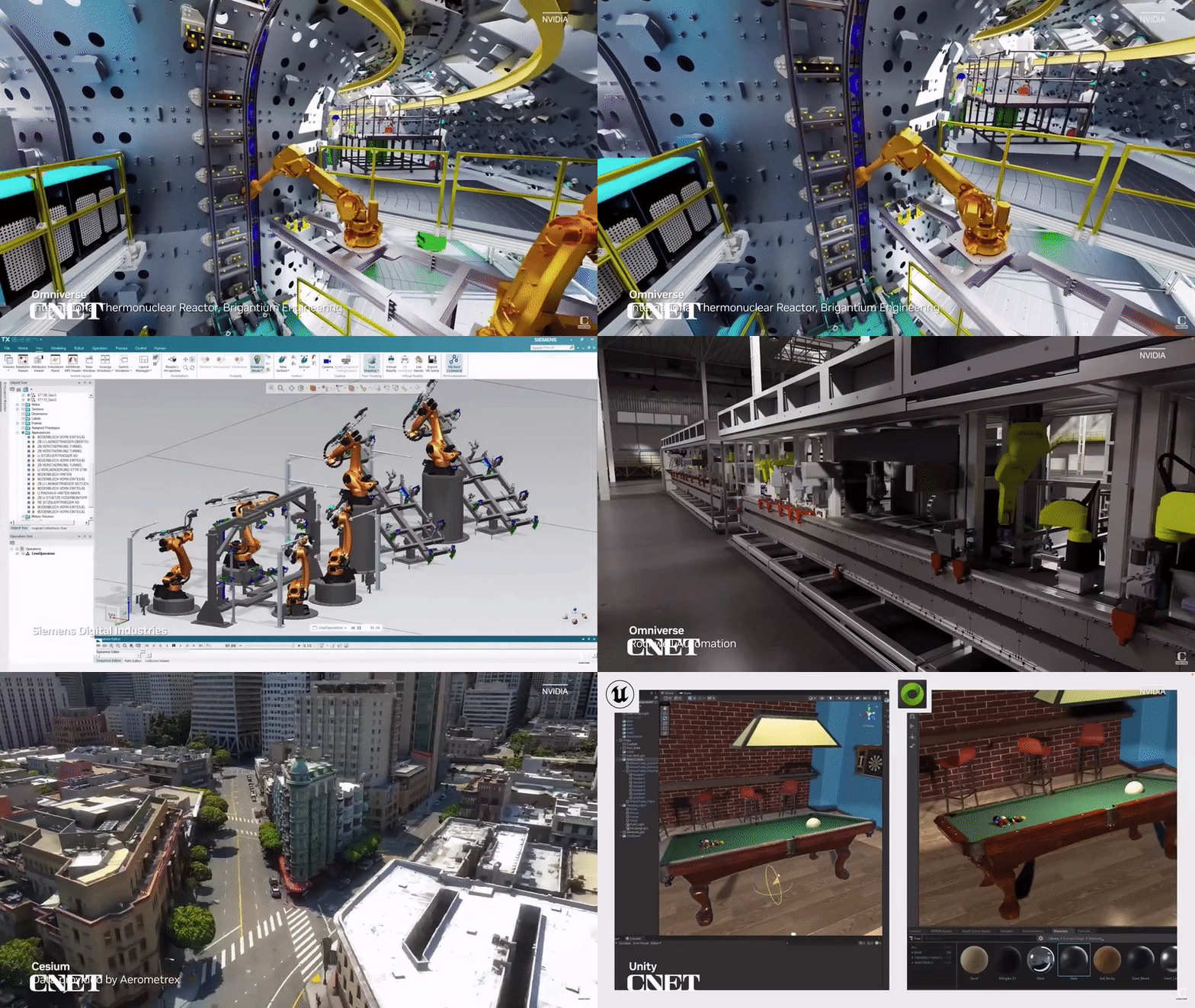
Digital Twin technology is the concept surrounding the creation of a digital "twin" or replica of a physical asset. Digital twins are interactive, artificial intelligence (AI)-based virtual models that serve as digital replicas of real-life objects and/or environments. The benefits of a Digital Twin is to provide an abstraction layer that allows for applications to interact with a device or devices in a consistent manner. The vision of a digital twin is that it follows the lifecycle of a device and the data associated with the device. Digital Twins will enable features like device simulation during development, integration of analytics and Machine Learning (ML) during deployment, and so on. The Reality of Digital Twins for IoT | Ian Skerrett - Medium
The Digital Twin can allow companies to have a complete digital footprint of their products from design and development through the end of the product life cycle. This, in turn, may enable them to understand not only the product as designed but also the system that built the product and how the product is used in the field. With the creation of the digital twin, companies may realize significant value in the areas of speed to market with a new product, improved operations, reduced defects, and emerging new business models to drive revenue. The Digital Twin may enable companies to solve physical issues faster by detecting them sooner, predict outcomes to a much higher degree of accuracy, design and build better products, and, ultimately, better serve their customers. With this type of smart architecture design, companies may realize value and benefits interactively and faster than ever before. Industry 4.0 and the digital twin | Deloitte Insights
Digital twins offer a range of benefits across various industries, revolutionizing operations and driving efficiency. Here are some key advantages of using digital twins in industry:
- Enhanced Monitoring: Digital twins provide real-time insights into the behavior of physical products or processes, enabling companies to track performance trends, health, and potential failures proactively.
- Cost Reduction: Organizations can reduce costs and minimize potential failure rates through the use of digital twins, leading to more efficient resource utilization and maintenance practices.
- Improved Decision Making: By offering a comprehensive view of asset performance, digital twins empower organizations to make more informed decisions, ultimately leading to improved outcomes.
- Streamlined Design Process: Digital twins facilitate faster product innovation by allowing companies to simulate and test new products before investing in physical prototypes, thus accelerating the design process.
- Predictive Maintenance: With IoT sensors generating real-time data, businesses can proactively analyze information to identify and address system issues before they lead to breakdowns, enhancing production line efficiency and reducing maintenance costs
- Real-time Remote Monitoring: Digital twins enable remote access to monitor and control system performance from anywhere, providing a detailed view of large physical systems that would otherwise be challenging to obtain in real-time.
- Improved Team Collaboration: Automation processes and continuous access to system information enhance team collaboration among technicians, boosting productivity and operational efficiency.
- Data-backed Decision Making: By integrating financial data into virtual representations, businesses can make better financial decisions faster, leveraging real-time data and advanced analytics for improved outcomes.
|
|
|
|
|
|
|
|
|
|
|
|
|
|
|
|
|
Digital Twin of Life: Virtual Cells
- CZI Launches rBio: Reasoning Model Trained on Virtual Cell Simulations | Chan Zuckerberg Initiative, August 21, 2025 Announcement of the rBio reasoning model and how it learns from virtual cell models.
- AI Virtual Cells and Multi-Scale Digital Twins ... Life Sciences ... Science Fiction Turning Real
Digital twins aren't limited to machines and infrastructure. The Chan Zuckerberg Initiative (CZI) is developing virtual cell models: AI systems that simulate how living cells behave and predict how real cells will respond to changes such as a drug, a mutation, or a disease. Its rBio reasoning model, launched in August 2025, lets scientists ask complex biology questions in plain language. Instead of learning only from costly lab experiments, rBio was trained with reinforcement learning whose rewards came from virtual cell simulations, mainly CZI's TranscriptFormer model. Biohub, the research organization backed by Priscilla Chan and Mark Zuckerberg, is building an open platform of these models to predict cell behavior across tissues, people, and conditions.
The long-term goal is to run experiments, and eventually test potential treatments, on a virtual cell before moving to the lab or to human trials. Today's models aren't there yet. Their predictions still have to be confirmed in the laboratory, and a model of a single cell is a long way from a model of a whole patient.
Nuclear Plasma Control
The accident at Three Mile Island (TMI), which occurred on March 28, 1979, was a partial meltdown of the nuclear reactor core that resulted from a series of equipment failures and human errors. During the accident, the control room operators received a series of confusing and conflicting signals from the reactor's instruments, which made it difficult for them to understand what was happening and respond effectively. The control room board did not suddenly light up in seconds, but rather displayed a complex and evolving pattern of alarms and indications over a period of several hours. The initial alarm that alerted operators to the problem was a high-pressure indication in the reactor coolant system. Over the next several hours, operators received a series of alarms related to coolant flow, water levels, and reactor temperature, among other factors. The complexity and ambiguity of these signals contributed to delays and errors in the operators' response, ultimately leading to the partial meltdown of the reactor core. The accident at Three Mile Island highlighted the need for improved training, communication, and safety protocols in the nuclear power industry. It also led to significant changes in the regulation and oversight of nuclear power plants, as well as increased public scrutiny and concern about the safety of nuclear energy.
Researchers have successfully demonstrated the world's first predictive control of a fusion plasma using a digital twin approach. The key points are:
- Researchers from Kyoto University, the National Institute for Fusion Science, and the Institute of Statistical Mathematics in Japan conducted an experiment to control the electron temperature of a fusion plasma using electron cyclotron resonance heating (ECH), while optimizing the predictive model based on real-time observations of the electron density and temperature profiles.
- This "data assimilation-based control" approach allowed them to bring the electron temperature close to the target while improving the prediction accuracy of the model. This was the first successful demonstration of predictive control of a fusion plasma using a digital twin.
- The digital twin is a virtual replica of the actual fusion plasma that receives real-time data from the experiment. It uses machine learning to anticipate the performance of the physical plasma, allowing researchers to test control strategies without making irreversible changes to the real system.
- This control approach is expected to be fundamental for the advanced control systems needed to realize fusion power generation, such as plasma profile control and avoidance of instabilities. It could also be applied to other complex systems with many uncertain factors, like traffic and water management.
- The research team believes this is an important step towards the advanced control capabilities required for practical fusion power plants.
In summary, the search results describe the first successful demonstration of predictive control of a fusion plasma using a digital twin approach, which is a significant milestone towards the realization of practical fusion energy
Three Mile Island Panel June 2022
Idaho National Laboratory panel on Three Mile Island.
First Nuclear Plasma Control with Digital Twin
Sabine Hossenfelder on the first control of nuclear fusion plasma using a digital twin.
Computerized Maintenance Management (CMM)
AI & IoT Predictive Maintenance | Symphony | #CoCoonpitch
#CoCoonPitch enables entrepreneurs to present their products or services to potential investors, co-founders, teammates, customers or corporate partners. Symphony - Alain Garner
86% of maintenance is scheduled either too late or unnecessarily and we want to change that. Using our Symphony sensors we can predict the unpredictable & tell when machines will fail using our industry 4.0 wireless sensors that generate plug & play, predictive maintenance. If you want to pitch, send your deck to pitch@hkcocoon.org
Customer Journey
Gartner defines digital twin of a customer (DToC) as a dynamic virtual mirror representation of a customer that simulates and learns to emulate and anticipate behavior. ... DToC represents a nascent technology that can revolutionize demand forecasting accuracy, vastly improve customer experience and serve as a critical input to enhance the use of AI and machine learning (ML) tools. While 52% of survey respondents viewed AI as an “important and disruptive” technology and 40% gave the same description for digital supply chain twins, only 27% specifically described DToC as an “important and disruptive” technology. Gartner: Full value of supply chain ‘digital twins’ goes unrecognized | Dan Berthiaume - Chain Store Age ... 60% are piloting or plan to implement a digital supply chain twin (DSCT), just 27% were also planning to incorporate a digital twin of a customer (DToC) as part of their digital strategy.
"Digital AI Twin" for best Customer Journey simulation | BUSINESS AI 2022 #businessintelligence
Discover AI on using a digital AI twin to simulate customer journeys.
Digital Twin of Customer - Webinar
Webinar on creating a digital twin of the customer.
Reinventing Retail: Lowe's Builds Digital Twins of Stores to Deliver Enhanced Shopping Experiences
NVIDIA on how Lowe's builds digital twins of its stores.
Microduck
At the GTC Berlin 2026 keynote, NVIDIA CEO Jensen Huang introduced the Microduck, a small, duck-shaped, autonomous robot that serves as a practical showcase for the company's latest advancements in physical AI.
Overview
Developed through a collaboration between Hugging Face and the French startup Pollen Robotics, the Microduck is an open-source, programmable robot standing approximately 25 centimeters (10 inches) tall. First released in August 2026 for $399, the platform aims to democratize robotics research, allowing students and developers to experiment with Reinforcement Learning (RL) and behavioral customization. During the live demonstration, the robots performed various tasks such as walking and sitting. A humorous moment occurred when three robots followed a command to "take a nap," while a fourth paused, providing a candid demonstration of the current realities of autonomous robotic behavior.
Technical Architecture
The spectacle on stage was supported by a sophisticated end-to-end training pipeline built on the NVIDIA Isaac ecosystem:
- Simulation & Training: The robots utilize NVIDIA Isaac Lab, Isaac Sim, and the Newton physics engine to undergo rigorous training in a virtual environment.
- Agent Orchestration: AI agents were employed to manage the training workflows, while cloud infrastructure provided the necessary computational power for these complex simulations.
- Deployment: An NVIDIA RTX Spark workstation acted as the central hub, responsible for evaluating simulated results and refining learned behaviors before they were deployed to the physical machines.
Significance for Physical AI
This demonstration highlights NVIDIA's strategic push to bridge the gap between digital twins and real-world robotics. By streamlining the transfer of skills learned in simulation to physical hardware, NVIDIA is accelerating the development of the next generation of intelligent machines. The Microduck serves not just as a consumer product, but as a proof-of-concept for the Isaac platform's ability to make complex robotics training faster, more affordable, and highly accessible to the global developer community.
Nvidia Microduck AI Robots are mind blowing - World Premiere and First Look
Nvidia Microduck AI Robots are mind blowing - World Premiere and First Look
First look at NVIDIA's small AI robots.