Bidirectional Encoder Representations from Transformers (BERT)
Youtube search... ...Google search
- Large Language Model (LLM) ... Multimodal ... Native Multimodal Architectures ... Foundation Models (FM) ... Tabular Foundation Models (TabPFN) ... Time-Series Foundation Models (Chronos, TimesFM) ... Generative Pre-trained ... Transformer ... Attention ... GAN ... BERT ... Tokens
- Natural Language Processing (NLP) ... Generation (NLG) ... Classification (NLC) ... Understanding (NLU) ... Translation ... Summarization ... Sentiment ... Tools
- Agents/Assistants ... Personal Companions ... Team AI ... Customer-Facing AI ... Negotiation ... Productivity ... Email ... Web Automation ... Computer Use ... Model Context Protocol (MCP) ... Robotic Process Automation (RPA) ... LangChain
- SMART - Multi-Task Deep Neural Networks (MT-DNN)
- Deep Distributed Q Network Partial Observability
- TaBERT
- Google is improving 10 percent of searches by understanding language context - Say hello to BERT | Dieter Bohn - The Verge ...the old Google search algorithm treated that sentence as a “Bag-of-Words (BoW)”
- Google AI’s ALBERT claims top spot in multiple NLP performance benchmarks | Khari Johnson - VentureBeat
- RoBERTa:
- RoBERTa: A Robustly Optimized BERT Pretraining Approach | Y. Li, M. Ott, N. Goyal, J. Du, M. Joshi, D. Chen, O. Levy, M. Lewis, L. Zettlemoyer, and V. Stoyanov
- RoBERTa: A Robustly Optimized BERT Pretraining Approach | GitHub - iterates on BERT's pretraining procedure, including training the model longer, with bigger batches over more data; removing the next sentence prediction objective; training on longer sequences; and dynamically changing the masking pattern applied to the training data.
- Facebook AI’s RoBERTa improves Google’s BERT pretraining methods | Khari Johnson - VentureBeat
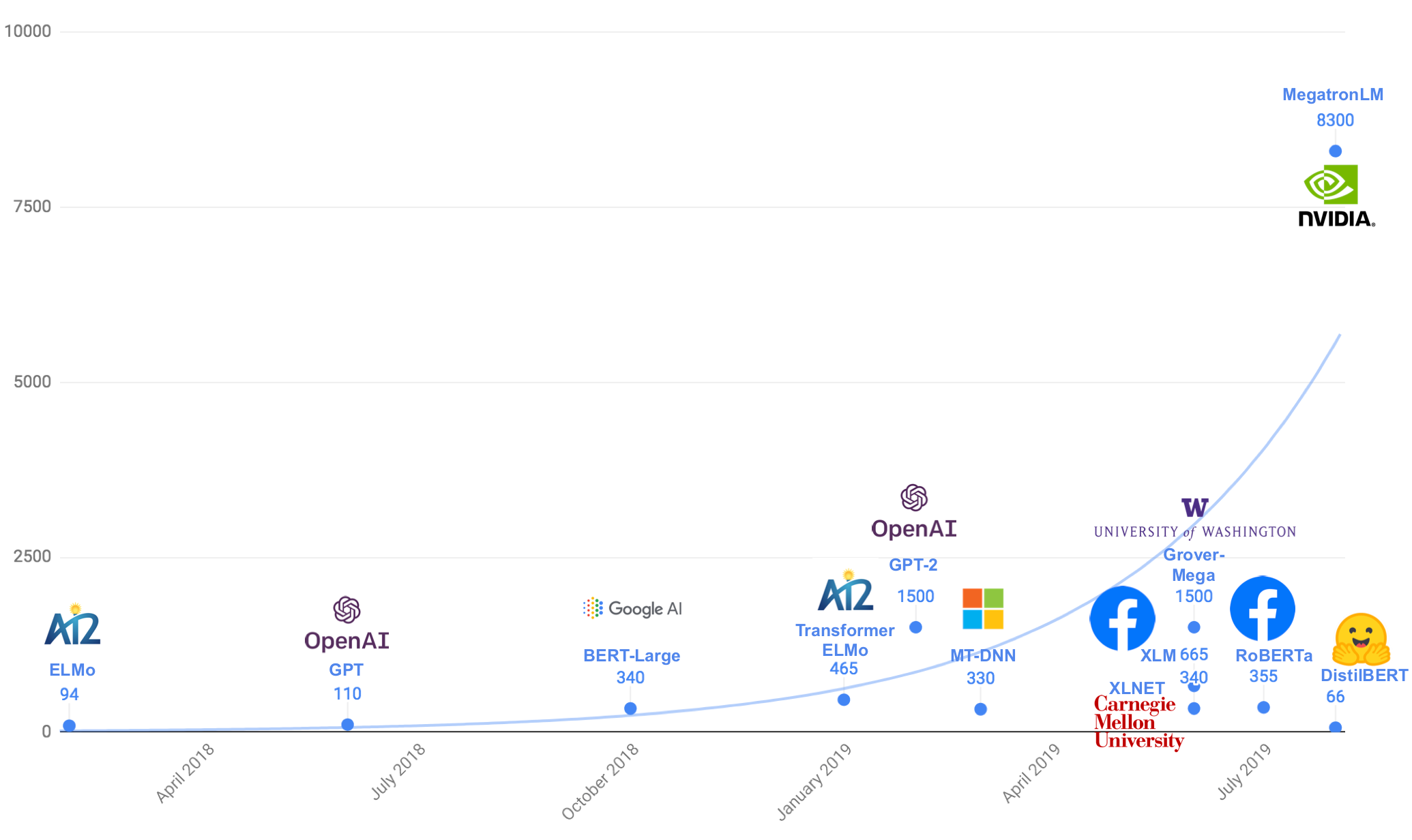
- Google's BERT - built on ideas from ULMFiT, ELMo, and OpenAI
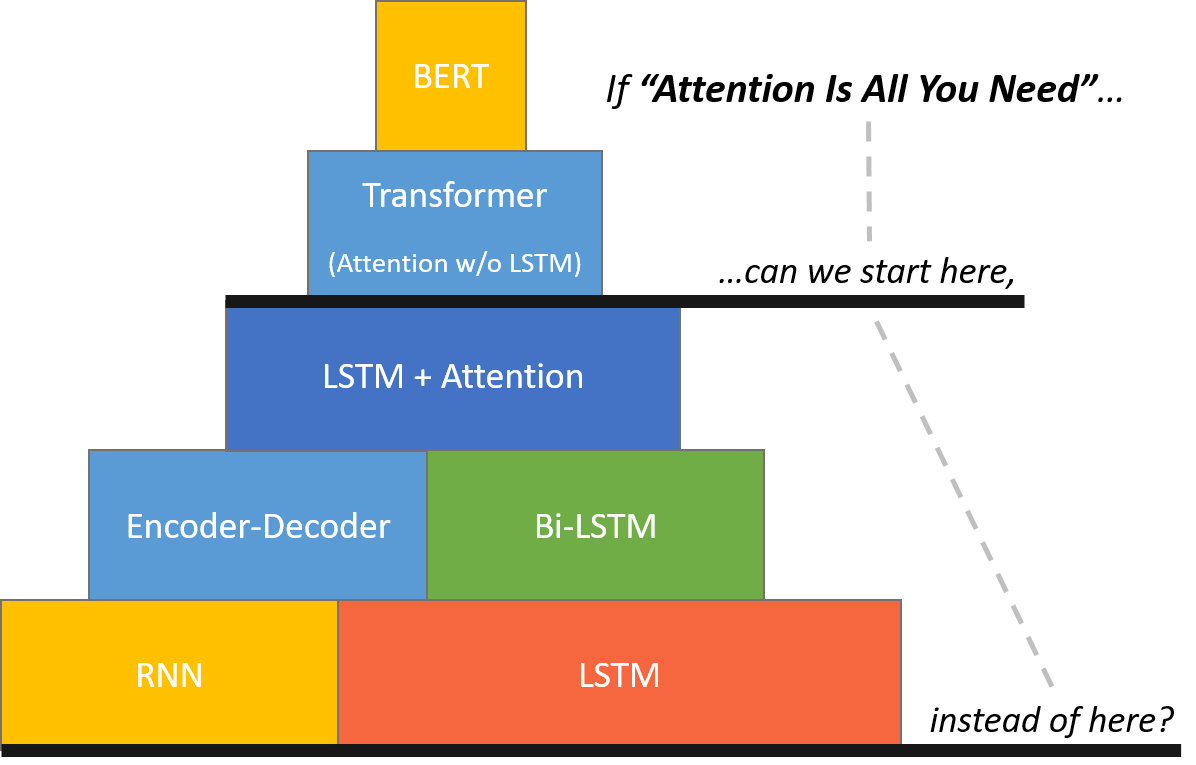
- Attention Mechanism/Transformer Model
- Conversational AI ... ChatGPT | OpenAI ... Gemini | Google ... Claude | Anthropic ... Bing | Microsoft ... Siri | Apple ... Meta AI/Muse | Meta ... Perplexity ... Grok | SpaceXSI ... Manus ... Ernie | Baidu ... DeepSeek ... Qwen | Alibaba ... Mistral
- Transformer-XL
- Microsoft makes Google’s BERT NLP model better | Khari Johnson - VentureBeat
- Watch me Build a Finance Startup | Siraj Raval
- Smaller, faster, cheaper, lighter: Introducing DistilBERT, a distilled version of BERT | Victor Sanh - Medium
- TinyBERT: Distilling BERT for Natural Language Understanding | X. Jiao, Y. Yin, L. Shang, X. Jiang, X. Chen, L. Li, F. Wang, and Q. Liu researchers at Huawei produces a model called TinyBERT that is 7.5 times smaller and nearly 10 times faster than the original. It also reaches nearly the same language understanding performance as the original.
- Understanding BERT: Is it a Game Changer in NLP? | Bharat S Raj - Towards Data Science
- Allen Institute for Artificial Intelligence, or AI2’s Aristo AI system finally passes an eighth-grade science test | Alan Boyle - GeekWire
- 7 Leading Language Models for NLP in 2020 | Mariya Yao - TOPBOTS
- BERT Inner Workings | George Mihaila - TOPBOTS
- Top BERT Applications You Should Know About | Tanya Malhotra - MarkTechPost ... PaLM
- BERT 101 | Hugging Face
How BERT works using a fun MadLibs example. BERT is like a super smart language model that understands words and sentences really well. Imagine you're playing MadLibs, and you have a sentence with a missing word. Let's say the sentence is:
I went to the _______ to buy some delicious ice cream.
You need to fill in the blank with the right word to make the sentence make sense. BERT does something similar, but with much more complex sentences. Here's how it works:
- Tokenization: BERT first breaks down the sentence into smaller pieces, called tokens. In our MadLibs example, each word is a token. So, "I," "went," "to," "the," "_______," "to," "buy," "some," "delicious," "ice," and "cream" are all tokens.
- Word Representation: BERT gives each token a special code to represent it. Just like in MadLibs, you might have a list of possible words that could fit in the blank, and each word has a number next to it. BERT does something similar by giving each token a unique code that helps it understand what the word means.
- Context Matters: BERT doesn't just look at one token at a time; it pays attention to all the tokens in the sentence. This is like looking at the whole MadLibs sentence to figure out what word fits best in the blank. BERT considers the words that come before and after the blank to understand the context.
- Prediction: Now, the magic happens. BERT tries to predict what the missing word is by looking at the surrounding words and their codes. It's like guessing the right word for the MadLibs sentence based on the words you've already filled in.
- Learning from Data: BERT got really good at this by studying lots and lots of sentences from the internet. It learned to understand language by seeing how words are used in different contexts. So, it's like you getting better at MadLibs by playing it over and over.
- Results: BERT gives a list of possible words for the blank, along with how confident it is about each one. It can even give more than one option, just like you might have a few choices in MadLibs.

BERT: pre-training of deep bidirectional transformers for language understanding
Presentation of the BERT paper on pre-training deep bidirectional transformers.
BERT: Pre-training of Deep Bidirectional Transformers for Language Understanding
Yannic Kilcher explains the BERT paper.
Tutorials - Juhi, Dana: Intro to Hugging Face: Fine-tuning BERT for NLP tasks
PyCon US tutorial on fine-tuning BERT for NLP tasks with Hugging Face.
[BERT] Pretranied Deep Bidirectional Transformers for Language Understanding (algorithm) | TDLS
TDLS discussion of the BERT algorithm.
Kaggle Reading Group: Bidirectional Encoder Representations from Transformers (aka BERT) | Kaggle
Kaggle Reading Group discusses BERT.
Language Learning with BERT - TensorFlow and Deep Learning Singapore
Talk on language learning with BERT at TensorFlow and Deep Learning Singapore.
Google BERT Architecture Explained 3/3 -(Masked Language Model, Attention visualizations etc)
Part 3 of an explanation of Google BERT, covering the masked language model and attention visualizations.
Google BERT Architecture Explained 1/3 - (BERT, Seq2Seq, Encoder Decoder)
Part 1 of an explanation of Google BERT, covering seq2seq and encoder-decoder models.
Language Learning with BERT - TensorFlow and Deep Learning Singapore
Talk on language learning with BERT at TensorFlow and Deep Learning Singapore.
Intent Recognition with BERT using Keras and TensorFlow 2 in Python | Text Classification Tutorial
Tutorial on intent recognition with BERT using Keras and TensorFlow 2.
Natural Language Processing
Siraj Raval introduces natural language processing.
BERT Research | Chris McCormick
- BERT Research | Chris McCormick
- ChrisMcCormickAI online education
BERT Research - Ep. 1 - Key Concepts & Sources
Episode 1 of the BERT Research series: key concepts and sources.
BERT Research - Ep. 2 - WordPiece Embeddings
Episode 2 of the BERT Research series: WordPiece embeddings.
BERT Research - Ep. 3 - Fine Tuning - p.1
Episode 3 of the BERT Research series: fine-tuning, part 1.
BERT Research - Ep. 3 - Fine Tuning - p.2
Episode 3 of the BERT Research series: fine-tuning, part 2.
BERT Research - Ep. 4 - Inner Workings I
Episode 4 of the BERT Research series on BERT's inner workings.
BERT Research - Ep. 5 - Inner Workings II - Self-Attention
Episode 5 of the BERT Research series: self-attention.
BERT Research - Ep. 6 - Inner Workings III - Multi-Headed Attention
Episode 6 of the BERT Research series: multi-headed attention.
BERT Research - Ep. 7 - Inner Workings IV - FFN and Positional Encoding
Episode 7 of the BERT Research series: feed-forward networks and positional encoding.
BERT Research - Ep. 8 - Inner Workings V - Masked Language Model
Episode 8 of the BERT Research series: the masked language model.
Applying BERT to Question Answering (SQuAD v1.1)
Applies BERT to question answering on the SQuAD v1.1 dataset.
BERT Document Classification Tutorial with Code
Tutorial with code on classifying documents with BERT.