Claude
YouTube ... Quora ...Google search ...Google News ...Bing News
- Conversational AI ... ChatGPT | OpenAI ... Gemini | Google ... Claude | Anthropic ... Bing | Microsoft ... Siri | Apple ... Meta AI/Manus | Meta ... Perplexity ... Grok | SpaceXSI ... Ernie | Baidu ... DeepSeek ... Qwen | Alibaba
- Prompt Engineering (PE) ... PromptBase ... Prompt Injection Attack
- Agents/Assistants ... Agent Catalog ... Personal Companions ... Negotiation ... Productivity ... Email ... Web Automation ... Robotic Process Automation (RPA) ... LangChain
- ...build an agent ... Ready-to-Use AI Agents ... Visual & Low-Code Agent Builders ... AI Coding Agents ... Agent Development Frameworks
- Spreadsheets ... Documents ... Slides ... Database; Vector & Relational ... Graph ... Wiki
Claude is a family of generative artificial intelligence models and applications developed by Anthropic, an American AI research company founded in 2021. It combines Conversational AI, Natural Language Processing (NLP), multimodal understanding, advanced reasoning, and AI agents capable of performing work through software tools. Claude is available through conversational applications, developer interfaces, coding environments, business productivity tools, and specialized professional services.
Claude originally attracted attention as an alternative to ChatGPT and Gemini, emphasizing helpfulness, honesty, safety, and the ability to process lengthy documents. Its capabilities subsequently expanded into software engineering, visual design, scientific research, cybersecurity, enterprise automation, and proactive personal assistance. By October 2026, the Claude ecosystem included multiple model families and applications capable of acting across connected services rather than merely generating answers.
The distinction between Claude the model and Claude the application is important. A model provides capabilities such as reasoning, language generation, and image understanding, while an application surrounds those capabilities with interfaces, memory, connected tools, execution environments, and permissions. Products such as Claude Code, Claude Cowork, and Claude Duet use models within different operating environments designed for specific types of work.
Claude's underlying technology is closely associated with foundation models, Transformer architectures, Reinforcement Learning (RL), and Anthropic's Constitutional AI approach to model alignment. Its practical effectiveness depends on more than model intelligence: access to reliable information, appropriate tools, execution safeguards, and procedures for verifying results can be equally important. Claude is increasingly designed as a system that can help carry out work, not simply describe how that work should be performed.
Claude's evolution illustrates a fundamental shift in artificial intelligence: from a conversational model that responds to questions toward a collection of agents that can understand objectives, use tools, perform tasks, and return results while keeping people responsible for consequential decisions.
| Attribute | Details |
|---|---|
| Developer | Anthropic |
| Initial Public Release | March 2023 |
| Technology | Large language models, multimodal reasoning, Constitutional AI, and agentic systems |
| Current Model Families | Claude Haiku 5.5, Sonnet 5.5, Opus 5.5, Fable 5.1, and restricted Mythos 5.1 |
| General Assistant | Claude.ai, desktop application, iOS and Android |
| Proactive Personal Agent | Claude Duet |
| Software Engineering | Claude Code |
| Knowledge-Work Automation | Claude Cowork |
| Team Collaboration | Claude Tag |
| Browser Automation | Claude in Chrome |
| Visual and Document Applications | Claude Artifacts, Docs, Slides, Design, Dashboards, Motion |
| Specialized Applications | Claude Science, Claude Security, industry-specific Claude solutions |
| Developer Tools | Claude Platform API, Agent SDK, Managed Agents, Agent Skills, Model Context Protocol |
| Typical Context Window | Up to 1 million tokens across the current primary model lineup, subject to platform and feature limits |
| Official Application | claude.ai |
| Model Documentation | Models Overview |
| Developer Platform | Claude Platform |
| Main Website | claude.com |
The Claude Model Evolution (2023–2026)
From Claude 1 to Claude 3
Anthropic introduced Claude publicly in March 2023, initially emphasizing conversational assistance, long-document processing, and model behavior guided by safety principles. Claude 2 followed in July 2023 with improvements in reasoning, coding, and context capacity, while Claude Instant offered a lower-cost alternative for faster applications. These early models established the distinction between relatively capable models for difficult work and smaller models optimized for throughput and affordability.
The Claude 3 family, released in March 2024, formalized the Opus, Sonnet, and Haiku tiers. These models introduced stronger visual understanding and broader performance improvements, enabling applications to analyze images, screenshots, charts, and documents in addition to ordinary text. Claude 3.5 Sonnet, released later in 2024, became especially influential in software development and introduced Artifacts, an interface for displaying and working with generated content.
In October 2024, Anthropic introduced a public beta of computer use. This gave Claude a mechanism for operating graphical software through actions such as clicking, typing, and interpreting screenshots. Computer use became an important foundation for later agentic products because it enabled AI to interact with applications that didn't expose a dedicated API.
Extended Thinking and Claude 4
Claude 3.7 Sonnet, introduced in February 2025, was Anthropic's first hybrid reasoning model. It supported both conventional responses and extended thinking, allowing the model to devote additional computation to difficult problems. This development connected Claude with techniques related to multi-step reasoning and more deliberate problem-solving.
Claude 4, introduced in May 2025, expanded the emphasis on advanced coding, tool use, and sustained task execution. Opus 4 and Sonnet 4 demonstrated improvements in agentic programming, while Claude Code became an increasingly important component of Anthropic's commercial ecosystem. Subsequent releases improved long-context capabilities, execution efficiency, and the ability to maintain progress through larger projects.
The Claude 4 generation also marked a change in how model performance was evaluated. Conventional knowledge benchmarks remained useful, but tests involving software repositories, terminal environments, and complex professional tasks became increasingly important. This change reflected growing interest in whether an AI system could complete meaningful work rather than merely produce a convincing explanation.
Claude 5 and Claude 5.5
The Claude 5 series arrived during 2026, expanding Anthropic's model lineup with higher-capability reasoning and autonomous task performance. The introduction of Fable and Mythos added a distinction based on safety restrictions and eligibility for specialized applications. Fable provides general access to frontier capabilities, while Mythos uses different safeguards and restricted access arrangements for qualified professional researchers.
Anthropic introduced Claude Opus 5.5 on September 22, Sonnet 5.5 on September 28, and Haiku 5.5 on October 7, 2026. The releases emphasized improvements in performance, inference speed, and cost efficiency. Opus 5.5 was particularly important because it became the model powering Claude Duet's initial research preview.
| Model | Release | Principal Strength | Typical Use |
|---|---|---|---|
| Claude Haiku 5.5 | October 7, 2026 | Speed and low operating cost | Classification, extraction, summarization, customer support, subagents |
| Claude Sonnet 5.5 | September 28, 2026 | Balance of capability, speed, and cost | Coding, documents, analysis, presentations, everyday professional work |
| Claude Opus 5.5 | September 22, 2026 | Complex judgment and agentic work | Large coding projects, reasoning, knowledge work, Claude Duet |
| Claude Fable 5.1 | September 2026 | Frontier reasoning and long-horizon problem-solving | Scientific research, advanced coding, challenging multi-application tasks |
| Claude Mythos 5.1 | September 2026 | Fable-level capability with specialized access safeguards | Approved cybersecurity and life sciences research |
Selecting a Claude Model
Anthropic's model families address different operating requirements rather than representing an absolute ranking for every possible task. Haiku is designed for high-volume, latency-sensitive workloads, Sonnet for balanced everyday work, Opus for more demanding reasoning and execution, and Fable for tasks requiring the highest general capabilities. Mythos is a specialized access configuration rather than an ordinary upgrade intended for all users.
Developers should compare models using representative workloads, including the costs of input tokens, output tokens, caching, tool calls, and repeated attempts after failures. A smaller model that succeeds consistently may provide better value than a more expensive model, while a stronger model can be more economical if it avoids costly errors and repeated work. This selection process relates to ...choose a model, AI Technology Selector, and Evaluating Machine Learning Models.
Core Concepts & Architecture
Large Language Models and Transformers
Claude belongs to the class of large language models trained on extensive collections of text, code, and other information. Like other modern foundation models, it relies on neural network computation to predict and generate sequences of tokens, which are units of text or other model representations. Through training, the model develops statistical representations of language, programming patterns, factual relationships, and many forms of reasoning.
Transformer architectures and attention mechanisms are foundational to the development of this class of AI systems. Attention enables neural networks to use relationships among elements of an input when producing outputs, supporting understanding of context across extended passages. Although these general principles are established, Anthropic doesn't publish every architectural detail of its proprietary frontier models.
The distinction matters because publicly documented features should not be confused with independently established knowledge of model internals. Claims that a particular Claude generation uses a specific undisclosed sparse-attention design or a unified audio-video latent architecture require evidence beyond ordinary marketing descriptions. The publicly documented model interfaces provide a more reliable basis for describing what the system can accept and produce.
Extended Thinking and Adaptive Reasoning
Claude's reasoning capabilities involve allocating additional computation to problems that benefit from multiple intermediate steps. Extended thinking was introduced as an explicit feature with Claude 3.7 Sonnet, and later generations expanded adaptive reasoning and configurable effort. These capabilities are useful for software engineering, Mathematics, planning, research, and difficult decisions with multiple constraints.
Longer reasoning doesn't guarantee a correct answer. A model can make incorrect assumptions, overlook constraints, or follow a convincing but mistaken path through a problem. Effective systems combine reasoning with tool use, source verification, testing, and feedback instead of relying exclusively on generated explanations.
There is also an important difference between the internal computation responsible for a model's output and any explanation the model gives about that computation. Anthropic's mechanistic interpretability research has shown that natural-language explanations may not perfectly describe the underlying processes. This is one reason why Explainable / Interpretable AI remains a significant research challenge.
Multimodal Processing
Current Claude models support text and image inputs, multilingual understanding, tool use, and text output. Visual inputs can include photographs, charts, scanned pages, diagrams, and application screenshots. These capabilities connect with Vision, Document Understanding AI, Image Classification, and Natural Language Processing (NLP).
Claude applications may also support voice dictation, spoken interaction, and other audio-related experiences. However, application-level audio functionality doesn't establish that every underlying Claude model directly consumes raw audio or video waveforms. Developers should verify the supported input and output modalities of the particular model and API they intend to use.
Visual understanding has practical limitations. Claude may misread small text, overlook elements in crowded images, or draw incorrect conclusions from ambiguous diagrams. It is appropriate to verify important details, especially when interpreting medical imagery, financial charts, safety instructions, or complex technical drawings.
Long Context Windows and Memory
Claude became known for large context windows, enabling it to process extensive documents, code repositories, and collections of related information. The current primary model lineup supports context windows of up to one million tokens in documented API configurations. Actual usable limits may depend on the application, subscription, deployment environment, and available features.
A context window is the information available to a model within a particular request or working session. It isn't the same as persistent memory, which involves storing or recovering relevant information across separate conversations or tasks. A large context window also doesn't guarantee that every detail will receive equal attention, particularly when important evidence is buried among unrelated material.
Claude applications provide features such as projects, memory, and search across eligible earlier conversations. Agentic applications can additionally use files, external databases, and retrieval-augmented generation to obtain information when needed. These mechanisms relate to Context, Memory, Semantic Search, and embeddings.
Claude Applications and Capabilities
Claude.ai and the Conversational Experience
Claude.ai is Anthropic's general-purpose application for working with Claude through conversation. Users can ask questions, upload documents, analyze data, write software, brainstorm ideas, and create formatted materials. The application is accessible through the web and supported desktop and mobile platforms, with features varying according to the plan.
Claude can help with Summarization, Language Translation, Writing/Publishing, Analytics, and Personal Productivity. Projects allow related work to be organized around instructions and supporting material, while connected applications can provide information beyond the immediate conversation. Features such as web search and external connectors make it possible to incorporate current or organization-specific information.
For important work, Claude's output should be treated as a draft or analysis requiring suitable verification. Its language may be clear and persuasive even when some factual details are wrong. Users benefit from asking for sources, checking calculations, and establishing criteria for evaluating completed work.
Claude Artifacts
Claude Artifacts are editable outputs created and displayed alongside a conversation. They include documents, slide decks, designs, dashboards, and small interactive applications. Unlike plain chat responses, artifacts provide a workspace where generated material can be examined, revised, and shared.
Artifacts began as a prominent feature of Claude 3.5 Sonnet in 2024 and expanded substantially in subsequent releases. By October 2026, Anthropic had integrated a broader set of creation tools into the Artifacts experience. This evolution made Claude useful for people who want finished materials rather than instructions for creating them in separate software.
Artifacts support applications associated with Visualization, Documents, Slides, and low-code development. They may still require external testing, editing, and validation before production use. Generated applications and reports should not automatically be assumed to contain complete business logic or reliable calculations.
Claude Docs, Slides, and Design
Claude Docs supports the creation and editing of structured documents, including reports, briefs, and other written materials. Claude Slides provides presentation creation and revision capabilities, while Claude Design supports visual layouts, prototypes, and design systems. These capabilities combine conversational instructions with editing interfaces and generated assets.
Claude Design originally operated as a standalone application but was integrated into the main Claude experience beginning in September 2026. Anthropic announced that the standalone Design website would close on December 14, 2026, with migration options for eligible projects and design systems. By October 2026, Docs, Slides, and Design were available on Claude plans including Free.
The integrated approach helps users move from exploration to production within a single application. For example, a research conversation may lead to a structured report, a presentation, and a visual prototype using shared context. Users should still review factual content, formatting, accessibility, and suitability for the intended audience.
Claude Dashboards and Motion
Claude Dashboards creates interactive data views that can connect to business systems such as BigQuery, Databricks, Snowflake, and Salesforce. Dashboards can present operational metrics, trends, and analytical summaries without requiring every user to write database queries manually. The product entered beta in October 2026 for supported paid plans.
Claude Motion supports the creation of animated explanations and presentation materials. It is intended for situations where movement or sequential presentation can make complex ideas easier to understand. As of October 2026, Motion was available in beta on supported Team and Enterprise plans.
These applications extend Claude's capabilities into Data Science, business intelligence, and visual communication. AI-generated dashboards still depend on accurate data connections, clearly defined measures, and appropriate access controls. Animated presentations require review for factual consistency and clear communication.
Claude in Chrome
Claude in Chrome allows Claude to interact with websites through a browser-based interface. Depending on supported permissions and features, it can read page content, navigate websites, fill forms, and perform browser tasks. These capabilities are related to Web Automation and robotic process automation.
Browser-based agents are useful when an application doesn't offer a suitable API or when a task involves several websites. They are also vulnerable to changes in page layouts, ambiguous controls, authentication barriers, and malicious instructions embedded in web content. Appropriate applications require restricted permissions, user approvals, and safeguards against prompt injection attacks.
Claude Cowork
- ...build an agent ... Ready-to-Use AI Agents ... Visual & Low-Code Agent Builders ... AI Coding Agents ... Agent Development Frameworks - Agents/Assistants ... Agent Catalog ... Personal Companions ... Negotiation ... Productivity ... Email ... Web Automation ... Robotic Process Automation (RPA) ... LangChain
Claude Cowork is Anthropic's general-purpose agent for knowledge work, extending agentic capabilities beyond software development into everyday office tasks with no terminal or programming experience required. It can interact with files, connected applications, and supported execution environments to prepare reports, spreadsheets, presentations, and other deliverables. By abstracting complex API calls and file-system navigation into a conversational interface, Cowork allows users to simply describe an outcome. Rather than requiring users to manually perform every step, Cowork translates that natural language request into a series of executable steps, managing the entire lifecycle of the task and returning finished work for review.
The product is related to Claude Code but designed for users who aren't necessarily software developers. An analyst might request a financial model, a manager might ask for a project status report, or a business owner might need information consolidated from several applications. Cowork organizes the necessary steps and performs the work through the tools available to it.
When you describe an outcome, Cowork executes the following core behaviors: - Works with your files and tools: It reads, edits, and creates files in folders you grant access to, and works seamlessly through connected apps such as Google Drive, Gmail, Microsoft 365, and DocuSign. This is not merely reading text; Cowork understands document structures, spreadsheet formulas, and presentation layouts, allowing it to manipulate data natively within those formats. - Splits up big jobs: When presented with a massive, multi-faceted project, Cowork does not attempt to process the entire request in a single linear thread. Instead, it utilizes a recursive task-decomposition algorithm. It breaks large projects into discrete, manageable subtasks, evaluates the dependencies between them, and runs independent pieces in parallel using concurrent agent threads. - Shows its work: Transparency is a core design principle of the Cowork interface. As the agent operates, you see exactly what Claude is planning and doing through a real-time execution log. This log exposes the agent's internal chain of thought, the specific tool calls it is making, and the raw data it is retrieving. You can actively steer it or let it run on its own. - Keeps going: It runs scheduled tasks and continues working in the cloud after you close your laptop. This asynchronous capability transforms the AI from a synchronous chatbot into a persistent digital employee that can monitor inboxes, compile end-of-day reports, and trigger alerts without human intervention.
Anthropic launched Cowork as a research preview on January 12, 2026, made it generally available on April 9, 2026, and brought it to the web and mobile in July. On September 16, 2026, Anthropic began merging Cowork into the main Claude experience. Users no longer choose a "Cowork" mode: Claude dynamically decides whether a request needs a quick conversational answer or a longer, multi-step agentic job based on the complexity of the prompt. This reflects a broader product strategy in which ordinary conversation and autonomous work become different operating modes of the same assistant, where the user's objective increasingly determines the tools and workflow rather than requiring selection of an entirely separate application.
- The Mechanism: Cowork uses the exact same underlying agentic architecture as Claude Code, built natively on the Claude Agent SDK, but wrapped in a friendlier, consumer-facing interface. Its execution model has evolved significantly over its lifecycle:
- At launch: It ran locally in an isolated virtual machine on your computer, utilizing a strict folder-permission model. Users granted read, write, and create access to specific directories, and Claude could also use local Model Context Protocol (MCP) integrations to interact with desktop applications safely.
- Since July 2026 (beta): Sessions run remotely in a highly secure, isolated environment on Anthropic's servers, completely separate from your local computer and corporate network. Sessions and files are saved to your Claude account and follow you across devices, enabling true cross-platform continuity.
When a task contains independent subtasks, Cowork spawns multiple Claude instances that run concurrently and then combines the results into a unified output. It extends its capabilities through:
- Skills: reusable workflows authored in the open Agent Skills format, allowing users to define standard operating procedures for the AI.
- Connectors: authenticated links to business apps and data silos, managing OAuth tokens securely.
- Plugins: comprehensive bundles of skills, connectors, slash commands, and specialized sub-agents tailored for specific roles or teams (such as a Legal Review Plugin or a Financial Audit Plugin).
- The Physics: Giving an autonomous agent real access to files and accounts trades convenience against significant security risks. Anthropic engineered several physical and algorithmic safeguards:
- Prompt injection: Anthropic launched Cowork with explicit cautions regarding prompt injection attacks. It advised users not to grant access to local files containing sensitive information, and to strictly limit Claude in Chrome to trusted websites to prevent malicious instructions hidden in web pages from hijacking the agent.
- Layered defenses: Anthropic says it uses advanced reinforcement learning from human feedback (RLHF) to train Claude to refuse malicious instructions. This is augmented by secondary classifier models that act as a firewall, attempting to catch malicious content or unauthorized data exfiltration attempts before they reach the primary model.
- Permission by default: In the merged Claude experience, Claude asks for explicit human permission before taking any destructive or high-stakes action (like sending an email or deleting a file) by default, ensuring a human-in-the-loop safety net.
- Cloud by default: On October 6, 2026, new Cowork tasks on Pro and Max plans will run in the cloud, and the "Only on your computer" option will be removed. Tasks already started locally stay there, reflecting a shift toward centralized compute and security monitoring.
- Why This Matters: Cowork successfully moved agentic AI from the domain of developers to general office workers, democratizing complex automation.
- Market impact: Its January launch rattled software stocks, as investors weighed AI's potential to disrupt existing business software and traditional robotic process automation (RPA) vendors.
- Real usage: In a sample of 1.2 million anonymized Cowork sessions, Anthropic found the largest share (33.4%) involved business process and operations work, and 16.4% involved producing decks, documents, and proposals, proving its utility beyond simple coding tasks.
- Open ecosystem: Anthropic released its launch plugins as open source, and the Agent Skills format behind Cowork's extensibility has been adopted beyond Anthropic's own products, creating a standardized way to teach AI new workflows.
- Competitive pressure: Rivals followed quickly. Microsoft shipped its own Copilot Cowork and redesigned Copilot partly to compete with Anthropic (see Microsoft Copilot Autopilot).
- Enterprise focus: Enterprise customers account for roughly 80% of Anthropic's business, and Cowork added robust admin controls, detailed analytics, and enterprise-grade connectors to match the strict compliance requirements of Fortune 500 companies.
Cowork Recent Developments
January 2026: Initial Research Preview
On January 12, 2026, Anthropic launched Cowork as a research preview for Max subscribers in the macOS Claude Desktop app, running in a local isolated VM. Anthropic noted that the tool was built in about a week and a half, largely by Claude Code itself, demonstrating remarkable self-hosting capabilities. The initial pass rates on internal multi-step reasoning benchmarks exceeded 82%, giving the team the confidence to release it to early testers. On January 16, 2026, the preview expanded to Pro subscribers. Late in the month, Anthropic added plugin support, featuring 11 open-source plugins at launch, establishing the foundation for community-driven extensibility.
- First impressions of Claude Cowork | Simon Willison Venue note.
February 2026: Platform Expansion and Enterprise Launch
Cowork expanded rapidly across platforms and user tiers. On February 10, Cowork came to Windows, utilizing a specialized Hyper-V sandbox for local execution. On February 12, self-serve Enterprise plans launched, bundling Claude, Claude Code, and Cowork into a single unified seat license. By February 24, Anthropic introduced a plugin marketplace equipped with admin controls for Team and Enterprise users, alongside official connectors for Google Drive, Gmail, DocuSign, and FactSet. On February 25, scheduled tasks were introduced, allowing users to set up recurring or on-demand tasks, managed through a new Customize section for skills, plugins, and connectors.
- Anthropic updates Claude Cowork tool | CNBC Venue note.
March 2026: Dispatch and Computer Use Previews
March saw the introduction of highly requested autonomous features. Dispatch launched on March 17, providing a persistent agent thread that users could message from their mobile phones to assign Cowork tasks asynchronously. On March 23, the computer use feature arrived as a research preview for Pro and Max users. This allowed Claude to open files, run local tools, and physically point, click, and navigate on the user's screen using computer vision and coordinate mapping, bridging the gap between API-driven tasks and legacy GUI applications.
April 2026: General Availability
On April 9, 2026, Cowork officially exited the research preview phase and became generally available on macOS and Windows. This release included robust infrastructure upgrades, notably adding Analytics API and OpenTelemetry support for enterprise monitoring. Furthermore, Enterprise plans gained granular role-based access controls (RBAC), allowing IT administrators to restrict specific agent capabilities based on user departments or security clearances.
June to August 2026: Cloud Transition and Security Upgrades
On June 12, 2026, Anthropic introduced inline editing, allowing users to edit Claude's drafts in place by highlighting text and describing the desired change. On July 7, 2026, Cowork expanded to the web and mobile platforms. Sessions began running remotely in beta, meaning work could continue with the laptop closed and scheduled tasks could execute without any local device being online. During this period, Anthropic shared usage data from 1.2 million Cowork sessions, validating the product's market fit. In August, Enterprise plans gained automated skill and plugin security scanning (August 6), and persistent memory began working seamlessly across chat and Cowork in the cloud (August 25).
September 2026: The Great Merger
September marked a structural shift in how users interacted with the AI. On September 15, a Salesforce in Claude plugin featuring 37 distinct sales skills launched in beta. On September 16, Anthropic began merging Cowork and standard chat into one unified Claude experience. This update also launched Claude Docs and Claude Slides in beta, with Claude Design moving directly into conversations. Finally, on September 25, a developer portal opened for submitting third-party plugins to the official public Claude directory.
- Anthropic merges Claude chat and Cowork | TechCrunch Venue note.
What Remains Under Investigation
Despite rapid feature deployment, several technical frontiers remain under active investigation by Anthropic and independent researchers. Multi-turn consistency over extended timeframes (e.g., a scheduled task running daily for a month) occasionally suffers from context degradation. The boundaries of authority delegation are also being tested, specifically regarding how the agent handles expired OAuth tokens during a long-running asynchronous task without halting the entire workflow. Finally, the efficiency of the computer use vision models is being optimized to reduce the latency between screen observation and cursor action.
Cowork Technical Architecture
Evolution from Claude Code to Claude Cowork
The architectural foundation of Claude Cowork is a direct evolution of Claude Code, Anthropic's developer-centric agent. Claude Code operated primarily through a read-eval-print loop (REPL) in the command-line interface, requiring users to understand terminal commands, environment variables, and local pathing. It was highly effective but fundamentally inaccessible to non-technical users.
Claude Cowork abstracts this CLI architecture into a visual, cloud-synced workspace. The core transition involved replacing the terminal REPL with a rich graphical interface that parses natural language into the same underlying system commands. - File-System Interactions: In Claude Code, the agent interacted directly with the host OS file system. Cowork introduced a dual-mode file system architecture. In local mode, it utilizes a restricted, chroot-like virtualized environment to prevent the agent from accessing unauthorized directories. In cloud mode, it utilizes ephemeral, containerized storage volumes that spin up for the duration of the task and sync state back to the user's persistent Claude account. - Business Tool Integration: Where Claude Code relied on developers writing custom Python scripts to hit APIs, Cowork introduced a standardized API translation layer. This layer handles OAuth2 token lifecycle management natively. When a user connects Google Drive, Cowork securely stores the refresh tokens and automatically injects short-lived access tokens into the agent's context window only when a specific tool call requires it, minimizing the risk of token leakage.
System Components and Failure Modes
The architecture relies on several interconnected subsystems to maintain state, execute actions, and ensure safety.
| Component | Responsibility | Known Failure Modes to Test |
|---|---|---|
| Orchestration Engine | Manages the OODA loop (Observe, Orient, Decide, Act). Spawns concurrent sub-agents for parallel tasks and aggregates their outputs. | Deadlocks during parallel execution if sub-agents require the same locked file; context window overflow if too many sub-tasks return massive data payloads simultaneously. |
| Context Manager | Maintains the state of the conversation, active files, and memory topics across sessions. | Hallucination of file contents if the document exceeds the token limit and is improperly chunked; failure to recall user preferences stored in older memory topics. |
| Tool Execution Sandbox | Provides an isolated environment (local VM or cloud container) for the agent to run code, format documents, or execute API calls. | Timeout errors on long-running API requests; memory exhaustion within the container if the agent attempts to process excessively large datasets in memory. |
| Safety Classifier Firewall | Intercepts all outgoing tool calls and incoming data to scan for prompt injection, data exfiltration, or policy violations. | False positives blocking legitimate business workflows (e.g., blocking a legal contract review because it contains sensitive terms); latency overhead added to every tool invocation. |
Cowork Technologies Implemented
Agent Skills and Plugins Ecosystem
The extensibility of Claude Cowork is driven by the Agent Skills and Plugins ecosystem. Rather than hardcoding every possible integration, Anthropic adopted the open Agent Skills standard (agentskills.io). This allows developers to write declarative YAML or JSON files that define exactly what a tool does, what inputs it requires, and what outputs it produces, which the Claude Agent SDK then translates into native model tool-calling formats.
- The Claude Agent SDK: This is the underlying engine powering the ecosystem. It is a robust library that handles the complex state management required for multi-step agentic workflows. It standardizes how the model requests a tool, how the system executes that tool, and how the result is fed back into the model's context window, complete with error handling and retry logic.
Structured Capabilities Matrix:
| Connector / Plugin | Supported Modalities | Scheduled Task Capabilities | Execution Environment |
|---|---|---|---|
| Google Workspace | Docs, Sheets, Gmail, Drive | Automated daily inbox triage; weekly metric aggregation from Sheets to Docs. | Cloud API (OAuth2) |
| Microsoft 365 | Word, Excel, Outlook, OneDrive | End-of-day calendar summaries; automated drafting of responses to flagged emails. | Cloud API (OAuth2) |
| Salesforce (Beta) | CRM Records, Lead Data, Reports | Daily pipeline updates; automated lead enrichment and logging. | Cloud API (OAuth2) |
| Local Computer Use | Screen Vision, Mouse/Keyboard Control | Automated data entry into legacy desktop applications without APIs. | Local Hyper-V / macOS Sandbox |
| Custom Internal APIs | REST, GraphQL, SOAP | Scheduled database queries; automated internal system health checks. | Hybrid (via local MCP or Cloud) |
Enterprise Controls and Security
To meet the stringent requirements of enterprise deployments, Claude Cowork implements a comprehensive suite of administrative and security controls. This ensures that while the agent is autonomous, it operates strictly within the boundaries defined by corporate IT policies.
- Administrative Oversight: Team and Enterprise admins have access to a centralized dashboard. From here, they can utilize an admin toggle to turn Cowork features on or off globally or for specific organizational units. The dashboard integrates with OpenTelemetry and an Analytics API, allowing security teams to ingest agent activity logs directly into their existing SIEM (Security Information and Event Management) tools like Splunk or Datadog. - Permission Management (SCIM): Access is not managed manually. Cowork integrates with identity providers (like Okta or Microsoft Entra ID) via SCIM (System for Cross-domain Identity Management). This allows role-based access controls (RBAC) to sync automatically. If an employee changes departments, their Cowork agent instantly loses access to the previous department's plugins and data silos. - Security Protocols for Computer Use: The computer use feature is heavily sandboxed. Admins can enforce restricted domain lists, preventing the agent from navigating to unauthorized websites. Furthermore, the vision model incorporates pixel-level redaction capabilities, automatically blurring sensitive information (like passwords or personal identifiable information) before the screenshot is processed by the cloud model, ensuring data privacy even during autonomous GUI navigation. - Private Plugin Marketplaces: Organizations can run private plugin marketplaces, ensuring that proprietary internal tools are not exposed to the public directory. Admins can also enforce mandatory security scanning for any third-party skills before they are approved for employee use.
Cowork Building Blocks
| Component | What It Does | Notes |
|---|---|---|
| Folders and files | Claude reads, edits, and creates files you give it access to, including documents, spreadsheets, PDFs, and slides. | Launched with a folder-permission model. Files are now saved to your Claude account in cloud sessions, ensuring cross-device continuity. |
| Connectors | Links to tools such as Google Drive, Gmail, DocuSign, FactSet, and Microsoft 365. | The Microsoft 365 connector gained write tools in July 2026 for email, calendar, OneDrive, and SharePoint. Teams remains read-only due to API limitations. |
| Skills and plugins | Package repeatable workflows, connectors, slash commands, and sub-agents for a role or team. | 11 open-source plugins at launch. Organizations can run private plugin marketplaces, and a developer portal for the public Claude directory opened in September 2026. |
| Scheduled tasks | Run recurring or on-demand work automatically, such as morning briefs or weekly reports. | Available on all paid plans. Tasks run remotely, so they continue while your computer is asleep or disconnected from the network. |
| Dispatch | A persistent agent thread you can message from your phone to assign Cowork tasks. | Research preview for Pro and Max, launched March 2026. Acts as a mobile command center for asynchronous workflows. |
| Computer use | Claude can open files, run tools, and point, click, and navigate on your screen. | Research preview for Pro and Max, launched March 2026. Utilizes advanced vision-to-action coordinate mapping. |
| Memory | Claude remembers context across chat and Cowork, listed as editable Topics in Settings. | On by default for Free, Pro, and Max, and off by default for Team and Enterprise to comply with strict corporate data retention policies. |
| Docs, Slides, and Design | Create living documents, presentations, and visual designs inside any conversation. | Added with the September 2026 merger. Docs and Slides are in beta, providing a native workspace alternative to Google Workspace or Office. |
Cowork Ecosystem Fit
Claude Cowork occupies a unique position in the AI ecosystem, bridging the gap between highly technical developer frameworks (like LangChain or AutoGPT) and rigid, deterministic automation tools (like Zapier or traditional RPA). By leveraging the reasoning capabilities of the Claude model family, it provides a probabilistic, goal-oriented automation platform that can handle edge cases and unstructured data that would break traditional scripts.
Getting Started with Cowork
- Plans: Cowork is available exclusively on paid tiers: Pro, Max, Team, and Enterprise. It is not included on the Free plan due to the high compute costs associated with agentic loops. - Where to use it: Use the Claude Desktop app on macOS or Windows 10 or later, claude.ai on the web, or the iOS and Android apps. Web and mobile access are currently in beta. - Start a task: In the new merged Claude experience, simply describe the task in any conversation and Claude dynamically takes it from there. In the older legacy experience, users must select the Cowork toggle in the message box first. Either way, review Claude's proposed approach in the execution log, then let it run. - Give it context: Grant explicit access to the folders and connectors the task needs. Add specific skills and plugins from the Customize section to tailor the agent's capabilities to the task at hand. - Automate: Open the "Scheduled" tab in the sidebar to create recurring or on-demand tasks using natural language (e.g., "Run this report every Friday at 4 PM"). Review past and upcoming runs in the dashboard. - Work from anywhere: Use the Dispatch feature to hand Cowork tasks to Claude directly from your smartphone, allowing you to initiate complex workflows while away from your desk. - For admins: Team and Enterprise admins can manage the entire deployment through the centralized dashboard, handling SCIM provisioning, analytics, and security policies.
Cowork Known Limitations
- A product in transition: The merger into one unified Claude experience is rolling out gradually. Pro and Max users received the update first, with no announced date for Team and Free plans. Enterprise admins are guaranteed at least 30 days' notice before structural changes reach their organizations to allow for internal training. Claude Code remains a separate, dedicated product for software engineers. - Cloud sessions are in beta: Remote execution on web and mobile is still labeled beta. The October 6, 2026 shift to cloud-by-default may present compliance challenges for users or organizations who preferred strict local-only processing for sensitive data. - Security caveats: Anthropic explicitly warns that agents with broad file and browser access remain exposed to sophisticated prompt injection attacks. They advise against granting the agent access to highly sensitive files unless absolutely necessary. - Preview features: Computer use and Dispatch remain research previews, meaning they may exhibit unexpected behavior or latency. Docs and Slides are in beta, and are strictly off by default on Enterprise plans until an organization owner explicitly turns them on. - Paid plans only: Free users cannot access Cowork features.
Cowork Practical Workflow Examples
To understand the ecosystem fit, consider these testable workflows: - Automated Quarterly Business Review (QBR) Generation:
- Input: "Read the Q3 sales data from the connected Salesforce plugin, cross-reference it with the marketing spend in the Google Sheet 'Q3 Budget', and generate a 10-slide Claude Slides presentation summarizing the ROI."
- Acceptance Criteria: The agent successfully authenticates with both platforms, accurately extracts the data, performs the necessary ROI calculations, and formats a coherent presentation without hallucinating figures.
- Inbox Triage and Drafting:
- Input: "Every morning at 8 AM, scan my Microsoft 365 inbox for emails from the 'Legal' department. Draft polite responses acknowledging receipt and summarizing the key action items, but save them as drafts for my review."
- Acceptance Criteria: The scheduled task triggers reliably, correctly filters the emails, generates accurate summaries, and successfully utilizes the write-access connector to save drafts without sending them autonomously.
How to Evaluate a Cowork Deployment
When evaluating Claude Cowork for enterprise deployment, organizations should structure their testing around these dimensions:
| Evaluation Dimension | Questions to Verify | Evidence to Request |
|---|---|---|
| Authentication & Authorization | Does the agent respect existing SCIM roles? Are OAuth tokens handled securely? | Audit logs showing token lifecycle; demonstration of access denial when a user switches departments. |
| Task Decomposition Accuracy | Can the agent break down a 10-step workflow without losing context by step 7? | Execution logs of complex tasks; pass/fail rates on internal standardized workflows. |
| Interruption Handling | If a user interrupts the agent mid-task to provide a correction, does it seamlessly integrate the feedback? | Live demonstration of steering the agent during a long-running data compilation task. |
| Failure Classification | When a task fails, is it due to API timeouts, context window limits, or model hallucination? | OpenTelemetry dashboards categorizing error codes and failure points. |
Cowork Glossary
- Agentic Architecture
- A system design where the AI model is given autonomy to plan, use tools, and execute multi-step workflows in a loop, rather than just generating text in a single pass.
- Dispatch
- Anthropic's mobile interface feature that allows users to initiate and monitor long-running Cowork tasks asynchronously from their phones.
- Model Context Protocol (MCP)
- An open standard that allows AI models to securely interface with local desktop applications and file systems.
- Prompt Injection
- A security vulnerability where malicious instructions embedded in a file or webpage trick the AI agent into executing unauthorized actions.
- SCIM (System for Cross-domain Identity Management)
- An open standard for automating the exchange of user identity information between identity domains, used by Cowork for enterprise permission syncing.
Claude Duet
- ...build an agent ... Ready-to-Use AI Agents ... Visual & Low-Code Agent Builders ... AI Coding Agents ... Agent Development Frameworks - Agents/Assistants ... Agent Catalog ... Personal Companions ... Negotiation ... Productivity ... Email ... Web Automation ... Robotic Process Automation ... LangChain
Claude Duet is a standalone app from Anthropic in which Claude acts as a proactive personal AI agent: instead of waiting for someone to open a chat and type a request, it watches the apps a person has connected, surfaces what needs their attention, takes on assigned work, and keeps going after the app is closed. Anthropic opened Duet as a waitlisted research preview on October 21, 2026, for Claude Pro and Max subscribers in the United States, with dedicated standalone applications for iOS and Android and web access available through claude.ai. The product runs on Claude Opus 5.5, Anthropic's top-tier large language model at launch, and incorporates memory, skills, and connected applications from the user's Claude account. It is designed primarily for professionals, entrepreneurs, and small business owners who are juggling more obligations than they can comfortably monitor and want an assistant capable of identifying priorities, preparing work, and following through across connected applications. Unlike conventional conversational assistants, Duet is intended to initiate useful interactions rather than depend entirely on new prompts from the user. During the preview it costs nothing beyond the existing subscription, but everything it does, including its background checks, draws on the same usage limits as the rest of Claude.
Duet's defining change is who starts the conversation. Each morning it sends a short brief on the most important items across a person's email, calendar, and other connected tools, then revisits those tools every few hours and messages the user only when something needs a decision. People hand it work by text or voice, from scheduling a meeting to building a dashboard, a sales forecast, a prototype, or a web app, and it carries out that work on its own cloud-based computer and execution environment with a built-in browser, allowing it to continue working after the user's phone or computer is turned off. Before it sends a message, makes a payment, signs a document, or deletes anything, it shows the user exactly what it intends to do and waits for approval, and a few actions, such as trading securities or moving money between accounts, are off-limits even when the user approves.
Duet is the newest step in a lineage that began with Claude Code, Anthropic's developer agent, and continued through Claude Cowork, which brought the same agent loop to everyday office work in January 2026 and was folded into the main Claude experience in September 2026. Duet inherits the memory, skills, and connected apps a person has already set up in Claude, so setup takes little effort, but it lives in its own app for now, and Anthropic says early feedback will decide how the two products fit together. Duet is particularly significant because it combines proactive monitoring with the ability to perform substantial multi-step tasks: its objective isn't merely to send reminders, but to help determine what deserves attention, prepare appropriate responses or deliverables, and ask for human approval when needed. The system is still experimental, and its effectiveness depends on how reliably it identifies priorities and interprets the user's intentions. It also arrives in a crowded field of always-on personal AI agents, including Google Gemini Spark, Meta Muse, and OpenAI dots, and Anthropic has positioned it as a work tool with an unusually explicit safety architecture rather than a general-purpose personal companion.
Claude Code taught Claude to do the work when asked, and Cowork carried that agent loop to everyone's files and inboxes; Claude Duet turns the conversation around, so the agent watches the work, comes to you with what matters, and waits for your approval before anything consequential happens.
Claude Duet changes the starting point of AI assistance: instead of waiting for the user to ask every question, the agent periodically reviews authorized information, identifies possible work, prepares useful outcomes, and returns consequential decisions to the user for approval.
How Claude Duet Differs from Claude Chat
In a conventional Claude conversation, a user generally initiates an interaction, supplies information, and requests a result. Claude Duet reverses part of this relationship by monitoring selected connected information and communicating when something may require attention. Its intended role resembles a proactive administrative colleague or personal chief of staff rather than a chatbot waiting for instructions.
The interaction takes place through an ongoing conversation, with messages entered by typing or voice. Users can organize work into different channels, while shared memory allows Duet to retain relevant context across those channels. Anthropic's design also includes separate interfaces for tracking active tasks and accessing completed work.
This doesn't mean Duet continuously observes every connected system or can independently act without limits. It checks accounts periodically, uses available permissions, and requires approval for consequential actions. These constraints are central to understanding both its potential value and its limitations.
Key Capabilities
| Capability | Function | Example |
|---|---|---|
| Morning Brief | Identifies notable messages, appointments, and pending tasks | Summarizes important email and calendar developments |
| Proactive Follow-Up | Reviews selected connected information at intervals | Flags a client thread that appears to need attention |
| Task Execution | Performs multi-step work through connected applications and its cloud environment | Collects sales information and prepares a report |
| Document Creation | Produces editable materials | Generates a research brief, spreadsheet, or presentation |
| Business Administration | Supports operational work across approved services | Finds unpaid invoices and drafts reminders |
| Research and Analysis | Retrieves and organizes information from available sources | Prepares a company briefing before a meeting |
| Purchasing | Uses approved payment integrations and one-time payment cards | Orders supplies after purchase approval |
| Task Management | Tracks active work, pending decisions, and completed results | Organizes ongoing assignments in the Tasks tab |
| Approval Management | Pauses consequential actions for user confirmation | Requests approval before sending an email |
| Connected Context | Reuses relevant Claude memory, skills, and connected applications | Continues an earlier research or business task |
The Mechanism: How Claude Duet Works
Duet combines three ideas that appeared separately in earlier Claude products: a persistent agent that can run long tasks in the cloud (from Cowork), a large library of connectors and skills that give it reach into business software (from the Claude plugin ecosystem), and a scheduler that wakes the agent without a human prompt. Practitioners call this pattern an ambient or proactive agent, a term championed in 2025 by Harrison Chase of LangChain to describe systems that respond to events in the background while people review their work through an inbox of pending decisions. Anthropic's bet is that judgment, more than tool access, is what makes such an agent useful: deciding what deserves a person's attention, what can wait, and what should be prepared in advance. Mike Krieger, the Instagram co-founder who now builds products at Anthropic, credited Opus 5.5 as the company's first model with "the judgment to be proactive in the right ways."
Viewed structurally, Duet combines four principal elements: previously authorized context, an agent capable of planning tasks, an independent cloud execution environment, and a system for deciding when human approval is required. Together, these elements enable it to interpret an objective, select tools, prepare work, and communicate results. The model provides reasoning and planning, while the surrounding software manages connections, execution, memory, and safeguards.
- Inherited context comes from the user's existing Claude account. Relevant memory, configured skills, and connected applications may be available when Duet begins operating. Duet can also search supported previous conversations, including eligible Claude conversations outside projects, subject to account settings and access restrictions. - Task organization takes place through an ongoing conversation and associated channels. The Tasks tab displays active assignments and items needing attention, while the Make tab collects completed outputs. Duet may suggest that an assignment appears finished, but the user remains responsible for marking it complete. - Interval-based monitoring allows Duet to inspect connected information every few hours instead of consuming resources through constant polling. The user can provide preferences about what deserves attention and how often notifications should occur. This conserves usage capacity but introduces delays when events occur between checks. - Cloud execution allows Duet to work through a virtual computer and browser independent of the user's local hardware. It can use supported connectors and, where appropriate, interact with websites through its browser. The work environment is separated from credential-handling infrastructure so that the model doesn't directly receive passwords or authentication tokens.
A Typical Task Cycle
- Receive the objective. The user requests a specific outcome, such as checking overdue invoices and preparing reminder messages.
- Identify information and tools. Duet determines which connected applications and records are relevant.
- Plan the work. The agent organizes the necessary steps and determines which can proceed without further input.
- Execute permitted operations. It reads information, performs calculations, prepares drafts, and creates relevant outputs.
- Request approval. If an action involves sending messages, payments, signing documents, or deletion, Duet presents the proposed action for authorization.
- Report the result. The system returns an output or task update, including source information where available.
- Complete the assignment. The user reviews the result, corrects any mistakes, and marks the task complete.
This workflow connects Agents/Assistants, Personal Productivity, Scheduling, and Robotic Process Automation (RPA). It also demonstrates why agentic systems require stronger operational controls than ordinary text generation. A mistaken answer can be corrected in conversation, but a mistaken external action may create consequences that cannot be easily reversed.
The Proactive Loop: Briefs, Check-ins, and Tasks
The day begins with the morning brief, a summary of potentially important information from connected applications. Duet reviews the user's email and calendar, identifies meetings or unfinished work, highlights priorities, and may start on first steps, such as drafting replies or preparing suggestions, so that items arrive ready for review rather than merely flagged. This is automated summarization combined with triage: the agent must decide which of dozens of messages represent real obligations, which are informational, and which can safely be ignored. Anthropic's launch examples include catching a misdated property showing for a real estate broker and flagging a client call that conflicted with the user's flight.
The central technical challenge is determining what deserves attention. Urgency depends on context, relationships, deadlines, and individual preferences that may not be fully represented in connected data. An agent that generates too many notifications becomes distracting, while one that rarely communicates may fail to provide meaningful assistance. Duet is therefore an experiment in proactive judgment as much as automated task execution. Anthropic acknowledges that it can misread conversations, misjudge importance, and overlook urgent events between monitoring intervals. Users should continue using conventional notifications for critical deadlines and high-consequence communications.
Through the rest of the day, Duet checks connected accounts at set intervals of every few hours rather than continuously, and may follow up when a task is completed or a decision appears necessary. Anthropic explains the choice in economic terms, since constant polling would burn through a subscriber's plan limits far faster. The trade-off is that Duet operates under partial observability: an urgent message that lands just after a check may sit unseen until the next one, a gap the help center acknowledges directly. Users can tell Duet what they want to hear about and how often, which lets them tune the balance between responsiveness and usage cost.
The interface centers on a single main thread, which stays quieter than a typical chat log because Duet posts there mainly when a task finishes or needs a decision. Users can open additional channels for separate topics, and every channel shares the same memory, skills, and connectors, while requests can be typed or sent as voice notes. A Tasks tab tracks everything Duet is working on and highlights items awaiting input, and only the user can mark a task complete, even when Duet believes the job is done. Larger deliverables, such as briefs, financial models, slide decks, and dashboards, appear in a Make tab for review, and whenever Duet reports numbers or summaries it names the email, file, or spreadsheet they came from.
Cloud Computer, Browser, and Model
Duet runs on its own virtual machine with a browser in Anthropic's cloud, so the user's laptop or phone does not need to stay on. When a service has a connector, Duet uses it; when it does not, Duet opens the site in its cloud browser and works through it the way a person would. That browser runs on a separate, dedicated machine isolated from both the model and the agent's working computer, and the agent can drive it only through a fixed set of commands such as opening a page, clicking, or typing. Site code, cookies, and downloads stay on the browser machine, while page text flows back to the agent so it can use the content.
Duet identifies itself to websites with a distinct User-Agent header and publishes the IP addresses it browses from, and Anthropic says it contacted several large websites before launch, some of which chose to block the agent. This openness matters for web automation etiquette, because sites can recognize and govern agent traffic instead of mistaking it for a human visitor or a scraper. During the preview, however, users cannot watch the browser work or take control of it, which sets Duet apart from OpenAI's dots, whose users can open the agent's computer to inspect its work.
The model is fixed as well. Duet always runs on Claude Opus 5.5 and decides for itself how much reasoning effort each job needs, so a quick reply and a week-long project both start in the same thread. Choosing Anthropic's most capable model rather than a cheaper one signals that the company treats proactive work as a judgment problem: misreading the urgency of an email or the intent of a thread costs more when an agent acts unprompted than when a chatbot simply answers a question. Anthropic nonetheless warns that Duet can misread threads or misjudge urgency, and it recommends reviewing drafts and approval requests before confirming them.
Memory, Connectors, Skills, and Payments
Duet carries over the user's memory, skills, and connected apps from their Claude account, which is why Anthropic describes setup as requiring minimal work. Claude's memory has worked across chat and Cowork since August 25, 2026, organized into editable Topics, and Duet can also search past conversations, including its own chats and Claude chats outside projects, to pick up context from earlier work. This past-chat search is a form of retrieval over the user's own history, and it follows the same chat search setting as Claude, so switching it off under Settings also stops Duet from using it.
Through the Claude Marketplace, Duet can draw on more than 6,000 connectors and plugins. Supported applications include Gmail, Google Calendar, Google Drive, Slack, QuickBooks, HubSpot, Docusign, and Calendly, along with Stripe, Gusto, LinkedIn, Canva, and Shopify. Anthropic's launch materials describe work across Gmail and Slack (finding missed messages and drafting replies), QuickBooks and Stripe (checking for unpaid invoices), Gusto (preparing payroll for review), LinkedIn (posting a job listing once approved), Docusign (sending agreements for signature), HubSpot (drafting follow-ups from deal history), Canva (turning a product launch into a social campaign), and Shopify (setting up and running a store). Plugins such as a small business plugin bundle related skills for a role, and Duet can suggest plugins that suit a user's work. Connections are shared between Claude and Duet, so turning an app off in one place turns it off in both.
Connectors provide structured access to application functions and information, while browser automation can help when a supported connector is unavailable. A connection doesn't necessarily expose every operation supported by the underlying service; available functionality depends on the connector, permissions, product restrictions, and the current research-preview implementation. Duet can also assist with larger projects that involve several applications, such as building a business dashboard combining customer records, accounting data, and sales information, followed by a written summary and presentation, though every integration introduces questions about data quality, access permissions, and whether the resulting analysis correctly represents the source systems.
| Application or Service | Example Work | Human Responsibility |
|---|---|---|
| Gmail and Slack | Identify important messages and draft responses | Review and approve outgoing messages |
| Google Calendar and Calendly | Review appointments and prepare scheduling changes | Approve consequential invitations or changes |
| QuickBooks and Stripe | Find overdue invoices and draft reminders | Verify financial details and authorize communications |
| Gusto | Prepare payroll data, hours, and reimbursements | Review and authorize payroll |
| Prepare job postings | Edit and approve before publication | |
| Docusign | Prepare documents for review and signature | Confirm recipients and authorize sending or signing |
| HubSpot | Analyze contacts and prepare follow-up messages | Verify details and approve communications |
| Canva | Develop campaign materials | Review branding, content, and accuracy |
| Shopify | Assist with store setup, content, and management | Review changes and authorize publication or purchases |
Purchasing Through Link and Shop Pay
Duet can also make purchases through Link, Stripe's digital wallet, or Shop Pay, Shopify's wallet, subject to eligibility and merchant compatibility. These services are separate from ordinary business connectors and are set up inside Duet rather than through Claude's connector directory: the Stripe connector can assist with information in a Stripe account, while Link is a payment wallet for approved purchases; similarly, the Shopify connector supports store operations, while Shop Pay supports checkout.
A typical purchase begins when Duet identifies an item and prepares a proposed transaction. Every purchase uses a one-time virtual card restricted to a single merchant and amount, so the user's real card number or bank account number is never exposed to Duet or to the merchant. The user sees the item and total and confirms the purchase in the wallet app. Depending on the wallet, Duet may receive limited payment-method metadata and shipping information needed to complete a transaction. The merchant remains responsible for ordinary order fulfillment and returns, while the wallet provider handles payment-account issues. Anthropic also lists sign-in through 1Password as coming soon, which would let Duet use saved logins without any credential passing through the model.
| Area | Current Arrangement |
|---|---|
| User Authorization | Approval required for each purchase |
| Payment Methods | Link by Stripe and Shop Pay |
| Payment Protection | One-time cards scoped to an approved purchase |
| Geographic Eligibility | United States research preview with applicable payment-method requirements |
| Recurring Payments | Not supported through the documented Duet purchase flow |
| Merchant Restrictions | Some websites may block agent checkout |
| Financial Trading | Not permitted |
| Banking Transfers | Moving money between accounts is prohibited |
| Refunds and Returns | Primarily handled by the merchant and payment provider |
Purchasing is an important test case for autonomous systems because the agent must interpret product specifications, quantities, availability, merchants, and pricing correctly. Approval mechanisms reduce risk but don't guarantee that a user will notice every mistake. Clear transaction summaries and independent verification of important purchases remain necessary.
Duet Building Blocks
| Component | What It Does | Preview Notes |
|---|---|---|
| Morning brief | Reviews email and calendar each morning, highlights priorities, and may start drafting replies. | Users can change what Duet reports and how often. |
| Check-ins | Revisits connected accounts at set intervals and messages the user only when something needs attention. | Every few hours rather than continuous; urgent items can arrive between checks. |
| Main thread and channels | One ongoing conversation by text or voice, plus optional topic channels. | Channels share memory, skills, and connectors. |
| Tasks tab | Tracks work in progress and flags items that need input. | Only the user can mark a task complete. |
| Make tab | Holds finished deliverables such as briefs, financial models, decks, and dashboards. | Duet names the source email, file, or spreadsheet behind figures it reports. |
| Cloud computer and browser | Runs tasks on Anthropic's servers and browses sites that lack connectors. | Users cannot yet watch or take over the browser. |
| Connectors and plugins | More than 6,000 integrations from the Claude Marketplace. | Slack works with limitations; Microsoft 365 is not yet available. |
| Memory and chat search | Inherits Claude memory and searches past chats for context. | Governed by the same settings as Claude. |
| Payments | Buys approved items through Link or Shop Pay. | One-time card per purchase; 1Password sign-in coming soon. |
| Approvals | Shows the exact action, destination, and content before sending, paying, signing, or deleting. | Some actions remain off-limits even with approval. |
The Physics: Safety, Privacy, and Security
Giving an autonomous agent standing access to email, calendars, payments, and business software trades convenience against real security risk. Security researcher Simon Willison has named the most dangerous combination the "lethal trifecta": access to private data, exposure to untrusted content, and the ability to communicate externally. A proactive agent like Duet has all three by design, since its job is to read a person's inbox and the open web and then send messages and make purchases on their behalf. Anthropic's response, laid out in a safety, privacy, and security article published October 23, 2026, is defense in depth: safety training in the Claude model itself, safeguards inherited from Claude Code and Claude Managed Agents, and new protections built specifically for an agent that works across accounts.
Anthropic organizes Duet around three principles. The first is discretion, meaning that information about the user, and information other people share in the user's connected apps, should be handled with care. The second is control, meaning that the user decides what Duet does on their behalf, and the third is credential isolation, meaning that Duet never sees passwords, browser cookies, sign-in tokens, or other credentials. These principles extend a framework for safe and trustworthy agents that Anthropic published in 2025, which treats human control, privacy, and secure interactions as baseline requirements, and they sit on top of the training methods, such as Constitutional AI and reinforcement learning from human feedback, that teach Claude to refuse harmful instructions in the first place.
Duet's operating model distinguishes between activities that prepare information and actions that produce external consequences. It may read connected material, draft responses, analyze records, and assemble deliverables without seeking approval at every intermediate step. Sending communications, making payments, signing documents, and deleting information require explicit authorization.
| Action Category | Examples | Expected Treatment |
|---|---|---|
| Preparation | Reading permitted information, drafting documents, building reports | May proceed autonomously |
| Consequential Action | Sending messages, making purchases, signing documents, deleting records | Requires user approval |
| Prohibited Action | Trading securities, moving money between accounts, accessing another person's account without authorization | Not permitted |
| Highly Sensitive Data | Full account numbers, credentials, government identification numbers | Dedicated safeguards designed to prevent disclosure |
| Sensitive Personal Information | Health and personal financial details | Disclosure subject to explicit user authorization and applicable safeguards |
Approvals and the Out-of-Model Action Check
Before Duet sends a potentially sensitive message, makes a payment, signs a document, or deletes anything, it displays the action, the destination, and the complete content, including every recipient, and then waits. If the user cannot respond right away, Duet finishes the rest of the job and returns to the approval later, so one pending decision does not stall unrelated work. Scheduled routines that run while the user is away follow the same rules, and certain actions, including payments, sending money, deleting an order, and creating an account, can never be placed under a "don't ask again" rule. This is a human-in-the-loop design applied to individual actions rather than to model training.
Alongside each action, a separate automated check judges whether the action matches what the user actually asked for. It is derived from the auto mode classifier Anthropic built for Claude Code and extended for Duet, and because it runs outside the model, instructions hidden in a web page or email cannot answer an approval prompt or sway its verdict. A short list of actions is prohibited no matter what the user says: trading securities, moving money between accounts, and accessing someone else's account. Anthropic also acknowledges the problem of approval fatigue, in which frequent prompts train people to click through without reading, and says it is still calibrating how often Duet asks. Users must understand what they are approving rather than treating confirmation prompts as routine formalities.
Credentials, Passwords, and Tokens
Duet borrows its credential design from Claude Managed Agents, Anthropic's hosted agent platform for developers. In an April 2026 engineering post, Anthropic described splitting an agent into a "brain" (the model plus the harness loop that calls it) and "hands" (sandboxes and tools), with credentials kept in a vault outside the sandbox and injected by a proxy only when an external call is made. The goal is that a prompt injection, which can influence what the model writes, can never reach a secret, because the secret never exists anywhere the model's output can touch. The same post reports that decoupling the harness from containers cut median time-to-first-token by roughly 60 percent and the 95th-percentile figure by more than 90 percent.
Duet applies this pattern at several points. Real sign-in tokens never enter the agent's working machine, which holds only placeholders, and a proxy outside that machine swaps in the real value when a request goes out. When a website asks for a password, the user types it into a form inside the Claude app that encrypts it with a single-use key held only by the secure browser machine, so the password travels through the model sealed, never appears in the ordinary chat history or model context, and only the browser can open it and enter it on the site. To blunt phishing, that sign-in form appears only inside the app, during a sign-in the user requested, and never arrives through a link, a text message, an email, or another website.
Credential isolation doesn't eliminate every security risk. An agent may still misuse permissions legitimately available to it, select an incorrect recipient, or misunderstand a financial transaction. Effective protection therefore requires both technical separation of secrets and independent controls over the actions performed using those secrets.
Sensitive-Information Classifier
Because Duet reads messages that contain other people's private details, Anthropic built a new classifier that runs separately from the main model and screens every message Duet is about to send, along with files it uploads through its browser. The classifier sorts sensitive content into two tiers. The strictest tier, covering sign-in credentials, full card and bank account numbers, and government ID numbers, is never shared even when the user asks, while the second tier, which includes health and financial details, is shared only with explicit consent. A user's own request counts as consent, so a note to a dentist describing tooth pain generally needs no extra approval.
When a message is blocked, Duet can rewrite it without the sensitive material and ask the user to approve the new version. Anthropic is candid that the classifier will sometimes miss things and sometimes flag harmless messages, which is why it works alongside the approval system rather than replacing it. This reflects a broader lesson of privacy engineering: probabilistic filters reduce risk but cannot eliminate it, so they work best as one layer among several.
Prompt Injection and Browser Isolation
Prompt injection, in which malicious instructions are hidden inside untrusted content an agent reads to redirect it away from the user's legitimate objective, remains unsolved across the industry, and Anthropic states plainly that Duet can still be targeted. A malicious webpage or email might tell an agent to reveal information, ignore previous instructions, or perform an unauthorized action. Duet is designed to treat email and web content as information rather than instructions, its injection defenses draw on Anthropic's browser-use research, and it follows the same trustworthy-agent framework as Claude Code and Claude in Chrome, reflecting Anthropic's broader work on Defenses Against Adversarial Attacks.
The structural protections arguably matter more than any single filter: the out-of-model action check cannot be argued with by page text, the fixed browser command set limits what a hijacked agent could attempt, cookies never leave the isolated browser machine, and every consequential action still requires a human decision. Willison has argued since 2023 that a filter that catches most attacks is still a failing grade in security, and Duet's layered design is an attempt to limit the damage when a filter does fail. Organizations and users should still apply least-privilege access, appropriate monitoring, independent validation, and careful approval for sensitive operations.
Testing and Assurance
Anthropic's safeguards team built evaluations from routine-style tasks, each in three versions (an innocent one, one carrying injected instructions, and one that tempts the agent to overstep), and runs them alongside shadow traffic drawn from real use. Red teams probed for information leaks, actions taken without approval, and responses to malicious prompts, simulating the adversarial attacks a real attacker might attempt, and built a threat model covering the whole system. An outside penetration-testing firm examined Duet with access to its source code, a follow-on engagement is covering the cloud browser and sign-in form, and Duet falls within Anthropic's public bug bounty program on HackerOne. These practices align with AI verification and validation and adversarial defense methods used for other high-stakes systems, although Anthropic has not published quantitative results such as attack success rates.
| Safeguard | Threat Addressed | Residual Risk |
|---|---|---|
| Human approval gates | Unwanted sends, payments, signatures, and deletions | Approval fatigue; users confirming without reading |
| Out-of-model action check | Actions the user never requested, including those triggered by injected instructions | Classifier errors; novel attack patterns |
| Prohibited actions list | Securities trades, transfers between accounts, and access to other people's accounts | Narrow scope; other harmful actions remain possible with approval |
| Credential vault, proxy, and encrypted password form | Theft of passwords and tokens through prompt injection | Phishing outside the app; compromise of the user's own accounts |
| Sensitive-information classifier | Leaks of IDs, card numbers, and health or financial details | False negatives and false positives |
| Isolated browser machine | Cookie theft and malicious site code | Page text still reaches the agent |
| One-time virtual cards | Card number exposure and overcharging | Wrong product, store, or option selected |
| Red teams, penetration testing, and bug bounty | Unknown vulnerabilities | No published metrics yet |
Memory, Privacy, and User Control
Duet uses memory and relevant account information to maintain continuity across tasks. Its channels share memory, so they should be treated as organizational tools rather than independent privacy compartments. Supported search across previous Claude conversations can provide additional context when the relevant account setting is enabled.
Users can disconnect applications to prevent future access, but disconnecting doesn't automatically erase information previously learned by the agent. Anthropic's Duet documentation describes controls for resetting retained memory and deleting history. These distinctions are important when changing accounts, ending a business relationship, or reducing an agent's access to sensitive information.
Duet's Task view provides visibility into active assignments, and users can intervene while work is underway. Nevertheless, the preview doesn't offer complete live observation or takeover of its browser. The combination of autonomy and limited direct visibility makes review of task histories, permissions, and completed outputs especially important.
Why Claude Duet Matters
Duet represents a shift in the basic contract between people and AI assistants by making initiative part of the AI product experience. For most of the history of conversational AI, the human noticed a problem, gathered context, opened a chat, and asked for help, whereas Duet moves the starting point to the agent, which attempts to recognize the need first. When it works, the value lies less in any single task than in the mental load it removes, because the user no longer has to remember to check a dozen tools when something trustworthy is checking for them, shifting the user's primary responsibility toward setting objectives, reviewing exceptions, and approving consequential actions. When it fails, the costs are equally distinctive: missed urgent items, noisy alerts, and usage limits drained by check-ins nobody needed.
Duet also illustrates a practical approach to governing autonomous systems: allow preparation and analysis within authorized boundaries, but require explicit approval for sensitive external actions. This separates the ability to perform a task from permission to carry out every possible consequence, a distinction central to AI Governance, AI Trust & Evaluation, and trustworthy agent design. Open questions remain about proactive judgment, approval fatigue, security, inference costs, and the amount of contextual information users are willing to entrust to a persistent agent. These are not merely interface problems; they concern the relationship between Privacy, Memory, autonomy, and human decision-making.
Anthropic aimed Duet squarely at professionals and small businesses, a segment that usually lacks IT staff, operations teams, and integration budgets. One early tester, the owner of the South Florida restaurant group Shahs of Kabob, uses it for accounting, customer support, and marketing, and worked through his invoices one location at a time, summing up the benefit as "I don't need to open up 100 tabs." These jobs closely resemble what Cowork users were already doing: Anthropic's analysis of 1.2 million Cowork sessions from May 2026 found that business process and operations work accounted for 33.4 percent of usage, more than any other category. Duet extends that back-office role by removing the need for the user to remember to ask.
For software vendors, Duet hints at a structural change in how customers reach their products. One small-studio founder argued that agents like Duet turn a user's apps into a back office that the agent polls on a schedule, so the person may stop visiting the app at all. That shift rewards products with strong connectors, concise "what changed since" interfaces, and write operations split into draft and confirm steps, and it echoes the investor anxiety that followed Cowork, whose January launch and open-source plugins were widely cited as a trigger for a selloff in software and data stocks in early February 2026 estimated at about $285 billion.
How Early Testers Use Claude Duet
Anthropic's launch materials describe early use by employees and selected business owners. These examples demonstrate potential workflows but should not be treated as independent evidence of general reliability or quantified productivity improvements. The examples are most useful for understanding the kinds of tasks the product is designed to support: - Personal task organization: Boris Cherny, who leads Claude Code, described using Duet during walks to discuss and organize his work instead of recording everything for later attention. - After-hours delegation: Chelsea Larsson, an Anthropic design leader, described handing Duet a collection of tasks before leaving work and reviewing its report afterward. - Real estate scheduling: Jess Provencher of Pro Homes reported that Duet identified a property showing scheduled for the wrong day. - Restaurant operations: Amin Ebrahimi of Shahs of Kabob described using Duet across accounting, invoices, customer support, and marketing for a business with approximately 110 employees. - Meeting preparation: Brand strategist Mya Dalton reported that Duet prepared material for an upcoming client meeting and identified a scheduling conflict involving travel.
These examples highlight a central design principle: the most valuable contribution may be identifying useful work without requiring detailed instructions each time. The ability to recognize the right task, however, is difficult to evaluate using conventional language model benchmarks. Real-world testing must consider false alerts, missed obligations, user trust, and the quality of completed actions.
Independent Early Reviews
Early independent assessments of Duet generally emphasized its interface, contextual continuity, and ability to prepare substantial work. Dan Shipper's Every review, based on early access, highlighted the product's professional utility and channel-based organization while identifying limitations concerning custom connectors and coordination with existing Claude sessions. The review is useful as a hands-on assessment, although it represents one early user's experience rather than a controlled benchmark.
Lenny's Newsletter described the product's polished task and artifact interfaces while questioning whether its proactive behavior would be frequent and useful enough to develop a lasting habit. Other technology writers emphasized that published product specifications don't establish reliable performance on every real-world workflow. These critiques point to the importance of measuring successful task completion, appropriate intervention, user satisfaction, and the cost of correcting mistakes.
As of October 2026, no broadly accepted independent benchmark established Duet's overall task-completion superiority over competing proactive agents. Comparisons should therefore distinguish verified features from demonstrated performance. The safest evaluation approach is to begin with one bounded, repeatable workflow and measure actual results against existing methods.
Competitive Landscape and the Personal Agent Market
By the time Duet launched, the always-on personal agent had become one of the most contested categories in AI. Google announced Gemini Spark at I/O on May 19, 2026, as a 24/7 agent built on Gemini 3.5 Flash and the Google Antigravity agent harness, running on Google Cloud virtual machines. Grok Bot entered beta on August 11 as a team of always-on agents that sign in to apps and operate them the way a person would, Meta's Muse launched in the United States on September 8 and climbed to the top of the U.S. App Store within about ten days, and OpenAI introduced dots at DevDay on September 29. TechCrunch observed that many of these rivals, like Duet, increasingly target business work, and general-purpose cloud agents such as Perplexity Computer and Manus compete for overlapping tasks, as does Microsoft's Copilot Cowork, an enterprise agent built in close collaboration with Anthropic and announced on March 9, 2026 (see Microsoft Copilot Autopilot).
| Agent | Developer | Announced | Model | Access at Launch | Notable Traits |
|---|---|---|---|---|---|
| Gemini Spark | May 19, 2026 | Gemini 3.5 Flash | Google AI Ultra subscribers, starting in the U.S. | Runs on Google Cloud virtual machines; deep Gmail and Workspace integration; MCP for third-party apps | |
| Muse | Meta | September 8, 2026 | Muse Spark | Free in the U.S. | Private virtual machine; payments through Stripe, Shop Pay, and PayPal |
| dots | OpenAI | September 29, 2026 | GPT-6 Astra | ChatGPT Pro and Business Premium | Each dot has its own cloud computer that users can inspect; chatting with a dot does not count toward ChatGPT limits |
| Claude Duet | Anthropic | October 21, 2026 | Claude Opus 5.5 | U.S. Pro and Max subscribers by waitlist | Interval check-ins; approval gates; credential isolation; shares Claude usage limits |
These systems also differ in their relationships with memory, connected applications, scheduled activities, cloud computers, and user supervision. Some emphasize personal errands and everyday coordination, while others focus on professional work and software execution.
| Dimension | Claude Duet | ChatGPT Dots | Grok Bot |
|---|---|---|---|
| Principal Emphasis | Proactive professional and small-business work | Ongoing personal and professional responsibilities | Configurable agents and recurring responsibilities |
| Organization | Main conversation, shared-memory channels, Tasks and Make tabs | Persistent agent responsibilities and task context | Named agents with defined roles |
| Execution Environment | Managed cloud computer and browser | Cloud execution environment | Persistent computer-based execution environment |
| Recurring Work | Periodic monitoring, morning brief, follow-ups | Proactive follow-up and scheduled work | Scheduled or event-driven routines |
| Browser Visibility | No live takeover during initial preview | Depends on supported execution mode | Browser visibility and control supported in documented configurations |
| Human Oversight | Explicit approvals for consequential actions | Permission and confirmation controls | Configurable supervision and execution controls |
Compared with some rivals, Duet launched with tighter limits, such as interval checks instead of continuous monitoring, no live browser view, and a U.S.-only waitlist, paired with a detailed public account of its safeguards. Its price position is also distinctive, since it is included in the $20 Pro plan during the preview, while OpenAI's dots launched on plans starting at $100 a month. Capabilities and eligibility can change quickly, and similarly named functions may behave differently across services. For side-by-side comparisons of agents that are ready to use without development work, see Ready-to-Use AI Agent Comparison, ...build an agent, and Agents/Assistants.
Anthropic's Family of Agents
Duet is one of several agent surfaces Anthropic now offers, and each gives a different answer to two questions: who starts the work, and where it runs. Claude Tag, launched on June 23, 2026, as a research preview for Team and Enterprise customers, is Duet's closest sibling. Anthropic describes Tag as an evolution of Claude Code that is more proactive and built for teams: it joins Slack as a member, takes tasks when someone tags @Claude, follows up on threads that have gone quiet, and flags relevant updates unprompted. Duet applies a similar kind of initiative to one person's working life rather than a shared channel, which suggests Anthropic is pursuing proactivity on both the team and the personal front.
| Product | Primary User | Where It Runs | Who Initiates Work |
|---|---|---|---|
| Claude Code | Developers | Terminal, IDE, desktop, and cloud | The developer, on request |
| Claude (with Cowork capabilities) | Knowledge workers | Desktop, web, and mobile; new Pro and Max tasks run in the cloud since October 6, 2026 | The user, plus scheduled tasks |
| Claude Tag | Teams on Team and Enterprise plans | Slack channels | Team members who tag @Claude, plus proactive follow-ups |
| Claude Managed Agents | Developers building products | Anthropic-hosted runtime accessed through APIs | The developer's application |
| Claude Duet | Individual professionals and small business owners | Standalone iOS, Android, and web app backed by a cloud computer | Duet itself, with user approval for consequential actions |
Duet Development History
From Claude Code to Cowork
Duet's foundations were laid by Claude Code, Anthropic's terminal-based coding agent (see AI Coding Agent Comparison), whose loop of gathering context, acting with tools, and checking results proved useful far beyond programming. In January 2026, Anthropic wrapped that loop in a graphical interface for non-developers and called it Claude Cowork: users granted access to folders and connected apps, described an outcome, and came back to finished documents, spreadsheets, and research. Anthropic reportedly built Cowork in about a week and a half, largely with Claude Code itself. The launch, and especially the 11 role-based plugins released as open source on January 30, rattled investors who feared AI agents would erode demand for existing business software.
| Date (2026) | Milestone |
|---|---|
| January 12 | Cowork research preview for Max subscribers in the macOS desktop app, running locally in an isolated virtual machine |
| January 16 | Preview expands to Pro subscribers |
| January 30 | 11 open-source plugins for functions such as legal, sales, marketing, and data analysis |
| February 12 | Self-serve Enterprise plans bundle Claude, Claude Code, and Cowork |
| February 24 | Plugin marketplace and admin controls for Team and Enterprise |
| February 25 | Recurring and on-demand scheduled tasks, plus a Customize section for skills, plugins, and connectors |
| March 9 | Microsoft announces Copilot Cowork, built in close collaboration with Anthropic |
| March 17 | Dispatch, a persistent thread for assigning Cowork tasks from a phone |
| March 23 | Computer use research preview for Pro and Max |
| April 9 | General availability on macOS and Windows, with usage analytics, OpenTelemetry support, and role-based access controls |
| June 12 | Inline editing of Claude's drafts in chat and Cowork |
| June 23 | Claude Tag brings a proactive Claude teammate to Slack for Team and Enterprise |
| July 7 | Cowork on web and mobile; sessions run in the cloud, and scheduled tasks no longer need a device online |
| August 6 | Optional security scanning of third-party skills and plugins for Enterprise |
| August 25 | Memory works across chat and Cowork in the cloud, with editable Topics |
The July expansion came with the first large look at how people actually used Cowork. Anthropic sampled 1.2 million anonymized sessions from more than 600,000 organizations between May 11 and May 31, 2026, and sorted them into 20 categories of work. Business process and operations tasks, such as pulling scattered updates into one report, building onboarding checklists, and reconciling spreadsheets, led at 33.4 percent, followed by content creation and copywriting at 16.4 percent, while software development made up just 8.7 percent. Anthropic cautioned that the taxonomy has no separate categories for marketing, finance, or HR, which likely inflates the operations share, and that about 5 percent of sessions involved personal use such as hobbies or companionship-style conversation. Those results described an operations agent rather than a coding agent, and they foreshadowed Duet's focus on small business back-office work.
One Claude and the Move to the Cloud
On September 16, 2026, Anthropic began merging Cowork and chat into a single Claude experience, starting with Pro and Max, after users said it was frustrating to decide where a task belonged and that work begun in one mode did not carry into the other. Claude now decides whether a request needs a quick answer or a longer agentic job, and the same update introduced Claude Docs and Claude Slides in beta and moved Claude Design into conversations. A Salesforce plugin with 37 sales skills arrived on September 15, and a developer portal for submitting plugins to the Claude directory opened on September 25. On October 8, Docs, Slides, and Design left beta on every plan, including Free, and new Dashboards and Motion features entered beta.
The execution model shifted at the same time. On October 6, new Cowork tasks on Pro and Max plans began running in the cloud, and the "Only on your computer" option disappeared, although tasks already started locally could finish there and Anthropic pointed people who need strictly local execution to Claude Code. On October 23, the unified experience became generally available for Enterprise, with new usage controls that include an Efficient mode keeping work on Sonnet and Haiku models, per-role model entitlements, spend limits, and pooled group budgets. Duet sits on top of this cloud-first foundation, since the shared memory, connector, and skill layers, along with the expectation that agents keep working while devices are off, were all in place before it launched.
Duet Launch and Rollout
Anthropic announced Claude Duet on October 21, 2026, as a research preview with a U.S. waitlist for Pro and Max subscribers, published a getting-started help article the following day, and released a detailed safety, privacy, and security article on October 23. The product is led by Karan Ahuja, a former product leader at Meta Superintelligence Labs who joined Anthropic in August 2026. Krieger said he had used Duet at home and at work for several weeks, during which it drafted questions for a fireside chat, monitored Slack, and recommended and ordered a book, and the early testers named in Anthropic's announcement included a real estate broker, a restaurant group owner, and a brand strategist.
Rollout has proceeded in waves. On October 28, Ahuja reported that many invitations had gone out, with U.S. Max subscribers first and Pro subscribers next, and said Anthropic was working to expand access internationally but did not yet have a date. Admitted users receive one full reset of their five-hour and weekly usage limits, usable until November 30, 2026, which partly offsets the extra usage that background check-ins generate. As of late October, Anthropic had not announced post-preview pricing, a timeline for Team and Enterprise plans, or support for Microsoft 365.
What Remains Under Investigation in Duet
Several open questions will determine whether proactive agents like Duet become everyday tools. The first is judgment under uncertainty: Anthropic acknowledges that Duet can misread threads and misjudge urgency, and no public benchmark yet measures how well an agent triages a real inbox, so both precision (avoiding noisy alerts) and recall (not missing what matters) remain unmeasured in public. The second is the cadence trade-off, because interval checks protect usage limits but leave windows in which urgent items wait, and the right interval probably varies by role and industry. A third concerns long-running work, where expired or revoked authorizations and gradual drift from the user's intent can derail tasks that span days.
Security is the largest uncertainty. Prompt injection has no complete solution, classifiers produce both false positives and false negatives, and approval systems depend on people who may tire of reviewing prompts, a problem Anthropic says it is still calibrating. Anthropic states that Duet keeps conversation history and memory until the user deletes them, and that information learned from a disconnected app persists until memory is reset, but independent reviewers noted that, as of late October, the company had not published a retention period, a statement on whether Duet data is used for training, or the audit and admin controls organizations would need for data governance. Finally, Anthropic has said the relationship between Duet and the main Claude app will depend on early feedback, leaving open whether Duet remains a separate product or is eventually absorbed into Claude, as Cowork was.
Duet Technical Architecture
From Claude Code to Cowork to Duet
All three products share one core pattern: a model in a loop that reads its context, chooses a tool call, executes it in an environment, observes the result, and repeats until the goal is met. Claude Code exposes that loop through a terminal and developer tools, where the agent works on the user's own machine with the user's permissions, and the Claude Agent SDK packages the same harness for developers building their own agents. Cowork placed the loop behind a graphical interface for non-developers, first inside a local isolated virtual machine with folder-level permissions and later in per-session cloud sandboxes that are created for one session, kept off the user's home and corporate networks, and destroyed when the session ends. Since October 6, 2026, such cloud sessions reach back to a user's computer only when a task needs a file from a connected folder and the desktop app is open.
Duet changes this architecture in two ways. It replaces the per-task sandbox with a persistent cloud computer that keeps state across days, and it adds an initiative layer, a scheduler that wakes the agent for the morning brief and periodic check-ins without any human prompt. Around that core, Anthropic placed components that run beyond the model's reach: a credential proxy, an encrypted password channel, an isolated browser machine, a classifier for outgoing messages, and an action checker that compares proposed actions with the user's intent. Anthropic has not published a full architecture diagram for Duet, so the component view below combines its documentation with general agent-engineering practice.
Duet System Components and Failure Modes
| Component | Responsibility | Known Failure Modes to Test |
|---|---|---|
| Initiative Scheduler | Triggers the morning brief and interval check-ins, and decides when to message the user. | Urgent items arriving between checks; over-notification and alert fatigue; usage limits consumed by low-value checks. |
| Agent Harness and Model (Claude Opus 5.5) | Plans tasks, chooses tools and effort level, drafts outputs, and reports results with their sources. | Misread threads or misjudged urgency; errors compounding over long tasks; figures that do not match cited sources. |
| Memory and Chat Search | Supplies preferences and history from Claude memory, Topics, and past chats. | Stale or incorrect memories; retained information from disconnected apps; context pulled from unrelated chats. |
| Connectors and Plugins | Provide read and write access to business apps through the Claude Marketplace. | Partial connector support (for example, Slack limitations); expired or revoked authorizations mid-task; unsupported apps such as Microsoft 365. |
| Isolated Cloud Browser | Navigates sites without connectors through a fixed command set. | Sites blocking agent traffic; sign-in failures; no live view for the user to diagnose problems. |
| Credential Proxy and Password Form | Insert real tokens and passwords outside the model's reach. | Phishing pages imitating the sign-in form; placeholder tokens not resolved; compromise of the underlying third-party account. |
| Action Checker (Extended Auto Mode Classifier) | Compares each proposed action with user intent, independently of the model. | False blocks of legitimate work; missed misaligned actions; approval fatigue. |
| Sensitive-Information Classifier | Screens outgoing messages and uploads against two sensitivity tiers. | False positives on harmless content; false negatives on unusual formats of sensitive data. |
Duet Technologies Implemented
Agent Skills and Plugins Ecosystem in Duet
Much of Duet's breadth comes from the extensibility layer Anthropic built for Claude and Cowork. Skills use the Agent Skills format, which Anthropic originally developed and released as an open standard: each skill is a folder containing a SKILL.md file with a name, a description, and instructions, optionally bundled with scripts, reference documents, and templates. Agents load skills through progressive disclosure, reading only names and descriptions at startup, pulling in full instructions when a task matches, and running bundled code or opening references only when needed, which keeps many skills available without crowding the model's context window. The format has since been adopted by a growing number of agent products beyond Anthropic's own.
Plugins bundle skills with connectors, slash commands, and sub-agents for a particular role or team, while connectors link Claude to business apps, many of them through the Model Context Protocol (MCP), an open standard for connecting AI applications to external tools and data. Anthropic released Cowork's first plugins as open source, added a plugin marketplace with admin controls in February 2026, opened a developer portal for third-party submissions in September, and counted more than 6,000 connectors and plugins in the Claude Marketplace by Duet's launch. Because Duet inherits a person's existing skills and connections, the effort individuals and organizations invested in Cowork workflows carries forward.
Duet Workflow Matrix:
| Connector or Plugin | Example Duet Workflow (per Anthropic) | Gated Step | Status |
|---|---|---|---|
| Gmail and Slack | Find missed messages and draft replies | Sending replies | Available; Slack has limitations |
| Google Calendar | Surface priorities in the morning brief and flag conflicts, such as a call that overlaps a flight | Messages sent to others | Available |
| QuickBooks and Stripe | Check for unpaid invoices and draft reminder emails | Sending reminders | Available |
| Gusto | Prepare payroll with hours, bonuses, and reimbursements for review | Running payroll (a payment) | Available |
| Draft a job posting | Posting after the user edits and approves | Available | |
| Docusign | Prepare agreements and send them for signature | Sending and signing | Available |
| HubSpot | Draft follow-up emails from contact and deal history | Sending follow-ups | Available |
| Canva | Turn a product launch into a social campaign | Anything sent or shared on the user's behalf | Available |
| Shopify, Link, and Shop Pay | Set up and manage a store; buy approved items | Every purchase, each with a one-time card | Link and Shop Pay available only in Duet |
| 1Password | Sign in with saved logins without exposing credentials | Approval inside 1Password | Coming soon |
| Microsoft 365 | Outlook, calendar, and file workflows | Not applicable | Not yet available |
The Claude Agent SDK and Managed Agents Foundation
The Claude Agent SDK is the developer-facing form of the harness behind Claude Code, standardizing how the model requests a tool, how the system executes it, and how results flow back into the model, with the error handling that multi-step work requires. Claude Managed Agents, introduced in April 2026, goes further by hosting the entire runtime on Anthropic's infrastructure. Its design separates three virtualized components: a durable, append-only session log that records everything that happened; a stateless harness that calls Claude, routes tool calls, and can be restarted from the log after a crash; and disposable sandboxes, often containers, where code runs. Every tool sits behind one generic execute interface, so the harness does not need to know whether a "hand" is a container, a browser, or a phone, and credentials stay in a vault the sandbox cannot reach, which is the property Duet relies on when Anthropic says the agent never sees the secrets it uses.
Enterprise Controls and Security Context
Duet itself is not yet available on Team or Enterprise plans, and Anthropic has not published Duet-specific admin controls, audit logging, or organizational retention settings. Organizations evaluating it should therefore look at the controls that already exist across the broader Claude platform, which indicate what an enterprise version would likely need. During 2026, Anthropic gave Team and Enterprise admins private plugin marketplaces with approval controls (February), role-based access to agentic features and monitoring through an Analytics API and OpenTelemetry, which security teams can route into existing monitoring tools (April), and optional security scanning of third-party skills and plugins (August).
The unified Claude experience for Enterprise, generally available since October 23, 2026, adds Efficient mode, per-role model entitlements, spend limits at the organization, group, and member levels, and pooled group budgets, on top of single sign-on and the Compliance API, while organizations using zero data retention for Claude Code, HIPAA-ready configurations, or customer-managed encryption keys stay on their current setup. For individuals who might connect work accounts to Duet on a personal plan, independent security reviewers recommend checking employer AI policies first, since such an agent operates outside these organizational controls. These considerations connect directly to AI governance and broader risk and compliance planning.
Duet Ecosystem Fit, Availability, and Evaluation
Duet occupies a middle ground among automation approaches. Deterministic tools such as Zapier and traditional robotic process automation execute predefined triggers and steps reliably but break when inputs change or a step requires judgment, while developer frameworks such as LangChain and the Claude Agent SDK can produce flexible agents but demand engineering time and hosting. Some engineers had already improvised their own versions of Duet by pairing scheduled Claude Code runs with MCP servers and push notifications to their phones. Duet packages that pattern as a consumer-grade app with no setup beyond connecting accounts, adds safeguards a do-it-yourself build would rarely include, and gives up control over models, check intervals, and visibility in return. For no-code users and small businesses, that trade is the point.
Availability, Pricing, and Usage Limits
| Item | Details |
|---|---|
| Launch | October 21, 2026 |
| Product Status | Waitlisted research preview |
| Eligible Region | United States |
| Eligible Plans | Claude Pro and Max |
| Team and Enterprise | Not yet supported |
| Platforms | Standalone iOS and Android applications, plus web access through claude.ai |
| Model | Claude Opus 5.5 |
| Model Selection | Not user-configurable during preview |
| Preview Price | Included in qualifying subscriptions without an additional Duet charge |
| Claude Pro Price | $20 per month in the United States |
| Claude Max Price | Starting at $100 per month |
| Usage | Shares the Claude plan's session and weekly limits |
| Background Monitoring | Consumes usage capacity |
| Launch Benefit | One full usage-limit reset upon admission, available until November 30, 2026 |
Access is granted in waves through a waitlist rather than being available immediately to every eligible subscriber. Users must register with an appropriate Claude account and complete the mobile onboarding process when invited. Eligibility, feature availability, and usage policies may change as Anthropic evaluates the research preview.
Duet's continuous availability doesn't mean that its inference costs are unlimited. Morning briefs, background monitoring, and long-running tasks consume the same usage allowance as other Claude activity. A user who delegates substantial background work may consequently have less capacity available for ordinary conversations.
Getting Started with Duet
- Eligibility: A Claude Pro or Max plan, a U.S. Claude account, and an invitation from the waitlist. Team and Enterprise plans are not yet supported. - Join the waitlist: Select "Join the waitlist" on the Claude Duet product page and use the email tied to the Claude account. Access is linked to that email, which must also match the Apple or Google account on the phone. - Install: When invited, install the iOS or Android app or open Duet on claude.ai, and sign in with the same Claude account. - Review connections: Duet inherits memory, skills, and connected apps from Claude. Manage access in Claude settings and disconnect anything Duet should not see. - Set expectations: Tell Duet what it should report and how often, then hand it tasks by text or voice in the main thread or a topic channel. - Approve carefully: Read every approval request, including recipients, amounts, and full content, before confirming. - Watch usage: Duet shares the plan's five-hour and weekly limits with the rest of Claude, and background work counts. Admitted users get one full limit reset, usable until November 30, 2026. - Report problems: Tell Duet about issues in the chat and it passes them to Anthropic. Store and delivery problems go to the merchant, wallet charges to Link or Shop Pay support, and wrong product choices by Duet to Anthropic support.
Duet Known Limitations
Duet's research-preview status introduces practical restrictions that should influence how it is used: - Research preview: Duet is early software and can misread threads, misjudge urgency, make incorrect assumptions about priorities, or report inaccurate information. Preview features and restrictions may change without remaining stable across later releases. - Interval checks: Proactive checking occurs periodically every few hours rather than continuously, so urgent items can arrive between checks. - No model choice or browser view: Duet always runs on Claude Opus 5.5, and users cannot display a live view of its browser to watch or take over during the preview. - Limited reach: It cannot directly inspect arbitrary files stored on the user's own computer, does not have unrestricted access to all of a user's Claude projects or application features, and can read but not change work in Claude. - Communication limits: It cannot make telephone calls or send text messages to other people, although it can send email through supported connected accounts with appropriate approval. - Prohibited actions: Trading securities, moving money between accounts, and accessing someone else's account are blocked even with approval. - Connector gaps: Some connectors, including Slack, work with limitations in the Duet environment, and Microsoft 365 is not yet available during the initial preview. - Work focus: Personal errands such as booking tickets are less mature than work-oriented tasks. - Availability: U.S. only, Pro and Max only, by waitlist, and in a separate app from the main Claude app. - Usage: Background checks and large jobs such as financial models or decks consume shared plan limits with other Claude activity.
These limitations make Duet better suited to supervised knowledge work than to time-critical emergency monitoring or fully independent business administration. A user should maintain ordinary notification systems and established financial or operational controls. The appropriate level of autonomy depends on the consequences of an error and the reliability demonstrated in actual use.
Duet Practical Workflow Examples
The following workflows illustrate where Duet fits in daily work. Each pairs an input with acceptance criteria, so that a person or team can test the agent against observable outcomes rather than impressions. They adapt Anthropic's published examples to realistic small business scenarios. - Invoice follow-up:
- Input: "Every Monday, check Stripe and QuickBooks for invoices more than 30 days overdue and draft polite reminder emails for my approval."
- Acceptance criteria: Duet lists every overdue invoice with amounts that match the source systems, cites the invoice records, drafts one reminder per customer, and sends nothing until each draft is approved.
- Morning triage:
- Input: "In my morning brief, flag anything from clients or my accountant, and warn me about calendar conflicts with travel."
- Acceptance criteria: The brief arrives every morning, surfaces client and accountant messages ahead of newsletters, detects overlaps between meetings and flight times, and proposes reschedule messages without sending them.
- Quarterly business review:
- Input: "Pull Q3 deal data from HubSpot, combine it with marketing spend in the Google Sheet 'Q3 Budget,' and build a 10-slide deck summarizing return on investment."
- Acceptance criteria: The deck appears in the Make tab, every figure traces to a cited source, the ROI calculations can be reproduced from the sheet, and no numbers are invented.
- Approved purchase:
- Input: "Reorder the same printer toner we bought last month and ask me before paying."
- Acceptance criteria: Duet identifies the earlier order, finds the matching item, presents the merchant, item, and total for approval in the Link or Shop Pay app, and completes the purchase with a one-time card.
How to Evaluate a Duet Deployment
Because Duet acts without being asked, evaluating it takes more than spot-checking a few answers. Individuals and teams should structure testing around the dimensions below and collect evidence over several weeks, so that rare failures have a chance to appear. Many of these methods adapt standard model evaluation practice to an agent that takes actions, and ...evaluate and trust AI offers broader guidance.
| Evaluation Dimension | Questions to Verify | Evidence to Request |
|---|---|---|
| Triage Accuracy | Does the morning brief surface what matters and leave out what does not? | A log comparing flagged items with items the user later acted on (precision and recall). |
| Check-in Latency | How long do urgent items wait between arrival and notification? | Arrival timestamps compared with Duet's messages over several weeks. |
| Approval Integrity | Does Duet ever send, pay, sign, or delete without approval, and do approvals show full recipients and content? | Approval history; attempts to induce unapproved actions in test accounts. |
| Authentication and Authorization | Are tokens and passwords kept out of the model, and does disconnecting an app stop access immediately? | Disconnect tests; confirmation that a memory reset removes information learned from the app. |
| Prompt Injection Resistance | Do hidden instructions in emails or web pages change Duet's behavior? | Results from seeded test emails and pages in a sandbox account. |
| Sensitive-Data Handling | Does the classifier block card numbers, IDs, and credentials while allowing legitimate messages? | Counts of blocked and rewritten messages; any false negatives found. |
| Interruption Handling | When the user steers a task midway, does Duet incorporate the correction? | Task-page history showing mid-task steering and the resulting changes. |
| Source Fidelity | Do reported numbers match their cited emails, files, and spreadsheets? | Spot audits of figures in briefs, models, and decks. |
| Usage Cost | How much of the plan's limits do background checks consume? | Usage readings before and after enabling Duet. |
| Failure Classification | When a task fails, is the cause a connector, a site block, a judgment error, or a usage limit? | Task history annotated with failure causes. |
Duet Glossary
- Agentic Architecture
- A system design in which an AI model plans, uses tools, and executes multi-step workflows in a loop, rather than generating text in a single pass.
- Ambient (Proactive) Agent
- An agent that runs in the background and acts on events or schedules instead of waiting for a chat message, escalating decisions to a human when needed.
- Approval Gate
- A checkpoint where the agent shows a proposed action and waits for human confirmation; in Duet, required before sending, paying, signing, or deleting.
- Auto Mode Classifier
- An automated check, originally built for Claude Code and extended for Duet, that runs outside the model and judges whether each action matches the user's intent.
- Dispatch
- A Cowork feature introduced in March 2026 that provides a persistent thread for assigning Cowork tasks from a phone.
- Model Context Protocol (MCP)
- An open standard for connecting AI applications to external tools, data sources, and services; many Claude connectors use it.
- One-Time Virtual Card
- A card number generated for a single purchase and limited to one merchant and amount, which Duet uses through wallets such as Link and Shop Pay.
- Prompt Injection
- A security vulnerability in which malicious instructions embedded in a file, email, or web page try to trick an AI agent into unauthorized actions.
- Research Preview
- Anthropic's label for an early release offered to a limited audience while the product is still being tuned.
- SCIM (System for Cross-domain Identity Management)
- An open standard for automating the exchange of user identity information between identity providers and applications, used in enterprise provisioning; Duet does not yet support Team or Enterprise plans.
Claude Code & Autonomous Agents
- Mixture-of-Experts (MoE) ... Chain of Thought (CoT) ... Tree of Thoughts (ToT) ... Theory of Mind (ToM)
Claude Code
Claude Code is Anthropic's agentic software engineering environment, capable of inspecting repositories, editing source code, executing commands, running tests, and coordinating development work. It extends beyond code completion because it can plan and carry out sequences of actions involving multiple files and tools. Claude Code is accessible through supported terminal, development, desktop, and cloud workflows.
A typical assignment begins with a natural-language objective, such as implementing a feature or investigating a failure. Claude Code may inspect the repository, identify relevant dependencies, propose modifications, run automated tests, and revise its work based on the results. The developer remains responsible for reviewing the changes and determining whether they satisfy functional, security, and architectural requirements.
The system can support Python, JavaScript, and other languages and development environments. It also connects with Git-based version control and software engineering workflows. Its effectiveness depends on access to a correctly configured environment, clear project instructions, reliable tests, and appropriate permissions.
Plan Mode, Execution, and Self-Correction
Plan Mode allows Claude Code to examine a problem and formulate a proposed approach before making changes. The plan can identify affected components, dependencies, required tests, and potential risks. This provides an opportunity for developers to correct assumptions or limit the scope before execution begins.
During execution, Claude Code may use a feedback loop in which it modifies code, runs tests, examines failures, and tries additional corrections. This resembles iterative optimization and tool-assisted problem-solving, but it isn't equivalent to retraining the underlying model. The agent changes its actions based on observations within the active task.
Automated self-correction has limitations. An agent may repeatedly misinterpret a failing test, introduce regressions, or modify unrelated code while attempting to solve the immediate problem. Version control, test isolation, human review, and explicit acceptance criteria remain necessary.
Auto Mode and Permission Controls
Anthropic introduced Claude Code auto mode to reduce the burden of approving routine development actions while retaining safeguards for riskier operations. The mechanism uses automated checks that evaluate whether proposed actions are consistent with the user's instructions and appropriate operating boundaries. It represents an intermediate approach between approving every command and giving an agent unrestricted execution privileges.
The system uses defenses at both the input and action stages. Tool outputs can be examined for suspicious instructions, while consequential tool calls may be evaluated by a separate classifier. Anthropic has publicly discussed internal incidents involving excessive initiative, illustrating why autonomous coding requires attention to authorization and scope.
These controls don't replace conventional software security. Developers should isolate execution environments, review changes, protect credentials, and restrict access to production systems. Additional guidance is available through AI Coding Agent Comparison, AI Verification and Validation, and Defenses Against Adversarial Attacks.
Claude Tag
Claude Tag brings Claude into organizational conversations, initially through Slack. Team members can mention @Claude in a channel and delegate work using the surrounding conversation as context. The system can perform tasks, remember relevant information, and follow up without requiring every participant to move into a separate AI application.
Claude Tag was introduced as a replacement for the earlier Claude in Slack experience during 2026 and is available in beta on supported Team and Enterprise plans. Shared channel work uses organization-configured permissions and resources, while direct interactions may use the individual's connected capabilities. The distinction helps maintain organizational control over the information and actions available to the agent.
Claude Tag illustrates a move toward AI as a participant in team workflows rather than a private assistant used by one person. Its value depends on transparent attribution, appropriate permissions, and reliable interpretation of conversations. Organizational adoption should include policies for memory retention, channel access, and human responsibility for decisions.
Agent Skills
Agent Skills are reusable collections of instructions and supporting resources that help Claude perform specialized tasks. A skill may include task procedures, reference material, scripts, templates, and rules for interacting with particular tools. Skills allow a workflow to be reused without recreating the full instructions every time.
Skills are useful for recurring activities such as preparing business reports, creating standardized documents, reviewing source code, or performing structured analyses. They can also encode organization-specific practices that aren't part of the model's general training. However, skills should be maintained and validated like other operational resources, particularly when they influence external actions.
Claude Agent SDK
- Agents/Assistants ... Agent Development Framework Comparison ... ...build an agent ... AI Coding Agent Comparison ... Python ... JavaScript
Overview
The Claude Agent SDK is Anthropic's software development kit for building autonomous agents on the same harness that runs Claude Code. Instead of asking developers to write their own tool-calling loop, it gives Claude a working environment with files, a shell, built-in tools, and automatic context management, and it lets the application decide which of those capabilities to expose. Packages are available for Python and for TypeScript on JavaScript runtimes, and each bundles a native Claude Code binary that runs inside the developer's own process. Anthropic summarizes the design idea as giving agents a computer so that they can work much as a person at a terminal would.
The SDK began as the Claude Code SDK and was renamed on September 29, 2025, alongside the release of Claude Sonnet 4.5. Anthropic explained that its own teams had already been using the Claude Code harness for deep research, video creation, note-taking, and other work that had little to do with programming. The new name signaled that the same loop of reading context, taking actions, and checking results could serve finance, customer support, research, and personal productivity agents as well as coding tools. By late 2026, new versions were being published several times a week, with the TypeScript package in its 0.3 series and the Python package in its 0.2 series.
The SDK occupies a middle position in Anthropic's developer stack. The Client SDK exposes the Messages API directly and leaves the agent loop to the developer, while Claude Managed Agents hosts both the loop and its execution environment as a service. The Agent SDK runs the complete Claude Code loop inside a library the developer controls, which makes it suitable for applications that need local files, private networks, custom deployment, or tight integration with existing code. Developers working in languages without an official package can run the Claude Code command line in non-interactive mode with claude -p and parse its JSON output from a subprocess.
The Claude Agent SDK turns the Claude Code harness into a reusable building block: developers supply the goal, the tools, and the permissions, and the SDK supplies the loop of gathering context, taking action, and verifying results that allows a model to behave like an agent.
The Agent Loop: Gather Context, Act, Verify
Anthropic describes effective agents as following a repeating cycle of gathering context, taking action, and verifying work. In the context stage, the SDK favors agentic search, in which Claude uses tools such as grep, glob, and file reads to locate information, rather than relying only on semantic search over embeddings. The file system itself becomes a form of context management, because an agent can save notes, intermediate results, and helper scripts in folders and load them again when needed. Subagents with isolated context windows can investigate subproblems in parallel and return only condensed findings, while automatic compaction summarizes earlier turns when a long session approaches its context limit.
In the action stage, Claude can call built-in tools, run bash commands and scripts, generate code, and use external services through the Model Context Protocol. Code generation is useful even for non-coding work, because a short program can transform spreadsheets, call APIs, or produce documents more precisely and repeatably than a long sequence of individual tool calls. The tools an agent is given are prominent in its context, so the choice of which tools to provide strongly shapes how the agent approaches a task. Bash access offers the broadest flexibility, but it should be paired with suitable permission controls and an isolated execution environment.
The verification stage gives the agent a way to check its own output before returning it. Rules-based feedback, such as linting, type checks, and automated tests, is the most dependable form because it produces clear signals of failure. Visual feedback, such as screenshots of a rendered page or document, helps when appearance matters, and a second model can act as a judge for qualities that are difficult to specify formally. Anthropic recommends studying an agent's failures to decide whether it lacked information, lacked a suitable tool, or lacked a way to detect its own mistakes.
Core Capabilities
| Capability | Description |
|---|---|
| Built-in tools | Claude Code tools such as Read, Write, Edit, Bash, Glob, Grep, WebSearch, and WebFetch, enabled or restricted through an allowed-tools list |
| Permission modes | Default, acceptEdits, plan, and bypassPermissions modes, plus callbacks that can approve or deny individual tool calls |
| Hooks | Application code that runs at defined points, such as before or after a tool call or when a session starts or stops, for validation, logging, and blocking |
| Subagents | Specialized agents with their own instructions, tools, and context windows that the main agent can delegate focused tasks to |
| MCP servers | Connections to databases, browsers, business applications, and custom in-process tools through the Model Context Protocol |
| Sessions | Conversations that keep context across multiple exchanges and can be resumed later or forked to explore alternatives |
| Skills, commands, and memory | Agent Skills, slash commands, and CLAUDE.md project instructions loaded from project and user configuration directories |
| Plugins | Packaged collections of commands, agents, skills, hooks, and MCP servers that can be loaded programmatically |
| Model providers | Anthropic API, Amazon Bedrock, Claude Platform on AWS, Google Cloud Vertex AI, and Microsoft Foundry, selected with environment variables |
These capabilities mirror the features available to an interactive Claude Code user, so a workflow prototyped in Claude Code can usually be moved into an application with modest changes. In his Claude Agent SDK workshop, Anthropic's Thariq Shihipar recommends exactly this approach: refine instructions, helper scripts, and skills interactively, inspect real transcripts, and only then wrap the working behavior in a small SDK entry point. Configuration stored in files, such as project instructions and skills, can be versioned alongside the application's code. The same mechanism allows organization-specific practices to be packaged once as skills and reused across many agents.
Getting Started
The SDK requires Python 3.10 or later, or Node.js 18 or later, together with an Anthropic API key stored in the ANTHROPIC_API_KEY environment variable. Python developers install it with pip install claude-agent-sdk or uv add claude-agent-sdk, and TypeScript developers use npm install @anthropic-ai/claude-agent-sdk. Setting CLAUDE_CODE_USE_BEDROCK, CLAUDE_CODE_USE_VERTEX, CLAUDE_CODE_USE_FOUNDRY, or CLAUDE_CODE_USE_ANTHROPIC_AWS to 1 routes requests through the corresponding cloud provider instead. The following example, adapted from Anthropic's quickstart, creates an agent that reviews a file for bugs, fixes them, and streams its progress.
import asyncio
from claude_agent_sdk import query, ClaudeAgentOptions, AssistantMessage, ResultMessage

async def main():
    async for message in query(
        prompt="Review utils.py for bugs that would cause crashes. Fix any issues you find.",
        options=ClaudeAgentOptions(
            allowed_tools=["Read", "Edit", "Glob"],
            permission_mode="acceptEdits",
        ),
    ):
        if isinstance(message, AssistantMessage):
            for block in message.content:
                if hasattr(block, "text"):
                    print(block.text)
                elif hasattr(block, "name"):
                    print(f"Tool: {block.name}")
        elif isinstance(message, ResultMessage):
            print(f"Done: {message.subtype}")

asyncio.run(main())
In this example, the allowed tools let Claude read files, find files by pattern, and edit them, while the acceptEdits permission mode approves file changes automatically so the agent can work without interruption. Restricting the list to Read, Glob, and Grep would produce a read-only analysis agent, and adding Bash would allow it to run tests or other commands. The query function returns an asynchronous stream of messages, so an application can display Claude's reasoning, tool use, and final result as they occur. The TypeScript version follows the same structure, as shown below.
import { query } from "@anthropic-ai/claude-agent-sdk";

for await (const message of query({
  prompt: "Review utils.py for bugs that would cause crashes. Fix any issues you find.",
  options: { allowedTools: ["Read", "Edit", "Glob"], permissionMode: "acceptEdits" }
})) {
  if (message.type === "assistant") {
    for (const block of message.message.content) {
      if ("text" in block) console.log(block.text);
      else if ("name" in block) console.log(`Tool: ${block.name}`);
    }
  } else if (message.type === "result") {
    console.log(`Done: ${message.subtype}`);
  }
}
Deployment, Authentication, and Billing
Because the SDK runs the agent inside the application's own process, the developer is responsible for the environment in which it executes. Anthropic's hosting guidance covers containers, cloud sandboxes, and continuous integration pipelines, and production deployments typically run each agent session in an isolated container with only the files, network access, and credentials the task requires. This model fits well with containerized infrastructure and Git-based automation, such as agents that triage issues, review pull requests, or repair failing builds. It also gives organizations more control over data location and network boundaries than a hosted service, at the cost of operating that infrastructure themselves.
Applications built with the SDK are governed by Anthropic's Commercial Terms of Service and are expected to authenticate with API keys or supported cloud provider credentials. Anthropic doesn't allow third-party developers to offer claude.ai login or consumer subscription limits to their own users unless it has approved the integration. For an individual's own use, signing in with a Claude plan lets the SDK and the claude -p command draw on that plan's usage limits, and Anthropic paused a previously announced change to this arrangement on June 15, 2026. On October 7, 2026, Max, Ultra, and Team plans began including monthly API credits that can be applied to the Claude API, Managed Agents, and the Agent SDK when they are used with an API key from the linked Claude Console organization.
"Claude Agent" in Third-Party Developer Tools
The SDK has become the foundation for Claude integrations inside other companies' development tools, which often present it to users as "Claude Agent." Anthropic's branding guidance encourages partners to use names such as "Claude Agent" in product menus and doesn't permit them to label their integrations "Claude Code" or "Claude Code Agent." As a result, a developer may encounter essentially the same agent harness in several environments, each adapted to that tool's interface, context sources, and approval model. This pattern shows how an agent framework can act as a distribution channel for a model as well as a developer library.
| Product | Introduced | How the Agent SDK Is Used |
|---|---|---|
| JetBrains IDEs | September 2025 | Claude Agent appears in the AI chat as the first third-party agent in JetBrains AI, built on the Agent SDK, connected to the IDE through the JetBrains MCP server, and included in the JetBrains AI subscription |
| Apple Xcode 26.3 | February 2026 | Native Claude Agent support with subagents, background tasks, plugins, visual verification through Xcode Previews, and Apple documentation search, while Xcode also exposes its capabilities to Claude Code through MCP |
| Zed | September 2025 | Claude Agent runs through the Agent Client Protocol, using an open-source adapter that wraps the Agent SDK |
| Devin Desktop | June 2026 | Claude Agent is available as an external agent through the Agent Client Protocol |
GitHub's Agent HQ also added Claude as a selectable coding agent in public preview on February 4, 2026, for Copilot Pro+ and Copilot Enterprise subscribers. These integrations differ in how they expose permissions, which files and tools Claude can reach, and how usage is billed, so teams should review each product's documentation rather than assume identical behavior. They also complicate comparisons among coding agents, because the same model and harness can appear inside competing products. For many organizations, the practical question is less about which tool hosts Claude and more about which environment offers the right context, controls, and audit trail.
Limitations and Security Considerations
An SDK agent is only as safe as the environment and permissions it is given. Bash access, file editing, and network tools allow an agent to make real changes, so production deployments should use isolated containers, least-privilege credentials, and explicit allow-lists for tools and network destinations. Content read from web pages, documents, issues, or emails can carry prompt injection attempts, which makes hooks, permission callbacks, and human approval of consequential actions important defensive layers. These measures complement broader adversarial defenses and Cybersecurity practices rather than replacing them.
Agent behavior is also non-deterministic, so the same prompt can lead to different tool sequences and results on different runs. Long sessions can become costly because every turn consumes tokens, and complex tasks may require careful use of subagents and compaction to stay within context limits. Rapid release cycles mean that option names, defaults, and supported features change often, so teams should pin package versions and follow the release notes. Evaluation should cover not only final answers but also the agent's tool choices, permission requests, and recovery from failure, as discussed in AI Verification and Validation and AI Trust & Evaluation.
Claude Managed Agents
- Agents/Assistants ... AI Platform ... ...build an agent ... AI Agent Environment Selector ... Serverless ... Containers
Overview
Claude Managed Agents is a hosted service on the Claude Platform for building and running long-horizon agents without operating the agent loop or its execution environment. Anthropic launched it in public beta on April 8, 2026, as a suite of composable APIs that pair a performance-tuned agent harness with production infrastructure for sandboxing, state management, credentials, permissions, and tracing. Developers define the agent's model, instructions, tools, and guardrails, while Anthropic runs the loop, the sandbox, and the session history. The service is intended for long-running, stateful, or scheduled work that should continue independently of any user's device.
Anthropic positioned the product as an answer to the months of infrastructure work that usually precede a production agent launch. Launch customers included Notion, Rakuten, Asana, Sentry, and Atlassian, with Rakuten reporting that it deployed specialist agents within a week and Vibecode reporting that it could provision agent infrastructure at least ten times faster. Sentry connected its Seer debugging agent to a Claude agent that writes fixes and opens pull requests, while Asana built AI Teammates that pick up assigned tasks inside its project management application. Anthropic also reported that, in internal tests on structured file generation, Managed Agents improved task success by up to 10 points over a standard prompting loop.
Claude Managed Agents separates an agent's reasoning from its execution: the session records what happened, the harness decides what to do next, and the sandbox carries out the work, so each part can fail, scale, or be replaced without losing the task.
Architecture: Session, Harness, and Sandbox
Anthropic's engineering team describes Managed Agents as virtualizing the parts of an agent in the way operating systems virtualize hardware. The session is an append-only log of everything that has happened in a task, the harness is the loop that calls Claude and routes its tool calls, and the sandbox is the environment where Claude runs code and edits files. Because these components communicate through narrow interfaces, the harness can remain stateless and a failed sandbox can be replaced without losing the history of the task. Anthropic summarizes the approach as decoupling the brain from the hands.
This separation has several practical consequences. The session lives outside Claude's context window, so the harness can select, summarize, or replay parts of the history rather than depending on a single ever-growing prompt. Decoupling the harness from the sandbox also improved responsiveness, with Anthropic reporting that median time to first token fell by roughly 60 percent and 95th-percentile time to first token by more than 90 percent. Credentials are kept in a vault and used through a proxy that the sandbox can't reach directly, which limits the damage a compromised or misled agent could do with stolen tokens.
Core Concepts
| Concept | Role |
|---|---|
| Agent | A reusable definition of the model, system prompt, tools, MCP servers, skills, and permission policies |
| Environment | A cloud container template describing packages, files, and network access, such as limited networking with package managers allowed |
| Session | A running instance of an agent inside an environment, with a persistent event history and file system |
| Events | User messages, agent messages, tool calls, and status changes exchanged with a session and streamed over server-sent events |
| Vaults | Stored credentials for external services that the agent can use without exposing secrets inside the sandbox |
| Memory stores | Persistent memory that agents can read and update across sessions |
| Deployments | Scheduled runs of an agent on a cron-style schedule, with webhooks available to notify other systems of session activity |
The built-in agent toolset includes bash, file operations for reading, writing, editing, and searching files, and web search and fetch tools that can be restricted with domain allow and block lists. Agents can also connect to remote MCP servers, use Agent Skills, and work with GitHub repositories. Permission policies decide whether each tool call runs automatically, is denied, or pauses for human approval, and an auto policy added in September 2026 lets the server evaluate each call and choose among those outcomes. Sessions can be inspected in the Claude Console, attached to a developer's terminal with the ant command-line tool, or exported to observability platforms through OpenTelemetry.
Getting Started
Managed Agents requires a Claude Platform API key, and its requests use the managed-agents-2026-04-01 beta header. Agents and environments can be created through the API, in the Claude Console, or from files kept in a repository using the ant command-line tool, whose apply command creates and updates agents, environments, skills, memory stores, and deployments. In Anthropic's quickstart, a Markdown file defines a coding assistant agent and a YAML file defines a cloud environment with limited networking, and both are created with ant apply coding-assistant.md environment.yaml.
---
name: Coding Assistant
model: claude-opus-5-5
tools:
  - type: agent_toolset_20260401
---

You are a helpful coding assistant. Write clean, well-documented code.
name: quickstart-env
config:
  type: cloud
  networking:
    type: limited
    allow_package_managers: true
After the agent and environment exist, an application starts a session and exchanges events with it through the standard Anthropic client library, installed with pip install anthropic. The stream is opened before the user message is sent so that no events are missed. The loop then prints Claude's text, reports each tool call, and stops when the session becomes idle.
import anthropic

client = anthropic.Anthropic()  # reads ANTHROPIC_API_KEY

session = client.beta.sessions.create(
    agent="AGENT_ID",                # printed by ant apply
    environment_id="ENVIRONMENT_ID",
    title="Quickstart session",
)

with client.beta.sessions.events.stream(session.id) as stream:
    client.beta.sessions.events.send(
        session.id,
        events=[{
            "type": "user.message",
            "content": [{
                "type": "text",
                "text": "Create a Python script that generates the first 20 "
                        "Fibonacci numbers and saves them to fibonacci.txt",
            }],
        }],
    )
    for event in stream:
        match event.type:
            case "agent.message":
                for block in event.content:
                    if block.type == "text":
                        print(block.text, end="")
            case "agent.tool_use":
                print(f"\n[Using tool: {event.name}]")
            case "session.status_idle":
                print("\n\nAgent finished.")
                break
The agent works inside the cloud container defined by the environment, where it can write and run the script and save its output file. Because the session persists on Anthropic's infrastructure, a client can disconnect and later reconnect to read its history or send further instructions. The same pattern scales from a single quickstart task to scheduled deployments and multi-agent workflows.
Milestones and Advanced Capabilities
| Date | Development |
|---|---|
| April 8 | Public beta launch with sessions, sandboxed environments, vault credentials, scoped permissions, and Console tracing, with multiagent orchestration in research preview |
| April 23 | Memory enters public beta, giving agents persistent memory across sessions |
| May 6 | Outcomes, multiagent orchestration, and webhooks enter public beta at Code with Claude in San Francisco, and dreaming is introduced as a research preview |
| May 19 | Self-hosted sandboxes enter public beta with partners including Cloudflare, Daytona, Modal, and Vercel, and MCP tunnels arrive as a research preview |
| September 3 to 10 | The ant command-line tool adds repository-based configuration and terminal attachment to sessions, and permission policies gain an auto option |
| October 7 | Environment network allow-lists extend to web search and fetch, and web fetch is limited to URLs already present in the session |
| October 9 | Dynamic workflows enter beta, letting an agent launch background workflow runs that coordinate multiple agents |
| October 14 to 20 | OpenTelemetry export enters beta, scheduled deployments reach Claude Platform on AWS, and web tools begin following organization-level domain restrictions |
Several of these features expand the kinds of work a hosted agent can take on. Outcomes let developers define success criteria that the agent evaluates its own work against, so it can keep iterating toward a rubric instead of stopping after a single attempt. Multiagent orchestration and the later dynamic workflows let a coordinating agent divide a task among specialized agents with their own tools and context, which suits large research, review, and migration jobs. Dreaming, still a research preview, is designed to let agents review earlier sessions in the background and curate what they remember for future work.
Self-hosted sandboxes address one of the main objections to hosted agents by keeping the harness on Anthropic's infrastructure while tool execution happens in a sandbox the customer controls, either on its own systems or through partners such as Cloudflare, Daytona, Modal, and Vercel. This keeps source code, internal services, and sensitive files within the customer's network boundary while preserving the managed session and orchestration layer. MCP tunnels similarly let agents reach MCP servers on private networks without exposing those servers to the public internet. These options make the service more practical for enterprises whose data can't leave controlled environments, although they reintroduce some of the operational responsibility that the fully hosted model removes.
Availability, Pricing, and Limitations
Managed Agents is available in beta on the Claude API, on Claude Platform on AWS, and through Claude on Google Cloud, and it supports the current Claude model lineup. Pricing combines standard token rates with a runtime charge of $0.08 per session-hour that applies only while a session is actively running, so an agent running continuously for a month would incur roughly $58 in runtime charges before token costs. Monthly API credits included with Max, Ultra, and Team plans since October 2026 can also be applied to Managed Agents usage. Some features have narrower availability, and self-hosted sandboxes, for example, were not initially offered on Claude Platform on AWS.
The service also has important limitations. Managed Agents isn't eligible for zero data retention arrangements or HIPAA-covered workloads, which rules it out for some regulated Healthcare and financial uses. Because sessions, memory, and credentials are held by Anthropic, organizations must evaluate data governance, vendor dependence, and portability, and agents built around Managed Agents primitives can't simply be moved to another platform. Long-running autonomous sessions can also accumulate costs and errors, so teams should set session budgets, apply permission policies to consequential actions, and review traces regularly.
Choosing Between the Agent SDK and Managed Agents
The two products are complementary rather than competing. The Agent SDK suits teams that want the Claude Code harness inside their own infrastructure and are prepared to operate it, while Managed Agents suits teams that want Anthropic to run the loop, the sandbox, and the session store. Both rely on the same model family, tool concepts, skills, and MCP integrations, so a prototype built with one can inform a deployment on the other. The table below summarizes how they relate to Anthropic's other developer options.
| Option | Where the Agent Loop Runs | Best Suited For | Main Trade-offs |
|---|---|---|---|
| Client SDK (Messages API) | The developer's own code, either hand-written or using the beta tool runner | Custom applications that need full control over every model call | Tools, context management, and error recovery must be built by the developer |
| Claude Agent SDK | The developer's process, using the bundled Claude Code harness | Agents embedded in applications, CI/CD pipelines, and private infrastructure | The developer operates sandboxing, scaling, and session storage |
| Claude Code CLI | A developer's terminal or scripts using claude -p |
Interactive development and scripted automation | Oriented toward individual developer workflows rather than products |
| Claude Managed Agents | Anthropic's cloud, with optional self-hosted sandboxes | Long-running, stateful, scheduled, or multi-agent work | Beta status, runtime charges, platform dependence, and no ZDR or HIPAA eligibility |
These technologies connect with Agent Development Framework Comparison, ...build an agent, AI Agent Environment Selector, and AI Platform. Developers should compare managed services with self-hosted alternatives according to cost, observability, security, portability, and the need for integration with existing enterprise systems. Frameworks such as LangChain remain options when a team needs to support several model providers through one abstraction. For workloads that touch sensitive data, the decision should also involve security, legal, and AI Governance stakeholders.
Model Context Protocol (MCP)
- Model Context Protocol (MCP)
Anthropic introduced the Model Context Protocol (MCP) in November 2024 as an open standard for connecting AI applications with external information and tools. It addresses the difficulty of building separate integrations for every combination of model, application, and external service. A common protocol allows compatible applications to discover and use capabilities exposed by participating systems.
Foundational Alignment: Constitutional AI
What Constitutional AI Means
Constitutional AI is Anthropic's approach to shaping model behavior through explicit principles and AI-assisted evaluation. Instead of relying exclusively on humans to rate possible responses, the training process can use model-generated critiques and preferences guided by a constitution. The objective is to produce systems that are helpful, broadly safe, honest, and responsive to legitimate instructions.
The method complements reinforcement learning from human feedback rather than replacing every form of human supervision. Human researchers still determine important principles, evaluate outcomes, and refine training procedures. Constitutional AI provides an additional way to scale feedback and make intended behavioral requirements more explicit.
The approach also raises difficult questions about how values should be selected and interpreted. Written principles can conflict in unfamiliar situations, and an AI may apply them differently from their authors' intentions. Training against a constitution doesn't establish that a model will behave correctly in every context.
Supervised Learning Phase
The original Constitutional AI methodology included a supervised learning phase in which a model generated initial responses, examined them against stated principles, and produced revised answers. These revised examples could then be used for additional training. The process aimed to teach the model to distinguish between less desirable behavior and responses more consistent with its guiding principles.
For example, a model might generate an answer that is misleading, unnecessarily evasive, or inconsistent with a safety rule. A critique can identify the problem, after which the model produces a revised response. Repeated examples of this process can improve the model's ability to follow desired behavioral patterns.
The technique relates to Supervised, Fine-tuning, and Learning Techniques. Its effectiveness depends on the quality of generated critiques, the training distribution, and the ability of the model to generalize beyond familiar examples. A model that produces persuasive critiques isn't necessarily capable of detecting every important error.
Historical supervised-learning illustration:
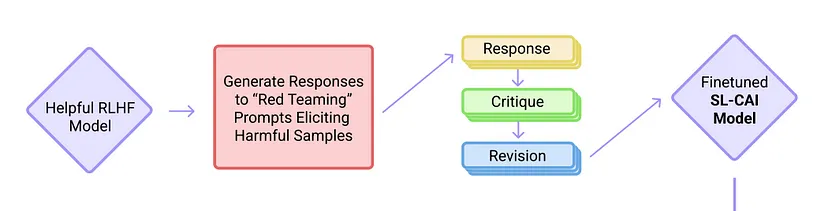
Reinforcement Learning from AI Feedback
The second original phase involved Reinforcement Learning from AI Feedback (RLAIF). Rather than requiring a human evaluator to compare every pair of responses, an AI system can assess alternatives using constitutional principles. Those preferences provide training signals for a model that learns to favor more appropriate responses.
In the published methodology, a preference model was trained using AI-generated comparisons, and reinforcement learning was then applied using the preference model as a reward signal. The objective was to improve behavior while reducing the amount of direct human labeling required. This approach connects with Reinforcement Learning (RL), Policy Gradient (PG), and Optimization Methods.
RLAIF illustrates how AI systems can participate in training other AI systems, but the process doesn't remove the need for human evaluation. AI-generated feedback can contain systematic errors, and models can learn to satisfy a reward mechanism without fulfilling the intended objective. Independent evaluation is necessary to determine whether observed behavior genuinely improves.
Historical reinforcement-learning illustration:
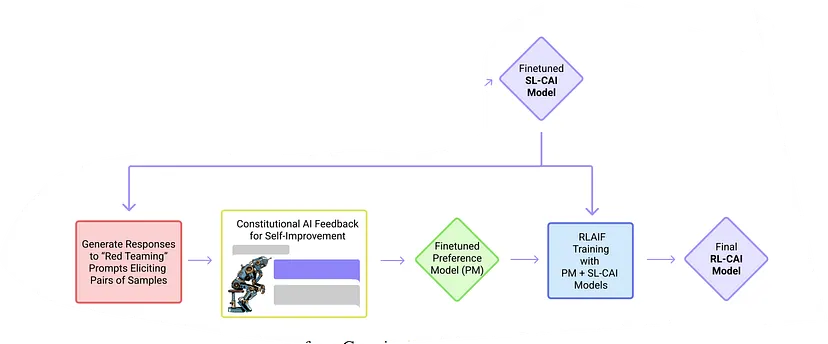
Claude's 2026 Constitution
In January 2026, Anthropic published a substantially revised Claude constitution. The document moved beyond a simple collection of separate rules toward explanations of values, intended behavior, and the reasoning behind different priorities. Anthropic argued that models need to understand the purposes underlying rules if they are to exercise appropriate judgment in unfamiliar circumstances.
The constitution addresses broad safety, ethical behavior, compliance with guidelines, and helpfulness. It also discusses uncertainty about AI consciousness and moral status without claiming that current Claude models are conscious. The document is intended as both a training resource and a public explanation of Anthropic's behavioral objectives.
Publication increases transparency about intended behavior but shouldn't be confused with proof of actual alignment. Anthropic itself acknowledges that models may fail to follow the constitution. This distinction is fundamental to AI Governance, Ethics, and AI Verification and Validation.
Mechanistic Interpretability
Anthropic's mechanistic interpretability research attempts to understand the internal computations that produce model behavior. Researchers examine learned representations, activation patterns, and relationships between components of neural networks. The goal is to move beyond observing outputs toward developing evidence about how particular responses arise.
Research involving sparse autoencoders has identified features associated with recognizable concepts and behaviors. Subsequent work on circuit tracing investigated how models represent and process information during reasoning. These studies suggest that models sometimes perform internal operations that aren't faithfully described by their generated natural-language explanations.
Mechanistic interpretability remains incomplete. Researchers can sometimes identify meaningful computational patterns, but they cannot yet provide complete causal explanations for every model decision. The field is important because better understanding may eventually improve safety evaluation, debugging, and control over increasingly capable AI systems.
Benchmarks & Evaluations
Why Evaluation Matters
Model benchmarks provide structured ways to compare performance on particular tasks. Tests may examine factual knowledge, mathematical reasoning, coding, visual understanding, computer use, or the ability to perform multi-step work. Each benchmark measures a limited set of capabilities under specified conditions.
An evaluation score depends on more than the model itself. Results can vary with the execution environment, available tools, prompting strategy, reasoning effort, number of attempts, and scoring rules. Scores collected under different conditions should not be treated as directly comparable.
For Claude, the increased emphasis on agents has made real-world execution benchmarks particularly relevant. A model may answer software questions accurately yet struggle to complete a repository modification, or it may reason well about a browser task but fail when interacting with an unfamiliar interface. These differences make task-specific evaluation essential.
Selected Published Claude Fable 5.1 Results
Anthropic's September 2026 publication for Claude Fable 5.1 and Mythos 5.1 reported the following results. They represent company-reported evaluations under documented conditions and shouldn't be interpreted as universal performance guarantees. Some tasks are sensitive to model safeguards, tool access, and evaluation settings.
| Benchmark | Model / Configuration | Reported Result | What It Tests |
|---|---|---|---|
| Terminal-Bench-Science 0.1 | Fable 5.1 | 52.6% | Scientific research tasks using terminal-based workflows |
| Terminal-Bench 4.0 | Fable 5.1 | 55.8% | Agentic terminal coding and execution |
| Terminal-Bench 4.0 | Mythos 5.1 | 60.9% | Related coding evaluation with different safeguard restrictions |
| Humanity's Last Exam | Fable 5.1, no tools | 60.9% | Difficult multidisciplinary reasoning |
| Humanity's Last Exam | Fable 5.1, with tools | 65.0% | Reasoning with permitted external tools |
| AutomationBench | Fable 5.1 | 31.4% | Multi-step business automation |
| CursorBench 3.2.0 | Fable 5.1 | 73.4% | Agentic software development |
| OSWorld 2.0 | Fable 5.1, partial scoring | 77.9% | Computer-use tasks |
| OSWorld 2.0 | Fable 5.1, strict scoring | 41.7% | Computer-use tasks under stricter success criteria |
The difference between partial and strict OSWorld results illustrates how strongly evaluation methodology can affect conclusions. A task may receive partial credit when the system completes some components yet fail under a metric requiring full completion. Real deployments should use acceptance criteria that reflect the actual consequences of incomplete work.
Anthropic's published Fable and Mythos results also demonstrate the effect of safeguard configurations. The underlying models are the same, but restrictions on certain cybersecurity and life sciences operations can affect performance in tasks where those safeguards intervene. This distinction should be considered when comparing specialized models with general-access models.
Sonnet 5.5 and Agentic Evaluation
Anthropic reported substantial performance improvements for Sonnet 5.5 relative to Sonnet 5, including faster inference and reduced operating cost on many workloads. The company reported a Terminal-Bench 4.0 score of 70.6% for Sonnet 5.5 under its stated evaluation configuration. This result provides evidence of progress in the tested setting but shouldn't be compared mechanically with benchmark scores produced using different harnesses or experimental procedures.
Model selection should therefore depend on a representative evaluation suite rather than one published percentage. Organizations can build tests based on their own documents, coding environments, spreadsheets, and agent workflows. The resulting evidence is more useful when it includes failure analysis, repeatability, operating cost, and the consequences of incorrect actions.
Recommended Evaluation Dimensions
| Dimension | Questions to Examine |
|---|---|
| Accuracy | Does the system produce correct, evidence-supported results? |
| Task Completion | Does it finish the full objective rather than only part of the work? |
| Reliability | Does performance remain consistent across repeated trials? |
| Tool Use | Does it select and operate authorized tools correctly? |
| Security | Does it respect permissions and resist malicious instructions? |
| Transparency | Can reviewers determine what the system did and what information it used? |
| Recoverability | Can errors be corrected without unacceptable consequences? |
| Cost | What is the complete cost of successful results, including retries? |
| Latency | Does the system complete work within acceptable time limits? |
| Human Oversight | Are approvals requested appropriately and presented clearly? |
These dimensions connect with Benchmarks, Evaluation - Measures, AI Trust & Evaluation, and AI Verification and Validation. Evaluation should be continuous because model versions, connected applications, and operating conditions change over time. A successful pilot is evidence for a particular use case, not proof that the system will behave identically across every deployment.
Practical Applications and Workflows
Claude can support many activities, but different products are designed for different levels of autonomy. A conversational assistant is appropriate for exploration and drafting, while Claude Code, Cowork, and Duet support more substantial execution. Choosing the correct environment can be as important as choosing the underlying model.
| Objective | Suggested Starting Point | Important Considerations |
|---|---|---|
| General questions and research | Claude.ai | Verify important sources and conclusions |
| Analysis of large documents | Claude.ai with file support | Check completeness and source interpretation |
| Software development | Claude Code | Use version control, testing, and code review |
| Multi-application office work | Claude Cowork | Establish permissions and review outputs |
| Proactive personal administration | Claude Duet | Understand monitoring intervals and approval requirements |
| Team collaboration in Slack | Claude Tag | Manage channel access, memory, and organizational permissions |
| Browser-based tasks | Claude in Chrome or supported agent tools | Protect accounts and verify consequential actions |
| Documents and presentations | Claude Artifacts, Docs, Slides | Review accuracy, design, and formatting |
| Visual prototyping | Claude Design | Validate accessibility and production requirements |
| Business dashboards | Claude Dashboards | Verify data sources and calculations |
| Scientific analysis | Claude Science or supported Claude models | Ensure reproducibility and expert validation |
| Defensive code analysis | Claude Security | Confirm findings and test proposed fixes |
| Custom AI application | Claude Platform API | Assess model costs, security, and integration |
| Long-running custom agent | Agent SDK or Managed Agents | Define execution boundaries and monitoring |
Example: Small Business Administration
A small business owner may use Duet to identify overdue invoices, summarize important messages, and prepare follow-up communications. Claude Cowork can help produce a weekly operational report, while Claude Artifacts can present the results as editable documents or dashboards. The owner remains responsible for verifying financial information and approving outgoing communications or payments.
This arrangement illustrates how several Claude products can operate around the same business objective. The proactive agent helps identify work, the execution environment prepares deliverables, and the user provides supervision. Appropriate deployment connects with AI Strategy & Adoption, Project Management, and Finance & Accounting.
Example: Software Development
A software team may use Claude Code to inspect a repository, develop a feature, and execute tests. A developer can review the proposed approach in Plan Mode before authorizing changes. Once implemented, the modifications can be evaluated using ordinary continuous integration, code review, and application testing.
Complex tasks may involve multiple specialized agents or reusable skills. However, additional autonomy doesn't eliminate the need for clear requirements and engineering discipline. Reliable use depends on well-maintained tests, limited privileges, and explicit acceptance criteria.
Example: Research and Analysis
A researcher may use Claude to organize literature, investigate a technical question, and produce a structured report. More specialized workflows can use Claude Science, external datasets, or computational tools to analyze information. Claude can help identify patterns and hypotheses, but scientific conclusions still require verification and, where appropriate, experimental confirmation.
The relevant principles include Data Quality, Causation vs. Correlation, Cross-Validation, and Train, Validate, and Test. Source provenance and reproducibility are particularly important when the model synthesizes information from multiple sources. AI-generated analysis should make assumptions and uncertainties clear enough for others to inspect.
Risks, Limitations, and Open Research Questions
Claude's expanding capabilities introduce risks that differ according to the environment in which the model operates. A conversational mistake may lead to an incorrect answer, while an agentic mistake may result in unauthorized changes, lost data, financial consequences, or disclosure of confidential information. This distinction makes operational safeguards increasingly important as Claude gains access to external systems.
Hallucinations remain a concern across language models. A model can invent a source, misinterpret a document, or produce an apparently valid calculation based on incorrect assumptions. Access to tools can reduce some errors but can also introduce new failure modes when tools are selected or operated incorrectly.
Long-running agents also face challenges involving memory, changing context, incomplete instructions, and the coordination of multiple tasks. A system may begin with a reasonable interpretation of the user's objective but drift as new information arrives. Regular checkpoints, explicit task boundaries, and independent verification can help reduce these failures.
There are additional governance questions concerning the amount of personal and organizational information stored by persistent assistants. The more useful an agent becomes through memory and connected applications, the more significant its privacy, security, and portability implications may be. These concerns connect with Data Governance, Privacy, AI Governance, and Ethics.
Recent Developments and Future Directions
October 2026 Product Expansion
October 2026 brought several significant additions to the Claude ecosystem. Haiku 5.5 expanded the low-cost model lineup, while Claude Dashboards and Motion introduced additional ways to create interactive and animated materials. Claude Duet then opened a research preview centered on proactive assistance and background execution.
Anthropic also expanded Claude Security's automated repository monitoring and introduced additional enterprise capabilities. Continued integration of Claude Cowork with the main Claude experience reduced the separation between conversational assistance and autonomous work. These developments reflect a strategy of bringing multiple types of AI activity into connected user and enterprise environments.
The pace of development makes it important to distinguish current product capabilities from announced future functionality. Research previews and beta applications can change rapidly, and access may depend on subscription, location, and organizational configuration. Primary documentation should be consulted before depending on a feature for consequential operations.
Agent Developer Infrastructure
Alongside its consumer and workplace products, Anthropic spent much of 2026 expanding the infrastructure developers use to build their own Claude agents. Claude Managed Agents moved from its April public beta launch to support memory, outcomes, multiagent orchestration, self-hosted sandboxes, and scheduled deployments, and in October it added dynamic workflows and OpenTelemetry tracing. The Claude Agent SDK continued to publish frequent releases while serving as the basis for Claude Agent integrations in Apple Xcode, JetBrains IDEs, Zed, and other developer tools. The October 2026 addition of monthly API credits to Max, Ultra, and Team plans also made it easier for individual subscribers to experiment with both products through an API key.
From Reactive Assistants to Persistent Agents
The most significant direction in Claude's development is the transition from responding to isolated requests toward maintaining ongoing responsibilities. Claude Duet, Claude Tag, Claude Cowork, and Managed Agents represent different expressions of this approach. Each combines model reasoning with persistent context, tools, and execution infrastructure.
The technical challenges include selecting appropriate work, coordinating actions, recovering from errors, and knowing when to request human involvement. These challenges cannot be solved merely by increasing the number of model parameters or extending context windows. They require progress in AI Verification and Validation, software security, agent evaluation, and human-centered interface design.
Persistent agents also create new questions about authority and accountability. A user may authorize an overall objective without anticipating every intermediate action an agent might consider useful. Safe systems need to distinguish inferred intent from explicit authorization and provide mechanisms for reviewing consequential steps.
The Future of Claude
Claude's development is likely to involve further advances in reasoning, coding, scientific research, computer use, and integration with external applications. Improvements in model efficiency may allow more frequent background work, while new interfaces could make agentic systems easier for people without technical training. These possibilities remain dependent on research progress, economic constraints, and successful deployment testing.
Anthropic's continued work on Constitutional AI, interpretability, model evaluation, and safety governance may be as consequential as improvements in raw model capability. The central challenge is not simply making AI systems more autonomous, but making their autonomy sufficiently predictable and controllable for real-world use. The future of Claude will therefore be shaped by the interaction between increasingly capable models and the technical and institutional mechanisms that govern their behavior.
References and Further Reading
Claude Models and Platform
- Models Overview | Anthropic Current model families, capabilities, context windows, model identifiers, and developer pricing.
- Model System Cards | Anthropic Official reports documenting model capabilities, evaluations, safeguards, and deployment decisions.
- Introducing Claude Opus 5.5 | Anthropic, September 22, 2026 Details concerning reasoning, agentic coding, efficiency, and model safety.
- Introducing Claude Sonnet 5.5 | Anthropic, September 28, 2026 Model improvements, operating cost, and professional use cases.
- Introducing Claude Haiku 5.5 | Anthropic, October 7, 2026 Information on efficient inference, high-volume applications, and smaller agent workloads.
- Introducing Claude Fable 5.1 and Mythos 5.1 | Anthropic, September 2026 Research results, benchmark methodology, and the distinction between general access and specialized safeguards.
- Claude Platform Documentation | Anthropic Technical documentation for integrating Claude models, tools, and application capabilities.
Applications, Agents, and Productivity
- Introducing Claude Duet (Blog) | Anthropic Launch announcement from October 21, 2026, describing the morning brief, check-ins every few hours, the cloud virtual machine, more than 6,000 connectors and plugins, payments through Link and Shop Pay, the safety approach, early tester stories, and preview limitations.
- Introducing Claude Duet | Anthropic, October 21, 2026 Primary announcement describing the research preview, proactive workflows, cloud execution, and approval model.
- Claude Duet Product Page | Anthropic Official overview of features, availability on iOS, Android, and claude.ai, the Opus 5.5 model, shared usage limits, and frequently asked questions, with the waitlist sign-up.
- Get Started with Claude Duet | Claude Help Center Detailed help article covering eligibility, setup, the Tasks and Make tabs, connectors and partner integrations, past-chat search, limitations, pricing, usage limits, the one-time limit reset, and approvals.
- Claude Duet Safety, Privacy, and Security | Anthropic, October 23, 2026 Technical explanation of Duet's three principles, the two-tier sensitive-information classifier, out-of-model action checks, approval controls, credential isolation, encrypted password handling, the isolated browser, payment cards, data deletion, and testing.
- How to Use Link by Stripe with Claude Duet | Claude Help Center Purchase authorization, one-time payment cards, financial data visibility, and payment limitations.
- How to Use Shop Pay with Claude Duet | Claude Help Center Instructions for connecting and using Shop Pay with approved purchases.
- Get Started with Claude Cowork | Claude Help Center Official guide to setting up and using Claude Cowork.
- Release Notes | Claude Help Center Dated history of Cowork features and platform updates.
- Claude Cowork and Chat Are One Claude | Claude Help Center Documentation of the September 16, 2026 merger of Cowork and chat.
- Schedule Recurring Tasks in Claude Cowork | Claude Help Center Guide to configuring recurring and on-demand scheduled tasks.
- Use Claude Cowork on Web, Desktop, and Mobile | Claude Help Center Documents the October 6, 2026 move of new Pro and Max Cowork tasks to the cloud and the removal of the local-only option.
- How People Are Using Claude Cowork | Anthropic Analysis of 1.2 million anonymized Cowork sessions from May 11 to 31, 2026, across more than 600,000 organizations, including category shares and stated limitations.
- Claude Cowork and Chat Come Together for Enterprise | Anthropic October 23, 2026 announcement of the unified Claude experience for Enterprise, with Efficient mode, model entitlements, spend limits, and pooled budgets.
- Build Live Dashboards and Animate Explainers with Claude | Anthropic, October 8, 2026 Announcement introducing Claude Dashboards and Motion in beta and moving Docs, Slides, and Design out of beta on every plan.
- What Are Artifacts and How Do I Use Them? | Claude Help Center Overview of editable outputs and the integrated Artifacts workspace.
- What Is Claude Tag? | Claude Help Center Details of collaborative agent workflows, Slack integration, memory, and organizational permissions.
- How We Built Claude Code Auto Mode | Anthropic, 2026 Research and engineering discussion of automated permission checks, prompt injection defenses, and autonomous coding risks.
- Agent Skills | Open Standard Official documentation for the open Agent Skills format used by Cowork and Duet and adopted across AI platforms.
Foundational Research and AI Safety
- Claude's New Constitution | Anthropic, January 22, 2026 Explanation of Anthropic's revised approach to values, behavioral priorities, and model alignment.
- Claude's Constitution | Anthropic Published constitutional framework describing intended model behavior and ethical priorities.
- Constitutional AI: Harmlessness from AI Feedback | Anthropic Researchers, 2022 Foundational research describing supervised revision and reinforcement learning from AI-generated preferences.
- Tracing the Thoughts of a Large Language Model | Anthropic, March 27, 2025 Research on internal model computation, planning, and mechanistic interpretability.
- Framework for Trustworthy Agents | Anthropic Research and design principles for developing AI systems that operate tools and interact with external environments.
- Responsible Scaling Policy | Anthropic Framework for assessing and managing risks associated with advanced AI capabilities.
- Prompt Injection Explained | Simon Willison Transcript and notes from a May 2023 talk explaining why prompt injection threatens tool-using assistants and why filtering alone is insufficient.
Model Context Protocol and Developer Infrastructure
- Model Context Protocol | Official Project Documentation, architecture, specifications, and implementation resources for interoperable AI tool connections.
- Introducing the Model Context Protocol | Anthropic, November 25, 2024 Original announcement describing the integration problem addressed by MCP.
- Claude Code Documentation | Anthropic Developer guidance for software engineering workflows, tool use, execution permissions, and project configuration.
Claude Agent SDK and Managed Agents
- Agent SDK Overview | Anthropic Official documentation of the SDK's built-in tools, hooks, subagents, sessions, permissions, branding rules, and comparison with other Claude developer tools.
- Agent SDK Quickstart | Anthropic Installation requirements, authentication, cloud provider settings, and a first bug-fixing agent in Python and TypeScript.
- Building Agents with the Claude Agent SDK | Anthropic, September 29, 2025 Explanation of the rename from the Claude Code SDK and of the gather context, take action, and verify work loop.
- Claude Agent SDK for Python Releases | Anthropic, GitHub Release history and change notes for the Python package.
- Claude Agent SDK for TypeScript | npm Package listing with installation instructions and version history for the TypeScript SDK.
- Use the Claude Agent SDK with Your Claude Plan | Claude Help Center Subscription limits, the paused billing change, and monthly API credits for Max, Ultra, and Team plans.
- Apple's Xcode Now Supports the Claude Agent SDK | Anthropic, February 2026 Announcement of Claude Agent support, subagents, background tasks, plugins, and visual verification in Xcode 26.3.
- Introducing Claude Agent in JetBrains IDEs | JetBrains, September 2025 Launch of the first third-party agent in JetBrains AI, built on the Claude Agent SDK.
- Claude Agent | Zed Agent Client Protocol integration that brings Claude Agent into the Zed editor.
- Claude Managed Agents | Anthropic, April 8, 2026 Launch announcement covering the hosted harness, sandboxing, pricing, and early customers.
- Scaling Managed Agents: Decoupling the Brain from the Hands | Anthropic Engineering, April 8, 2026 Architecture of sessions, harnesses, and sandboxes, with latency and credential security results (also available at anthropic.com/research/managed-agents by Lance Martin, Gabe Cemaj, and Michael Cohen).
- Claude Managed Agents Overview | Anthropic Concepts, tools, features, platform availability, and data retention eligibility.
- Managed Agents Quickstart | Anthropic Creating an agent and environment with the ant tool and streaming a first session in Python.
- New in Claude Managed Agents | Anthropic, May 6, 2026 Outcomes, multiagent orchestration, webhooks, and the dreaming research preview.
- Claude Platform Release Notes | Anthropic Dated changes including dynamic workflows, permission policies, networking controls, scheduled deployments, and OpenTelemetry export.
- Anthropic Rolls Out Claude Managed Agents | InfoWorld, April 2026 Independent coverage of the launch and its place in the enterprise agent market.
- Anthropic Reveals Claude Managed Agents | TechRadar, April 2026 Report on the platform's positioning, consumption-based pricing, and promised development speed.
- Agentic Coding Comes to Apple's Xcode 26.3 | TechCrunch, February 3, 2026 Independent reporting on the Xcode integrations from Anthropic and OpenAI.
- Pick Your Agent: Use Claude and Codex on Agent HQ | GitHub Blog, February 2026 Announcement of Claude as a selectable coding agent in GitHub's Agent HQ.
Independent Commentary on Claude Cowork and Claude Duet
- Vibe Check: Duet, Anthropic's Always-on Agent | Dan Shipper, Every Early hands-on review discussing workflow organization, professional utility, and limitations.
- Claude Duet Is Beautiful. I Still Forgot to Use It | Lenny's Newsletter Examination of the relationship between polished agent interfaces, proactivity, and long-term user adoption.
- Claude Duet App Is Anthropic's Bet on Agents | Ivan Mehta, TechCrunch, October 22, 2026 Places Duet among competing personal and business agents and summarizes its positioning, purchases, and safeguards.
- Anthropic Launches Claude Duet, a Proactive AI Agent | MacRumors, October 21, 2026 Launch coverage of the assistant's availability, security design, and account integration.
- Claude Duet: Anthropic Previews an AI Agent That Messages You First | Michelle Hawley, VKTR Reports Duet's safety measures, what it cannot do, and Mike Krieger's account of using it.
- Anthropic Debuts Claude Duet Personal AI Agent | Megan Cerullo, CBS News Consumer-oriented explainer on Duet's purpose, setup, security statements, and waitlist availability, published October 23, 2026.
- Claude Duet Preview Brings Anthropic's Proactive Agent to Pro and Max | Camila Nogueira, BetaNews Covers the waitlist, the sensitive-information classifier, and the usage trade-offs of interval check-ins.
- Anthropic Lead Says Claude Duet Invites Reach US Max First, With Pro Next | Nerdschalk Reports Karan Ahuja's October 28, 2026 rollout update on invitation order and international plans.
- First Impressions of Claude Cowork, Anthropic's General Agent | Simon Willison, January 12, 2026 Hands-on analysis of Cowork's initial macOS research preview and security considerations.
- Anthropic Claude Wants to Be Your Helpful Colleague | The Register, January 13, 2026 Coverage of Cowork's launch for office automation.
- Anthropic Updates Claude Cowork Tool Built to Give the Average Office Worker a Productivity Boost | CNBC, February 24, 2026 Reports the plugin marketplace, enterprise controls, and new business connectors.
- Anthropic Merging Claude Cowork with Chat | Zac Hall, 9to5Mac, September 16, 2026 Coverage of the unified Claude interface rollout.
- Anthropic Merges Claude Chat and Cowork in One Interface | TechCrunch, September 16, 2026 Details the unification of chat and Cowork alongside the beta launch of Claude Docs and Slides.
- Anthropic Puts Claude AI Agent Inside Slack Channels | Sheryl Hodge, Reworked Describes Claude Tag, Anthropic's proactive team agent for Slack launched June 23, 2026.
- Everything OpenAI Announced At DevDay 2026, Including Its Muse Alternative | BGR Summarizes OpenAI's dots and the launch dates of Meta Muse and Grok Bot.
- Google Introduces Gemini Spark, a 24/7 Agentic Assistant with Gmail Integration | TechCrunch Coverage of Google's always-on personal agent announced at I/O 2026.
- Microsoft Launches AI Tool That Competes with Anthropic | Axios Reports Microsoft's Copilot Cowork, built in close collaboration with Anthropic, announced March 9, 2026.
- Why One Anthropic Update Wiped Billions Off Software Stocks | Fast Company Explains the market reaction to Cowork's plugins in early February 2026.
Additional Viewing
Introducing Claude Duet is Anthropic's official October 2026 introduction to its proactive personal agent. The demonstration provides a visual starting point for understanding morning briefs, background task execution, and the approval model discussed in the Claude Duet section.
Meet Claude Duet is Anthropic's official short introduction from the Claude YouTube channel, posted October 23, 2026. It shows the loop described in The Mechanism section: Claude messaging first only when something needs attention, a morning brief of top priorities, larger tasks handed off by voice note, and a request for approval before anything is sent, paid, or signed. It works as a quick visual companion to the Building Blocks table. Watch on YouTube
In Anthropic Just Released Claude DUET (Full Breakdown), posted October 22, 2026, the Kev Builds Apps channel walks through Anthropic's documentation for Duet, including limitations the creator considers easy to overlook, the Stripe, Link, and Shop Pay payment integrations, and how Duet compares with Grok Bot, OpenAI's dots, and Meta's Muse. The video also contrasts Duet with the creator's own self-built always-on agents, which complements the Known Limitations, Competitive Landscape, and Ecosystem Fit sections.
In Ambient Agents and the New Agent Inbox, published by Sequoia Capital in May 2025, LangChain CEO Harrison Chase introduces ambient agents, AI systems that run continuously in the background and respond to events rather than to chat prompts while people stay involved through an inbox of items awaiting review. The talk predates Duet but explains the design pattern behind its check-ins, Tasks tab, and approval requests, and it makes the case for why human oversight stays essential as these agents scale.
What is Claude Managed Agents?, from Anthropic's Claude channel in April 2026, introduces the hosted agent runtime whose credential design Duet adopts. It explains how developers define tools, environments, and success criteria while Claude works until a task is complete, giving useful background for the brain-and-hands architecture and credential vault discussed in the Credentials and Technical Architecture sections.
In Prompt Injection, explained, Simon Willison presents his roughly twelve-minute segment from a May 2023 LangChain webinar, using the example of an email assistant tricked into forwarding password-reset messages to an attacker. He argues that filters catching most attacks are not good enough in security and outlines the dual-model pattern for separating trusted and untrusted inputs. These ideas directly inform The Physics section's discussion of out-of-model checks, isolated browsers, and approval gates.
Claude Cowork Tutorial (Exact Prompts I Use) by Jake Dawson is a hands-on Cowork tutorial organized around the creator's own prompts. Because Duet inherits the skills, connectors, and memory people build in Claude, habits formed in Cowork carry over directly, which makes this tutorial relevant to the Claude Cowork section, the From Claude Code to Cowork section, and the Getting Started steps.
Claude Cowork Complete Tutorial 2026 (15 Features Tested on Real Work) by Maksims Sics tests a wide range of Cowork features against real tasks. It provides a practical view of the capabilities listed in the Claude Cowork section and the Development History timeline, many of which, including connectors, plugins, and scheduled work, form the foundation Duet builds on.
What Claude Cowork Can Do for You: A Beginner's Guide by Amy Bruce of AI & Data for Nonprofits introduces Cowork for non-technical audiences. Small organizations weighing whether Cowork or Duet's proactive model suits them can use it to understand the delegated-task foundation first, and it pairs well with the Ecosystem Fit and How to Evaluate a Deployment sections.
Building Claude Code with Boris Cherny, published by The Pragmatic Engineer in March 2026, is an extended technical interview with the creator of Claude Code. It discusses engineering workflows, agentic coding, code review, permission controls, and the practical challenges of deploying coding agents, directly complementing the Claude Code section.
Building Agents with Model Context Protocol is a technical workshop presented by Mahesh Murag of Anthropic at the AI Engineer Summit in March 2025. The approximately 104-minute presentation explains MCP's client-server approach, tool integration, resources, and practical development techniques, making it especially useful for understanding the Model Context Protocol section.
Defending Against AI Jailbreaks features Anthropic researchers discussing Constitutional Classifiers, adversarial attacks, and the use of layered safeguards to protect language models. The extended discussion connects directly with Constitutional AI, prompt injection defenses, and the security architecture used by Claude's agentic products.
Tracing the Thoughts of a Large Language Model is an Anthropic research presentation released in March 2025. It introduces visual methods for investigating the internal computations of language models, including planning and relationships between model representations, and provides a useful introduction to mechanistic interpretability.
Introducing Claude Managed Agents is the official launch video published on the Claude channel in April 2026. It presents Managed Agents as a suite of composable APIs for building and deploying agents at scale, with native MCP support, tool integrations, and production infrastructure. The video is a concise visual companion to the Claude Managed Agents section of this page.
Claude Agent SDK Full Workshop is a nearly two-hour hands-on session presented by Thariq Shihipar of Anthropic and published by AI Engineer in January 2026. It covers the agent harness, bash and file system tools, context engineering, verification, hooks, and a live-coded research agent, along with audience questions about reproducibility and very large codebases. It is one of the most detailed public explanations of the design ideas described in the Claude Agent SDK section.
More
- The Claude prompting library
- Anthropic, the $4.1 billion OpenAI rival, debuts new A.I. chatbot and opens it to public - Hayden Field | CNBC
- 3 Ways to Access Claude AI for Free | Abid Ali Awan - KD Nuggets
- ChatGPT and Bard Get New AI Chatbot Rival: Anthropic Debuts Claude 2 | Carrie Mihalcik - CNET
- Claude 5 Series: Advancing Enterprise Agentic Reasoning | Anthropic - August 2026
- New "Mythos 5" architecture achieves state-of-the-art performance in complex multi-step reasoning and autonomous tool orchestration.
- Model Context Protocol Reaches 1000+ Integrations | Anthropic - July 2026
- Anthropic's Claude Code: The Future of Autonomous Software Engineering | The Verge - May 2026
- Deep Dive: Multimodal Architectures in Claude 5 | TechCrunch - March 2026
- Get started with Claude Cowork | Claude Help Center ... Official guide.
- Release notes | Claude Help Center ... Dated history of Cowork features.
- Claude Cowork and chat are one Claude | Claude Help Center ... September 16, 2026 merger.
- Schedule recurring tasks in Claude Cowork | Claude Help Center
- Agent Skills | Open standard ... The skills format Cowork uses, adopted across AI platforms.
- First impressions of Claude Cowork, Anthropic's general agent | Simon Willison
- Anthropic Claude wants to be your helpful colleague | The Register
- Anthropic updates Claude Cowork tool built to give the average office worker a productivity boost | CNBC
- Anthropic merging Claude Cowork with chat | Zac Hall - 9to5Mac
- Anthropic merges Claude chat and Cowork in one interface | TechCrunch
- Introducing Claude Duet | Anthropic - October 21, 2026
- Research preview of a proactive agent app built on Claude Opus 5.5: morning briefs, background work on its own cloud computer, and approval before it sends, pays, signs, or deletes anything.
- Claude Duet: product page, FAQ, and waitlist | Anthropic
- Get started with Claude Duet | Claude Help Center
- The most detailed official reference: eligibility, setup, Tasks and Make tabs, connectors, limitations, and how usage limits work during the preview.
- Claude Duet app is Anthropic's bet on agents | TechCrunch - October 22, 2026
- Positions Duet against Meta Muse, OpenAI Dots, Grok Bot, and other personal agents, and notes what it deliberately does not do.