Neuroscience
YouTube search... ...Google search
- Symbiotic Intelligence ... Connecting Brains ... Neuroscience ... Nanobots
- Life~Meaning ... Consciousness ... Creating Consciousness ... Biology ... Quantum Biology ... LEV ... TAME ... Orch-OR
- Biocomputing ... Bio-inspired Computing ... Neuromorphic ... Molecular ... (Artificial) Immune System ... Self-Organizing
- Life Sciences ... Evolutionary ... Bioinformatics ... Proteins ... Genome ... Genealogy ... Pharmaceuticals ... Chemistry
Neuroscience studies how nervous systems develop, function, adapt, and give rise to behavior. Its connection with artificial intelligence runs in both directions: AI helps researchers analyze brain images, reconstruct connections, quantify behavior, and predict neural activity, while discoveries about learning, memory, sensory processing, and biological computation can suggest new AI designs. The relationship is strongest when a computational idea produces a prediction that can be checked against an experiment.
Recent work brings together data that used to be studied separately. Researchers can compare a neuron's molecular identity, shape, connections, activity, and the behavior of the animal. Large pretrained models can reuse information across experiments, reducing some annotation or training burdens. Yet a detailed anatomical map isn't a complete account of how a brain works, and a model that predicts recordings hasn't necessarily identified the biological mechanism that generated them.
This page connects the methods to recent advances, usable software and data resources, and their impacts. It distinguishes published results from preprints and announced programs, and separates research tools from clinically validated applications. Research and resource status were reviewed on 24 November 2026. MICrONS resource · BrainIAC study · Stanford project announcement
Neuroscience and AI
AI for neuroscience uses computational methods to measure or explain biological systems. Examples include segmenting neurons in electron-microscopy images, detecting body movements in video, estimating neural states, and fitting models to brain recordings. These methods can process far more data than manual analysis alone, but their errors become part of the scientific measurement and must be quantified.
Neuroscience for AI studies biological ideas that may improve computation, such as sparse activity, recurrent dynamics, local plasticity, memory, dendritic processing, and embodied learning. An artificial network can borrow one of these principles without reproducing an entire biological neuron or brain. Similar terminology, such as “attention,” doesn't establish identical mechanisms.
The original page cited Hassabis, Kumaran, Summerfield, and Botvinick's 2017 Neuroscience-Inspired Artificial Intelligence. That remains useful background, but the current landscape includes large shared datasets, transferable models, and explicit NeuroAI programs. The November 2026 BRAIN NeuroAI roadmap emphasizes biological grounding, brain-inspired computation, and embodied systems. It's a research agenda, rather than a demonstration that the brain has been reverse engineered. 2017 Neuron review · 2026 BRAIN NeuroAI roadmap
How Brains Are Studied
A neuroscience result depends on the scale and measurement method. Electron microscopy can reveal fine anatomy in preserved tissue; electrical recordings capture fast activity from sampled cells; calcium imaging provides an indirect optical signal; MRI and related methods measure anatomy or physiological changes at larger scales. None gives an unrestricted view of a person's thoughts.
| Method | Main information | How AI can help | Important limitation |
|---|---|---|---|
| Electron microscopy and reconstruction | Fine cellular anatomy and candidate synaptic connections. | Segment images, trace processes, detect synapses, and prioritize proofreading. | Destructive tissue preparation, reconstruction errors, and limited sampled volume; anatomy alone lacks live dynamics. |
| Single-cell sequencing and spatial assays | Molecular profiles and the locations of cell populations. | Cluster profiles, align datasets, and integrate molecular and anatomical information. | Sampling, assay sensitivity, and analysis choices affect the inferred categories. |
| Electrophysiology | Rapid voltage-related signals from sampled locations. | Detect and sort spikes, characterize population activity, and decode trained signals. | Noise, drift, sampling bias, and spike-sorting errors. |
| Optical physiology | Activity-related fluorescence and cell-level imaging. | Correct motion, identify regions, extract signals, and infer activity. | Fluorescence is an indirect measurement, and inferred spikes depend on model assumptions. |
| MRI, fMRI, EEG, and MEG | Different views of large-scale anatomy or activity-related signals. | Improve processing, representation learning, prediction, and multimodal comparison. | Spatial and temporal trade-offs, artifacts, population differences, and inverse-problem ambiguity. |
| Behavioral video and perturbation experiments | Movement, task performance, and responses to interventions. | Track pose and compare neural activity with behavioral variables. | Pose isn't an explanation of behavior; interventions and controls are needed for causal claims. |
These distinctions matter when comparing headlines. “A whole-brain atlas” may refer to cell-type locations, while “a whole-brain connectome” refers to reconstructed wiring for a particular organism and sample. A human MRI model and a fly synaptic reconstruction are valuable at very different levels of description.
Research Advances
Transferable MRI representations: BrainIAC (February 2026)
A generalizable foundation model for analysis of human brain MRI introduces Brain Imaging Adaptive Core (BrainIAC). The study developed and evaluated representations using 48,965 MRI scans across downstream tasks, with particular benefits in some low-data settings. The significance is reuse: a pretrained representation can be adapted instead of training a separate model from scratch for each task. The work remains a research foundation; scanner variation, population shift, and prospective clinical performance require separate assessment. Tak and colleagues, Nature Neuroscience, 5 February 2026
Transferable electron-microscopy features: ConnectoFM (June 2026 preprint)
ConnectoFM reports pretraining on 1.7 million unlabeled EM images from six species and 25 subdomains, then evaluating segmentation and cell-typing tasks across 29 datasets. The authors report strong low-label performance relative to the baselines tested. This could reduce repeated annotation and dataset-specific training, but segmentation performance doesn't itself establish error-free neural wiring. It's a preprint, and generalization to independent acquisitions and complete reconstruction workflows needs further validation. ConnectoFM, posted 10 June 2026
Dendritic inspiration for AI architecture (October 2026)
Dendritic computation bridges neuroscience and foundation models proposes a mathematical analogy between simplified dendritic computations and attention mechanisms, then develops a dendritic-inspired computational framework. It illustrates a route from biological ideas to AI architecture. An analogy or an improved computational benchmark doesn't establish that biological dendrites implement a particular deployed model's mechanism. Nature Communications, 15 October 2026
Predictive human-brain models: a new research program (November 2026)
Stanford announced its Digital Brain Project on 2 November 2026. The planned program combines advanced imaging, including 7-Tesla MRI and wearable OPM-MEG, with foundation-model development to predict brain dynamics. The announcement describes research goals and infrastructure, not a completed whole-human-brain model or validated treatment system. Its value will depend on how accurately predictions generalize and how they guide testable experiments. Stanford announcement
Connectomics
Connectomics maps neural wiring at a specified scale. AI-assisted image processing makes larger reconstructions possible, while human proofreading and biological validation remain important. A connection graph identifies possible pathways; it doesn't fully specify synaptic strength, neuromodulation, ongoing activity, plasticity, or the organism's experience.
Human cortex at nanoscale (2024). Shapson-Coe and colleagues reconstructed approximately one cubic millimeter of surgically removed human temporal cortex, containing about 57,000 cells and 150 million synapses. The sample's scale and detail make it a major resource for studying local anatomy, not a map of a complete human brain or a representative sample of every person. Science paper and author-hosted abstract
Adult fly brain (2024). FlyWire's flagship reconstruction includes 139,255 proofread neurons. Its open tools allow researchers to inspect cell types and pathways in an adult female fly brain. The accompanying community infrastructure supports annotations and corrections, which are part of making the resource scientifically useful. Nature paper · FlyWire resources
Mouse structure and function together (2025). MICrONS links calcium-imaging responses from around 75,000 neurons to an EM reconstruction containing more than 200,000 cells and roughly half a billion synapses within a small cortical volume. This lets researchers compare wiring with responses to visual stimuli in the same tissue. The dataset represents particular mouse visual areas, not an entire mouse brain. Nature study · Data explorer
Brain and nerve cord together (June 2026). Distributed control circuits across a brain-and-cord connectome reports an adult fly reconstruction uniting the brain and ventral nerve cord. It expands questions about distributed control from brain-only pathways to sensorimotor systems across the body-related nervous system. “Unified” in this context shouldn't be confused with a functional simulation of every behavior. Nature study, 8 June 2026
Cell Types and Atlases
Cells differ in molecular expression, morphology, connectivity, physiology, and location. Modern atlases try to relate these descriptions rather than assume that a single label captures everything. Single-cell and spatial methods, combined with computational integration, provide a way to compare cell populations across brain regions and datasets.
The 2023 BICCN mouse-brain atlas studies brought transcriptomic and spatial measurements together at whole-brain scale. One reference taxonomy organizes the data into 34 classes, 338 subclasses, 1,201 supertypes, and 5,322 clusters or types. These are categories defined by the study's methods and resolution, not a claim that every species or every analysis will yield the same count. Transcriptomic and spatial atlas · Consortium resources
An anatomical atlas provides coordinates and reference regions; a molecular atlas characterizes cell populations; a connectome describes reconstructed connections. Combining them can help researchers ask which kinds of cells participate in a circuit and whether a finding is comparable across samples. It also creates new alignment problems: tissues can deform, boundaries vary between people, and different assays don't always sample the same cells. The original Julich-Brain section below provides an anatomical example.
Brain Models and Interfaces
Predictive models estimate observations, such as a neuron's response to a video. Mechanistic models propose how interacting biological components produce an effect. Simulators execute the assumptions of a chosen model. These categories overlap, but high prediction accuracy alone doesn't identify a unique biological explanation.
A 2025 mouse visual-cortex foundation model predicted responses to new stimulus types and adapted to new mice with limited training data. Applied to MICrONS, it supported a functional “digital twin” of the recorded visual system. The scope matters: this is a model of specified measured responses, rather than a complete replica of a mouse's nervous system, memories, or subjective experience. Foundation model of neural activity predicts response to new stimulus types
A brain-computer interface uses recorded neural signals for a defined communication or control task. A June 2026 study reported speech-and-cursor use at home by one participant with ALS over 19 months and more than 3,800 hours. This extends evaluation toward sustained daily utility. It still required external equipment and trained care-partner setup, and one participant doesn't establish broad clinical availability. Restoring a communication pathway is different from demonstrating general cognition enhancement. Long-term independent BCI use, Nature Medicine
For related coverage, see Connecting Brains, Symbiotic Intelligence, Neuromorphic Computing, and Biocomputing. A model of neural activity, a spiking processor, and a living neural culture are distinct systems even when all are described as “brain-like.”
Applications and Tools
Choose the resource by the measurement and the scientific question. A browser-based atlas or explorer is a useful starting point for learning; specialist analysis packages and simulators require more domain knowledge. The list combines established infrastructure with newer research implementations. It isn't a ranking, and not every resource is an AI model or an end-user app.
| Resource | Category | Useful task | What to check |
|---|---|---|---|
| Allen Brain Map / Brain Knowledge Platform | Atlases, cell data, and reference resources | Explore anatomy, cell taxonomies, datasets, and associated tools. | Match species, atlas version, region, and assay to the question. |
| FlyWire and Codex | Fly connectomics | Inspect proofread neurons, annotations, and pathways in a browser. | Record dataset version and proofreading status; connectivity is not a complete functional explanation. |
| MICrONS Explorer | Linked mouse anatomy and physiology | Compare cell morphology, synapses, and measured visual responses. | Limited tissue and experimental conditions; distinguish all cells from recorded neurons. |
| EBRAINS | Research infrastructure | Find atlases, data, models, simulation, and computational services. | Access requirements and capabilities differ by service. |
| Open Source Brain | Collaborative cloud modeling | Explore shared data, models, and workspaces with tools such as NWB Explorer and NetPyNE. | Reusing a model requires its assumptions, dependencies, and version history. |
| The Virtual Brain | Large-scale brain-network simulation | Combine anatomical connectivity with mathematical models of regional dynamics. | A regional model is not a cell-by-cell reconstruction; clinical predictions require separate validation. |
| NEURON | Cell and network simulation | Build and test biophysical models using compartments, mechanisms, and connectivity. | Detailed parameters can be uncertain or non-identifiable from available data. |
| Brian 2 | Spiking-network simulation | Express and simulate models of spikes, synapses, and plasticity. | Model behavior reflects the chosen equations, parameters, and numerical methods. |
| Nengo | Neural-system engineering | Build spiking or non-spiking networks and explore cognitive or dynamic models. | Engineering a useful neural system does not establish biological fidelity. |
| MNE-Python | Neurophysiology analysis | Process, visualize, and analyze EEG, MEG, and related signals. | Artifact handling, source assumptions, and statistical choices can change conclusions. |
| DeepLabCut | Markerless pose estimation | Track user-selected body features in behavioral video. | Validate on the actual camera, species, lighting, occlusions, and behavior. |
| Suite2p | Optical-imaging analysis | Register images, detect regions, extract signals, and perform deconvolution. | Extracted fluorescence and inferred activity require quality checks. |
| Neurodata Without Borders (NWB) | Data standard and software ecosystem | Store neurophysiology and behavioral data with structured metadata. | A valid file format does not guarantee valid experiments or sufficient metadata. |
| DANDI Archive | Neurophysiology data archive | Find and share supported recordings, imaging, and behavioral datasets. | Review consent, provenance, version, and reuse conditions. |
| OpenNeuro | Open neuroimaging datasets | Explore shared datasets organized with BIDS. | Use dataset-level documentation; sample composition and acquisition may limit transfer. |
| Brain Imaging Data Structure (BIDS) | Data organization standard | Organize imaging and associated data for compatible tools and reuse. | Validation checks organization and metadata, not the truth of a scientific claim. |
| BrainIAC | 2026 MRI foundation-model research implementation | Access model checkpoints and pipelines for research adaptation to downstream MRI tasks. | The repository specifies non-commercial academic research use; research performance is not clinical authorization. |
A practical starting route: Explore a small example in an atlas or connectome viewer, read the dataset description, and write a question the resource can actually answer. For a modeling exercise, select a published model with documented inputs and reproduce its reported behavior before changing assumptions. Keep the data version, preprocessing choices, and model configuration together so another person can repeat the analysis.
Impacts
The biggest change is the ability to combine measurements at scales that previously required separate projects. AI reduces some manual work and creates new hypotheses, while shared datasets let other groups inspect and challenge the results. It also moves bottlenecks: proofreading, metadata quality, independent validation, and computing costs can become more important as automated processing expands.
| Area | What changes | Potential impact | Unresolved requirement |
|---|---|---|---|
| Circuit reconstruction | More images can be segmented and assembled into connection graphs. | Study motifs and compare structure with measured function. | Quantify merges, splits, missed synapses, and the impact of residual errors. |
| Behavioral neuroscience | Video can be converted into quantitative pose and movement measurements. | Relate neural activity to detailed behavioral events. | Validate tracking and avoid treating a correlated movement as a causal explanation. |
| Brain imaging | Pretrained representations can be adapted to multiple research tasks. | Reduce task-specific labeling and explore new biomarkers. | External, prospective validation and evaluation of population and scanner differences. |
| Simulation and experiment design | Models predict responses and candidate interventions. | Prioritize experiments and compare competing mechanisms. | Test predictions on data not used to fit or select the model. |
| Assistive communication | Decoders translate trained neural signals into text or control. | Increase communication and digital access for some participants. | Long-term reliability, user control, setup burden, and broader clinical evidence. |
| Brain-inspired AI | Biological principles suggest alternative representations and learning rules. | Explore efficient or more adaptive computational architectures. | Compare fairly with strong baselines and avoid inferring biological equivalence from terminology. |
For clinical applications, usefulness includes effects on people and decisions, not only prediction scores. For basic neuroscience, a model can be valuable even before it supports a clinical product, provided its scope, uncertainty, and experimental predictions are clear.
Evidence and Ethics
Separate prediction, explanation, and causation. A decoder that predicts a behavior from recorded activity may exploit a correlated variable. A model can reproduce a response through a mechanism different from the biological one. Interventions, controls, and comparisons between explanations help determine which claim the evidence supports.
Prevent leakage and misleading comparisons. Nearby image patches, repeated scans, or recordings from the same person can be highly similar. Splits must match the intended claim: new patches, new sessions, new people, and new laboratories are different generalization tests. Report uncertainty and meaningful baseline comparisons, and distinguish computationally inferred labels from experimentally verified ones.
Protect neural and related personal data. Brain recordings, scans, clinical metadata, and behavioral video can contain sensitive information. Consent, access controls, retention, and permitted reuse matter even when a dataset is described as open. Combining datasets can change what can be inferred or reidentified. Data standards support reuse but don't replace ethical review or appropriate governance. NWB publications, including International Data Governance for Neuroscience
Respect research participants and animals. Consider welfare, participant agency, explanation of limitations, and the practical burden of sustained use. A BCI user should have meaningful control over outputs and correction. Descriptions of organoids, simulations, or AI models should distinguish measured capabilities from claims about sentience or consciousness. Related discussions appear in Consciousness and Biocomputing.
Brain Mapping
The original resources below are retained and updated. Atlases, model-sharing services, and simulators serve different roles: an atlas supplies a reference, a repository shares data or models, and a simulator calculates the behavior of a specified model. The introductory videos are collected in the Videos section; project-specific videos remain with their sections.
Open Source Brain
YouTube search... ...Google search
- Open Source Brain shares data, analysis code, and computational models of neural systems. Its current platform includes persistent workspaces and interactive applications such as NWB Explorer, NetPyNE, and JupyterLab. A workspace supports reproducible investigation only when the underlying data, code, and assumptions are recorded.
Open Source Brain Teaser
Teaser for Open Source Brain.
NWB Explorer Teaser
Teaser for NWB Explorer.
The Human Brain Project (HBP)
YouTube search... ...Google search
The Human Brain Project ran from 2013 to September 2023. Its continuing legacy includes the EBRAINS research infrastructure, brain atlases, computational modeling, neuromorphic computing, and neurorobotics resources. It should be described as a completed research program with continuing infrastructure, rather than a current attempt that has already simulated an entire human brain. HBP completion report
Its historical platform areas included neuroinformatics, brain simulation, high-performance analytics and computing, medical informatics, neuromorphic computing, and neurorobotics. These areas remain useful ways to understand the breadth of digital neuroscience. Since 2024, the EBRAINS 2.0 project has continued infrastructure development around multimodal data, atlases, and modeling. Current EBRAINS services and status
An Overview of the Human Brain Project
Overview of the Human Brain Project.
Gewaltig Marc-Oliver - The Human Brain Project: Virtualizing and Accelerating Neuroscience
Marc-Oliver Gewaltig on how the Human Brain Project virtualizes and accelerates neuroscience.
Jeff Hawkins - Human Brain Project Keynote [Screencast]
Jeff Hawkins' keynote at the Human Brain Project.
The Human Brain Project: Future Neuroscience
The Human Brain Project on the future of neuroscience.
Virtual Brain
YouTube search... ...Google search
The Virtual Brain (TVB) is a platform for simulating large-scale brain-network dynamics, rather than simply a repository of neurological recordings. It combines anatomical connectivity with mathematical models of regional activity and can generate signals for comparison with measurements such as EEG, MEG, or fMRI. Its clinical research applications include personalized models for studying epilepsy. A subject-specific model is a representation at a chosen scale, not a complete digital copy of the person. Project description and resources
The Virtual Brain
Toronto Star on The Virtual Brain.
The Virtual Brain (15:30 - 16:15h CEST)
Human Brain Project session on The Virtual Brain.
Julich-Brain Atlas
YouTube search... ...Google search
- Julich-Brain: A 3D probabilistic atlas of the human brain’s cytoarchitecture | K. Amunts, H. Mohlberg, S. Bludau, and K. Zilles
- Brain Atlases | EBRAINS
Julich-Brain provides probabilistic maps of human cytoarchitecture: brain regions defined by the organization of cells in tissue. Probabilistic maps represent variation between brains rather than a single boundary that applies identically to everyone. The 2020 paper and the continuing EBRAINS atlas services connect fine-scale anatomy to a reusable reference framework. This is an anatomical resource; it doesn't read a person's memories or reproduce their neural dynamics. Original Science paper
The original page also linked this historical overview: These Scientists Just Completed a 3D ‘Google Earth’ for the Brain | Shelly Fan - SingularityHub.

China's Brain Project
YouTube search... ...Google search
A 2016 Neuron article by Poo and colleagues describes the China Brain Project through three connected themes: basic neuroscience, brain diseases, and brain-inspired computing. These describe a research strategy, rather than a claim that a complete functional human brain model exists. The videos below are retained as background coverage; use dated primary publications to evaluate specific scientific results. China Brain Project: Basic Neuroscience, Brain Diseases, and Brain-Inspired Computing
How does China’s brain project differ from that in the US and Europe?
CGTN on how China's brain project differs from those in the US and Europe.
The China Brain Science Project, Prof. Nancy Ip
Prof. Nancy Ip on the China Brain Science Project.
China Brain Project and non human primate research, Prof. Mu ming Poo
Prof. Mu-ming Poo on the China Brain Project and non-human primate research.
China Super Technology That Can Be Controlled By Mind
On Chinese mind-controlled technology.

How the Mind's Mistakes Make Humans Creative, Innovative, and Successful | Henning Beck
These retained talks offer perspectives on memory, creativity, and cognitive mistakes. Evaluate particular claims against the relevant experimental literature; a broad account of creativity is different from a tested explanation of a neural mechanism.
What is a Thought? How the Brain Creates New Ideas | Henning Beck | TEDxHHL
Henning Beck's TEDx talk on how the brain creates new ideas.
How to Use Your Brain with Neuroscientist Henning Beck | Episode 11
Neuroscientist Henning Beck on how to use your brain.
Timeline
This timeline connects measurement, computation, shared infrastructure, and recent discoveries. Dates identify publications, announcements, or stated program milestones, rather than universal availability or the first possible example of an idea. Preprints and announced programs are labeled separately from published research results.
| Date | Event | Significance | Source |
|---|---|---|---|
| 28 August 1952 | Hodgkin and Huxley publish their quantitative nerve model. | Links membrane currents to action-potential dynamics through explicit equations. | Original paper |
| 1986 | White and colleagues publish the C. elegans nervous-system reconstruction. | Establishes a foundational synaptic wiring resource for an animal nervous system. | Original paper |
| 2005 | Genetically targeted optical control of neural activity is reported. | Optogenetic methods strengthen the ability to perturb selected neural populations. | Nature Neuroscience |
| 2007 journal publication | Allen mouse gene-expression atlas paper is published. | Connects molecular measurements with an anatomical reference for the adult mouse brain. | Nature paper |
| 2 April 2013 | The US BRAIN Initiative is announced. | Creates a coordinated program for developing tools to study brain circuits and activity. | Official announcement |
| 2013 | The Human Brain Project begins. | Brings European neuroscience and computing work into a long-term research program. | Project history |
| 21 June 2013 | BigBrain is published in Science. | Provides an ultrahigh-resolution three-dimensional human-brain anatomical reference. | Original study |
| 5 June 2014 | BRAIN 2025 scientific vision is published. | Sets out a multiscale research strategy from cells and circuits to behavior. | NIH report |
| 2016 | The BIDS paper is published. | Standardizes organization and description of imaging data to support sharing and compatible analyses. | Scientific Data |
| 2 November 2016 | China Brain Project strategy is described in Neuron. | Connects basic research, brain diseases, and brain-inspired computing. | Strategy article |
| 2017 | Neuroscience-Inspired Artificial Intelligence is published. | Examines how biological research can inform AI methods and research questions. | Neuron review |
| 8 November 2017 | Neuropixels silicon-probe study is published. | Enables high-density recordings of neural activity across sampled regions. | Nature study |
| 2018 | DeepLabCut is introduced. | Uses deep learning for markerless tracking of user-selected body parts. | Nature Neuroscience |
| 30 July 2020 | Julich-Brain atlas paper is published online. | Provides a probabilistic reference for human cytoarchitectonic regions and their variation. | Science paper |
| May 2021 | Brain-to-text handwriting decoding study is published. | Shows how trained neural decoding can support communication in paralysis. | Nature study |
| October 2022 | NWB ecosystem paper is published. | Describes extensible standards and software for reproducible neurophysiology data workflows. | eLife paper and official publications |
| August 2023 | High-performance speech neuroprosthesis study is published. | Advances attempted-speech decoding in a research participant with severe speech impairment. | Nature study |
| September 2023 | The Human Brain Project concludes. | EBRAINS continues as a research infrastructure beyond the original program. | HBP completion report |
| December 2023 | Whole-mouse-brain cell-atlas papers are published. | Integrate molecular and spatial data into a reference for cell diversity across the brain. | BICCN papers and resources |
| 2024 | EBRAINS 2.0 infrastructure development begins. | Continues work on brain atlases, multimodal data, and digital modeling resources. | EBRAINS status |
| 10 May 2024 | Human cortical petavoxel reconstruction is published. | Creates a detailed anatomical resource from a small surgical tissue sample. | Science paper and author-hosted abstract |
| October 2024 | FlyWire adult fly-brain connectome paper is published. | Makes a large proofread wiring resource and associated annotations available for circuit research. | Nature paper |
| April 2025 | MICrONS functional-connectomics study is published. | Links measured visual responses with reconstructed cells and synapses in mouse cortical tissue. | Nature study |
| April 2025 | Mouse visual-cortex foundation-model study is published. | Predicts responses across new stimulus domains and supports functional digital-twin research. | Nature study |
| 5 February 2026 | BrainIAC MRI foundation-model study is published. | Tests reusable representations across brain-imaging tasks, including low-data settings. | Nature Neuroscience |
| 8 June 2026 | Adult fly brain-and-cord connectome study is published. | Unites brain and ventral nerve cord to investigate distributed neural control. | Nature study |
| 10 June 2026 | ConnectoFM preprint is posted. | Proposes transferable connectomics-specific EM representations; independent validation remains important. | bioRxiv preprint |
| 15 June 2026 | Long-term home speech-and-cursor BCI study is published online. | Examines sustained daily assistive use by one participant rather than only supervised peak performance. | Nature Medicine |
| 15 October 2026 | Dendritic-computation and foundation-model study is published. | Explores mathematical and architectural connections between simplified dendritic models and attention. | Nature Communications |
| 2 November 2026 | Stanford Digital Brain Project is announced. | Proposes advanced imaging and predictive foundation models; it is a research program, not a completed brain replica. | Stanford announcement |
| 11 November 2026 | BRAIN NeuroAI roadmap is published. | Sets research priorities for reciprocal progress in neuroscience and artificial intelligence. | Journal of Neuroscience roadmap |
Videos
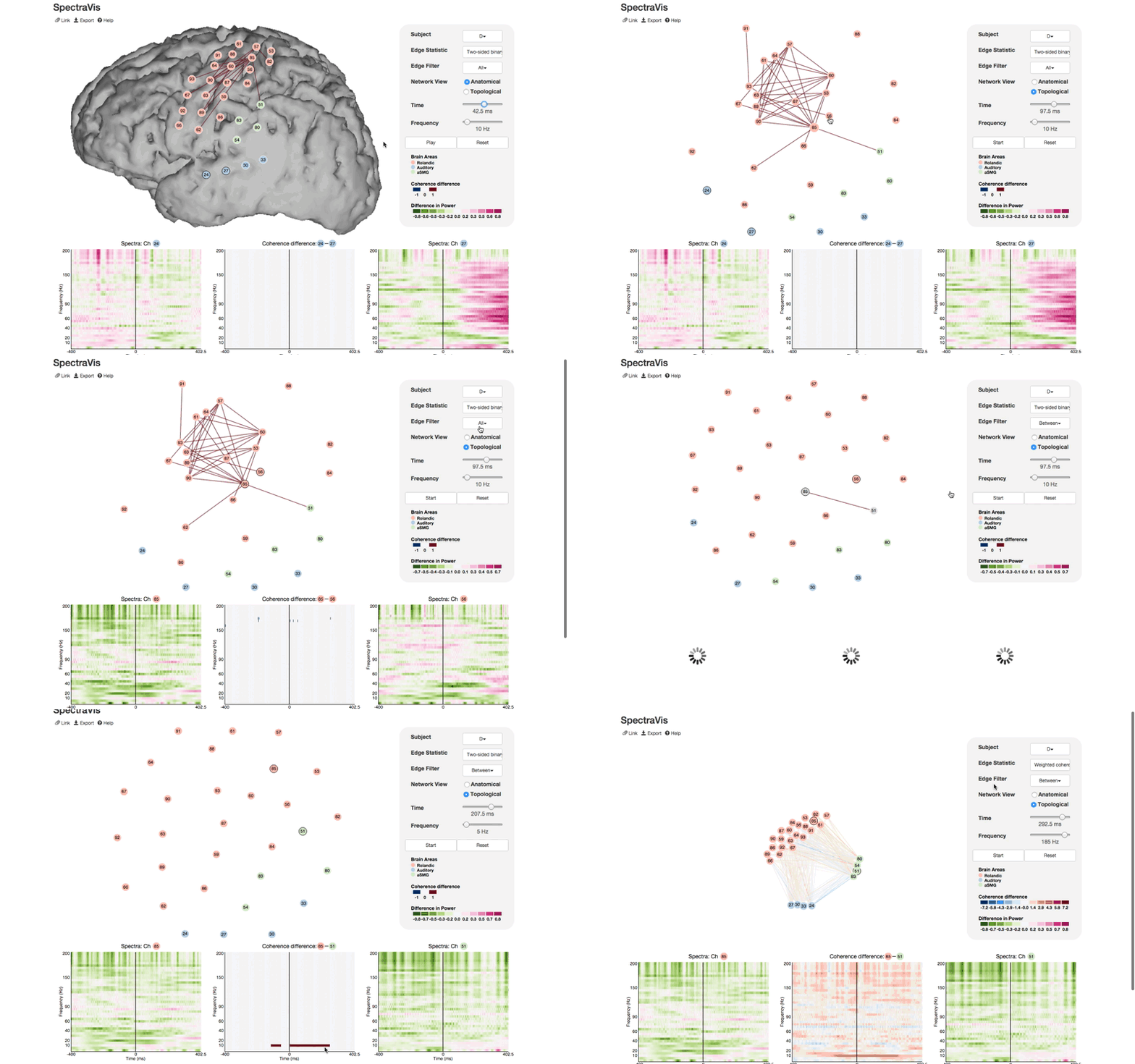
The original page's introductory videos and SpectraVis demonstration are retained below. Project-specific videos remain with Open Source Brain, the Human Brain Project, Virtual Brain, and the China Brain Project. Some describe earlier stages of the field; use the dated research sections above for current scientific claims.
Neuroscience and AI - Matt Botvinick
DeepMind's Matt Botvinick on neuroscience and AI.
AI and neuroscience: The virtuous circle
DeepMind on the virtuous circle between AI and neuroscience.
WEBINAR: Modelling the brain, together
MetaCell webinar on modeling the brain together.
The Nervous System, Part 1: Crash Course Anatomy & Physiology #8
Crash Course Anatomy & Physiology on the nervous system, part 1.
Neural networks and the brain: from the retina to semantic cognition - Surya Ganguli
Surya Ganguli on neural networks and the brain, from the retina to semantic cognition.
Machine Learning in Neuroscience
Siraj Raval on machine learning in neuroscience.
Neuroscience and Artificial Intelligence Need Each Other | Marvin Chun | TEDxKFAS
Marvin Chun's TEDx talk on why neuroscience and AI need each other.
References
- Immersive Reality ... Metaverse ... Omniverse ... Transhumanism ... Religion ... Versions of Yourself
- Telecommunications ... Computer Networks ... 5G ... Satellite Communications ... Quantum Communications ... Smart Cities ... Digital Twin ... Internet of Things (IoT) ... Space-based Data Centers
- Memory
- Artificial General Intelligence (AGI) to Singularity ... Curiosity ... Emergence ... Moonshots ... Explainable AI ... Automated Learning
- Architectures for AI ... New Architecture Options ... Generative AI Stack ... Enterprise Architecture (EA) ... Enterprise Portfolio Management (EPM) ... Architecture and Interior Design
- Neuroscience News - Artificial Intelligence
- Brain (neural networks) | Wikipedia
- SpectraVis
- Society for Neuroscience
- Neural network software | Wikipedia
- Neural Engineering Object (Nengo)
- How to Build a Brain: A Neural Architecture for Biological Cognition (Oxford Series on Cognitive Models and Architectures)
- MICrONS Explorer: linked structural and functional data, with publication and citation information.
- FlyWire: adult fly connectomics resources and associated publications.
- Whole Mouse Brain Atlas: BICCN papers and cell-atlas resources.
- A generalizable foundation model for analysis of human brain MRI: BrainIAC study (2026).
- ConnectoFM: connectomics representation-learning preprint (2026).
- Stanford Digital Brain Project: institutional announcement (2026).
- BRAIN Initiative Roadmap: Building the Next Decade of NeuroAI: research priorities (2026).
- EBRAINS, Open Source Brain, and The Virtual Brain: continuing infrastructure and modeling resources.
- BIDS and NWB: data standards and software ecosystems.