Government services use AI to help people find official information, help staff process documents, and support planning, consultation analysis, research, and cybersecurity. The practical change is a shift from searching separate websites and reading every document manually toward asking a question, retrieving evidence, and preparing an answer or draft for review. America.gov, GOV.UK Chat, and FDA's Elsa illustrate different parts of that shift. GSA: America.gov · GOV.UK Chat · FDA: Elsa
A helpful answer and a legally effective decision are different outputs. An assistant might explain a permit requirement or draft a case summary, while an authorized official or established service process determines the outcome. Good implementation connects answers to current official sources, limits access to personal information, records consequential actions, and gives people a practical way to correct mistakes or reach a person. Evaluation should ask whether the service resolved the request correctly, reduced repeat contacts, and improved access.
The developments below cover public-facing tools, internal applications, and supporting policy and research. A launch announcement establishes that a program exists; it doesn't establish accuracy, accessibility, or net savings. Availability varies by department and jurisdiction. Research updated: November 23, 2026.
AI can support a service without controlling its final decision. A resident could ask which documents a housing application needs, receive links to official guidance, and submit through an authenticated portal. A staff assistant could check for attachments and draft a summary. The authority to approve, deny, or change the resident's record needs explicit rules and review.
From a public question to an accountable outcome
1. Understand
Identify the service, jurisdiction, language, and urgency. Offer a person when needed.
2. Retrieve
Find current official guidance and show sources. Separate public information from protected records.
3. Assist
Explain requirements, extract fields, or draft a response. Flag missing or conflicting evidence.
4. Resolve
Use authorized processes for actions. Record results and provide correction or appeal routes.
Illustrative service design. Each step needs appropriate data permissions and authority.
Applications
A public search assistant, an internal writing tool, and a consultation-analysis system serve different audiences. The impact column describes opportunities and evaluation needs, rather than independently verified savings.
AI-enhanced search across federal information, alongside an executive direction toward a unified digital entry point.
Could reduce the effort of finding the responsible agency. Search doesn't establish eligibility or complete every transaction; use the authorized agency process.
U.S. federal agencies; shared platform launched August 2025. Agency access and approved uses remain separately governed.
Shared infrastructure for agency AI evaluation and use. GSA's current offering includes chat, API access, and usage oversight.
Can reduce duplicated setup. Provider availability changes: GSA announced Anthropic's removal in February 2026. Platform authorization doesn't approve every dataset or workflow. Current platform · Provider change
Assists with reading, writing, summarizing, and comparing material in a government cloud environment.
Can reduce preparation effort. This is an internal assistant, rather than autonomous approval of medicines or other regulated products. Staff need to verify outputs.
UK civil servants; July 2026 guidance describes a waitlist and wider rollout planned for 2027.
Identifies themes in consultation responses and maps responses to those themes.
Can help analysts handle large submissions. Inspect original responses and minority views; frequent themes aren't equivalent to representative public opinion.
Singapore public officers; operational assistant with published usage reporting.
Supports staff drafting and summarization.
Shows how a shared tool can spread across agencies. Program estimates of time saved don't replace independently measured service outcomes.
Information, assistance, and decision authority
Public information
Published guidance and directories. Cite current sources and identify the responsible service.
Internal assistance
Staff documents and drafts. Apply role-based access, retention rules, and output verification.
Consequential casework
Benefits, enforcement, and licensing. Define authority, reasons, audit records, human review, and remedies.
A fluent answer doesn't grant permission to access a record or make a decision.
Advancements
Grounded public answers. Natural-language interaction combined with retrieval can connect a resident's question to official content even when the resident doesn't know agency terminology. Content maintenance remains part of the service: stale guidance can produce a persuasive but outdated answer. America.gov and GOV.UK Chat illustrate this direction. America.gov · GOV.UK Chat
Documents become usable data. Extract and Consult address information locked in planning material and large volumes of public submissions. They can prepare structured evidence for staff, but extraction errors and overlooked arguments can change the substance of a case. Preserve original documents, connect fields to evidence, and test errors across document types. Extract · Consult
Shared platforms and governed integration. USAi and Pair show a move toward common staff services, creating opportunities to manage access and usage centrally. Procurement also needs to address supplier dependency, data export, model changes, incidents, continuity, and review costs. U.S. OMB's April 2025 policies address agency AI use and acquisition; GSA updated its own directive in March 2026. OMB announcement · GSA directive
Agents and research infrastructure. DARPA's August 2025 AI Cyber Challenge results demonstrate systems finding vulnerabilities and proposing patches within a competition setting. The November 2025 Genesis Mission directs a broader AI-assisted scientific platform effort. These are advances in bounded tasks and research infrastructure, rather than proof that an agent can safely run an unrestricted public service. DARPA results · Genesis Mission
Impacts and evaluation
Start with a service problem: a backlog, hard-to-find guidance, repeated transcription, or slow consultation analysis. Measure a baseline before introducing AI, then compare completed cases, accuracy, total staff effort, repeat contacts, and access across groups. A fast draft can still increase total cost if reviewers must repair it or residents submit incorrect applications.
What should improve for the public?
Correct resolution
Measure completed requests, factual errors, inappropriate refusals, and corrections.
Time and total cost
Include review, rework, infrastructure, escalations, and repeat contacts.
Fair access
Test language, disability access, digital exclusion, and different case types. Retain alternatives.
Accountability
Track sources, responsible officials, complaints, appeals, and the ability to stop a faulty process.
Illustrative evaluation framework. Compare outcomes with a baseline, rather than output volume alone.
For residents, better access might mean a clear answer outside office hours or finding the correct form immediately. For staff, it might mean less document sorting and more attention to difficult cases. Risks include incorrect guidance at scale, inappropriate sharing of personal information, automation bias, and shifting work onto people who can't use digital channels. These are evaluation questions for each deployment, rather than claims that every listed tool has produced these effects.
Policy and implementation
U.S. terminology. The September 29, 2026 executive order directs executive agencies to use “Super Intelligence” and “SI” in specified non-statutory communications where law permits. FDA began applying the terminology to new public communications November 16, retaining statutory and regulatory wording. This administrative naming change isn't scientific evidence that systems have achieved superintelligence. This article retains AI as the general technical term. Order · FDA implementation
EU dates changed during 2026. The AI Act has staged application dates. The July 2026 AI Omnibus extended Annex III high-risk requirements to December 2, 2027 and relevant product-embedded high-risk requirements to August 2, 2028. Don't assume the original 2026 schedule applies to every public-sector use. Check the current legal text for the particular system and obligation. Omnibus · Current framework
Read a milestone by its evidence level
Announcement or directive
A commitment, rule, or plan exists. Delivery and benefits may still be ahead.
Pilot or limited access
A bounded group is testing the tool. Findings may not generalize.
Operational service
People or staff can use it in a stated setting. Availability alone says little about quality.
Evaluated impact
Check the method, baseline, measured outcomes, evaluator, and exclusions.
Timeline labels distinguish policy status, availability, and evidence of outcomes.
Timeline
Dated milestones distinguish directives, legislation, announcements, launches, and results. Dates identify the event or publication shown, rather than implying that all implementation was complete. New entries use official sources; the earlier historical collection follows.
Timeline 2026
Date
Jurisdiction
Status and development
2026-11-16
United States
Agency implementation. FDA begins using the executive order’s SI terminology in new public communications, with existing legal wording retained. Official source
2026-09-29
United States
Service launch. GSA unveils America.gov as an AI-enhanced entry point for federal information. This does not establish completion of every agency transaction. Official source
2026-09-29
United States
Executive directive. An executive order directs a unified America.gov digital front door; authorized transactions and exclusions remain defined by the order and agency processes. Official source
2026-09-29
United States
Terminology directive. Executive Order 14434 directs executive-branch terminology changes. Naming does not demonstrate a new technical capability. Official source
2026-08-02
European Union
Staged application. Most AI Act rules become applicable, with separate dates for high-risk systems under the amended schedule. Official source
2026-07-27
European Union
Amendment in force. AI Omnibus takes effect, extending high-risk implementation dates and changing administrative provisions. Official source
2026-07-22
United Kingdom
Access guidance. Consult publishes registration guidance: demand exceeds capacity, access is waitlisted, and broader rollout is planned for 2027. Official source
2026-06-29
European Union
Legislative approval. Council gives final approval to the AI Omnibus, preceding its entry into force. Official source
2026-05-14
United Kingdom
Public tool announcement. GOV.UK Chat is announced for the GOV.UK app, aiming to simplify access to government information. Official source
2026-05-07
European Union
Provisional agreement. Council and Parliament reach an AI Omnibus agreement; final adoption follows later. Official source
2026-03-13
European Union
Negotiating position. Council adopts its position on AI Omnibus simplification proposals. Official source
2026-03-11
United States
Agency governance. GSA issues its updated responsible AI directive, connecting acquisition, assessment, governance, and monitoring. Official source
2026-02-27
United States
Platform and procurement change. GSA announces removal of Anthropic from USAi and its Multiple Award Schedule, illustrating that approved suppliers can change. Official source
Timeline 2025
Date
Jurisdiction
Status and development
2025-11-24
United States
Research directive. Genesis Mission directs a coordinated AI-assisted scientific platform effort. The order establishes goals rather than measured scientific gains. Official source
2025-11-19
European Union
Legislative proposal. Commission proposes AI Omnibus simplification; a proposal is distinct from the subsequently adopted 2026 rules. Official source
2025-08-14
United States
Shared platform launch. GSA launches USAi for federal agency AI evaluation and use. Agencies still need appropriate authorization and data controls. Official source
2025-08-08
United States
Competition results. DARPA reports AI Cyber Challenge results in vulnerability discovery and patching. Competition performance is bounded evidence. Official source
2025-08-02
European Union
Staged application. AI Act provisions for general-purpose models begin applying, subject to the framework’s transition rules. Official source
2025-07-23
United States
National plan. America’s AI Action Plan announces actions on innovation, infrastructure, and international policy. Announced actions are not completed outcomes. Official source
2025-06-09
United Kingdom
Tool announcement. Extract is announced to digitize planning documents and maps, with deployment plans beyond the initial testing. Official source
2025-06-02
United States
Internal tool launch. FDA launches Elsa agency-wide for staff assistance with document-intensive work. Official source
2025-04-03
United States
Use and procurement policies. OMB announces M-25-21 and M-25-22, updating federal AI use and acquisition policy. Official source
2025-02-02
European Union
Staged application. Initial AI Act prohibitions and AI literacy provisions begin applying. Later amendments change parts of the framework. Official source
2025-01-23
United States
Executive directive. An executive order directs development of an AI action plan and review of earlier policies. Official source
2025-01-21
United Kingdom
Staff tools announcement. Government introduces the Humphrey suite of AI tools for civil-service work. Official source
2025-01-13
United Kingdom
National plan. AI Opportunities Action Plan sets out recommendations on capability, adoption, and public-sector use. Official source
Timeline 2024
Date
Jurisdiction
Status and development
2024-09-05
Council of Europe
Treaty opened for signature. AI Framework Convention opens for signature in Vilnius. Signature is distinct from ratification and entry into force. Official source
2024-08-01
European Union
Regulation in force. AI Act enters into force, starting a staged implementation schedule. Official source
2024-07-26
United States
Risk guidance. NIST publishes its Generative AI Profile, a companion to the voluntary AI Risk Management Framework. Official source
2024-05-21
European Union
Legislative approval. Council gives final approval to the AI Act before its August entry into force. Official source
2024-05-17
Council of Europe
Convention adoption. Committee of Ministers adopts the AI Framework Convention, ahead of its opening for signature. Official source
2024-03-07
India
National mission approval. Cabinet approves IndiaAI Mission to support compute, data, skills, innovation, and responsible AI capacity. Official source
2024-01-24
United States
Research pilot launch. NSF launches the National AI Research Resource pilot to broaden access to AI research infrastructure. Official source
Additional contemporary coverage
The following retained reporting provides political and security context. Headlines and quoted positions are attributed to their publishers, rather than statements of technical capability.
Historical events and reporting below retain their original dates. Earlier executive orders and policy announcements may have been replaced or revoked; consult current guidance for operational decisions.
Senators use hearings to explore regulation on artificial intelligence | Ryan Terinelli - Roll Call ... Lawmakers are looking to build rules for AI as the technology comes into greater public consciousness ... Judiciary Subcommittee on Privacy, Technology and the Law. Samuel Altman, the CEO of OpenAI, which released ChatGPT, told the committee that the artificial intelligence research and deployment company thinks “regulatory intervention by governments will be critical to mitigate the risks of increasingly powerful models.” May 17, 2023
Annual Defense Bill ... 63-page AI plan establishing a civilian-led initiative to coordinate and accelerate investments in “trustworthy” artificial intelligence systems across the federal government.
The recordings below document earlier hearings and views at the time they were recorded. Speaker titles and organizational roles in historical descriptions may have changed.
LIVE: AI Startup Anthropic’s CEO Dario Amodei Testifies to Senate on Potential Regulations Anthropic CEO Dario Amodei testifies to the US Senate on potential AI regulation.
The Power of Artificial Intelligence - US Congressional Hearing, June 26th, 2018
Subcommittee on Research and Technology and Subcommittee on Energy Hearing - Artificial Intelligence - June 26th, 2018 Dr. Tim Persons, chief scientist, GAO Mr. Greg Brockman, co-founder and chief technology officer, OpenAI Dr. Fei-Fei Li, chairperson of the board and co-founder, AI4ALL OpenAI was founded by Elon Musk and Sam Altman
US Congress Artificial Intelligence Hearing - Hearing I
Recorded: Feb 14th, 2018
“Over the next three months, the IT Subcommittee will hear from industry professionals as well as government stakeholders with the goal of working together to keep the United States the world leader in artificial intelligence technology,” said Chairman Hurd. Witnesses: Dr. Amir Khosrowshahi - Vice President and Chief Technology Officer, Artificial Intelligence Products Group, Intel Dr. Charles Isbell - Senior Associate Dean, College of Computing Georgia Institute of Technology Dr. Oren Etzioni - Chief Executive Officer Allen Institute for Artificial Intelligence Dr. Ian Buck - Vice President and General Manager, Tesla Data Center Business, NVIDIA
US Congress Artificial Intelligence Hearing - Hearing II
Recorded: March 7th, 2018 Witnesses: Mr. John O. Everett, Ph.D. -Deputy Director, Information Innovation Office, DARPA Mr. Keith Nakasone - Deputy Assistant Commissioner, Information Technology Category Acquisition Management, U.S. General Services Administration (GSA) Mr. James F. Kurose, Ph.D. - Assistant Director, Computer Science and Information Science and Engineering National Science Foundation Mr. Douglas Maughan, Ph.D. - Division Director, Cybersecurity Division, Homeland Security Advanced Research Project Agency, U.S. Department of Homeland Security (DHS)
US Congress Artificial Intelligence Hearing - Hearing III
Recorded: April 18th, 2018 Witnesses: Gary Shapiro - President - Consumer Technology Association Jack Clark -Director, OpenAI Terah Lyons -Executive Director , Partnership for AI Ben Buchanan - Postdoctoral Fellow, Cyber Security Project, Science, Technology, and Public Policy Program, Belfer Center for Science and International Affairs, Harvard Kennedy School
The First Congressional Hearing on Artificial Intelligence
Witnesses: - Dr. Eric Horvitz, Interim Co-Chair, Partnership on Artificial Intelligence; Managing Director, Microsoft Research Lab - Dr. Andrew Moore, Dean, School of Computer Science, Carnegie Mellon University - Mr. Greg Brockman, Cofounder and Chief Technology Officer, OpenAI - Dr. Steve Chien, Senior Research Scientist, Autonomous Space Systems and Technical Group Supervisor, Artificial Intelligence Group, NASA Jet Propulsion Laboratory, California Institute of Technology Hearing Details: Subcommittee on Space, Science, and Competitiveness Hearing Wednesday, November 30, 2016
Interview: Congressional Artificial Intelligence Caucus
The chairmen of the House of Representatives caucus aimed at ensuring rapid innovation in artificial intelligence discuss the social impacts and opportunities the technology brings plus how legislation fits in.
U.S. Rep. Pete Olson, Co-Chair, Congressional Artificial Intelligence Caucus U.S. Rep. Jerry McNerney, Co-Chair, Congressional Artificial Intelligence Caucus Moderator Michael Hoffman, President, GovernmentCIO Media & Research
Executive Branch: White House & Federal Departments/Agencies
AI Covert Testing Used Common Platforms to Create Viable Attack Plans | GAO ... The report (publicly released around November 18, 2026, after completion in October) describes GAO’s spring 2026 covert testing of the then-most-used generative AI platforms; ChatGPT, Claude, Gemini, and Grok. Investigators used prompts (and common techniques to bypass initial safeguards) that led the systems to produce detailed, largely viable information for planning attacks: two platforms on constructing/detonating an IED for mass casualties, and two on targeting the electrical grid (via drone or firearms) for economic harm. Plans included specifics on targets, locations (e.g., in major U.S. cities), methods, and sometimes timing; each took under 12 hours. GAO verified feasibility with experts but withheld exact prompts, assignments of which model produced what, and operational details to avoid enabling misuse.
AI: New Horizons in Medicine
Data analytics and artificial intelligence have sharpened delivery of health care and medical discoveries. Agency experts explore the various ways natural language processing, machine learning, robotic process automation and data analytics play a role in revolutionizing the landscape of health and the public. Listen to discussion by Veterans Affairs' Gil Alterovitz; GSA's Anil Chaudhry; Acxiom's Craig Wingate; National Library of Medicine's Patti Brennan; NVIDIA's Mona Flores; NIH's Behrouz Shabestari and Alastair Thomson; DHS' Karen Evans; DARPA's Rohit Chitale; DHA's Jesus Caban; Red Hat's Ben Cushing; DHMS' Chris Nichols; HHS OIG's Caryl Brzymialkiewicz; and NetApp's Ray Deiotte.
Trump signs AI initiative to ensure American leadership
U.S. President Donald Trump signed an executive order Monday, launching an initiative to ensure the country's leadership in artificial intelligence (AI). This technology-promoting initiative calls for protecting the advantage of the United States in AI "against strategic competitors and foreign adversaries," but without specifying its competitors or adversaries.
President Barack Obama on How Artificial Intelligence Will Affect Jobs | WIRED
WIRED guest editor President Barack Obama, WIRED editor in chief Scott Dadich and MIT Media Lab director Joi Ito discuss how artificial intelligence might up-end economies and how societies can adapt.
White House announces artificial intelligence task force
The White House held a summit with tech leaders on A.I., saying it plans to take an "America First" approach to promoting the technology. House Democrats also released more than 3000 Facebook ads they say show Russian interference in the 2016 presidential election. CNET Executive Editor Ian Sherr joins CBSN to discuss the latest.
Trump White House panicked about China's investment in AI: Alex Turkeltaub
Roam Analytics Advisor co-founder Alex Turkeltaub on efforts for U.S. to take the lead in the field of artificial intelligence.
Web Summit 2019 - CTO of The United States, Perspective from The White house by Michael Kratsios USA
I was today at the amazing WebSummit conference in Lisbon and I will share all the videos with the world so you can also have the opportunity to watch the world’s biggest leaders.
National Security Agency (NSA)
CNSA 2.0 addresses quantum-resistant cryptography for national security systems. It shouldn't be described as a blanket claim that post-quantum cryptography is already the default across all federal browsers, networks, and operating systems. NSA's current suite page describes a phased transition through 2031; component profiles and updated guidance determine applicable requirements. Agencies should inventory cryptographic dependencies and consult the current profile for their systems. NSA: current CNSA Suite guidance
Artificial Intelligence in Federal Procurement
Learn about artificial intelligence in federal procurement, and riding the digital wave of transformation. www.gsa.gov
Artificial Intelligence - Expanding the Value Proposition for Federal Agencies
This video discusses how GSA can help the federal government modernize its IT infrastructure and application through the use of Artificial Intelligence. www.gsa.gov
Non-US Bodies
Current international developments appear in the 2024–2026 timeline and applications sections above. The material below retains earlier institutional and country coverage as historical context.
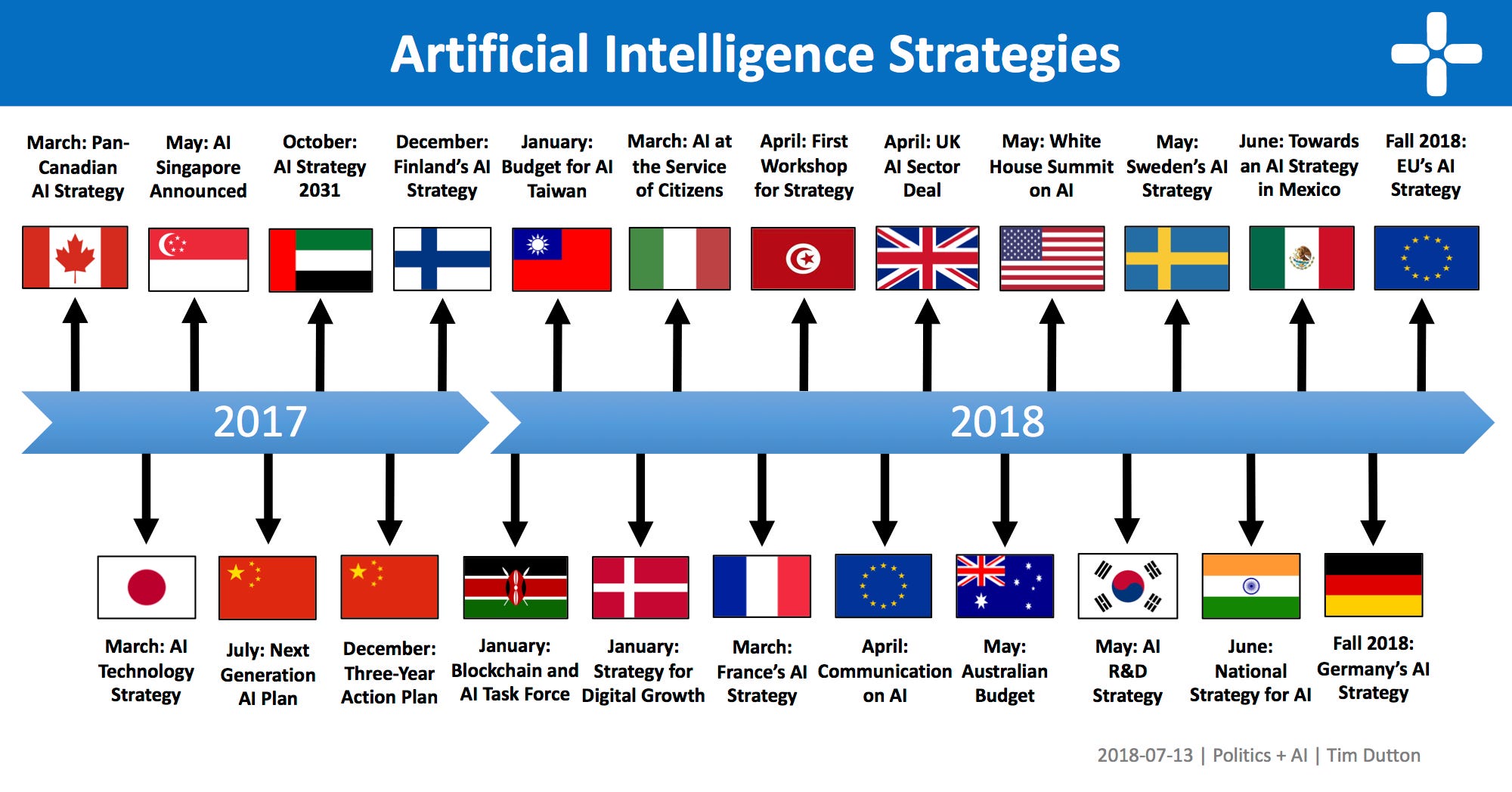
Assessing the EU's Artificial Intelligence Strategy - European Parliament roundtable 26 April 2018
Roundtable organised by MEP Marietje Schaake on 26 April 2018 in the European Parliament featuringJuha Heikkila (Head of Unit of DG Connects Robotics and Artificial Intelligence Unit (European Commission), Andre Loesekrug-Pietri (JEDI - Joint European Disruptive Initiative), Nicklas Lundblad (Vice-President Public Policy and Governmental Relations EMEA, Google), Stephanie Fink (Senior Director, Salesforce), Prof. Luciano Floridi (University of Oxford)
What Disruptive Technologies and Artificial Intelligence Mean for NATO
This video establishes a baseline understanding of disruptive technology (DT), artificial intelligence (AI) and autonomy aimed at NATO policymakers and senior military officials. It explains disruptive technology and its historical importance for military innovation and changes in warfare, in addition to the current state of artificial intelligence and autonomous systems technology. The video features experts Dr. Andrew Moore, Dean of the School of Computer Science at Carnegie Mellon University and Co-Chair of the CNAS Task Force on AI and National Security, and Paul Scharre, Senior Fellow and Director of the Technology and National Security Program at CNAS and Executive Director of the CNAS Task Force on AI and National Security.
Leading scientists address dangers of Artificial Intelligence before United Nations
Recently esteemed M I T physicist, Max Tegmark, and science philosophy professor, from Oxford university, Nick Bostrom, joined forces to address the United Nations. They were there with the sole purpose of addressing their concerns over the dangers of Artificial Intelligence.
NATO to Use Artificial Intelligence in Military Operations
Warfare developments will increasingly involve artificial intelligence systems. #NATO is actively working to make sure #AI advances are appropriately used for future military decision-making.
AI For Good - UN Congress on Artificial Intelligence
Audi CEO Prof. Rupert Stadler has spoken at a congress of the United Nations about the use of artificial intelligence for the benefit of humankind. In his keynote speech at the start of the “AI for Good Global Summit,” he stated that automated driving presents an opportunity to improve life significantly. He warned, however, against excessive expectations: “In situations where an accident is unavoidable, we expect a decision from the autonomous car. But a dilemma situation cannot be solved either by a human or by a machine.” Therefore, alongside legal issues, ethical questions about the use of the new technology also needed to be discussed, he added. With the beyond initiative, Stadler is now calling for such a discourse. At the first “AI for Good Global Summit” in Geneva, the Chairman of the Board of Management of AUDI AG said in front of UN experts: “We need a discourse in society that looks at the enormous potential of piloted and autonomous driving in relation to the ethical and legal questions.” Artificial intelligence (AI) is regarded by experts from science and industry as a key technology for piloted and autonomous driving. It assists the car in perceiving and interpreting its environment, and deriving decisions from this. But who is liable in the case of accidents, and how should the car driving autonomously behave in a situation of unavoidable danger? Prof. Stadler: “We take the concerns of the public seriously and are facing up to the challenges associated with this.”
Artificial Intelligence: The Future of Homeland Security
i24NEWS DESK | Israel is hosting an event surrounding the use of artificial intelligence for homeland security. Our Daniel Tsemach has more. Story: Israel is hosting it's first ever international event for artificial intelligence and security led by the Israel Export Institute and the Foreign Trade Administration. There were 65 representatives from around the world in attendance for the week long event, in order to find out how Artificial Intelligence can assist with homeland security. Companies were featuring A.I. technology from virtual reality to facial recognition software.
News - China and Russia have agreed to work together on using artificial intelligence for military purposes, adding a new dimension to their rivalry with Washington. In a recent statement, the Russian foreign ministry stated that during talks in Beijing last week, departmental officials from both countries extensively discussed and exchanged assessments on the use of AI technology for military purposes.
What's their plan? Both countries have decided to work together more closely within the UN-backed Group of Governmental Experts (GGE) on Lethal Autonomous Weapons Systems (LAWS). The group focuses on creating guidelines for the responsible development and use of such advanced weapons. In this context, the agreement between Russia and China confirms that they have a similar approach to such weapons.
Why is this problematic? The rapid growth of AI has sparked concerns about lethal autonomous weapons systems. This is due to major powers like the U.S., China, and Russia investing heavily in AI without any agreed-upon rules for the technology, particularly its military use. It is also worth noting that last year, Washington launched the Political Declaration on the Responsible Military Use of Artificial Intelligence and Autonomy, aiming to set global norms. This was supported by 46 countries, mainly U.S. allies like Australia, Britain, Canada, Singapore, and South Korea. However, China and Russia chose to not join this effort.
Since at least late 2024, China-based AI companies, including DeepSeek (DeepSeek Artificial Intelligence Technology Research Co., Ltd.), Moonshot AI (Beijing Moonshot Technology Co., Ltd.), Alibaba Group, MiniMax (Shanghai MiniMax Co., Ltd.), StepFun (Shanghai Jieyue Xingchen Intelligence Technology Co., Ltd.), and Z.AI, have conducted high-volume knowledge distillation campaigns against several U.S. AI companies. The sheer scale of these campaigns and their sophistication indicate that
distillation is not a supplement to these companies’ AI model development, but the critical core of it.
Chinese Perspectives on AI and Future Military Capabilities | Ryan Fedasiuk - CSET ... This study constructs a framework for systematically assessing arguments about AI’s effect on military capabilities and strategic stability. It applies the framework to 58 journal articles written from 2016–2020 by People’s Liberation Army (PLA) officers, defense industry engineers, and academics at leading Chinese universities (hereafter “experts”) about artificial intelligence and future weapons systems.
Rise of Chinese AI and Quantum computing threatens American military tech, says report for US Congress | Kristin Huang - South China Morning Post ...The days of the PLA lagging well behind the US in military technology are long gone, says analyst
US or China Winning in AI? China the World Leader by 2030?
Matthew Voke Is China Winning in AI, or the US? Will China be the World Leader by 2030? Who's ahead in Artificial Intelligence? Is the US or China winning the AI race? In 2020, who's leading in AI Competition between China and the United States? I hear these questions frequently. China has stated that they will be the world leader by 2030, but where are they right now, and how likely are they to achieve dominance in the next decade? This video examines where the United States and China have strengths in 2020, and where they are weak. What are their approaches to innovation in Artificial Intelligence, and how will they improve over the next decade. ##Kai-Fu Lee's "AI Superpowers" Book is great: https://amzn.to/35gXZGN ##Graham Allison's "Destined for War" Book explains the thucydides' Trap: https://amzn.to/2Wme0aL Finally let's talk about the Thucydides' Trap. This is an area of concern when people begin talking about an "Artificial Intelligence Arms Race." This is NOT an Arms Race, nor should it be treated as such. I'll discuss why. I wrote this myself, used some videos under fair use - the owner is in the bottom of the video. I do not push, support, or endorse any policy, strategy, or grand strategy in this video. These are my views alone, and may not reflect those of the United States Department of Defense, or the United States Government.
Chinese Defense Innovation: AI, Cyber, and Quantum Computing
Elsa Kania, Adjunct Fellow - Center for a New American Security’s Technology and National Security Program Emerging Technologies in Great Power Competition CYBERWEEK 2018 Tel Aviv University 19.6.18
What data does China have on its citizens?
The "oracle of AI" Kai Fu Lee says the data the Chinese government has collected on its citizens is "too large and too raw" to be used for AI.
Who is winning the artificial intelligence race?
In a recent talk at Stanford, Kai-Fu Lee says China has taken the lead. Lee is a venture capitalist and author of “AI Superpowers: China, Silicon Valley and the New World Order.” Who’s winning the worldwide competition to develop and exploit artificial intelligence? Not the U.S., says Kai-Fu Lee, a venture capitalist and author of AI Superpowers: China, Silicon Valley and the New World Order. Although researchers and tech companies in the U.S. hold the lion’s share of AI patents and are responsible for key breakthroughs in the field, the game has changed, and China is taking the lead. “We are now in the implementation phase. It’s a question of who can build the fastest,” Lee said during a recent talk at the AI Salon series presented by the Stanford Human-Centered Artificial Intelligence (HAI) Initiative and the Stanford Artificial Intelligence Lab (SAIL). Building the fastest doesn’t necessarily require the top tier of researchers. “For most applications, you don’t really need super AI experts. Young AI engineers will suffice,” he said. And China has them. Indeed, the last really significant breakthrough in AI – deep learning – was nine years ago, Lee said. “Without big breakthroughs, it is hard for the U.S to maintain its lead because AI technologies are reasonably well understood,” he said. Machine learning and artificial intelligence rely on data – lots of data – to function. And that’s where China has its biggest advantage. Not only does China have a huge population, its residents lead by far the United States in the use of mobile applications and payments. Every click, every sale, generates data. “If data is the new oil, China is the new OPEC,” Lee said. What’s more, the business environment in China is friendlier to AI companies, with more government support and less regulation than in the U.S. China’s advances in AI haven’t gone unnoticed by investors. Last year, 48 percent of the venture capital money directed to AI went to China, compared with 38 percent invested in U.S. ventures, Lee said. There are, of course, challenges posed by AI, not the least of which is the threat of job losses, a point made by Lee and two other speakers at the Salon: Susan Athey, a professor of economics at Stanford Graduate School of Business, and Erik Brynjolfsson, director of the MIT Initiative on the Digital Economy. Even so, the stakes in the AI race are extremely high. Over the next 11 years, AI and related technologies will account for some $11 trillion in economic activity, a sum larger than the combined economies of China and India, Lee said.
Shaping the Future of Artificial Intelligence in China
Between 2010 and 2015, artificial intelligence-related patent applications in China grew to over 8,000 submissions, up 190% from the previous five years. What is the role and responsibility of Chinese businesses to accelerate the technology’s potential while mitigating potential negative impacts for the world? Dimensions to be addressed: - New collaboration and partnership models for AI research and development - Public awareness of AI and tackling issues of public trust - (Un)blocking data flows throughout industry supply chains Speakers: - Dai Wenyuan, Founder and Chief Executive Officer, 4th Paradigm Data & Technology Co., People's Republic of China. - Huang Dinglong, Co-Founder and Chief Executive Officer, Malong Technologies, People's Republic of China.
Wendell Wallach, Scholar, Interdisciplinary Center for Bioethics, Yale University, USA. - Wang Xiaoming, Director, Center for Innovation Strategy and Policy Research, Chinese Academy of Sciences, People's Republic of China. - Yuan Hui, Chairman, Shanghai Xiaoi Robot Technology, People's Republic of China.
AI in China
The Chinese state run news agency Xinhua recently revealed the first Artificial Intelligence news anchor. They're now able to generate video of a newscaster using a model trained on real newscaster data and use it to disseminate information 24/7. When I saw this, I knew it was time to start studying China's role in the AI revolution in-depth. In this video, I'll cover China's power structure, generative adversarial networks, its startup scene, Confucianism, the social credit scoring system, algorithmic policing, surveillance, privacy, autonomous weapons, and convolutional neural networks. A lot of different topics to cover, but I hope this video provides a coherent narrative around the use of AI in China and how it plays into the global AI community. Enjoy!
Vladimir Putin at the AI Journey 2019 conference on artificial intelligence.
Russian President Vladimir Putin recently explained what he believes is necessary to rule the world. “If someone could guarantee themselves a monopoly in the area of artificial intelligence, the consequences are clear to us all – they would become the world ruler,” the TASS news agency cited Putin as saying. The Russian president remarked that the fight for technological superiority, including in the field of AI, has already become a field for global competition. “The speed at which new products and solutions are created is growing exponentially,” he observed. Putin noted that many countries have already chosen their strategies concerning AI. “We too, of course, must ensure our technological sovereignty in the AI field,” he said, adding that it is the most important condition for the success of Russia’s business, economy, security, defensive capability and quality of human life.
Bendett, Kania & Watley on Chinese, Russian Artificial Intelligence, Autonomy
Sam Bendett of the Center for Naval Analysis, Elsa Kania of the Center for a New American Security, and Jack Watley, PhD, of the Royal United Services Institute, discuss Russian and Chinese artificial intelligence and autonomy capabilities with Defense & Aerospace Report Editor Vago Muradian. The interview was conducted after a panel discussion hosted by CNA at its Northern Virginia headquarters.
Russia's War in Ukraine
The Russian Ministry of Defense has created an AI department for implementing artificial intelligence in weapons development. Russia has invested enormous resources into the development of artificial intelligence, big data and software technologies; impacting various aspects of modern warfare, such as intelligence gathering, autonomous weapon systems, cybersecurity, and information warfare.
Artificial Intelligence Montreal Powerhouse
#AITechMTL , Discover Montréal's #AI #ML #datascience scene! A seductive overview of the thriving Montréal's AI ecosystem - starring world famous AI researchers and the most innovating companies in deep learning, data science and machine learning such as : - Google Brain - Facebook - DeepMind - Maluuba
Element AI - Samsung - Thales - Imagia Key speakers: - (0:08) Justin Trudeau, Prime Minister of Canada - (0:26) Yoshua Bengio - Full Professor, Université de Montréal & Head of the Montreal Institute for Learning Algorithms (MILA) - (0:43) Doina Precup - Associate Professor- McGill School of Computer Science - DeepMind - (01:04) Yann LeCun - Director of AI Research - Facebook - (01:13) Hugo Larochelle - Lead of Google Brain team, Montréal - (1:40) Mohamed Musbah - Head of Product - Microsoft Research Maluuba, Montréal - (1:52) Valérie Bécaert- Director Reasearch group - Element AI - (2:06) Alexandre Le Bouthiller- Founder & COO - Imagia Video produced by TCB MÉDIAS
Deep Learning (DL) solutions for Smart Cities use cases
Deep Learning techniques are being used to address challenges in Smart Cities. Though many use cases have been solved independently, stitching these solutions together using a flexible, scalable and efficient architecture is difficult. We developed a platform for Smart Cities. Here are some technical papers and solutions that inspired us in the process.
How AI can transform Public Services
Our CEO, Keesup Choe was invited to the Essex quarterly Partnership Board Meeting to help inspire the board with innovative ways in which they could help drive forward public sector reforms across Greater Essex. Here he describes ‘How AI can transform Public Services’