Time: Do the past, present, and future exist all at once? | BigThink (video) ... astrophysicist Michelle Thaller, science educator Bill Nye, author James Gleick, and neuroscientist Dean Buonomano discuss how the human brain perceives of the passage of time, the idea in theoretical physics of time as a fourth dimension, and the theory that space and time are interwoven.
Crown Sterling ... changing the face of digital security with its non-integer-based algorithms that leverage time, AI and irrational numbers.
Quantum cryptography ... the infosec industry looks to quantum cryptography and quantum key distribution (QKD)
What’s a Time Crystal? | Charles Q. Choi - IEEE Spectrum ... And how do Google researchers use quantum computers to make them? ... quantum system of many particles that organize themselves into a periodic pattern of motion—periodic in time rather than in space—that persists in perpetuity.
NIST's aluminum-ion "quantum logic" clock reached a systematic uncertainty of 5.5×10⁻¹⁹, 41% better than the previous record, and feeds the international effort to redefine the second.
Ten optical clocks in six countries were compared at the same time over fiber and satellite links, producing 38 frequency ratios. Some results disagreed, showing that comparison uncertainties must still shrink before the second can be redefined.
Classical machine learning models such as XGBoost detected GPS spoofing with about 94% accuracy, and a ResNet18 network classified jamming types from spectrogram images with about 99% accuracy.
Timekeeping is heading for its biggest change since 1967, when the second was defined by the caesium atom. Optical atomic clocks, which use lasers to probe atoms held in an optical lattice or a single trapped ion, now outperform the best caesium fountain clocks by about two orders of magnitude. In July 2025 NIST's aluminum-ion clock set an accuracy record of 5.5×10⁻¹⁹, and in June 2025 a coordinated campaign compared ten optical clocks across six countries. The international roadmap targets 2030 for a decision on an optical definition of the second (see Redefining the Second).
AI is entering timing and navigation mainly as a detection and prediction tool. Researchers train machine learning models to recognize GNSS spoofing and jamming from receiver measurements and spectrograms, and quantum navigation systems use machine learning to strip a vehicle's own magnetic noise from sensor readings (see Quantum Sensors in Navigation). On the forecasting side, pretrained time-series foundation models now predict the next values in a sequence the way large language models predict the next word (see Time Series Foundation Models).
Atomic Clocks Are Reinventing Time
Though humans don't experience it in their daily lives, gravity and movement can change how time elapses. Ultra-precise atomic clocks are now able to measure these tiny changes, known as time dilation. It's a technological advance that could revolutionize our understanding of time.
How Far Back is the James Webb able to See? with Dr. Klaus Pontoppidan
How Far Back is the James Webb able to See?
Project scientist for the James Webb Space Telescope Dr. Klaus Pontoppidan explains the science revealed in the first full-color images released from the JWST.
A Brief History of Timekeeping
SciShow It’s time for another leap second! Join SciShow as we celebrate by exploring the long and strange history of timekeeping. Hosted by: Michael Aranda Dooblydoo thanks go to the following Patreon supporters -- we couldn't make SciShow without them! Shout out to Justin Ove, Justin Lentz, David Campos, John Szymakowski, Peso255, Jeremy Peng, Avi Yaschin, and Fatima Iqbal. Like SciShow? Want to help support us, and also get things to put on your walls, cover your torso and hold your liquids? Check out our awesome products over at DFTBA Records: https://dftba.com/scishow Or help support us by becoming our patron on Patreon: https://www.patreon.com/scishow
TimeLine - A Brief Introduction To The History Of Timekeeping Devices
SpotImageryLtd An animated documentary about how time was measured in the past, and how we measure it in present day.
This 3D Quantum Gas Clock Could Redefine Time
Seeker Time may be a human construct but that hasn't stopped physicists from perfecting it. Read More: JILA’s 3-D Quantum Gas Atomic Clock Offers New Dimensions in Measurement https://www.nist.gov/news-events/news... “JILA physicists have created an entirely new design for an atomic clock, in which strontium atoms are packed into a tiny three-dimensional (3-D) cube at 1,000 times the density of previous one-dimensional (1-D) clocks. In doing so, they are the first to harness the ultra-controlled behavior of a so-called “quantum gas” to make a practical measurement device.” Jun Ye: Let There Be Light (and Thus, Time) https://www.youtube.com/watch?v=bbBmk... Dr. Jun Ye, professor of physics at the University of Colorado at Boulder and a fellow of both the National Institute of Standards and Technology and JILA, explains how lasers are used to manipulate atoms inside and out for ultra-precise clocks. Ultra-Accurate Clocks Lead Search for New Laws of Physics https://www.quantamagazine.org/ultra-.. Atomic clocks are letting physicists tighten the lasso around elusive phenomena such as dark matter. Sign Up For The Seeker Newsletter Here - https://bit.ly/1UO1PxI Seeker inspires us to see the world through the lens of science and evokes a sense of curiosity, optimism and adventure.
Visit the Seeker website https://www.seeker.com/
David Wineland Public Lecture: Keeping Better Time - The Era of Optical Atomic Clocks
Perimeter Institute for Theoretical Physics David Wineland, 2012 Nobel Laureate in Physics, will explore the theoretical and technological know-how needed to build ultra-precise atomic clocks during his Perimeter Institute Public Lecture on Wednesday, Nov. 4, 2015. Find information about future Perimeter institute Public Lectures here: https://ow.ly/UiOr5
A brief History of the Calendar and Time Keeping
School of Business and Economics Tuesday 23 February, 20h00 • Aula Minderbroedersberg 4-6 • Dr. Donna Carroll, Lecturer of Physics, Maastricht University How many times a day do you check your calendar or look at your clock? These days our lives are driven by deadlines, schedules and timetables. Time and its many divisions (hours, days, weeks, months, and years) have completely shaped our lives and yet we seldom take the time to consider how these concepts arose. The calendar is inextricably linked to the mechanics of our solar system, and the way in which we describe our periods of time has arisen from ancient speculation in astronomy, mathematics and religion.
In this talk, Donna Carroll will provide a brief history of our calendar and an introduction to time measurement. A fascinating field where astronomy, astrology, mathematics, politics, agriculture, superstition and religion all come together. For more information please visit: SG Maastricht: https://www.sg.unimaas.nl/ Talkin'Business: https://www.talkinbusiness.nl/ University Maastricht: https://www.maastrichtuniversity.nl/
WSU: Space, Time, and Einstein with Brian Greene
World Science Festival Join Brian Greene, acclaimed physicist and author, on a wild ride into the mind of Albert Einstein, revealing deep aspects of the world that defy everyday experience. Using a visually rich canvas of animations, Greene leads you through all the startling conclusions of special relativity, from time travel to space warps to E = mc2. In the span of 2+ hours, this short master class will change your conception of reality. This is a mostly non-mathematical version of the WSU Master Class “Special Relativity with Brian Greene.” https://youtu.be/XFV2feKDK9E #WorldSciU
The Special Theory of Relativity - 00:05
Speed - 00:05:50
The Speed of Light - 00:18:23
Relativity of Simultaneity - 00:27:42
Time in Motion - 00:37:42
How Fast Does Time Slow? - 00:47:49
Time Dilation: Experimental Evidence - 01:05:31
The Reality of Past, Present, and Future - 01:14:37
Time Dilation: Intuitive Explanation - 01:28:38
Motion's Effect on Space - 01:32:34
The Pole in the Barn: Quantitative Details - 01:49:48
The Twin Paradox - 02:10:39
Implications for Mass - 02:19:17
Special Relativity - 02:29:06
Timing in Mission-Critical Systems
GPS World You’ll hear from our expert speaker panel about real-life timing challenges in mission-critical applications, such as satellite and military communications, test ranges and radar; time transfer accuracy and stability via GPS or PTP; and what technologies to look for in your next-generation instrument class clock to cost-effectively deliver accurate and stable time and frequency signal types, signal output flexibility and robust security. Speakers: Paul Skoog, Microsemi Corporation; Scott Williams, G.L. Williams Associates; and James L. Wright, Range Generation Next Original Broadcast Date: March 31, 2016
The Importance of Time Synchronization - I&C Short Tips
Affinity Energy Learn more at https://affinityenergy.com - Time synchronization is overlooked in terms of specification of applications in terms of hardware, proper controls, and data acquisition. Here's an example of why time synchronization is so important in a double ended substation.
The Earth's rotation is so accurate it varies only in milliseconds ...do you feel the Earth rotation slowing down?
Imagine you have a special clock that works with light. This clock has two mirrors facing each other, and a beam of light bounces up and down between them. Every time the light goes from the bottom mirror to the top and back down, it counts as one tick of the clock. Einstein's light clock thought experiment shows that when things move fast, time slows down for them. This surprising idea helps us understand the nature of time and motion in our universe. Now, let's think about this clock in two different situations.
Situation 1: Standing Still: First, picture the clock sitting on a table, not moving at all. The light goes straight up to the top mirror and straight back down to the bottom mirror. If you measured the time it takes for the light to do this, you would see it takes a certain amount of time for one tick.
Situation 2: Moving Clock: Now, imagine you place the clock on a skateboard and push it so it's moving. As the clock moves, the light beam has to travel a different path. Instead of going straight up and down, it now has to go in a diagonal path because the mirrors are moving while the light is traveling. It's like when you throw a ball to a friend while running; the ball has to cover more distance because both of you are moving.
What This Means ... Because the light in the moving clock has to travel a longer, diagonal path, it takes more time for one tick to happen compared to when the clock is standing still. This means that for someone watching the moving clock, time appears to run slower for the moving clock compared to a clock that's not moving. This idea is called time dilation. It means that time actually passes at different rates depending on how fast something is moving. If you were riding on the skateboard with the clock, you wouldn't notice anything different about the clock's ticks. But someone standing still and watching you would see that your clock ticks more slowly.
Why It Matters ... This thought experiment helps us understand that time isn't the same everywhere and can be different depending on how fast things are moving. This concept is a key part of Einstein's theory of special relativity, which helps scientists understand how the universe works, especially when things are moving very fast, like spaceships or particles in a collider.
Since 1967 the SI second has been defined by microwave radiation from caesium-133 atoms: exactly 9,192,631,770 oscillations make one second. Optical clocks tick at frequencies about 50,000 to 100,000 times higher, so they divide time far more finely. The best of them now have systematic uncertainties roughly 100 times lower than the best caesium fountain clocks, which means the definition itself has become the limit on how accurately time can be measured.
Option 1: define the second by a single optical atomic transition.
Option 2: define it by a weighted average of several optical transitions.
Option 3: fix the value of another fundamental constant, such as the electron mass. This is impractical for now because those constants are known far less precisely than optical clocks can measure.
Timeline: the General Conference on Weights and Measures (CGPM) reviews progress in 2026. The Consultative Committee for Time and Frequency (CCTF) then checks the mandatory criteria in 2028 and 2029. The CGPM could adopt a new definition in 2030 if those criteria are met and there is consensus. Caesium clocks would then become secondary standards and would still contribute to UTC.
Recent milestones
Record accuracy (July 2025): NIST's aluminum-ion "quantum logic" clock, paired with a magnesium ion that cools it and reads out its state, reached a systematic uncertainty of 5.5×10⁻¹⁹. That is 41% better than the previous record, and the clock is 2.6 times more stable than any other ion clock.
Clock networks (June 2025): a European-led campaign compared ten optical clocks in six countries, linked by GPS signals and by custom optical fibers between France, Germany and Italy. It produced 38 frequency ratios, four of them measured directly for the first time.
Clocks in space (April 2025): ESA's Atomic Clock Ensemble in Space (ACES) launched on 21 April 2025 and was installed on the International Space Station's Columbus module four days later. It carries the PHARAO caesium clock and a space hydrogen maser, and it can compare clocks on different continents to about 1 part in 1017. That is one to two orders of magnitude better than GPS-based comparisons. The 30-month mission tests general relativity and supports the redefinition of the second.
Nuclear Clocks
A nuclear clock would tick to a transition inside an atom's nucleus instead of its electron cloud. The nucleus is tiny and well shielded from stray electric and magnetic fields, so a nuclear clock could be both very stable and compact. Thorium-229 has a uniquely low-energy nuclear transition that a vacuum-ultraviolet laser can reach.
September 2024: JILA researchers measured the thorium-229 nuclear transition directly against a strontium optical clock (Nature).
October 2026: a TU Wien team reported a working thorium-229 clock in which the nuclear transition itself steers a 148-nm laser through a feedback loop. The thorium nuclei sit in a millimetre-sized calcium fluoride crystal at room temperature, and the clock ran for about a day without intervention. Its stability, approaching about 10-15 over a day, is not yet competitive with optical atomic clocks. The authors expect improvements of several orders of magnitude, and they used the data to set new limits on ultralight dark matter.
Atomic time runs at a perfectly steady rate, but Earth's rotation does not. Since 1972, Coordinated Universal Time (UTC) has been kept within 0.9 seconds of Earth's rotation by inserting leap seconds: 27 so far, the last on 31 December 2016. Leap seconds can disrupt computer systems that assume every minute has exactly 60 seconds. In 2022 the CGPM voted to retire the leap second by 2035 by letting UTC drift further from Earth's rotation before any correction.
Meanwhile, Earth has been spinning slightly faster. Several days in summer 2025 came in short: about 1.3 milliseconds under 86,400 seconds on 9 July and 1.4 ms on 22 July, with 5 August forecast at about 1.5 ms. If the trend continues, timekeepers could face the first-ever negative leap second, removing a second instead of adding one. NIST's Judah Levine puts the chance at about 30% within the next decade or so. Duncan Agnew's 2024 Nature study found that melting polar ice, which makes Earth bulge at the equator and slows its spin, has pushed back the possible need for one by about three years, to around 2029.
Because of relativity, a clock on the Moon runs faster than one on Earth: the Moon's weaker gravity speeds it up more than its orbital motion slows it down. The net gain is about 56 to 59 microseconds per day, depending on how the calculation is set up (NIST's model gives about 56 µs, and the White House cites 58.7 µs). That sounds tiny, but light travels almost 17 km in 56 µs, so uncorrected clocks would quickly ruin lunar navigation.
Coordinated Lunar Time (LTC): first proposed by ESA in early 2023. In April 2024 the White House Office of Science and Technology Policy directed NASA to deliver a lunar time strategy by the end of 2026. The standard must be traceable to UTC, accurate enough for navigation and science, resilient if contact with Earth is lost, and scalable beyond the Earth–Moon system. In August 2024 the International Astronomical Union called on space agencies to establish a lunar time standard. In December 2025, researchers at China's Purple Mountain Observatory published LTE440, software that computes lunar time to about 0.15 nanoseconds through 2050.
Mars: in December 2025 NIST physicists Neil Ashby and Bijunath Patla calculated that clocks on Mars run about 477 microseconds per day faster than on Earth on average. The gap varies by up to 226 µs per day over the Martian year because of Mars's eccentric orbit and the pull of other bodies (The Astronomical Journal).
What Powers An Electron?
Sir Roger Penrose draws a fascinating connection between the electron’s constant motion and the nature of time itself (23:30). Here is the breakdown of that relationship:
The Asymmetry of Time: While the Schrödinger equation (the math that describes quantum waves) is perfectly time-symmetric meaning it works exactly the same whether you run time forward or backward our daily experience of reality is not (24:10-24:25). We experience an "arrow of time" where heat flows from hot to cold, and shattered objects don't spontaneously reassemble.
The Universe’s Restlessness: Just as the electron cannot stop moving because it would violate the geometric rules of quantum confinement, the universe as a whole cannot "stop" and settle into a state of maximum disorder (equilibrium) (25:40-25:55).
The Cosmic Connection: Penrose suggests that the electron's inability to sit still is a local, miniature echo of the universe's own history (25:34). The universe began in an incredibly specific, low-entropy state, and the continuous "unfolding" of everything since the passage of time is essentially the process of the universe moving toward a more disordered state (24:40-25:15).
Ultimately, Penrose proposes that when we finally figure out why a quantum wave "collapses" into a definite particle, we might discover that the answer wasn't just about electrons, but about why time exists at all and why the universe is set up the way it is (31:09-31:34).
The Precision Time Protocol (PTP) is a protocol used to synchronize clocks throughout a computer network. On a local area network, it achieves clock accuracy in the sub-microsecond range, making it suitable for measurement and control systems.[1] PTP is currently employed to synchronize financial transactions, mobile phone tower transmissions, sub-sea acoustic arrays, and networks that require precise timing but lack access to satellite navigation signals.Wikipedia
Overall, its structure is similar to NTP in that there are different levels within it and GPS satellites can serve as its time source. However, the major difference between Network Time Protocol (NTP) and PTP is that PTP is accurate to microseconds, meaning that it is more exact than NTP
Precision Time Protocol (PTP) IEEE-1588
a basic overview of how the Precision Time Protocol (PTP) is used to synchronize, and set the correct time of day within a network. Potentially Nano Second accuracy can be achieved.
How Computers Synchronize Their Clocks - NTP and PTP Explained
It is important for computers to know the correct time. Everything from online shopping to stock market trades rely on accurate time keeping. But how do computers know what time it is? Here is a quick look at how computers synchronize their clocks including a look at NTP and PTP.
Clock Synchronization in Data Centers and the Cloud
Distributed databases, financial trading and other large distributed systems use timestamps to put events in a consistent order across machines and data centers. The more closely the clocks agree, the less time these systems spend waiting, locking data or journaling transactions to stay consistent. Google's Spanner database uses TrueTime, which is backed by GPS receivers and atomic clocks and reports the current time as an interval with an explicit uncertainty bound. In November 2023 AWS added a local reference clock to supported EC2 instances. It can be reached over NTP or through a PTP hardware clock on the Nitro System, with typical error bounds under 40 microseconds on the hardware clock. AWS's open-source ClockBound daemon passes that confidence interval to applications. Meta has moved its data centers from NTP to PTP (see the links above).
VN-300 | Vectornav ...miniature, high-performance Dual Antenna Global Navigation Satellite Systems (GNSS)-Aided Inertial Navigation System (INS) that combines micro-electromechanical systems (MEMS) inertial sensors, two high-sensitivity GNSS receivers, and advanced Kalman filtering algorithms to provide optimal estimates of position, velocity, and orientation.
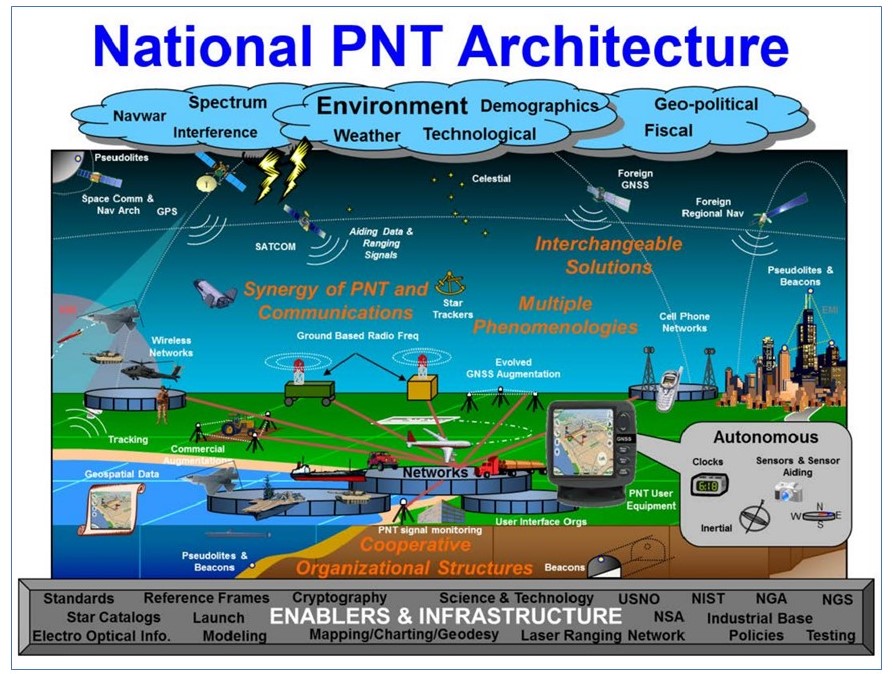
Navigation is a field of study that focuses on the process of monitoring and controlling the movement of a craft or vehicle from one place to another.[1] The field of navigation includes four general categories: land navigation, marine navigation, aeronautic navigation, and space navigation. Navigation | Wikipedia
In critical infrastructure, AI-driven signal processing is fundamentally enhancing PNT resilience. By utilizing deep learning models to analyze the spectral characteristics of incoming signals, systems can now distinguish between authentic satellite transmissions and malicious spoofing attempts. These AI models operate at the edge, processing raw radio frequency data to detect anomalies in signal arrival angles and timing offsets, providing a robust defense against jamming and spoofing in environments where GPS is contested.
How did Planes Fly Before GPS?
How did Planes Fly Before GPS?:
The Wright Brothers first took to the skies in 1903 but GPS wasn't publicly available until 1983, so how did planes traverse the world in those 80 years? From celestial navigation to dead reckoning, to the firsts forms of radio telemetry (like adock range stations and LORAN) we'll be discussing them all in this video. Discord: https://discord.gg/DUvyS8n Amazon Affiliate Link*: https://amzn.to/3kNTHhK
PNT Requirements Definition – Some Principles with John Pottle
Royal Institute of Navigation. Presenter: John Pottle, Director of the Royal Institute of Navigation
Hosted PNT as a Service (PNTaaS)
NAVSYS Corporation. The threat to GPS drives demand for a back-up position, navigation, and timing (PNT) solution that can operate in the event of denial of service to the GPS satellite signals. The military is dependent on PNT for their warfighting operations, and national critical infrastructure is also reliant on GPS for positioning and timing. In this video, we describe our PNT as a Service (PNTaaS) concept that will leverage capabilities already existing on certain commercial broadband internet satellite constellations to allow their signals to be used for PNT.
Inside GNSS ...Global Navigation Satellite Systems
Navstar | Space.com ...is a network of U.S. satellites that provide GPS services
SpaceX launches third-generation GPS navigation satellite | CBS News ...GPS-3 satellite — the fourth in a series of more powerful third-generation navigation stations built by Lockheed Martin — was expected to be deployed about a 90 minutes after liftoff. Assuming tests and checkout go well, it will join a globe-spanning constellation of 31 GPS satellites.
GPS receivers that use the L5 band can pinpoint to within 30 centimeters or 11.8 inches. The GPS concept is based on time and the known position of GPS specialized satellites. The satellites carry very stable atomic clocks that are synchronized with one another and with the ground clocks. Any drift from time maintained on the ground is corrected daily. In the same manner, the satellite locations are known with great precision. GPS receivers have clocks as well, but they are less stable and less precise. Each GPS satellite continuously transmits a radio signal containing the current time and data about its position. Since the speed of radio waves is constant and independent of the satellite speed, the time delay between when the satellite transmits a signal and the receiver receives it is proportional to the distance from the satellite to the receiver. A GPS receiver monitors multiple satellites and solves equations to determine the precise position of the receiver and its deviation from true time. At a minimum, four satellites must be in view of the receiver for it to compute four unknown quantities (three position coordinates and clock deviation from satellite time). Global Positioning System | Wikipedia
Why The US Military Made GPS Free-To-Use
Create a free account on SimScale here: https://goo.gl/qByVRB Find all recordings of the Drone Design Workshop here: https://goo.gl/hSh5nA Listen to our new podcast at:
Showmakers YouTube channel at: https://goo.gl/Ks1WMp
Satellite Navigation Systems Overview with John Pottle
Royal Institute of Navigation. John Pottle, Director of the Royal Institute of Navigation, will put into context what the hundreds of navigation satellites in space are all for and how they work together. This webinar will explain the similarities and differences between global and regional satellite navigation systems, how they are co-ordinated, and by whom. The space-based augmentation systems will also be covered: what are these and how do they help? *During the webinar Q&A there was a question about whether or not GNSS could be used for moon missions - please see: Website: https://rin.org.uk/
GPS, How does it work? | ICT #12
GPS has already become an integral part of our lives, and you can see a few useful applications from these examples. GPS is really an interesting technology. It uses a system of 24 satellites continuously orbiting the earth, and requires at least four satellites to track your location; it uses an atomic clock, and the time error of your mobile phone is also a matter of great concern. Moreover, Albert Einstein’s theory of relativity plays an important role in GPS technology, finally, a real-life application for the theory of relativity! Let’s put aside all these complications and understand the technology of GPS in a step by step and logical manner. Be a Learn Engineering supporter or contributor: https://www.youtube.com/channel/UCqZQ...
MIT's AI System helps to improve GPS navigation in places with limited map data | RoadTagger
Rajamanickam Antonimuthu An AI model developed at MIT and Qatar Computing Research Institute uses only satellite imagery to automatically tag road features in digital maps. This innovation could improve GPS navigation, especially in countries with limited map data.
GPS vs AI: The Challenges of Losing Satellite Signal | Roborace
How do trees affect satellite and GPS acquisition during a Roborace test run? #Education #Roborace #AutonomousVehicles Trees have a detrimental effect on the GPS and Satellite system for the DevBot 2.0, as it is one of the most important factors for autonomous racing. Roborace is the world’s first competition for human + machine teams, using both self-driving and manually-controlled cars. Race formats will feature new forms of immersive entertainment to engage the next generation of racing fans. Through sport, innovations in machine-driven technologies will be accelerated. Roborace will redefine the way you think about autonomous technology. To be a part of our autonomous journey, subscribe to our channel: https://goo.gl/TNbPAB
Brian Cox Just Announced Mind-Bending Theory Of Time
Everything in our universe seems perfect. There are laws governing the entire universe, but certain mysteries have remained unsolved despite decades of research. Why does time travel in one direction? What is the nature of reality? Why does Gravity exist? Why does time slow down when we travel at the speed of light? These are questions that have fascinated us for millennia.
Using AI to get city and weather from GPS
A quick demo of how Noodl AI and the Function Co-pilot node can be used to call different API's from a simple text prompts to gather location and weather data from location coordinates.
Space Is Hard | There Is No GPS in Space
There is no mapping app for deep space, at least not yet. If we're going to explore there we'll need new navigation tools. Here's how NASA is going to keep its rockets on target. Still haven’t subscribed to WIRED on YouTube? https://wrd.cm/15fP7B7 CONNECT WITH WIRED Web: https://wired.com
GPS satellites orbit about 20,200 km above Earth, so their signals arrive very weak and are easy to jam or spoof. Satellites in low Earth orbit are much closer, so their signals can arrive far stronger.
Commercial LEO PNT: in June 2025 Xona Space Systems launched Pulsar-0 on SpaceX's Transporter-14 rideshare. It is the first production-class satellite of Xona's planned commercial PNT constellation. Xona says Pulsar signals are received about 100 times stronger than legacy GPS and support real-time positioning to better than 10 cm.
U.S. policy: in March 2025 the Federal Communications Commission opened an inquiry (WT Docket No. 25-110) into alternatives that could complement or back up GPS. These include LEO and MEO satellite signals; terrestrial options such as longwave radio, TV broadcast signals and fiber-synchronized networks; and multi-signal receivers that are harder to jam or spoof.
2019-06-19_The History of GPS Spoofing
Incose Chesapeake Mr Dana Goward discussed the development of Global Positioning System (GPS) spoofing from a fiction account in film to being an everyday problem.
How to fool a GPS - Todd Humphreys
TED-Ed Todd Humphreys forecasts the near-future of geolocation when millimeter-accurate GPS "dots" will enable you to find pin-point locations, index-search your physical possessions ... or to track people without their knowledge. And the response to the sinister side of this technology may have unintended consequences of its own. (Filmed at TEDxAustin.) Talk by Todd Humphreys.
Orolia Presents: GPS World Webinar – Resilient PNT for a 5G World
Panelists will discuss key factors for the successful implementation of 5G technology for 5G infrastructures, automotive, and mission critical applications:
- Testing requirements needed to ensure consistent operations
- Resilient Positioning, Navigation and Timing (PNT) technologies that can help ensure accurate, continuous operations for critical applications during interference or signal loss.
Which is the bigger problem? Risk assessment for PNT with Dana Goward
This webinar is part of the Resilient Positioning Navigation and Timing Seminar Series. Find out more about this series at: https://rin.org.uk/events/EventDetail... Presenter: Dana Goward, President & Director, Resilient Navigation and Timing Foundation
Assured-Positioning, Navigation and Timing (A-PNT)
DOD is Developing Positioning, Navigation, and Timing Technologies to Complement GPS | GAO DOD is pursuing approaches, such as creating common standards and interfaces, to aid in integrating and fielding new PNT technologies faster and at lower cost. DOD is developing its PNT modeling and simulation capabilities to evaluate the performance of new PNT technologies.
Like the GPS units in many automobiles today, a simple receiver and some processing power is all that is needed for accurate navigation. But, what if the GPS satellites suddenly became unavailable due to malfunction, enemy action or simple interference, such as driving into a tunnel? Unavailability of GPS would be inconvenient for drivers on the road, but could be disastrous for military missions. Extreme Miniaturization: Seven Devices, One Chip to Navigate without GPS | US Defense Advanced Research Projects Agency (DARPA)
System Performance and Resilience or: What could possibly go wrong? with Prof Marek Ziebart
Royal Institute of Navigation. Presenter: Prof Marek Ziebart, Director, Space Geodesy and Navigation Group, University College London Website: https://rin.org.uk/
When GNSS fails, what will you do? - MarRINav!
Royal Institute of Navigation. This webinar, called 'When GNSS fails, what will you do? - MarRINav! ' features presentations and comments form Jonathan Turner (NLA Int.), Dr Alan Grant (GLA), and Dana Goward (RNTF). The webinar provides analysis and insights from Phase 1 of the Maritime Resilience and Integrity of Navigation (MarRINav) project. To download the full transcript of Jonathan's presentation please follow this link: https://rin.org.uk/resource/resmgr/fi... Many thanks to all co-sponsors of this webinar: Resilient Navigation and Timing Foundation, Institute of Navigation, GPS World, The Maritime Executive, and of course the MarRINav project. Website: https://rin.org.uk/
The Coming Revolution in MEMS Gyroscopes and MEMS Inertial Sensors
Wireless Integrated MicroSensing & Systems - WIMS2 Relevant for automotive robotic drone wearable applications.
Enabling the Next Generation of GPS Technology with Supercorrelation with Dr Ramsey Faragher
Royal Institute of Navigation. Focal Point Positioning have developed a new method for processing GNSS radio signals called Supercorrelation which dramatically improves the performance of the earliest stage of radio processing. The software update removes multipath interference at the correlator level, and provides the ability to determine signal arrival angle without adding any new hardware to a standard GNSS device. In this webinar Dr Ramsey Faragher, Founder/CEO of FocalPoint will explain how the technology works, will cover some of the challenges that FocalPoint have overcome in deploying it on very low cost platforms, and will show off the new capabilities that it unlocks. Website: https://rin.org.uk/
AgilLOC Global Navigation Satellite System (GNSS) Anti-Jamming and Spoofing Capability
AgilLOC Antenna Element Compact (AEC) & Resilient Time Source (RTS) provide assured access to Position, Navigation and Timing (PNT) information for mission-critical systems. AEC provides GNSS anti-jam capability under denied environment through adaptive nulling of interference sources. RTS provides add-on GNSS anti-spoof capability and timing resiliency to ensure the integrity of the GNSS.
GRCon20 - Software defined radio based Global Navigation Satellite System real time spoofing....
Software defined radio based Global Navigation Satellite System real time spoofing detection and cancellation Presented by Jean-Michel Friedt,, D. Rabus and G. Goavec-Merou at GNU Radio Conference 2020 https://gnuradio.org/grcon20 Global Navigation Satellite Systems (GNSS) -- most significantly the Global Positioning System (GPS) -- have become ubiquitous to most daily activities, from positioning and navigation to long range time synchronization or distributed energy production ("smart grid"). While initially developed as a military system hardly accessible to civilians, the advent of Software Defined Radio jamming and spoofing capabilities emphasize the low security of GNSS weak signals emitted from satellites orbiting the Earth 20000 km away. While a properly spoofing signal cannot be detected after a consumer-grade receiver has decoded the radiofrequency signal, addressing at the radiofrequency wave level the signal integrity provides the solution of identifying spoofing with all satellites appearing at the same direction of arrival. This classical beamforming analysis -- Controlled Reception Pattern Antenna (CRPA) with multiple antenna reception and phase analysis -- is demonstrated using commercial, off the shelf software defined radio platform receivers (Ettus Research B210) running the real-time GNSS decoder gnss-sdr based on GNU Radio running on embedded boards such as the Raspberry Pi4.
PULP-DroNet -- Autonomous Artificial Intelligence-powered Nano-Drone
PULP-DroNet is a Deep Learning-powered visual navigation engine that enables autonomous navigation of a pocket-size quadrotor in a previously unseen environment.
Thanks to PULP-DroNet the nano-drone can explore the environment, avoiding collisions also with dynamic obstacles, in complete autonomy -- no human operator, no ad-hoc external signals, and no remote laptop! This means that all the complex computations are done directly aboard the vehicle and very fast. The visual navigation engine is composed of both a software and a hardware part. The former is based on the previous DroNet [1] project developed by the RPG [2] from the University of Zürich (UZH). DroNet is a shallow convolutional neural network (CNN) which has been used to control a standard-size quadrotor in a set of environments via remote computation. The hardware soul of PULP-DroNet is embodied by the PULP-Shield an ultra-low power visual navigation module featuring a Parallel Ultra-Low-Power (PULP) GAP8 System-on-Chip (SoC) from GreenWaves Technologies [3], an ultra-low power camera, and off-chip Flash/DRAM memory; the shield is designed as a pluggable PCB for the Crazyflie 2.0 [4] nano-drone. Then, we developed a general methodology for deploying state-of-the-art Deep Learning algorithms on top of ultra-low power embedded computation nodes, like a miniaturized drone. Our novel methodology allowed us first to deploy DroNet on the PULP-Shield, and then demonstrating how it enables the execution the CNN on board the CrazyFlie 2.0 within only 64-284mW and with a throughput of 6-18 frame-per-second! Finally, we field-prove our methodology presenting a closed-loop fully working demonstration of vision-driven autonomous navigation relying only on onboard resources, and within an ultra-low power budget. We release here, as open source, all our code, hardware designs, datasets, and trained networks. Reference: D. Palossi, F. Conti, and L. Benini An Open Source and Open Hardware Deep Learning-powered Visual Navigation Engine for Autonomous Nano-UAVs Preprint: https://arxiv.org/abs/1905.04166 PULP-Platform Project Webpage: https://www.pulp-platform.org/
Securing Positioning & Timing 7: Improving Performance by Augmenting GPS/GNSS
Royal Institute of Navigation. The seventh, and final, of a series of webinars from the Securing Positioning & Timing short course. This webinar covers Improving Performance by Augmenting GPS/GNSS. Presented by Prof Terry Moore. Supported by the UK Space Agency. Website: https://rin.org.uk/
Assess performance & reduce risks across a multisensor, multi-system integration with Peter Rylands
Royal Institute of Navigation. Presenter: Peter Rylands, Product Manager, Oxford Technical Solutions Ltd
Resilient PNT for Unmanned Systems
Orolia. Demand for unmanned systems is growing exponentially across defense and civil/commercial organizations, for applications ranging from military missions and intelligence surveillance to border security and precision agriculture.
Resilient Positioning, Navigation and Timing (PNT) data and GPS/GNSS signals are critical for unmanned systems in order to successfully pilot and control aircraft, vehicle and vessel onboard systems.
Securing Positioning & Timing 3: Detecting and Characterising GPS/GNSS Jamming & Spoofing
Royal Institute of Navigation. The third of a series of webinars from the Securing Positioning & Timing short course. This webinar covers Detecting and Characterising GPS/GNSS Jamming & Spoofing. Presented by Dr Mark Dumville. Supported by the UK Space Agency. Website: https://rin.org.uk/
Securing Positioning & Timing 4: Locating GPS/GNSS Jamming and Spoofing
Royal Institute of Navigation. The fourth of a series of webinars from the Securing Positioning & Timing short course. This webinar covers Locating GPS/GNSS Jamming and Spoofing. Presented by Mike Jones. Supported by the UK Space Agency. Website: https://rin.org.uk/
Harris Corporation - Detect and Locate GPS Jamming with Signal Sentry™ 1000
Harris Corporation The Global Positioning System—GPS—is an essential element of the global information infrastructure. GPS jamming devices are becoming cheaper and more accessible, creating a greater need to protect from a diverse range of threats. Harris Signal Sentry 1000 is a GPS interference detection and geolocation solution. It provides a web-based visualization tool to support timely and effective actionable intelligence.
Why isn’t my GPS receiver consistently more accurate? with John Pottle
Royal Institute of Navigation. Presenter: John Pottle, Director of the RIN Website: https://rin.org.uk/
Current threats to GNSS: An update of incidents and impacts with Guy Buesnel
Royal Institute of Navigation. Presenter: Guy Buesnel, PNT Security Technologist Spirent Communications plc. Website: https://rin.org.uk/
Software-defined Global Navigation Satellite Systems (GNSS)
Dr. Carles Fernandez: An Open Source Global Navigation Satellite Systems Software-Defined Receiver
Software Defined Radio Academy GNSS-SDR (see https://gnss-sdr.org) is an open source, software-defined Global Navigation Satellite Systems (GNSS) receiver. This software application takes care of all the digital signal processing chain (from the output of the Analog-to-Digital Converter of a radio-frequency front-end, or from raw sam- ples stored in a file), performing signal acquisition and tracking of the available satellite signals, decoding the navigation message and computing the observables needed by positioning algorithms, which ultimately compute the navigation solution. Several outputs are provided in standard formats, including RINEX observation and navigation files, RTCM-104 v3.2 message streaming via TCP/IP and NMEA-0183, as well as KML, GeoJSON, and GPX files for Geographic Information Systems, map representation and Earth browsers. Currently, the software is able to process GLONASS L1 C/A, GPS L1 C/A, Galileo E1b/c, BeiDou B1I, BeiDou B3I, GLONASS L2 C/A, GPS L2C, GPS L5 and Galileo E5a signals, in all possible combinations, including multi-constellation and multi-frequency configurations. The software leverages on the GNU Radio framework, inheriting multithreading scheduling and a modular, scalable architecture. The software is designed to facilitate the inclusion of new signal processing techniques, offering an easy way to measure their impact in the overall receiver performance under fair conditions, as well as the expansion to other signals.
GRCon20 - Software defined radio based Global Navigation Satellite System real time spoofing....
Software defined radio based Global Navigation Satellite System real time spoofing detection and cancellation Presented by Jean-Michel Friedt,, D. Rabus and G. Goavec-Merou at GNU Radio Conference 2020 https://gnuradio.org/grcon20 Global Navigation Satellite Systems (GNSS) -- most significantly the Global Positioning System (GPS) -- have become ubiquitous to most daily activities, from positioning and navigation to long range time synchronization or distributed energy production ("smart grid"). While initially developed as a military system hardly accessible to civilians, the advent of Software Defined Radio jamming and spoofing capabilities emphasize the low security of GNSS weak signals emitted from satellites orbiting the Earth 20000 km away. While a properly spoofing signal cannot be detected after a consumer-grade receiver has decoded the radiofrequency signal, addressing at the radiofrequency wave level the signal integrity provides the solution of identifying spoofing with all satellites appearing at the same direction of arrival. This classical beamforming analysis -- Controlled Reception Pattern Antenna (CRPA) with multiple antenna reception and phase analysis -- is demonstrated using commercial, off the shelf software defined radio platform receivers (Ettus Research B210) running the real-time GNSS decoder gnss-sdr based on GNU Radio running on embedded boards such as the Raspberry Pi4.
BBC Click no GPS radio eLoran instead. Filmed at the Port of Felixstowe
BBC Click report at the Port of Felixstowe demonstrating the loss of GPS and using eLoran as an alternative
Typically, the performance of measurement devices is limited by deleterious effects such as thermal noise and vibration. Notable exceptions are atomic clocks, which operate very near their fundamental limits. Driving devices to their physical limits will open new application spaces critical to future DoD systems. Indeed, many defense-critical applications already require exceptionally precise time and frequency standards enabled only by atomic clocks. The Global Positioning System (GPS) and the internet are two key examples. Measurement systems based on atomic physics benefit from the exquisite properties of the atom. Among these are (a) precise frequency transitions, (b) the ability to initialize, control, and readout the atomic state and (c) environmental isolation. In addition, atomic properties are absolute, and do not “drift” over time. In this sense, atoms are self-calibrated, making them ideal for precision sensing. Quantum-Assisted Sensing and Readout (QuASAR) | US Defense Advanced Research Projects Agency (DARPA)
Quantum navigation is now in field trials. In April 2025 Q-CTRL reported flight and road tests of Ironstone Opal, a magnetic-anomaly navigation system. Quantum magnetometers measure the local magnetic field and match it against public magnetic maps. Because the system relies on Earth's magnetic field rather than radio signals, it is not exposed to radio jamming or spoofing. The company reported positioning errors up to 50 times lower than a strategic-grade inertial navigation system in flight, or about 0.03% of the distance traveled (0.01% in the best trials). Machine learning is central: a physics-informed denoising algorithm learns and removes the aircraft's own magnetic interference in flight, with no pretraining or calibration maneuvers.
Quantum Sensors in Navigation with Roger McKinlay, George Shaw and Kai Bongs
Royal Institute of Navigation Co-hosted by the UK Quantum Technology Hub Sensors and Timing and the Royal Institute of Navigation Presenters: Professor Kai Bongs, Principal Investigator at the UK Quantum Technology Hub Sensors and Timing; Roger McKinlay, Challenge Director for Quantum Technologies, UK Research and Innovation; George Shaw, Principal Systems Engineer, General Lighthouse Authority In this trio of presentations Roger, George and Kai discuss quantum sensors in navigation... Roger covers systems considerations in PNT and vulnerabilities in GNSS, UK industry opportunities and IUK programmes George covers current maritime navigation challenges, the resilient PNT system-of-systems approach and opportunity for Quantum Sensor technology insertion Kai covers quantum Sensor developments towards navigation solutions Website: https://rin.org.uk/
Nanoscale Quantum Sensing - Prof. Jorg Wrachtrup
Bar-Ilan University Nanoscale Quantum Sensing - a lecture by Prof. Jorg Wrachtrup of the Institute for Quantum Science and Technology in Germany. This lecture was given during the conference QUEST - Quantum Entanglement Science & Technology, held by Bar-Ilan University's Physics Department in June 2017.
Spacetime is a mathematical model that fuses the three dimensions of space (length, width, height) and the single dimension of time into a single four-dimensional continuum.
Before the 20th century, scientists viewed space and time as completely separate entities. Space was a static stage where events occurred, and time was a constant, universal clock. Albert Einstein and mathematician Hermann Minkowski revolutionized this view by proving they are inextricably linked.
Spacetime Core Concept: The Fabric of the Universe
In physics, every occurrence is an "event" located at a specific point in spacetime, described by four coordinates:
<math>(x, y, z, t)</math>
Imagine meeting a friend. To ensure you meet, you must provide a specific location (spatial coordinates) and a specific time (temporal coordinate). If you omit the time, the meeting cannot happen.
Newton's View: Gravity is an invisible force that pulls objects together.
Einstein's View: Gravity is not a force; it is the curvature of spacetime.
Massive objects (like the Earth or Sun) warp the fabric of spacetime around them. Smaller objects (like the Moon or a satellite) do not "feel" a force pulling them; they are simply following the straightest possible path (a geodesic) along this curved surface.
Visualizing Spacetime: The Light Cone
Physicists often use Minkowski diagrams to visualize spacetime. In these graphs, time is usually plotted on the vertical axis and space on the horizontal axis.
World Line: A line representing an object's path through time. Even if an object is stationary in space, it moves through time, creating a straight vertical world line.
Light Cone: Since nothing can travel faster than light, light spreading out from a single event forms a "cone" shape in the diagram. Events inside this cone can affect one another (causality); events outside are effectively disconnected.
Key Implications
Time dilation: Because space and time are linked, moving through space affects movement through time. The faster an object travels through space, the slower it moves through time relative to a stationary observer.
No Universal "Now": There is no single clock for the universe. Two observers moving at different speeds or in different gravitational fields will disagree on when an event happened (Relativity of simultaneity).
Comparison Table
Concept
Classical View (Newton)
Spacetime View (Einstein)
Space
A static, rigid stage.
A flexible fabric that can bend and twist.
Time
Universal and constant for everyone.
Relative; flows at different rates for different observers.
What Exactly is Spacetime? Explained in Ridiculously Simple Words
Spacetime, as a concept, is related to a space that consists of 4 dimensions instead of the regular 3-dimensional space. As early as 1905, Einstein proposed a now widely popular theory that the speed of light is independent of the motion of all observers, and that space and time are interconnected in a single continuum. This theory, which is now a cornerstone of modern and quantum physics, is known as Einstein’s special theory of relativity. Einstein's proposed idea of a single continuum where space and time are interwoven is what people call “space-time”.
According to this theory, time—which has traditionally been considered an independent entity according to the principles of classical physics—is affected when a body moves through space. This happens because, according to the theory, time and space are connected and part of a single continuum—spacetime.
In this video, we discuss spacetime in absolutely simple words: what exactly is spacetime and how is it related to the force of gravitation and Einstein’s theory of relativity?
Longitude
Dava Sobel's book is a captivating story, such a good film with an impressive cast. What a genius Mr Harrison was. Such determination. A lesson to us all..
The Clock That Changed the World (BBC History of the World)
BBC - A History of the World. How self-taught clockmaker John Harrison spent decades building a series of sea clocks, H1 through H5, to solve the longitude problem. His H4 kept time well enough at sea to fix a ship's longitude, but the Board of Longitude paid him only part of the prize, and he received his reward in 1773 after appealing to King George III.
Henrik Mouritsen on How do migratory birds find their way?
Prof. Henrik Mouritsen (University of Oldenburg, Germany) on "How do migratory birds find their way?", at the FENS Hertie Winter School 2017 on Neural Control of Behaviour - Series 1: Navigation, 10-16 December 2017, Obergurgl, Austria.
Animal Navigation || Radcliffe Institute
Lizabeth Cohen 00:16 Dean, Radcliffe Institute for Advanced Study Howard Mumford Jones Professor of American Studies Department of History Harvard University John Huth 7:32 Donner Professor of Science
Codirector of the Science Program Radcliffe Institute for Advanced Study Harvard University ANIMAL NAVIGATION 16:50 Susanne Åkesson 19:53 Professor and Principal Investigator Centre for Animal Movement Research, Lund University (Sweden) Introduced by Scott Edwards 17:51 Professor of Organismic and Evolutionary Biology Curator of Ornithology Alexander Agassiz Professor of Zoology in the Museum of Comparative Zoology Harvard University
Scientists use the molecular clock, which assumes steady genetic changes, to estimate species divergence times, but recent models like the Covariant Evolutionary Tempo (CET) by Budd & Mann suggest evolution isn't always steady, predicting rapid bursts in major groups (like mammals or birds) early on, explaining mismatches with fossil records by showing faster initial evolution and diversification, thus refining our understanding of how large animal groups rapidly emerge.
How the Molecular Clock Works
Rate of Mutation: The core idea is that mutations in DNA accumulate at a relatively constant rate over time.
Genetic Differences: By comparing DNA or protein sequences between species, scientists count the genetic differences.
Dating Divergence: More differences imply a longer time since the species shared a common ancestor, allowing estimation of evolutionary timelines.
Challenges & New Models (Budd & Mann's CET)
The Covariant Evolutionary Tempo model suggests that when a big group of organisms appear, evolution actually speeds up. This would make it appear like more time was passing when evolution was really on fast-forward, differentiating into various groups that eventually appeared in the fossil record. “While the speeding clock idea needs testing,” evolutionary biologist Max Telford of University College London wrote, “it could explain other mismatches between molecular clocks and fossil record.”
Fossil Record Mismatch: Molecular clocks sometimes suggest earlier origins for animal groups than the fossil record shows, creating a gap (e.g., the Cambrian explosion).
The CET Model: This model proposes that when a major group starts to diversify, it experiences:
Explosive Radiation: Rapid increases in species diversity.
Elevated Molecular Rates: Faster rates of genetic change.
Impact: This explains why fossil records show sudden appearances of major groups, as they truly did evolve and diversify quickly, rather than gradually over long periods, according to Uppsala University paleontologist Graham Budd and mathematician Richard Mann.
Significance
Refined Timelines: The new models provide a more nuanced understanding of evolutionary history, reconciling molecular data with fossil evidence.
Understanding Major Events: Helps explain rapid evolutionary events, like the emergence of mammals after dinosaur extinction, where a surviving lineage exploded in diversity.
Connecting Disciplines: Bridges gaps between molecular biology, paleontology, and geology to build more accurate evolutionary trees.
Time travel in science and fiction serves as a rich narrative tool to explore causality, free will, and the malleability of timelines. Scientific theories like wormholes, relativistic travel involving time dilation, and closed timelike curves provide possible mechanisms for how time travel might work. Popular movies, books and shows usually care less about how it works “under the hood” than about how it causally affects the perspective of characters’ timelines: who has free will, and can you change things by going back to the past or forward into the future? The first video below explores this through Ender's Game, Planet of the Apes, Harry Potter and the Prisoner of Azkaban, Primer, Bill & Ted’s Excellent Adventure, Back to the Future, Groundhog Day, Looper, the video game “Braid”, and Lifeline. Whether driven by science or narrative needs, these portrayals reflect how characters experience and manipulate time, raising questions about fate, agency, and the consequences of tampering with the past
Time-based AI algorithms are algorithms that use time series data to make predictions or analyses. Time series data are data that are collected over time and have a temporal order. For example, the daily temperature, the stock prices, or the number of visitors to a website are all time series data. These algorithms can be used for a variety of purposes, such as forecasting future values, detecting trends and patterns, and making informed decisions based on historical data. They can be applied to many different fields, including finance, economics, meteorology, and healthcare.
There are different types of sequence/time-based AI algorithms, depending on the goal and the method of the algorithm. Some of the most common ones are:
Autoregressive (AR): uses past values of the time series to predict future values. It assumes that the current value is a linear function of previous values. For example, AR can be used to forecast the weather based on historical data.
Autoregressive Integrated Moving Average (ARIMA): is an extension of AR that also accounts for the trend and the seasonality of the time series. It uses differencing to make the time series stationary (i.e., having constant mean and variance) and then applies AR and moving average (MA) models. For example, ARIMA can be used to forecast the sales of a product based on past sales and seasonal patterns.
Seasonal Autoregressive Integrated Moving Average (SARIMA): is a further extension of ARIMA that also accounts for the cyclic variations of the time series. It uses seasonal differencing and seasonal AR and MA models to capture the periodic fluctuations of the time series. For example, SARIMA can be used to forecast the electricity demand based on past demand and seasonal factors.
Exponential Smoothing (ES): uses weighted averages of past values of the time series to predict future values. It gives more weight to recent values than older values, and it can also incorporate trend and seasonality components. For example, ES can be used to forecast the inventory level based on past demand and supply.
Prophet: is a modern and flexible approach to time series forecasting developed by Facebook. It uses a decomposable model that consists of trend, seasonality, and holiday components, and it allows for adding custom effects and prior information. For example, Prophet can be used to forecast the web traffic for a data science blog website based on past traffic and special events.
Neural Turing Machine (NTM): the fuzzy pattern matching capabilities of Neural Networks with the algorithmic power of programmable computers. NTMs are an instance of Memory Augmented Neural Networks, a new class of Recurrent Neural Network (RNN)s which decouple computation from memory by introducing an external memory unit. NTMs have demonstrated superior performance over Long Short-Term Memory Cells in several sequence learning tasks.
Recurrent Neural Network (RNN): is a type of Deep Learning model that can process sequential data such as time series. It uses a network of neurons that have feedback loops, which enable them to store information from previous inputs. For example, RNN can be used to forecast the prices of Bitcoin based on past prices and other factors.
Gated Recurrent Unit (GRU): are a gating mechanism in Recurrent Neural Network (RNN) architecture. Like other RNNs, a GRU can process sequential data such as time series, natural language, and speech1. The GRU is similar to a Long Short-Term Memory (LSTM) with a forget gate, but has fewer parameters than LSTM, as it lacks an output gate. This means that GRUs are generally easier and faster to train than their LSTM counterparts. GRUs have been found to perform similarly to LSTMs on certain tasks such as polyphonic music modeling, speech signal modeling, and natural language processing. They have shown that gating is indeed helpful in general.
Long Short-Term Memory (LSTM): is a special type of RNN that can handle long-term dependencies in sequential data. It uses a memory cell that can store, update, and forget information over time, and it has gates that control the flow of information in and out of the cell. For example, LSTM can be used to forecast the generation of wind power based on past generation and weather conditions:
Bidirectional Long Short-Term Memory (BI-LSTM): is a type of Recurrent Neural Network (RNN) architecture that processes data in both forward and backward directions. It consists of two LSTMs: one taking the input in a forward direction, and the other in a backward direction. BI-LSTMs effectively increase the amount of information available to the network, improving the context available to the algorithm. For example, knowing what words immediately follow and precede a word in a sentence. Compared to LSTM, BI-LSTM combines the forward hidden layer and the backward hidden layer, which can access both the preceding and succeeding contexts¹. This feature of flow of data in both directions makes the BI-LSTM different from other LSTMs. BI-LSTMs have been successfully applied to various tasks such as natural language processing, speech recognition, and traffic forecasting.
Bidirectional Long Short-Term Memory (BI-LSTM) with Attention Mechanism: is a type of Recurrent Neural Network (RNN) architecture that processes data in both forward and backward directions, and uses an attention mechanism to weigh the importance of different parts of the input sequence. The attention mechanism allows the network to focus on specific parts of the input sequence when making predictions, rather than treating all parts of the sequence equally. This can be particularly useful when dealing with long input sequences, where some parts of the sequence may be more relevant to the prediction than others. BI-LSTMs with Attention Mechanism have been successfully applied to various tasks such as text classification, Sentiment Analysis, and human activity recognition.
Average-Stochastic Gradient Descent (SGD) Weight-Dropped LSTM (AWD-LSTM): is a variant of LSTM that employs DropConnect for regularization, as well as NT-ASGD for optimization. NT-ASGD stands for non-monotonically triggered averaged stochastic gradient descent, which returns an average of the last iterations of weights. AWD-LSTM has shown great results on both word-level and character-level models. It has been used in research papers on word-level models and has shown great results on character-level models as well.
Sequence to Sequence (Seq2Seq): can map a variable-length input sequence to a variable-length output sequence. It is often used for natural language processing tasks, such as machine translation, text summarization, conversational models, and question answering. The Seq2Seq algorithm consists of two main components: an encoder and a decoder. The encoder reads the input sequence one timestep at a time and produces a hidden vector representation of the input. The decoder then uses the hidden vector as the initial state and generates the output sequence one timestep at a time, using the previous output as the input context.
Transformer: is a state-of-the-art Deep Learning model that can process sequential data such as time series. It uses layers of attention mechanisms that can learn how to focus on relevant parts of the input data, and it can handle long-term dependencies and parallel computations efficiently. For example, Transformer can be used to forecast the spread of COVID-19 based on past cases and interventions. Transformer can process sequential data using layers of attention mechanisms, without using recurrent or convolutional layers. It can handle long-term dependencies and parallel computations efficiently, and it can achieve better results than RNN-based Seq2Seq models on various tasks.
Generative Pre-trained Transformer (GPT): are a family of language models that use Deep Learning techniques to generate natural language text. They are based on the transformer architecture and can be fine-tuned for various natural language processing tasks such as text generation, language translation, and text classification. The first GPT was introduced in 2018 by the American artificial intelligence (AI) company OpenAI. GPT models are artificial Neural Networks that are based on the transformer architecture, pre-trained on large data sets of unlabelled text, and able to generate novel human-like content
Attention Mechanism: allows the decoder to selectively focus on different parts of the input sequence when generating the output, instead of relying on a single fixed vector. This can improve the performance and accuracy of the Seq2Seq model, especially for long sequences
Transformer-XL: is a transformer-based language model that introduces the notion of recurrence to the deep self-attention network. It was designed to enable learning dependency beyond a fixed length without disrupting temporal coherence. The model consists of a segment-level recurrence mechanism and a novel positional encoding scheme. This method not only enables capturing longer-term dependency, but also resolves the context fragmentation problem. As a result, Transformer-XL learns dependency that is 80% longer than RNNs and 450% longer than vanilla Transformers, achieves better performance on both short and long sequences, and is up to 1,800+ times faster than vanilla Transformers during evaluation.
Beam search: is a technique to find the most probable output sequence given the input sequence, by keeping track of multiple candidate sequences and expanding them based on their probabilities. This can improve the quality and diversity of the output, compared to using a greedy or random search.
Convolutional Neural Network (CNN): is another type of Deep Learning model that can process sequential data such as time series. It uses layers of filters that can extract features from local regions of the input data, and it can capture complex patterns and relationships in the data. For example, CNN can be used to forecast an avalanche in a famous ski resort based on past snowfall and temperature data.
Spatial-Temporal Dynamic Network (STDN): a Deep Learning framework proposed to address the challenge of modeling complex spatial dependencies and temporal dynamics in traffic prediction. A flow gating mechanism is introduced to learn the dynamic similarity between locations, and a periodically shifted attention mechanism is designed to handle long-term periodic temporal shifting. This approach has been shown to be effective in predicting taxi demand
Other:
Gaussian Process (GP): is a type of probabilistic model that can handle uncertainty and noise in time series data. It uses a function that defines how similar any two points in the input space are, and it produces a distribution over possible outputs for any given input. For example, GP can be used to forecast the depletion level of stocks in stores based on past sales and inventory data.
End-to-End Speech: translation is an approach to speech translation that is gaining high interest from the research world in the last few years. It consists of using a single Deep Learning model that learns to generate translated text of the input audio in an end-to-end fashion. This approach, known as “end-to-end” or “direct” ST, supposes many advantages over the former, such as avoiding the concatenation of errors, the direct use of prosodic from speech and a lower inference time.
(Tree) Recursive Neural (Tensor) Network (RNTN): type of Neural Network that is mostly used for natural language processing. It has a tree structure with a neural net at each node. The purpose of these nets is to analyze data that have a hierarchy of structure. An RNTN is a powerful tool for deciphering and labeling patterns. Structurally, an RNTN is a binary tree with three nodes: a root and two leaves. The root and leaf nodes are not neurons, but instead, they are groups of neurons – the more complicated the input data, the more neurons are required. RNTNs have been successfully applied to Sentiment Analysis, where the input is a sentence in its parse tree structure, and the output is the classification for the input sentence, i.e., whether the meaning is very negative, negative, neutral, positive, or very positive
Temporal Difference (TD) Learning: refers to a class of model-free Reinforcement Learning (RL) methods which learn by bootstrapping from the current estimate of the value function. These methods sample from the environment, like Monte Carlo methods, and perform updates based on current estimates, like dynamic programming methods. While Monte Carlo methods only adjust their estimates once the final outcome is known, TD methods adjust predictions to match later, more accurate, predictions about the future before the final outcome is known.
The newest sequence models borrow the large-language-model recipe: pretrain one model on a huge collection of time series, then forecast new series zero-shot, with no training on the target data. Just as an LLM predicts the next word, these models predict the next values in a sequence.
TimesFM (Google Research, 2024): a decoder-only Transformer with about 200 million parameters, pretrained on about 100 billion real-world time points. Its zero-shot accuracy approaches that of supervised models trained on each dataset (ICML 2024).
Chronos (Amazon, 2024): scales and quantizes values into tokens and trains language-model architectures on them. Chronos-Bolt (November 2024) is patch-based and up to 250 times faster than original Chronos models of the same size. Chronos-2 (October 2025) adds zero-shot multivariate and covariate-informed forecasting.
Moirai (Salesforce AI Research): a universal forecaster that handles varied frequencies, numbers of variables and forecast lengths. Moirai 2.0 (November 2025) moved to a simpler decoder-only design trained on 36 million series, and it is about twice as fast and 30 times smaller than Moirai 1.0-Large.
Others: Lag-Llama produces probabilistic forecasts with uncertainty intervals, and Time-LLM adapts frozen LLMs to forecasting.
Models are compared on shared benchmarks such as GIFT-Eval and fev-bench, but vendors' leaderboard claims are worth testing on your own data. The Moirai 2.0 authors report that gains level off as models grow and weaken at longer forecast horizons. Classical methods such as ARIMA and exponential smoothing remain essential baselines.