Music
Youtube search... ...Google search
- End-to-End Speech ... Synthesize Speech ... Speech Recognition ... Music
- Video/Image ... Vision ... Enhancement ... Fake ... Reconstruction ... Colorize ... Occlusions ... Predict image ... Image/Video Transfer Learning ... Classification ... Art ... Photography
- Humor ... Writing/Publishing ... Storytelling ... Broadcast ... Journalism/News ... Podcasts ... Books, Radio & Movies - Exploring Possibilities
- Magenta ... open source Python library, powered by TensorFlow
- Time & Music
Question: What do you want to do with music and AI?
Start: Choose Your Music Task
Choose the branch that matches your goal, then follow the linked sections. The destinations are alternatives and references, not a mandatory reading sequence, and each branch ends with a checkpoint to apply before you publish. Branches A and B produce new music, C through E help you shape or reuse your own material, and F through H cover listening, performance, and rights.
- Make a complete song with lyrics and vocals from a prompt: A. Generate Songs → Suno → Udio → ElevenLabs
- Score a video, game, podcast, or advertisement: B. Background Music and Sound Design → Stable Audio → Epidemic Sound
- Develop ideas inside your own studio workflow: C. Co-Create in the Studio → Music AI Sandbox → Magenta
- Separate vocals, drums, bass, or other instruments from a recording: D. Split a Recording into Stems → Ultimate Vocal Remover → Demucs
- Sing, speak, or clone a voice: E. Voices and Text-to-Song → Text-to-Song → Synthesize Speech
- Discover, recommend, or analyze music: F. Discover and Analyze Music → Recommendation
- Perform live with AI visuals or instruments: G. Live Performance → Neurorack → Anyma
- Check rights, licensing, and disclosure before publishing: H. Rights, Licensing, and Detection
Next question: How much control do you need?
- A finished result from a short description: Use the prompt-based generators in branches A and B.
- Editable parts you can mix and arrange: Look for stem or MIDI export, or add a separation step from branch D.
- Note-level control of melody and harmony: Use symbolic and MIDI tools in branch C.
- Real-time interaction: Explore streaming models such as Lyria RealTime in branches C and G.
Checkpoint: Before choosing a tool, write down the intended use (personal, educational, or commercial), the length and format you need, and whether you need vocals, stems, or MIDI. These answers rule out most unsuitable options before you spend time generating.
How AI Music Generation Works
Music is hard for machines because it unfolds over long time spans while carrying fine detail. A three-minute song at CD quality contains roughly eight million audio samples per channel, yet listeners immediately notice whether a chorus returns in the right place or a singer's phrasing drifts. Generators handle this in one of two ways. Symbolic systems work with notes, chords, and timing, which keeps output compact and editable but leaves the actual sound to a synthesizer or performer, while audio systems generate the waveform itself, capturing timbre, voice, and production style at the cost of modeling far more data.
Modern audio generators usually compress sound before modeling it. A neural audio codec or autoencoder learns to turn short slices of audio into compact codes or a latent representation, and a second model learns to produce sequences of those codes. Autoregressive Transformers predict the next audio token from the ones before it, using attention to keep track of long-range structure, an approach shared by Jukebox, MusicLM, and Meta's MusicGen. Diffusion models, used by Stable Audio, start from random noise in the latent space and refine it step by step into music, which makes it easier to control duration and to fill in or extend existing audio. Earlier systems relied on LSTMs and other recurrent networks, which capture short phrases well but struggle to hold a whole song together.
Text prompts steer generation through conditioning. The prompt is converted into numerical embeddings, often by a text encoder trained to match descriptions with audio, and those embeddings guide every generation step so that the output follows the requested genre, mood, tempo, or instrumentation. Song generators add lyrics, which must be aligned with a melody and sung by a synthetic voice, and many services also accept a reference melody, an uploaded clip to extend, or structural tags such as verse, chorus, and bridge. Beyond the basics, some systems transfer the style of a reference piece, generate melodies and chord progressions that fit a prompt, or respond to a performer in real time.
Training data is the most consequential and contested ingredient. Models learn from very large datasets of recordings paired with descriptions or metadata, and the origin of that data now determines whether a company can sign licensing deals or must defend itself in court (see H. Rights, Licensing, and Detection). Quality is also hard to measure: researchers compare generated and real music statistically, for example with Fréchet Audio Distance, and run listening tests, while users judge coherence, fidelity, and how faithfully the result follows the prompt. To make generated audio traceable, Google embeds an imperceptible SynthID watermark in Lyria output.
AI music tools can generate instrumental compositions, songs with vocals, sound effects, speech, and experimental audio. Some generate complete recordings from text descriptions, while others provide editable tracks or tools for musicians. Because raw quality has improved quickly across the field, the deciding factors are increasingly control, export options, and licensing terms rather than the sound alone.
Music and Audio Playgrounds
- Suno: Generate songs from text descriptions, including vocals, lyrics, instrumentation, and musical arrangements. Experiment with genres, moods, tempos, and song structures. Try creating three versions of the same lyrics as jazz, folk, and electronic music.
- Udio: Explore AI music generation and editing, subject to the service's current access and licensing restrictions. Compare instrumental arrangements, vocal styles, and production approaches. Downloads have been disabled since October 2025 while Udio moves to a licensed platform, so check what export options exist before beginning a project.
- Gemini app (Lyria 3): Generate short tracks with automatically written lyrics from a text prompt, a photo, or a video. Compare instrumental and vocal versions, and try asking Gemini whether an audio file carries Google's SynthID watermark.
- AIVA: Compose instrumental music with an emphasis on cinematic, orchestral, and soundtrack applications. Experiment with musical styles and composition settings, then explore available editing and export options.
- SOUNDRAW: Generate and customize royalty-free-style background music for videos, games, presentations, and other media. Experiment with mood, genre, length, and arrangement. Review the subscription's licensing terms before publishing.
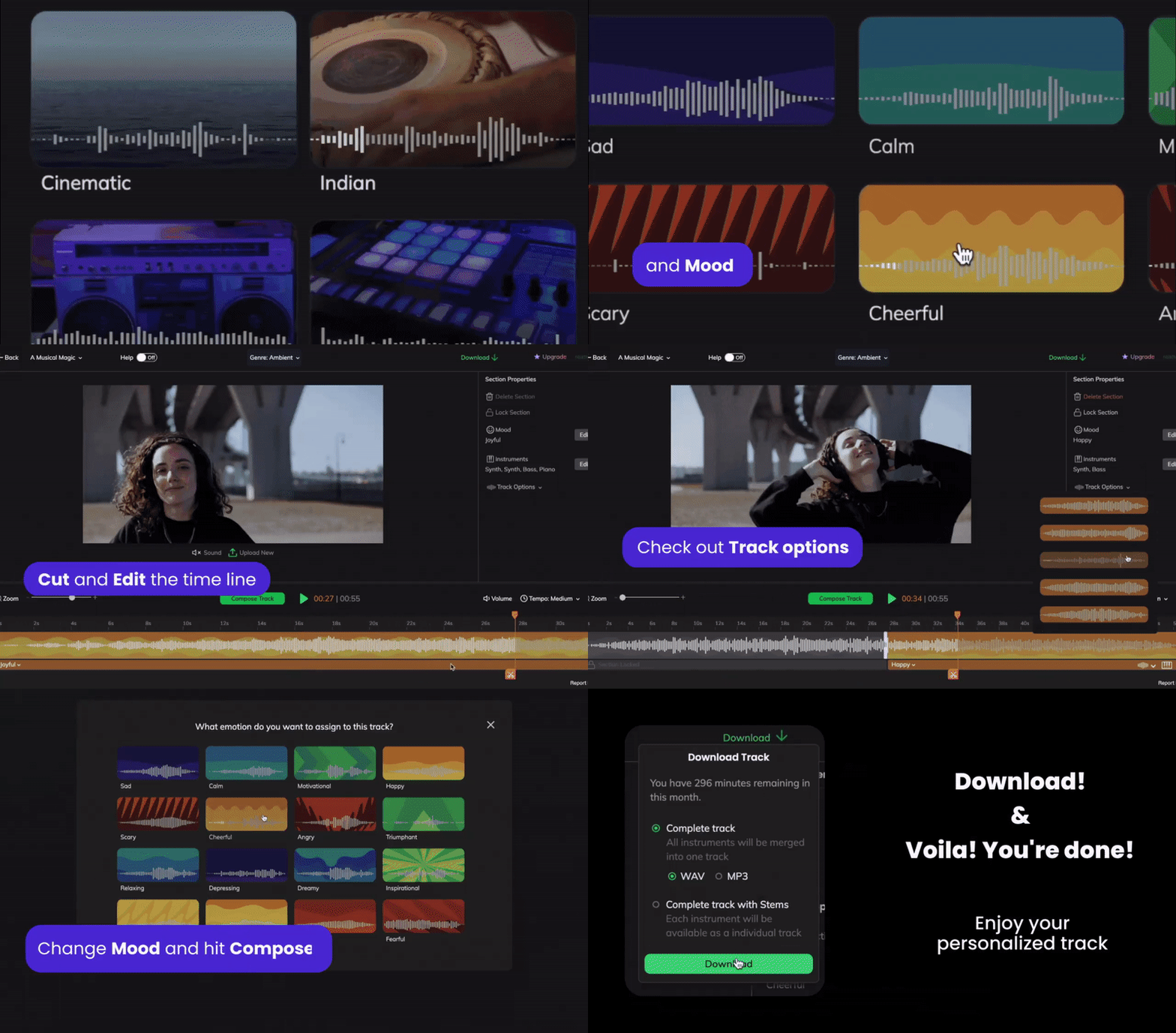
- Beatoven.ai: Create background music for storytelling, podcasts, games, and videos. Explore how changes in emotion, pacing, and instrumentation affect the atmosphere of a scene.
- Stable Audio: Experiment with text-to-audio generation for musical passages, sound textures, and sound effects. Available models, audio duration, and editing features depend on the current service.
- Ultimate Vocal Remover: Split a song you have the right to use into vocals and instruments on your own computer. Compare how different separation models handle reverb, backing vocals, and dense mixes.
- Chrome Music Lab: Explore interactive music experiments involving rhythm, melody, harmonics, and sound visualization. This is primarily an educational music playground rather than a generative AI service, but it provides an accessible way to understand musical structure.
- Magenta: Explore Google's research into machine learning for music and artistic creativity. Its research projects and demonstrations illustrate melody generation, musical continuation, and human-machine collaboration.
Try these experiments:
- Genre transformation: Generate a 30-second instrumental melody in classical, jazz, and electronic styles. Compare rhythm, harmony, instrumentation, and emotional character.
- Soundtrack design: Describe a mysterious underwater city and generate background music suitable for a movie or video game. Compare suspenseful and peaceful versions.
- Sound effects: Generate an original science-fiction spacecraft sound, then experiment with different descriptions of engine size, environment, and motion.
- Lyrics and composition: Write a short original verse and explore how different musical arrangements change its interpretation.
- Stem separation: Separate one of your own recordings into vocals, drums, bass, and other, then rebuild the mix and listen for what the separation lost.
Technical considerations: Music generation systems may produce complete audio waveforms or use intermediate musical representations. Unlike MIDI composition, generated audio isn't necessarily separated into editable notes or instrument tracks, so check whether a tool supports stems, MIDI export, tempo control, consistent song structure, and commercial licensing. Avoid assuming that generated music is copyright-free or that a paid subscription automatically grants unrestricted rights.
A. Generate Songs from a Prompt
Question: What matters most for your song?
- Complete songs with vocals across a wide range of genres: Suno
- Commercial use backed by licensed training data: Suno v6 → ElevenLabs Music → Stable Audio 2.5 for instrumentals
- Short tracks inside an assistant you already use: Google Lyria 3 in the Gemini app
- Editing and remixing that stays inside one platform: Udio
- Research history and how the field developed: MusicLM → Jukebox
Next question: What will you do with the result?
- Personal experiments and learning: Free tiers are usually enough, but read what the terms allow you to share.
- Release on streaming services: Confirm that your plan grants ownership or commercial rights and that your distributor accepts AI-generated music.
- Advertising, film, or game licensing: Prefer services that document licensed training data and indemnity terms, and keep records of prompts and edits.
Checkpoint: Listen for structural drift, garbled lyrics, and vocal artifacts, and confirm the rights that come with your subscription before publishing.
Prompt-based song generators are the most visible form of AI music. A short description such as "upbeat indie folk song about leaving home, female vocals, acoustic guitar" produces one or more complete tracks in under a minute, and most services let users supply their own lyrics, extend a song, or regenerate a section. The quality of vocals and production has risen quickly, but control remains coarse: precise changes to a melody or arrangement usually require regeneration, stem separation, or a move into a conventional digital audio workstation. The licensing picture has changed even faster, as the services below shifted between 2025 and 2026 from contested training data toward agreements with record labels and publishers.
Suno
Suno, a company based in Cambridge, Massachusetts, generates complete songs, including lyrics, vocals, and instrumentation, from a text description or from lyrics the user writes. It became widely available in December 2023 through a web app and a plugin for Microsoft Copilot, and it has a loyal following for its ability to craft impressive music in many styles and to translate prompts into cohesive pieces. Successive model versions improved song length, vocal realism, and structure, with v3 in March 2024, v4 in November 2024, and v5.5 listed as the stable release in March 2026, and Suno Studio launched in September 2025.
Suno's legal position changed sharply after the record-label lawsuits filed in June 2024. Warner Music Group settled its case in November 2025, and on September 9, 2026 Suno launched v6, which the company says was trained from scratch on licensed material from Warner Music Group, BMG, and Believe together with user preference signals and internal research data, while excluding Universal Music Group and Sony Music recordings. The earlier models were retired the same day; v6 and v6-wild are reserved for Pro and Premier subscribers, a smaller v6-mini is available to everyone, and Suno says paying subscribers own their generated music subject to commercial-use restrictions. In Germany, the Munich Regional Court ruled in 2026 that Suno had infringed the rights of works represented by the collecting society GEMA, a reminder that licensing in one country does not settle every market.
Users often describe Suno as their first stop for quick song ideas. As the creator AI Andy put it: "It's one of the most popular AI music tools available. And more often than not, it's my first choice when it comes to music creation. Suno allows you to input your own lyrics (or have ChatGPT write you some) and it lets you select the music style, which you can then customise. That's more than enough to create a decent AI song! If you're looking to create unique compositions and experiment with different musical translations, this one's ideal for you!"
AI Music is Here... and it’s GOOD! Suno AI Full Tutorial
Futurepedia's full tutorial on making music with Suno AI.
Suno Prompting SECRETS! Powerful Metatags That Transform Your AI Music!
Prompting tips and metatags for better Suno AI music.
Udio
Udio launched in 2024 with powerful creation tools and high-fidelity audio, letting users describe the music they want through prompts, much like giving instructions to a session band. Its editing features let users regenerate, extend, and remix songs, apply style references and voices, and browse, like, and share tracks or build playlists within the service. Those features made Udio a favorite for iterative songwriting, because a promising 30-second idea could be grown section by section into a full track.
Universal Music Group settled its lawsuit against Udio on October 29, 2025, with a compensatory payment and new licenses for recorded music and publishing, and the two companies announced a subscription platform for creating, streaming, and sharing music inside a licensed "walled garden." Udio disabled downloads of audio, video, and stems the same day, and Warner Music Group later reached its own settlement. As of October 2026 the licensed platform had not launched and downloads had not returned, so Udio currently suits listening, sharing, and experimentation within the service rather than projects that need exported files.
The new AI Music KING! - Udio is the BEST AI Music to Date..
MattVidPro reviews Udio's AI music generation.
Udio Music AI is MIND BLOWING
Reaction to the Udio AI music generator.
Eleven Labs
- Eleven Labs Synthesize Speech
- ElevenLabs
- ElevenLabs is launching a new AI music generator, and you have to hear these clips to appreciate it | Ryan Morrison - Tom's Guide
ElevenLabs is better known for natural-sounding artificial voices and accurate voice cloning, and it gradually built out a range of audio features, including sound effects, before turning to music. After previewing a music generator with vocals in 2024, the company launched Eleven Music in August 2025 with licensing agreements from the independent digital-rights agency Merlin and the publisher Kobalt, and it marketed the model as cleared for commercial use. That licensing-first approach set ElevenLabs apart from rivals that were still in litigation at the time.
In 2026 ElevenLabs expanded the model into ElevenMusic, a platform that combines listening, remixing, and original creation. A standalone app reached the App Store on April 1, 2026, and the full platform launched around May 1 with more than 4,000 independent and emerging artists, whose tracks listeners can stream and then remix by changing genre or tempo. On April 30, 2026 the distributor Believe confirmed its own licensing agreement with ElevenLabs, and Believe and TuneCore said they would block distribution of AI-generated tracks from unlicensed platforms.
Udio & Suno AI just got STOMPED on.. New AI Music is SCARY GOOD
MattVidPro on a new AI music model that outdoes Udio and Suno.
Music AI Sandbox
- Google Unveils Music AI Sandbox Making Loops From Prompts | Ty Pendlebury - CNET ... Producers say the AI-generated loops can make music sound 'more human.
- Music AI Sandbox, now with new features and broader access | Google DeepMind
- Use Lyria 3 to create music tracks in the Gemini app | Google
Music AI Sandbox tackles the world of music creation as a suite of experimental tools that give musicians and producers a "playground" for ideas. With text descriptions, users can generate instrumental sections from scratch, modify sounds in unusual ways, and integrate the resulting clips into their own compositions. An April 2025 update organized the tools into Create (generate samples from a description of genre, mood, vocal style, or instruments, or place your own lyrics on a timeline), Extend (continue an uploaded or generated clip), and Edit (transform the mood, genre, or style of a clip or a section), and it introduced the Lyria 2 model and Lyria RealTime for interactive performance. Google widened access to more musicians, producers, and songwriters in the United States through a waitlist and watermarks all Lyria 2 and Lyria RealTime output with SynthID.
Google's Lyria models have since moved into mainstream products. On February 18, 2026 Lyria 3 arrived in beta in the Gemini app, generating 30-second tracks with automatically written lyrics from a text prompt, an uploaded photo, or a video, with cover art and a SynthID watermark that Gemini can check on request; it is limited to users 18 and older and supports eight languages. Lyria 3 Pro followed in March 2026 with tracks up to three minutes long and prompts for intros, verses, choruses, and bridges, available through Vertex AI, Google AI Studio and the Gemini API, Google Vids, and the agentic ProducerAI experience. Google says Lyria 3 is designed for original expression rather than imitation, treats artist names in prompts as broad stylistic inspiration, and filters output against existing content, while acknowledging the safeguards are not foolproof.
The ultimate collaborator in music | Music AI Sandbox
Google DeepMind introduces Music AI Sandbox for musicians.
MusicLM
- MusicLM: Generating Music From Text | A. Agostinelli, T. Denk, Z. Borsos, J. Engel, M. Verzetti, A. Caillon, Q. Huang, A. Jansen, A. Roberts, M. Tagliasacchi, M. Sharifi, N. Zeghidour, &C. Frank - Google Research
- Google’s new AI turns text into music | Mitchell Clark - The Verge
MusicLM, published by Google Research in January 2023, was one of the first systems to generate convincing music from detailed text descriptions at 24 kHz, using a hierarchy of audio tokens modeled by Transformers. Google also showed off MusicLM's "long generation" (creating five-minute music clips from a simple prompt), "story mode" (which takes a sequence of text prompts and turns it into a morphing series of musical tunes), "text and melody conditioning" (which takes a human humming or whistling audio input and changes it to match the style laid out in a prompt), and generating music that matches the mood of image captions. MusicLM remained a research model, but its ideas carried into Google's later Lyria models, described under Music AI Sandbox. ... MusicLM: Google AI generates music in various genres at 24 kHz | Benj Edwards - Ars Technica
Slow tempo, bass-and-drums-led reggae song. Sustained electric guitar. High-pitched bongos with ringing tones. Vocals are relaxed with a laid-back feel, very expressive.

Google's MusicLM: Text Generated Music & It's Absurdly Good
bycloud on Google's MusicLM, which generates music from text.
Google's AI Tool "MusicLM" creates Music based on text descriptions
On Google's MusicLM, which creates music from text descriptions.
OpenAI JukeBox AI
Jukebox, released by OpenAI in April 2020, was a landmark research model that generated raw audio, including rudimentary singing, in many genres and in the styles of specific artists. It compressed audio into discrete codes with a VQ-VAE (a type of variational autoencoder) and then used Transformers to model those codes at several time scales, conditioned on genre, artist, and lyrics. Generation was very slow and the results were noisy by today's standards, but Jukebox demonstrated the token-based approach that later systems such as MusicLM and MusicGen refined.
[Vinesauce] Vinny - This Song Does Not Exist
Vinny of Vinesauce listens to AI-generated songs that don't exist.
Jukebox: A Generative Model for Music (Paper Explained)
Yannic Kilcher explains OpenAI's Jukebox, a generative model for music.
Prafulla Dhariwal (OpenAI) - Jukebox: A Generative Model for Music
Prafulla Dhariwal of OpenAI presents Jukebox.
Jukebox Tutorial
Tutorial on using OpenAI Jukebox.
How Does AI Generated Songs Sound Like? [OpenAI Jukebox]
bycloud on what songs generated by OpenAI Jukebox sound like.
This A.I. Can Sound Just Like Famous Artists | Jukebox OpenAI
OpenAI Jukebox imitating the styles of famous artists.
B. Background Music, Soundtracks, and Sound Effects
Question: What kind of audio does your project need?
- Royalty-free background tracks with simple controls: SOUNDRAW, Beatoven.ai, Soundful, or Evoke Music (see the playground list and the resource links above)
- Orchestral and cinematic scoring: AIVA
- Custom audio for brands at scale with an enterprise license: Stable Audio 2.5
- A curated, human-made library with AI-assisted search: Epidemic Sound
- Sound effects and textures: Stable Audio → ElevenLabs sound effects
- Music for an interactive game: Game Development with Generative AI → Gaming
Next question: Who may use the music, where, and for how long?
- Online video only: Most creator subscriptions cover this, but check whether the license survives cancellation.
- Broadcast, film, or paid advertising: Look for written commercial terms, licensed training data, and content-recognition safeguards.
- Products you sell, such as games or apps: Confirm redistribution rights and whether attribution is required.
Checkpoint: Match the license to the platform where the audio will appear, and keep a copy of the terms that applied on the day you generated or downloaded each track.
Background-music services are the most commercially mature corner of AI music because their users usually want reliable mood and length rather than a distinctive artist voice. Many offer sliders or tags for genre, energy, instrumentation, and duration, and some build tracks from human-composed loops arranged by algorithms rather than generating audio from scratch. For creators, the practical differences are the license, the ability to edit structure and length, and whether the service can export stems for mixing under dialogue.
Stable Audio
- Stable Audio | Stability AI
- Stability AI debuts Stable Audio bringing text to audio generation to the masses | Sean Michael Kerner - VentureBeat
- Stability AI Introduces Stable Audio 2.5 | Stability AI
Stable Audio is a music generation tool from Stability AI that uses latent diffusion to create high-quality, 44.1 kHz music for commercial use. Latent diffusion is a type of generative AI in which training gradually adds noise to a compressed latent representation of audio and the model learns to remove that noise, so that at generation time it can turn random noise into a new piece that matches the prompt. Stable Audio's architecture is conditioned on text metadata as well as audio file duration and start time, which lets it generate audio of a specified length and style and keep the result musically coherent.
Stability AI introduced Stable Audio 2.5 in September 2025 as a model built for enterprise sound production. It generates multi-part tracks up to three minutes long, with an intro, development, and outro, in under two seconds on a GPU, a speed gained through a post-training technique the company calls Adversarial Relativistic-Contrastive (ARC). Stability AI says the model was trained on a fully licensed dataset, and its audio inpainting feature lets users upload their own audio, choose a starting point, and have the model continue from that context, with content recognition used to keep copyrighted uploads out. Here are some of the key features of Stable Audio:
- High-quality music: Stable Audio produces full-band stereo audio with coherent multi-part structure.
- Control over the content and length: Users can specify the desired style, mood, and length of the generated music.
- Ease of use: Stable Audio has a simple web interface at StableAudio.com, plus the Stability AI API and partner platforms such as fal, Replicate, and ComfyUI.
- Commercial use: Stable Audio is designed for commercial projects, and enterprises can deploy it on their own infrastructure under an enterprise license.
The BEST AI Music For Your Next Project! | Full Guide, Stable Audio, Suno AI, Jen-1
MattVidPro's guide to AI music tools including Stable Audio, Suno and Jen-1.
Epidemic Sound
Epidemic Sound is a subscription library of music and sound effects for video creators, streamers, and brands, with licensing that covers publishing worldwide. Unlike prompt-based generators, its catalog consists of tracks commissioned from human musicians, and AI appears mainly in discovery: the service suggests tracks based on frames within a video, and its SoundMatch feature finds tracks with a similar tone and sound to a favorite riff, hook, drop, or bridge. The company says its catalog is heard more than 2.5 billion times per day, which makes it a useful baseline when comparing generated background music against a professionally produced library.
The BEST Way To Get Copyright Free Music for Your YouTube Videos 2025 | Epidemic Sound Tutorial
Tutorial on getting copyright-free music for YouTube with Epidemic Sound.
C. Co-Create in the Studio
Question: What should AI contribute to your own music?
- Loops, continuations, or transformed clips: Music AI Sandbox (Create, Extend, Edit)
- Interactive, real-time generation: Lyria RealTime in Google AI Studio
- Melody, harmony, and MIDI ideas: Magenta → MIDI chord assistants such as LANDR Composer (see Dissonance)
- Quick songs for non-musicians: Making Music with Boomy
- Rhythm and percussion ideas: Drums
- Reuse parts of an existing recording: D. Split a Recording into Stems
- A dedicated AI hardware instrument: Neurorack
Next question: Where will the final decisions be made?
- In a digital audio workstation: Prefer tools that export stems, MIDI, or tempo-locked audio.
- In the AI service itself: Expect faster results but fewer precise edits.
Checkpoint: Keep a record of your own contributions, such as lyrics, arrangement, performance, and editing, because human authorship determines what parts of the result copyright law protects.
Co-creation tools treat AI as a collaborator rather than a replacement. A producer might ask a model for twenty drum-loop variations, extend a four-bar sketch into a full section, or transform a guitar riff into a different genre, then keep the best fragments and finish the track by hand. This workflow also matters legally: the U.S. Copyright Office concluded in January 2025 that prompts alone do not make an output protectable, but that creative human selection, arrangement, and modification of AI material, or AI assistance within a larger human-made work, can be protected. Many digital audio workstations now build AI features in directly, including the stem separation tools described in branch D.
Making Music
- Boomy AI ... select the genre, choose the mood, and create original songs in seconds
AI evolves to compose 3 hours of jazz!
carykh evolves an AI that composes three hours of jazz.
Mr Shadow: a song composed with Artificial Intelligence
Mr Shadow, a song composed with AI by Sony CSL.
✪ Humans Not Needed (Artificial Intelligence Composed Music | Beatles Inspired Pop Song)
A Beatles-inspired pop song composed by artificial intelligence.
A.I. is Progressing Faster Than You Think!
ColdFusion on how fast AI is progressing.
Aiva - 1hour music collection
One-hour collection of music composed by AIVA.
Can Artificial Intelligence Make Good Music?
Inside the Score asks whether AI can make good music.
AI-Generated Music Vocals Are Crazy (New Tech)
Matt Wolfe on new tech for AI-generated vocals.
A.I. Experiments: A.I. Duet
Google's A.I. Duet experiment, which plays piano along with you.
Daddy's Car: a song composed with Artificial Intelligence - in the style of the Beatles
Daddy's Car, a Beatles-style song composed with AI by Sony CSL.
Google Nsynth Super Demo and Improvisation
Demo and improvisation on Google's NSynth Super.
(Several) Free AI Music Tools You Can Use Today - Exploring Music for AI #2.5
Several free AI music tools you can use today.
How AI could compose a personalized soundtrack to your life | Pierre Barreau
Pierre Barreau's TED talk on AI composing a personalized soundtrack to your life.
This AI Recognises Moods in Songs and Explains How it Does it
An AI that recognizes moods in songs and explains how.
Drums
Can A.I. Teach Me the Drums? (Chat GPT)
Asks whether ChatGPT can teach drums.
This AI Generated Kick Drum Will Change Music Production Forever
On an AI-generated kick drum for music production.
X Drummer - The World's First AI Drum App
Positive Grid introduces X Drummer, an AI drum app.
Dissonance
The phrase "dissonance music AI" generally refers to how artificial intelligence generates and manages musical tension. While there isn't a major platform explicitly called "Dissonance AI," modern music generators easily produce dissonant, atonal, or noise-driven tracks, and producers achieve this by using specific text prompts or AI-assisted MIDI tools to create complex, unresolved harmonies. In music theory, dissonance is the sound of clashing notes that create suspense or unease, while consonance provides the stable, pleasant sounds we usually expect. For an AI music generator, creating dissonance means stepping away from predictable pop structures and producing more complex frequency relationships that simulate that tension.
How Current AI Tools Use Dissonance
- Text-to-Audio Generators: Platforms like Suno and Udio rely on user tags to shape the sound. If you want a track that sounds tense or chaotic, you can use prompts like "dissonant," "atonal," "noise music," or "industrial." Users frequently rely on these tags to build horror soundtracks, aggressive metal, or surreal background music.
- MIDI Composition Plugins: Tools like LANDR Composer generate chord progressions rather than raw audio. Producers use these AI assistants to add what musicians call pleasing dissonance to their tracks. The AI calculates chord extensions and inversions that make a progression sound jazzy or build suspense before a major shift in the song.
The Creative Angle: Some artists intentionally push AI into generating dissonant music as an artistic experiment. By feeding the algorithm conflicting prompts or raw noise, they force the system to improvise outside of its standard, harmonious training data. This process often yields unpredictable and highly experimental results that are difficult to obtain from the default behavior of a model tuned toward pleasant output.
The Physics Of Dissonance
minutephysics explains the physics of dissonance.
D. Split a Recording into Stems
Stem separation, also called music source separation or demixing, splits a finished stereo recording into its parts, such as vocals, drums, bass, and everything else. Until the late 2010s this was largely impossible without the original multitrack session files, and engineers relied on tricks such as phase cancellation that worked only on unusual mixes. Deep learning changed that: modern separators are supervised neural networks trained on songs for which the individual stems are known, so they learn what a voice, a snare drum, or a bass line looks like inside a mixture. Today a free desktop app can produce an a cappella vocal or a karaoke instrumental in minutes, and the same technology runs inside professional workstations and online services.
Separation serves a wide range of uses. Musicians make practice and karaoke tracks or transcribe parts by ear, DJs and producers build remixes and mashups, and engineers repair or remaster recordings when the original tapes are lost; the 2023 Beatles release "Now and Then" used machine-learning separation developed by Peter Jackson's team to free John Lennon's voice from a 1970s cassette demo. Researchers and archivists use separation to study performance styles in historical recordings, and podcast and video producers use related models to pull dialogue away from background music. Separation is also a building block for other AI systems: isolating vocals first improves lyric transcription with speech recognition, and separated stems can become training material for other models, which raises the same rights questions discussed in branch H.
Question: Where and how do you want to separate audio?
- A free desktop app with many models that runs offline: Ultimate Vocal Remover (UVR)
- Scripts, batch jobs, or your own pipeline: Demucs → Spleeter → Python
- The best vocal and instrumental quality available: Band-Split RoFormer and newer models, often combined in ensembles
- Inside your digital audio workstation: Logic Pro Stem Splitter or Ableton Live 12.3
- A phone or browser with no setup: online services such as MVSEP, LALAL.AI, or Moises
Next question: Which stems do you need?
- Vocals and instrumental (a cappella or karaoke): Dedicated two-stem vocal models give the cleanest results.
- Vocals, drums, bass, and other: Standard four-stem models such as Demucs v4.
- Guitar and piano as separate parts: Six-stem models such as Demucs htdemucs_6s or Logic Pro 11.2, with noticeably weaker results on these instruments.
- Lead versus backing vocals, or individual drums: Specialized karaoke and drum-separation models in UVR or MVSEP.
Checkpoint: Solo each stem and listen for bleed from other instruments, watery or "phasey" artifacts, and missing reverb tails, then confirm you have the right to use the source recording for your intended purpose.
How Stem Separation Works
Most separators analyze audio through a spectrogram, a picture of how much energy each frequency carries over time, produced by the short-time Fourier transform familiar from signal processing. Early neural systems such as Deezer's Spleeter and Open-Unmix used convolutional or recurrent networks to predict a "mask" for each source, a set of values between zero and one that says how much of each time-frequency cell belongs to the vocals, the drums, and so on. Multiplying the mixture's spectrogram by each mask and converting back to audio yields the stems. Masking is fast and effective, but it struggles where instruments overlap in frequency and it usually reuses the mixture's phase, which contributes to the watery artifacts heard in weaker separations.
Later models work partly or wholly on the waveform. Demucs began as a waveform U-Net, an encoder-decoder network with skip connections, and its hybrid versions process the waveform and the spectrogram in parallel branches that exchange information, combining the precision of time-domain modeling with the frequency resolution of spectrograms. The current generation relies on Transformers: HT Demucs inserts a cross-domain Transformer at the center of its hybrid U-Net, and Band-Split RoFormer divides the spectrum into dozens of frequency bands and applies Transformers with rotary position embeddings within and across those bands. Top results now often come from ensembles that average the outputs of several models, trading longer processing time for cleaner stems.
Quality is usually measured with the signal-to-distortion ratio (SDR), expressed in decibels as 10 × log10 of the reference stem's energy divided by the energy of the error, so each additional 3 dB roughly halves the error energy. The standard benchmark is MUSDB18, a set of 150 songs with four stems, and the field's progress was tracked in the Sony-led Music Demixing Challenge of 2021 and the Sound Demixing Challenge of 2023. Average SDR on these tests rose from around 6 dB for Demucs v2 to about 9 dB for HT Demucs and roughly 10 to 12 dB for Band-Split RoFormer, depending on the training data. Scores from different test sets cannot be compared directly, and SDR does not capture everything listeners hear, so careful users still judge separations by ear.
Ultimate Vocal Remover
Ultimate Vocal Remover (UVR) is a free, open-source desktop application that brings many state-of-the-art separation models together behind one graphical interface. Developed by Anjok07 and aufr33, who trained most of its bundled models, it is released under the MIT license and runs on 64-bit Windows 10 or later, macOS Big Sur or later on both Apple silicon and Intel machines, and Linux. Version 5.6 supports several model families: the original VR Architecture models, MDX-Net and MDX23C models, and Demucs, including the Demucs v4 four-stem models. Because everything runs locally, audio never leaves the user's computer, which matters for unreleased material and private recordings.
A typical UVR session starts by choosing an input file, a process method such as MDX-Net or Demucs, a specific model, and the stems to output, then pressing Start Processing. Users often chain steps, for example extracting vocals with one model and then cleaning echo and reverb with a specialized VR model, or use ensemble mode to combine several models' results. UVR runs on a CPU, but a graphics card speeds it up substantially: the developers list an NVIDIA GTX 1060 with 6 GB of memory as the minimum for GPU processing and recommend 8 GB, offer a DirectML build for AMD Radeon and Intel Arc cards, and support Apple's Metal acceleration for Demucs v4 and MDX-Net models (see processing units). FFmpeg is needed to read formats other than WAV.
Demucs
- Demucs: Music Source Separation | facebookresearch - GitHub
- Hybrid Transformers for Music Source Separation | Simon Rouard, Francisco Massa, and Alexandre Défossez - arXiv
Demucs is an open-source separation model created by Alexandre Défossez and colleagues at Meta's Fundamental AI Research lab. Its hybrid version won the training-data-restricted track of the 2021 Music Demixing Challenge, and the fourth version, Hybrid Transformer Demucs (HT Demucs), published in November 2022, reached 9.0 dB SDR on MUSDB18-HQ when trained with 800 extra songs, with an unreleased sparse-attention variant reaching 9.2 dB. The released models include htdemucs (the default), htdemucs_ft (fine-tuned per source, about four times slower and slightly better), and htdemucs_6s, which adds guitar and piano, although its authors note the piano stem does not work well. Demucs is written in PyTorch, licensed under MIT, and embedded in many other tools, including UVR. It runs from the command line after installation with pip, which makes it convenient for batch processing:
python3 -m pip install -U demucs
demucs -n htdemucs_ft "song.mp3"
demucs --two-stems=vocals "song.mp3"
The official repository was archived on January 1, 2025 after Défossez left Meta, and it is now read-only. Important bug fixes continue in his personal fork, but no new models or features are planned, so Demucs is best viewed as a stable, well-understood baseline rather than the quality leader. For most four-stem tasks it remains an excellent default, and its hybrid and Transformer designs influenced nearly every later separator.
Band-Split RoFormer and Newer Models
- Music Source Separation with Band-Split RoPE Transformer | Wei-Tsung Lu, Ju-Chiang Wang, Qiuqiang Kong, and Yun-Ning Hung - ByteDance
- MVSEP separation algorithms | MVSEP
Band-Split RoFormer (BS-RoFormer), developed by ByteDance's SAMI research team in 2023, splits the complex spectrogram into 62 frequency bands, processes each band with its own small network, and then uses Transformers with rotary position embeddings (RoPE) to model sequences both within each band and across bands. The system took first place in the music separation track of the 2023 Sound Demixing Challenge with a mean SDR of 9.97 dB, and a larger version trained with 500 additional songs reached 11.99 dB on MUSDB18-HQ, more than 2 dB above earlier models. A related design, Mel-Band RoFormer, groups frequencies on the mel scale that better matches human hearing, and other architectures such as SCNet compete on the same tasks.
Much recent progress has come from the open community rather than from published papers. Volunteer researchers train new BS-RoFormer and Mel-Band RoFormer weights for specific jobs, such as removing backing vocals, crowd noise, or reverb, and share them for use in separation tools. The MVSEP web service, which offers dozens of such models and ensembles, reported in 2026 that its best single BS-RoFormer model reached 12.33 dB SDR for vocals and 18.64 dB for instrumentals on its own multisong test set. These numbers show how far vocal separation has advanced, but because they come from a different test set they should not be compared directly with MUSDB18 results.
Spleeter
Spleeter, released by Deezer Research in 2019, was the first widely used open-source separator and introduced many musicians to the idea of AI stem splitting. Built on TensorFlow, it ships pretrained models for two stems (vocals and accompaniment), four stems (vocals, drums, bass, and other), and five stems (adding piano), and its four-stem model runs about 100 times faster than real time on a GPU. Although Spleeter's quality is now well below Demucs v4 and RoFormer models, its speed and simple Python interface still make it useful for quick previews, large batch jobs, and teaching.
Stem Separation in DAWs and Online Services
- Apple Logic Pro 11.2 review | Sound On Sound
- Ableton Live 12.3 public beta brings stem separation where it belongs: inside your DAW | Mixdown
Stem separation has moved inside the major digital audio workstations. Apple's Logic Pro 11 added a Stem Splitter that separates vocals, drums, bass, and other parts, and version 11.2, released in May 2025, added guitar and piano for up to six stems with cleaner results; it requires an Apple silicon Mac, and Sound On Sound's reviewer found it fast and generally impressive, though Steinberg's SpectraLayers 11 produced better results in its slower Extreme mode. Ableton Live 12.3, released to public beta in October 2025, separates vocals, drums, bass, and other elements using Music.AI algorithms for Live Suite and Push Standalone users, as a free update for Live 12 owners. Working inside the workstation removes export and import steps and keeps separated stems aligned with the session.
Online services suit users who do not want to install software or who need the newest models. MVSEP provides free access to a large collection of separation algorithms and ensembles, including specialized models for karaoke, individual drums, choirs, and crowd removal, while commercial services such as LALAL.AI, Moises, and AudioShake (which won the extra-data track of the 2021 Music Demixing Challenge) add practice tools, developer APIs, or business licensing. Uploading audio to a cloud service raises privacy and rights questions for unreleased or client material, so check each service's terms before sending files.
| Tool | Type | Typical stems | Runs on | Cost and license | Best for |
|---|---|---|---|---|---|
| Ultimate Vocal Remover | Desktop app | 2 to 4, plus specialized models | Windows, macOS, Linux (local) | Free, MIT | Flexible offline separation with many models |
| Demucs v4 | Python library and command line | 4 or 6 | Local CPU or GPU | Free, MIT | Scripts, batch jobs, a reliable baseline |
| BS-RoFormer and Mel-Band RoFormer | Model weights used by other tools | 2 to 6 | Local GPU or web services | Free community weights | Highest vocal and instrumental quality |
| Spleeter | Python library | 2, 4, or 5 | Local CPU or GPU | Free, MIT | Very fast previews and teaching |
| Logic Pro Stem Splitter | Built into a workstation | Up to 6 | Apple silicon Macs | Included with Logic Pro | Producers working in Logic |
| Ableton Live 12.3 | Built into a workstation | 4 | Live Suite and Push Standalone | Included with Live 12 Suite | Producers and performers working in Live |
| MVSEP, LALAL.AI, Moises | Web and mobile services | 2 to many | Cloud | Free tiers and subscriptions | No-install use and specialized models |
E. Voices and Text-to-Song
Question: What should the voice do?
- Turn lyrics into a sung track: Text-to-Song tools, or the song generators in branch A
- Narration or spoken word over music: Synthesize Speech → ElevenLabs
- Your own voice as a reusable model: Voice cloning tools such as MyVocal.AI, used only with your own voice or with documented consent
- Transcribe lyrics from a recording: Isolate the vocal with stem separation, then apply Speech Recognition
- Spoken, real-time conversation with audio: End-to-End Speech
Checkpoint: Never publish a vocal that imitates a real artist without permission. Major platforms now remove unauthorized voice clones, and impersonation can create legal liability even when the music itself is original.
AI singing voices combine speech synthesis with pitch and timing control, so a model can sing supplied lyrics on a given melody in a chosen vocal style. The same technology enables voice cloning, in which a model learns a specific person's timbre from a short recording, and it has produced both creative tools and viral deepfakes such as the 2023 track "Heart On My Sleeve," which imitated Drake and The Weeknd. In September 2025 Spotify banned unauthorized AI voice clones, deepfakes, and vocal replicas, allowing vocal impersonation only when the impersonated artist has authorized it, and other platforms and distributors have adopted similar rules (see Fake for detecting synthetic media).
Text-to-Song
- Synthesize Speech
- VoiceMod ... text to song
- MyVocal.AI ... clone your voice within 60 seconds, use your AI voice for sing or content creation
Text-to-song tools turn typed words into a short sung performance, usually by setting the text to a preset melody and backing track in a chosen style. They are designed for greetings, social media clips, and quick experiments rather than full productions, and they make a playful introduction to singing voice synthesis. For complete songs with original melodies and arrangements, the prompt-based generators in branch A offer far more control over genre, structure, and vocal character.
Free A.I. Text To Song Generator - VoiceMod - Quick Tutorial
Quick tutorial on VoiceMod's free AI text-to-song generator.
Free Text to Speech AI : Clone Your Voice and Make it Sing! | AI Voice Cloning
Clones your voice and makes it sing with free AI text-to-speech.
F. Discover and Analyze Music
Question: What do you want to learn from music?
- Find songs similar to ones you love: Maroofy (see the resource links above) → Recommendation → Spotify
- Organize or tag a large catalog: Classification → Clustering → Embedding
- Detect AI-generated or fraudulent uploads: Anomaly Detection → H. Rights, Licensing, and Detection
- Study rhythm, tempo, and musical time: Time & Music
- Learn or transcribe individual parts: D. Split a Recording into Stems
Checkpoint: Treat automated tags, similarity scores, and AI-detection labels as evidence to review, not final judgments, because each can be wrong on unusual music.
Music information retrieval, the field that teaches computers to understand music, predates generative AI and powers much of how people find music today. Streaming recommendations combine listening behavior from millions of users with audio embeddings that place songs with similar sound near one another, which lets services suggest new or obscure tracks that few people have played. The same techniques classify genre and mood, identify songs from short clips, estimate tempo and key, and help researchers explore, as MIT Technology Review has described, why some songs make listeners feel good.
Analysis tools have also become the front line against synthetic spam. Deezer labels fully AI-generated music, says its detection system can identify tracks made with Suno and Udio models, and released a tool that scans Apple Music and Spotify playlists for AI tracks; in July 2026 it reported receiving about 90,000 fully AI-generated tracks per day in June 2026 and announced it would remove such tracks when they have no streams in six months or are tied to streaming fraud. Spotify, which said in September 2025 that it had removed more than 75 million "spammy" tracks in the previous year, introduced a filter for mass uploads, duplicates, and other manipulation. Practice apps such as Moises apply separation and analysis for learners, slowing tracks, detecting chords, and muting individual instruments.
G. Live Performance
Question: What role should AI play on stage?
- Generative visuals synchronized with the music: Anyma → Immersive Reality
- An AI-powered hardware instrument: Neurorack → NVIDIA Jetson Nano
- Real-time generated music that responds to a performer: Lyria RealTime (Music AI Sandbox)
- Live remixing from existing tracks: Real-time stem separation in DJ software (see branch D)
- Digital collectibles tied to performances: Non-Fungible Token (NFT)
Checkpoint: Test latency, failure modes, and fallback options before a show, because live audiences hear every glitch.
Neurorack
Neurorack, from the ACIDS team at IRCAM in Paris, is presented by its creators as the first deep AI-based musical synthesizer, combining the power of deep generative models with the compact Eurorack modular format. The current prototype relies on the NVIDIA Jetson Nano to run its models inside the module, and the team designed both the hardware and software, with equal contributions from Ninon Devis, Philippe Esling, and Martin Vert. The project's goal is to design the next generation of musical instrument, giving musicians a new tool that enhances creativity and proposes a novel approach to thinking about and composing music.
Neurorack - The first deep AI-based Eurorack synthesizer
IRCAM's Neurorack, a deep-learning-based Eurorack synthesizer.
FlowSynth by Acids Team // Ircam 2020
FlowSynth, an AI synthesizer from IRCAM's ACIDS team.
Anyma
- Tale Of Us' Matteo Milleri launches new solo project, Anyma, announcing three EPs and a debut album | Nyshka Chandran - Nyshka Chandran
- Anyma's Sophomore Album Explores The Synchronicity Between Humanity And Technology | Rachel Freeman - EDM
Anyma's LIVE Afterlife performances are a fascinating blend of music and cutting-edge AI technology, creating an immersive experience that is both visually and sonically captivating. The AI behind the show generates real-time visuals that are synchronized with the music, so the concerts become journeys into a world where sound and image respond to each other. In "Simulation" by Anyma and Chris Avantgarde, for example, the system analyzes the music's tempo, rhythm, and intensity and crafts visuals that complement the sound, making each performance different from the last. Matteo Milleri, one half of Tale of Us and the mastermind behind Anyma, takes things a step further by incorporating NFTs. These unique digital tokens come alive with AI visuals created by artists like Alessio De Vecchi, and rather than relying on pre-recorded clips, the visuals evolve alongside the music, adding a layer of unpredictable dynamism to the performance.
The goal? To transport the audience to a different reality. Deep techno beats merge with ever-evolving AI art, pushing the boundaries of music, art, and technology.
Behind this concept lies Ben Heim, a specialist in real-time generative visuals who uses a combination of software and hardware to create images that respond directly to the music, with abstract shapes morphing in time with the beats. These visuals find their home on a massive 5,000 square foot LED wall, transforming it into a canvas for AI-generated art. The synchronization between music, visuals, and this colossal display creates a unique journey for each audience member and shows how AI can blur the lines between music, art, and technology in live entertainment.
Best of Anyma LIVE Afterlife 2024
Highlights from Anyma's Afterlife 2024 live show.
Best of Anyma LIVE Afterlife 2024 Vol. 2
More highlights from Anyma's Afterlife 2024 live show.
H. Rights, Licensing, and Detection
Question: What are you about to do with AI music?
- Release it on streaming services: Check your distributor's AI policy and each platform's rules on disclosure, spam, and impersonation.
- Use it commercially: Confirm your subscription tier grants ownership or commercial rights, and prefer services with licensed training data.
- Register a copyright: Document your human contributions, because prompts alone do not establish authorship in the United States.
- Use a famous voice or a recognizable style: Get permission for any voice imitation, and avoid prompts that recreate specific songs.
- Separate or sample someone else's recording: Treat stems as part of the original copyrighted work and obtain a license before release.
Checkpoint: If you cannot explain where the training data came from, what your license allows, and which parts of the work are yours, wait before publishing.
Copyright disputes have reshaped the AI music business. In June 2024 the Recording Industry Association of America coordinated lawsuits by the major labels against Suno and Udio, alleging that both trained on copyrighted recordings without permission. Universal Music Group settled with Udio in October 2025 and Warner Music Group settled with both companies, leading to licensed models such as Suno v6 and Udio's planned walled-garden platform, while ElevenLabs, Stability AI, and Google promote licensed or filtered training from the start. Courts in Europe have moved in the same direction: the Munich Regional Court ruled for the German collecting society GEMA against OpenAI over song lyrics in November 2025 (OpenAI has appealed) and against Suno over musical works in 2026, holding that training without licenses and outputs that closely match protected songs infringe copyright. These developments place ethical and legal questions of consent, credit, and compensation at the center of AI music, alongside broader risk and compliance and AI governance concerns.
Ownership of AI output is a separate question from training. The U.S. Copyright Office's January 2025 report on copyrightability concluded that purely AI-generated material, including output shaped only by prompts, is not protected, but that human-authored elements, creative arrangements or modifications of AI output, and works that merely use AI as an assistive tool can be. Service terms then allocate whatever rights exist: Suno, for example, assigns output rights to paying subscribers subject to restrictions and makes no copyright warranty. Musicians who want enforceable rights should therefore write their own lyrics or melodies, edit and arrange generated material, and keep records of their contributions.
Platforms are building disclosure and detection into distribution. Spotify supports a DDEX industry standard that lets rightsholders state how AI was used in a track, such as in vocals, instrumentation, or post-production, and it bans unauthorized vocal impersonation. Deezer tags fully AI-generated music and removes AI tracks tied to fraud, and Believe and TuneCore have said they will block AI tracks from unlicensed platforms. Watermarks such as Google's SynthID make generated audio identifiable by design, while forensic detectors analyze audio for statistical traces of generation, an area related to integrity forensics and to deepfake detection.
Recent Developments
| Date | Development |
|---|---|
| September 9, 2026 | Suno launches v6 models trained on licensed music from Warner Music Group, BMG, and Believe and retires its earlier models. |
| July 2026 | Deezer reports that fully AI-generated tracks exceed half of daily uploads, about 90,000 per day in June, and begins removing unstreamed and fraudulent AI tracks. |
| July 2026 | GEMA announces that the Munich Regional Court ruled in its favor against Suno. |
| July 2026 | MVSEP reports a BS-RoFormer separation model reaching 12.33 dB vocal SDR on its multisong test set. |
| May 2026 | ElevenLabs launches the ElevenMusic platform for streaming, remixing, and creation with more than 4,000 artists. |
| March 2026 | Google releases Lyria 3 Pro with tracks up to three minutes in Vertex AI, AI Studio, the Gemini API, Google Vids, and ProducerAI. |
| February 18, 2026 | Lyria 3 arrives in beta in the Gemini app, generating 30-second tracks with lyrics from text, photos, or videos. |
| November 2025 | Warner Music Group settles with Suno, and the Munich Regional Court rules for GEMA against OpenAI over song lyrics. |
| October 2025 | Universal Music Group settles with Udio, Udio disables downloads, and Ableton Live 12.3 enters public beta with built-in stem separation. |
| September 2025 | Spotify announces policies on impersonation, spam, and AI disclosure; Stability AI releases Stable Audio 2.5. |
| August 2025 | ElevenLabs launches Eleven Music with licenses from Merlin and Kobalt. |
| May 2025 | Logic Pro 11.2 adds guitar and piano stems to its Stem Splitter. |
| April 2025 | Google DeepMind expands Music AI Sandbox with Lyria 2 and Lyria RealTime. |
| January 2025 | The U.S. Copyright Office publishes its report on the copyrightability of AI-generated output, and the official Demucs repository is archived. |
Music Project Completion Check
For any music project that uses AI, describe:
- The goal and the audience for the music.
- The task branch you followed and the tools you chose.
- Your own creative contributions, such as lyrics, melody, arrangement, performance, and editing.
- The license terms and training-data sources of each AI tool.
- The quality checks you performed, including listening to stems and checking for artifacts.
- The disclosure you will provide when you publish.
AI isn't a requirement for every good piece of music. Use it where it saves time, opens new ideas, or solves a problem you could not otherwise solve, and keep the final creative decisions in human hands. Writing these answers down also makes your choices clear to collaborators, distributors, and listeners.
Background
Leverage the power of artificial intelligence, specifically a kind of AI called deep learning, to compose, perform, edit, and understand music. AI music systems learn patterns from recorded audio, written scores, lyrics, and text descriptions, then use those patterns to generate new material, transform existing recordings, or analyze what listeners hear. Typically these tools have been trained on massive datasets of music, allowing them to identify patterns and recreate them based on your prompts. The same family of neural networks powers very different products: song generators that write lyrics and sing them, background-music services for video creators, studio assistants that extend a musician's sketch, and separation tools that pull vocals, drums, and bass out of a finished mix.
Computer music has a long history. In 1957 Lejaren Hiller and Leonard Isaacson used the ILLIAC computer at the University of Illinois to compose the Illiac Suite for string quartet, and for decades afterward most AI music worked with symbolic representations such as notes, chords, and MIDI events. Google's Magenta project brought deep learning to that symbolic tradition with models such as MusicVAE, which blends melodies in a learned latent space, while early startups such as Jukedeck generated soundtracks for online video before TikTok's parent company ByteDance reportedly acquired it in 2019. OpenAI's Jukebox (2020) then showed that a neural network could generate raw audio with rudimentary singing, and Google's MusicLM (2023) turned text descriptions into music.
Since 2023, consumer services such as Suno and Udio have made full-song generation with vocals widely available, and audio models from Stability AI, ElevenLabs, and Google DeepMind's Lyria family have pushed quality, length, and control further. Rapid adoption brought legal and commercial upheaval: major record labels sued Suno and Udio in June 2024, and by late 2025 several labels had settled and begun licensing their catalogs for new models. Streaming services now face a flood of synthetic uploads, and Deezer reported in July 2026 that fully AI-generated tracks made up more than half of the music delivered to it each day. Meanwhile, quieter tools such as stem separation have become everyday studio utilities that engineers use to repair, remix, and restore recordings.
AI now reaches every stage of music, from composing and performing to separating, mixing, and recommending. The practical question is no longer whether a machine can make a song, but which tool fits the task, how much control it gives you, and who holds the rights to what comes out.
References
- Ultimate Vocal Remover GUI | Anjok07 and aufr33 Project page for the open-source UVR desktop application, documenting version 5.6, supported model architectures, platform requirements, and GPU guidance.
- Demucs: Music Source Separation in the Waveform Domain | Meta Fundamental AI Research Official repository describing the Demucs models, their SDR results, installation, and the January 2025 archiving of the project.
- Hybrid Transformers for Music Source Separation | Simon Rouard, Francisco Massa, and Alexandre Défossez November 2022 paper introducing HT Demucs and its cross-domain Transformer, reporting 9.20 dB SDR with extra training data.
- Music Source Separation with Band-Split RoPE Transformer | Wei-Tsung Lu, Ju-Chiang Wang, Qiuqiang Kong, and Yun-Ning Hung, ByteDance 2023 paper describing BS-RoFormer, its first-place result in the Sound Demixing Challenge 2023, and its MUSDB18-HQ scores.
- Music Demixing Challenge 2021 | Yuki Mitsufuji and colleagues, Frontiers in Signal Processing Technology report on the Sony-led challenge, its MUSDB18 and MDXDB21 test sets, the SDR metric, and the winning systems.
- MVSEP Algorithms | MVSEP Catalog of separation models and ensembles offered by the MVSEP service, with SDR results for BS-RoFormer, Mel-Band RoFormer, SCNet, MDX23C, and Demucs.
- Spleeter | Deezer Research Package page for Deezer's TensorFlow-based separation library, listing its 2, 4, and 5 stem models and speed.
- Apple Logic Pro 11.2 | Sound On Sound August 2025 review covering the Stem Splitter's new guitar and piano stems and comparing its quality with SpectraLayers 11.
- Ableton Live 12.3 public beta brings stem separation where it belongs | Mixdown October 2025 report on stem separation in Ableton Live 12.3 using Music.AI algorithms.
- Suno v6 AI music models launch in partnership with Warner Music, BMG, and Believe | Murray Stassen, Music Business Worldwide September 2026 report on Suno's licensed v6 models, training data, tiers, and ownership terms.
- Suno (platform) | Wikipedia Overview of Suno's history, model versions, lawsuits, and the November 2025 Warner Music Group settlement.
- Universal Music settles Udio lawsuit, strikes deal for licensed AI music platform | Music Business Worldwide October 2025 report on the settlement terms and the planned walled-garden platform.
- What Happened to Udio? | Loop October 2026 summary of Udio's download shutdown, label settlements, and the status of its licensed platform.
- ElevenLabs officially launches ElevenMusic | Music Business Worldwide May 2026 report on the ElevenMusic platform, its artist partners, and licensing deals with Merlin, Kobalt, and Believe.
- Music AI Sandbox, now with new features and broader access | Google DeepMind April 2025 announcement of Create, Extend, and Edit tools, Lyria 2, Lyria RealTime, and SynthID watermarking.
- Use Lyria 3 to create music tracks in the Gemini app | Google February 2026 announcement of Lyria 3 in the Gemini app, its inputs, limits, safeguards, and SynthID verification.
- Lyria 3 expands to more Google products, adds more features | Google March 2026 announcement of Lyria 3 Pro and its availability across Google products.
- Stability AI Introduces Stable Audio 2.5 | Stability AI September 2025 announcement of Stable Audio 2.5, its licensed training data, speed, and audio inpainting.
- Music streamer Deezer says more than 50% of daily uploads are AI-generated | TechCrunch July 2026 report on Deezer's AI upload figures and its new removal policy.
- Spotify has deleted 75m+ spammy tracks as it unveils new AI music policies | Music Business Worldwide September 2025 report on Spotify's impersonation policy, spam filter, and support for DDEX AI disclosures.
- GEMA prevails over SUNO | GEMA July 2026 announcement of the Munich Regional Court ruling against Suno, with background on the earlier GEMA v. OpenAI lyrics decision.
- Copyright Office Releases Part 2 of Artificial Intelligence Report | U.S. Copyright Office January 2025 summary of the Office's conclusions on human authorship and the copyrightability of AI-generated output.
- It looks like TikTok has acquired Jukedeck, a pioneering music AI UK startup | TechCrunch July 2019 report on ByteDance's acquisition of the early AI soundtrack company Jukedeck.
- AI-generated music rocks the music industry | Jerry Clayton, Texas Public Radio November 2026 feature in which musicians and a studio owner discuss AI generation and the studio's use of AI for track separation and cleanup.
- Maroofy ... Discover similar music you'll love
- AI could help us deconstruct why some songs just make us feel so good | Karen Hao - MIT Technology Review
- AIVA (Artificial Intelligence Virtual Artist)
- Jukedeck
- Melody Mixer: Using TensorFlow.js to Mix Melodies in the Browser | Torin Blankensmith - Medium
- AI co-produced Taryn Southern's new album | The Verge
- How AI is solving one of music’s most expensive problems | Dani Deahl
- MusicVAE: Creating a palette for musical scores with machine learning | Roberts, engel, Raffel, Simon, and Hawthorne
- Microsoft’s AI generates voices that sing in Chinese and English: Singing Voice Synthesis with Data Mined From the Web | Kyle Wiggers - VentureBeat
- Spotify Offers Personalized Artificial Intelligence Experience With The Weeknd | Gabrielle Leung - HypeBeast ...When users enter the microsite, an avatar of The Weeknd appears on screen and addresses each user by name.
- Lost Tapes of the 27 Club | Over The Bridge
- AI-generated Drake and The Weeknd song goes viral | Mark Savage - BBC Music ...Called Heart On My Sleeve simulates the two stars trading verses about pop star and actress Selena Gomez
- Google AI Introduces SoundStorm: An AI Model For Efficient And Non-Autoregressive Audio Generation | Aneesh Tickoo - MarkTechPost ... attention-based models, in particular, will have quadratic runtime complexity concerning the length of the sequence used to calculate self-attention.
- How to Use MusicLM – Google’s Music Generator (2023 Guide) | Kamina Gilani - AMB Crypto
- Evoke Music ... a royalty-free music library made with AI for content creators
- SongR ... Pick a genre and enter your prompt
- Soundraw ... Stop searching for the song you need. Create it. Royalty-free music, AI generated for you
- Soundful ... Leverage the power of AI to generate royalty free background music at the click of a button for your videos, streams, podcasts and much more.
- Audio Synthesizer Hooked Up With ChatGPT Interface | Lewin Day ... played out by a PWM-based synthesizer running on a Raspberry Pi Pico.
Additional Viewing
Sound Codex's 13-minute tutorial, published in January 2025, walks through UVR5 with audio examples of isolated vocals, instrumentals, and individual instruments, presenting the app as a free and open-source way to separate audio with neural networks. Hearing the examples makes it a practical companion to the Ultimate Vocal Remover section and the separation checkpoint in branch D. YouTube
In this first part of his audio source separation series (2020), Seth Adams demonstrates the open-source Open-Unmix model in PyTorch and explains its architecture, from spectrogram input through the network that predicts masks for each source. The video makes the masking approach described in How Stem Separation Works concrete for readers who want to train or adapt a separator themselves. YouTube
This 13-minute video from May 2025 demonstrates the Stem Splitter update in Logic Pro 11.2, including the new guitar and piano stems and how separated parts can be used for remixing and production inside the workstation. It illustrates the built-in workstation option covered in Stem Separation in DAWs and Online Services and lets readers hear the separated parts before choosing between a workstation and a standalone tool. YouTube
Valerio Velardo of The Sound of AI teaches the intuition, theory, and mathematics of Transformer architectures in this 73-minute lecture from his Generative Music AI course (2023). It explains the attention mechanism and sequence modeling that underlie models such as MusicLM, MusicGen, and HT Demucs, deepening the overview in How AI Music Generation Works. YouTube
In this 15-minute TED talk from March 2025, composer and former AI music executive Ed Newton-Rex argues that generative AI companies invest heavily in people and computing power but often take creative training data without licenses, and he proposes ways to change that. The talk gives a creator's perspective on the training-data disputes, settlements, and licensed models described in H. Rights, Licensing, and Detection. YouTube