Case Studies
YouTube
... Quora
...Google search
...Google News
...Bing News
- Conversational AI ... ChatGPT | OpenAI ... Gemini | Google ... Claude | Anthropic ... Bing/Copilot | Microsoft ... Siri | Apple ... Meta ... Perplexity ... You ... phind ... Grok | xAI ... Groq ... Ernie | Baidu ... DeepSeek ... Alibaba
- How do I leverage Artificial Intelligence (AI)? ... Reading/Glossary ... Education ... Help Wanted ... Human Resources ... Social Science
This page indexes real-world deployments of artificial intelligence: what organizations actually built, what it cost them, how they engineered around operational bottlenecks, and what measurable economic or scientific value it returned. Use the curated libraries and empirical research benchmarks below to examine documented production implementations, and use the industry index further down to jump to PRIMO.ai coverage of specific technical domains.
In applied computer science and organizational economics, an AI case study is an empirical record of how an algorithm, foundation model, or autonomous agent system transitions from a controlled laboratory benchmark into a live operational environment. Whereas academic machine learning benchmarks measure isolated model capabilities on static test sets (such as MMLU, ImageNet, or SWE-bench), production case studies evaluate the complete socio-technical system. That system includes data pipelines, retrieval architectures, latency and compute constraints, deterministic safety guardrails, regulatory compliance under Risk, Compliance and Regulation, and human-in-the-loop workflow redesign.
The analytical frameworks governing how organizations select, deploy, and measure AI use cases were established by researchers across computer science, management science, and macroeconomics. Foundational contributions include task-based automation models developed by Daron Acemoglu and Pascual Restrepo at MIT; the Productivity J-Curve and Turing Trap frameworks formulated by Erik Brynjolfsson, Daniel Rock, and Chad Syverson at the Stanford Digital Economy Lab; empirical field experiments on the Jagged Technological Frontier led by Fabrizio Dell'Acqua, Ethan Mollick, and Karim Lakhani at Harvard Business School and Wharton; and engineering deployment heuristics popularized by Andrew Ng at Stanford and Landing AI. Institutional tracking is maintained by the Stanford Institute for Human-Centered AI (HAI), the National Institute of Standards and Technology (NIST), the OECD.AI Policy Observatory, the RAND Corporation, and major cloud hyperscalers including Google, Microsoft, and AWS.
The central problem addressed by rigorous case-study analysis is the pilot-to-production chasm (often called "pilot purgatory"). While 88% of surveyed global enterprises reported using AI in at least one business function by 2025/2026, empirical audits by the RAND Corporation, Deloitte, and McKinsey consistently show that between 60% and 80% of enterprise AI proofs-of-concept fail to scale into production or generate measurable earnings before interest and taxes (EBIT). Models rarely fail in the enterprise because their neural architectures lack representational capacity. Instead, projects fail when probabilistic models collide with fragmented legacy data, uncalibrated confidence thresholds, compounding multi-step error rates, unclear business ownership, and unadapted human workflows.
Over the past decade, real-world AI deployments have undergone a fundamental paradigm shift across three distinct engineering eras:
- Software 1.0 (Rule-Based and Expert Systems): Engineers explicitly programmed deterministic logic ($y = f(x)$) to automate structured, predictable processes such as traditional Robotic Process Automation (RPA).
- Software 2.0 (Predictive and Discriminative Machine Learning): Organizations trained domain-specific supervised and unsupervised models on historical input-output pairs to estimate probabilities, classify defects via Anomaly Detection, optimize Supply Chain inventory through Forecasting, and power Recommendation engines.
- Generative and Agentic Systems (Foundation Models and Closed-Loop Autonomy): Beginning with large language models (LLMs) and multimodal transformers, deployments shifted toward open-ended synthesis, natural-language reasoning over unstructured enterprise documents, and multi-agent orchestration capable of executing multi-step actions across external software APIs and physical Robotics.
If a typical person can do a mental task with less than one second of thought, we can automate it using supervised AI; and where modern generative and agentic systems extend that reach to multi-step cognitive workflows, durable production return on investment depends on pairing foundation models with proprietary data grounding, deterministic verification gates, and redesigned human-in-the-loop processes.
Understanding the empirical mechanics of AI case studies matters because the gap between how organizations implement AI determines whether the technology generates broadly shared economic value or expensive operational failures.
- Navigating the Jagged Technological Frontier: Field experiments by Harvard Business School, Wharton, and MIT Sloan demonstrate that AI capabilities do not expand uniformly like a rising tide. Instead, they form an invisible, highly uneven boundary known as the Jagged Technological Frontier. Two business tasks that appear equally complex to a human professional (for instance, drafting a persuasive strategic marketing memo versus synthesizing conflicting quantitative trends across spreadsheets and qualitative interview notes) can sit on opposite sides of the frontier. On tasks inside the frontier, AI substantially increases human speed and quality. On tasks just outside the frontier, AI produces fluent, highly confident, yet factually flawed reasoning. When workers do not know where the frontier lies and fail to apply rigorous domain verification, AI usage actively degrades performance compared to working without AI.
- Skill Compression vs. Power-Law Amplification: Across documented customer service, consulting, and writing deployments, generative AI consistently exhibits a skill-leveling effect on standardized tasks: bottom-quintile and novice workers experience the largest productivity gains (often 30% to 43%) because the model transfers tacit best practices learned from top performers. Conversely, in complex engineering, scientific research, and multi-agent orchestration, AI acts as an amplifier that follows a power law: domain experts who possess deep mental models of the underlying physics, codebase, or business logic can formulate precise questions, catch subtle model hallucinations, and direct fleets of agents to achieve 10x output, whereas uncritical operators amplify errors and accumulate technical debt faster than ever before.
- Avoiding the Turing Trap: As Erik Brynjolfsson warns, when technologists and executives focus exclusively on building human-like AI designed to substitute directly for existing human labor, they fall into the Turing Trap. Pure substitution caps an organization's ambition at replicating existing products at lower labor cost, while eroding worker bargaining power and shrinking entry-level career pipelines. In contrast, case studies focused on human-AI complementarity (or "centaur" architectures) use machine intelligence to solve previously intractable problems, such as predicting 3D structures for 200 million proteins in Protein Folding & Discovery, monitoring real-time supply-chain ESG risks across thousands of sub-tier suppliers, or running closed-loop defect prevention on legacy factory floors.
- What Remains Uncertain: Key unresolved questions in enterprise deployment include how organizations will train the next generation of senior domain experts (who must verify AI outputs) if entry-level "grunt work" roles are automated away; how liability and insurance frameworks under Law and Insurance will allocate fault when autonomous multi-agent systems execute erroneous cross-company transactions; and whether synthetic training data and domain-specific fine-tuning can overcome data scarcity in specialized physical industries.
Recent Developments
Research published between 2024 and 2026 has replaced early anecdotal hype with large-scale randomized controlled trials (RCTs), administrative payroll analyses, and multi-thousand-organization audits. Together, these studies clarify where AI delivers verified return on investment and where structural bottlenecks persist.
Global Enterprise Adoption vs. Financial Impact (2025 to 2026)
The ninth edition of the Stanford HAI AI Index Report (2026) and McKinsey's 2026 Global AI Survey (covering 1,719 participants across 97 nations) establish a sharp distinction between tool access and production value. While 88% of surveyed organizations reported using AI in at least one business function (up from 78% in 2024) and between 70% and 79% used generative AI, only 44% reported scaling AI across the enterprise, and only 37% attributed any measurable EBIT impact to their AI deployments. Scale correlates strongly with organizational size: 54% of enterprises with over $1 billion in annual revenue reported enterprise-wide scaling, compared to roughly one-third of smaller firms. Similarly, Deloitte's State of AI in the Enterprise (surveying 3,235 leaders at AI-forward organizations) found that while worker access to sanctioned AI tools jumped from under 40% to roughly 60%, only 25% of organizations had successfully transitioned 40% or more of their AI pilots into live production.
In regulated clinical and scientific domains, deployment velocity accelerated sharply: the U.S. Food and Drug Administration (FDA) authorized a record 258 AI-enabled medical devices in a single year (bringing cumulative FDA approvals to 1,357, with radiology accounting for 76.6% of all cleared devices). At the same time, operational failures rose alongside deployment volume: the AI Incident Database recorded 362 AI-related incidents in 2025 (up from 233 in 2024), and a 26-model factual accuracy benchmark highlighted in the 2026 AI Index showed that when leading models were required to separate objective facts from a user's false presuppositions, accuracy dropped steeply (with GPT-4o falling from 98.2% to 64.4% and DeepSeek R1 dropping from over 90% to 14.4%).
- The 2026 AI Index Report | Stanford Institute for Human-Centered AI (HAI) Comprehensive 400+ page empirical assessment of global AI R&D, technical benchmarks, enterprise adoption rates, medical device approvals, and safety incidents.
- The Simple Macroeconomics of AI | Daron Acemoglu, MIT Department of Economics (Economic Policy, 2024/2025) Task-based macroeconomic evaluation demonstrating why microeconomic task speedups translate into a more modest 0.93% to 1.16% cumulative U.S. GDP boost over 10 years unless AI creates new high-productivity tasks.
Field Experiments on Knowledge Work and Customer Operations
Two landmark peer-reviewed field studies established the empirical baseline for generative AI in knowledge work and service operations:
- Consulting Knowledge Work (Dell'Acqua et al., Organization Science, March 2026): Researchers from Harvard Business School, Wharton, MIT Sloan, and the Boston Consulting Group conducted a pre-registered randomized controlled trial with 758 management consultants (~7% of BCG's individual contributor cohort). After completing a baseline task, consultants were randomly assigned to no AI, GPT-4 access, or GPT-4 access with prompt engineering overview across 18 realistic business tasks. For tasks inside the AI capability frontier, AI-assisted consultants completed 12.2% more tasks on average, completed tasks 25.1% faster, and produced outputs rated 40% higher in quality by blinded human evaluators. Bottom-half performers saw a 43% quality jump, while top-half performers gained 17%. However, on a problem-solving task deliberately designed to sit outside the frontier (where quantitative spreadsheet data subtly contradicted qualitative interview narratives), AI-assisted consultants were 19 percentage points less likely to find the correct answer than unassisted consultants. The study also identified two effective human workflows: "Centaurs" (who strategically divide sub-tasks between human and machine based on comparative advantage) and "Cyborgs" (who tightly interleave human judgment and machine generation at every step).
- Contact Center Operations (Brynjolfsson, Li, & Raymond, Quarterly Journal of Economics, 2025): Analyzing staggered deployment of a GPT-based conversational assistant across 5,179 customer support agents at an enterprise software firm, researchers documented a 14% average increase in issues resolved per hour. Novice and low-skill workers improved by 34%, reaching the productivity level of 6-month veterans within just 2 months, whereas top-quintile experienced agents saw near-zero speed gains. Crucially, exploiting random system outages as a natural experiment, the authors demonstrated that workers who had used the AI assistant maintained significantly higher productivity even when the AI crashed, proving that real-time AI suggestions facilitated durable human skill learning rather than mere dependency. Customer sentiment rose and agent attrition declined significantly, particularly among newer hires.
- Navigating the Jagged Technological Frontier: Field Experimental Evidence of the Effects of Artificial Intelligence on Knowledge Worker Productivity and Quality | Fabrizio Dell'Acqua, Ethan Mollick, Karim R. Lakhani et al. (Organization Science, Vol. 37, No. 2, March 2026) Pre-registered field experiment with 758 BCG consultants demonstrating both large productivity/quality gains inside the frontier and performance degradation outside the frontier.
- Generative AI at Work | Erik Brynjolfsson, Danielle Li, and Lindsey R. Raymond (Quarterly Journal of Economics, Vol. 140, No. 2, 2025) Empirical evaluation of 5,179 customer support agents establishing skill compression, durable worker learning during outages, and reduced employee turnover.
Software Engineering RCTs: Synthetic Benchmarks vs. Brownfield Codebases
Software Development has seen the fastest adoption of autonomous coding agents, with frontier models advancing from roughly 60% to near-human baselines on the SWE-bench Verified benchmark between 2024 and 2026. Early controlled trials on isolated coding tasks (such as Peng et al.'s GitHub Copilot experiment) showed 55.8% faster task completion on self-contained greenfield problems. However, recent field trials on complex, brownfield codebases revealed critical qualifications:
- The METR Open-Source Maintainer Trial (2025 to 2026): Model Evaluation & Threat Research (METR) conducted a randomized controlled trial with 16 experienced open-source software developers completing 246 real maintenance and feature tasks on large, mature repositories where the developers already possessed years of deep architectural context. When randomly assigned to allow frontier AI coding assistants (Primarily Cursor Pro with Claude 3.5/3.7 Sonnet), developers actually took 19% longer to complete tasks than when working without AI, even though the developers subjectively believed AI had sped them up by 20%. The slowdown stemmed from time spent prompting, reviewing plausible but subtly flawed multi-file code diffs, and fixing edge-case regressions that violated undocumented repository invariants. A February 2026 METR follow-up using late-2025 agentic models showed improved results (point estimates of -18% and -4% completion time across sub-cohorts), but confidence intervals crossed zero, confirming that in high-context expert engineering, verification overhead can offset raw code-generation speed unless test harnesses and codebase indexing are tightly integrated.
- Observational Selection Bias in Corporate Studies: As Erik Brynjolfsson noted in 2026 audits of corporate software teams, companies measuring AI coding ROI frequently mistake observational correlation for causation: in one enterprise audit, an apparent 41% productivity advantage among AI tool users shrank to 11% after controlling for selection bias (because the company's most productive "super-users" had disproportionately opted into the AI tools first).
Labor Market Administrative Data: "Canaries in the Coal Mine"
To resolve the debate over whether enterprise AI deployments are displacing workers or augmenting them, Erik Brynjolfsson, Bharat Chandar, and Ruyu Chen at Stanford's Digital Economy Lab analyzed millions of monthly, individual-level administrative payroll records from ADP (the largest U.S. payroll processor) through 2025 and 2026. Their study, Canaries in the Coal Mine? Six Facts about the Recent Employment Effects of Artificial Intelligence, established that:
- Aggregate U.S. employment across the economy remains stable, with macro slowdowns largely driven by non-AI cyclical factors.
- However, when disaggregated by age and task exposure, early-career workers (ages 22 to 25) in the top quintile of AI-exposed occupations (such as software engineering and customer support) experienced a 13% to 20% relative decline in employment compared to mid-career and senior workers in the exact same occupations, whose employment remained stable or grew.
- Labor market adjustments occurred primarily through reduced entry-level hiring (transforming traditional corporate staffing pyramids into "diamonds") rather than wage cuts or mass layoffs of experienced staff.
- Crucially, when the researchers separated occupations and firms by how AI was deployed, employment declines were heavily concentrated in workflows where AI was used purely to automate existing routine tasks, whereas workflows that used AI to augment workers and unlock new tasks experienced expanding employment alongside productivity growth.
- Canaries in the Coal Mine? Six Facts about the Recent Employment Effects of Artificial Intelligence | Erik Brynjolfsson, Bharat Chandar, and Ruyu Chen, Stanford Digital Economy Lab (2025/2026) High-frequency administrative payroll analysis of millions of U.S. workers tracking entry-level hiring shifts and the divergence between automation and augmentation strategies.
Root Causes of Enterprise Project Failure and Governance Audits
To investigate why up to 80% of AI projects fail to reach production, the RAND Corporation published a primary root-cause investigation (Report RRA2680-1) based on structured technical interviews with 65 experienced data scientists and engineers across industry, government, and academia. RAND found that AI failures almost never stem from a lack of mathematical sophistication in the model. Instead, they trace to five operational root causes:
- Misunderstanding Problem Intent (Leadership-Driven Failure): Executives mandate vague "AI initiatives" without defining the exact operational decision or metric to optimize, or shift priorities before a model can be validated (which typically requires at least a one-year commitment).
- Insufficient Data Readiness and Semantic Fragmentation: Organizations underestimate the time and capital required to collect, label, and reconcile balanced, high-quality operational data across siloed systems.
- Technology-First Thinking ("Bottom-Up" Over-Abstraction): Engineering teams chase complex, fashionable multi-agent frameworks or frontier models for their own sake rather than choosing transparent, maintainable architectures suited to the business problem. Production engineering teams (such as software-testing startup Octomind) have documented that stripping out overly abstracted orchestration wrappers in favor of direct, transparent API control significantly reduced hidden LLM call costs and debugging failures.
- Underinvestment in Deployment Infrastructure: Firms fund model experimentation while neglecting MLOps/LLMOps pipelines, continuous evaluation harnesses, cybersecurity controls, and edge connectivity.
- Applying AI Beyond Current Calibration Limits: Attempting to deploy general-purpose models into zero-tolerance closed-loop environments without domain fine-tuning or deterministic safety boundaries.
Parallel findings emerged from the U.S. Federal Agency AI Use Case Inventory audited under Office of Management and Budget (OMB) governance directives. Across 3,611 documented federal AI use cases, agencies retired 314 projects (8.7%) due to pilot sprawl or lack of mission return, while only 787 use cases recorded a formal Authority to Operate (ATO) and 2,069 left the authorization field blank, underscoring that governance and security clearance remain the primary gatekeepers between pilot experimentation and production scale.
- The Root Causes of Failure for Artificial Intelligence Projects and How They Can Succeed | James Ryseff, Brandon De Bruhl, and Sydne J. Newberry, RAND Corporation (RRA2680-1, August 2024) Primary empirical study of 65 experienced AI practitioners detailing the five structural causes of enterprise AI project failure and five corrective principles.
- A Repository of Real-World AI Governance | Stanford / MIT / NIST Collaborative Study (arXiv:2508.14119, August 2025) Empirical analysis mapping operational AI governance structures across autonomous and human-in-the-loop deployments in high-stakes and low-risk domains.
Case Study Libraries
Searchable collections of documented, named-organization deployments, architectural blueprints, and intergovernmental use-case registries.
- AI Use Case & Case Study Library | Best Practice AI ... The largest independent curated collection of its kind: 1,171+ case studies and 972+ validated use cases, filterable by 40+ industries and 18+ business functions. Each case study links to the generalized use-case pattern, business challenge, and reported ROI behind it. Start here.
- Real-world gen AI use cases from the world's leading organizations | Google Cloud ... Named-customer production deployments organized by 11 major industry groups and six Agent types (Customer, Employee, Creative, Code, Data, and Security). First published in April 2024 with 101 cases, expanded to 601 cases in April 2025, and expanded past 1,001 documented enterprise deployments by late 2025/2026; check the "last updated" stamp as the repository grows with each Cloud Next cycle.
- 101 real-world gen AI use cases with technical blueprints | Google Cloud ... The engineering companion to the Google Cloud library above: detailed architectural patterns, data-flow sequences, and reference tech stacks (such as Vertex AI, BigQuery, Google Kubernetes Engine, and Apigee) for each enterprise scenario across 10 industry groups.
- AI-powered success: more than 1,000 stories of customer transformation and innovation | Microsoft Cloud Blog ... Over 1,000 named enterprise deployments across financial services, healthcare, manufacturing, retail, and telecommunications, detailing production metrics for Azure AI Foundry, GitHub Copilot, and Microsoft 365 Copilot implementations.
- Generative AI Use Cases and Customer Stories Explorer | Amazon Web Services (AWS) ... Searchable directory of enterprise case studies, Well-Architected Responsible AI Lens patterns, and production deployments built on Amazon Bedrock, SageMaker AI, and agentic orchestration frameworks.
- U.S. Federal Agency AI Use Case Inventory | Office of Management and Budget (OMB) / CIO.gov ... Public dataset documenting more than 3,600 real-world AI use cases across U.S. federal agencies, including deployment stage, custom vs. commercial procurement status, high-impact risk classification, and Authority to Operate (ATO) governance records.
- Catalogue of Tools & Metrics for Trustworthy AI | OECD.AI Policy Observatory ... Intergovernmental repository of validated AI deployment tools, technical risk-management metrics, and documented governance use cases across OECD member nations.
- AI Tools Use Cases | TopAI.tools ... 333 task-level themes across business, personal, and digital categories. A tool directory rather than a case-study library: useful for identifying "what commercial software targets this task," rather than "who deployed it in production and what happened."
- Applications of Artificial Intelligence | Wikipedia ... Broad, well-cited survey of application domains across science, engineering, and commerce.
Research & Benchmarks
For macroeconomic adoption rates, private investment figures, labor-market impacts, and controlled experimental outcomes rather than single-vendor case studies.
- The 2026 AI Index Report | Stanford HAI ... Ninth edition, 400+ pages across nine chapters (R&D, Technical Performance, Responsible AI, Economy, Science, Medicine, Education, Policy, and Public Opinion). The standard neutral reference for global AI adoption, compute scaling, and economic-impact data.
- The Productivity J-Curve: How Intangibles Complement General Purpose Technologies | Erik Brynjolfsson, Daniel Rock, and Chad Syverson (American Economic Journal: Macroeconomics, 2021) ... Foundational econometric framework explaining why general-purpose technologies require unmeasured intangible organizational investments before productivity gains appear on financial statements.
- The Artificial Intelligence Database | Wired ... Ongoing investigative journalism on real-world AI deployments, algorithmic accountability, and their operational consequences.
Historical (pre-generative AI)
Retained for the analytical frameworks, problem-type taxonomies, and portfolio matrices, which hold up far better than the period-specific software examples. Treat the company examples as historical baseline documents from the supervised deep-learning era (Software 2.0).
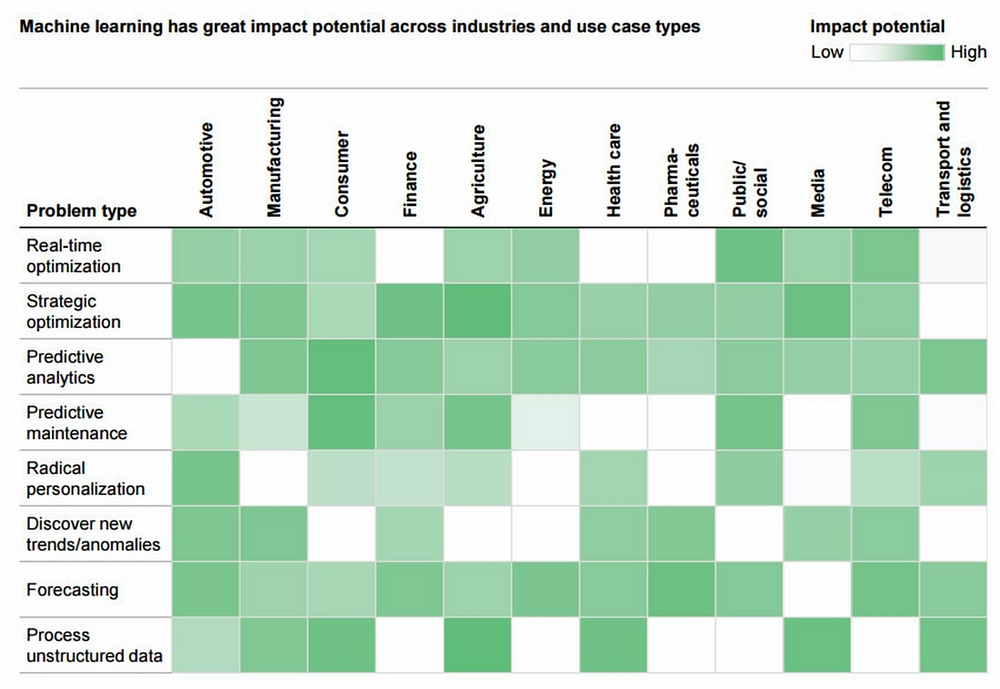
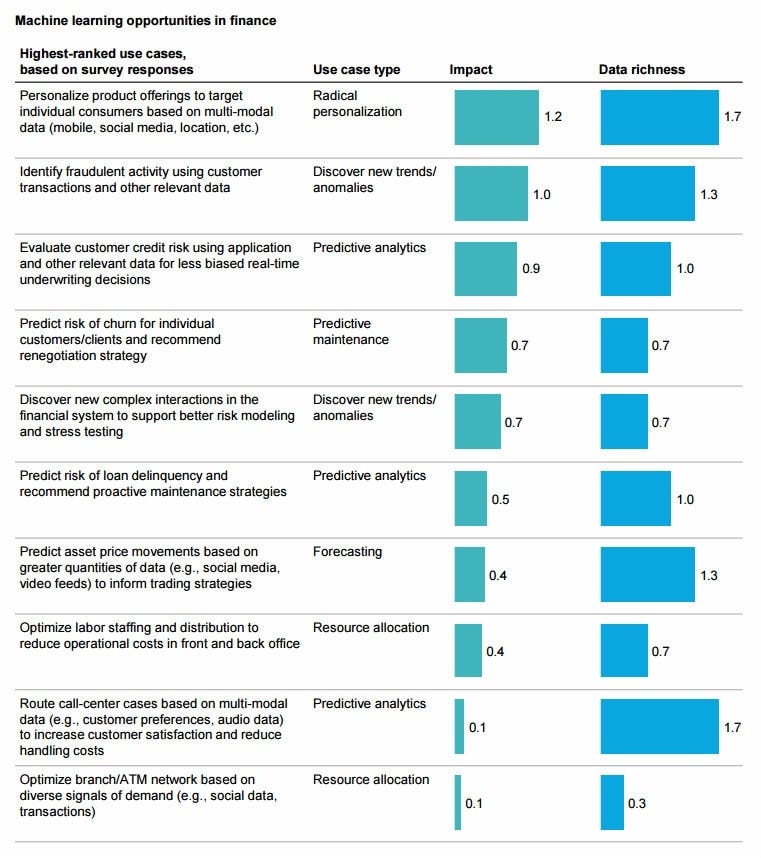
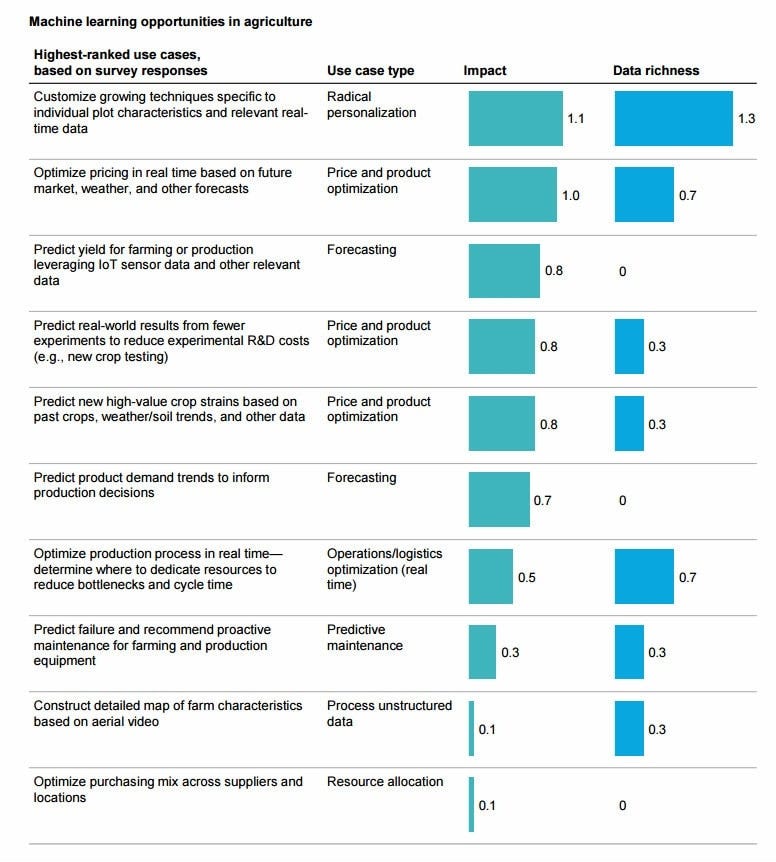
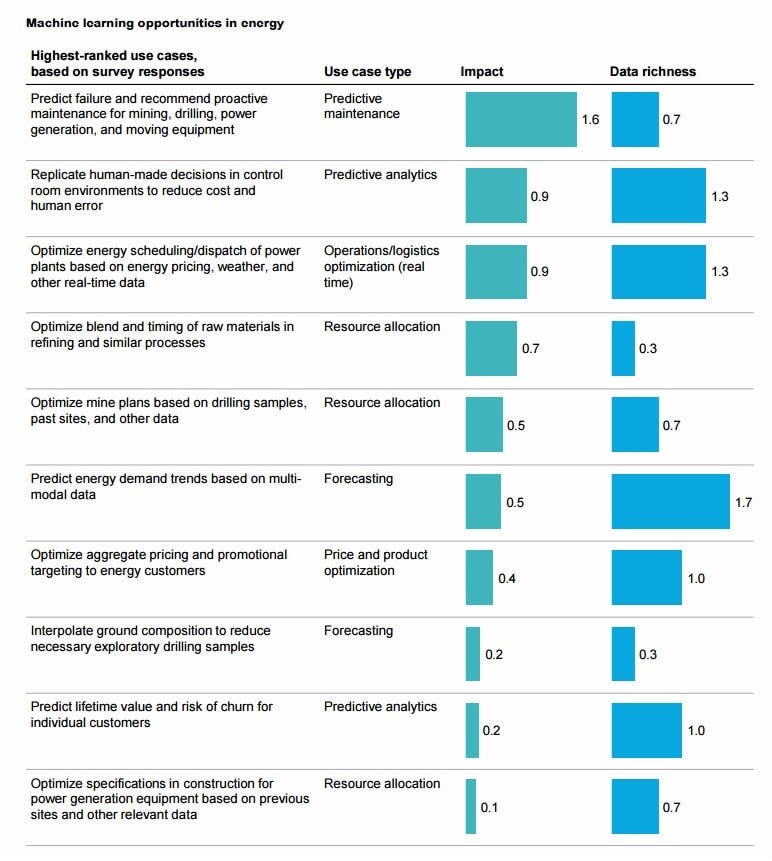
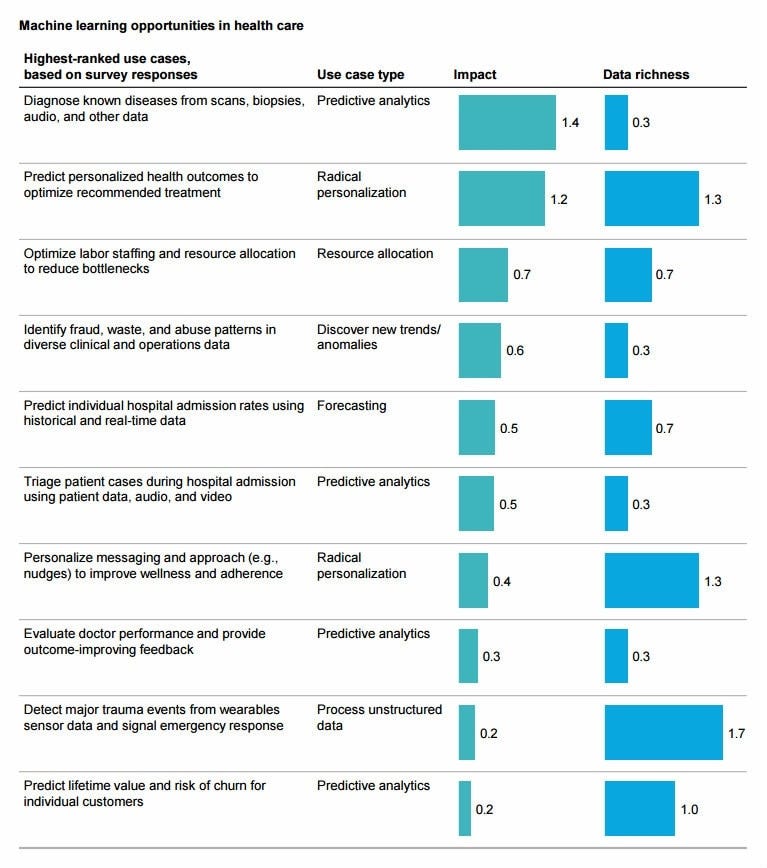
- Notes from the AI frontier: Applications and value of deep learning | McKinsey Global Institute, April 2018 ... Maps traditional machine learning and deep learning techniques to eight core mathematical problem types (classification, continuous estimation, clustering, optimization, anomaly detection, ranking, recommendations, and data generation) across 400+ use cases in 19 industries and nine business functions. The eight-problem-type taxonomy remains an essential diagnostic tool for determining whether a problem actually requires generative AI or is better solved by classical predictive ML.
- Deep Learning, Machine Learning & AI Use Cases | Chris Nicholson, Pathmind A.I. Wiki ... Concise mapping of supervised and reinforcement learning capabilities to industrial and commercial sectors. Note that the site is an archived static resource (last updated 2023).
- 15 Business Applications For Artificial Intelligence And Machine Learning | Forbes Technology Council, September 2018 ... Early practitioner accounts from 15 CIOs and CTOs on predictive analytics, chatbots, and process automation. Note that Forbes Technology Council is fee-based executive membership commentary rather than peer-reviewed or editorial reporting.
Business Value & Outcome Taxonomy
What challenge(s) can your AI investment solve?
Before selecting a model architecture or vendor, organizations must anchor every proposed use case to a specific, quantifiable operational outcome:
- Increase revenue and conversion (marketing, dynamic pricing, hyper-personalized outreach, and automated engineer-to-order quoting)
- Build strategic competitive capabilities (gain capability, new product formulation, and proprietary domain-tuned models)
- Increase operational performance and throughput (detection of manufacturing defects, closed-loop automation, and scientific discovery)
- Reduce operating and capital costs (optimization of precision inputs, predictive maintenance to cut unplanned downtime, and demand reduce inventory carrying costs)
- Compress R&D and cycle times (time reduction in target identification, Protein Folding & Discovery, and automated code refactoring)
- Deliver real-time personalization at scale (recommendations across e-commerce, media streaming, and adaptive Education)
- Mitigate regulatory, legal, and security exposure (avoid risk of non-compliance, automated audit trails, and real-time Cybersecurity threat containment)
- Improve human-machine and cross-language communication (multimodal user interfaces, natural-language understanding, real-time Language Translation, and Telecommunications network optimization)
- Achieve broader physical-digital system integration (retrofitting legacy brownfield machinery via Internet of Things (IoT), digital twins, and coordinated smart cities infrastructure)
- Or target domain-specific outcomes across the industry index below:
| Business Function / Outcome | Primary Technical Mechanism | Required Data Foundation | Documented Production Impact & Failure Trap |
|---|---|---|---|
| Customer Service & Contact Centers (Client Engagement) | RAG-grounded real-time agent assist (Ring 2) and bounded self-service resolution agents (Ring 3) | Historical call transcripts, CRM customer records, up-to-date policy/SOP knowledge bases | +14% to +34% issues resolved per hour (highest gains among novices); reduced agent turnover. Trap: Deploying ungrounded chatbots that hallucinate refund or compliance policies. |
| Software Engineering & IT Modernization (Development) | Repository-indexed code completion, automated unit-test generation, and legacy COBOL/Java migration agents | Version-controlled source repositories, CI/CD automated test suites, strict type-checking and linting gates | +11% to +55% speedup on well-scoped greenfield and boilerplate tasks. Trap: 19% slowdown on complex brownfield repositories when verification and regression-testing overhead exceeds generation speed. |
| Industrial Manufacturing & Plant Operations (Operations & Maintenance, Robotics) | Multi-sensor time-series Anomaly Detection, machine-vision defect inspection, and LLM synthesis of operator maintenance logs | PLC/MQTT sensor telemetry, high-frame-rate optical camera feeds, digitized maintenance manuals and ERP part catalogs | 15% to 40% reduction in unplanned downtime and scrap rates; automated root-cause diagnosis. Trap: Attempting closed-loop actuation on uncalibrated models or across unstandardized ERP/MES part schemas. |
| Supply Chain, Logistics & Retail (Supply Chain, Forecasting) | Probabilistic demand forecasting, multi-tier supplier ESG risk monitoring, and computer-vision shelf planogram auditing | POS daily sales streams, warehouse inventory ledgers, carrier telemetry, global supplier news/regulatory feeds | 10% to 30% reduction in stockouts and excess inventory carrying costs; faster disruption rerouting. Trap: Semantic gaps where ERP, warehouse, and retail channels define stock availability differently. |
| Healthcare & Life Sciences (Healthcare, Drug Discovery) | Deep learning medical imaging triage (CNN/ViT), ambient clinical scribe summarization, and biomolecular structure prediction (Protein Folding & Discovery) | Curated PACS imaging archives (DICOM), EHR clinical notes (FHIR), genomic and proteomic assay databases | 1,357 FDA-authorized AI medical devices (76.6% in radiology); 50%+ reduction in physician EHR documentation time. Trap: Distribution shift across hospital scanner hardware or demographic cohorts without local calibration. |
| Finance, Banking & Legal Compliance (Finance & Accounting, Banking, Law) | Graph neural networks for real-time fraud detection, RAG contract clause risk scoring, and automated financial close reconciliation | Transaction ledgers, KYC/AML watchlists, executed legal contract repositories, general ledger ERP schemas | 40% to 75% reduction in contract review and audit preparation time; sub-100ms payment fraud interception. Trap: Diffusion of legal accountability when human reviewers rubber-stamp plausible AI legal citations or financial figures. |
Industry & Domain Index
The directory below links to dedicated PRIMO.ai domain pages covering sector-specific architectures, datasets, and case studies:
- Market Trading
- Sports
- Gaming
- Toys
- Social Science
- Journalism/News
- Marketing
- Religion
- Education
- Art
- Music
- Photography
- Video & Movie Entertainment
- Writing/Publishing
- Fashion
- Fabrics & Textiles
- Project Management
- Client Engagement
- Human Resources (HR)
- Personal Productivity
- Language
- Travel & Tourism
- Hospitality, Food, and Spirits
- Quantum
- Science:
- Real Estate
- Architecture and Interior Design
- Construction
- Smart Cities
- Transportation (Autonomous Vehicles)
- Robotics
- Supply Chain ... Logistics ... Warehousing ... Retail
- Software Development
- Computer Networks
- Telecommunications
- Power (Management)
- Resources & Utilities
- Operations & Maintenance
- Requirements Management
- Enterprise Architecture (EA)
- Risk, Compliance and Regulation
- Law
- Economics
- Finance & Accounting
- Banking
- Insurance
- Business Strategy/Consulting
- Politics
- Government Services
Consumer Products
Unlike enterprise software deployments that run on centralized cloud clusters, consumer product AI case studies frequently rely on edge inference: running quantized neural networks directly on low-power microcontrollers, smartphones, or dedicated Neural Processing Units (NPUs) to preserve battery life, guarantee sub-10-millisecond latency, and protect user privacy.
- Connected Oral and Personal Care Hardware: Early consumer edge-AI deployments integrated 6-axis inertial measurement units (accelerometers and gyroscopes) with localized position-tracking algorithms inside electric toothbrushes to map brushing coverage across 16 dental zones in real time, guiding users via companion apps to reduce missed plaque zones.
- A revolutionary toothbrush with artificial intelligence | British Dental Journal - Nature, 2019 Clinical and product overview of position-detection sensor fusion and real-time behavioral feedback in consumer dental hardware.
- A revolutionary toothbrush with artificial intelligence | British Dental Journal - Nature, 2019 Clinical and product overview of position-detection sensor fusion and real-time behavioral feedback in consumer dental hardware.
- FDA-Cleared Wearable Physiological Monitoring: Consumer smartwatches and biometric rings from Apple, Google (Fitbit), and specialized health-tech vendors deploy deep convolutional and recurrent neural networks on photoplethysmography (PPG) optical sensor streams and single-lead electrocardiograms (ECG). These on-device models detect irregular heart rhythms (such as atrial fibrillation), estimate sleep apnea respiratory disturbances, and flag gait instability, operating under high-specificity calibration thresholds designed to minimize false-positive clinical alerts.
- On-Device Multimodal Assistants and Smart Home Robotics: Modern smartphones and consumer Robotics (such as autonomous robotic vacuums and lawnmowers) combine Simultaneous Localization and Mapping (SLAM) with compact vision-language models. Rather than streaming continuous interior home video to cloud servers, on-device object-recognition models classify floor obstacles (such as cables, pet waste, or socks) locally in real time, while on-device NPUs execute voice transcription, live Language Translation, and photographic computational imaging without network dependency.
Analysts' Lists
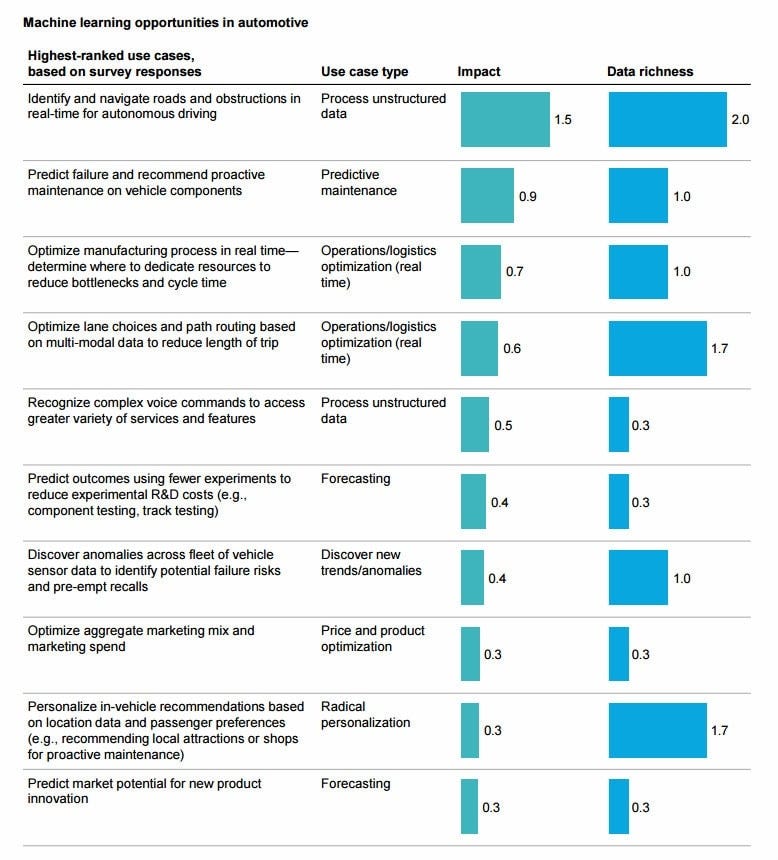
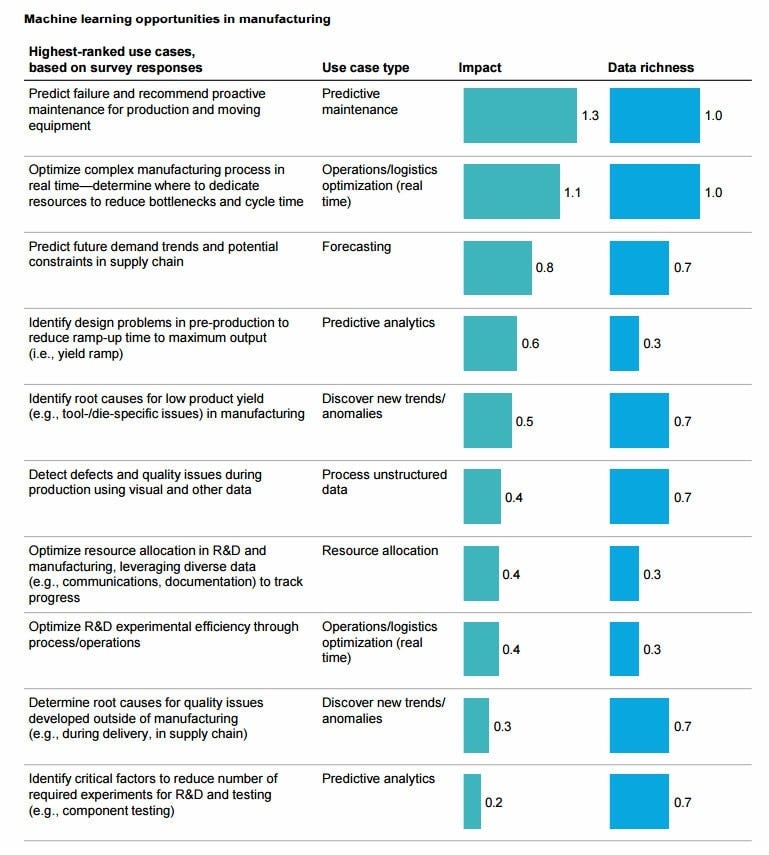
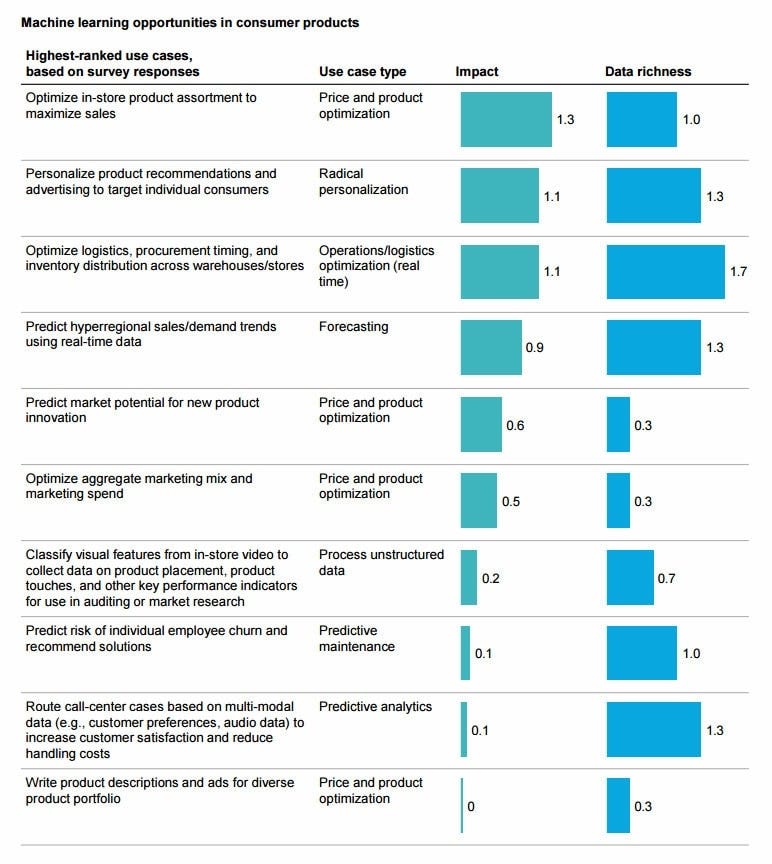
Management consultancies, market-intelligence firms, and industry analysts regularly publish visual taxonomies that map AI use cases across two axes: business value (revenue uplift, cost reduction, or strategic differentiation) and implementation feasibility (data readiness, technical maturity, and organizational friction). While these matrices are useful for initial executive brainstorming during portfolio discovery, practitioners should treat generic industry heatmaps as starting hypotheses rather than turnkey roadmaps. A use case rated "high feasibility" in an analyst report may still stall in a specific enterprise if local ERP and MES data schemas are unaligned.
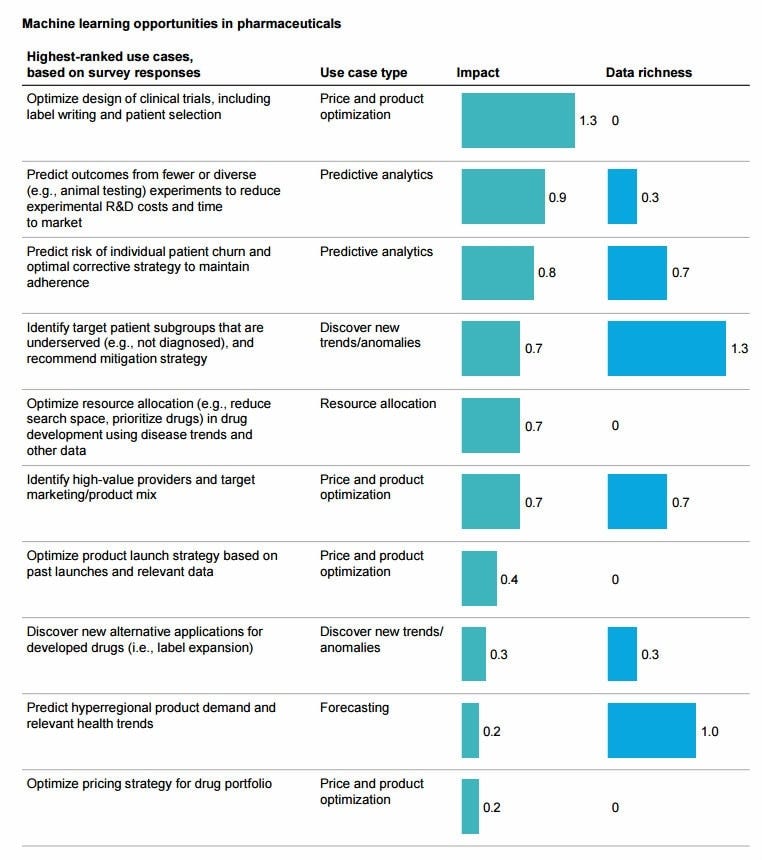
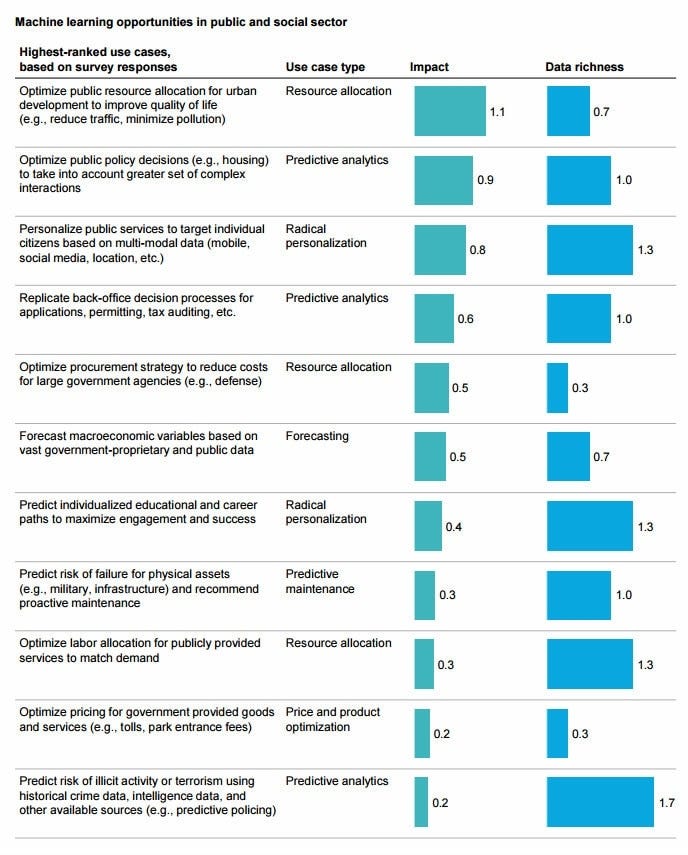
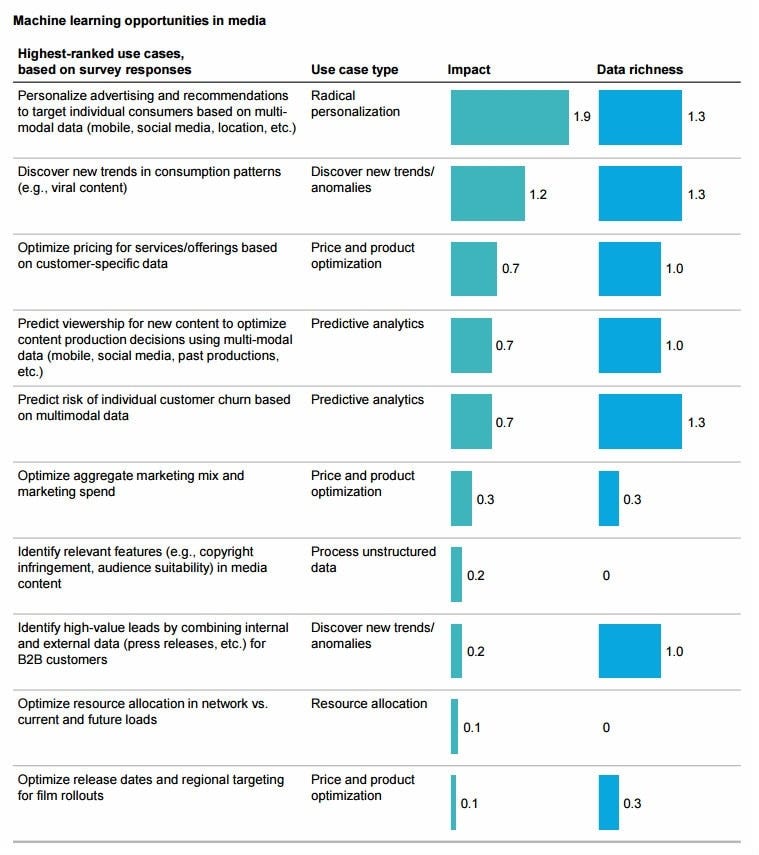
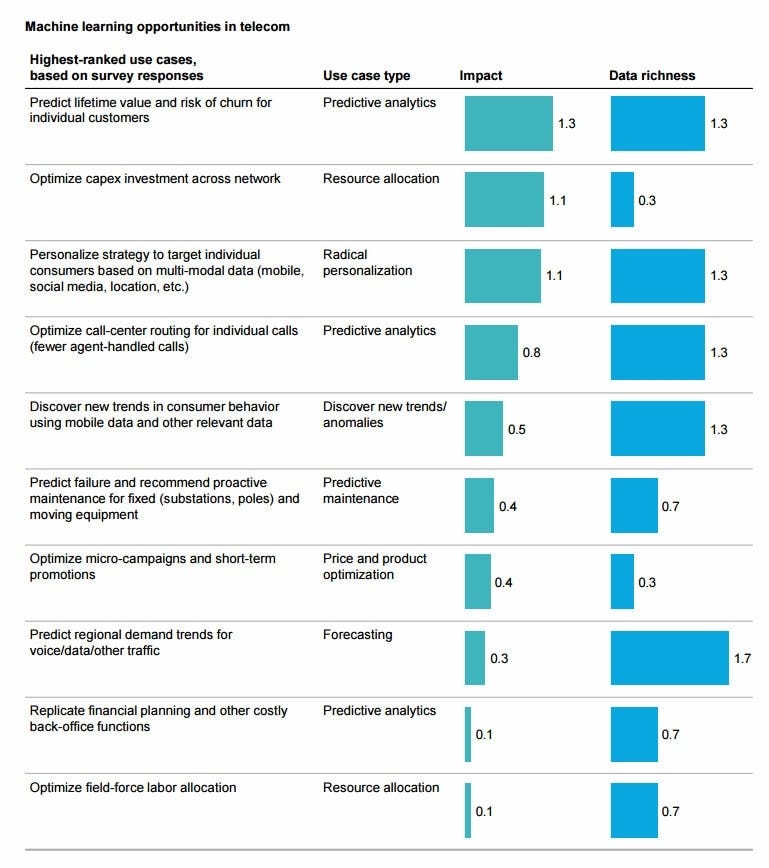
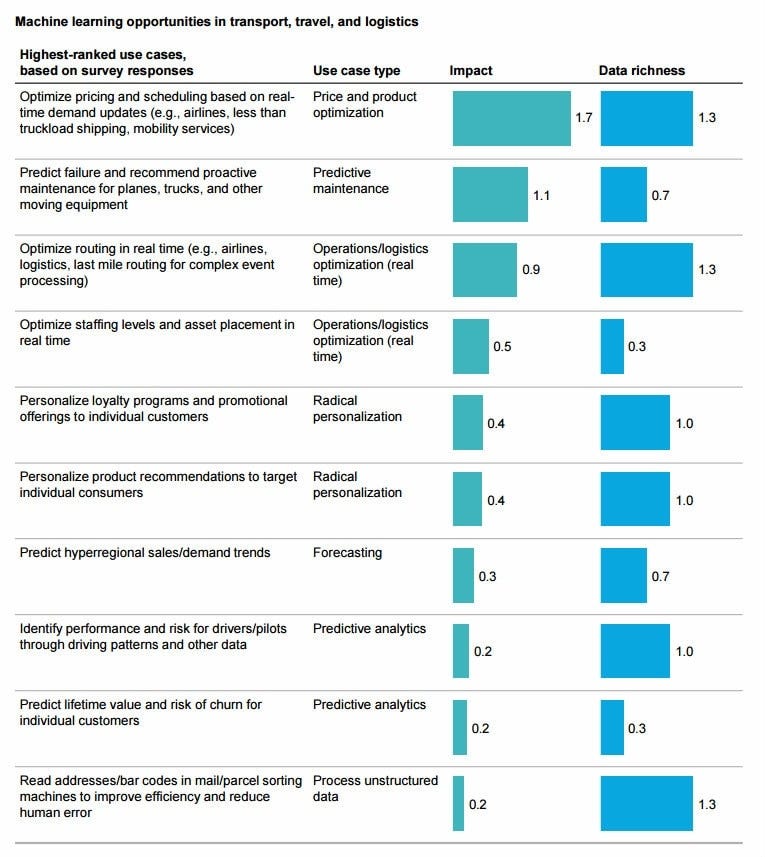

Identifying AI Use Cases
If a typical person can do a mental task with less than one second of thought, we can automate it using AI ... - Andrew Ng
Portfolio Selection and Production Readiness Frameworks
To avoid the "experimentation trap" (running dozens of disconnected $20,000 pilots that lack a path to production funding), mature organizations evaluate candidate use cases using a structured Three-Gate Selection Protocol before writing code:
- Gate 1: Business Fit and Single-P&L Ownership (Should we do it?): Every candidate use case must pass the funding truth test: "If this pilot meets its target metrics in 90 days, which specific P&L owner has committed budget to fund full production deployment?" In industrial and enterprise settings, projects that span multiple organizational silos (such as trying to automate feedback from factory-floor manufacturing realization all the way back to upstream CAD product design without a single accountable executive) routinely fail. High-survival projects start inside a single accountable ownership domain (Design, Realize, or Optimize) tied to a concrete KPI such as scrap reduction, mean time to repair (MTTR), or quote turnaround speed.
- Gate 2: Data and Human-Baseline Feasibility (Can we do it?): Before adopting AI for a workflow, organizations apply the Existing Human Team Test: does a human team or department already collect and use the underlying data to perform this task today, even if the current process is slow, manual, and scattered across PDFs, emails, and ERP screens?
- If humans already gather the inputs and produce a verified output (such as an engineering bill-of-materials quote or a compliance audit), the data foundation exists and an AI system can be trained to ingest, standardize, and accelerate that workflow, using the human team's historical outputs as a ground-truth evaluation rubric.
- Conversely, if the required data does not exist even for human experts (for example, unconnected legacy machines with no sensor telemetry, or conflicting ERP/MES master data where departments argue over which number is correct), the organization does not have an AI use case yet; it has a data-modernization and instrumentation prerequisite.
- Gate 3: Upfront Scaling Economics (What will it take to operate in production?): Rather than deferring operational requirements until after a flashy demo, teams estimate the "below-the-waterline iceberg" costs upfront: API integration into legacy software versions, cybersecurity and data-privacy clearance, edge hardware retrofitting, workforce change management, and ongoing verification labor. Candidate use cases that survive all three gates are then stacked into a balanced portfolio combining quick operational wins with 1 or 2 strategic differentiators built on proprietary company data (since relying solely on off-the-shelf foundation models with zero proprietary data customization provides no durable advantage over competitors using the exact same models).
| Layer | Verification Component | Testable in Pilot? | Operational Function in Production |
|---|---|---|---|
| 1. Retrieval Grounding | Snippet-level document parsing and citation binding | Yes | Ensures responses and extracted parameters come strictly from supplied enterprise schematics, SOPs, and logs rather than generic pre-training weights. |
| 2. Domain Fine-Tuning | Post-training adaptation on proprietary historical workflows | No (Requires production data volume) | Aligns model terminology, formatting, and edge-case reasoning with organization-specific standards once live system connectors are active. |
| 3. Deterministic Checks | Hard-coded software rules, schema validators, and math bounds | Yes | Combines probabilistic LLM extraction with classical software engineering (`if/else` bounds, physical tolerances, pricing formulas) where 100% precision is mandatory. |
| 4. Verifier Pass & Calibration | Secondary critic models and uncertainty abstention flags | Yes | Trains the system to stop and flag ambiguous or out-of-distribution inputs for a human engineer rather than guessing with high confidence. |
| 5. Continuous Evals & Human Gate | Automated regression testing on live production traces + human sign-off | Partial (Human gate in pilot; Continuous Evals in production) | Periodically samples live production outputs against expert rubrics to detect model drift, while preserving clear human accountability for final sign-off. |
Practitioner Seminars & Use-Case Workshops
The first six sessions in the table below date from 2018 to 2020 and predate generative AI; the seventh session (2026) examines modern industrial and agentic deployments. The core selection frameworks (problem-type matching, data-readiness assessment, and portfolio prioritization) transfer directly across eras.
|
|
|
|
|
|
|
|
Additional Viewing
In this 49-minute technical conversation with the Siemens Knowledge Hub (July 2026, YouTube link), Professor Erik Brynjolfsson (Director of the Stanford Digital Economy Lab and Senior Fellow at Stanford HAI) explains why enterprise productivity often lags behind raw AI model capabilities along the Productivity J-Curve. He details how organizations can break roles down into atomic tasks (using taxonomies of 18,000 to 200,000 tasks) to identify high-ROI AI opportunities, why managers must use econometric causal inference rather than observational correlations to avoid selection-bias mirages in coding and operations studies, and how human operators act as "CEOs of agent fleets" responsible for formulating questions and verifying outputs.
Recorded at the Stanford Institute for Economic Policy Research (SIEPR) Economic Summit (March 2026, 55 minutes, YouTube link), this panel features Stanford economists Erik Brynjolfsson and Chad Jones alongside former Bureau of Labor Statistics Commissioner Erika McEntarfer examining the empirical macroeconomic and labor-market evidence of AI deployments. The speakers contrast the Silicon Valley exponential-growth thesis against historical general-purpose technology diffusion, analyze how "weak links" in enterprise production functions govern the pace of real-world ROI, and present the administrative payroll findings from the Canaries in the Coal Mine study showing how task automation versus task augmentation shapes entry-level hiring.
In this 59-minute keynote lecture at the Wharton Human-AI Research Workshop (October 2024, YouTube link), Professor Erik Brynjolfsson traces the evolution of computation from Software 1.0 (explicitly coded rules) to Software 2.0 (supervised machine learning) and generative AI. He presents the complete empirical data from his contact-center natural experiment (documenting 14% overall and 34% novice productivity gains, customer sentiment improvements, and durable human skill retention during system outages) and explains the economic mathematics of the "Turing Trap," illustrating why human-AI complementarity outperforms pure human substitution.
Moderated by Yash Titus with panelists Benson Chan (Strategy of Things), Flemming Kock (Siemens CTO Office), Jonathan Weiss (Cumulosity), and Maddie Zeng (NeoAI), this 69-minute IIoT World engineering panel (September 2026, YouTube link) provides a ground-level blueprint for transitioning industrial AI from pilot to production in brownfield manufacturing plants. The speakers break down the three dimensions of model progress (abstraction, confidence calibration, and the four concentric rings of agentic autonomy), walk through a multi-agent machine-vision quality inspection architecture, and detail the 5-layer verification pipeline and 3-gate portfolio funding framework that prevent pilot purgatory.