AI Solver
| AI Solver map |
|---|
|
Your current page is in bold
0 · Start
1 · Predict & analyze
tables, numbers, events
Predict values
Predict categories Forecast time series Cluster / segment Find outliers Make recommendations Find key drivers 2 · Understand unstructured data
text, documents, images, audio
3 · Generate & converse
4 · Decide & act
5 · Build it right
applies to every path
|
YouTube ... Quora ...Google search ...Google News ...Bing News
- AI Solver ... Algorithms ... Administration ... Model Search ... Discriminative vs. Generative ... Train, Validate, and Test
The AI Solver walks you from what you want to do to a short list of approaches worth trying. Each page asks a few questions; take the first answer that fits. Then test two or three options on your own data, because no rule of thumb beats a quick experiment.
Start here
How to use it: (1) check Step 0, (2) pick your goal below, (3) use the Build it right pages to choose, customize, deploy and evaluate a model. The AI Solver map box on every page shows the whole tree with your current page in bold, and the bar at the top of each page shows your path.
Step 0: Do I Need AI?
- Can clear rules, a database query or a spreadsheet formula do the job? → Start there. A simple heuristic is also the baseline any model must beat.
- Do you have examples of correct answers, or does a pretrained model already understand your kind of data (text, images, speech)? → If neither, collect data first or start from a pretrained foundation model.
- Could a wrong answer hurt someone (money, safety, health, legal rights)? → Plan human review, testing and governance from day one: ...evaluate and trust AI.
- Is the problem worth solving? → Pick a use case with a measurable outcome and an owner. See A Framework for Picking the Right Generative AI Project | M. Zao-Sanders & M. Ramos - Harvard Business Review and Rules of Machine Learning | Google.
Choose your goal
I want to...
Predict and analyze
Structured data: rows and columns, numbers, events. Mostly discriminative models that learn from labeled examples to predict or classify. Gradient-boosted trees remain the workhorse; tabular and time-series foundation models are the new baselines.
- ...predict values — how much or how many? (price, demand, delivery time, risk score)
- ...predict categories — which class? yes or no? (churn, fraud, spam, diagnosis)
- ...forecast time series — what happens next over time? (sales, energy load, traffic)
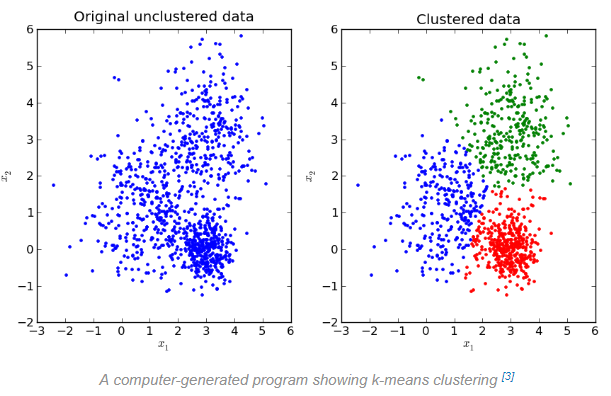
- ...cluster — what natural groups exist? (customer segments, topics)
- ...find outliers — what is unusual? (fraud, defects, incidents)
- ...make recommendations — what will each user want next?
- ...find key drivers — what matters, and is it cause or correlation? (feature importance, Dimensional Reduction, A/B tests)
Understand unstructured data
Text, documents, images, video and audio. Start from a pretrained foundation model and adapt it, rather than training from scratch.
- ...understand language — classify, extract, summarize, translate (Natural Language Processing (NLP), Sentiment Analysis)
- ...understand images and video — detect, segment, read, describe
- ...work with speech and audio — transcribe, speak, hold voice conversations (Speech Recognition)
Generate and converse
Generative models create new content; agentic systems use models with tools to complete tasks. Start simple and add autonomy only when it pays.
- ...generate content — text, code, images, video, audio, 3D, synthetic data (Generative AI)
- ...answer questions from my data — chat with documents and databases (RAG, text-to-SQL, knowledge graphs)
- ...build an agent — automate multi-step tasks with tools (Agents/Assistants, Personal Companions)
Decide and act
Choose the best action under constraints or uncertainty.
- ...optimize decisions — schedule, route, price, allocate, control: mathematical optimization, bandits, reinforcement learning, robotics
Build it right
Applies to every path above.
- ...choose a model — size, open vs. closed, reasoning, cost, latency, small (SLM) vs. large (LLM)
- ...customize a model — prompt → retrieval → tools → fine-tune → distill
- ...deploy AI — API, cloud platform, self-hosted, on-device
- ...evaluate and trust AI — metrics, evals, guardrails, governance
- ...understand new architectures — mixture of experts, reasoning models, hybrid Mamba, diffusion LLMs, foundation models for tables and time series
- ...pick a product or platform — the product landscape by category
Quick picker: start from your data
| Your data | Typical goals | Usually start with | Go to |
|---|---|---|---|
| Rows and columns (tabular) | predict a number or class, segment, flag anomalies | gradient-boosted trees (XGBoost, LightGBM, CatBoost); TabPFN for small tables; AutoML | ...predict values, ...predict categories, ...cluster, ...find outliers |
| Time-stamped values | forecast, detect anomalies | seasonal-naive baseline → statistical models or LightGBM → time-series foundation models (Chronos, TimesFM) | ...forecast time series |
| User–item interactions | recommend, personalize | item-to-item similarity → two-tower retrieval + ranking model | ...make recommendations |
| Text and documents | classify, extract, summarize, answer questions | prompted LLM → embeddings and RAG → fine-tuned small model | ...understand language, ...answer questions from my data |
| Images and video | detect, segment, read, describe | pretrained detectors (YOLO), SAM, vision-language models | ...understand images and video |
| Audio and speech | transcribe, speak, converse | Whisper or cloud speech-to-text, neural text-to-speech, speech-to-speech models | ...work with speech and audio |
| Graphs and networks | fraud rings, routes, molecules | graph algorithms, graph neural networks, optimization | ...find outliers, ...optimize decisions |
| APIs, apps and tools | automate multi-step work | a fixed workflow first; an agent with MCP tools when the steps vary | ...build an agent |
| Objectives and constraints | schedule, route, allocate | optimization solvers (OR-Tools), bandits, reinforcement learning | ...optimize decisions |
Full decision tree

- Step 0 — Do you need AI? Rules or a query suffice → no AI yet · no data and no pretrained model fits → collect data first · high stakes → plan evaluation and human oversight
- Structured data — what do you want to know?
- A number → ...predict values: linear baseline → gradient-boosted trees; small table → TabPFN; ranges → quantile or conformal; counts → Poisson
- A class → ...predict categories: must explain → logistic regression or EBM; accuracy → gradient-boosted trees; rare positives → imbalance tactics; few labels → LLM zero-shot or LLM-labeled data
- The future of a series → ...forecast time series: few series → ETS, ARIMA, Prophet; many series → global LightGBM; little history → time-series foundation model
- Natural groups → ...cluster: number of groups known → K-Means or GMM; unknown → HDBSCAN or DBSCAN; text or images → embeddings + UMAP + HDBSCAN
- Anomalies → ...find outliers: labeled incidents → classification; tables → Isolation Forest; time series → forecast residuals; images → PatchCore
- What a user wants next → ...make recommendations: no history → content-based; history → collaborative filtering → two-tower + ranker; sequences → generative recommenders
- Why, and what matters → ...find key drivers: model drivers → SHAP; too many features → PCA or UMAP; cause and effect → A/B test or causal inference
- Unstructured data — what kind?
- Text and documents → ...understand language: few labels → prompt an LLM; high volume → fine-tuned small encoder; PDFs and scans → document AI
- Images and video → ...understand images and video: one label → classifier; boxes → YOLO or RT-DETR; masks → SAM; descriptions → vision-language model
- Audio → ...work with speech and audio: transcribe → speech-to-text; speak → text-to-speech; converse → cascaded pipeline or speech-to-speech model
- Create or converse?
- New content → ...generate content
- Answers from your knowledge → ...answer questions from my data: small corpus → long context; large or changing → RAG; relationships → GraphRAG; databases → text-to-SQL
- Actions across tools → ...build an agent: one call → workflow (chain, route, parallelize, orchestrate, evaluate) → autonomous agent → multi-agent only when needed
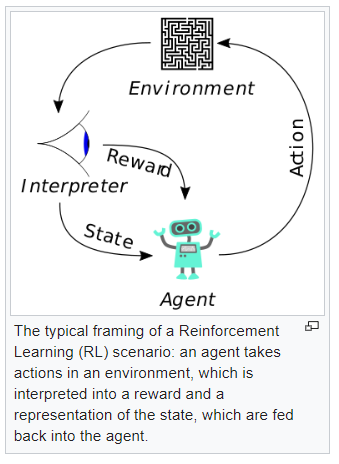
- Decide? → ...optimize decisions: objective and constraints → solver; repeated choices with feedback → bandits; sequential decisions with a simulator → reinforcement learning; robots → vision-language-action models
- Then build it right: ...choose a model → ...customize a model → ...deploy AI → ...evaluate and trust AI
What changed since the classic cheat sheets
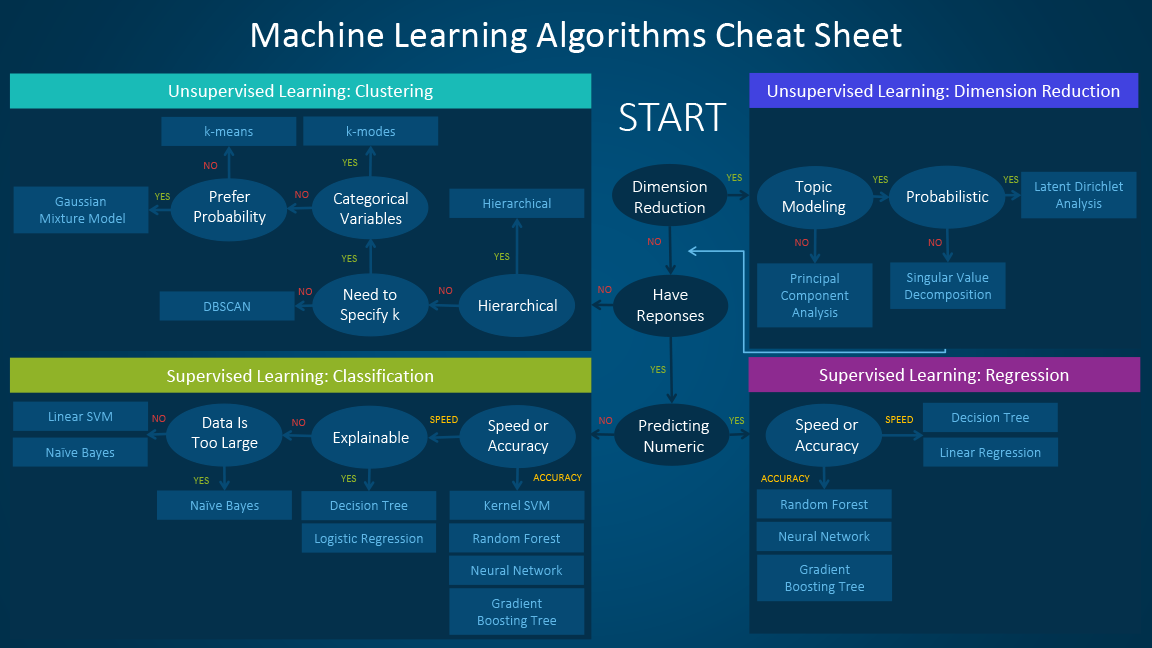
The algorithm cheat sheets at the bottom of this page (Microsoft, SAS, scikit-learn) are still good guides for tabular data. Since they were drawn:
- Foundation models first. For text, images and audio, and now for tables and time series, start from a pretrained model and adapt it.
- Trees still rule large tables; tabular foundation models such as TabPFN now lead on many small and medium tables (Accurate predictions on small data with a tabular foundation model | Nature).
- LLM applications are systems, not single models: prompts + retrieval + tools + evaluation. Agents add planning and actions; start with the simplest pattern that works (Building effective agents | Anthropic).
- Open standards for agents. MCP (tools and data), A2A (agent-to-agent) and AGENTS.md now sit under the Linux Foundation's Agentic AI Foundation; A2A joined in August 2026.
- New architectures shift cost and speed: mixture of experts, reasoning models, hybrid Mamba-Transformers, diffusion LLMs. See ...understand new architectures.
- Products churn. Azure AI Anomaly Detector and Personalizer were retired on 1 October 2026, and Vertex AI became the Gemini Enterprise Agent Platform in April 2026. Choose categories and portable designs, not just brands: ...pick a product or platform.
- Rules are arriving. EU AI Act obligations for general-purpose AI models have applied since August 2025; high-risk obligations now start in December 2027 and August 2028. See ...evaluate and trust AI.
Key terms
- Discriminative model — learns to map inputs to a label or value (classify, predict). Discriminative vs. Generative
- Generative model — learns to produce new data: text, images, audio. Generative AI
- Foundation model — a large model pretrained on broad data and adapted to many tasks.
- LLM / SLM — large / small language model; SLMs (roughly 1–15 billion parameters) run on laptops and phones.
- Embedding — a vector that captures meaning, used for search, clustering and RAG. Embedding
- RAG — retrieve relevant content and give it to the model along with the question. RAG
- Fine-tuning — further training a pretrained model on your own examples. Fine-tuning
- Agent — a model using tools in a loop to reach a goal. Agents/Assistants
- MCP / A2A — open protocols that connect agents to tools and data (MCP) and to other agents (A2A).
- Eval — a repeatable test set that measures whether the AI does the job. Train, Validate, and Test
Other solution finders
- Choosing the right estimator (ML map) | scikit-learn
- Machine Learning Algorithm Cheat Sheet for the designer | Microsoft
- Choosing a generative AI service | AWS Decision Guides
- Choosing an AWS machine learning service | AWS Decision Guides
- Choose a design pattern for your agentic AI system | Google Cloud
- AI agent orchestration patterns | Microsoft
- A practical guide to building agents | OpenAI
- Building effective agents | Anthropic
- Find models by task | Hugging Face ... Models | Hugging Face ... click on Sort: Trending
- People + AI Guidebook | Google PAIR
- How to pick an algorithm | Willem Meints
- An easy guide to choose the right Machine Learning algorithm | Yogita Kinha - KDnuggets
- Everything you should know about AI models | Eray Eliaçık - Dataconomy
- The state of AI | McKinsey & Company ... annual survey of how organizations adopt and scale AI
- Algorithms & Neural Network Models to learn about approaches used to solve specific AI-related problems ... Model Search
Classic ML cheat sheets
Still useful for tabular data; they predate foundation models and agents.
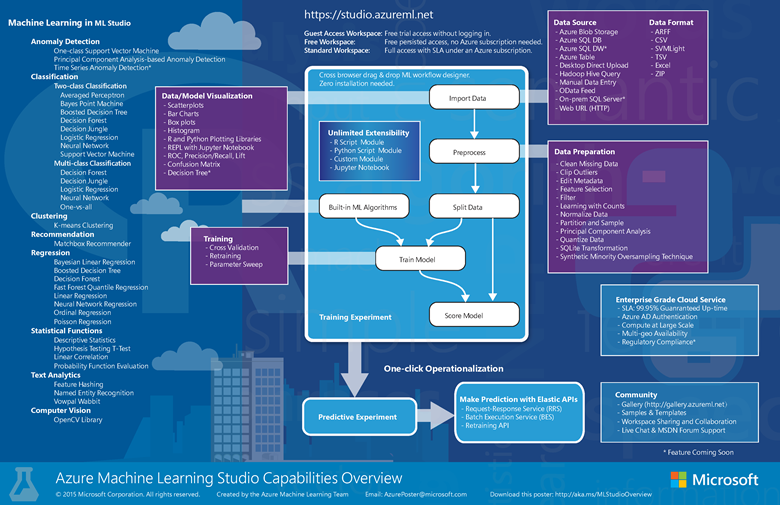
Microsoft Azure Machine Learning Cheat Sheet
- How to choose algorithms for Microsoft Azure Machine Learning | Microsoft ... Studio (classic) was retired in 2024; the cheat sheet now covers the Azure Machine Learning designer.

SAS
Notes