Joint Force Requirements Process (JFRP)
Youtube search... ...Google search
- Strategy & Tactics ... Leadership ... Best Practices ... Checklists ... Project Management ... Project Check-in ... JFRP ... Evaluation ... Measures ... Benchmarks
- Cybersecurity ... OSINT ... Frameworks ... References ... Offense ... NIST ... DHS ... Screening ... Law Enforcement ... Government ... Defense ... Lifecycle Integration ... Products ... Evaluating
- Architectures for AI ... New Architecture Options ... Generative AI Stack ... Enterprise Architecture (EA) ... Enterprise Portfolio Management (EPM) ... Architecture and Interior Design ... What is a Capability?
- Analytics Advisor ... Visualization ... Graphical Tools ... Diagrams & Business Analysis ... Requirements ... Loop ... Bayes ... Network Pattern
- AI Software Engineering ... Notebooks ... AI Pair Programming ... AI App Builders ... AIOps/MLOps ... AIaaS/MLaaS
The Joint Force Requirements Process (JFRP) is how the U.S. military now decides which joint problems matter most and how Service capabilities must fit together to solve them. It was introduced on January 15, 2026 by CJCSI 5123.01J and is detailed in CJCSM 5123.01A (August 5, 2026). The JFRP replaces the Joint Capabilities Integration and Development System (JCIDS) in its entirety. Instead of validating each Service's requirement documents, the Joint Requirements Oversight Council (JROC) ranks Joint Operational Problems (JOPs) every year and concentrates on Joint Force Design, Joint Capability Integration and combatant command (CCMD) requirements, with Capability Portfolio Management (CPM) as its analytic engine. The Military Services now validate their own Service-specific requirements. The process belongs to the Department of Defense, now styled the Department of War (DoW).
For PRIMO readers, the JFRP is a large-scale example of an organization trading page counts for data, portfolios and analytics at the same moment it declared itself "AI-first." See AI and the JFRP and JCIDS vs. JFRP.
- Governing documents: CJCSI 5123.01J Charter of the JROC and the JFRP (pdf) January 15, 2026 ... Change 1 (pdf) August 5, 2026 ... CJCSM 5123.01A Manual for the JROC and the JFRP (pdf) August 5, 2026, superseding CJCSM 5123.01 (pdf) January 15, 2026
- Direction: Reforming the Joint Requirements Process to Accelerate Fielding of Warfighting Capabilities (pdf) Deputy Secretary of War, November 7, 2025 ... 10 U.S.C. 181 Joint Requirements Oversight Council, as amended by the FY2026 NDAA, Section 1811
- Briefing: The Joint Force Requirements Process: Accelerating Capability Delivery through Joint Operational Problems & Portfolio Management (pdf) ... implementation brief for CJCSI 5123.01J and CJCSM 5123.01
How the JFRP Works
The JFRP starts with problems, not programs. Key Operational Problems drawn from the National Defense Strategy feed a ranked list of Joint Operational Problems (1 to N). The JROC then works that list through four connected lines of effort, and the Services and their Portfolio Acquisition Executives deliver the solutions.
| Line of effort | What it does | Who leads | Typical outputs |
|---|---|---|---|
| Joint Force Design (JFD) | Reconciles Service initiatives against the JOPs to create options and trade-space, so the Joint Force has more than one way to solve each problem. Horizons: near term (0 to 2 years), mid term (2 to 7 years) and long term (7 to 25 years). | JROC and Joint Staff | Chairman's Risk Assessment (CRA) and Chairman's Program Recommendation (CPR) |
| Joint Capability Integration (JCI) | Reviews, rather than validates, Service capabilities for interoperability, JOP alignment and duplication. The JROC assigns a Joint Staffing Designator and pulls programs for review only by exception. | JROC; Joint Staff J-8 | Integration findings and by-exception program reviews |
| CCMD requirements | Carries the warfighter's voice through Capability Gap Assessments, CCMD Derived Requirements (CDRs) and Joint Immediate Combatant Command Requirements (JICRs). | Combatant commands; Joint Staff | Joint and urgent requirements for the most serious operational risks |
| Resourcing (RRAB and JAR) | The Requirements and Resourcing Alignment Board selects top-ranked problems each budget cycle, issues programming guidance and recommends Joint Acceleration Reserve allocations. | VCJCS and Deputy Secretary of War (co-chairs); Director, CAPE and Director, J-8 (executive secretaries) | Decision memos to start, stop or realign programs; JAR funding |
| Experimentation (MEIA) | The Mission Engineering and Integration Activity engages industry, runs mission engineering analysis to refine requirements and conducts integration and experimentation campaigns. | Under Secretaries of War for Research & Engineering and for Acquisition & Sustainment | Validated solution elements and JAR funding recommendations |
Joint Operational Problems (JOPs)
- A JOP is a challenge that prevents the Joint Force from achieving an objective, based on doctrine, threat or concept. The implementation brief's rule of thumb: if a need does not help solve a JOP, it is not a joint priority.
- The reform memo directed the JROC to become the single forum for identifying and annually ranking the Joint Force's top operational problems and their capability gaps.
- The FY2026 NDAA wrote JOPs into law: 10 U.S.C. 181 now has the JROC compile, refine and prioritize joint operational problems with the combatant commands, propose nonprescriptive solutions and keep a repository of JOPs and the capabilities that address them.
Capability Portfolio Management (CPM)
CPM is the JROC's analytic engine. It moves decisions from individual programs to portfolios by combining four enterprise views:
- CPMR (Joint Staff) ... the requirements view
- IAPR (Acquisition & Sustainment) ... acquisition health
- TMTR (Research & Engineering) ... technology and science & technology
- PBR (CAPE) ... the budget view
See also Enterprise Portfolio Management (EPM) and Requirements Management.
Documents and Data
- Leaner documents: Capstone Requirements Documents (CRDs) give overarching guidance for a portfolio; CCMD Derived Requirements state a specific warfighter need as tasks, conditions and standards without a Service sponsor; Joint DOTmLPF-P Change Requests (JDCRs) cover non-materiel fixes.
- Service formats accepted: Services own their requirement document formats. The JROC requires only specific data fields, submitted through the Joint Staff's Knowledge Management/Decision Support (KM/DS) system.
- Continuity: Previously approved JROC requirements remain approved, and signed JROC Memorandums (JROCMs) remain in effect.
Urgent Needs: Joint Immediate Combatant Command Requirements (JICRs)
CJCSM 5123.01A consolidated the legacy Joint Urgent Operational Need (JUON) and Joint Emergent Operational Need (JEON) pathways into a single JICR process, and redesignated all existing JUONs and JEONs as JICRs. Change 1 to CJCSI 5123.01J aligned the JROC charter with the new terminology. The approval threshold stays high: preventing mission failure or loss of life.
Resourcing, Industry and the Law
- RRAB: joint decisions move directly into the budget build without added review layers unless the Deputy Secretary directs otherwise. By exception, the RRAB may flag a Service or component requirement for modification or termination.
- Joint Acceleration Reserve: beginning with the FY2027 budget cycle, the Director of CAPE proposes withholding part of the top-line fiscal guidance, which is then allocated during the Program and Budget Review based on RRAB decisions, aimed at the "valley of death" for joint capabilities.
- Industry: the MEIA must develop an industry engagement plan, and the FY2026 NDAA directs the JROC to seek industry input on commercially available technology for joint operational problems.
- Statute: the FY2026 NDAA (Section 1811) removed the JROC's "validate" and "approve" authorities for Service-level requirements and created Portfolio Acquisition Executives (Section 1802) to manage capability portfolios.
Artificial Intelligence (AI) and the JFRP
The JFRP is a process reform, not an AI program, but it was launched for an AI-first department. The public reform memo and the implementation brief do not prescribe AI tools. What they do is replace page counts with data fields, portfolios and analytics, in the same months that the department rolled out an AI-first strategy and an enterprise generative AI platform.
From Documents to Data
- The implementation brief describes the culture shift as moving from document to data: decisions should rest on analytics, not page count, and the old document-heavy compliance gives way to data-driven portfolios.
- Joint data fields in KM/DS and the four CPM views create structured, portfolio-wide data. That is the raw material that predictive and prescriptive analytics, knowledge graphs and LLM assistants need to find duplication, interoperability conflicts and unfunded gaps across Services.
- CJCSM 5123.01A, Enclosure D, covers the JFRP's supporting digital tools, metrics and training alongside the Joint Capability Areas.
An AI-First Department
- AI strategy: a January 9, 2026 memorandum directed the department to become an "AI-first" warfighting force through seven Pace-Setting Projects, aggressive data access and a 30-day AI model parity requirement. Secretary Hegseth presented it at SpaceX Starbase on January 12. The strategy argues that becoming AI-first means reimagining existing workflows and processes, not only adding AI to them, which is the same logic the JFRP applies to requirements.
- GenAI.mil: launched December 9, 2025 with Google's Gemini for Government. OpenAI's ChatGPT Mil and Grok for Government were added at the end of August 2026, and the department reports more than 1.7 million unique users. It gives requirements staffs a sanctioned assistant for drafting and summarizing at the CUI / Impact Level 5 level. See Gemini, ChatGPT and Grok.
- Commercial AI: the FY2026 NDAA's call for industry input on commercially available technology, and the MEIA's experimentation campaigns, give commercial AI and autonomy a route into joint solutions.
Generative AI for Requirements Work
- RAIMOND (MIT Lincoln Laboratory, February 2026): researchers used LLMs to draft JCIDS-style Capabilities-Based Assessments. Prompt engineering alone produced drafts too thin to pass validation. Combining agentic workflows, prompt engineering and enough context produced assessments at about 80 percent readiness, which still needed subject matter experts to validate and verify them. The JFRP's leaner documents and fixed data fields are an easier target for this kind of assistant.
- NDIA Emerging Technologies Institute and MITRE hosted "AI for Requirements" in November 2025 to map the data- and labor-intensive pain points in the post-JCIDS requirements process and to demonstrate industry AI tools (video below).
- Army Contracting Command began testing AI prototypes in January 2026 that cut the preparation of Acquisition Requirement Packages, the contracting step that follows a validated need, from weeks to hours.
- A lesson from Army doctrine writers: an AI tool once drew on an outdated manual, and only an expert user caught the error. With the JCIDS manuals rescinded, an assistant used for JFRP work should be grounded in CJCSI 5123.01J (with Change 1) and CJCSM 5123.01A. A Retrieval-Augmented Generation (RAG) index of current directives is a practical safeguard.
AI and Autonomy as Joint Operational Problems
- Many problems the JROC now ranks, such as counter-drone defense and contested electromagnetic operations, involve AI on both sides. Military leaders have called for a more integrated, joint approach to drone dominance after years of Service-by-Service efforts. That is exactly the kind of duplication and interoperability gap Joint Capability Integration is meant to catch.
- MEIA mission engineering and experimentation, followed by Joint Acceleration Reserve funding, give AI-enabled solutions a path from demonstration to funding inside a single budget cycle. See Robotics and Digital Twin.
- Carnegie's August 2026 study uses autonomous drones to show how technical, cultural, bureaucratic and political barriers slow AI diffusion in the U.S. military: the kinds of barriers the JFRP's speed rules try to remove.
Where AI Can Help Across the JFRP
Illustrative uses. The JFRP guidance does not mandate these tools.
| JFRP activity | How AI can assist | Human check |
|---|---|---|
| Identify and rank JOPs | Summarize threat assessments, concepts and CCMD Capability Gap Assessments; cluster similar problems; trace each JOP back to its sources | Analysts confirm sources, classification and the ranking rationale |
| Capability Portfolio Management | Join requirements, acquisition-health, technology and budget data; flag duplication, orphaned requirements and funding gaps | Portfolio managers validate data quality and conclusions |
| Joint Capability Integration | Compare Service documents' interfaces, data standards and dependencies to spot interoperability conflicts | Joint Staff action officers adjudicate; the JROC decides whether to intervene |
| CCMD Derived Requirements and JICRs | Turn operator input into draft tasks, conditions and standards; check them against existing programs | The CCMD and the validation authority approve |
| RRAB and Joint Acceleration Reserve | Scenario and cost-per-effect modeling; compare options for the budget build | The RRAB co-chairs decide |
| MEIA experimentation | Digital twins, simulation and mission-thread analysis; summarize test results | Test and evaluation leads certify results |
Guardrails
- Classification: JOP rankings and much portfolio data are classified. GenAI.mil is approved for Controlled Unclassified Information only, so classified work needs separately accredited tools.
- Version control: name the directive edition (CJCSM 5123.01A, CJCSI 5123.01J Change 1) in every prompt or retrieval index, and use JCIDS sources only for historical comparison.
- Accountability: AI can draft and analyze, but validation, prioritization and funding decisions stay with the Services, the JROC and the RRAB. Record which model and which data produced each analysis. See AI Governance, Explainable / Interpretable AI, Risk, Safety, Compliance and Regulation and Evaluation.
- Evidence over fluency: the AI-assisted review example in the historical section applies the same rule to commercial teams.
JCIDS vs. JFRP: What Changed
| Topic | JCIDS (2003 to 2026) | JFRP (2026 onward) |
|---|---|---|
| Governing documents | CJCSI 5123.01I and the JCIDS Manual (October 30, 2021), both rescinded in their entirety by CJCSI 5123.01J | CJCSI 5123.01J (January 15, 2026; Change 1, August 5, 2026) and CJCSM 5123.01A (August 5, 2026) |
| Organizing lens | Capability gaps identified sponsor by sponsor, usually through Capabilities-Based Assessments | One ranked list of Joint Operational Problems, refreshed every year and tied to the National Defense Strategy |
| Who validates Service requirements | The JROC or Joint Capabilities Board for JROC- or JCB-Interest documents, with Functional Capabilities Boards reviewing; lower Joint Staffing Designators went back to the sponsor | The sponsoring Military Service. The Joint Staff validates only what the law requires. |
| JROC's role | Gatekeeper and validator of capability documents | Joint Force Design, Joint Capability Integration and CCMD requirements |
| Review model | Push: documents entered staffing for initial review, and decisions were consensus-based | Pull: the JROC reviews programs by exception, using "productively adversarial" debate |
| Documents | Standard JCIDS formats (ICD, CDD, CPD, Joint DCR); documents could be rejected for formatting | Lean JFR documents (CRD, CDR, JDCR); Service formats accepted, with required data fields submitted through KM/DS |
| Urgent needs | JUON for ongoing operations and JEON for anticipated operations | A single Joint Immediate Combatant Command Requirement (JICR) pathway |
| Link to funding | Validation and PPBE ran on separate tracks | RRAB decisions flow into the budget build; Joint Acceleration Reserve from the FY2027 cycle |
| Industry | Engaged mostly after requirements were validated | Engaged early through the MEIA, with statutory industry input on commercial technology |
| Analytics | Document-centric. GAO found the Joint Staff lacked reliable data to measure review timeliness. | Data-driven portfolios, with CPM as the analytic engine |
| Speed | A notional 103-day document review that none of the documents GAO sampled met; critics cited requirements languishing 800 days or more | Goal: resolve the hardest operational problems with funded, interoperable capabilities within a single budget cycle |
| AI posture | Designed before generative AI; documents were written and staffed by hand | Launched alongside the AI strategy and GenAI.mil; joint data fields and portfolios suit machine analysis, though no AI tools are mandated |
What Carried Over
- The JROC remains a statutory council to the Chairman of the Joint Chiefs of Staff under 10 U.S.C. 181.
- Previously approved JROC requirements remain approved, and signed JROCMs remain in effect.
- DOTmLPF-P analysis of non-materiel solutions, Joint Capability Areas and CCMD capability gap assessments still feed the process.
Translating JCIDS-Era Artifacts
An approximate crosswalk. Check the current manual for exact requirements.
| JCIDS artifact | Nearest JFRP equivalent |
|---|---|
| Capabilities-Based Assessment (CBA) | JOP analysis, Capability Portfolio Management and CCMD Capability Gap Assessments |
| ICD, CDD and CPD | Service-owned requirement documents in the Service's own format, plus the joint data fields the JROC requires |
| Joint DOTmLPF-P Change Recommendation (DCR) | Joint DOTmLPF-P Change Request (JDCR) |
| JUON and JEON | Joint Immediate Combatant Command Requirement (JICR) |
| JROC validation of a capability document | Joint Staff validation only where law requires it (under the interim guidance, a signed VCJCS memo citing the legal basis for a joint performance requirement); earlier JROCMs remain in effect |
Timeline: From JCIDS to JFRP
| Date | Event |
|---|---|
| May 2025 | William Greenwalt (AEI) and Dan Patt publish Required to Fail, arguing for direct resourcing and experimentation instead of document-driven requirements. |
| August 20, 2025 | A memo from Secretary Hegseth and Deputy Secretary Feinberg directs the disestablishment of JCIDS and tells the JROC to stop validating component-level requirement documents. |
| November 7, 2025 | In his "Arsenal of Freedom" speech, Secretary Hegseth announces the end of JCIDS. The memo dated that day (posted November 10) sets 15-, 30-, 90- and 120-day tasks and creates the RRAB, MEIA and Joint Acceleration Reserve. |
| December 9, 2025 | GenAI.mil launches with Gemini for Government. |
| December 2025 | The FY2026 NDAA becomes law. Section 1811 refocuses the JROC on joint operational problems and removes its authority to validate Service-level requirements. |
| January 9 to 12, 2026 | The AI strategy memorandum calls for an AI-first warfighting force, and Secretary Hegseth presents it at Starbase. |
| January 15, 2026 | CJCSI 5123.01J and CJCSM 5123.01 take effect. CJCSI 5123.01I and the JCIDS Manual are rescinded. |
| August 5, 2026 | CJCSM 5123.01A and Change 1 to CJCSI 5123.01J consolidate JUONs and JEONs into the JICR process. |
| August 31, 2026 | ChatGPT Mil and Grok for Government join GenAI.mil. |
JFRP Videos
|
|
|
|
|
|
|
|
JFRP & AI References
- Policy: CJCSI 5123.01J (pdf) ... CJCSI 5123.01J Change 1 (pdf) ... CJCSM 5123.01A (pdf) ... CJCSM 5123.01 (pdf) | Joint Staff
- Reforming the Joint Requirements Process to Accelerate Fielding of Warfighting Capabilities (pdf) November 7, 2025 | Deputy Secretary of War
- The Joint Force Requirements Process (JFRP): implementation brief (pdf) | Military Health System Research Symposium
- Webinar on the new JROC and JFRP Manual | Joint Staff J-8 and Warfighting Acquisition University
- Modernization Process Model glossary: CJCSI 5123.01J and CJCSM 5123.01 | AFACPO
- FY2026 NDAA Executive Summary (pdf) | Senate Armed Services Committee ... The FY 2026 National Defense Authorization Act | Crowell & Moring ... An Industry Guide to the FY2026 NDAA | War on the Rocks
- Pentagon terminating JCIDS process as part of larger acquisition reform: Memo | Breaking Defense ... JCIDS is dead, thank God: Here's what comes next | Breaking Defense opinion
- Hegseth Cuts JCIDS in Move to Speed Weapons Development | Air & Space Forces Magazine ... Hegseth to slash red tape, empower program heads in acquisition revamp | Military Times
- Taking down JCIDS is the right move. What comes next will be crucial | Defense News opinion ... Commentary on the end of JCIDS | Shyam Sankar, Hudson Institute
- GAO-22-104432: JCIDS document review timeliness | Government Accountability Office
- AI: Department of War's Artificial Intelligence-First Agenda: A New Era for Defense Contractors | Holland & Knight ... Hegseth AI strategy and tech hub reorganization | DefenseScoop
- The War Department Unleashes AI on New GenAI.mil Platform December 9, 2025 | Chief Digital and AI Office ... ChatGPT, Grok Added to War Department's AI System Options | Air Force Personnel Center
- RAIMOND: Requirements AI for Military Operational Needs Development February 2026 | MIT Lincoln Laboratory
- Accelerating the Future: Leveraging AI for the Transformative Federal Acquisition May 2025 | MITRE and NDIA ETI ... The AI Acquisition Nexus: A Framework for Program Managers in the U.S. Department of War April 30, 2026 | Naval Postgraduate School Acquisition Research Program
- Army AI prototypes speed up acquisition, enable faster capability delivery February 18, 2026 | U.S. Army ... Army says it's using AI to help produce doctrine, but acknowledges the technology's flaws | DefenseScoop
- Confronting the Barriers to AI Diffusion in the U.S. Military August 2026 | Carnegie Endowment for International Peace
JCIDS: Historical Reference
This section preserves PRIMO's earlier page on the Joint Capabilities Integration and Development System (JCIDS) for historical reference. The page was retitled "Joint Force Requirements Process (JFRP)" in November 2026. JCIDS was disestablished and its instruction and manual were rescinded on January 15, 2026. The Adaptive Acquisition Framework, acquisition pathway and cybersecurity material below also reflects pre-reform policy: in November 2025 the department began transforming the Defense Acquisition System into the Warfighting Acquisition System, and the FY2026 NDAA created Portfolio Acquisition Executives.
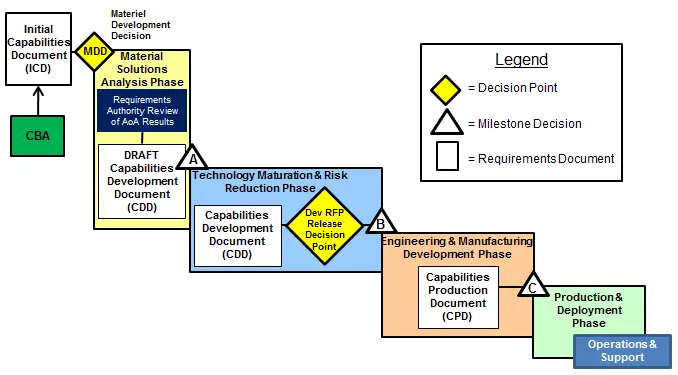
JCIDS is a historical requirements process. It gave reviewers a common way to describe a missing capability, decide which performance requirements mattered and document the evidence for an investment. The Joint Force Requirements Process (JFRP) succeeded it in 2026. Read the older flowcharts and document templates below in light of that change. The acquisition pathways elsewhere on this page address a separate question: how an approved investment is acquired and delivered. January 2026 transition manual · Manual directory, entry 5123.01A
Commercial capability reviews
A business can use the historical artifacts to organize an investment decision. In a small team, the following records can be sections of the same brief. Give each requirement a stable ID so reviewers can follow it from a customer observation to an acceptance test and a decision. Commercial artifact examples in Project Management
| Historical concept | Commercial review question and artifact |
|---|---|
| Capabilities-Based Assessment (CBA) | Is there a gap worth addressing? In a capability assessment, record the affected users, observed baseline, sample period and business consequence. Compare a process change, reuse of an existing service and new development. |
| Initial Capabilities Document (ICD) | What outcome is worth funding? A capability brief names the customer task, desired outcome, scope and decision owner. Attach a current-state process map showing where the task fails. |
| Capability Development Document (CDD) | What must the selected approach do, and under what conditions? Link the product specification to a system context diagram, data-flow diagram, interface agreement and test owner. Include an exception case such as a stale source or an unavailable service. |
| Key Performance Parameters (KPPs) and Key System Attributes (KSAs) | What result is essential, and what trade-offs matter? State the minimum threshold, desired objective, unit, population and method of measurement. Show supporting attributes such as reviewer effort alongside the critical measure. |
| CDD update or legacy Capability Production Document (CPD) | What did the release candidate demonstrate? Record its version, observed results, exceptions and operating owner. The sponsor decides whether to expand, limit the pilot or hold. Link unresolved exposure to the risk register. |
AI-assisted review
Example: a customer needs the current returns policy. A support team discovers that its assistant can retrieve yesterday’s policy after an editor has published a correction. The following figures illustrate how the same requirement appears in three records.
Editors update the policy during business hours. The current feed refreshes only overnight. The service owner wants customers on both phone and desktop to receive the correction promptly.
For 20 representative updates, at least 19 must appear on both devices within 10 minutes. The objective is 20 of 20 within five minutes. Record publication and first-correct-answer timestamps.
Only 18 of 20 updates met the ten-minute threshold on both devices. Hold expansion. The feed owner investigates the two misses and the evaluation lead schedules a fresh test.
Run the check-in. Give the meeting assistant the dated capability brief, the interface specification and the test log. Ask, “Which results support each threshold? Which evidence is missing? What decision is due, who owns it, and what would change it?” Record the decision and ask the accountable owner to confirm the follow-up. A preference score or reinforcement-learning reward for a helpful-sounding answer cannot establish which policy version a customer received. Verify the source version in the test log. AI release review
Use one row per requirement in Excel or Sheets. A phone reviewer can submit a timestamp, device and test ID. On desktop, compare both devices, the customer feedback and the retest cost against the approved budget. If an agent opens a corrective task, require the task ID in its acknowledgment. At the next meeting, ask what the team learned about the refresh assumption and which interface or roadmap entry needs updating. Architecture review questions · Roadmaps

Integrated Product Support Implementation Roadmap ...List ... Timeline ... Alternate
Adaptive Acquisition Framework (AAF)
- Acquisition Process - DOD Instruction 5000.02
- Adaptive Acquisition Framework | DAU
- The Adaptive Acquisition Framework - Better, Faster, More Tailored (pdf) .. An interview with Stacy Cummings, Principal Deputy for Acquisition Enablers in the Office of the Under Secretary of Defense for Acquisition and Sustainment (A&S)
- Overview of the Adaptive Acquisition Framework | Stacy Cummings, Principal Deputy Assistant Secretary of Defense for Acquisition
- Modernizing DOD Software Production (pdf) | Jeff Boleng, OUSD(A&S), Special Assistant for Software Acquisition
- Milestone Document Identification tool (MDID) ...helps acquisition personnel identify statutory and regulatory program information requirements, as referenced in DODI 5000.85 and DODI 5000.81
The AAF is a major advancement for modern defense acquisition. It is more than a policy update. It is policy re-envisioned and restructured in a framework that encourages critical thinking by program managers in selecting and tailoring the best suited approach or pathway for a particular acquisition. It facilitates more rapid delivery to the point of need. The AAF acquisition pathways provide opportunities for MDAs/DAs and PMs to develop acquisition strategies and employ acquisition processes that match the characteristics of the capability being acquired.

 5000.02 Hybrid Program Model A (Hardware Dominant) ...
- Interactive Adaptive Acquisition Framework Tool (ppt)
- Interactive Defense Acquisition Life Cycle Wall Chart (ppt)
- Defense Acquisition Life Cycle Wall Chart; Compliance Baseline (Pre-Tailoring) (pdf)
- Defense Acquisition Life Cycle Wall Chart; Objectives & Contributions with Tailoring, and Compliance with Tailoring (pdf)
Adaptive Acquisition Framework Methods (Pathways)
Urgent Capability Acquisition (UCA) 5000.81
Need identified by Commanders involved in an ongoing contingency operation or emergent need.
- Fielded less than 2 years
- There are three (3) types of of Urgent Needs: 1. Joint Urgent Operational Needs (JUON), 2. Joint Emergent Operational Need (JEON), and 3. Urgent Operational Need (UON)
- JCIDS Process - Urgent Capability Acquisition | AcqNotes
Middle-Tier Acquisition (MTA) 5000.84
Programs that are intended to be completed in a period of 2-5 years via two acquisition pathways.
- Acquisition Process Middle Tier Acquisition (Section 804) | AcqNotes
- Section 804 “Middle Tier of acquisition paths to acquire critical national security capabilities”
- Section 806 “Developing, Prototyping, Developing of Weapons System Components or Technology”
Major Capability Acquisition (MCA) 5000.85
Execute to the standard defense acquisition model with modifications.
- Tailorable
- Major Capability Acquisition | DAU
- Acquisition Process DOD Instruction 5000.85 Major Capability Acquisition ...establishes policy and procedures that guide the acquisition of major capability acquisition programs including: Major Defense Acquisition Programs (MDAPs); Other programs categorized as Acquisition Category (ACAT); Major systems, usually categorized as ACAT II; Automated information systems (AIS) (not managed by other acquisition pathways); and Other capabilities developed via the major capability acquisition pathway.
Software Acquisition
To facilitate rapid and iterative delivery of software capability to the user.
- 6 to 12 months; enable continuous integration and delivery
- Software Acquisition Pathway as the preferred path for acquisition and development of software-intensive systems
- Capability Needs Statements
- The Software Acquisition Pathway (pdf) 3 Jan 20 - Interim Policy
- DOD Software Acquisition: Can DOD Build Weapon Systems Software Better and Faster (pdf) 11 Apr 19 | Carmela B. Rice - Defense Acquisition University
Defense Business Systems (DBS) 5000.75
Business systems are information systems that are operated by, for, or on behalf of the DOD.
Acquisition of Services 5000.74
Acquisition of contracted services from private sector entities by or for the DOD.
- It provides guidance for the acquisition of contracted services from private sector entities by the DOD with
- a total estimated acquisition value in current year dollars at or
- above the Simplified Acquisition Threshold (SAT)
- and acquisition of all Advisory and Assistance Services (A&AS) in support of Research and Development R&D
- or construction activities that are categorized within the knowledge-based services portfolio group
- Acquisition Process - Acquisition of Services | AcqNotes
- DAU's virtual Service Acquisition Mall (SAM) ...create your performance-based service acquisition requirements
Prototyping & Experiments
Early Prototyping 3201.01
Technology or capability that is being matured by the research laboratories.
10 USC 2373: Procurement for Experimental Purposes: Rapid acquisition tool for fielding and testing new capabilities
Overview
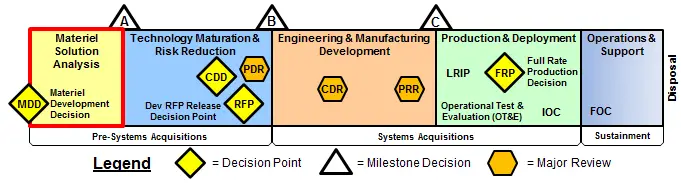
These diagrams illustrate earlier JCIDS and acquisition processes. For the 2026 transition, see Requirements history.
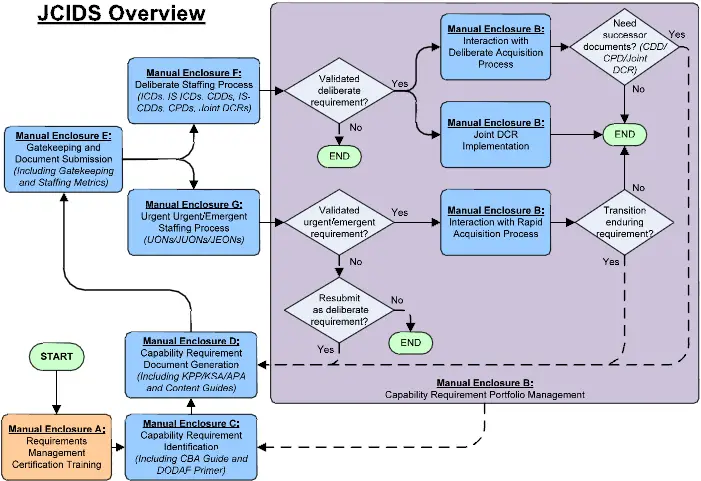 Click: JCIDS Process Flow Chart (pdf)
AcqNotes Videos
|
|
|
|
U.S. Army
|
|
Cybersecurity & Acquisition Lifecycle Integration
- Cybersecurity ... OSINT ... Frameworks ... References ... Offense ... NIST ... DHS ... Screening ... Law Enforcement ... Government ... Defense ... Lifecycle Integration ... Products ... Evaluating
- DevSecOps in Government
- Cybersecurity - Visualization
- Cybersecurity Black Card | Defense Acquisition University (DAU)
- Cybersecurity and Acquisition Lifecycle Integration Tool (CALIT) | Defense Acquisition University (DAU)
- The Cybersecurity and Acquisition Life-Cycle Integration Tool | Steve Mills and Tim Denman ...(pdf) - AcqNotes
Understanding what these processes are and how they interact will lead to better acquisition outcomes. The Cybersecurity & Acquisition Lifecycle Integration Tool (CALIT) provides the user the insight into these supporting processes and the ability to visualize how these processes work together to promote cyber resilient weapon systems.

 DOD Cybersecurity Policy Chart | Cyber Security & Information Systems Information Analysis Center ...Changelog
- DODI 5000.02T - Operation of the Defense Acquisition System, Enclosure 14; Cybersecurity in the Defense Acquisition System
- Information Technology - Cybersecurity | AcqNotes
- Cybersecurity Test and Evaluation Guidebook (pdf) - Defense Acquisition University (DAU)
- Intelligence & Security - Cybersecurity Strategy ...The strategy is created and maintained by the Program Office and appended to the Program Protection Plan (PPP). It’s required for all ACAT level programs.
- Intelligence & Security - Program Protection Plan (PPP) | AcqNotes
- Outline (doc)
- Template (doc)
- Defense Acquisition Guidebook (DAG) Chapter 9 (pdf) ...provides guidance for the system security engineering (SSE) discipline and Department of Defense (DOD) program protection for defense acquisition programs. The program manager (PM) and the systems engineer (SE) should use DAG
- Intelligence & Security - System Security Engineering (SSE) | AcqNotes ...Systems Security Engineering (SSE) is an element of Systems Engineering (SE) that applies scientific and engineering principles in a standardized, repeatable, and efficient manner to identify security vulnerabilities, requirements, and methods of verifications that minimize risks. SSE delivers systems that satisfy stakeholder security needs for weapon system operation in today’s cyber-contested environments.
- Cyber Threat Analysis
- Intelligence & Security - Validated Online Lifecycle Threat (VOLT) ...The VOLT Reports involve the application of threat modules, and are to be written to articulate the relevance of each module to a specific acquisition program or planned capability. Note: The STAR was replaced by the VOLT
- DODI 5200.39, Critical Program Information (CPI) Identification and Protection Within Research, Development, Test and Evaluation (RDT&E) (pdf)
- DODI 5200.44, Protection of Mission Critical Functions to Achieve Trusted Systems and Networks (TSN) (pdf)
|
|
Insights
|
|
|
|
Center for Strategic & International Studies
|
|
Requirements History
| Date | What changed for readers of the documents |
|---|---|
| June 2003 | The first JCIDS manual set out procedures for developing and reviewing capability documents. The early framework included initial, development and production documents. Requirements history |
| October 2021 | The revised JCIDS manual documented the later framework. Check the edition when interpreting an older template, particularly a Capability Production Document. Historical manual |
| July 2025 | A report on requirements reform documented the evolution of the manuals. Its historical appendix helps explain why two diagrams labeled JCIDS can show different document sequences. July report |
| November 7, 2025 | A reform memorandum directed that disestablishment of JCIDS begin immediately and set a timetable for rescinding its governing materials. Reform memorandum |
| January 15, 2026 | CJCSM 5123.01 rescinded the JCIDS Manual in full and described the JFRP. This is the transition point for interpreting the legacy requirements documents below. January manual |
| August 5, 2026 | The official directory lists revised JFRP manual CJCSM 5123.01A. The companion charter, CJCSI 5123.01J, also lists Change 1 on this date. Manuals · Instructions |
Resources
- AcqNotes: ... Search/TopicList ... Dictionary ... Acquisition Policies | DAU
- Main References
- Main Acquisition References: Website: Defense Acquisition Guidebook (DAG), DOD Directive 7045.14: Program Planning Budget & Execution (PPBE) Process (pdf), and DAU Program Managers Toolkit (pdf) ...
- DOD Directive 5000.01: The Defense Acquisition System - DoD Directives
- DOD Directive 5000.01: The Defense Acquisition System (pdf) - DoD Directives
- Historical CJCS Instruction 5123.01I Charter of The Joint Requirements Oversight Council (JROC) and Implementation of The Joint Capabilities Integration and Development System (JCIDS) (pdf) | Joint Staff - CJCS Directives Library ...This historical instruction established JCIDS as the process used by the Joint Requirements Oversight Council (JROC) to fulfill its advisory responsibilities to the Chairman of the Joint Chiefs of Staff in identifying, assessing, validating, and prioritizing joint military capability requirements ... AcqNotes
- Website: JCIDS Intellipedia (CAC Required)
- DOD Instruction 5000.02 - Acquisition Process
- DOD Directive 5000.01: The Defense Acquisition System - DoD Directives
- Key Guides and Handbooks: Integrated Master Plan and Integrated Master Schedule Preparation and User Guide (pdf), DAU Systems Engineering Fundamentals (pdf), Test and Evaluation Management Guide (pdf), GAO Cost Estimating Guide (pdf), Draft Naval Aviation Systems Team Acquisition Logistics Support Plan Guide, and Navy DOD Information Assurance Certification and Accreditation Process Handbook (pdf)
- JCIDS Process - Capabilities Based Assessment (CBA)
- Systems Engineering Initial Capabilities Document (ICD)
- Program Management - Business Case Analysis (BCA)
- Acquisition Process Materiel Development Decision (MDD) ...where the Joint Capabilities Integration and Development System (JCIDS) analysis has identified a capability gap/need and a MDD Review has determined a materiel solution is needed. The MDD is the formal point that initiates the ...
- DOD Document Databases: DOD Directives, DoD Instructions, DOD Manuals, Website: ASSIST forDefense Standardization Program (DSP), and EverySpec.com]...Specifications, Standards, Handbooks and Mil-Spec documents
- Main Acquisition References: Website: Defense Acquisition Guidebook (DAG), DOD Directive 7045.14: Program Planning Budget & Execution (PPBE) Process (pdf), and DAU Program Managers Toolkit (pdf) ...
- DOD Guides and Handbooks
- Milestone Requirements Matrix ..tab ACAT I, ACAT II, and ACAT III & Below
- Templates ...main templates that are used in defense acquisitions; need to check with requesting organization
- Main References
- Office of Acquisition Enablers (AE);an organization within the Office of the Under Secretary of Defense (OUSD) for Acquisition & Sustainment (A&S) enabling innovative acquisition approaches