Overview of the technical shift toward "System 2" thinking in AI models.
Today, "Artificial Intelligence" is a ubiquitous term used by corporations and consumers alike to describe advanced computational capabilities.
Chronological Eras & Generations of AI
Before AI became a unified field of study, the discipline lacked a standardized name or distinct identity, and its evolution has since been defined by four distinct technological generations.
Competing Visions Before 1956
In the early 1950s, mathematicians and scientists were already exploring the concept of machine intelligence, but they categorized their work under various competing labels:
Cybernetics: Focused on communication and control in machines and living beings, this term gained significant traction during a major 1951 conference in Paris.
Automata Studies: Centered on self-operating machines, this phrase was favored by Claude Shannon, the renowned "father of information theory."
Complex Information Processing: Computer science pioneer Herbert Simon used this descriptor to define his early computational and cognitive research.
The Birth of AI: The Dartmouth Workshop (1956)
The need for a distinct, unifying term culminated in a 1955 conference proposal drafted by mathematician John McCarthy. Seeking to separate this specific study from the broader scope of cybernetics, McCarthy coined the phrase "Artificial Intelligence." The following year, McCarthy joined forces with Marvin Minsky, Nathaniel Rochester, and Claude Shannon to host the Dartmouth Summer Research Project on Artificial Intelligence (1956). This historic workshop formally established AI as an independent scientific field. It was anchored by a singular, bold premise that continues to drive the industry today: every aspect of learning or any other feature of intelligence can in principle be so precisely described that a machine can be made to simulate it.
First Generation AI: Good Old-Fashioned AI & The AI Winters
The initial decades following Dartmouth were defined by First Generation AI, also known as Good Old-Fashioned AI (GOFAI). In this paradigm, programmers handcrafted everything, and the machines learned nothing independently. These simple programs could only do one task really well, acting like little robots programmed to do a specific thing, like adding numbers or sorting data.
In the 1980s, this generation saw a resurgence through "Expert Systems"—programs designed to solve complex problems by reasoning through bodies of knowledge represented as handcrafted "if-then" rules. While successful in specific domains, they lacked flexibility. The failure of early symbolic AI to meet the high expectations set by researchers led to skepticism and severe funding cuts in the 1970s and late 1980s, periods known as the "AI Winters."
Second Generation AI: Shallow Learning
To overcome the limitations of rigid, handcrafted rules, researchers shifted toward Second Generation AI: shallow learning. In this era, developers handcrafted the features and learned a classifier. This marked the point when people started teaching computers how to learn by giving them lots of data and letting them figure out patterns on their own. These early "machine learning" programs could successfully accomplish more dynamic tasks like recognizing images or translating basic languages.
Third Generation AI: Deep Learning & Generative AI
Beginning in the 2010s, the field evolved into Third Generation AI, defined by deep learning. In this paradigm, developers handcraft the algorithm, but the model learns the features and the predictions end-to-end. These programs are often called "neural networks" because they are modeled loosely after the way human brains work.
The convergence of massive datasets, GPU acceleration, and the Transformer architecture (introduced in 2017) triggered an explosion in this generation. Computers started to get really good at things that only humans used to be able to do, leading to the rise of Large Language Models (LLMs) capable of human-like text generation, reasoning, and multimodal understanding.
Fourth Generation AI: Agentic Systems & Learning-to-Learn (2025-2026)
By 2025, the industry began a fundamental shift toward Fourth Generation AI. This is the most advanced kind of AI we have so far, characterized by "learning-to-learn." These programs can adapt to novel situations, learn from experience, and get better at things over time, just like humans do. They can even approximate and understand concepts like emotions and creativity.
Unlike previous generations that required constant human prompting, these systems are designed as "Agentic AI." They utilize "System 2" thinking—a cognitive process involving deliberate, slow, and logical reasoning—to autonomously execute complex workflows, multi-step planning, and tool use without human intervention. Because they are almost as good as humans at thinking and learning across diverse domains, models in this era represent a major stepping stone toward what is often called "artificial general intelligence" (AGI), marking the maturation of AI into an active, goal-oriented agent.
Never give up on a dream just because it will take time to accomplish it. The time will pass anyway.
Full interview: "Godfather of artificial intelligence" talks impact and potential of AI
Geoffrey Hinton is considered a godfather of artificial intelligence, having championed machine learning decades before it became mainstream. As chatbots like ChatGPT bring his work to widespread attention, we spoke to Hinton about the past, present and future of AI. CBS Saturday Morning's Brook Silva-Braga interviewed him at the Vector Institute in Toronto on March 1, 2023
Who Invented A.I.? - The Pioneers of Our Future
ColdFusion is an Australian based online media company independently run by Dagogo Altraide since 2009. Topics cover anything in science, technology, history and business in a calm and relaxed environment.
You and AI – the history, capabilities and frontiers of AI
Demis Hassabis, world-renowned British neuroscientist, artificial intelligence (AI) researcher and the co-founder and CEO of DeepMind, explores the groundbreaking research driving the application of AI to scientific discovery. The talk launches the Royal Society’s 2018 series: You and AI, a collaborative effort to help people understand what machine learning and AI are, how these technologies work and the ways they may affect our lives. Supported by DeepMind. For more information on the event series: https://ow.ly/PKug30jWEYV
History of the entire AI field, i guess
The Brief History of Artificial Intelligence, which we commonly abbreviate as "AI". Here I am, bothered enough to make another 20+ mins video again. Well actually, my editors are probably more bothered.
A Brief History of Artificial Intelligence
While everyone seems to be talking about artificial intelligence these days, it’s good to remember that this is not something new!
History of Artificial Intelligence | Evolution Of AI | The Age Of A.I | Science Knowledge Facts
History of Artificial Intelligence | Evolution Of AI | The Age Of A.I | Science Knowledge Facts Video by Knowleseum.
The Epistemology of Deep Learning - Yann LeCun Deep Learning: Alchemy or Science? Topic: The Epistemology of Deep Learning Speaker: Yann LeCun Affiliation: Facebook AI Research/New York University Date: February 22, 2019
A Brief History of AI
AI is now a mainstream topic reaching a broader business audience. Every executive who wants their company to be a leader in their industry should be asking themselves two questions. First, is the potential of AI real? Second, how do I apply it to my business? This Dreamtalk will dispel the 5 common myths about AI and replace it with a framework for executives to apply to their business.
The Future of Artificial Intelligence: Views from History
On the evening of 29th November 2018, the Leverhulme Centre for the Future of Intelligence (CFI) will host an expert panel on ‘The Future of Artificial Intelligence: Views from History’ featuring:
Prof. Simon Schaffer (University of Cambridge)
Prof. Murray Shanahan (DeepMind, Imperial)
Prof. Margaret A. Boden OBE ScD FBA, (University of Sussex)
Prof. Nathan Ensmenger (Indiana University)
Pamela McCorduck (author of Machines Who Think, an authoritative history of AI)
and chaired by Dr Sarah Dillon (Leverhulme Centre for the Future of Intelligence).
Speakers will interrogate the past, present, and future of intelligent systems for a general audience, with an interest towards the nuanced power dynamics that have operated around such systems throughout the ages.
This event will commemorates the 60th anniversary of the landmark 1958 ‘Mechanisation of Thought Conference’ held in Teddington, England; an event that served to establish artificial intelligence as a standalone field in the UK.
The Man who forever changed Artificial Intelligence
History of Artificial Intelligence: The success of Neural Networks has sparked the AI revolution in the last 10 years. From Atari Games to Go, to Dota and to Starcraft. What many people don't know - the basic idea of Neural Networks has been around since the late 1950s. My name is Sebastian Schuchmann and I hope you enjoy watching! Support me on Patreon: https://www.patreon.com/user?u=25285137 Keep in touch: https://twitter.com/SebastianSchuc7
The Year Artificial Intelligence changed forever
Sebastian Schuchmann AI History: In 1986 the World of Neural Networks was about to change. After decades of silence, finally, a method to efficiently compute the weights in multi-layer Neural Networks was invented. The stage was set for a revolution. Learn more about A.I. History on my Medium: https://medium.com/@schuchmannsebastian
Support me on Patreon: https://www.patreon.com/user?u=25285137
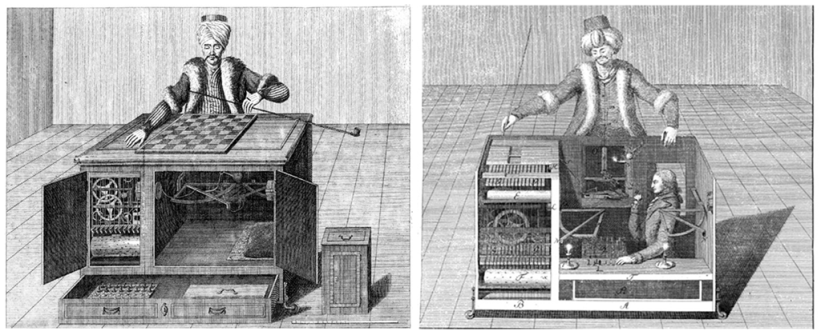
Mechanical Marvels—Automaton: The Chess Player "Android," 1769
Touted as an android that could defeat chess masters, Wolfgang von Kempelen's famed illusion debuted at the court of Empress Maria Theresa during wedding celebrations for her daughter in 1769. Over the course of the eighteenth century, the chess player (known in its time as The Turk for its costume) won games against Catherine the Great and Benjamin Franklin. When Napoléon Bonaparte tried to cheat, it wiped all the pieces from the board. The mysterious machine sparked discussions of the possibilities and limits of artificial intelligence, and it inspired the development of the power loom, the telephone, and the computer. The original and its secrets were destroyed in a fire in 1854. The subject of more than eight hundred publications attempting to uncover its secrets, Kempelen's illusion also inspired a 1927 silent movie, The Chess Player, directed by Raymond Bernard. In the sequence shown here, the inventor presents his creation at court. The year of its release, this early science-fiction drama attracted more attention than Fritz Lang's Metropolis, a now-legendary film that also involves an android. Featured Artwork: The Chess Player (The Turk), Original ca. 1769. Wolfgang von Kempelen (1734–1804). Austrian, Vienna. Wood, brass, fabric, steel. Collection of Mr. John Gaughan, Los Angeles