Difference between revisions of "ML Test Score"
m |
m |
||
| Line 24: | Line 24: | ||
** [[Bias and Variances]] | ** [[Bias and Variances]] | ||
** [[Algorithm Administration#Model Monitoring|Model Monitoring]] | ** [[Algorithm Administration#Model Monitoring|Model Monitoring]] | ||
| − | * [[AI Solver]] ... [[Algorithms]] ... [[Algorithm Administration|Administration]] ... [[Model Search]] ... [[Discriminative vs. Generative | + | * [[AI Solver]] ... [[Algorithms]] ... [[Algorithm Administration|Administration]] ... [[Model Search]] ... [[Discriminative vs. Generative]] ... [[Train, Validate, and Test]] |
* [[Risk, Compliance and Regulation]] ... [[Ethics]] ... [[Privacy]] ... [[Law]] ... [[AI Governance]] ... [[AI Verification and Validation]] | * [[Risk, Compliance and Regulation]] ... [[Ethics]] ... [[Privacy]] ... [[Law]] ... [[AI Governance]] ... [[AI Verification and Validation]] | ||
* [[Artificial General Intelligence (AGI) to Singularity]] ... [[Inside Out - Curious Optimistic Reasoning| Curious Reasoning]] ... [[Emergence]] ... [[Moonshots]] ... [[Explainable / Interpretable AI|Explainable AI]] ... [[Algorithm Administration#Automated Learning|Automated Learning]] | * [[Artificial General Intelligence (AGI) to Singularity]] ... [[Inside Out - Curious Optimistic Reasoning| Curious Reasoning]] ... [[Emergence]] ... [[Moonshots]] ... [[Explainable / Interpretable AI|Explainable AI]] ... [[Algorithm Administration#Automated Learning|Automated Learning]] | ||
Revision as of 22:46, 5 March 2024
YouTube search... ...Google search
- Strategy & Tactics ... Project Management ... Best Practices ... Checklists ... Project Check-in ... Evaluation ... Measures
- AI Solver ... Algorithms ... Administration ... Model Search ... Discriminative vs. Generative ... Train, Validate, and Test
- Risk, Compliance and Regulation ... Ethics ... Privacy ... Law ... AI Governance ... AI Verification and Validation
- Artificial General Intelligence (AGI) to Singularity ... Curious Reasoning ... Emergence ... Moonshots ... Explainable AI ... Automated Learning
- Cybersecurity: Evaluating & Selling
- Data Science ... Governance ... Preprocessing ... Exploration ... Interoperability ... Master Data Management (MDM) ... Bias and Variances ... Benchmarks ... Datasets
- Automated Scoring
- Development ... Notebooks ... AI Pair Programming ... Codeless, Generators, Drag n' Drop ... AIOps/MLOps ... AIaaS/MLaaS
- Machine Learning: The High Interest Credit Card of Technical Debt | | D. Sculley, G Holt, D. Golovin, E. Davydov, T. Phillips, D. Ebner, V. Chaudhary, and M. Young - Google Research
- Hidden Technical Debt in Machine Learning Systems D. Sculley, G Holt, D. Golovin, E. Davydov, T. Phillips, D. Ebner, V. Chaudhary, M. Young, J. Crespo, and D. Dennison - Google Research
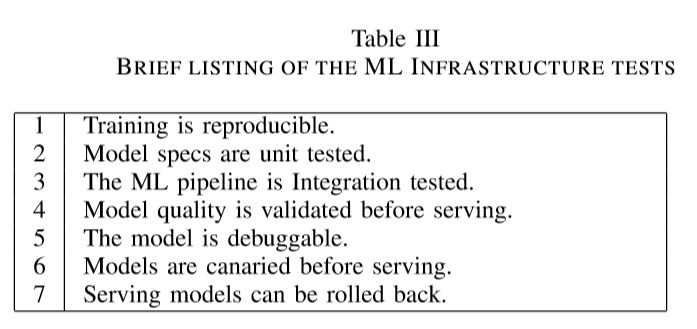
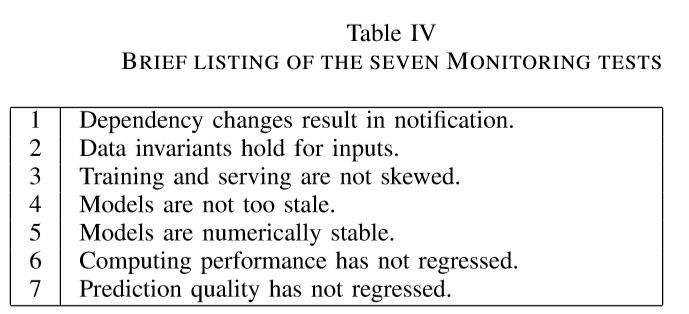
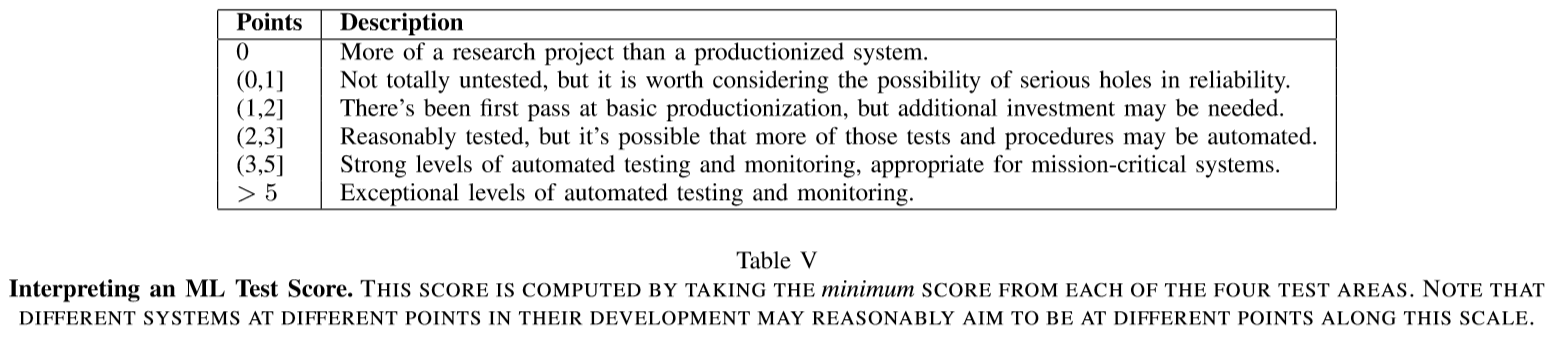
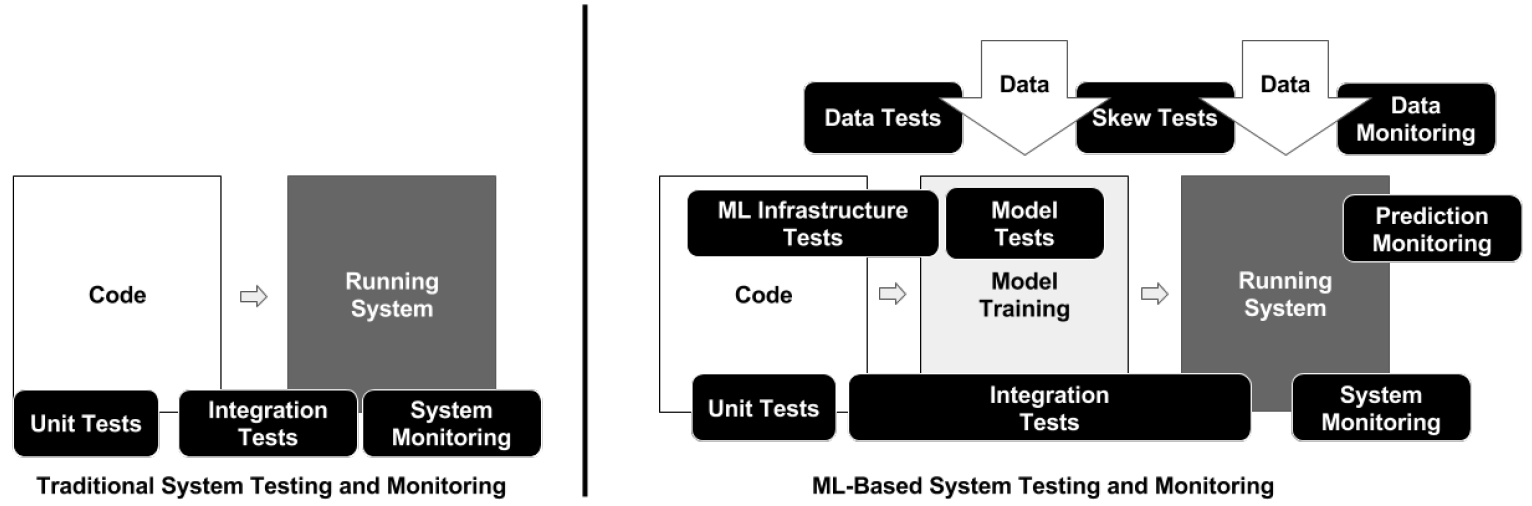
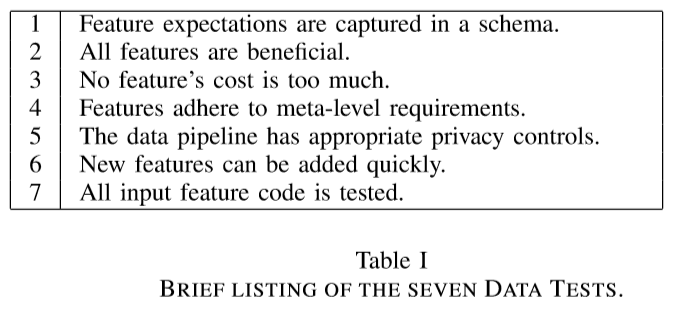
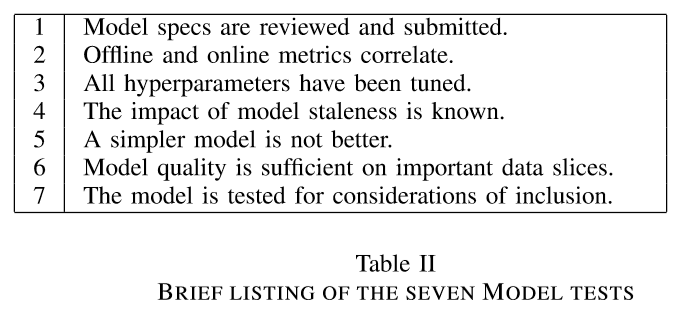
Creating reliable, production-level machine learning systems brings on a host of concerns not found in small toy examples or even large offline research experiments. Testing and monitoring are key considerations for ensuring the production-readiness of an ML system, and for reducing technical debt of ML systems. But it can be difficult to formulate specific tests, given that the actual prediction behavior of any given model is difficult to specify a priori. In this paper, we present 28 specific tests and monitoring needs, drawn from experience with a wide range of production ML systems to help quantify these issues and present an easy to follow road-map to improve production readiness and pay down ML technical debt. The ML Test Score: A Rubric for ML Production Readiness and Technical Debt Reduction | E. Breck, S. Cai, E. Nielsen, M. Salib, and D. Sculley - Google Research Full Stack Deep Learning
|
|
|
|
|
|