Generative AI
YouTube ... Quora ...Google search ...Google News ...Bing News
- Generative AI ... Conversational AI ... OpenAI's ChatGPT ... Perplexity ... Microsoft's Bing ... You ...Google's Bard ... Baidu's Ernie
- Large Language Model (LLM) ... Natural Language Processing (NLP) ...Generation ... Classification ... Understanding ... Translation ... Tools & Services
- Policy ... Policy vs Plan ... Constitutional AI ... Trust Region Policy Optimization (TRPO) ... Policy Gradient (PG) ... Proximal Policy Optimization (PPO)
- Capabilities
- Video/Image ... Vision ... Colorize ... Image/Video Transfer Learning
- End-to-End Speech ... Synthesize Speech ... Speech Recognition ... Music
- Demos, generating...
- Music: Generating Piano Music with Transformer | I. Simon, A. Huang, J. Engel, C. "Fjord" Hawthorne - Google on Colab play with pretrained Transformer models for piano music generation, based on the Music Transformer model
- Faces: TF-Hub generative image model | The TensorFlow Hub Authors - Google use of a TF-Hub module based on a generative adversarial network (GAN). The module maps from N-dimensional vectors, called latent space, to RGB images.
- 3D Objects: 3D Style Transfer | Google uses Lucid to implement style transfer from a textured 3D model and a style image onto a new texture for the 3D model by using a Differentiable Image Parameterization
- Try Stable Diffusion | Stability AI ... text-to-image diffusion model capable of generating photo-realistic images
- Demo, summarizing, priority listing, & analysis...
- Singularity ... Sentience ... AGI ... Curious Reasoning ... Emergence ... Moonshots ... Explainable AI ... Automated Learning
- In-Context Learning (ICL) ... LLMs understand to encode learning algorithms implicitly during their training processes ... [Context]]
- AI Solver
- Discriminative vs. Generative
- Assistants ... Personal Companions ... Agents ... Negotiation ... LangChain
- Development ... Notebooks ... AI Pair Programming ... Codeless, Generators, Drag n' Drop ... AIOps/MLOps ... AIaaS/MLaaS
- Generative Model | Wikipedia
- Attention Mechanism ...Transformer ...Generative Pre-trained Transformer (GPT) ... GAN ... BERT
- Generative Query Network (GQN)
- Data Augmentation, Data Labeling, and Auto-Tagging
- Python ... Generative AI with Python ... Javascript ... Generative AI with Javascript
- Generative AI for Business Analysis
- Gaming ... Game-Based Learning (GBL) ... Security ... Generative AI ... Metaverse ... Quantum ... Game Theory
- Roblox ... building tools to allow creators to develop integrated 3D objects that come with behaviour built in.
- Immersive Reality ... Metaverse ... Digital Twin ... Internet of Things (IoT) ... Transhumanism
Generative AI is technology that creates original content, including text, images, video, and computer code, by identifying patterns in large quantities of training data. Generative AI could improve the speed and accuracy of product research and development. Generative AI technology can also help with product engineering by allowing teams to simulate products in virtual environments. This allows for complex problems to be solved more quickly and efficiently, leading to improved design accuracy. - The Generative AI Revolution Is Creating The Next Phase Of Autonomous Enterprise | Mark Minevich - Forbes
Generative AI are predictive models, filtering available information to draw inferences on what should logically follow
Background: What is a Generative Model? | Google
More formally, given a set of data instances X and a set of labels Y:
- Generative models capture the joint probability p(X, Y), or just p(X) if there are no labels.
- Discriminative models capture the conditional probability p(Y | X).
A generative model includes the distribution of the data itself, and tells you how likely a given example is. For example, models that predict the next word in a sequence are typically generative models (usually much simpler than GANs) because they can assign a probability to a sequence of words.
Informally:
- Generative models can generate new data instances.
- Discriminative models discriminate between different kinds of data instances.
Contents
Deep Generative Modeling
Generative Modeling Language
Hallucination
Hallucination is a term used to describe when Large Language Models (LLMs) generate text that is factually incorrect or entirely fictional. This can happen because the model’s primary objective is to generate text that is coherent and contextually appropriate, rather than factually accurate1. Hallucination can be a serious problem for LLMs because it can lead to the spread of misinformation, expose confidential information, and create unrealistic expectations about what LLMs can do. Hallucination refers to mistakes in the generated text that are semantically or syntactically plausible but are in fact incorrect or nonsensical1. This occurs because the model’s primary objective is to generate text that is coherent and contextually appropriate, rather than factually accurate. The model’s training data may contain inaccuracies, inconsistencies, and fictional content, and the model has no way of distinguishing between fact and fiction. As a result, it may generate text that aligns with the patterns observed in the training data but is not grounded in reality. From a technical perspective, hallucination in language models can be attributed to a lack of ground truth from external sources.
Ground truth refers to data that accurately represents the real-world phenomena or outcomes that an AI model aims to predict, classify, or generate. Ground truth is information that is known to be real or true, provided by direct observation and measurement (i.e. empirical evidence) as opposed to information provided by inference1. It refers to data that accurately represents the real-world phenomena or outcomes that an AI model aims to predict, classify, or generate.
MIT GenAI Summit
SynthAI
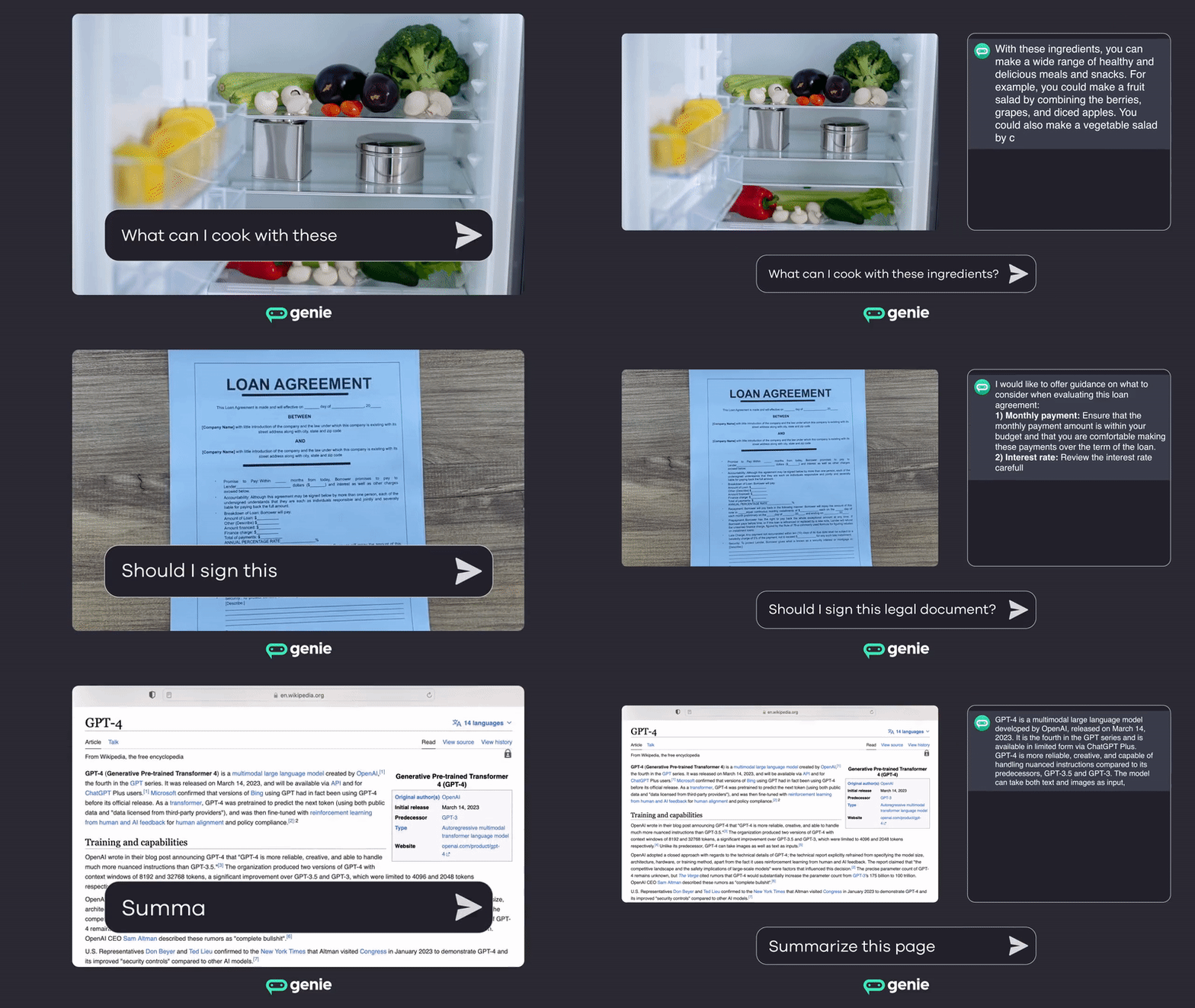
To date, generative AI applications have overwhelmingly focused on the divergence of information. That is, they create new content based on a set of instructions. In Wave 2, we believe we will see more applications of AI to converge information. That is, they will show us less content by synthesizing the information available. Aptly, we refer to Wave 2 as synthesis AI (“SynthAI”) to contrast with Wave 1. While Wave 1 has created some value at the application layer, we believe Wave 2 will bring a step function change. -For B2B Generative AI Apps, Is Less More? | Zeya Yang and Kristina Shen - Andreessen Horowitz

As we think through what Wave 2 might look like, we believe the use cases that will benefit most from synthesis AI will be when there is both:
A high volume of information, such that it’s not pragmatic for a human to manually sift through all the information. A high signal-to-noise ratio, such that the themes or insights are obvious and consistent. In the name of accuracy, you don’t want to task an AI model with deciphering nuance. In the diagram below, we categorize examples of common analysis and synthesis by these dimensions to help bring this to life.

