Expectation–Maximization (EM) Clustering using Gaussian Mixture Models (GMM)
Youtube search... ...Google search
- AI Solver ... Algorithms ... Administration ... Model Search ... Discriminative vs. Generative ... Train, Validate, and Test
- Embedding ... Fine-tuning ... RAG ... Distillation ... Alpaca ... Dimensional Reduction
- Clustering ... Recommendation ... Anomaly Detection ... Classification ...find outliers
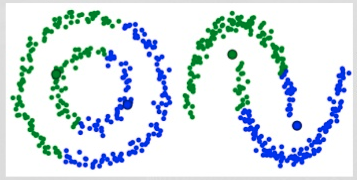
One of the major drawbacks of K-Means is its naive use of the mean value for the cluster center. We can see why this isn’t the best way of doing things by looking at the image below. On the left hand side it looks quite obvious to the human eye that there are two circular clusters with different radius’ centered at the same mean. K-Means can’t handle this because the mean values of the clusters are a very close together. K-Means also fails in cases where the clusters are not circular, again as a result of using the mean as cluster center. The 5 Clustering Algorithms Data Scientists Need to Know | Towards Data Science
Gaussian Mixture Models (GMMs) give us more flexibility than K-Means. With GMMs we assume that the data points are Gaussian distributed; this is a less restrictive assumption than saying they are circular by using the mean. That way, we have two parameters to describe the shape of the clusters: the mean and the standard deviation! Taking an example in two dimensions, this means that the clusters can take any kind of elliptical shape (since we have standard deviation in both the x and y directions). Thus, each Gaussian distribution is assigned to a single cluster.
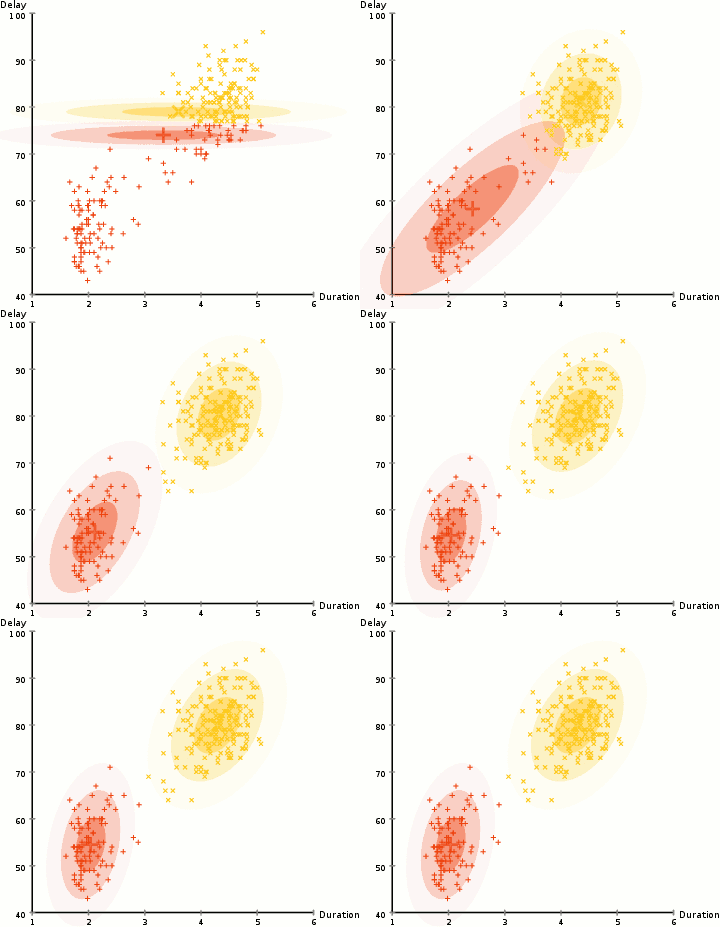
In order to find the parameters of the Gaussian for each cluster (e.g the mean and standard deviation) we will use an optimization algorithm called Expectation–Maximization (EM). Take a look at the graphic below as an illustration of the Gaussians being fitted to the clusters. Then we can proceed on to the process of Expectation–Maximization clustering using GMMs.
There are really 2 key advantages to using GMMs. Firstly GMMs are a lot more flexible in terms of cluster covariance than K-Means; due to the standard deviation parameter, the clusters can take on any ellipse shape, rather than being restricted to circles. K-Means is actually a special case of GMM in which each cluster’s covariance along all dimensions approaches 0. Secondly, since GMMs use probabilities, they can have multiple clusters per data point. So if a data point is in the middle of two overlapping clusters, we can simply define its class by saying it belongs X-percent to class 1 and Y-percent to class 2. I.e GMMs support mixed membership.
Gaussian Mixture Models - The Math of Intelligence (Week 7)
Siraj Raval explains Gaussian mixture models in The Math of Intelligence.
The expectation maximization algorithm for the Gaussian mixture model
Explains the expectation-maximization algorithm for Gaussian mixture models.
Clustering (4): Gaussian Mixture Models and EM
Alexander Ihler explains Gaussian mixture models and EM for clustering.
(ML 16.8) EM for the Gaussian mixture model (part 2)
mathematicalmonk explains EM for the Gaussian mixture model, part 2.
Expectation–Maximization (EM)
EM.3: Visualizing the EM algorithm
Victor Lavrenko visualizes the EM algorithm.
EM Examples - Georgia Tech - Machine Learning
Udacity lesson with examples of the EM algorithm.
EM algorithm: how it works
Victor Lavrenko explains how the EM algorithm works.
EM Algorithm
Explains the expectation-maximization algorithm.