Agents
Youtube ... Quora ...Google search ...Google News ...Bing News
- Assistants ... Agents ... Negotiation ... LangChain
- Singularity ... Sentience ... AGI ... Curious Reasoning ... Emergence ... Moonshots ... Explainable AI ... Automated Learning
- Python ... Generative AI with Python ... Javascript ... Generative AI with Javascript
- Development ...AI Pair Programming Tools ... Analytics ... Visualization ... Diagrams for Business Analysis
- Gaming ... Game-Based Learning (GBL) ... Security ... Generative AI ... Metaverse ... Quantum ... Game Theory
- Generative AI ... Conversational AI ... OpenAI's ChatGPT ... Perplexity ... Microsoft's Bing ... You ...Google's Bard ... Baidu's Ernie
- Large Language Model (LLM) ... Natural Language Processing (NLP) ...Generation ... Classification ... Understanding ... Translation ... Tools & Services
- Attention Mechanism ...Transformer ...Generative Pre-trained Transformer (GPT) ... GAN ... BERT
- Game Theory
- Reinforcement Learning (RL)
- Policy ... Policy vs Plan ... Constitutional AI ... Trust Region Policy Optimization (TRPO) ... Policy Gradient (PG) ... Proximal Policy Optimization (PPO)
- Multi-Task Learning (MTL) ... SMART - Multi-Task Deep Neural Networks (MT-DNN)
- Deep Distributed Q Network Partial Observability
- Types of AI Agents | JavaTpoint ... Simple Reflex, Model-based reflex, Goal-based, Utility-based, Learning agents
- Key Research Advances in Building Task-Oriented Dialog Agents | Mariya Yao - TOPBOTS
- MineDojo ... framework built on the popular Minecraft game for embodied agent research
- Google Tells AI Agents to Behave Like 'Believable Humans' to Create 'Artificial Society' | Chloe Xiang - Vice ... The characters have developed specific routines, such as waking up, taking a shower, cooking breakfast, interacting with their families, then going to work every day... researchers input one paragraph per character into ChatGPT
- Amazon creates a new user-centric simulation platform to develop embodied AI agents | Ingrid Fadelli - TechExplore ... Arena is a new Embodied AI platform, for robotic task completion in simulated environments.
An intelligent agent is anything which perceives its environment, takes actions autonomously in order to achieve goals, and may improve its performance with learning or acquiring knowledge. An agent has an "objective function" that encapsulates all the IA's goals. Such an agent is designed to create and execute whatever plan will, upon completion, maximize the expected value of the objective function.[2] For example, a reinforcement learning agent has a "reward function" that allows the programmers to shape the IA's desired behavior,[3] and an evolutionary algorithm's behavior is shaped by a "fitness function". - Wikipedia
- AI will be beside what you are doing: AI is a helper, a sidebar, conversational AI, most of the work you do is the same and you use AI as an assistant. Help us with research, writing, presentations, our personal lives, such as managing our finances and scheduling appointments, automate tasks, such as data entry and email processing
Free up our time so that we can focus on more important tasks
- AI will inside what you are doing: AI is everywhere, the scaffolding, we aren't going to wait for the keystroke, but wait for the AI, move away from application or document-centric, AI will select the app, AI coaches from a choice of enormous possibilities
- AI will be outside what you are doing: Disparate data sources, agents pulling in information from the World, from other agents, the agent as your intermediary, AI will see and interpret the World for us, and AI to help us navigate and figure things out for us
Contents
Jarvis
YouTube ... Quora ...Google search ...Google News ...Bing News
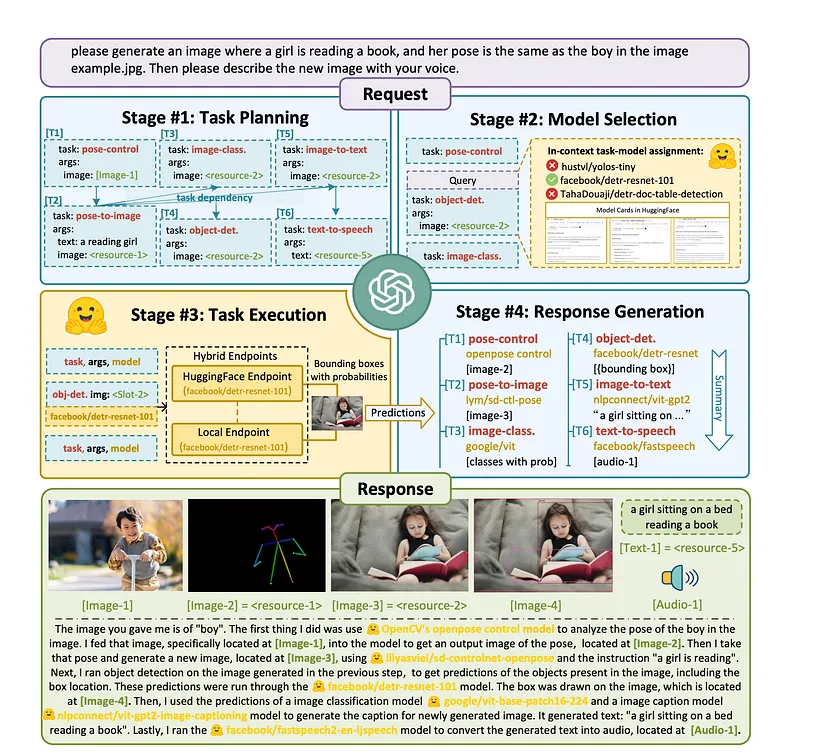
Jarvis is a project from Microsoft that uses ChatGPT as the controller for a system where it can employ a variety of other models as needed to respond to your prompt. Microsoft Jarvis connects LLMs with ML community. Language serves as an interface for Large Language Model (LLM)s to connect numerous AI models for solving complicated AI tasks. Solving complicated AI tasks with different domains and modalities is a key step toward advanced artificial intelligence. While there are abundant AI models available for different domains and modalities, they cannot handle complicated AI tasks. Considering Large Language Model (LLM) have exhibited exceptional ability in language understanding, generation, interaction, and reasoning, we advocate that LLMs could act as a controller to manage existing AI models to solve complicated AI tasks and language could be a generic interface to empower this.
HuggingGPT is one instance of Jarvis, a web-based chatbot at Hugging Face, an online AI community which hosts thousands of open-source models.
When a user makes a request to the bot, Jarvis plans the task, chooses which models it needs, has those models perform the task and then generates and issues a response. The workflow of this system consists of four stages:
- Task Planning: Using ChatGPT to analyze the requests of users to understand their intention, and disassemble them into possible solvable tasks via prompts.
- Model Selection: To solve the planned tasks, ChatGPT selects expert models that are hosted on Hugging Face based on model descriptions.
- Task Execution: Invoke and execute each selected model, and return the results to ChatGPT.
- Response Generation: Finally, using ChatGPT to integrate the prediction of all models, and generate answers for users.
HuggingGPT
YouTube ... Quora ...Google search ...Google News ...Bing News
- HuggingGPT | Microsoft ... A system to connect LLMs with ML community.
- How to Use Jarvis, Microsoft's One AI Bot to Rule Them All | Avram Piltch - Tom's Hardware
- How to Use Microsoft JARVIS (HuggingGPT) Right Now | Arjun Sha - Beebom
- HuggingGPT ... A Framework That Leverages LLMs to Connect Various AI Models in Machine Learning Communities Hugging Face to Solve AI Tasks
HuggingGPT that the Microsoft researchers have set up that leverages Large Language Model (LLM) such as ChatGPT to connect various AI models in machine learning communities to solve AI tasks. Specifically, HuggingGPT uses ChatGPT to conduct task planning when receiving a user request, select models according to their function descriptions available in Hugging Face, execute each subtask with the selected AI model, and summarize the response according to the execution results. To use HuggingGPT, you'll need to obtain an OpenAPI API Key if you don't already have one and sign up for a free account at Hugging Face. Once you've logged in to the site, navigate to Settings -> Access Tokens by clicking the links in the left rail.
Auto-GPT
YouTube ... Quora ...Google search ...Google News ...Bing News
- Auto-GPT | Significant Gravitas - GitHub
- GPT-4 | OpenAI
- ElevenLabs
- Pinecone
- Colaboratory | Google
- What is Auto-GPT? Everything to know about the next powerful AI tool | Sabrina Ortiz - ZDnet ... Auto-GPT can do a lot of things ChatGPT can't do.
- 6 Common Auto-GPT Installation Issues and How to Resolve Them | Jayric Maning - MakeUseOf
- AutoGPT: Everything You Need To Know | Nisha Arya - KDnuggets ... GPT has the ability to write its own code using GPT-4. It also executes Python scripts which allow it to recursively debug, develop, build and continuously self-improve.
- Revolutionizing Autonomous AI: Harnessing Vector Databases to Empower Auto-GPT | Sim Fu - zilliz ... Auto-GPT has limitations in understanding and retaining extensive contextual information because the GPT model it leverages has a token limit
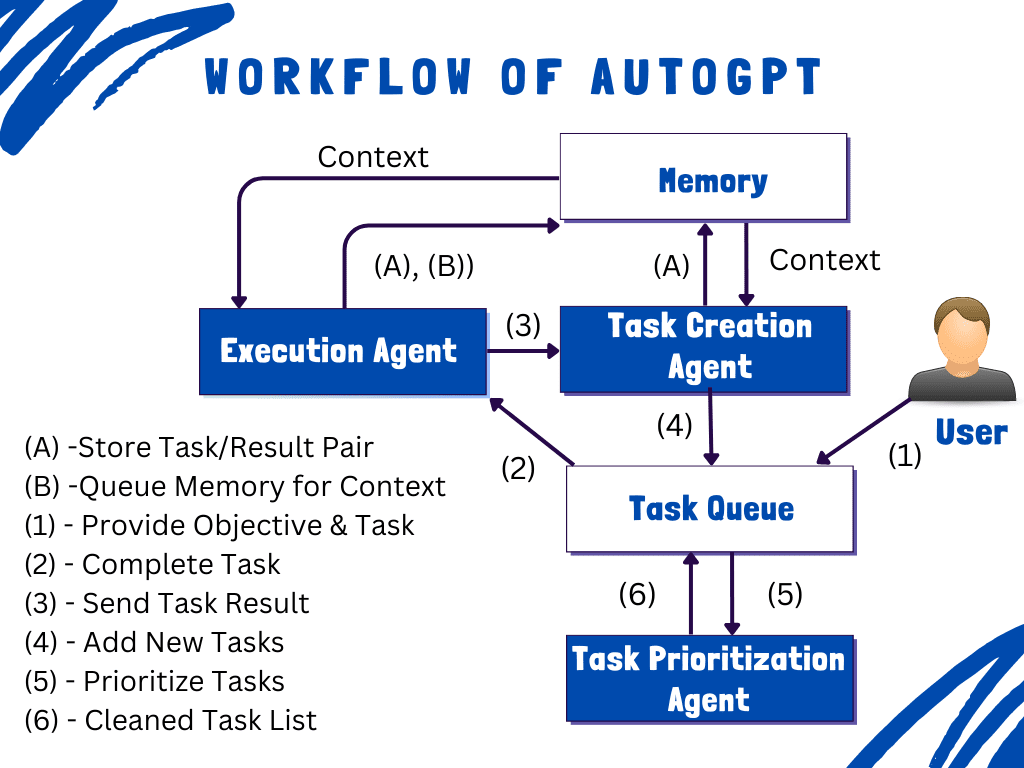
Auto-GPT (AutoGPT) is an open-source Python AI Agent application based on GPT-4 that can self-prompt. This means that if the user states an end goal, the system can work out the steps needed to get there and carry them out. Auto-GPT works by setting a goal; the AI will then generate and complete tasks. Basically, it does all the follow-up work for you, asking and answering its own prompts in a loop. It utilizes the GPT-4 API and can perform a task with little human intervention.
Auto-GPT manages short-term and long-term memory by writing to and reading from databases and files; manages context window length requirements with summarization; can perform internet-based actions such as web searching, web form, and API interactions unattended; and includes text-to-speech for voice output. However, it has limitations in understanding and retaining extensive contextual information because the GPT model it leverages has a token limit. One way to address this contextual issue is to access a window of historical messages, such as the last ten messages or a fixed number of tokens, without exceeding the token limit of a single conversation. However, this method restricts Auto-GPT from accessing earlier contextual information, which might lead to the failure of Auto-GPT to accomplish its goal
To install Auto-GPT, you will need to have Python and Pip installed on your computer. You can download the latest version of Python from the official website and install it on your computer. You will also need to add API keys to use Auto-GPT. You can go to the GitHub release page of Auto-GPT and download the ZIP file by clicking on “Source code (zip)”
If you want Auto-GPT to speak using ElevenLabs, you will need to have an ElevenLabs API key. You can obtain your ElevenLabs API key from their website. Once you have your API key, you can add it to the .env file in the Auto-GPT directory.
Auto-GPT is not yet capable of achieving the AGI (Artificial General Intelligence) due to data quality, generalization, and explainability issues. - Kanwal Mehreen
Breaking Down AutoGPT | Kanwal Mehreen - KDnuggets ... here are the steps
- Input from the User
- Task Creation Agent
- Task Prioritization Agent
- Communication Between Agents
- Final Result - It also uses external memory to keep track of history and learn from its past experiences to generate more precise results.
The actions of these agents are visible on the user end in the following form:
- Thoughts: AI agent share their thoughts after completing the action
- Reasoning: It explains its choices of why is it choosing a particular course of action
- Plan: The plan includes the new set of tasks
- Criticism: Critically review the choices by identifying the limitations or concerns
Reflexion
YouTube ... Quora ...Google search ...Google News ...Bing News
- Reflexion: an autonomous agent with dynamic memory and self-reflection | N. Shinn, B. Labash, A. Gopinath - arXiv
- GPT-4 | OpenAI
- AlfWorld
Reflexion is a meta-technique approach that endows an agent with dynamic memory and self-reflection capabilities to enhance its existing reasoning trace and task-specific action choice abilities1 It builds on recent research and allows agents to learn from their mistakes and solve novel problems efficiently through a process of trial and error. Reflexion’s success has been demonstrated through evaluations in AlfWorld and HotPotQA environments, achieving success rates of 97% and 51%, respectively. To achieve full automation, Reflexion introduces a straightforward yet effective heuristic that enables the agent to pinpoint hallucination instances, avoid repetition in action sequences, and, in some environments, construct an internal memory map of the given environment.
Self-reflection allows humans to efficiently solve novel problems through a process of trial and error.
Generative Agents: Interactive Simulacra of Human Behavior
- Generative Agents: Interactive Simulacra of Human Behavior | S. Park, J, O'Brien, C. Cai, M. Morris, P. Liang, M. Bernstein - Stanford & Google - arXiv
- Generative Agents | mkturkcan - GitHub ... An attempt to build a working, locally-running cheap version
Researchers at Google and Stanford used ChatGPT to generate human-like characters who live and interact in a contained, video game-like world called Smallville. Smallville features 25 characters with preloaded personas who wake up, go to sleep, make breakfast, interact with each other, and attend each other’s parties in an attempt to mimic human behavior as closely as possible. One popular AI observer likened the experiment to an early version of Westworld, though it's more like a video game demo where the characters' actions and dialogue are autogenerated by AI. - Google Tells AI Agents to Behave Like 'Believable Humans' to Create 'Artificial Society' | Chloe Xiang - Vice
Autonomous GPT
YouTube ... Quora ...Google search ...Google News ...Bing News
- Embedding: Search ... Clustering ... Recommendation ... Anomaly Detection ... Classification ... Dimensional Reduction ... ...find outliers
- Developers Are Connecting Multiple AI Agents to Make More ‘Autonomous’ AI | Chloe Xiang - Vice ... Auto-GPT
- Auto-GPT | Toran Bruce Richards ... driven by GPT-4, chains together LLM "thoughts", to autonomously achieve whatever goal you set by can prompting itself to complete an objective.
- Task-driven Autonomous Agent Utilizing GPT-4, Pinecone, and LangChain for Diverse Applications | Yohei Nakajima
AgentGPT
YouTube ... Quora ...Google search ...Google News ...Bing News
- AgentGPT
- Beyond ChatGPT: AgentGPT is Bringing Autonomous AI To The Browser NOW | Sebastian - Medium
- AgentGPT template | Vercel ... Assemble, configure, and deploy autonomous AI Agents in your browser, using LangChain, OpenAI, AutoGPT and T3 Stack
AgentGPT allows you to configure and deploy Autonomous AI agents. Name your custom AI and have it embark on any goal imaginable. It will attempt to reach the goal by thinking of tasks to do, executing them, and learning from the results
BabyAGI
YouTube ... Quora ...Google search ...Google News ...Bing News
- Auto-GPT and BabyAGI: How ‘autonomous agents’ are bringing generative AI to the masses | Mark Sullivan - Fast Company ... Autonomous agents may mark an important step toward a world where AI-driven systems are smart enough to work on their own, without need of human involvement.
Agents with Reinforcement Learning (RL)
Reinforcement Learning (RL) aims to make an agent (our “model”) learn through the interaction with an environment (this can be either virtual or real). RL was firstly developed to adhere to Markov Decision Process (MDP)es. In this ambit, an agent is placed in a stochastic stationary environment and tries to learn a policy through a reward/punishment mechanism. In this scenario, it is proved the agent will converge to a satisfactory policy. However, if multiple agents are placed in the same environment, this condition is no longer true. In fact, before the learning of the agent was only dependent on the interaction between the agent and the environment, now it is also dependent on the interaction between agents
AI-Powered Search
YouTube ... Quora ...Google search ...Google News ...Bing News
- Embedding: Search ... Clustering ... Recommendation ... Anomaly Detection ... Classification ... Dimensional Reduction ... ...find outliers
- Recurrent Neural Network (RNN)
- Autoencoder (AE) / Encoder-Decoder
Pinecone
- Pinecone console
- Introduction
- LangChain
- Embedding: Search ... Clustering ... Recommendation ... Anomaly Detection ... Classification ... Dimensional Reduction ... ...find outliers
- OpenAI Integration ...utilize OpenAI for generating language embeddings, which can then be stored in Pinecone and used for Semantic Search
Key concepts:
- Vector search - Unlike traditional search methods that revolve around keywords, it is done by indexing and searching through ML-generated representations of data — vector embeddings — to find items most similar to the query.
- Vector embeddings - Vector embeddings, or “vectors,” are sets of floating-point numbers that represent objects. They are generated by embedding models trained to capture the semantic similarity of objects in a given set.
Multi-Agents Reinforcement Learning (MARL)
In a similar vein, multi-agent RL also addresses sequential decision-making problems, but with more than one agent involved. In particular, both the evolution of the system state and the reward received by each agent are influenced by the joint actions of all agents. More intriguingly, each agent has its own long-term reward to optimize, which now becomes a function of the policies of all other agents.
- Markov/Stochastic Games
- Cooperative Setting
- Competitive Setting
- Mixed Setting
- Extensive-Form Games
Challenges
Despite a general model with broad applications, MARL suffers from several challenges in theoretical analysis, in addition to those that arise in single-agent RL.
- Non-Unique Learning Goals - Unlike single-agent RL, where the goal of the agent is to maximize the long-term return efficiently, the learning goals of MARL can be vague at times. ...Indeed, the goals that need to be considered in the analysis of MARL algorithms can be multi-dimensional ... is undoubtedly a reasonable solution concept in game theory, under the assumption that the agents are all rational, and are capable of perfectly reasoning and infinite mutual modeling of agents. However, with bounded rationality, the agents may only be able to perform finite mutual modeling
- Non-Stationarity - multiple agents usually learn concurrently, causing the environment faced by each individual agent to be non-stationary. In particular, the action taken by one agent affects the reward of other opponent agents, and the evolution of the state. As a result, the learning agent is required to account for how the other agents behave and adapt to the joint behavior accordingly. This invalidates the stationarity assumption for establishing the convergence of single-agent RL algorithms
- Scalability Issue - To handle non-stationarity, each individual agent may need to account for the joint action space, whose dimension increases exponentially with the number of agents. This is also referred to as the combinatorial nature of MARL
- Various Information Structures - Compared to the single-agent case, the information structure of MARL, namely, who knows what at the training and execution, is more involved. For example, in the framework of Markov games, it suffices to observe the instantaneous state st , in order for each agent to make decisions
Communication
Youtube search... ...Google search
- Computer Networks
- Attention
- TALISMAN: A multi-agent system for natural language processing | Marie-Hélène Stefanini & Yves Demazeau - Part of the Lecture Notes in Computer Science book series (LNAI,volume 991) ... One of the originalities of this system is the distributed treatment of sentence analysis (as opposed to a classic sequential treatment) and the introduction of linguistic laws which handle the communication between agents, without central control. At the implementation level, the system brings openness to dictionary modification, grammars and strategies of analysis, as well as the necessary mechanisms for the integration of new modules.
- Integrating AI Planning with Natural Language Processing: A Combination of Explicit and Tacit Knowledge | Kebing Jin, Hankz Hankui Zhuo - Cornell University
