YouTube search...
Quora search...
...Google search
- AI Governance / Algorithm Administration
- Algorithms
- Automated Machine Learning (AML) - AutoML
- AIOps / MLOps
- Data Science / Data Governance
- Benchmarks
- Data Preprocessing
- Feature Exploration/Learning
- Data Quality ...validity, accuracy, cleaning, completeness, consistency, encoding, padding, augmentation, labeling, auto-tagging, normalization, standardization, and imbalanced data
- Bias and Variances
- Master Data Management (MDM)
- Privacy in Data Science
- Data Interoperability
- Excel - Data Analysis
- Visualization
- Graphical Tools for Modeling AI Components
- Hyperparameters
- Evaluation
- Train, Validate, and Test
- NLP Workbench / Pipeline
- Development
- Building Your Environment
- Service Capabilities
- AI Marketplace & Toolkit/Model Interoperability
- Directed Acyclic Graph (DAG) - programming pipelines
- Containers; Docker, Kubernetes & Microservices
- Platforms: Machine Learning as a Service (MLaaS)
- Tools:
- TensorBoard
- Comet ML ...self-hosted and cloud-based meta machine learning platform allowing data scientists and teams to track, compare, explain and optimize experiments and models
- MLflow | Databrinks ...manage the ML lifecycle, including experimentation, reproducibility and deployment
- Domino Model Monitor (DMM) | Domino ...monitor the performance of all models across your entire organization
- alteryx: Feature Labs, Featuretools
- Weights and Biases ...experiment tracking, model optimization, and dataset versioning
- How can we improve Azure Data Catalog?
- SigOpt ...optimization platform and API designed to unlock the potential of modeling pipelines. This fully agnostic software solution accelerates, amplifies, and scales the model development process
- DVC ...Open-source Version Control System for Machine Learning Projects
- ModelOp Center | ModelOp
- Google Kubeflow Pipelines - a platform for building and deploying portable, scalable machine learning (ML) workflows based on Docker containers. Introducing AI Hub and Kubeflow Pipelines: Making AI simpler, faster, and more useful for businesses
- SageMaker | Amazon
- Moogsoft and Red Hat Ansible Tower
- MLOps | Microsoft ...model management, deployment, and monitoring with Azure
- DSS | Dataiku
- Model Manager | SAS
- Machine Learning Operations (MLOps) | DataRobot
- Metaflow, Netflix and AWS open source Python library
- Automate your data lineage
- Benefiting from AI: A different approach to data management is needed
- Git - GitHub and GitLab ...publishing your model
- Use a Pipeline to Chain PCA with a RandomForest Classifier Jupyter Notebook | Jon Tupitza
- ML.NET Model Lifecycle with Azure DevOps CI/CD pipelines | Cesar de la Torre - Microsoft
- A Great Model is Not Enough: Deploying AI Without Technical Debt | DataKitchen - Medium
- Infrastructure Tools for Production | Aparna Dhinakaran - Towards Data Science ...Model Deployment and Serving
- Global Community for Artificial Intelligence (AI) in Master Data Management (MDM) | Camelot Management Consultants
Master Data Management (MDM)
Feature Store / Data Lineage / Data Catalog
|
How is AI changing the game for Master Data Management?
Tony Brownlee talks about the ability to inspect and find data quality issues as one of several ways cognitive computing technology is influencing master data management.
|
|
|
|
Introducing Roxie. Data Management Meets Artificial Intelligence.
Introducing Roxie, Rubrik's Intelligent Personal Assistant. A hackathon project by Manjunath Chinni. Created in 10 hours with the power of Rubrik APIs.
|
|
|
DAS Webinar: Master Data Management – Aligning Data, Process, and Governance
Getting MDM “right” requires a strategic mix of Data Architecture, business process, and Data Governance.
|
|
|
|
IBM MDM Feature Spotlight: Machine learning-assisted Data Stewardship
This three minute overview shows the benefits of using machine learning models trained by a clients' own data stewards to facilitate faster resolution of pending clerical tasks in IBM Master Data Management Standard Edition.
|
|
|
Better Machine Learning Outcomes rely on Modern Data Management
Tarun Batra, CEO, LumenData, talks about how the movement towards artificial intelligence and machine learning relies on a Modern Data Management platform that is able to correlate large amounts of data, and provide a reliable data foundation for machine learning algorithms to deliver better business outcomes. In this video, Tarun discusses: Key industry trends driving Modern Data Management, Data management best practices, Creating joint value for customers "There is a lot of movement towards artificial intelligence and machine learning as being the next big domain that organizations are focusing on. With data volumes continuing to increase, and the velocity of change of data, decisions have to be made in an automated, data-driven fashion for organizations to remain competitive. Machine learning can predict and recommend actions, but a reliable data foundation through MDM that continuously manages and ensures data quality is essential for machine learning algorithms to create accurate, meaningful insight." - Tarun Batra
|
|
|
|
How to manage Artificial Intelligence Data Collection [Enterprise AI Governance Data Management ]
Mind Data AI AI researcher Brian Ka Chan's AI ML DL introduction series. Collecting Data is an important step to the success of Artificial intelligence Program in the 4th industrial Revolution. In the current advancement of Artificial Intelligence technologies, machine learning has always been associated with AI, and in many cases, Machine Learning is considered equivalent of Artifical Intelligence. Machine learning is actually a subset of Artificial Intelligence, this discipline of machine learning relies on data to perform AI training, supervised or unsupervised. On average, 80% of the time that my team spent in AI or Data Sciences projects is about preparing data. Preparing data includes, but not limited to:
Identify Data required, Identify the availability of data, and location of them, Profiling the data, Source the data, Integrating the data, Cleanse the data, and prepare the data for learning
|
|
|
What is Data Governance?
Understand what problems a Data Governance program is intended to solve and why the Business Users must own it. Also learn some sample roles that each group might need to play.
|
|
|
|
Versioning
|
How to manage model and data versions
Raj Ramesh Managing data versions and model versions is critical in deploying machine learning models. This is because if you want to re-create the models or go back to fix them, you will need both the data that went into training the model and as well as the model hyperparameters itself. In this video I explained that concept.
Here's what I can do to help you. I speak on the topics of architecture and AI, help you integrate AI into your organization, educate your team on what AI can or cannot do, and make things simple enough that you can take action from your new knowledge. I work with your organization to understand the nuances and challenges that you face, and together we can understand, frame, analyze, and address challenges in a systematic way so you see improvement in your overall business, is aligned with your strategy, and most importantly, you and your organization can incrementally change to transform and thrive in the future. If any of this sounds like something you might need, please reach out to me at dr.raj.ramesh@topsigma.com, and we'll get back in touch within a day. Thanks for watching my videos and for subscribing. www.topsigma.com www.linkedin.com/in/rajramesh
|
|
|
|
Version Control for Data Science Explained in 5 Minutes (No Code!)
In this code-free, five-minute explainer for complete beginners, we'll teach you about Data Version Control (DVC), a tool for adapting Git version control to machine learning projects.
- Why data science and machine learning badly need tools for versioning
- Why Git version control alone will fall short
- How DVC helps you use Git with big datasets and models
- Cool features in DVC, like metrics, pipelines, and plots
Check out the DVC open source project on GitHub: http://github.com/iterative/dvc
|
|
|
How to easily set up and version your Machine Learning pipelines, using Data Version Control (DVC) and Machine Learning Versioning (MLV)-tools | PyData Amsterdam 2019
Stephanie Bracaloni, Sarah Diot-Girard Have you ever heard about Machine Learning versioning solutions? Have you ever tried one of them? And what about automation? Come with us and learn how to easily build versionable pipelines! This tutorial explains through small exercises how to setup a project using DVC and MLV-tools. www.pydata.org
|
|
|
|
Alessia Marcolini: Version Control for Data Science | PyData Berlin 2019
Track:PyData Are you versioning your Machine Learning project as you would do in a traditional software project? How are you keeping track of changes in your datasets? Recorded at the PyConDE & PyData Berlin 2019 conference. http://pycon.de
|
|
|
Introduction to Pachyderm
Joey Zwicker A high-level introduction to the core concepts and features of Pachyderm as well as a quick demo. Learn more at: pachyderm.io github.com/pachyderm/pachyderm docs.pachyderm.io
|
|
|
|
E05 Pioneering version control for data science with Pachyderm co-founder and CEO Joe Doliner
5 years ago, Joe Doliner and his co-founder Joey Zwicker decided to focus on the hard problems in data science, rather than building just another dashboard on top of the existing mess. It's been a long road, but it's really payed off. Last year, after an adventurous journey, they closed a $10m Series A led by Benchmark. In this episode, Erasmus Elsner is joined by Joe Doliner to explore what Pachyderm does and how it scaled from just an idea into a fast growing tech company. Listen to the podcast version
http://apple.co/2W2g0nV
|
|
Model Versioning - ModelDB
- ModelDB: An open-source system for Machine Learning model versioning, metadata, and experiment management
Hyperparameter
YouTube search...
...Google search
In machine learning, a hyperparameter is a parameter whose value is set before the learning process begins. By contrast, the values of other parameters are derived via training. Different model training algorithms require different hyperparameters, some simple algorithms (such as ordinary least squares regression) require none. Given these hyperparameters, the training algorithm learns the parameters from the data. Hyperparameter (machine learning) | Wikipedia
Machine learning algorithms train on data to find the best set of weights for each independent variable that affects the predicted value or class. The algorithms themselves have variables, called hyperparameters. They’re called hyperparameters, as opposed to parameters, because they control the operation of the algorithm rather than the weights being determined. The most important hyperparameter is often the learning rate, which determines the step size used when finding the next set of weights to try when optimizing. If the learning rate is too high, the gradient descent may quickly converge on a plateau or suboptimal point. If the learning rate is too low, the gradient descent may stall and never completely converge. Many other common hyperparameters depend on the algorithms used. Most algorithms have stopping parameters, such as the maximum number of epochs, or the maximum time to run, or the minimum improvement from epoch to epoch. Specific algorithms have hyperparameters that control the shape of their search. For example, a Random Forest (or) Random Decision Forest Classifier has hyperparameters for minimum samples per leaf, max depth, minimum samples at a split, minimum weight fraction for a leaf, and about 8 more. Machine learning algorithms explained | Martin Heller - InfoWorld
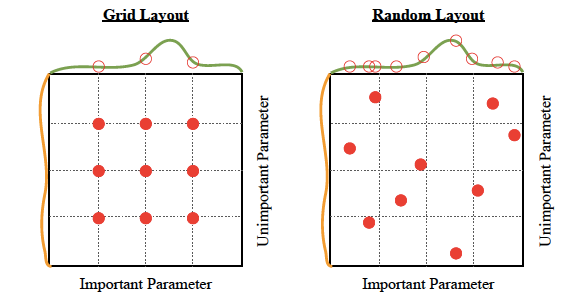
Hyperparameter Tuning
Hyperparameters are the variables that govern the training process. Your model parameters are optimized (you could say "tuned") by the training process: you run data through the operations of the model, compare the resulting prediction with the actual value for each data instance, evaluate the accuracy, and adjust until you find the best combination to handle the problem.
These algorithms automatically adjust (learn) their internal parameters based on data. However, there is a subset of parameters that is not learned and that have to be configured by an expert. Such parameters are often referred to as “hyperparameters” — and they have a big impact ...For example, the tree depth in a decision tree model and the number of layers in an artificial neural network are typical hyperparameters. The performance of a model can drastically depend on the choice of its hyperparameters. Machine learning algorithms and the art of hyperparameter selection - A review of four optimization strategies | Mischa Lisovyi and Rosaria Silipo - TNW
There are four commonly used optimization strategies for hyperparameters:
- Bayesian optimization
- Grid search
- Random search
- Hill climbing
Bayesian optimization tends to be the most efficient. You would think that tuning as many hyperparameters as possible would give you the best answer. However, unless you are running on your own personal hardware, that could be very expensive. There are diminishing returns, in any case. With experience, you’ll discover which hyperparameters matter the most for your data and choice of algorithms. Machine learning algorithms explained | Martin Heller - InfoWorld
Hyperparameter Optimization libraries:
Tuning:
- Optimizer type
- Learning rate (fixed or not)
- Epochs
- Regularization rate (or not)
- Type of Regularization - L1, L2, ElasticNet
- Search type for local minima
- Gradient descent
- Simulated
- Annealing
- Evolutionary
- Decay rate (or not)
- Momentum (fixed or not)
- Nesterov Accelerated Gradient momentum (or not)
- Batch size
- Fitness measurement type
Automatic Hyperparameter Tuning
Several production machine-learning platforms now offer automatic hyperparameter tuning. Essentially, you tell the system what hyperparameters you want to vary, and possibly what metric you want to optimize, and the system sweeps those hyperparameters across as many runs as you allow. (Google Cloud hyperparameter tuning extracts the appropriate metric from the TensorFlow model, so you don’t have to specify it.)
AIOps / MLOps
Youtube search...
...Google search
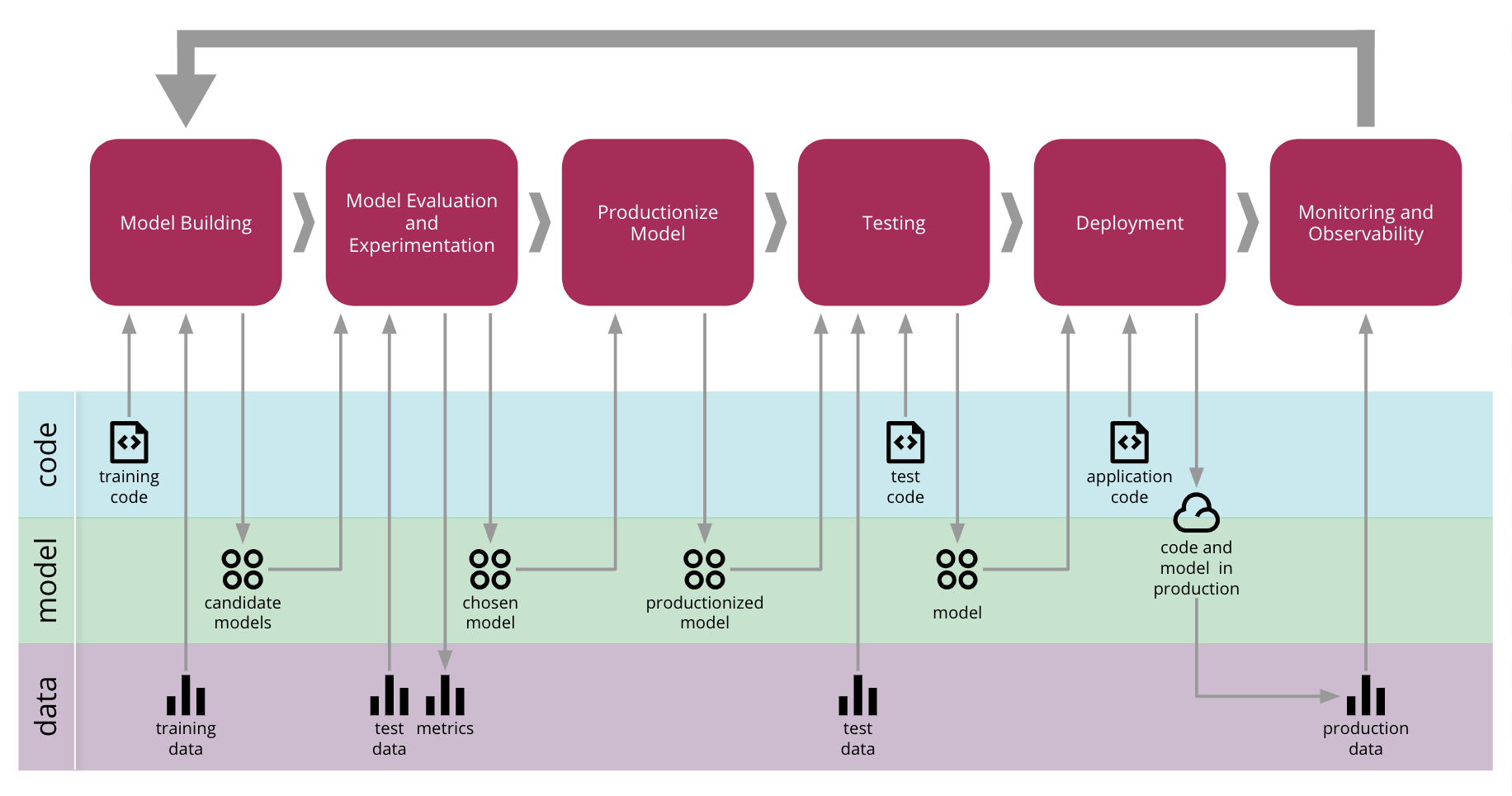
Machine learning capabilities give IT operations teams contextual, actionable insights to make better decisions on the job. More importantly, AIOps is an approach that transforms how systems are automated, detecting important signals from vast amounts of data and relieving the operator from the headaches of managing according to tired, outdated runbooks or policies. In the AIOps future, the environment is continually improving. The administrator can get out of the impossible business of refactoring rules and policies that are immediately outdated in today’s modern IT environment. Now that we have AI and machine learning technologies embedded into IT operations systems, the game changes drastically. AI and machine learning-enhanced automation will bridge the gap between DevOps and IT Ops teams: helping the latter solve issues faster and more accurately to keep pace with business goals and user needs. How AIOps Helps IT Operators on the Job | Ciaran Byrne - Toolbox
|
MLOps #28 ML Observability // Aparna Dhinakaran - Chief Product Officer at Arize AI
MLOps.community As more and more machine learning models are deployed into production, it is imperative we have better observability tools to monitor, troubleshoot, and explain their decisions. In this talk, Aparna Dhinakaran, Co-Founder, CPO of Arize AI (Berkeley-based startup focused on ML Observability), will discuss the state of the commonly seen ML Production Workflow and its challenges. She will focus on the lack of model observability, its impacts, and how Arize AI can help. This talk highlights common challenges seen in models deployed in production, including model drift, data qualitydata quality issues, distribution changes, outliers, and bias. The talk will also cover best practices to address these challenges and where observability and explainability can help identify model issues before they impact the business. Aparna will be sharing a demo of how the Arize AI platform can help companies validate their models performance, provide real-time performance monitoring and alerts, and automate troubleshooting of slices of model performance with explainability. The talk will cover best practices in ML Observability and how companies can build more transparency and trust around their models. Aparna Dhinakaran is Chief Product Officer at Arize AI, a startup focused on ML Observability. She was previously an ML engineer at Uber, Apple, and Tubemogul (acquired by Adobe). During her time at Uber, she built a number of core ML Infrastructure platforms including Michaelangelo. She has a bachelors from Berkeley's Electrical Engineering and Computer Science program where she published research with Berkeley's AI Research group. She is on a leave of absence from the Computer Vision PhD program at Cornell University.
|
|
|
|
Building an MLOps Toolchain The Fundamentals
Artificial intelligence and machine learning are the latest “must-have” technologies in helping organizations realize better business outcomes. However, most organizations don’t have a structured process for rolling out AI-infused applications. Data scientists create AI models in isolation from IT, which then needs to insert those models into applications—and ensure their security—to deliver any business value. In this ebook/webinar, we examine the best way to set up an MLOps process to ensure successful delivery of AI-infused applications.
|
|
Continuous Machine Learning (CML)
Scoring Deployed Models
|
ML Model Deployment and Scoring on the Edge with Automatic ML & DF / Flink2Kafka
recorded on June 18, 2020. Machine Learning Model Deployment and Scoring on the Edge with Automatic Machine Learning and Data Flow Deploying Machine Learning models to the edge can present significant ML/IoT challenges centered around the need for low latency and accurate scoring on minimal resource environments. H2O.ai's Driverless AI AutoML and Cloudera Data Flow work nicely together to solve this challenge. Driverless AI automates the building of accurate Machine Learning models, which are deployed as light footprint and low latency Java or C++ artifacts, also known as a MOJO (Model Optimized). And Cloudera Data Flow leverage Apache NiFi that offers an innovative data flow framework to host MOJOs to make predictions on data moving on the edge. Speakers: James Medel (H2O.ai - Technical Community Maker) Greg Keys (H2O.ai - Solution Engineer) Kafka 2 Flink - An Apache Love Story This project has heavily inspired by two existing efforts from Data In Motion's FLaNK Stack and Data Artisan's blog on stateful streaming applications. The goal of this project is to provide insight into connecting an Apache Flink applications to Apache Kafka. Speaker: Ian R Brooks, PhD (Cloudera - Senior Solutions Engineer & Data)
|
|
|
|
Shawn Scully: Production and Beyond: Deploying and Managing Machine Learning Models
PyData NYC 2015 Machine learning has become the key component in building intelligence-infused applications. However, as companies increase the number of such deployments, the number of machine learning models that need to be created, maintained, monitored, tracked, and improved grow at a tremendous pace. This growth has lead to a huge (and well-documented) accumulation of technical debt. Developing a machine learning application is an iterative process that involves building multiple models over a dataset. The dataset itself evolves over time as new features and new data points are collected. Furthermore, once deployed, the models require updates over time. Changes in models and datasets become difficult to track over time, and one can quickly lose track of which version of the model used which data and why it was subsequently replaced. In this talk, we outline some of the key challenges in large-scale deployments of many interacting machine learning models. We then describe a methodology for management, monitoring, and optimization of such models in production, which helps mitigate the technical debt. In particular, we demonstrate how to: Track models and versions, and visualize their quality over time Track the provenance of models and datasets, and quantify how changes in data impact the models being served Optimize model ensembles in real time, based on changing data, and provide alerts when such ensembles no longer provide the desired accuracy.
|
|