Claude
YouTube ... Quora ...Google search ...Google News ...Bing News
- Conversational AI ... ChatGPT | OpenAI ... Bing/Copilot | Microsoft ... Gemini | Google ... Claude | Anthropic ... Perplexity ... You ... phind ... Grok | xAI ... Groq ... Ernie | Baidu ... DeepSeek
- Artificial Intelligence (AI) ... Generative AI ... Machine Learning (ML) ... Deep Learning ... Neural Network ... Reinforcement ... Learning Techniques
- Chat with Claude 2 here | Anthropic
- Agents ... Robotic Process Automation ... Assistants ... Personal Companions ... Productivity ... Email ... Negotiation ... LangChain
- Constitutional AI
- Artificial General Intelligence (AGI) to Singularity ... Curious Reasoning ... Emergence ... Moonshots ... Explainable AI ... Automated Learning
- The Claude prompting library
- Anthropic — the $4.1 billion OpenAI rival — debuts new A.I. chatbot and opens it to public - Hayden Field | CNBC
- 3 Ways to Access Claude AI for Free | Abid Ali Awan - KD Nuggets
- ChatGPT and Bard Get New AI Chatbot Rival: Anthropic Debuts Claude 2 | Carrie Mihalcik - CNET
Contents
The Claude Model Evolution (2024–2026)
Starting in 2024, Anthropic moved away from single-model releases and introduced tiered model families optimized for different workloads.
- Claude 3 & 3.5 (2024): The Claude 3 family (Opus, Sonnet, and Haiku) introduced native vision capabilities. The mid-tier Claude 3.5 Sonnet became a breakthrough model for software engineering and introduced Artifacts—a dedicated UI panel allowing users to instantly preview generated code, websites, and graphics.
- Computer Use (Late 2024): An upgraded 3.5 Sonnet introduced a public beta for "computer use," allowing the AI to autonomously control a desktop environment by moving the cursor, clicking buttons, and typing text across multiple applications.
- Claude 3.7 Sonnet (2025): Anthropic's first hybrid reasoning model. It introduced "extended thinking," giving users explicit control over how long the model computes before answering, greatly improving complex logic and architecture tasks.
- Claude 4 Series (2025): Brought context windows up to 1 million tokens, expanded agentic team capabilities, and introduced the official Files API.
- Claude 5 Series (2026): Revamped the upper tiers with models like Fable 5 (a highly capable, safeguarded model) and the restricted Mythos 5 class for trusted enterprise access.
Model Context Protocol (MCP)
In November 2024, Anthropic introduced the Model Context Protocol (MCP), an open-source standard designed to solve the fragmented ecosystem of AI tool-calling.
- The Universal Standard: Prior to MCP, developers had to write custom API integrations for every AI model to connect with every data source (the "N×M problem"). MCP acts as a universal adapter—a "USB-C cord for AI"—allowing models to securely read files, execute functions, and query databases through a standardized interface.
- Architecture: MCP utilizes a client-server architecture using JSON-RPC 2.0. An AI application (the MCP Host) communicates with an MCP Client, which requests tools or resources from a local or remote MCP Server.
- Industry Adoption: MCP was rapidly adopted by major platforms like Replit and Sourcegraph. In December 2025, Anthropic donated the protocol to the Agentic AI Foundation (under the Linux Foundation) to solidify its status as an open industry standard.
Claude Code & Autonomous Agents
Released as a research preview in early 2025 and moving to general availability by mid-year, Claude Code is a command-line agentic tool. It allows developers to give Claude direct access to their local codebase to run terminal commands, execute tests, and autonomously fix errors. By 2026, Claude Code integrated "Plan Mode," a pre-execution planning step that drastically reduced flaws and enabled Claude to function as an autonomous software engineer rather than just an interactive pair programmer.
Foundational Alignment: Constitutional AI
Anthropic’s core differentiator remains its focus on "helpful, honest, and harmless" AI. As AI systems become more capable, Anthropic uses Constitutional AI to supervise models. Instead of relying purely on human feedback (RLHF), the system uses AI to evaluate and critique its own responses based on a foundational "constitution" or set of rules. This allows for scalable oversight and reduces the likelihood of the AI generating harmful, unethical, or deceptive content while maintaining a high degree of steerability.
One of the advantages of Claude is that it has a larger context window than other large language models, such as GPT-4. This means that Claude can process more input data at once, and can analyze an entire book's worth of material in under a minute. This also allows Claude to have longer and more coherent conversations with users, and to remember more details from previous interactions.
Another advantage of Claude is that it is more steerable and less likely to produce harmful outputs than other models. Claude can take direction on personality, tone, and behavior, and can adapt to different domains and tasks. Claude is also trained to avoid generating offensive, misleading, or harmful content, and to flag any potential issues or uncertainties in its responses.
Claude is accessible through chat interface and API in Anthropic's developer console. There are two versions of Claude available: Claude and Claude Instant. Claude is a state-of-the-art high-performance model, while Claude Instant is a lighter, less expensive, and much faster option.
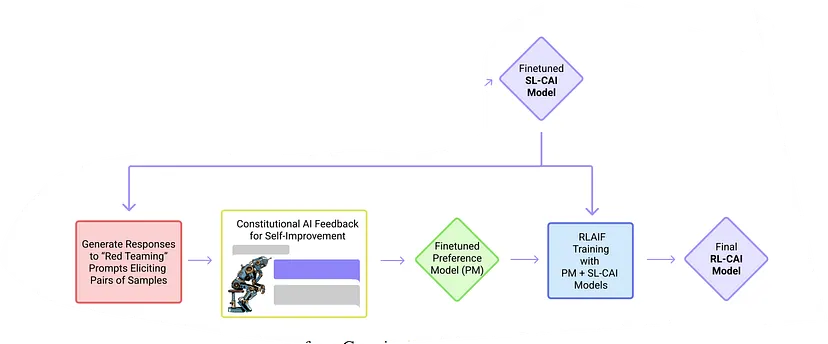
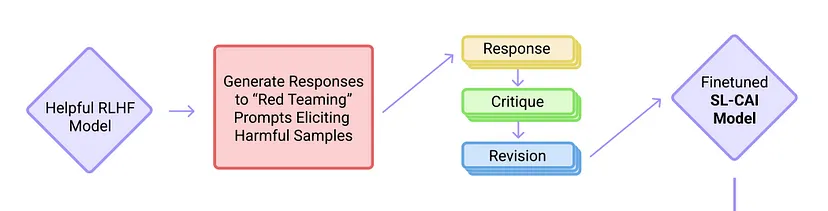
As AI systems become more capable, we would like to enlist their help to supervise other AIs. We experiment with methods for training a harmless AI assistant through self-improvement, without any human labels identifying harmful outputs. The only human oversight is provided through a list of rules or principles, and so we refer to the method as 'Constitutional AI'. The process involves both a Supervised Learning and a Reinforcement Learning (RL) phase. In the supervised phase we sample from an initial model, then generate self-critiques and revisions, and then finetune the original model on revised responses. In the RL phase, we sample from the finetuned model, use a model to evaluate which of the two samples is better, and then train a preference model from this dataset of AI preferences. We then train with RL using the preference model as the reward signal, i.e. we use 'RL from AI Feedback' (RLAIF). As a result we are able to train a harmless but non-evasive AI assistant that engages with harmful queries by explaining its objections to them. Both the SL and RL methods can leverage chain-of-thought style reasoning to improve the human-judged performance and transparency of AI decision making. These methods make it possible to control AI behavior more precisely and with far fewer human labels. - Anthropic
The Constitutional AI methodology has two phases, similar to Reinforcement Learning (RL) from Human Feedback (RLHF).
1. The Supervised Learning Phase.
2. The Reinforcement Learning Phase.