Difference between revisions of "Causation vs. Correlation"
m |
m (→Ice Cream and Sunburns) |
||
| Line 35: | Line 35: | ||
* <b>Correlation</b> means there is a relationship or pattern between the values of two variables. A correlation is a statistical indicator of the relationship between variables. These variables change together: they covary. But this covariation isn’t necessarily due to a direct or indirect causal link. | * <b>Correlation</b> means there is a relationship or pattern between the values of two variables. A correlation is a statistical indicator of the relationship between variables. These variables change together: they covary. But this covariation isn’t necessarily due to a direct or indirect causal link. | ||
| − | = Ice Cream and | + | = Ice Cream and Sunburn = |
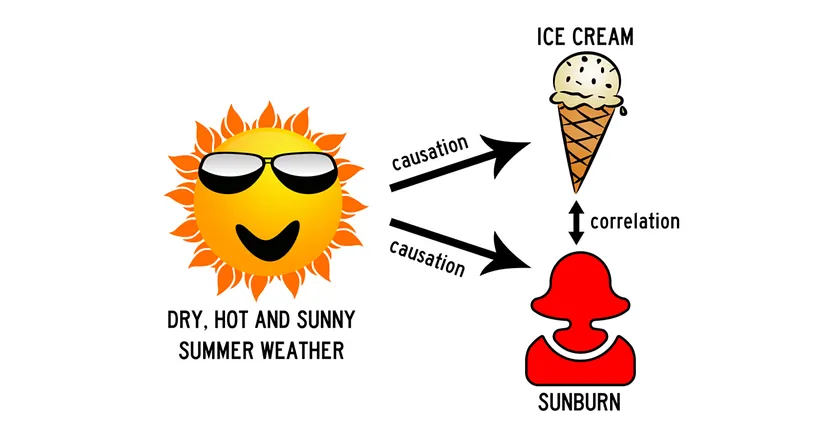
Correlation describes an association between types of variables while causation describes a cause-and-effect relationship between variables. For example there is a strong positive correlation between ice cream sales and sunburn rates. When ice cream sales rise, so does sunburns. However, there is no causal relationship between the ice cream itself and the rate of sunburns. The sunny weather brings the two factors together. | Correlation describes an association between types of variables while causation describes a cause-and-effect relationship between variables. For example there is a strong positive correlation between ice cream sales and sunburn rates. When ice cream sales rise, so does sunburns. However, there is no causal relationship between the ice cream itself and the rate of sunburns. The sunny weather brings the two factors together. | ||
Revision as of 10:19, 4 June 2023
YouTube ... Quora ...Google search ...Google News ...Bing News
- In-Context Learning (ICL) ... Context ... Causation vs. Correlation ... Autocorrelation ... Out-of-Distribution (OOD) Generalization ... Transfer Learning
- Convolution vs. Cross-Correlation (Autocorrelation)
- Math for Intelligence
- Evaluation - Measures
- Singularity ... Sentience ... AGI ... Curious Reasoning ... Emergence ... Moonshots ... Explainable AI ... Automated Learning
- Causal Inference Animated Plots | Nick Huntington-Klein
- Causal Inference | Causal-Inference.org
- The Book of Why: The New Science of Cause and Effect | Judea Pearl
- Correlation is not causation | Anthony Figueroa - Medium ... Why the confusion of these concepts has profound implications, from healthcare to business management
Correlation does not imply causation
In turn, a signal’s predictive power does not necessarily imply in any way that that signal is actually related to or explains the phenomena being predicted. This distinction matters when it comes to Machine Learning (ML) because many of the strongest signals these algorithms pick up in their training data are not actually related to the thing being measured. A Reminder That Machine Learning Is About Correlations Not Causation | Kalev Leetaru - Forbes
- Causation means that changes in one variable bring about changes in the other; there is a cause-and-effect relationship between variables. The two variables are correlated with each other and there is also a causal link between them.
- Correlation means there is a relationship or pattern between the values of two variables. A correlation is a statistical indicator of the relationship between variables. These variables change together: they covary. But this covariation isn’t necessarily due to a direct or indirect causal link.
Contents
Ice Cream and Sunburn
Correlation describes an association between types of variables while causation describes a cause-and-effect relationship between variables. For example there is a strong positive correlation between ice cream sales and sunburn rates. When ice cream sales rise, so does sunburns. However, there is no causal relationship between the ice cream itself and the rate of sunburns. The sunny weather brings the two factors together.
Causal AI - Cause & Effect
YouTube ... Quora ...Google search ...Google News ...Bing News
Causal AI is an artificial intelligence system that can explain cause and effect. Causal AI technology is used by organizations to help explain decision making and the causes for a decision. Wikipedia

Root Cause Analysis (RCA)
YouTube ... Quora ...Google search ...Google News ...Bing News
Root cause analysis (RCA) is the process of discovering the root causes of problems in order to identify appropriate solutions. RCA assumes that it is much more effective to systematically prevent and solve for underlying issues rather than just treating ad hoc symptoms and putting out fires. Root Cause Analysis Explained: Definition, Examples, and Methods | Tableau

Multivariate Additive Noise Model (MANM)
Model for general causality that identifies multiple causal connections without time-sequence data. "Uniquely, the model can identify multiple, hierarchical causal factors. It works even if data with time sequencing is not available. The model creates significant opportunities to analyse complex phenomena in areas such as economics, disease outbreaks, climate change and conservation," says Prof Tshilidzi Marwala, a professor of artificial intelligence, and global AI and economics expert at the University of Johannesburg, South Africa. "The model is especially useful at the regional, national or global level where no controlled or natural experiments are possible," adds Marwala. "MANM is based on Directed Acyclic Graph (DAG), which can identify a multi-nodal causal structure. MANM can estimate every possible causal direction in complex feature sets, with no missing or wrong directions." The use of DAGs is a key reason MANM significantly outperforms models previously developed by others, which were based on Independent Component Analysis (ICA), such as Linear Non-Gaussian Acyclic Model (ICA-LiNGAM), Greedy DAG Search (GDS) and Regression with Sub-sequent Independent Test (RESIT), he says. "Another key feature of MANM is the proposed Causal Influence Factor (CIF), for the successful discovery of causal directions in the multivariate system. The CIF score provides a reliable indicator of the quality of the casual inference, which enables avoiding most of the missing or wrong directions in the resulting causal structure," concludes Chakraverty. Where an existing dataset is available, MANM now makes it possible to identify multiple multi-nodal causal structures within the set. As an example, MANM can identify the multiple causes of persistent household debt for low, middle and high-income households in a region. Artificial intelligence trained to analyze causation | University of Johannesburg
Causalens
- CausaLens ... focusing on causality
While traditional machine learning focuses on correlations, Causal AI identifies cause-and-effect relationships, enabling companies to make better-informed decisions and predictions.
Causal AI examples:
- Use Causal AI to improve logistics and supply chain operations. By analyzing the causal relationships between different factors in the supply chain, such as demand, inventory, and transportation, the Organization could identify the most critical drivers of inefficiencies and bottlenecks, and optimize the entire system for greater efficiency and cost savings.
- Use causal AI to improve equipment maintenance and reduce downtime. By analyzing the causal factors that contribute to equipment failures or malfunctions, such as usage patterns, environmental conditions, and maintenance history, the Organization could proactively predict and prevent issues before they occur, reducing costly downtime and increasing the overall reliability of its systems.
- Use causal AI to enhance strategic planning and decision-making. By identifying the causal relationships between different variables such as budget allocation, resource utilization, and operational effectiveness, the Organization could gain deeper insights into the factors that drive success and failure in its operations, and make more informed decisions about where to focus its resources and investments for the greatest impact.
