Difference between revisions of "Government Services"
m |
m (→Non-US Bodies) |
||
| Line 275: | Line 275: | ||
|}<!-- B --> | |}<!-- B --> | ||
| − | + | = Non-US Bodies = | |
* [http://www.cfr.org/blog/what-did-2018-nato-summit-accomplish-respect-cyber-issues What Did the 2018 NATO Summit Accomplish With Respect to Cyber Issues?], July 16, 2018 | * [http://www.cfr.org/blog/what-did-2018-nato-summit-accomplish-respect-cyber-issues What Did the 2018 NATO Summit Accomplish With Respect to Cyber Issues?], July 16, 2018 | ||
| Line 327: | Line 327: | ||
<b>Artificial Intelligence: The Future of Homeland Security | <b>Artificial Intelligence: The Future of Homeland Security | ||
</b><br>i24NEWS DESK | Israel is hosting an event surrounding the use of artificial intelligence for homeland security. Our Daniel Tsemach has more. Story: Israel is hosting it's first ever international event for artificial intelligence and security led by the Israel Export Institute and the Foreign Trade Administration. There were 65 representatives from around the world in attendance for the week long event, in order to find out how Artificial Intelligence can assist with homeland security. Companies were featuring A.I. technology from virtual reality to facial recognition software. | </b><br>i24NEWS DESK | Israel is hosting an event surrounding the use of artificial intelligence for homeland security. Our Daniel Tsemach has more. Story: Israel is hosting it's first ever international event for artificial intelligence and security led by the Israel Export Institute and the Foreign Trade Administration. There were 65 representatives from around the world in attendance for the week long event, in order to find out how Artificial Intelligence can assist with homeland security. Companies were featuring A.I. technology from virtual reality to facial recognition software. | ||
| + | |} | ||
| + | |}<!-- B --> | ||
| + | |||
| + | == China == | ||
| + | [http://www.youtube.com/results?search_query=defense+china+artificial+intelligence+deep+machine+learning Youtube search...] | ||
| + | [http://www.google.com/search?q=defense+china+artificial+intelligence+deep+machine+learning ...Google search] | ||
| + | [http://news.google.com/search?q=defense+china+artificial+intelligence+deep+machine+learning ...Google News] | ||
| + | |||
| + | * [http://cset.georgetown.edu/research/chinese-perspectives-on-ai-and-future-military-capabilities/ Chinese Perspectives on AI and Future Military Capabilities | Ryan Fedasiuk - CSET] ... This study constructs a framework for systematically assessing arguments about AI’s effect on military capabilities and strategic stability. It applies the framework to 58 journal articles written from 2016–2020 by People’s Liberation Army (PLA) officers, defense industry engineers, and academics at leading Chinese universities (hereafter “experts”) about artificial intelligence and future weapons systems. | ||
| + | * [http://www.scmp.com/news/china/military/article/3098292/rise-chinese-ai-and-quantum-computing-threatens-american Rise of Chinese AI and quantum computing threatens American military tech, says report for US Congress | Kristin Huang - South China Morning Post] ...The days of the PLA lagging well behind the US in military technology are long gone, says analyst | ||
| + | * [http://emerj.com/ai-sector-overviews/artificial-intelligence-china-military/?utm_term=43600&utm_medium=artificial-intelligence-china-military&utm_campaign=broadcast&utm_source=email&utm_content=&_ke=eyJrbF9lbWFpbCI6ICJicGVhdEBlcHJvY2Vzc3NvbHV0aW9ucy5jb20iLCAia2xfY29tcGFueV9pZCI6ICJNanhacWcifQ%3D%3D Artificial Intelligence in the Chinese Military – Current Initiatives | Millicent Abadicio - AI Advantage] | ||
| + | * [http://emerj.com/ai-power/the-usa-china-ai-race/?utm_term=43598&utm_medium=the-usa-china-ai-race&utm_campaign=broadcast&utm_source=email&utm_content=&_ke=eyJrbF9lbWFpbCI6ICJicGVhdEBlcHJvY2Vzc3NvbHV0aW9ucy5jb20iLCAia2xfY29tcGFueV9pZCI6ICJNanhacWcifQ%3D%3D The USA-China AI Race – 7 Weaknesses of the West | Daniel Faggella - Emero] | ||
| + | |||
| + | {|<!-- T --> | ||
| + | | valign="top" | | ||
| + | {| class="wikitable" style="width: 550px;" | ||
| + | || | ||
| + | <youtube>VmQWGo08KCU</youtube> | ||
| + | <b>US or China Winning in AI? China the World Leader by 2030? | ||
| + | </b><br>Matthew Voke Is China Winning in AI, or the US? Will China be the World Leader by 2030? Who's ahead in Artificial Intelligence? Is the US or China winning the AI race? In 2020, who's leading in AI Competition between China and the United States? I hear these questions frequently. China has stated that they will be the world leader by 2030, but where are they right now, and how likely are they to achieve dominance in the next decade? This video examines where the United States and China have strengths in 2020, and where they are weak. What are their approaches to innovation in Artificial Intelligence, and how will they improve over the next decade. ##Kai-Fu Lee's "AI Superpowers" Book is great: http://amzn.to/35gXZGN ##Graham Allison's "Destined for War" Book explains the thucydides' Trap: http://amzn.to/2Wme0aL Finally let's talk about the Thucydides' Trap. This is an area of concern when people begin talking about an "Artificial Intelligence Arms Race." This is NOT an Arms Race, nor should it be treated as such. I'll discuss why. I wrote this myself, used some videos under fair use - the owner is in the bottom of the video. I do not push, support, or endorse any policy, strategy, or grand strategy in this video. These are my views alone, and may not reflect those of the United States Department of Defense, or the United States Government. | ||
| + | |} | ||
| + | |<!-- M --> | ||
| + | | valign="top" | | ||
| + | {| class="wikitable" style="width: 550px;" | ||
| + | || | ||
| + | <youtube>khUb0LWN7RI</youtube> | ||
| + | <b>Chinese Defense Innovation: AI, Cyber, and Quantum Computing | ||
| + | </b><br>Elsa Kania, Adjunct Fellow - Center for a New American Security’s Technology and National Security Program Emerging Technologies in Great Power Competition CYBERWEEK 2018 Tel Aviv University 19.6.18 | ||
| + | |} | ||
| + | |}<!-- B --> | ||
| + | {|<!-- T --> | ||
| + | | valign="top" | | ||
| + | {| class="wikitable" style="width: 550px;" | ||
| + | || | ||
| + | <youtube>jNkx_VJ0AAQ</youtube> | ||
| + | <b>What data does China have on its citizens? | ||
| + | </b><br>The "oracle of AI" Kai Fu Lee says the data the Chinese government has collected on its citizens is "too large and too raw" to be used for AI. | ||
| + | |} | ||
| + | |<!-- M --> | ||
| + | | valign="top" | | ||
| + | {| class="wikitable" style="width: 550px;" | ||
| + | || | ||
| + | <youtube>FYIVX5sFeZY</youtube> | ||
| + | <b>Who is winning the artificial intelligence race? | ||
| + | </b><br>In a recent talk at Stanford, Kai-Fu Lee says China has taken the lead. Lee is a venture capitalist and author of “AI Superpowers: China, Silicon Valley and the New World Order.” Who’s winning the worldwide competition to develop and exploit artificial intelligence? Not the U.S., says Kai-Fu Lee, a venture capitalist and author of AI Superpowers: China, Silicon Valley and the New World Order. Although researchers and tech companies in the U.S. hold the lion’s share of AI patents and are responsible for key breakthroughs in the field, the game has changed, and China is taking the lead. “We are now in the implementation phase. It’s a question of who can build the fastest,” Lee said during a recent talk at the AI Salon series presented by the Stanford Human-Centered Artificial Intelligence (HAI) Initiative and the Stanford Artificial Intelligence Lab (SAIL). Building the fastest doesn’t necessarily require the top tier of researchers. “For most applications, you don’t really need super AI experts. Young AI engineers will suffice,” he said. And China has them. Indeed, the last really significant breakthrough in AI – deep learning – was nine years ago, Lee said. “Without big breakthroughs, it is hard for the U.S to maintain its lead because AI technologies are reasonably well understood,” he said. Machine learning and artificial intelligence rely on data – lots of data – to function. And that’s where China has its biggest advantage. Not only does China have a huge population, its residents lead by far the United States in the use of mobile applications and payments. Every click, every sale, generates data. “If data is the new oil, China is the new OPEC,” Lee said. What’s more, the business environment in China is friendlier to AI companies, with more government support and less regulation than in the U.S. China’s advances in AI haven’t gone unnoticed by investors. Last year, 48 percent of the venture capital money directed to AI went to China, compared with 38 percent invested in U.S. ventures, Lee said. There are, of course, challenges posed by AI, not the least of which is the threat of job losses, a point made by Lee and two other speakers at the Salon: Susan Athey, a professor of economics at Stanford Graduate School of Business, and Erik Brynjolfsson, director of the MIT Initiative on the Digital Economy. Even so, the stakes in the AI race are extremely high. Over the next 11 years, AI and related technologies will account for some $11 trillion in economic activity, a sum larger than the combined economies of China and India, Lee said. | ||
| + | |} | ||
| + | |}<!-- B --> | ||
| + | {|<!-- T --> | ||
| + | | valign="top" | | ||
| + | {| class="wikitable" style="width: 550px;" | ||
| + | || | ||
| + | <youtube>V27n3gOo9eo</youtube> | ||
| + | <b>Shaping the Future of Artificial Intelligence in China | ||
| + | </b><br>Between 2010 and 2015, artificial intelligence-related patent applications in China grew to over 8,000 submissions, up 190% from the previous five years. What is the role and responsibility of Chinese businesses to accelerate the technology’s potential while mitigating potential negative impacts for the world? Dimensions to be addressed: - New collaboration and partnership models for AI research and development - Public awareness of AI and tackling issues of public trust - (Un)blocking data flows throughout industry supply chains Speakers: - Dai Wenyuan, Founder and Chief Executive Officer, 4th Paradigm Data & Technology Co., People's Republic of China. - Huang Dinglong, Co-Founder and Chief Executive Officer, Malong Technologies, People's Republic of China. | ||
| + | - Wendell Wallach, Scholar, Interdisciplinary Center for Bioethics, Yale University, USA. - Wang Xiaoming, Director, Center for Innovation Strategy and Policy Research, Chinese Academy of Sciences, People's Republic of China. - Yuan Hui, Chairman, Shanghai Xiaoi Robot Technology, People's Republic of China. | ||
| + | |} | ||
| + | |<!-- M --> | ||
| + | | valign="top" | | ||
| + | {| class="wikitable" style="width: 550px;" | ||
| + | || | ||
| + | <youtube>4Gk6mxKXKTk</youtube> | ||
| + | <b>AI in China | ||
| + | </b><br>The Chinese state run news agency Xinhua recently revealed the first Artificial Intelligence news anchor. They're now able to generate video of a newscaster using a model trained on real newscaster data and use it to disseminate information 24/7. When I saw this, I knew it was time to start studying China's role in the AI revolution in-depth. In this video, I'll cover China's power structure, generative adversarial networks, its startup scene, Confucianism, the social credit scoring system, algorithmic policing, surveillance, [[privacy]], autonomous weapons, and convolutional neural networks. A lot of different topics to cover, but I hope this video provides a coherent narrative around the use of AI in China and how it plays into the global AI community. Enjoy! | ||
| + | |} | ||
| + | |}<!-- B --> | ||
| + | |||
| + | == Russia == | ||
| + | [http://www.youtube.com/results?search_query=defense+Russia+artificial+intelligence+deep+machine+learning Youtube search...] | ||
| + | [http://www.google.com/search?q=defense+Russia+artificial+intelligence+deep+machine+learning ...Google search] | ||
| + | [http://news.google.com/search?q=defense+Russia+artificial+intelligence+deep+machine+learning ...Google News] | ||
| + | |||
| + | * [http://warontherocks.com/2019/07/russian-ai-enabled-combat-coming-to-a-city-near-you/ Russian AI-Enabled Combat: Coming To A City Near You? | Margarita Konaev and Samuel Bendett - War on the Rocks] ...when it comes to military applications of artificial intelligence, overlooking Russia is a mistake. | ||
| + | * [http://tass.com/defense/1111737 AI to assist Russian military brass in decision-making, says hi-tech manufacturer | TASS] ...The company CEO drew a line between "assistance" in decision-making and "decision-making" itself, stressing that he means the former | ||
| + | * [http://www.forbes.com/sites/davidaxe/2020/08/31/russias-got-dogfighting-drones-too-just-how-smart-are-they/#2cfa69be167f Russia’s Got Dogfighting Drones, Too—Just How Smart Are They? | David Axe - Forbes] | ||
| + | |||
| + | {|<!-- T --> | ||
| + | | valign="top" | | ||
| + | {| class="wikitable" style="width: 550px;" | ||
| + | || | ||
| + | <youtube>2KIlMKtETEY</youtube> | ||
| + | <b>Putin: Whoever Masters Artificial Intelligence (AI) Will Rule The World! | ||
| + | </b><br>Russian President Vladimir Putin recently explained what he believes is necessary to rule the world. “If someone could guarantee themselves a monopoly in the area of artificial intelligence, the consequences are clear to us all – they would become the world ruler,” the TASS news agency cited Putin as saying. The Russian president remarked that the fight for technological superiority, including in the field of AI, has already become a field for global competition. “The speed at which new products and solutions are created is growing exponentially,” he observed. Putin noted that many countries have already chosen their strategies concerning AI. “We too, of course, must ensure our technological sovereignty in the AI field,” he said, adding that it is the most important condition for the success of Russia’s business, economy, security, defensive capability and quality of human life. | ||
| + | |} | ||
| + | |<!-- M --> | ||
| + | | valign="top" | | ||
| + | {| class="wikitable" style="width: 550px;" | ||
| + | || | ||
| + | <youtube>NbyHFI5U6UU</youtube> | ||
| + | <b>Bendett, Kania & Watley on Chinese, Russian Artificial Intelligence, Autonomy | ||
| + | </b><br>Sam Bendett of the Center for Naval Analysis, Elsa Kania of the Center for a New American Security, and Jack Watley, PhD, of the Royal United Services Institute, discuss Russian and Chinese artificial intelligence and autonomy capabilities with Defense & Aerospace Report Editor Vago Muradian. The interview was conducted after a panel discussion hosted by CNA at its Northern Virginia headquarters. | ||
|} | |} | ||
|}<!-- B --> | |}<!-- B --> | ||
Revision as of 11:22, 8 October 2020
YouTube search... ...Google search ...Google News
- China
- Russia
- Case Studies
- Deepindex.org list
- AI.gov | White House
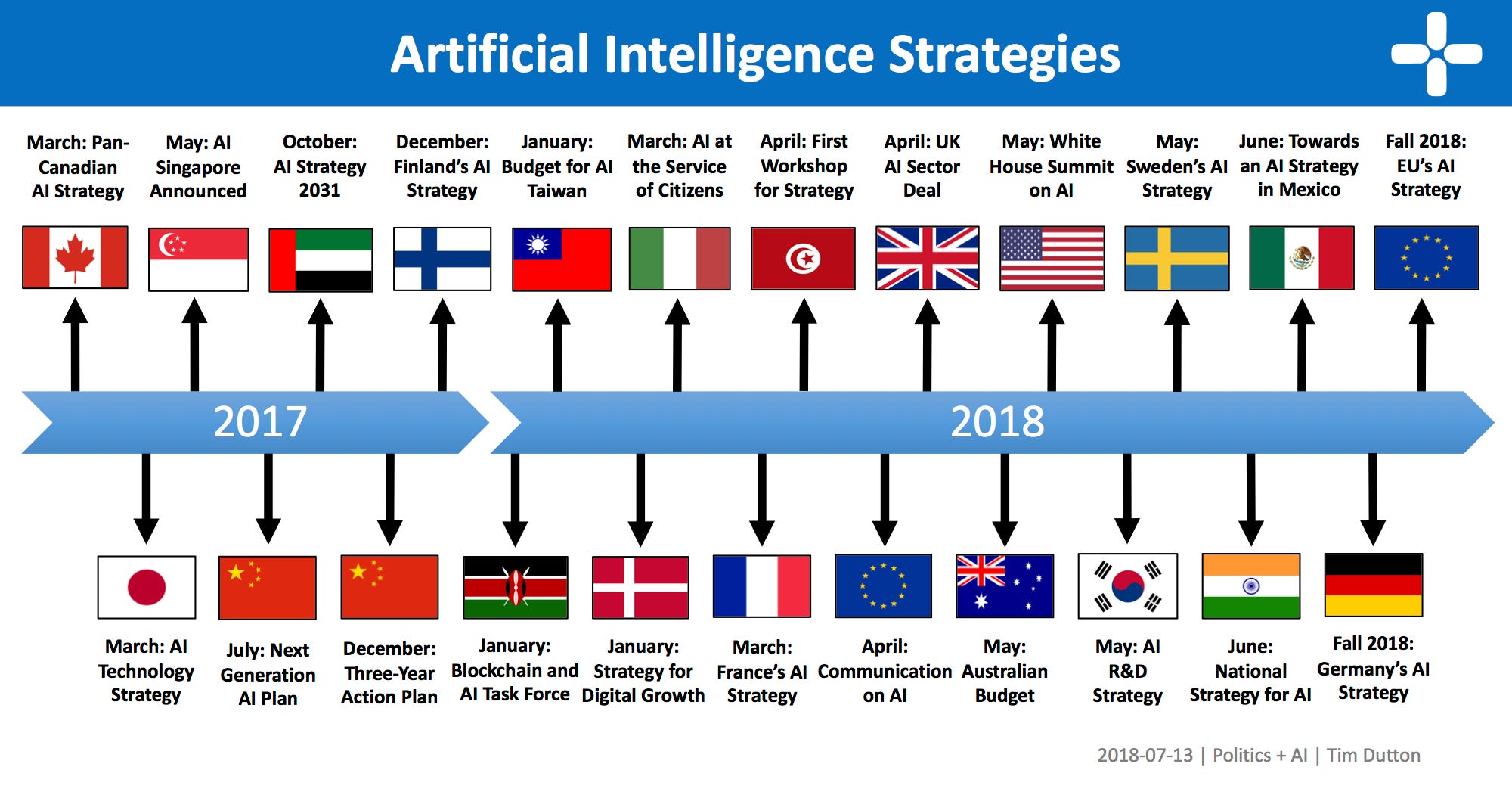
- An Overview of National AI Strategies | Tim Dutton - Medium
- First Responder
- Government Explainable Artificial Intelligence
- Artificial Intelligence | United States Patent and Trademark Office
- The National Science and Technology Council (NSTC) ... Interagency Select Committee on Artificial Intelligence (AI)
- Networking and Information Technology Research and Development (NITRD) ... Artificial Intelligence (AI) Interagency Working Group
- National Institute of Standards and Technology (NIST) ... Artificial Intelligence (AI)
- Silicon Valley Innovation Program | Homeland Security
- GSA’s Emerging Citizen Technology Office, the Artificial Intelligence for Citizen Services
- Regulating Artificial Intelligence Proposal for a Global Solution | Erdelyi. O, Goldsmith, J 2018
- Cyber Security Strategy Documents | NATO Cooperative Cyber Defence Centre of Excellence
- Artificial intelligence in Government | Wikipedia
- Government’s AI Odyssey - A Candid Poll on AI and Machine Learning in the Federal Government | Government Business Council
- The Geopolitics of Artificial Intelligence | Scientific American
- Reports of a Silicon Valley/Military Divide Have Been Greatly Exaggerated | Jack Poulson - Tech Inquiry
Artificial intelligence's incredible potential means that world governments have crucial interests in securing an edge over geopolitical rivals in the space, and advanced AI will be very important for cybersecurity at both the corporate and governmental levels. This dynamic is driving increased collaboration between technology leaders and government agencies, and it's also causing countries to be more protective of their technology assets and data. Tensions created by the new technological arms race are evident in the trade war between the U.S. and China, with the desire to secure leadership in crucial fields like AI and 5G internet representing a fundamental backdrop for the disputes between the two countries. The significance of the global competition for supremacy in artificial intelligence will likely foster close relationships between governments and leading companies in the space. Collaborations between private businesses and state entities will have a big impact on the progression of AI-dependent fields like the Internet of Things and cybersecurity. Investing in AI: A Beginner's Guide | Kieth Noonan - The Motley Fool
Contents
Timeline
- Artificial Intelligence and National Security (updated) | Congressional Research Service August 26, 2020
- NSF advances artificial intelligence research with new nationwide institutes | National Science Foundation (NSF) August 26, 2020
- China Just Called Trump's Bluff on TikTok | Tim Culpan - Bloomberg August 30, 2020
- US announces $1 billion research push for AI and quantum computing | James Vincent - The Verge August 26, 2020
- What’s this? A bipartisan plan for AI and national security | Tome Simonite | Wired ...Republican Will Hurd and Democrat Robin Kelly want more Pentagon spending, a Cold War-style “hotline,” and a curb on chip exports to China. August 1, 2020
- The Role of AI Technology in Pandemic Response and Preparedness: Recommended Investments and Initiatives | National Security Commission on Artificial Intelligence as an independent Commission (NSCAI) July 20, 2020
- Mitigating Economic Impacts of the COVID-19 Pandemic and Preserving U.S. Strategic Competitiveness in Artificial Intelligence | National Security Commission on Artificial Intelligence as an independent Commission (NSCAI) July 20, 2020
- GSA Official: Agencies Should Build Testing Data and Environments Specifically for AI | Aaron Boyd - NextGov January 29, 2020
- Guidance for Regulation of Artificial Intelligence Applications | U.S. Chief Technology Officer Michael Kratsios January 2020 draft
- U.S. expands blacklist to include China's top AI startups ahead of trade talks | David Shepardson and Josh Horwitz - Reuters October 7, 2019
- m-artificial-intelligence-research-center/160416/ Energy to Launch $5.5M Artificial Intelligence Research Center | Brandi Vincent - Nextgov October 7, 2019
- Artificial Intelligence Annex to The Department of Defense Artificial Intelligence Strategy | Air Force September 12, 2019
- Plan Outlines Priorities for Federal Agency Engagement in AI Standards Development;'U.S. LEADERSHIP IN AI: A Plan for Federal Engagement in Developing Technical Standards and Related Tools' | The U.S. Department of Commerce’s National Institute of Standards and Technology (NIST) August 9, 2019
- The National Artificial Intelligence Research and Development Strategic Plan: 2019 Update | The White House; National Science and Technology Council (NSTC) Machine Learning/Artificial Intelligence (ML/AI) June 2019
- G20 Ministerial Statement on Trade and Digital Economy - adopted human-centered AI Principles that draw from the Organisation for Economic Cooperation and Development (OECD) AI Principles June 2019
- National Institute of Standards and Technology RFI: Developing a Federal AI Standards Engagement Plan May 1, 2019
- Natural Language Processing (NLP) Project - RFI | Office of Personnel Management (OPM) April 9, 2019
- The Algorithmic Accountability Act of 2019 April 2019
- Dear Colleague Letter: Supporting Research at the Intersection of Agricultural Science, Big Data, Informatics, and Smart Communities, a joint effort between the National Science Foundation (NSF) and the U.S. Department of Agriculture's National Institute of Food and Agriculture (USDA/NIFA) March 21, 2019
- National Security Commission on Artificial Intelligence (NSCAI) hosted its inaugural meeting March 11, 2019
- Executive Order on Maintaining American Leadership in Artificial Intelligence February 11, 2019
- Eric Schmidt will join 14 other tech experts on the National Security Commission on Artificial Intelligence. created by the 2019 National Defense Authorization Act (NDAA)
- Summary of the 2018 Department of Defense Artificial Intelligence Strategy; Harnessing AI to Advance Our Security and Prosperity
- Government’s AI Odyssey: A Candid Poll on AI and Machine Learning in the Federal Government | Government Business Council December 20, 2018
- Report to Congressional Committees: National Security; Long-Range Emerging Threats Facing the United States As Identified by Federal Agencies | GAO, December 2018 (Classified version: GAO-18-497SPC (Washington, D.C. September. 28, 2018) SECRET//NOFORN
- President Donald J. Trump is Strengthening America’s Cybersecurity, September 20, 2018
- Rise of the Machines Artificial Intelligence and its Growing Impact on U.S. Policy Chairman Will Hurd and Ranking Member Robin Kelly, September 2018
- “AI Next” campaign | Defense Advanced Research Projects Agency (DARPA)
- H.R.5515 - John S. McCain National Defense Authorization Act for Fiscal Year 2019, reference section 238(g) August 30, 2018
- Joint Artificial Intelligence Center (JAIC) | U.S. Department of Defense, Jun 2018
- NIH Strategic Plan for Data Science | National Institutes of Health, Office of Data Science Strategy June 2018
- Defense Science Board Task Force on Counter Autonomy | U.S. Department of Defense, 18 Jun 2018
- The White House eliminates the position of cybersecurity coordinator on the National Security Council; John R. Bolton, said the post was no longer considered necessary 15 May 2018
- 2018 White House Summit on Artificial Intelligence for American Industry, 10 May 2018
- Artificial Intelligence and National Security | U.S. Air Force, 26 Apr 2018
- National Security Capability Review | HM Government, Mar 2018
- Defense Advanced Research Projects Agency: Overview and Issues for Congress. 2 Feb 2018
- NATO ministers agreed on the creation of a new Cyber Operations Centre as part of the outline design for the adapted NATO Command Structure 8 Nov 2017
- Report to the President on IT Modernization | American Technology Council (ATC), 2017
- Narrative Analysis, Artificial Intelligence | National Protection and Programs Directorate - Office of Cyber and Infrastructure Analysis, Jul 2017
- The Role of Big Data, Machine Learning, and AI in Assessing Risks: a Regulatory Perspective | Scott W. Bauguess - U.S. Securities and Exchange Commission 21 June 2017
- Presidential Executive Order Strengthening the Cybersecurity of Federal Networks and Critical Infrastructure | The White House 11 May 2017
- The Weaponization of Information, Committee on Armed Services Subcommittee on Cybersecurity United States Senate | Rand Waltzman - The RAND Corporation, 27 Apr 2017
- Report of the Defense Science Board Task Force on Cyber Supply Chain, Apr 2017
- Artificial Intelligence White Paper | Science and Technology Advisory Committee (HSSTAC): Quadrennial Homeland Security Review Subcommittee, 10 Mar 2017
- Global Trends: Paradox of Progress | Office of the Director of National Intelligence (ODNI), National Intelligence Council, January 2017
- The Dawn of Artificial Intelligence Hearing | Subcommittee on Space, Science, and Competitiveness, 30 Nov 2016
- The National Artificial Intelligence Research and Development Strategic Plan, National Science and Technology Council, Networking and Information Technology Research and Development Subcommittee, Oct 2016
- Preparing for the Future of Artificial Intelligence | Executive Office of the President, National Science and Technology Council Committee on Technology, Oct 2016
- General Data Protection Regulation (GDPR) | European Union ... a “right to explanation” for algorithms that “significantly affect” users, 27 Apr 2016
- The Brain Initiative: Brain Research through Advancing Innovative Neurotechnologies, aimed at reverse engineering the human brain receives $3 billion in funding by the White House, 2013
U.S. Congress
|
|
|
|
|
|
Executive Branch: White House & Federal Departments/Agencies
- Defense
- Cybersecurity: National Institute of Standards and Technology (NIST) & U.S. Department of Homeland Security (DHS)
- IARPA is Investing in AI That Constantly Analyzes Worldwide Satellite Images | Jack Corrigan - Nextgov
|
|
|
|
|
|
Federal Procurement
|
|
Department of Homeland Security (DHS)
YouTube search... ...Google search
- Cybersecurity
- First Responder
- Smart Cities
- Screening; Passenger, Luggage, & Cargo
- U.S. Department of Homeland Security Artificial Intelligence White Paper | Science and Technology Advisory Committee (HSSTAC): Quadrennial Homeland Security Review Subcommittee, 10 Mar 2017
- U.S. Department of Homeland Security Narrative Analysis: Artificial Intelligence | National Protection and Programs Directorate - Office of Cyber and Infrastructure Analysis, July 2017
- AI at the US Department of Homeland Security – Current Projects | Millicent Abadicio - Emerj, April 16, 2019
- Lie Detection
- Homeland Security's New Approach to Cyber Risk Management | Amanda Ziadeh - governmentCIO, June 15, 2018
- Homeland Security's AI Journey Starts with Trusting its Data | Amanda Ziadeh - governmentCIO, June 27, 2018
- The “smarter” wall: how drones, sensors, and AI are patrolling the border | Shirin Ghaffary - Vox
- DHS S&T Awards Colorado Start-up $147K for Intelligent Counting and Measuring Platform KickView kvSonata will perform real-time analysis of queue lengths and wait times in the international customs processing areas of airports.
- Tailoring Enterprise Architecture at DHS U.S. CIS
|
|
Non-US Bodies
|
|
|
|
|
|
China
Youtube search... ...Google search ...Google News
- Chinese Perspectives on AI and Future Military Capabilities | Ryan Fedasiuk - CSET ... This study constructs a framework for systematically assessing arguments about AI’s effect on military capabilities and strategic stability. It applies the framework to 58 journal articles written from 2016–2020 by People’s Liberation Army (PLA) officers, defense industry engineers, and academics at leading Chinese universities (hereafter “experts”) about artificial intelligence and future weapons systems.
- Rise of Chinese AI and quantum computing threatens American military tech, says report for US Congress | Kristin Huang - South China Morning Post ...The days of the PLA lagging well behind the US in military technology are long gone, says analyst
- Artificial Intelligence in the Chinese Military – Current Initiatives | Millicent Abadicio - AI Advantage
- The USA-China AI Race – 7 Weaknesses of the West | Daniel Faggella - Emero
|
|
|
|
|
|
Russia
Youtube search... ...Google search ...Google News
- Russian AI-Enabled Combat: Coming To A City Near You? | Margarita Konaev and Samuel Bendett - War on the Rocks ...when it comes to military applications of artificial intelligence, overlooking Russia is a mistake.
- AI to assist Russian military brass in decision-making, says hi-tech manufacturer | TASS ...The company CEO drew a line between "assistance" in decision-making and "decision-making" itself, stressing that he means the former
- Russia’s Got Dogfighting Drones, Too—Just How Smart Are They? | David Axe - Forbes
|
|
Public Advocates
- Trade Groups Ask White House to Seek Public Input on AI Policy Via RFI, 9 Jul 2018
- 'Artificial Intelligence – With Great Power Comes Great Responsibility' letter to House Committee on Science, Space, and Technology | epic,org
- 'Game Changers: Artificial Intelligence Part III, Artificial Intelligence and Public Policy' letter to Representative William Hurd | epic.org
|
|
|
|