Difference between revisions of "Neuroscience"
m |
|||
| (4 intermediate revisions by the same user not shown) | |||
| Line 17: | Line 17: | ||
[http://www.google.com/search?q=neuroscience+brain+simulation+deep+machine+learning+ML+artificial+intelligence ...Google search] | [http://www.google.com/search?q=neuroscience+brain+simulation+deep+machine+learning+ML+artificial+intelligence ...Google search] | ||
| − | * [[Symbiotic Intelligence]] ... [[ | + | *[[Symbiotic Intelligence]] ... [[Connecting Brains]] ... [[Neuroscience]] ... [[Nanobots#Brain Interface using AI and Nanobots|Nanobots]] |
| − | * [[Consciousness]] ... [[Loop#Feedback Loop - Creating Consciousness|Creating Consciousness]] ... [[Quantum#Quantum Biology|Quantum Biology]] ... [[Orch-OR]] ... [[TAME]] ... [[Protein Folding & Discovery|Proteins]] | + | *[[Biocomputing]] ... [[Bio-inspired Computing]] ... [[Neuromorphic Computing|Neuromorphic]] ... [[Molecular Artificial Intelligence (AI)|Molecular]] ... [[Evolutionary Computation / Genetic Algorithms|Evolutionary/Genetic]] |
| + | * [[Life~Meaning]] ... [[Consciousness]] ... [[Loop#Feedback Loop - Creating Consciousness|Creating Consciousness]] ... [[Quantum#Quantum Biology|Quantum Biology]] ... [[Orch-OR]] ... [[TAME]] ... [[Protein Folding & Discovery|Proteins]] | ||
* [[Immersive Reality]] ... [[Metaverse]] ... [[Omniverse]] ... [[Transhumanism]] ... [[Religion]] | * [[Immersive Reality]] ... [[Metaverse]] ... [[Omniverse]] ... [[Transhumanism]] ... [[Religion]] | ||
* [[Telecommunications]] ... [[Computer Networks]] ... [[Telecommunications#5G|5G]] ... [[Satellite#Satellite Communications|Satellite Communications]] ... [[Quantum Communications]] ... [[Agents#Communication | Communication Agents]] ... [[Smart Cities]] ... [[Digital Twin]] ... [[Internet of Things (IoT)]] | * [[Telecommunications]] ... [[Computer Networks]] ... [[Telecommunications#5G|5G]] ... [[Satellite#Satellite Communications|Satellite Communications]] ... [[Quantum Communications]] ... [[Agents#Communication | Communication Agents]] ... [[Smart Cities]] ... [[Digital Twin]] ... [[Internet of Things (IoT)]] | ||
| Line 40: | Line 41: | ||
<youtube>IQrEKIq58bQ</youtube> | <youtube>IQrEKIq58bQ</youtube> | ||
<youtube>qPix_X-9t7E</youtube> | <youtube>qPix_X-9t7E</youtube> | ||
| − | |||
<youtube>FKi6sWK9Qo0</youtube> | <youtube>FKi6sWK9Qo0</youtube> | ||
<youtube>e_BOJS1BLj8</youtube> | <youtube>e_BOJS1BLj8</youtube> | ||
| Line 66: | Line 66: | ||
* [http://en.wikipedia.org/wiki/Human_Brain_Project Wikipedia] | * [http://en.wikipedia.org/wiki/Human_Brain_Project Wikipedia] | ||
| − | + | was a massive, ten-year (€607 million) EU-funded research initiative spanning from 2013 to 2023. While highly controversial early on, it ultimately transformed computational neuroscience by creating digital 3D brain atlases, advancing neuromorphic AI systems like SpiNNaker, and establishing the EBRAINS open research platform. | |
| + | Key themes: | ||
| + | * The 3D Brain Atlas & EBRAINS Legacy: The project’s most enduring milestone is a highly detailed, 3D digital atlas of the human brain, which lives on through the EBRAINS collaborative web infrastructure. | ||
| + | * The 2014 Boycott & Restructuring: Early on, project coordinator Henry Markram’s hyper-ambitious attempt to simulate the entire physical brain on supercomputers sidelined cognitive and behavioral neuroscience, sparking an open letter revolt by over 100 top scientists that forced a complete governance restructure. | ||
| + | * Pioneering Neuromorphic AI: HBP's computing research directly accelerated the development of next-generation brain-inspired computer chips (such as SpiNNaker and SpiNNaker2) and commercial spin-offs like SpiNNcloud. | ||
| + | |||
| + | Six ICT research Platforms form the heart of the HBP infrastructure: | ||
* Neuroinformatics (access to shared brain data) | * Neuroinformatics (access to shared brain data) | ||
Latest revision as of 08:19, 25 August 2026
YouTube search... ...Google search
- Symbiotic Intelligence ... Connecting Brains ... Neuroscience ... Nanobots
- Biocomputing ... Bio-inspired Computing ... Neuromorphic ... Molecular ... Evolutionary/Genetic
- Life~Meaning ... Consciousness ... Creating Consciousness ... Quantum Biology ... Orch-OR ... TAME ... Proteins
- Immersive Reality ... Metaverse ... Omniverse ... Transhumanism ... Religion
- Telecommunications ... Computer Networks ... 5G ... Satellite Communications ... Quantum Communications ... Communication Agents ... Smart Cities ... Digital Twin ... Internet of Things (IoT)
- Memory
- Artificial General Intelligence (AGI) to Singularity ... Curious Reasoning ... Emergence ... Moonshots ... Explainable AI ... Automated Learning
- Architectures for AI ... Generative AI Stack ... Enterprise Architecture (EA) ... Enterprise Portfolio Management (EPM) ... Architecture and Interior Design
- Protein Folding & Discovery
- Neuroscience News - Artificial Intelligence
- Brain (neural networks) | Wikipedia
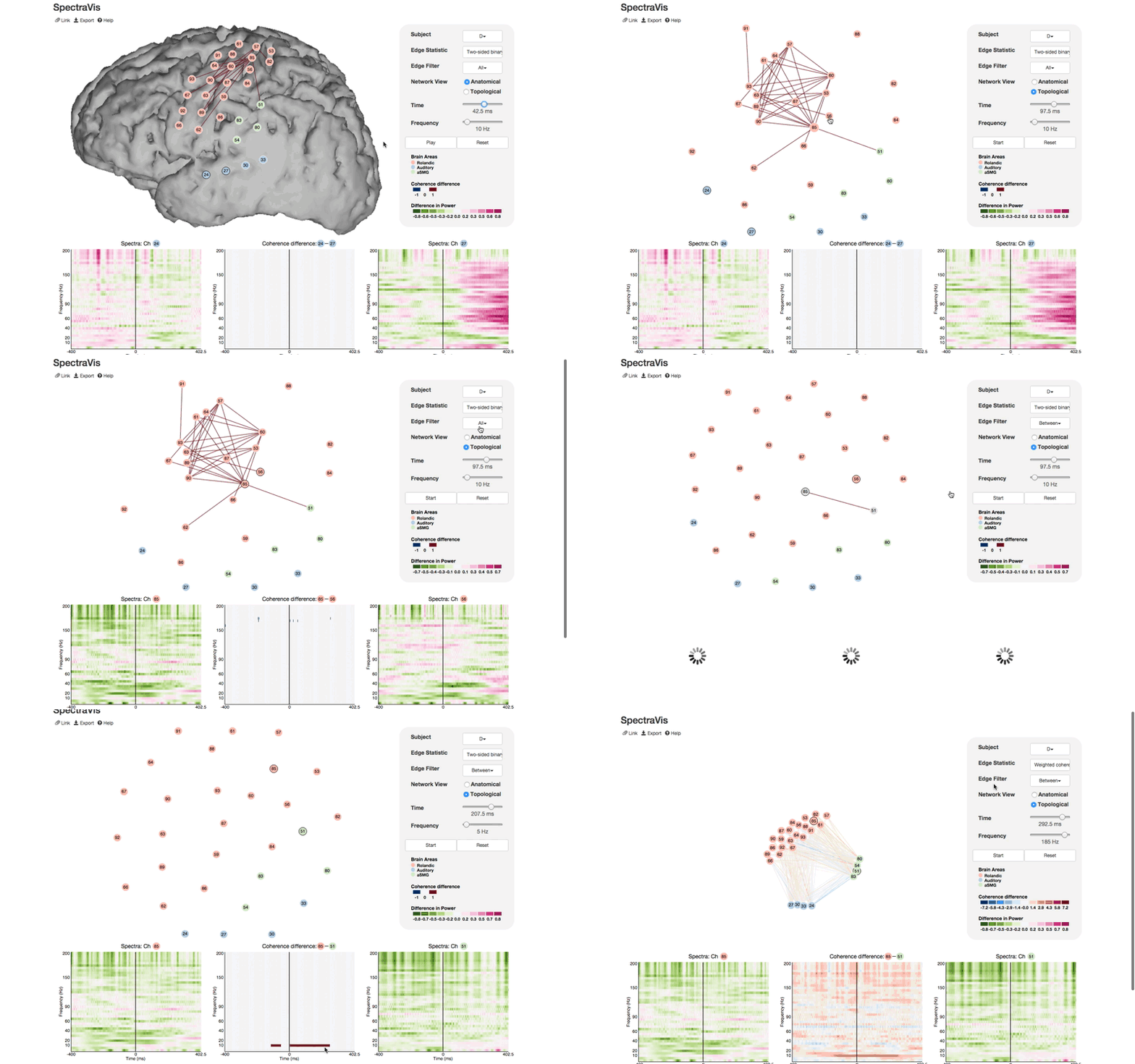
- SpectraVis
- Society for Neuroscience
- Neural network software | Wikipedia
- Neural Engineering Object (Nengo)
- How to Build a Brain: A Neural Architecture for Biological Cognition (Oxford Series on Cognitive Models and Architectures)
The fields of neuroscience and artificial intelligence (AI) have a long and intertwined history. In more recent times, however, communication and collaboration between the two fields has become less commonplace. Neuroscience-Inspired Artificial Intelligence | Demis Hassabis, Dharshan Kumaran, Christopher Summerfield, Matthew Botvinick 11 Jun 2017
Contents
Brain Mapping
Open Source Brain
YouTube search... ...Google search
- Open Source Brain is a resource for sharing and collaboratively developing computational models of neural systems.
The Human Brain Project (HBP)
YouTube search... ...Google search
was a massive, ten-year (€607 million) EU-funded research initiative spanning from 2013 to 2023. While highly controversial early on, it ultimately transformed computational neuroscience by creating digital 3D brain atlases, advancing neuromorphic AI systems like SpiNNaker, and establishing the EBRAINS open research platform. Key themes:
- The 3D Brain Atlas & EBRAINS Legacy: The project’s most enduring milestone is a highly detailed, 3D digital atlas of the human brain, which lives on through the EBRAINS collaborative web infrastructure.
- The 2014 Boycott & Restructuring: Early on, project coordinator Henry Markram’s hyper-ambitious attempt to simulate the entire physical brain on supercomputers sidelined cognitive and behavioral neuroscience, sparking an open letter revolt by over 100 top scientists that forced a complete governance restructure.
- Pioneering Neuromorphic AI: HBP's computing research directly accelerated the development of next-generation brain-inspired computer chips (such as SpiNNaker and SpiNNaker2) and commercial spin-offs like SpiNNcloud.
Six ICT research Platforms form the heart of the HBP infrastructure:
- Neuroinformatics (access to shared brain data)
- Brain Simulation (replication of brain architecture and activity on computers)
- High Performance Analytics and Computing (providing the required computing and analytics capabilities)
- Medical Informatics (access to patient data, identification of disease signatures)
- Neuromorphic Computing (development of brain-inspired computing)
- Neurorobotics (use of robots to test brain simulations)
Virtual Brain
YouTube search... ...Google search
Brain Wave Data Harnessed for Open-Source Brain Model - seeking more accessible ways of understanding a person’s brain activity that can take advantage of the Virtual Brain, a repository of neurological data from a wide range of clinical and experimental sources, including computational models and functional MRI, or fMRI, scans.
Julich-Brain Atlas
YouTube search... ...Google search
- Julich-Brain: A 3D probabilistic atlas of the human brain’s cytoarchitecture | K. Amunts, H. Mohlberg, S. Bludau, and K. Zilles
- Brain Atlases | EBRAINS
a probabilistic map of human brains that accounts for individual differences using a computational framework. Rather than generating a static PDF of a brain map, the Julich-Brain atlas is also dynamic, in that it continuously changes to incorporate more recent brain mapping results. So far, the map has data from over 24,000 thinly sliced sections from 23 postmortem brains covering most years of adulthood at the cellular level. But the atlas can also continuously adapt to progress in mapping technologies to aid brain modeling and simulation, and link to other atlases and alternatives. In other words, rather than “just another” human brain map, the Julich-Brain atlas is its own neuromapping API—one that could unite previous brain-mapping efforts with more modern methods. ... To build their “Google Earth” for the brain, the team hooked up with EBRAINS, a shared computing platform set up by the Human Brain Project to promote collaboration between neuroscience labs in the EU.These Scientists Just Completed a 3D ‘Google Earth’ for the Brain | Shelly Fan - SingularityHub

China's Brain Project
YouTube search... ...Google search

How the Mind's Mistakes Make Humans Creative, Innovative, and Successful | Henning Beck
We learn that boredom awakens the muse, distractions spark creativity, and misjudging time creates valuable memories, among other benefits of our faulty minds.
