Difference between revisions of "Hierarchical Clustering; Agglomerative (HAC) & Divisive (HDC)"
m |
m |
||
| (6 intermediate revisions by the same user not shown) | |||
| Line 2: | Line 2: | ||
|title=PRIMO.ai | |title=PRIMO.ai | ||
|titlemode=append | |titlemode=append | ||
| − | |keywords=artificial, intelligence, machine, learning, models | + | |keywords=ChatGPT, artificial, intelligence, machine, learning, GPT-4, GPT-5, NLP, NLG, NLC, NLU, models, data, singularity, moonshot, Sentience, AGI, Emergence, Moonshot, Explainable, TensorFlow, Google, Nvidia, Microsoft, Azure, Amazon, AWS, Hugging Face, OpenAI, Tensorflow, OpenAI, Google, Nvidia, Microsoft, Azure, Amazon, AWS, Meta, LLM, metaverse, assistants, agents, digital twin, IoT, Transhumanism, Immersive Reality, Generative AI, Conversational AI, Perplexity, Bing, You, Bard, Ernie, prompt Engineering LangChain, Video/Image, Vision, End-to-End Speech, Synthesize Speech, Speech Recognition, Stanford, MIT |description=Helpful resources for your journey with artificial intelligence; videos, articles, techniques, courses, profiles, and tools |
| − | |description=Helpful resources for your journey with artificial intelligence; videos, articles, techniques, courses, profiles, and tools | + | |
| + | <!-- Google tag (gtag.js) --> | ||
| + | <script async src="https://www.googletagmanager.com/gtag/js?id=G-4GCWLBVJ7T"></script> | ||
| + | <script> | ||
| + | window.dataLayer = window.dataLayer || []; | ||
| + | function gtag(){dataLayer.push(arguments);} | ||
| + | gtag('js', new Date()); | ||
| + | |||
| + | gtag('config', 'G-4GCWLBVJ7T'); | ||
| + | </script> | ||
}} | }} | ||
| − | [ | + | [https://www.youtube.com/results?search_query=Hierarchical+Agglomerative+Clustering+HAC Youtube search...] |
| − | [ | + | [https://www.google.com/search?q=Hierarchical+Cluster+Agglomerative+Divisive+HDC+Clustering+HAC+learning+ML ...Google search] |
| − | * [[AI Solver]] | + | * [[AI Solver]] ... [[Algorithms]] ... [[Algorithm Administration|Administration]] ... [[Model Search]] ... [[Discriminative vs. Generative]] ... [[Train, Validate, and Test]] |
| − | + | * [[Embedding]] ... [[Fine-tuning]] ... [[Retrieval-Augmented Generation (RAG)|RAG]] ... [[Agents#AI-Powered Search|Search]] ... [[Clustering]] ... [[Recommendation]] ... [[Anomaly Detection]] ... [[Classification]] ... [[Dimensional Reduction]]. [[...find outliers]] | |
| − | * | ||
| − | |||
| − | |||
* [[Hierarchical Cluster Analysis (HCA)]] | * [[Hierarchical Cluster Analysis (HCA)]] | ||
* [[Hierarchical Temporal Memory (HTM)]] | * [[Hierarchical Temporal Memory (HTM)]] | ||
* [[K-Means]] | * [[K-Means]] | ||
| − | * [ | + | * [https://www.r-bloggers.com/how-to-perform-hierarchical-clustering-using-r/ How to Perform Hierarchical Clustering using R | Perceptive Analytics] |
| − | * [ | + | * [https://www.researchgate.net/publication/315966848_Exploreing_K-Means_with_Internal_Validity_Indexes_for_Data_Clustering_in_Traffic_Management_System Exploreing K-Means with Internal Validity Indexes for Data Clustering in Traffic Management System | S. Nawrin, S. Akhter and M. Rahatur] |
| Line 24: | Line 30: | ||
# Divisive (HDC - DIANA); top-down, first groups all examples into one cluster and then iteratively divides the cluster into a hierarchical tree. | # Divisive (HDC - DIANA); top-down, first groups all examples into one cluster and then iteratively divides the cluster into a hierarchical tree. | ||
| − | + | https://i1.wp.com/r-posts.com/wp-content/uploads/2017/12/Agnes.png | |
{|<!-- T --> | {|<!-- T --> | ||
| Line 36: | Line 42: | ||
== Agglomerative Clustering - Bottom Up == | == Agglomerative Clustering - Bottom Up == | ||
| − | Bottom-up algorithms treat each data point as a single cluster at the outset and then successively merge (or agglomerate) pairs of clusters until all clusters have been merged into a single cluster that contains all data points. Bottom-up hierarchical clustering is therefore called hierarchical agglomerative clustering or HAC. This hierarchy of clusters is represented as a tree (or dendrogram). The root of the tree is the unique cluster that gathers all the samples, the leaves being the clusters with only one sample. [ | + | Bottom-up algorithms treat each data point as a single cluster at the outset and then successively merge (or agglomerate) pairs of clusters until all clusters have been merged into a single cluster that contains all data points. Bottom-up hierarchical clustering is therefore called hierarchical agglomerative clustering or HAC. This hierarchy of clusters is represented as a tree (or dendrogram). The root of the tree is the unique cluster that gathers all the samples, the leaves being the clusters with only one sample. [https://towardsdatascience.com/the-5-clustering-algorithms-data-scientists-need-to-know-a36d136ef68 The 5 Clustering Algorithms Data Scientists Need to Know | Towards Data Science] |
Hierarchical clustering does not require us to specify the number of clusters and we can even select which number of clusters looks best since we are building a tree. Additionally, the algorithm is not sensitive to the choice of distance metric; all of them tend to work equally well whereas with other clustering algorithms, the choice of distance metric is critical. A particularly good use case of hierarchical clustering methods is when the underlying data has a hierarchical structure and you want to recover the hierarchy; other clustering algorithms can’t do this. These advantages of hierarchical clustering come at the cost of lower efficiency, as it has a time complexity of O(n³), unlike the linear complexity of K-Means and GMM. | Hierarchical clustering does not require us to specify the number of clusters and we can even select which number of clusters looks best since we are building a tree. Additionally, the algorithm is not sensitive to the choice of distance metric; all of them tend to work equally well whereas with other clustering algorithms, the choice of distance metric is critical. A particularly good use case of hierarchical clustering methods is when the underlying data has a hierarchical structure and you want to recover the hierarchy; other clustering algorithms can’t do this. These advantages of hierarchical clustering come at the cost of lower efficiency, as it has a time complexity of O(n³), unlike the linear complexity of K-Means and GMM. | ||
Latest revision as of 21:48, 5 March 2024
Youtube search... ...Google search
- AI Solver ... Algorithms ... Administration ... Model Search ... Discriminative vs. Generative ... Train, Validate, and Test
- Embedding ... Fine-tuning ... RAG ... Search ... Clustering ... Recommendation ... Anomaly Detection ... Classification ... Dimensional Reduction. ...find outliers
- Hierarchical Cluster Analysis (HCA)
- Hierarchical Temporal Memory (HTM)
- K-Means
- How to Perform Hierarchical Clustering using R | Perceptive Analytics
- Exploreing K-Means with Internal Validity Indexes for Data Clustering in Traffic Management System | S. Nawrin, S. Akhter and M. Rahatur
Hierarchical clustering algorithms actually fall into 2 categories:
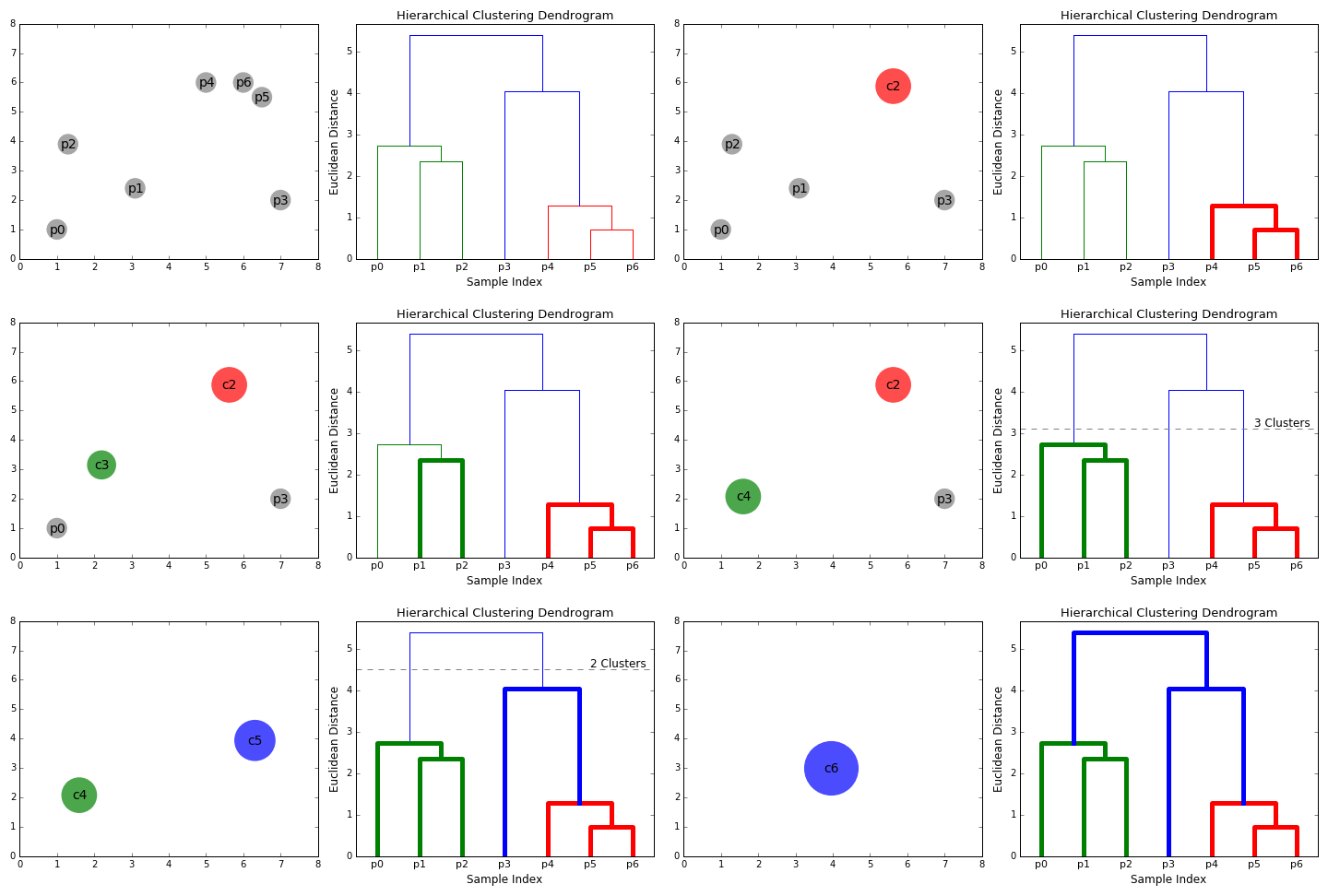
- Agglomerative (HAC - AGNES); bottom-up, first assigns every example to its own cluster, and iteratively merges the closest clusters to create a hierarchical tree.
- Divisive (HDC - DIANA); top-down, first groups all examples into one cluster and then iteratively divides the cluster into a hierarchical tree.

Agglomerative Clustering - Bottom UpBottom-up algorithms treat each data point as a single cluster at the outset and then successively merge (or agglomerate) pairs of clusters until all clusters have been merged into a single cluster that contains all data points. Bottom-up hierarchical clustering is therefore called hierarchical agglomerative clustering or HAC. This hierarchy of clusters is represented as a tree (or dendrogram). The root of the tree is the unique cluster that gathers all the samples, the leaves being the clusters with only one sample. The 5 Clustering Algorithms Data Scientists Need to Know | Towards Data Science Hierarchical clustering does not require us to specify the number of clusters and we can even select which number of clusters looks best since we are building a tree. Additionally, the algorithm is not sensitive to the choice of distance metric; all of them tend to work equally well whereas with other clustering algorithms, the choice of distance metric is critical. A particularly good use case of hierarchical clustering methods is when the underlying data has a hierarchical structure and you want to recover the hierarchy; other clustering algorithms can’t do this. These advantages of hierarchical clustering come at the cost of lower efficiency, as it has a time complexity of O(n³), unlike the linear complexity of K-Means and GMM.
Divisive Clustering = Top Down
|