Difference between revisions of "Digital Twin"
m |
m |
||
| (24 intermediate revisions by the same user not shown) | |||
| Line 2: | Line 2: | ||
|title=PRIMO.ai | |title=PRIMO.ai | ||
|titlemode=append | |titlemode=append | ||
| − | |keywords=artificial, intelligence, machine, learning, models | + | |keywords=ChatGPT, artificial, intelligence, machine, learning, GPT-4, GPT-5, NLP, NLG, NLC, NLU, models, data, singularity, moonshot, Sentience, AGI, Emergence, Moonshot, Explainable, TensorFlow, Google, Nvidia, Microsoft, Azure, Amazon, AWS, Hugging Face, OpenAI, Tensorflow, OpenAI, Google, Nvidia, Microsoft, Azure, Amazon, AWS, Meta, LLM, metaverse, assistants, agents, digital twin, IoT, Transhumanism, Immersive Reality, Generative AI, Conversational AI, Perplexity, Bing, You, Bard, Ernie, prompt Engineering LangChain, Video/Image, Vision, End-to-End Speech, Synthesize Speech, Speech Recognition, Stanford, MIT |description=Helpful resources for your journey with artificial intelligence; videos, articles, techniques, courses, profiles, and tools |
| − | |description=Helpful resources for your journey with artificial intelligence; videos, articles, techniques, courses, profiles, and tools | + | |
| + | <!-- Google tag (gtag.js) --> | ||
| + | <script async src="https://www.googletagmanager.com/gtag/js?id=G-4GCWLBVJ7T"></script> | ||
| + | <script> | ||
| + | window.dataLayer = window.dataLayer || []; | ||
| + | function gtag(){dataLayer.push(arguments);} | ||
| + | gtag('js', new Date()); | ||
| + | |||
| + | gtag('config', 'G-4GCWLBVJ7T'); | ||
| + | </script> | ||
}} | }} | ||
[https://www.youtube.com/results?search_query=digital+twins+learning+artificial+intelligence+ Youtube search...] | [https://www.youtube.com/results?search_query=digital+twins+learning+artificial+intelligence+ Youtube search...] | ||
[https://www.google.com/search?q=digital+twins+learning+deep+machine+learning+ML ...Google search] | [https://www.google.com/search?q=digital+twins+learning+deep+machine+learning+ML ...Google search] | ||
| − | * [[ | + | * [[Telecommunications]] ... [[Computer Networks]] ... [[Telecommunications#5G|5G]] ... [[Satellite#Satellite Communications|Satellite Communications]] ... [[Quantum Communications]] ... [[Agents#Communication | Communication Agents]] ... [[Smart Cities]] ... [[Digital Twin]] ... [[Internet of Things (IoT)]] |
| − | ** [[Operations & Maintenance]] | + | * [[Immersive Reality]] ... [[Metaverse]] ... [[Omniverse]] ... [[Transhumanism]] ... [[Religion]] |
| − | * [[ | + | ** [[Eggplant]] |
| − | * [[Algorithm Administration#Automated Learning|Automated Learning]] | + | * [[Predictive Analytics]] ... [[Operations & Maintenance|Predictive Maintenance]] ... [[Forecasting]] ... [[Market Trading]] ... [[Sports Prediction]] ... [[Marketing]] ... [[Politics]] ... [[Excel#Excel - Forecasting|Excel]] |
| + | * [[Agents]] ... [[Robotic Process Automation (RPA)|Robotic Process Automation]] ... [[Assistants]] ... [[Personal Companions]] ... [[Personal Productivity|Productivity]] ... [[Email]] ... [[Negotiation]] ... [[LangChain]] | ||
| + | * [[Robotics]] ... [[Transportation (Autonomous Vehicles)|Vehicles]] ... [[Autonomous Drones|Drones]] ... [[3D Model]] ... [[Point Cloud]] | ||
| + | * [[Artificial General Intelligence (AGI) to Singularity]] ... [[Inside Out - Curious Optimistic Reasoning| Curious Reasoning]] ... [[Emergence]] ... [[Moonshots]] ... [[Explainable / Interpretable AI|Explainable AI]] ... [[Algorithm Administration#Automated Learning|Automated Learning]] | ||
* [https://azure.microsoft.com/en-us/services/digital-twins/ Azure Digital Twins |] [[Microsoft]] | * [https://azure.microsoft.com/en-us/services/digital-twins/ Azure Digital Twins |] [[Microsoft]] | ||
** [https://azure.microsoft.com/en-us/blog/converging-the-physical-and-digital-with-digital-twins-mixed-reality-and-metaverse-apps/ Converging the physical and digital with digital twins,] [[Immersive Reality | mixed reality]], and [[Metaverse | metaverse]] apps | ** [https://azure.microsoft.com/en-us/blog/converging-the-physical-and-digital-with-digital-twins-mixed-reality-and-metaverse-apps/ Converging the physical and digital with digital twins,] [[Immersive Reality | mixed reality]], and [[Metaverse | metaverse]] apps | ||
| Line 19: | Line 31: | ||
* [[Other Challenges]] in Artificial Intelligence | * [[Other Challenges]] in Artificial Intelligence | ||
* [[Feature Exploration/Learning]] | * [[Feature Exploration/Learning]] | ||
| + | * [[Embodied AI]] | ||
| + | * [[Architectures]] for AI ... [[Generative AI Stack]] ... [[Enterprise Architecture (EA)]] ... [[Enterprise Portfolio Management (EPM)]] ... [[Architecture and Interior Design]] | ||
* [https://sightmachine.com/what-is-digital-twin/ Sight Machine] | * [https://sightmachine.com/what-is-digital-twin/ Sight Machine] | ||
| + | * [https://www.navalnews.com/naval-news/2019/04/us-navy-successfully-tests-new-aegis-virtual-twin-system/ US Navy Successfully Tests New AEGIS Virtual Twin System | Naval News Staff] | ||
| + | * [https://federalnewsnetwork.com/commentary/2024/07/ai-enabled-digital-twins-are-transforming-government-critical-infrastructure/ AI-enabled digital twins are transforming government critical infrastructure | Burnie Legette - Federal News Network] | ||
| + | Digital Twin technology is the concept surrounding the creation of a digital "twin" or replica of a physical asset. Digital twins are interactive, artificial intelligence (AI)-based virtual models that serve as digital replicas of real-life objects and/or environments. The benefits of a Digital Twin is to provide an abstraction layer that allows for applications to interact with a device or devices in a consistent manner. The vision of a digital twin is that it follows the lifecycle of a device and the data associated with the device. Digital Twins will enable features like device simulation during [[development]], integration of [[analytics]] and [[Machine Learning (ML)]] during deployment, and so on. [https://medium.com/@iskerrett/the-reality-of-digital-twins-for-iot-a89f7a51c6fc The Reality of Digital Twins for IoT | Ian Skerrett - Medium] | ||
| − | Digital Twin | + | The Digital Twin can allow companies to have a complete digital footprint of their products from design and [[development]] through the end of the product life cycle. This, in turn, may enable them to understand not only the product as designed but also the system that built the product and how the product is used in the field. With the creation of the digital twin, companies may realize significant value in the areas of speed to market with a new product, improved operations, reduced defects, and emerging new business models to drive revenue. The Digital Twin may enable companies to solve physical issues faster by detecting them sooner, predict outcomes to a much higher degree of accuracy, design and build better products, and, ultimately, better serve their customers. With this type of smart architecture design, companies may realize value and benefits interactively and faster than ever before. [https://www2.deloitte.com/insights/us/en/focus/industry-4-0/digital-twin-technology-smart-factory.html Industry 4.0 and the digital twin | Deloitte Insights] |
| − | + | Digital twins offer a range of benefits across various industries, revolutionizing operations and driving efficiency. Here are some key advantages of using digital twins in industry: | |
| + | |||
| + | * <b>Enhanced Monitoring:</b> Digital twins provide real-time insights into the behavior of physical products or processes, enabling companies to track performance trends, health, and potential failures proactively. | ||
| + | * <b>Cost Reduction:</b> Organizations can reduce costs and minimize potential failure rates through the use of digital twins, leading to more efficient resource utilization and maintenance practices. | ||
| + | * <b>Improved Decision Making:</b> By offering a comprehensive view of asset performance, digital twins empower organizations to make more informed decisions, ultimately leading to improved outcomes. | ||
| + | * <b>Streamlined Design Process:</b> Digital twins facilitate faster product innovation by allowing companies to simulate and test new products before investing in physical prototypes, thus accelerating the design process. | ||
| + | * <b>Predictive Maintenance:</b> With IoT sensors generating real-time data, businesses can proactively analyze information to identify and address system issues before they lead to breakdowns, enhancing production line efficiency and reducing maintenance costs | ||
| + | * <b>Real-time Remote Monitoring:</b> Digital twins enable remote access to monitor and control system performance from anywhere, providing a detailed view of large physical systems that would otherwise be challenging to obtain in real-time. | ||
| + | * <b>Improved Team Collaboration:</b> Automation processes and continuous access to system information enhance team collaboration among technicians, boosting productivity and operational efficiency. | ||
| + | * <b>Data-backed Decision Making:</b> By integrating financial data into virtual representations, businesses can make better financial decisions faster, leveraging real-time data and advanced analytics for improved outcomes. | ||
| + | |||
<img src="https://miro.medium.com/v2/resize:fit:828/0*bfkHZicdnEqzrObh.gif" width="600"> | <img src="https://miro.medium.com/v2/resize:fit:828/0*bfkHZicdnEqzrObh.gif" width="600"> | ||
| Line 110: | Line 137: | ||
{| class="wikitable" style="width: 550px;" | {| class="wikitable" style="width: 550px;" | ||
|| | || | ||
| − | <youtube> | + | <youtube>uDE3tlI_7fs</youtube> |
| − | <b> | + | <b>The Rise of Transformer AI and Digital Twins in Healthcare |
| − | </b><br> | + | </b><br>Transformer AI models are powering a new era of life sciences, helping researchers encode the structure and function of biology and chemistry, making sense of unstructured patient data, and improving detection and diagnosis in #medicalimaging. At the same time, advances in digital twin technology are powering researchers and clinical teams to simulate cells, organs, and surgeries to better understand workflows and improve patient outcomes. |
|} | |} | ||
|<!-- M --> | |<!-- M --> | ||
| Line 161: | Line 188: | ||
{| class="wikitable" style="width: 550px;" | {| class="wikitable" style="width: 550px;" | ||
|| | || | ||
| − | <youtube> | + | <youtube>KHjObXa-gQ4</youtube> |
| − | <b>Introduction | + | <b>IAn Introduction To Intelligent Digital Twins |
| − | </b><br> | + | </b><br>During this informative session, XMPro CEO, Pieter Van Schalkwyk will delve into the concept of Intelligent Digital Twins and discuss how they differ from traditional Digital Twins. This webinar aims to equip professionals across various domains with the knowledge necessary to harness the power of AI, accelerating the adoption and implementation of IDTs in diverse industries. |
|} | |} | ||
|<!-- M --> | |<!-- M --> | ||
| Line 188: | Line 215: | ||
<youtube>oWeAYJ8CN70</youtube> | <youtube>oWeAYJ8CN70</youtube> | ||
<b>The Digital Twin: Realizing Transformation (Introduction) | <b>The Digital Twin: Realizing Transformation (Introduction) | ||
| − | </b><br>At Siemens PLM Connections (May 2017), President and CEO Tony Hemmelgarn discusses the importance of digitalization as an [[Agents|agent]] for business transformation, and explains how leveraging a digital twin for product development, production and market performance is critical to realizing major business improvements and disruptive innovations. | + | </b><br>At Siemens PLM Connections (May 2017), President and CEO Tony Hemmelgarn discusses the importance of digitalization as an [[Agents|agent]] for business transformation, and explains how leveraging a digital twin for product [[development]], production and market performance is critical to realizing major business improvements and disruptive innovations. |
|} | |} | ||
|}<!-- B --> | |}<!-- B --> | ||
| − | = | + | = Nuclear Plasma Control = |
| − | + | The accident at Three Mile Island (TMI), which occurred on March 28, 1979, was a partial meltdown of the nuclear reactor core that resulted from a series of equipment failures and human errors. During the accident, the control room operators received a series of confusing and conflicting signals from the reactor's instruments, which made it difficult for them to understand what was happening and respond effectively. The control room board did not suddenly light up in seconds, but rather displayed a complex and evolving pattern of alarms and indications over a period of several hours. The initial alarm that alerted operators to the problem was a high-pressure indication in the reactor coolant system. Over the next several hours, operators received a series of alarms related to coolant flow, water levels, and reactor temperature, among other factors. The complexity and ambiguity of these signals contributed to delays and errors in the operators' response, ultimately leading to the partial meltdown of the reactor core. The accident at Three Mile Island highlighted the need for improved training, communication, and safety protocols in the nuclear power industry. It also led to significant changes in the regulation and oversight of nuclear power plants, as well as increased public scrutiny and concern about the safety of nuclear energy. | |
| − | * | + | |
| + | Researchers have successfully demonstrated the world's first predictive control of a fusion plasma using a digital twin approach. The key points are: | ||
| + | * Researchers from Kyoto University, the National Institute for Fusion Science, and the Institute of Statistical Mathematics in Japan conducted an experiment to control the electron temperature of a fusion plasma using electron cyclotron resonance heating (ECH), while optimizing the predictive model based on real-time observations of the electron density and temperature profiles. | ||
| + | * This "data assimilation-based control" approach allowed them to bring the electron temperature close to the target while improving the prediction accuracy of the model. This was the first successful demonstration of predictive control of a fusion plasma using a digital twin. | ||
| + | * The digital twin is a virtual replica of the actual fusion plasma that receives real-time data from the experiment. It uses machine learning to anticipate the performance of the physical plasma, allowing researchers to test control strategies without making irreversible changes to the real system. | ||
| + | * This control approach is expected to be fundamental for the advanced control systems needed to realize fusion power generation, such as plasma profile control and avoidance of instabilities. It could also be applied to other complex systems with many uncertain factors, like traffic and water management. | ||
| + | * The research team believes this is an important step towards the advanced control capabilities required for practical fusion power plants. | ||
| − | + | In summary, the search results describe the first successful demonstration of predictive control of a fusion plasma using a digital twin approach, which is a significant milestone towards the realization of practical fusion energy | |
| − | |||
| − | |||
| − | |||
| − | |||
| − | |||
| − | |||
| − | |||
| − | |||
| − | |||
| − | |||
| − | |||
| − | |||
| − | |||
| − | |||
| − | |||
| − | |||
| − | |||
| − | |||
| + | <youtube>RCLzmR4g5-8</youtube> | ||
| + | <youtube>4VD_DLPQJBU</youtube> | ||
= Computerized Maintenance Management (CMM) = | = Computerized Maintenance Management (CMM) = | ||
| Line 237: | Line 254: | ||
|} | |} | ||
|}<!-- B --> | |}<!-- B --> | ||
| + | |||
| + | = Customer Journey = | ||
| + | Gartner defines digital twin of a customer (DToC) as a dynamic virtual mirror representation of a customer that simulates and learns to emulate and anticipate behavior. ... DToC represents a nascent technology that can revolutionize demand forecasting accuracy, vastly improve customer experience and serve as a critical input to enhance the use of AI and machine learning (ML) tools. While 52% of survey respondents viewed AI as an “important and disruptive” technology and 40% gave the same description for digital supply chain twins, only 27% specifically described DToC as an “important and disruptive” technology. [https://chainstoreage.com/gartner-full-value-supply-chain-digital-twins-goes-unrecognized Gartner: Full value of supply chain ‘digital twins’ goes unrecognized | Dan Berthiaume - Chain Store Age] ... 60% are piloting or plan to implement a digital supply chain twin (DSCT), just 27% were also planning to incorporate a digital twin of a customer (DToC) as part of their digital strategy. | ||
| + | |||
| + | <youtube>8aOFeNjl_4o</youtube> | ||
| + | <youtube>K36cB1RyK9o</youtube> | ||
| + | <youtube>LTZolsZfyf0</youtube> | ||
| + | <youtube>6uUC63qD9vE</youtube> | ||
Latest revision as of 14:26, 12 July 2024
Youtube search... ...Google search
- Telecommunications ... Computer Networks ... 5G ... Satellite Communications ... Quantum Communications ... Communication Agents ... Smart Cities ... Digital Twin ... Internet of Things (IoT)
- Immersive Reality ... Metaverse ... Omniverse ... Transhumanism ... Religion
- Predictive Analytics ... Predictive Maintenance ... Forecasting ... Market Trading ... Sports Prediction ... Marketing ... Politics ... Excel
- Agents ... Robotic Process Automation ... Assistants ... Personal Companions ... Productivity ... Email ... Negotiation ... LangChain
- Robotics ... Vehicles ... Drones ... 3D Model ... Point Cloud
- Artificial General Intelligence (AGI) to Singularity ... Curious Reasoning ... Emergence ... Moonshots ... Explainable AI ... Automated Learning
- Azure Digital Twins | Microsoft
- Digital Twin: Bridging the physical-digital divide | IBM
- Prepare for the Impact of Digital Twins | Gartner
- The rise of the Digital Twin: Why the enterprise needs to take notice | Charlie Osborne - ZDNet
- Other Challenges in Artificial Intelligence
- Feature Exploration/Learning
- Embodied AI
- Architectures for AI ... Generative AI Stack ... Enterprise Architecture (EA) ... Enterprise Portfolio Management (EPM) ... Architecture and Interior Design
- Sight Machine
- US Navy Successfully Tests New AEGIS Virtual Twin System | Naval News Staff
- AI-enabled digital twins are transforming government critical infrastructure | Burnie Legette - Federal News Network
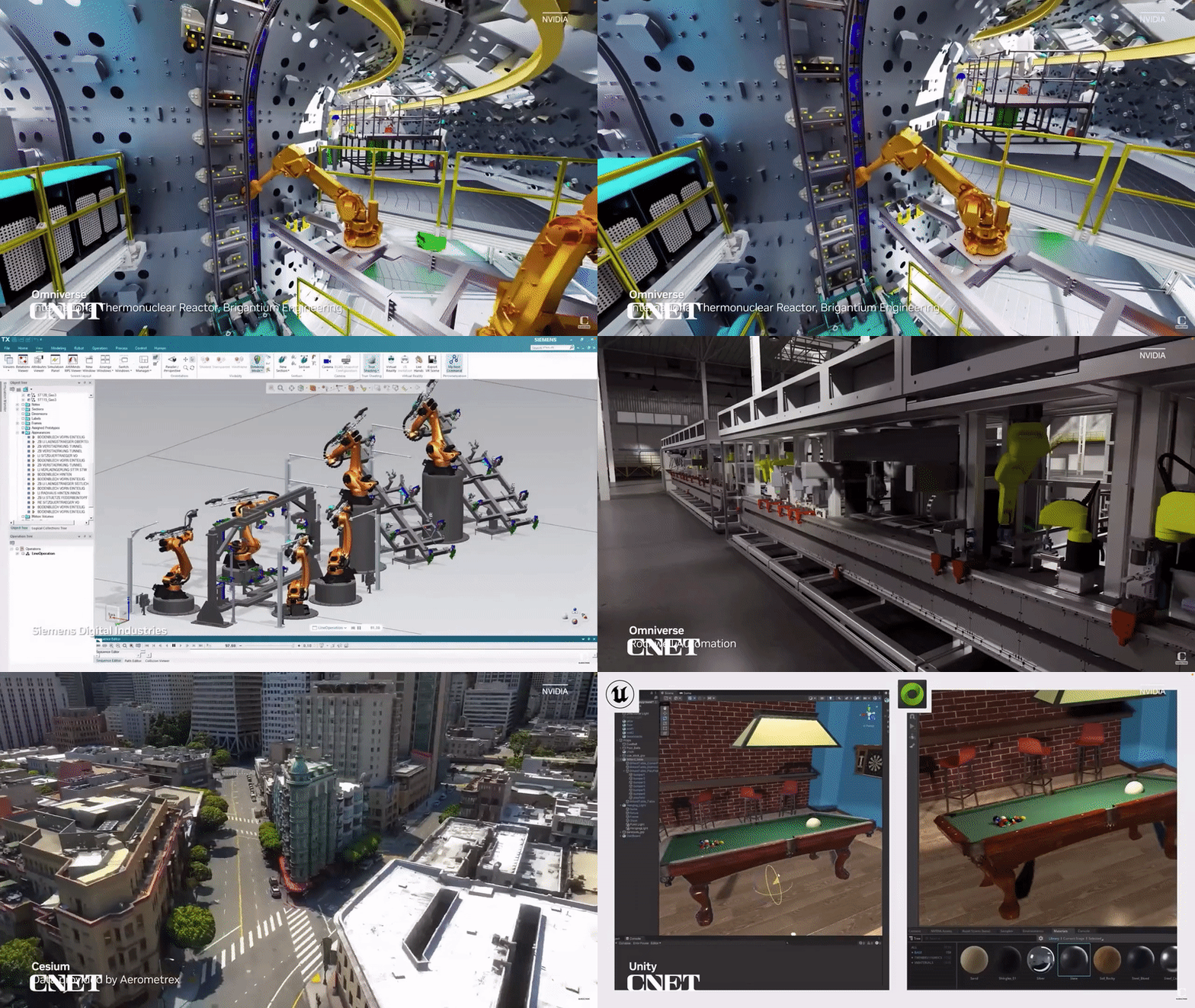
Digital Twin technology is the concept surrounding the creation of a digital "twin" or replica of a physical asset. Digital twins are interactive, artificial intelligence (AI)-based virtual models that serve as digital replicas of real-life objects and/or environments. The benefits of a Digital Twin is to provide an abstraction layer that allows for applications to interact with a device or devices in a consistent manner. The vision of a digital twin is that it follows the lifecycle of a device and the data associated with the device. Digital Twins will enable features like device simulation during development, integration of analytics and Machine Learning (ML) during deployment, and so on. The Reality of Digital Twins for IoT | Ian Skerrett - Medium
The Digital Twin can allow companies to have a complete digital footprint of their products from design and development through the end of the product life cycle. This, in turn, may enable them to understand not only the product as designed but also the system that built the product and how the product is used in the field. With the creation of the digital twin, companies may realize significant value in the areas of speed to market with a new product, improved operations, reduced defects, and emerging new business models to drive revenue. The Digital Twin may enable companies to solve physical issues faster by detecting them sooner, predict outcomes to a much higher degree of accuracy, design and build better products, and, ultimately, better serve their customers. With this type of smart architecture design, companies may realize value and benefits interactively and faster than ever before. Industry 4.0 and the digital twin | Deloitte Insights
Digital twins offer a range of benefits across various industries, revolutionizing operations and driving efficiency. Here are some key advantages of using digital twins in industry:
- Enhanced Monitoring: Digital twins provide real-time insights into the behavior of physical products or processes, enabling companies to track performance trends, health, and potential failures proactively.
- Cost Reduction: Organizations can reduce costs and minimize potential failure rates through the use of digital twins, leading to more efficient resource utilization and maintenance practices.
- Improved Decision Making: By offering a comprehensive view of asset performance, digital twins empower organizations to make more informed decisions, ultimately leading to improved outcomes.
- Streamlined Design Process: Digital twins facilitate faster product innovation by allowing companies to simulate and test new products before investing in physical prototypes, thus accelerating the design process.
- Predictive Maintenance: With IoT sensors generating real-time data, businesses can proactively analyze information to identify and address system issues before they lead to breakdowns, enhancing production line efficiency and reducing maintenance costs
- Real-time Remote Monitoring: Digital twins enable remote access to monitor and control system performance from anywhere, providing a detailed view of large physical systems that would otherwise be challenging to obtain in real-time.
- Improved Team Collaboration: Automation processes and continuous access to system information enhance team collaboration among technicians, boosting productivity and operational efficiency.
- Data-backed Decision Making: By integrating financial data into virtual representations, businesses can make better financial decisions faster, leveraging real-time data and advanced analytics for improved outcomes.
|
|
|
|
|
|
|
|
|
|
|
|
|
|
|
|
|
|
Nuclear Plasma Control
The accident at Three Mile Island (TMI), which occurred on March 28, 1979, was a partial meltdown of the nuclear reactor core that resulted from a series of equipment failures and human errors. During the accident, the control room operators received a series of confusing and conflicting signals from the reactor's instruments, which made it difficult for them to understand what was happening and respond effectively. The control room board did not suddenly light up in seconds, but rather displayed a complex and evolving pattern of alarms and indications over a period of several hours. The initial alarm that alerted operators to the problem was a high-pressure indication in the reactor coolant system. Over the next several hours, operators received a series of alarms related to coolant flow, water levels, and reactor temperature, among other factors. The complexity and ambiguity of these signals contributed to delays and errors in the operators' response, ultimately leading to the partial meltdown of the reactor core. The accident at Three Mile Island highlighted the need for improved training, communication, and safety protocols in the nuclear power industry. It also led to significant changes in the regulation and oversight of nuclear power plants, as well as increased public scrutiny and concern about the safety of nuclear energy.
Researchers have successfully demonstrated the world's first predictive control of a fusion plasma using a digital twin approach. The key points are:
- Researchers from Kyoto University, the National Institute for Fusion Science, and the Institute of Statistical Mathematics in Japan conducted an experiment to control the electron temperature of a fusion plasma using electron cyclotron resonance heating (ECH), while optimizing the predictive model based on real-time observations of the electron density and temperature profiles.
- This "data assimilation-based control" approach allowed them to bring the electron temperature close to the target while improving the prediction accuracy of the model. This was the first successful demonstration of predictive control of a fusion plasma using a digital twin.
- The digital twin is a virtual replica of the actual fusion plasma that receives real-time data from the experiment. It uses machine learning to anticipate the performance of the physical plasma, allowing researchers to test control strategies without making irreversible changes to the real system.
- This control approach is expected to be fundamental for the advanced control systems needed to realize fusion power generation, such as plasma profile control and avoidance of instabilities. It could also be applied to other complex systems with many uncertain factors, like traffic and water management.
- The research team believes this is an important step towards the advanced control capabilities required for practical fusion power plants.
In summary, the search results describe the first successful demonstration of predictive control of a fusion plasma using a digital twin approach, which is a significant milestone towards the realization of practical fusion energy
Computerized Maintenance Management (CMM)
|
|
Customer Journey
Gartner defines digital twin of a customer (DToC) as a dynamic virtual mirror representation of a customer that simulates and learns to emulate and anticipate behavior. ... DToC represents a nascent technology that can revolutionize demand forecasting accuracy, vastly improve customer experience and serve as a critical input to enhance the use of AI and machine learning (ML) tools. While 52% of survey respondents viewed AI as an “important and disruptive” technology and 40% gave the same description for digital supply chain twins, only 27% specifically described DToC as an “important and disruptive” technology. Gartner: Full value of supply chain ‘digital twins’ goes unrecognized | Dan Berthiaume - Chain Store Age ... 60% are piloting or plan to implement a digital supply chain twin (DSCT), just 27% were also planning to incorporate a digital twin of a customer (DToC) as part of their digital strategy.
