Difference between revisions of "Best Practices"
m |
m |
||
| (13 intermediate revisions by the same user not shown) | |||
| Line 2: | Line 2: | ||
|title=PRIMO.ai | |title=PRIMO.ai | ||
|titlemode=append | |titlemode=append | ||
| − | |keywords=artificial, intelligence, machine, learning, models | + | |keywords=ChatGPT, artificial, intelligence, machine, learning, GPT-4, GPT-5, NLP, NLG, NLC, NLU, models, data, singularity, moonshot, Sentience, AGI, Emergence, Moonshot, Explainable, TensorFlow, Google, Nvidia, Microsoft, Azure, Amazon, AWS, Hugging Face, OpenAI, Tensorflow, OpenAI, Google, Nvidia, Microsoft, Azure, Amazon, AWS, Meta, LLM, metaverse, assistants, agents, digital twin, IoT, Transhumanism, Immersive Reality, Generative AI, Conversational AI, Perplexity, Bing, You, Bard, Ernie, prompt Engineering LangChain, Video/Image, Vision, End-to-End Speech, Synthesize Speech, Speech Recognition, Stanford, MIT |description=Helpful resources for your journey with artificial intelligence; videos, articles, techniques, courses, profiles, and tools |
| − | |description=Helpful resources for your journey with artificial intelligence; videos, articles, techniques, courses, profiles, and tools | + | |
| + | <!-- Google tag (gtag.js) --> | ||
| + | <script async src="https://www.googletagmanager.com/gtag/js?id=G-4GCWLBVJ7T"></script> | ||
| + | <script> | ||
| + | window.dataLayer = window.dataLayer || []; | ||
| + | function gtag(){dataLayer.push(arguments);} | ||
| + | gtag('js', new Date()); | ||
| + | |||
| + | gtag('config', 'G-4GCWLBVJ7T'); | ||
| + | </script> | ||
}} | }} | ||
[https://www.youtube.com/results?search_query=ai+Best+Practice YouTube search...] | [https://www.youtube.com/results?search_query=ai+Best+Practice YouTube search...] | ||
| Line 11: | Line 20: | ||
[https://www.bing.com/news/search?q=ai+Best+Practice&qft=interval%3d%228%22 ...Bing News] | [https://www.bing.com/news/search?q=ai+Best+Practice&qft=interval%3d%228%22 ...Bing News] | ||
| + | * [[Strategy & Tactics]] ... [[Project Management]] ... [[Best Practices]] ... [[Checklists]] ... [[Project Check-in]] ... [[Evaluation]] ... [[Evaluation - Measures|Measures]] | ||
* [[Leadership]] | * [[Leadership]] | ||
| − | * [[ | + | * [[Risk, Compliance and Regulation]] ... [[Ethics]] ... [[Privacy]] ... [[Law]] ... [[AI Governance]] ... [[AI Verification and Validation]] |
| − | + | * [[Data Science]] ... [[Data Governance|Governance]] ... [[Data Preprocessing|Preprocessing]] ... [[Feature Exploration/Learning|Exploration]] ... [[Data Interoperability|Interoperability]] ... [[Algorithm Administration#Master Data Management (MDM)|Master Data Management (MDM)]] ... [[Bias and Variances]] ... [[Benchmarks]] ... [[Datasets]] | |
| − | + | * [https://developers.google.com/machine-learning/guides/rules-of-ml Rules of Machine Learning: Best Practices for ML Engineering | Martin Zinkevich - ][[Google]] | |
| − | + | * [https://cloud.google.com/solutions/machine-learning/best-practices-for-ml-performance-cost Best practices for performance and cost optimization for machine learning |] [[Google]] | |
| − | |||
| − | * [[Data Governance]] | ||
| − | |||
| − | |||
| − | |||
| − | * [ | ||
| − | * [ | ||
{|<!-- T --> | {|<!-- T --> | ||
| Line 103: | Line 106: | ||
<youtube>33EiOfCRpSQ</youtube> | <youtube>33EiOfCRpSQ</youtube> | ||
<b>Best Practices for Verification and Validation | <b>Best Practices for Verification and Validation | ||
| − | </b><br>In this webinar you will learn techniques and practices in Model-Based Design to verify and validate software designs and embedded code using MathWorks tools. We will address requirements driven [[development]], model coverage testing, and static code analysis of embedded software. About the Presenters: Nishaat Vasi is a product marketing manager at MathWorks. Since joining MathWorks in 2007, Nishaat has partnered with customers involved in high-integrity applications to promote the adoption of MathWorks tools for embedded software verification. He holds an M.S. in electrical engineering from University of Massachusetts and a B.E. in electronics engineering from University of Mumbai. Jay Abraham is a product marketing manager at MathWorks. His area of expertise is in software tools for the verification of critical embedded applications. He has over 20 years of software and hardware design experience. Jay has an M.S. in computer engineering from Syracuse University and a B.S. in electrical engineering from Boston University. See what's new in the latest release of MATLAB and Simulink: | + | </b><br>In this webinar you will learn techniques and practices in Model-Based Design to verify and validate software designs and embedded code using MathWorks tools. We will address requirements driven [[development]], model coverage testing, and static code analysis of embedded software. About the Presenters: Nishaat Vasi is a product marketing manager at MathWorks. Since joining MathWorks in 2007, Nishaat has partnered with customers involved in high-integrity applications to promote the adoption of MathWorks tools for embedded software verification. He holds an M.S. in electrical engineering from University of Massachusetts and a B.E. in electronics engineering from University of Mumbai. Jay Abraham is a product marketing manager at MathWorks. His area of expertise is in software tools for the verification of critical embedded applications. He has over 20 years of software and hardware design experience. Jay has an M.S. in computer engineering from Syracuse University and a B.S. in electrical engineering from Boston University. See what's new in the latest release of MATLAB and Simulink: https://goo.gl/3MdQK1 |
| − | Download a trial: | + | Download a trial: https://goo.gl/PSa78r |
|} | |} | ||
|}<!-- B --> | |}<!-- B --> | ||
| − | |||
| − | |||
| − | |||
| − | |||
| − | |||
| − | |||
| − | |||
| − | |||
| − | |||
| − | |||
| − | |||
| − | |||
| − | |||
| − | |||
| − | |||
| − | |||
| − | |||
| − | |||
| − | |||
| − | |||
| − | |||
| − | |||
| − | |||
| − | |||
| − | |||
| − | |||
| − | |||
| − | |||
| − | |||
| − | |||
| − | |||
| − | |||
| − | |||
| − | |||
| − | |||
| − | |||
| − | |||
| − | |||
| − | |||
| − | |||
| − | |||
= Heuristics = | = Heuristics = | ||
| Line 158: | Line 120: | ||
<youtube>ReFqFPJHLhA</youtube> | <youtube>ReFqFPJHLhA</youtube> | ||
<b>What Are Heuristics? | <b>What Are Heuristics? | ||
| − | </b><br>We all use heuristics to make everyday decisions — but sometimes they blind us to the truth. So we need to do something that doesn’t come easy: accept that our ideas might be wrong. SUBSCRIBE: | + | </b><br>We all use heuristics to make everyday decisions — but sometimes they blind us to the truth. So we need to do something that doesn’t come easy: accept that our ideas might be wrong. SUBSCRIBE: https://bit.ly/2dUx6wg LEARN MORE: Behavioral Economics (video series): Join Prof. Antony Davies of Duquesne University and Erika Davies of George Mason University as they take you on a crash course of behavioral economics, discussing topics like rational choice, heuristics, nudging, and public choice economics. |
|} | |} | ||
|<!-- M --> | |<!-- M --> | ||
| Line 184: | Line 146: | ||
<b>The Heuristics Revolution – Gerd Gigerenzer at Summer Institute 2018 | <b>The Heuristics Revolution – Gerd Gigerenzer at Summer Institute 2018 | ||
</b><br>Decision problems come in two kinds: risk and uncertainty. Risk applies to situations that are well structured and stable, such as gambles, lotteries, and cancer screening, and has been tamed by the probabilistic revolution in the sciences since the beginning of the 17th century. Uncertainty applies to situations that are ill structured and instable, such as human interaction, investment, and business. Although this is an old distinction, most economists and psychologists have ignored it and used the probability theory as the sole tool for dealing with both. Part of the problem was that no theory of decision-making under uncertainty existed until recently. Based on Herbert Simon’s work, we are now developing such a theory of intelligent heuristics that are able to deal with situations of uncertainty. The science of heuristics addresses three questions. The first is descriptive: What are the heuristics in the adaptive toolbox of a species, an organization, or an individual, and how do people choose between heuristics? The second is normative: In which situations is a heuristic better than a complex strategy? This question is known as the study of the ecological rationality of heuristics, which proceeds using analysis and simulation. The third question is one of intuitive design: How can systems be designed that help experts and laypeople make better decisions, be it in developing simple rules for safer financial regulation or improving medical diagnosis? The methodological tools are threefold: formal models of heuristics (instead of vague labels such as “System 1”), competitive testing of heuristics against complex strategies (instead of null hypothesis testing), and tests of the predictive power of heuristics (instead of data fitting). The heuristic revolution complements the probabilistic revolution and overcomes the earlier misconception of heuristics as biases. | </b><br>Decision problems come in two kinds: risk and uncertainty. Risk applies to situations that are well structured and stable, such as gambles, lotteries, and cancer screening, and has been tamed by the probabilistic revolution in the sciences since the beginning of the 17th century. Uncertainty applies to situations that are ill structured and instable, such as human interaction, investment, and business. Although this is an old distinction, most economists and psychologists have ignored it and used the probability theory as the sole tool for dealing with both. Part of the problem was that no theory of decision-making under uncertainty existed until recently. Based on Herbert Simon’s work, we are now developing such a theory of intelligent heuristics that are able to deal with situations of uncertainty. The science of heuristics addresses three questions. The first is descriptive: What are the heuristics in the adaptive toolbox of a species, an organization, or an individual, and how do people choose between heuristics? The second is normative: In which situations is a heuristic better than a complex strategy? This question is known as the study of the ecological rationality of heuristics, which proceeds using analysis and simulation. The third question is one of intuitive design: How can systems be designed that help experts and laypeople make better decisions, be it in developing simple rules for safer financial regulation or improving medical diagnosis? The methodological tools are threefold: formal models of heuristics (instead of vague labels such as “System 1”), competitive testing of heuristics against complex strategies (instead of null hypothesis testing), and tests of the predictive power of heuristics (instead of data fitting). The heuristic revolution complements the probabilistic revolution and overcomes the earlier misconception of heuristics as biases. | ||
| + | |} | ||
| + | |}<!-- B --> | ||
| + | |||
| + | = Pareto = | ||
| + | [https://www.youtube.com/results?search_query=Pareto+Principle+artificial+intelligence+Deep+Machine+Learning+AI YouTube search...] | ||
| + | [https://www.google.com/search?q=Pareto+Principle+artificial+intelligence+Deep+Machine+Learning+AI ...Google search] | ||
| + | |||
| + | * [https://en.wikipedia.org/wiki/Pareto_principle Pareto Principle | Wikipedia] | ||
| + | * [https://en.wikipedia.org/wiki/Pareto_distribution Pareto Distribution | Wikipedia] | ||
| + | * [https://en.wikipedia.org/wiki/Pareto_chart Pareto Chart | Wikipedia] | ||
| + | * [https://en.wikipedia.org/wiki/Pareto_priority_index https://en.wikipedia.org/wiki/Pareto_priority_index Pareto Priority Index | Wikipedia] | ||
| + | * [https://hbr.org/2017/02/ai-is-going-to-change-the-8020-rule AI Is Going to Change the 80/20 Rule | Michael Schrage - Harvard Business Review] | ||
| + | * [https://vigir.missouri.edu/~gdesouza/Research/Conference_CDs/IEEE_SSCI_2007/CI%20and%20Games%20-%20CIG%202007/data/papers/CIG/S002P003.pdf Pareto Evolution and Co-Evolution in Cognitive Neural Agents Synthesis for Tic-Tac-Toe | Y. Yau, J. Teo and P. Anthony] | ||
| + | * [https://www.aaai.org/Papers/JAIR/Vol21/JAIR-2104.pdf Competitive Coevolution through Evolutionary Complexification | Kenneth O. Stanley and Risto Miikkulainen] | ||
| + | * [https://www.sciencedirect.com/science/article/abs/pii/S0952197601000367 A Pareto-optimal genetic algorithm for warehouse multi-objective optimization | P.N. Poulos, G.G. Rigatos, S.G. Tzafestas, and A.K. Koukos - ScienceDirect] | ||
| + | * [https://www.kdnuggets.com/2019/03/pareto-principle-data-scientists.html The Pareto Principle for Data Scientists | Pradeep Gulipalli - Tiger Analytics KDnuggets] | ||
| + | * [https://medium.com/@mittajithendra46/pareto-distribution-to-normal-distribution-24cf3657a551 Pareto Distribution to Normal Distribution | result of strain - Medium] | ||
| + | * [https://resumelab.com/career-advice/pareto-principle Pareto Principle & the 80/20 Rule (Updated for 2020) | Maciej Duszynski - ResumeLab] | ||
| + | * [https://qctraininginc.com/7-basic-quality-tools-the-pareto-chart/ 7 Quality Tools – The Pareto Chart | Steven Bonacorsi - QC Training Services, Inc.] | ||
| + | * [https://arxiv.org/abs/2006.10782 AI Feynman 2.0: Pareto-optimal symbolic regression exploiting graph modularity | S. Udrescu, A. Tan, J. Feng, O. Neto, T. Wu, and M. Tegmark] | ||
| + | |||
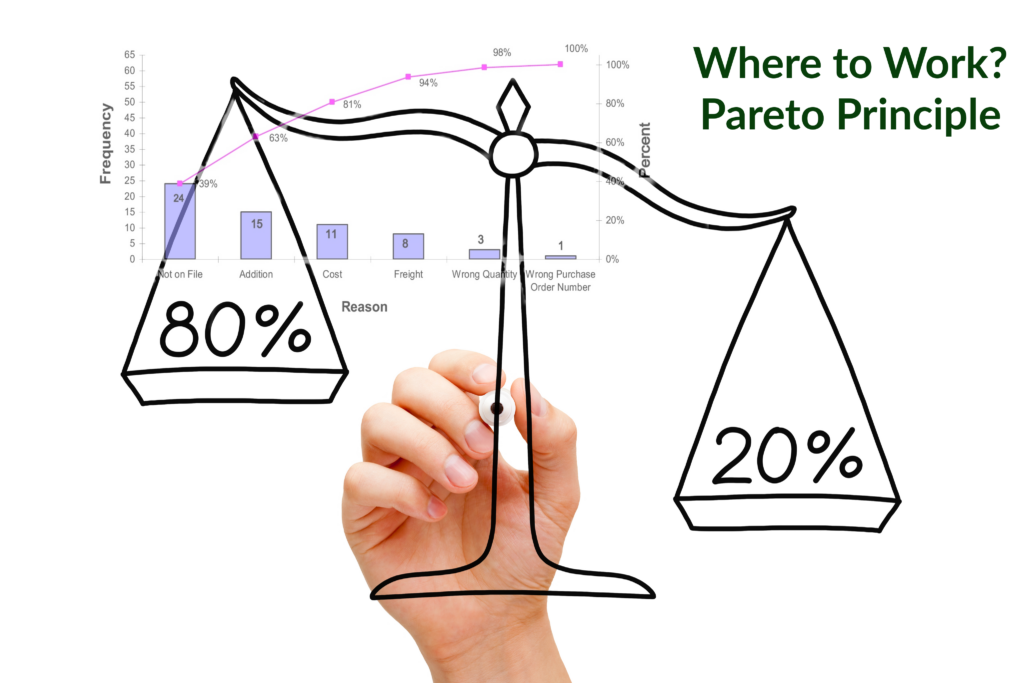
| + | If we consider the <b>Pareto Principle</b> when leveraging AI, we would employ human skills such as strategy, creativity, and collaboration for the <b>20 percent of tasks that drive 80 percent of business impact</b>. Then, apply AI to the 80 percent of tasks that are routine-oriented and structured, making them ideal for automation. [https://www.marchex.com/blog/artificial-intelligence-jobs-and-the-pareto-principle/#:~:text=If%20we%20consider%20the%20Pareto,making%20them%20ideal%20for%20automation. Artificial Intelligence, jobs and the Pareto Principle | Erin Murphy - Marchex] | ||
| + | |||
| + | <img src="https://qctraininginc.com/wp-content/uploads/80_20-Rule-Pareto-1024x683.png" width="800"> | ||
| + | |||
| + | {|<!-- T --> | ||
| + | | valign="top" | | ||
| + | {| class="wikitable" style="width: 550px;" | ||
| + | || | ||
| + | <youtube>AabUVkYsV2s</youtube> | ||
| + | <b>COVID-19 | ||
| + | </b><br>nETSETOS This video describes Pareto Distribution with given topics:- - 80-20 rule with graph - Parameter of Pareto Distribution - Application of Pareto Principle' - COVID - 19 Analysis with Pareto - How to Plot Pareto On [[Jupyter]] - Testing Pareto with the help of QQPlot | ||
| + | |} | ||
| + | |<!-- M --> | ||
| + | | valign="top" | | ||
| + | {| class="wikitable" style="width: 550px;" | ||
| + | || | ||
| + | <youtube>pkJkHB_c3nA</youtube> | ||
| + | <b>AI for physics & physics for AI | ||
| + | </b><br>Max Tegmark, MIT | ||
| + | Abstract: After briefly reviewing how machine learning is becoming ever-more widely used in physics, I explore how ideas and methods from physics can help improve machine learning, focusing on automated discovery of mathematical formulas from data. I present a method for unsupervised learning of equations of motion for objects in raw and optionally distorted unlabeled video. I also describe progress on symbolic regression, i.e., finding a symbolic expression that matches data from an unknown function. Although this problem is likely to be NP-hard in general, functions of practical interest often exhibit symmetries, separability, compositionality and other simplifying properties. In this spirit, we have developed a recursive multidimensional symbolic regression algorithm that combines neural network fitting with a suite of physics-inspired techniques that discover and exploit these simplifying properties, enabling significant improvement of state-of-the-art performance. | ||
| + | Related papers: AI Feynman: a Physics-Inspired Method for Symbolic Regression - https://arxiv.org/abs/1905.11481 AI Feynman 2.0: Pareto-optimal symbolic regression exploiting graph modularity - https://arxiv.org/abs/2006.10782 Symbolic Pregression: Discovering Physical Laws from Raw Distorted Video - https://arxiv.org/abs/2005.11212 | ||
|} | |} | ||
|}<!-- B --> | |}<!-- B --> | ||
Latest revision as of 05:48, 30 April 2024
YouTube search... ... Quora search ...Google search ...Google News ...Bing News
- Strategy & Tactics ... Project Management ... Best Practices ... Checklists ... Project Check-in ... Evaluation ... Measures
- Leadership
- Risk, Compliance and Regulation ... Ethics ... Privacy ... Law ... AI Governance ... AI Verification and Validation
- Data Science ... Governance ... Preprocessing ... Exploration ... Interoperability ... Master Data Management (MDM) ... Bias and Variances ... Benchmarks ... Datasets
- Rules of Machine Learning: Best Practices for ML Engineering | Martin Zinkevich - Google
- Best practices for performance and cost optimization for machine learning | Google
|
|
|
|
|
|
|
|
|
Heuristics
|
|
|
|
Pareto
YouTube search... ...Google search
- Pareto Principle | Wikipedia
- Pareto Distribution | Wikipedia
- Pareto Chart | Wikipedia
- https://en.wikipedia.org/wiki/Pareto_priority_index Pareto Priority Index | Wikipedia
- AI Is Going to Change the 80/20 Rule | Michael Schrage - Harvard Business Review
- Pareto Evolution and Co-Evolution in Cognitive Neural Agents Synthesis for Tic-Tac-Toe | Y. Yau, J. Teo and P. Anthony
- Competitive Coevolution through Evolutionary Complexification | Kenneth O. Stanley and Risto Miikkulainen
- A Pareto-optimal genetic algorithm for warehouse multi-objective optimization | P.N. Poulos, G.G. Rigatos, S.G. Tzafestas, and A.K. Koukos - ScienceDirect
- The Pareto Principle for Data Scientists | Pradeep Gulipalli - Tiger Analytics KDnuggets
- Pareto Distribution to Normal Distribution | result of strain - Medium
- Pareto Principle & the 80/20 Rule (Updated for 2020) | Maciej Duszynski - ResumeLab
- 7 Quality Tools – The Pareto Chart | Steven Bonacorsi - QC Training Services, Inc.
- AI Feynman 2.0: Pareto-optimal symbolic regression exploiting graph modularity | S. Udrescu, A. Tan, J. Feng, O. Neto, T. Wu, and M. Tegmark
If we consider the Pareto Principle when leveraging AI, we would employ human skills such as strategy, creativity, and collaboration for the 20 percent of tasks that drive 80 percent of business impact. Then, apply AI to the 80 percent of tasks that are routine-oriented and structured, making them ideal for automation. Artificial Intelligence, jobs and the Pareto Principle | Erin Murphy - Marchex
|
|
