Overfitting Challenge
Youtube search... ...Google search
Overfitting is a problem in machine learning in general, not just in neural networks. The problem is inherent in the way machine learning models are developed: A set of "training data" is used to "train" the model. The goal is to have a model that can then be used on data that hasn't been seen before. Over-fitting refers to the problem of having the model trained to work so well on the training data that it starts to work more poorly on data it hasn't seen before. There are a number of techniques to mitigate or prevent over-fitting. | Deep Learning Course Wiki
- Bias is the simplifying assumptions made by the model to make the target function easier to approximate.
- Variance is the amount that the estimate of the target function will change given different training data.
Trade-off is tension between the error introduced by the bias and the variance. Jason Brownlee
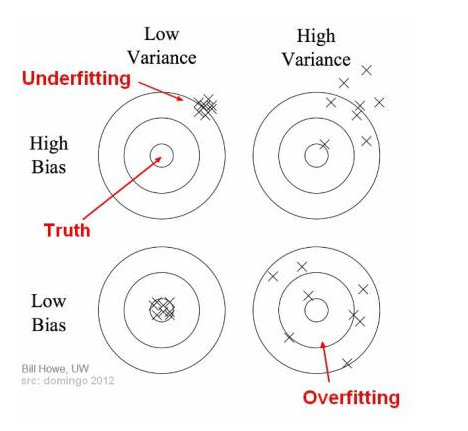
Whenever we discuss model prediction, it’s important to understand prediction errors (bias and variance). There is a tradeoff between a model’s ability to minimize bias and variance... To build a good model, we need to find a good balance between bias and variance such that it minimizes the total error.Understanding the Bias-Variance Tradeoff | Seema Singh
Good practices for addressing overfitting:
- add more data
- use Batch Norm(alization) & Standardization
- use architectures that generalize well
- reduce architecture complexity
- add Regularization
- L1 and L2 Regularization - update the general cost function by adding another term known as the regularization term.
- Dropout - at every iteration, it randomly selects some nodes and temporarily removes the nodes (along with all of their incoming and outgoing connections)
- Data Augmentation
- Early Stopping
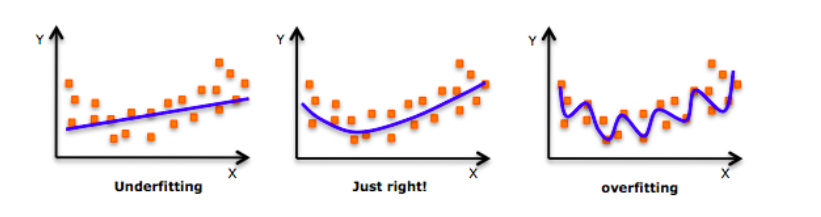
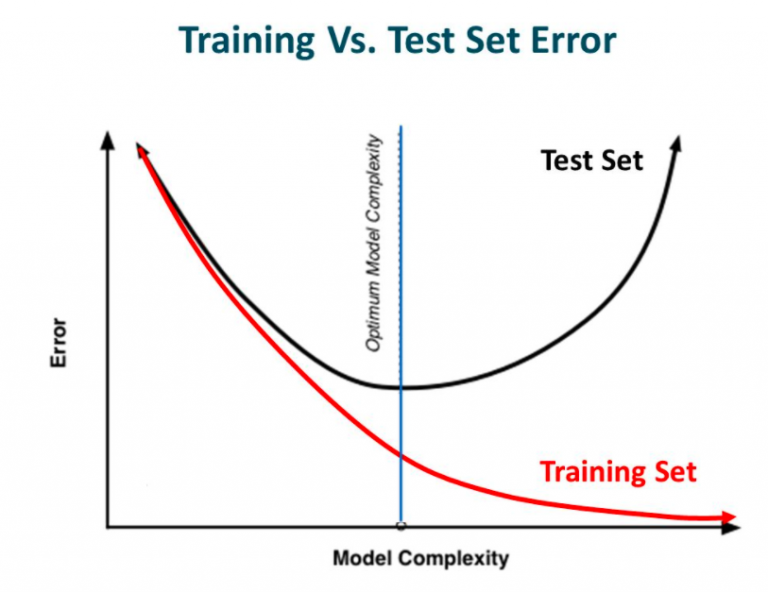
How good is your fit? - Ep. 21 (Deep Learning SIMPLIFIED)
Episode 21 of Deep Learning SIMPLIFIED on judging how good a model's fit is.
Overfitting, Underfitting, and Model Capacity
Leo Isikdogan on overfitting, underfitting and model capacity.
Overfitting
ritvikmath explains overfitting.
Neural Networks Demystified [Part 7: Overfitting, Testing, and Regularization]
Welch Labs on overfitting, testing and regularization (Neural Networks Demystified part 7).
What is R Squared?
ritvikmath explains R squared.
Machine Learning Fundamentals: Bias and Variance
StatQuest explains bias and variance.
Regularization Part 1: Ridge (L2) Regression
StatQuest explains ridge (L2) regression (regularization part 1).