Inverse Reinforcement Learning (IRL)
YouTube ... Quora ...Google search ...Google News ...Bing News
Overview
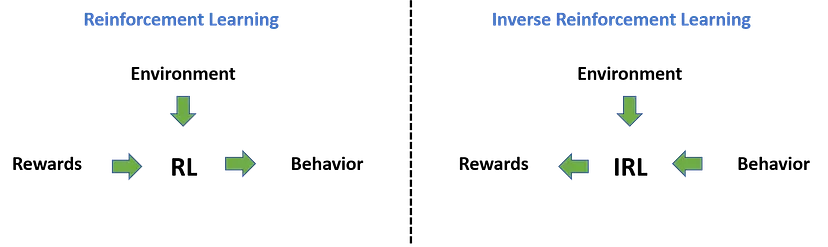
Inverse reinforcement learning (IRL) is the field of learning an Agent's objectives, values, or rewards by observing its behavior. While standard Reinforcement Learning (RL) assumes a known reward function and seeks to find an optimal policy to maximize cumulative rewards, IRL addresses the inverse problem: given a set of expert demonstrations, how can we infer the underlying reward function that the expert is optimizing? This "reward function inference" problem is critical because defining explicit reward functions for complex, real-world tasks is often intractable or prone to human error.
Core Algorithms
IRL methodologies have evolved to address the ambiguity of the reward function, where many different reward functions could explain the same observed behavior.
- Apprenticeship Learning: Focuses on finding a policy that performs as well as the expert by matching feature expectations.
- Maximum Entropy (MaxEnt) IRL: Addresses the ambiguity problem by assuming the expert acts with bounded rationality, choosing trajectories with a probability proportional to the exponent of their reward (Boltzmann distribution).
- Adversarial IRL (AIRL): A modern framework that leverages the GAN (Generative Adversarial Network) architecture, where a discriminator learns to distinguish between expert trajectories and Agent-generated trajectories, effectively acting as a learned reward function.
Practical Applications
The ability to infer intent from observation has significant implications for modern robotics and automation:
- Autonomous Vehicle Trajectory Planning: IRL allows vehicles to learn nuanced driving behaviors—such as merging, yielding, and lane changing—by observing human drivers, rather than relying on hand-coded rules.
- Human-Robot Interaction: By inferring the preferences and intent of human users, robots can adapt their behavior to be more collaborative, safe, and intuitive in shared workspaces.
Foundational Theory
|
|
Advanced Algorithms
|
|
Practical Implementations
|
|