Data Flow Graph (DFG)
Jump to navigation
Jump to search
YouTube search... ...Google search
- Decentralized: Federated & Distributed ... Blockchain ... NFT ... Hierarchical ... Tree-based ... DDRL ... DFG ... DAG
- Analytics Advisor ... Visualization ... Graphical Tools ... Diagrams & Business Analysis ... Requirements ... Loop ... Bayes ... Network Pattern
- TensorBoard
- Graph Convolutional Network (GCN), Graph Neural Networks (Graph Nets), Geometric Deep Learning
- Visualizing Dataflow Graphs of Deep Learning Models in TensorFlow | K. Wongsuphasawat, D. Smilkov, J. Wexler, J. Wilson, D. Mané, D. Fritz, D. Krishnan, F. B. Viégas, & M. Wattenberg - UW Interactive Data Lab
A data-flow graph (DFG) is a graph which represents a data dependencies between a number of operations. Any algorithm consists of a number of ordered operations.
- Node: In TensorFlow, each node represents the instantion of an operation. Each operation has >= inputs and >= 0 outputs.
- Edges: In TensorFlow, there are two types of edge:
- Normal Edges: They are carriers of data structures (tensors), where an output of one operation (from one node) becomes the input for another operation.
- Special Edges: These edges are not data carriers between the output of a node (operator) and the input of another node. A special edge indicates a control dependency between two nodes. Let's suppose we have two nodes A and B and a special edges connecting A to B; it means that B will start its operation only when the operation in A ends. Special edges are used in Data Flow Graph to set the happens-before relationship between operations on the tensors.
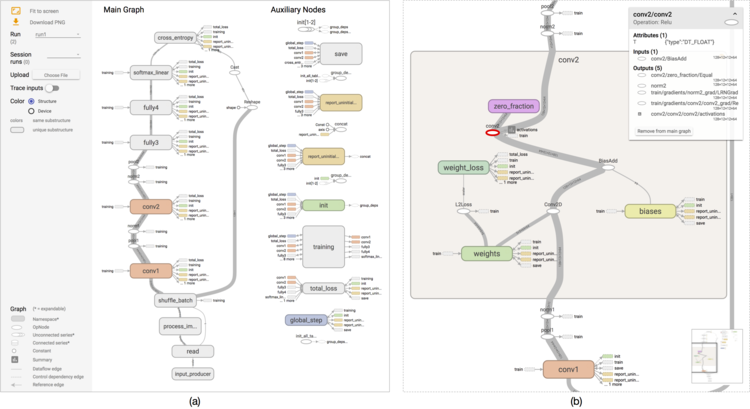
Visualizing Dataflow Graphs of Deep Learning Models in TensorFlow (VAST 2017 Best Paper)
VAST 2017 best paper on visualizing the dataflow graphs of TensorFlow deep learning models.
Real-time Twitter Sentiment Analytics with TensorFlow and Spring Cloud Dataflow
Real-time Twitter sentiment analytics with TensorFlow and Spring Cloud Data Flow.