YouTube search...
...Google search
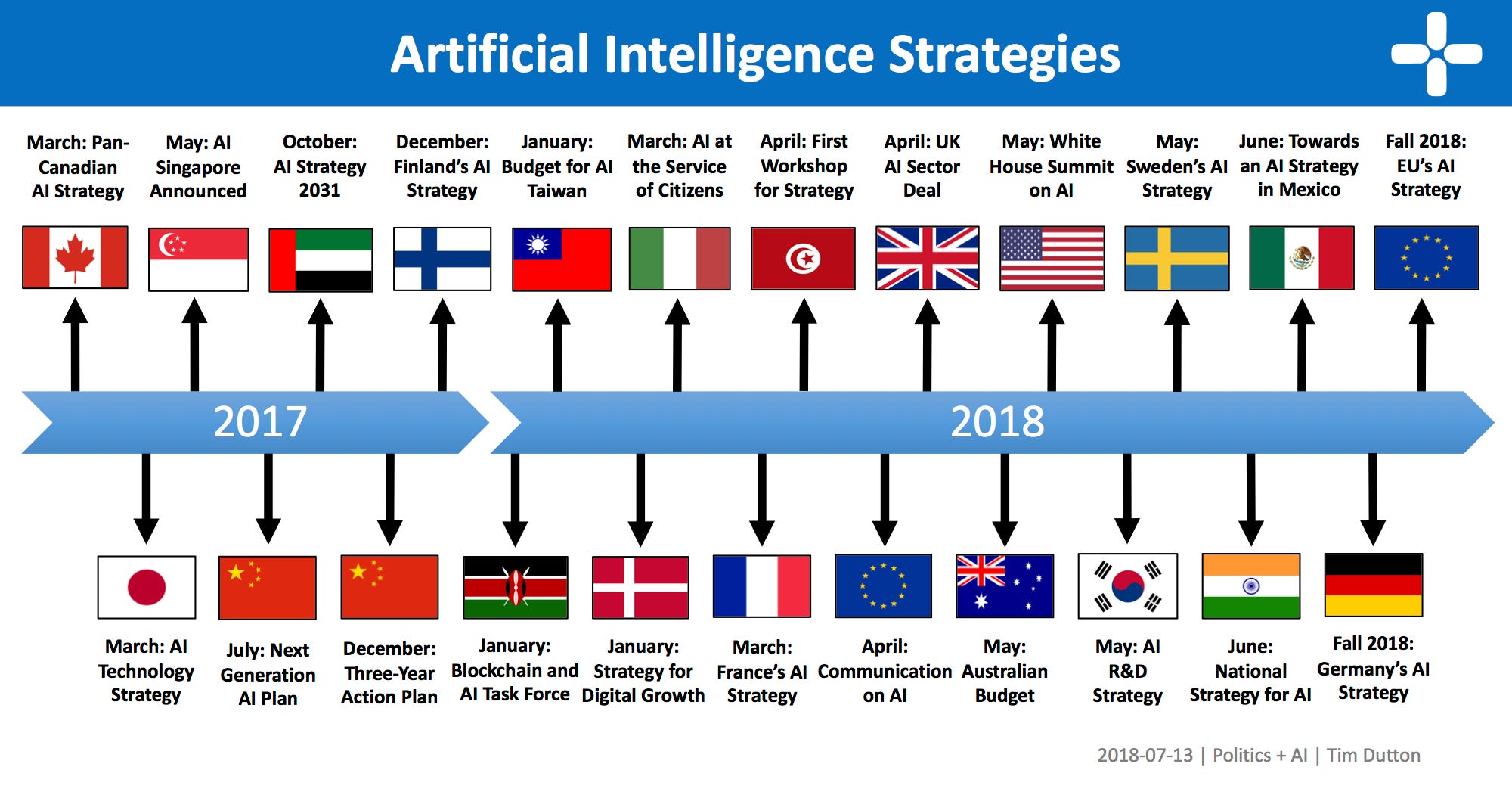
Artificial intelligence's incredible potential means that world governments have crucial interests in securing an edge over geopolitical rivals in the space, and advanced AI will be very important for cybersecurity at both the corporate and governmental levels. This dynamic is driving increased collaboration between technology leaders and government agencies, and it's also causing countries to be more protective of their technology assets and data. Tensions created by the new technological arms race are evident in the trade war between the U.S. and China, with the desire to secure leadership in crucial fields like AI and 5G internet representing a fundamental backdrop for the disputes between the two countries. The significance of the global competition for supremacy in artificial intelligence will likely foster close relationships between governments and leading companies in the space. Collaborations between private businesses and state entities will have a big impact on the progression of AI-dependent fields like the Internet of Things and cybersecurity. Investing in AI: A Beginner's Guide | Kieth Noonan - The Motley Fool
Timeline
- US announces $1 billion research push for AI and quantum computing | James Vincent - The Verge August 26, 2020
- What’s this? A bipartisan plan for AI and national security | Tome Simonite | Wired ...Republican Will Hurd and Democrat Robin Kelly want more Pentagon spending, a Cold War-style “hotline,” and a curb on chip exports to China. August 1, 2020
- The Role of AI Technology in Pandemic Response and Preparedness: Recommended Investments and Initiatives | National Security Commission on Artificial Intelligence as an independent Commission (NSCAI) July 20, 2020
- Mitigating Economic Impacts of the COVID-19 Pandemic and Preserving U.S. Strategic Competitiveness in Artificial Intelligence | National Security Commission on Artificial Intelligence as an independent Commission (NSCAI) July 20, 2020
- GSA Official: Agencies Should Build Testing Data and Environments Specifically for AI | Aaron Boyd - NextGov January 29, 2020
- Guidance for Regulation of Artificial Intelligence Applications | U.S. Chief Technology Officer Michael Kratsios January 2020 draft
- U.S. expands blacklist to include China's top AI startups ahead of trade talks | David Shepardson, Josh Horwitz - Reuters October 7, 2019
- m-artificial-intelligence-research-center/160416/ Energy to Launch $5.5M Artificial Intelligence Research Center | Brandi Vincent - Nextgov October 7, 2019
- Artificial Intelligence Annex to The Department of Defense Artificial Intelligence Strategy | Air Force September 12, 2019
- Plan Outlines Priorities for Federal Agency Engagement in AI Standards Development;'U.S. LEADERSHIP IN AI: A Plan for Federal Engagement in Developing Technical Standards and Related Tools' | The U.S. Department of Commerce’s National Institute of Standards and Technology (NIST) August 9, 2019
- The National Artificial Intelligence Research and Development Strategic Plan: 2019 Update | The White House; National Science and Technology Council (NSTC) Machine Learning/Artificial Intelligence (ML/AI) June 2019
- G20 Ministerial Statement on Trade and Digital Economy - adopted human-centered AI Principles that draw from the Organisation for Economic Cooperation and Development (OECD) AI Principles June 2019
- National Institute of Standards and Technology RFI: Developing a Federal AI Standards Engagement Plan May 1, 2019
- Natural Language Processing (NLP) Project - RFI | Office of Personnel Management (OPM) April 9, 2019
- The Algorithmic Accountability Act of 2019 April 2019
- Dear Colleague Letter: Supporting Research at the Intersection of Agricultural Science, Big Data, Informatics, and Smart Communities, a joint effort between the National Science Foundation (NSF) and the U.S. Department of Agriculture's National Institute of Food and Agriculture (USDA/NIFA) March 21, 2019
- National Security Commission on Artificial Intelligence (NSCAI) hosted its inaugural meeting March 11, 2019
- Executive Order on Maintaining American Leadership in Artificial Intelligence February 11, 2019
- Summary of the 2018 Department of Defense Artificial Intelligence Strategy; Harnessing AI to Advance Our Security and Prosperity
- Government’s AI Odyssey: A Candid Poll on AI and Machine Learning in the Federal Government | Government Business Council December 20, 2018
- Report to Congressional Committees: National Security; Long-Range Emerging Threats Facing the United States As Identified by Federal Agencies | GAO, December 2018 (Classified version: GAO-18-497SPC (Washington, D.C. September. 28, 2018) SECRET//NOFORN
- President Donald J. Trump is Strengthening America’s Cybersecurity, September 20, 2018
- Rise of the Machines Artificial Intelligence and its Growing Impact on U.S. Policy Chairman Will Hurd and Ranking Member Robin Kelly, September 2018
- “AI Next” campaign | Defense Advanced Research Projects Agency (DARPA)
- H.R.5515 - John S. McCain National Defense Authorization Act for Fiscal Year 2019, reference section 238(g) August 30, 2018
- Joint Artificial Intelligence Center (JAIC) | U.S. Department of Defense, Jun 2018
- NIH Strategic Plan for Data Science | National Institutes of Health, Office of Data Science Strategy June 2018
- Defense Science Board Task Force on Counter Autonomy | U.S. Department of Defense, 18 Jun 2018
- The White House eliminates the position of cybersecurity coordinator on the National Security Council; John R. Bolton, said the post was no longer considered necessary 15 May 2018
- 2018 White House Summit on Artificial Intelligence for American Industry, 10 May 2018
- Artificial Intelligence and National Security | U.S. Air Force, 26 Apr 2018
- National Security Capability Review | HM Government, Mar 2018
- Defense Advanced Research Projects Agency: Overview and Issues for Congress. 2 Feb 2018
- NATO ministers agreed on the creation of a new Cyber Operations Centre as part of the outline design for the adapted NATO Command Structure 8 Nov 2017
- Report to the President on IT Modernization | American Technology Council (ATC), 2017
- Narrative Analysis, Artificial Intelligence | National Protection and Programs Directorate - Office of Cyber and Infrastructure Analysis, Jul 2017
- The Role of Big Data, Machine Learning, and AI in Assessing Risks: a Regulatory Perspective | Scott W. Bauguess - U.S. Securities and Exchange Commission 21 June 2017
- Presidential Executive Order Strengthening the Cybersecurity of Federal Networks and Critical Infrastructure | The White House 11 May 2017
- The Weaponization of Information, Committee on Armed Services Subcommittee on Cybersecurity United States Senate | Rand Waltzman - The RAND Corporation, 27 Apr 2017
- Report of the Defense Science Board Task Force on Cyber Supply Chain, Apr 2017
- Artificial Intelligence White Paper | Science and Technology Advisory Committee (HSSTAC): Quadrennial Homeland Security Review Subcommittee, 10 Mar 2017
- Global Trends: Paradox of Progress | Office of the Director of National Intelligence (ODNI), National Intelligence Council, January 2017
- The Dawn of Artificial Intelligence Hearing | Subcommittee on Space, Science, and Competitiveness, 30 Nov 2016
- The National Artificial Intelligence Research and Development Strategic Plan, National Science and Technology Council, Networking and Information Technology Research and Development Subcommittee, Oct 2016
- Preparing for the Future of Artificial Intelligence | Executive Office of the President, National Science and Technology Council Committee on Technology, Oct 2016
- General Data Protection Regulation (GDPR) | European Union ... a “right to explanation” for algorithms that “significantly affect” users, 27 Apr 2016
- The Brain Initiative: Brain Research through Advancing Innovative Neurotechnologies, aimed at reverse engineering the human brain receives $3 billion in funding by the White House, 2013
U.S. Congress
YouTube search...
|
The Power of Artificial Intelligence - US Congressional Hearing, June 26th, 2018
Subcommittee on Research and Technology and Subcommittee on Energy Hearing - Artificial Intelligence - June 26th, 2018 Dr. Tim Persons, chief scientist, GAO Mr. Greg Brockman, co-founder and chief technology officer, OpenAI Dr. Fei-Fei Li, chairperson of the board and co-founder, AI4ALL OpenAI was founded by Elon Musk and Sam Altman
|
|
|
|
US Congress Artificial Intelligence Hearing - Hearing I
Recorded: Feb 14th, 2018
“Over the next three months, the IT Subcommittee will hear from industry professionals as well as government stakeholders with the goal of working together to keep the United States the world leader in artificial intelligence technology,” said Chairman Hurd. Witnesses: Dr. Amir Khosrowshahi - Vice President and Chief Technology Officer, Artificial Intelligence Products Group, Intel Dr. Charles Isbell - Senior Associate Dean, College of Computing Georgia Institute of Technology Dr. Oren Etzioni - Chief Executive Officer Allen Institute for Artificial Intelligence Dr. Ian Buck - Vice President and General Manager, Tesla Data Center Business, NVIDIA
|
|
|
US Congress Artificial Intelligence Hearing - Hearing II
Recorded: March 7th, 2018 Witnesses: Mr. John O. Everett, Ph.D. -Deputy Director, Information Innovation Office, DARPA Mr. Keith Nakasone - Deputy Assistant Commissioner, Information Technology Category Acquisition Management, U.S. General Services Administration (GSA) Mr. James F. Kurose, Ph.D. - Assistant Director, Computer Science and Information Science and Engineering National Science Foundation Mr. Douglas Maughan, Ph.D. - Division Director, Cybersecurity Division, Homeland Security Advanced Research Project Agency, U.S. Department of Homeland Security (DHS)
|
|
|
|
US Congress Artificial Intelligence Hearing - Hearing III
Recorded: April 18th, 2018 Witnesses: Gary Shapiro - President - Consumer Technology Association Jack Clark -Director, OpenAI Terah Lyons -Executive Director , Partnership for AI Ben Buchanan - Postdoctoral Fellow, Cyber Security Project, Science, Technology, and Public Policy Program, Belfer Center for Science and International Affairs, Harvard Kennedy School
|
|
|
The First Congressional Hearing on Artificial Intelligence
Witnesses: - Dr. Eric Horvitz, Interim Co-Chair, Partnership on Artificial Intelligence; Managing Director, Microsoft Research Lab - Dr. Andrew Moore, Dean, School of Computer Science, Carnegie Mellon University - Mr. Greg Brockman, Cofounder and Chief Technology Officer, OpenAI - Dr. Steve Chien, Senior Research Scientist, Autonomous Space Systems and Technical Group Supervisor, Artificial Intelligence Group, NASA Jet Propulsion Laboratory, California Institute of Technology Hearing Details: Subcommittee on Space, Science, and Competitiveness Hearing Wednesday, November 30, 2016
|
|
|
|
Interview: Congressional Artificial Intelligence Caucus
The chairmen of the House of Representatives caucus aimed at ensuring rapid innovation in artificial intelligence discuss the social impacts and opportunities the technology brings plus how legislation fits in.
U.S. Rep. Pete Olson, Co-Chair, Congressional Artificial Intelligence Caucus U.S. Rep. Jerry McNerney, Co-Chair, Congressional Artificial Intelligence Caucus Moderator Michael Hoffman, President, GovernmentCIO Media & Research
|
|
Executive Branch: White House & Federal Departments/Agencies
YouTube search...
|
AI: New Horizons in Medicine
Data analytics and artificial intelligence have sharpened delivery of health care and medical discoveries. Agency experts explore the various ways natural language processing, machine learning, robotic process automation and data analytics play a role in revolutionizing the landscape of health and the public. Listen to discussion by Veterans Affairs' Gil Alterovitz; GSA's Anil Chaudhry; Acxiom's Craig Wingate; National Library of Medicine's Patti Brennan; NVIDIA's Mona Flores; NIH's Behrouz Shabestari and Alastair Thomson; DHS' Karen Evans; DARPA's Rohit Chitale; DHA's Jesus Caban; Red Hat's Ben Cushing; DHMS' Chris Nichols; HHS OIG's Caryl Brzymialkiewicz; and NetApp's Ray Deiotte.
|
|
|
|
Trump signs AI initiative to ensure American leadership
U.S. President Donald Trump signed an executive order Monday, launching an initiative to ensure the country's leadership in artificial intelligence (AI). This technology-promoting initiative calls for protecting the advantage of the United States in AI "against strategic competitors and foreign adversaries," but without specifying its competitors or adversaries.
|
|
|
President Barack Obama on How Artificial Intelligence Will Affect Jobs | WIRED
WIRED guest editor President Barack Obama, WIRED editor in chief Scott Dadich and MIT Media Lab director Joi Ito discuss how artificial intelligence might up-end economies and how societies can adapt.
|
|
|
|
White House announces artificial intelligence task force
The White House held a summit with tech leaders on A.I., saying it plans to take an "America First" approach to promoting the technology. House Democrats also released more than 3000 Facebook ads they say show Russian interference in the 2016 presidential election. CNET Executive Editor Ian Sherr joins CBSN to discuss the latest.
|
|
|
Trump White House panicked about China's investment in AI: Alex Turkeltaub
Roam Analytics co-founder Alex Turkeltaub on efforts for U.S. to take the lead in the field of artificial intelligence.
|
|
|
|
Web Summit 2019 - CTO of The United States, Perspective from The White house by Michael Kratsios USA
I was today at the amazing WebSummit conference in Lisbon and I will share all the videos with the world so you can also have the opportunity to watch the world’s biggest leaders.
|
|
Department of Homeland Security (DHS)
YouTube search...
...Google search
- Cybersecurity
- First Responder
- Smart Cities
- Screening; Passenger, Luggage, & Cargo
- U.S. Department of Homeland Security Artificial Intelligence White Paper | Science and Technology Advisory Committee (HSSTAC): Quadrennial Homeland Security Review Subcommittee, 10 Mar 2017
- U.S. Department of Homeland Security Narrative Analysis: Artificial Intelligence | National Protection and Programs Directorate - Office of Cyber and Infrastructure Analysis, July 2017
- AI at the US Department of Homeland Security – Current Projects | Millicent Abadicio - Emerj, April 16, 2019
- Lie Detection
- Homeland Security's New Approach to Cyber Risk Management | Amanda Ziadeh - governmentCIO, June 15, 2018
- Homeland Security's AI Journey Starts with Trusting its Data | Amanda Ziadeh - governmentCIO, June 27, 2018
- The “smarter” wall: how drones, sensors, and AI are patrolling the border | Shirin Ghaffary - Vox
- DHS S&T Awards Colorado Start-up $147K for Intelligent Counting and Measuring Platform KickView kvSonata will perform real-time analysis of queue lengths and wait times in the international customs processing areas of airports.
- Tailoring Enterprise Architecture at DHS U.S. CIS
|
Teaser for AUDREY Hastings Experiment
Assistant for Understanding Data through Reasoning, Extraction, and Synthesis (AUDREY) The sheer volume of data from next-generation communication tools and sensors risks overwhelming or distracting first responders from their critical activities. As a result, first responders may make the wrong decisions, not because they lack relevant data, but because they are unable to quickly extract key insight from this flood of information. Information overload creates obstacles for first responders to perform their duties safely and efficiently. To learn more about AUDREY, visit: https://go.usa.gov/xPPBU
|
|
|
|
Local company uses technology to stop bad drones
A local company is using technology to stop drones used by cartels.
|
|
Non-US Bodies
|
Assessing the EU's Artificial Intelligence Strategy - European Parliament roundtable 26 April 2018
Roundtable organised by MEP Marietje Schaake on 26 April 2018 in the European Parliament featuringJuha Heikkila (Head of Unit of DG Connects Robotics and Artificial Intelligence Unit (European Commission), Andre Loesekrug-Pietri (JEDI - Joint European Disruptive Initiative), Nicklas Lundblad (Vice-President Public Policy and Governmental Relations EMEA, Google), Stephanie Fink (Senior Director, Salesforce), Prof. Luciano Floridi (University of Oxford)
|
|
|
|
What Disruptive Technologies and Artificial Intelligence Mean for NATO
This video establishes a baseline understanding of disruptive technology (DT), artificial intelligence (AI) and autonomy aimed at NATO policymakers and senior military officials. It explains disruptive technology and its historical importance for military innovation and changes in warfare, in addition to the current state of artificial intelligence and autonomous systems technology. The video features experts Dr. Andrew Moore, Dean of the School of Computer Science at Carnegie Mellon University and Co-Chair of the CNAS Task Force on AI and National Security, and Paul Scharre, Senior Fellow and Director of the Technology and National Security Program at CNAS and Executive Director of the CNAS Task Force on AI and National Security.
|
|
|
Leading scientists address dangers of Artificial Intelligence before United Nations
Recently esteemed M I T physicist, Max Tegmark, and science philosophy professor, from Oxford university, Nick Bostrom, joined forces to address the United Nations. They were there with the sole purpose of addressing their concerns over the dangers of Artificial Intelligence.
|
|
|
|
NATO to Use Artificial Intelligence in Military Operations
Warfare developments will increasingly involve artificial intelligence systems. #NATO is actively working to make sure #AI advances are appropriately used for future military decision-making.
|
|
|
AI For Good - UN Congress on Artificial Intelligence
Audi CEO Prof. Rupert Stadler has spoken at a congress of the United Nations about the use of artificial intelligence for the benefit of humankind. In his keynote speech at the start of the “AI for Good Global Summit,” he stated that automated driving presents an opportunity to improve life significantly. He warned, however, against excessive expectations: “In situations where an accident is unavoidable, we expect a decision from the autonomous car. But a dilemma situation cannot be solved either by a human or by a machine.” Therefore, alongside legal issues, ethical questions about the use of the new technology also needed to be discussed, he added. With the beyond initiative, Stadler is now calling for such a discourse. At the first “AI for Good Global Summit” in Geneva, the Chairman of the Board of Management of AUDI AG said in front of UN experts: “We need a discourse in society that looks at the enormous potential of piloted and autonomous driving in relation to the ethical and legal questions.” Artificial intelligence (AI) is regarded by experts from science and industry as a key technology for piloted and autonomous driving. It assists the car in perceiving and interpreting its environment, and deriving decisions from this. But who is liable in the case of accidents, and how should the car driving autonomously behave in a situation of unavoidable danger? Prof. Stadler: “We take the concerns of the public seriously and are facing up to the challenges associated with this.”
|
|
|
|
Artificial Intelligence: The Future of Homeland Security
i24NEWS DESK | Israel is hosting an event surrounding the use of artificial intelligence for homeland security. Our Daniel Tsemach has more. Story: Israel is hosting it's first ever international event for artificial intelligence and security led by the Israel Export Institute and the Foreign Trade Administration. There were 65 representatives from around the world in attendance for the week long event, in order to find out how Artificial Intelligence can assist with homeland security. Companies were featuring A.I. technology from virtual reality to facial recognition software.
|
|
AI in China
Public Advocates