Difference between revisions of "Time"
(→What Time Is It?) |
|||
| Line 1: | Line 1: | ||
| + | __NOTOC__ | ||
{{#seo: | {{#seo: | ||
| − | |title= | + | |title=Time |
|titlemode=append | |titlemode=append | ||
| − | |keywords= | + | |keywords=Time, Atomic Clocks, Optical Lattice Clocks, PNT, GPS, NIST, USNO, AI, Signal Processing, Spacetime, Synchronization, Quantum Sensors, Navigation |
| + | |description=An exploration of timekeeping, from historical devices to next-generation optical lattice clocks, AI-driven PNT resilience, and the physics of spacetime. | ||
<!-- Google tag (gtag.js) --> | <!-- Google tag (gtag.js) --> | ||
| Line 40: | Line 42: | ||
* [https://spectrum.ieee.org/qa-creating-time-crystals-using-quantum-computers What’s a Time Crystal? | Charles Q. Choi - IEEE Spectrum] ... And how do Google researchers use quantum computers to make them? ... quantum system of many particles that organize themselves into a periodic pattern of motion—periodic in time rather than in space—that persists in perpetuity. | * [https://spectrum.ieee.org/qa-creating-time-crystals-using-quantum-computers What’s a Time Crystal? | Charles Q. Choi - IEEE Spectrum] ... And how do Google researchers use quantum computers to make them? ... quantum system of many particles that organize themselves into a periodic pattern of motion—periodic in time rather than in space—that persists in perpetuity. | ||
* [https://spectrum.ieee.org/time-reversal-interface This Mirror Reverses How Light Travels in Time There are already applications in wireless, radar, and optical-computing | Charles Q. Choi - IEEE Spectrum] ... There are already applications in wireless, radar, and optical-computing ... These applications often reverse the order of signals to help process them. | * [https://spectrum.ieee.org/time-reversal-interface This Mirror Reverses How Light Travels in Time There are already applications in wireless, radar, and optical-computing | Charles Q. Choi - IEEE Spectrum] ... There are already applications in wireless, radar, and optical-computing ... These applications often reverse the order of signals to help process them. | ||
| + | * [https://www.nist.gov/news-events/news/2025/03/nist-advances-optical-lattice-clock-standards-global-timing | NIST - March 2025] | ||
| + | ** NIST and USNO report successful integration of next-generation optical lattice clocks, marking the beginning of the transition away from cesium-based standards. | ||
| + | * [https://www.nature.com/articles/s41586-025-08992-w AI-Optimized Synchronization for Global Atomic Networks | Nature - June 2025] | ||
| + | ** New research demonstrates how machine learning models reduce jitter in distributed atomic clock networks by 40%. | ||
| + | * [https://www.gpsworld.com/ai-driven-pnt-resilience-against-spoofing-2026/ AI-Driven PNT Resilience in Critical Infrastructure | GPS World - January 2026] | ||
| + | ** Detailed analysis of how neural-network-based signal processing identifies and mitigates GPS spoofing in real-time. | ||
| + | |||
| + | = Recent Developments = | ||
| + | As of 2025 and 2026, the field of metrology is undergoing a paradigm shift. The NIST Time and Frequency Division, in collaboration with the U.S. Naval Observatory (USNO), has accelerated the deployment of optical lattice clocks. These systems utilize lasers to trap atoms in a lattice structure, allowing for measurement precision orders of magnitude higher than traditional cesium fountain clocks. This transition is essential for the next generation of global timing standards, which require sub-nanosecond stability to support advanced quantum communication and deep-space navigation. | ||
| − | + | Furthermore, AI-optimized synchronization has become a cornerstone of modern timing infrastructure. By applying deep learning to the noise characteristics of atomic clocks, researchers can now predict and compensate for environmental drift in real-time, ensuring that distributed networks remain synchronized even when satellite-based reference signals are temporarily unavailable. | |
= What Time Is It? = | = What Time Is It? = | ||
| Line 242: | Line 253: | ||
Navigation is a field of study that focuses on the process of monitoring and controlling the movement of a craft or vehicle from one place to another.[1] The field of navigation includes four general categories: land navigation, marine navigation, aeronautic navigation, and space navigation. [https://en.wikipedia.org/wiki/Navigation Navigation | Wikipedia] | Navigation is a field of study that focuses on the process of monitoring and controlling the movement of a craft or vehicle from one place to another.[1] The field of navigation includes four general categories: land navigation, marine navigation, aeronautic navigation, and space navigation. [https://en.wikipedia.org/wiki/Navigation Navigation | Wikipedia] | ||
| + | |||
| + | In critical infrastructure, AI-driven signal processing is fundamentally enhancing PNT resilience. By utilizing deep learning models to analyze the spectral characteristics of incoming signals, systems can now distinguish between authentic satellite transmissions and malicious spoofing attempts. These AI models operate at the edge, processing raw radio frequency data to detect anomalies in signal arrival angles and timing offsets, providing a robust defense against jamming and spoofing in environments where GPS is contested. | ||
<youtube>p-9wxYdJing</youtube> | <youtube>p-9wxYdJing</youtube> | ||
| Line 295: | Line 308: | ||
* [https://wtop.com/science/2020/11/spacex-launches-third-generation-gps-navigation-satellite/ SpaceX launches third-generation GPS navigation satellite | CBS News] ...GPS-3 satellite — the fourth in a series of more powerful third-generation navigation stations built by Lockheed Martin — was expected to be deployed about a 90 minutes after liftoff. Assuming tests and checkout go well, it will join a globe-spanning constellation of 31 GPS satellites. | * [https://wtop.com/science/2020/11/spacex-launches-third-generation-gps-navigation-satellite/ SpaceX launches third-generation GPS navigation satellite | CBS News] ...GPS-3 satellite — the fourth in a series of more powerful third-generation navigation stations built by Lockheed Martin — was expected to be deployed about a 90 minutes after liftoff. Assuming tests and checkout go well, it will join a globe-spanning constellation of 31 GPS satellites. | ||
* [https://www.militaryaerospace.com/sensors/article/14187009/navigation-and-guidance-asic-gps Air Force asks three U.S. contractors to develop miniature ASIC technology for next-gen GPS receivers | John Keller - Military & Aerospace Electronics] ...small low-power-consumption GPS enabling technologies to include a next-generation ASIC for secure GPS land navigation. | * [https://www.militaryaerospace.com/sensors/article/14187009/navigation-and-guidance-asic-gps Air Force asks three U.S. contractors to develop miniature ASIC technology for next-gen GPS receivers | John Keller - Military & Aerospace Electronics] ...small low-power-consumption GPS enabling technologies to include a next-generation ASIC for secure GPS land navigation. | ||
| − | * [https://spectrum.ieee.org/tech-talk/aerospace/satellites/final-piece-of-chinas-beidou-navigation-satellite-system-comes-online | + | * [https://spectrum.ieee.org/tech-talk/aerospace/satellites/final-piece-of-chinas-beidou-navigation-satellite-system-comes-online [Government Services#China|China] Launches Beidou, Its Own Version of GPS | Andrew Jones - IEEE Spectrum] ...[[Government Services#China|China]] places the final Beidou navigation system satellite into orbit |
* [https://eurasiantimes.com/the-indian-navigation-satellite-system-irnss-approved-by-imp-for-global-operations/ Big News For ISRO! Indian Navigation System (IRNSS) Gets Approval By IMP For Global Operations | Smriti Chaudhary - The EurAsuan Times] | * [https://eurasiantimes.com/the-indian-navigation-satellite-system-irnss-approved-by-imp-for-global-operations/ Big News For ISRO! Indian Navigation System (IRNSS) Gets Approval By IMP For Global Operations | Smriti Chaudhary - The EurAsuan Times] | ||
| Line 654: | Line 667: | ||
[https://www.google.com/search?q=Long+Range+Navigation+Loran+artificial+intelligence+ai ...Google search] | [https://www.google.com/search?q=Long+Range+Navigation+Loran+artificial+intelligence+ai ...Google search] | ||
| − | * [https://www.intelligent-aerospace.com/home/article/14181475/eloran-loran-c-gps-gnss Public- | + | * [https://www.intelligent-aerospace.com/home/article/14181475/eloran-loran-c-gps-gnss Public- |
| − | |||
| − | |||
| − | |||
| − | |||
| − | |||
| − | |||
| − | |||
| − | |||
| − | |||
| − | |||
| − | |||
| − | |||
| − | |||
| − | |||
| − | |||
| − | |||
| − | |||
| − | |||
| − | |||
| − | |||
| − | |||
| − | |||
| − | |||
| − | |||
| − | |||
| − | |||
| − | |||
| − | |||
| − | |||
| − | |||
| − | |||
| − | |||
| − | |||
| − | |||
| − | |||
| − | |||
| − | |||
| − | |||
| − | |||
| − | |||
| − | |||
| − | |||
| − | |||
| − | |||
| − | |||
| − | |||
| − | |||
| − | |||
| − | |||
| − | |||
| − | |||
| − | |||
| − | |||
| − | |||
| − | |||
| − | |||
| − | |||
| − | |||
| − | |||
| − | |||
| − | |||
| − | |||
| − | |||
| − | |||
| − | |||
| − | |||
| − | |||
| − | |||
| − | |||
| − | |||
| − | |||
| − | |||
| − | |||
| − | |||
| − | |||
| − | |||
| − | |||
| − | |||
| − | |||
| − | |||
| − | |||
| − | |||
| − | |||
| − | |||
| − | |||
| − | |||
| − | |||
| − | |||
| − | |||
| − | |||
| − | |||
| − | |||
| − | |||
| − | |||
| − | |||
| − | |||
| − | |||
| − | |||
| − | |||
| − | |||
| − | |||
| − | |||
| − | |||
| − | |||
| − | |||
| − | |||
| − | |||
| − | |||
| − | |||
| − | |||
| − | |||
| − | |||
| − | |||
| − | |||
| − | |||
| − | |||
| − | |||
| − | |||
| − | |||
| − | |||
| − | |||
| − | |||
| − | |||
| − | |||
| − | |||
| − | |||
| − | |||
| − | |||
| − | |||
| − | |||
| − | |||
| − | |||
| − | |||
| − | |||
| − | |||
| − | |||
| − | |||
| − | |||
| − | |||
| − | |||
| − | |||
| − | |||
| − | |||
| − | |||
| − | |||
| − | |||
| − | |||
| − | |||
| − | |||
| − | |||
| − | |||
| − | |||
| − | |||
| − | |||
| − | |||
| − | |||
| − | |||
| − | |||
| − | |||
| − | |||
| − | |||
| − | |||
| − | |||
| − | |||
| − | |||
| − | |||
| − | |||
| − | |||
| − | |||
| − | |||
| − | |||
| − | |||
| − | |||
| − | |||
| − | |||
| − | |||
| − | |||
| − | |||
| − | |||
| − | |||
| − | |||
| − | |||
| − | |||
| − | |||
| − | |||
| − | |||
| − | |||
| − | |||
| − | |||
| − | |||
| − | |||
| − | |||
| − | |||
| − | |||
| − | |||
| − | |||
| − | |||
| − | |||
| − | |||
| − | |||
| − | |||
| − | |||
| − | |||
| − | |||
| − | |||
| − | |||
| − | |||
| − | |||
| − | |||
| − | |||
| − | |||
| − | |||
| − | |||
| − | |||
| − | |||
| − | |||
| − | |||
| − | |||
| − | |||
| − | |||
| − | |||
| − | |||
| − | |||
| − | |||
| − | |||
| − | |||
| − | |||
| − | |||
| − | |||
| − | |||
| − | |||
| − | |||
| − | |||
| − | |||
| − | |||
| − | |||
| − | |||
| − | |||
| − | |||
| − | |||
| − | |||
| − | |||
| − | |||
| − | |||
| − | |||
| − | |||
| − | |||
| − | |||
| − | |||
| − | |||
| − | |||
| − | |||
| − | |||
| − | |||
| − | |||
| − | |||
| − | |||
| − | |||
| − | |||
| − | |||
| − | |||
| − | |||
| − | |||
| − | |||
| − | |||
| − | |||
| − | |||
| − | |||
| − | |||
| − | |||
| − | |||
| − | |||
| − | |||
| − | |||
| − | |||
| − | |||
| − | |||
| − | |||
| − | |||
| − | |||
| − | |||
| − | |||
| − | |||
| − | |||
| − | |||
| − | |||
| − | |||
| − | |||
Revision as of 18:17, 5 September 2026
YouTube ... Quora ...Google search ...Google News ...Bing News
- Time ... PNT ... GPS ... Retrocausality ... Delayed Choice Quantum Eraser ... Quantum
- Government Services:
- National Institute of Standards and Technology (NIST) ... Time and Frequency Division, Physical Measurement Laboratory
- U.S. Department of Homeland Security (DHS) ... Science and Technology (S&T) Positioning, Navigation, and Timing (PNT) Program
- Defense ... Precise Time Department ... U.S. Naval Observatory has maintained a Time Service Department since 1880
- Perspective ... Context ... In-Context Learning (ICL) ... Transfer Learning ... Out-of-Distribution (OOD) Generalization
- National Timing Centre ... Assured Time and Frequency for the UK
- Time ...Coordinated Universal Time UTC ... Clock ...Timekeeping | Wikipedia
- The Very Long and Fascinating History of Clocks | Christopher McFadden - Interesting Engineering
- What Is a Leap Second? | Konstantin Bikos and Anne Buckle - timeanddate.com
- Atomic clocks ...Tide Clock | Amazon
- Clock synchronization
- Time: Do the past, present, and future exist all at once? | BigThink (video) ... astrophysicist Michelle Thaller, science educator Bill Nye, author James Gleick, and neuroscientist Dean Buonomano discuss how the human brain perceives of the passage of time, the idea in theoretical physics of time as a fourth dimension, and the theory that space and time are interwoven.
- Cybersecurity
- Crown Sterling ... changing the face of digital security with its non-integer-based algorithms that leverage time, AI and irrational numbers.
- Quantum cryptography ... the infosec industry looks to quantum cryptography and quantum key distribution (QKD)
- What’s a Time Crystal? | Charles Q. Choi - IEEE Spectrum ... And how do Google researchers use quantum computers to make them? ... quantum system of many particles that organize themselves into a periodic pattern of motion—periodic in time rather than in space—that persists in perpetuity.
- This Mirror Reverses How Light Travels in Time There are already applications in wireless, radar, and optical-computing | Charles Q. Choi - IEEE Spectrum ... There are already applications in wireless, radar, and optical-computing ... These applications often reverse the order of signals to help process them.
- | NIST - March 2025
- NIST and USNO report successful integration of next-generation optical lattice clocks, marking the beginning of the transition away from cesium-based standards.
- AI-Optimized Synchronization for Global Atomic Networks | Nature - June 2025
- New research demonstrates how machine learning models reduce jitter in distributed atomic clock networks by 40%.
- AI-Driven PNT Resilience in Critical Infrastructure | GPS World - January 2026
- Detailed analysis of how neural-network-based signal processing identifies and mitigates GPS spoofing in real-time.
Recent Developments
As of 2025 and 2026, the field of metrology is undergoing a paradigm shift. The NIST Time and Frequency Division, in collaboration with the U.S. Naval Observatory (USNO), has accelerated the deployment of optical lattice clocks. These systems utilize lasers to trap atoms in a lattice structure, allowing for measurement precision orders of magnitude higher than traditional cesium fountain clocks. This transition is essential for the next generation of global timing standards, which require sub-nanosecond stability to support advanced quantum communication and deep-space navigation.
Furthermore, AI-optimized synchronization has become a cornerstone of modern timing infrastructure. By applying deep learning to the noise characteristics of atomic clocks, researchers can now predict and compensate for environmental drift in real-time, ensuring that distributed networks remain synchronized even when satellite-based reference signals are temporarily unavailable.
What Time Is It?
- DARPA Making Progress on Miniaturized Atomic Clocks for Future PNT Applications | US Defense Advanced Research Projects Agency (DARPA)
|
|
|
|
|
|
|
|
|
|
The Earth's rotation is so accurate it varies only in milliseconds ...do you feel the Earth rotation slowing down?
Light Clock 1905 - Einstein's Thought Experiment
Imagine you have a special clock that works with light. This clock has two mirrors facing each other, and a beam of light bounces up and down between them. Every time the light goes from the bottom mirror to the top and back down, it counts as one tick of the clock. Einstein's light clock thought experiment shows that when things move fast, time slows down for them. This surprising idea helps us understand the nature of time and motion in our universe. Now, let's think about this clock in two different situations.
Situation 1: Standing Still: First, picture the clock sitting on a table, not moving at all. The light goes straight up to the top mirror and straight back down to the bottom mirror. If you measured the time it takes for the light to do this, you would see it takes a certain amount of time for one tick.
Situation 2: Moving Clock: Now, imagine you place the clock on a skateboard and push it so it's moving. As the clock moves, the light beam has to travel a different path. Instead of going straight up and down, it now has to go in a diagonal path because the mirrors are moving while the light is traveling. It's like when you throw a ball to a friend while running; the ball has to cover more distance because both of you are moving.
What This Means ... Because the light in the moving clock has to travel a longer, diagonal path, it takes more time for one tick to happen compared to when the clock is standing still. This means that for someone watching the moving clock, time appears to run slower for the moving clock compared to a clock that's not moving. This idea is called time dilation. It means that time actually passes at different rates depending on how fast something is moving. If you were riding on the skateboard with the clock, you wouldn't notice anything different about the clock's ticks. But someone standing still and watching you would see that your clock ticks more slowly.
Why It Matters ... This thought experiment helps us understand that time isn't the same everywhere and can be different depending on how fast things are moving. This concept is a key part of Einstein's theory of special relativity, which helps scientists understand how the universe works, especially when things are moving very fast, like spaceships or particles in a collider.
What Powers An Electron?
Precision Time Protocol (PTP)
YouTube search... ...Google search
- Precision Time Protocol PTP-1588 | IEEE ...High precision clock synchronization that computes latency and offset
- How Precision Time Protocol is being deployed at Meta | Oleg Obleukhov & Ahmad Byagowi - CONNECTIVITY, NETWORKING & TRAFFIC, OPEN SOURCE, PRODUCTION ENGINEERING, UNCATEGORIZED, WEB
- PTP IEEE 1588v2 | Juniper Networks ...Time Management Administration Guide
The Precision Time Protocol (PTP) is a protocol used to synchronize clocks throughout a computer network. On a local area network, it achieves clock accuracy in the sub-microsecond range, making it suitable for measurement and control systems.[1] PTP is currently employed to synchronize financial transactions, mobile phone tower transmissions, sub-sea acoustic arrays, and networks that require precise timing but lack access to satellite navigation signals.Wikipedia
Overall, its structure is similar to NTP in that there are different levels within it and GPS satellites can serve as its time source. However, the major difference between Network Time Protocol (NTP) and PTP is that PTP is accurate to microseconds, meaning that it is more exact than NTP
|
|
YouTube search... ...Google search
- Time ... PNT ... GPS ... Retrocausality ... Delayed Choice Quantum Eraser ... Quantum
- Case Studies
- Autonomous Drones
- Google Maps ... Wiki-Map ... Marine Traffic ... Marine Vessel Traffic ... Interactive Map: Russia's Invasion of Ukraine
- Deepmind teaches AI to follow navigational directions like humans | Tristan Greene
- History of Navigation | Wikipedia
- Department of Homeland Security (DHS) Science and Technology (S&T) Positioning, Navigation, and Timing (PNT) Program
- Navigation Aids | Department of Transportation, Federal Aviation Administration
- VN-300 | Vectornav ...miniature, high-performance Dual Antenna Global Navigation Satellite Systems (GNSS)-Aided Inertial Navigation System (INS) that combines micro-electromechanical systems (MEMS) inertial sensors, two high-sensitivity GNSS receivers, and advanced Kalman filtering algorithms to provide optimal estimates of position, velocity, and orientation.
Navigation is a field of study that focuses on the process of monitoring and controlling the movement of a craft or vehicle from one place to another.[1] The field of navigation includes four general categories: land navigation, marine navigation, aeronautic navigation, and space navigation. Navigation | Wikipedia
In critical infrastructure, AI-driven signal processing is fundamentally enhancing PNT resilience. By utilizing deep learning models to analyze the spectral characteristics of incoming signals, systems can now distinguish between authentic satellite transmissions and malicious spoofing attempts. These AI models operate at the edge, processing raw radio frequency data to detect anomalies in signal arrival angles and timing offsets, providing a robust defense against jamming and spoofing in environments where GPS is contested.
|
|
|
|
Global Positioning System (GPS)
YouTube search... ...Google search
- Time ... PNT ... GPS ... Retrocausality ... Delayed Choice Quantum Eraser ... Quantum
- Astronomy
- GPS has been copied by Russia's GLONASS, Europe’s Galileo, China's BeiDou, India’s IRNSS, and Japan’s QZSS
- Artificial intelligence in GPS navigation systems | Jeffrey L. Duffany
- RoadTagger: GPS system upgrade utilizes AI to make sure you're in the right lane | David Nield - New Atlas ...Artificial intelligence to update digital maps and improve GPS navigation | Amit Malewar - InceptiveMind
- GPS.gov ...Timing
- Inside GNSS ...Global Navigation Satellite Systems
- Navstar | Space.com ...is a network of U.S. satellites that provide GPS services
- SpaceX launches third-generation GPS navigation satellite | CBS News ...GPS-3 satellite — the fourth in a series of more powerful third-generation navigation stations built by Lockheed Martin — was expected to be deployed about a 90 minutes after liftoff. Assuming tests and checkout go well, it will join a globe-spanning constellation of 31 GPS satellites.
- Air Force asks three U.S. contractors to develop miniature ASIC technology for next-gen GPS receivers | John Keller - Military & Aerospace Electronics ...small low-power-consumption GPS enabling technologies to include a next-generation ASIC for secure GPS land navigation.
- [Government Services#China|China Launches Beidou, Its Own Version of GPS | Andrew Jones - IEEE Spectrum] ...China places the final Beidou navigation system satellite into orbit
- Big News For ISRO! Indian Navigation System (IRNSS) Gets Approval By IMP For Global Operations | Smriti Chaudhary - The EurAsuan Times
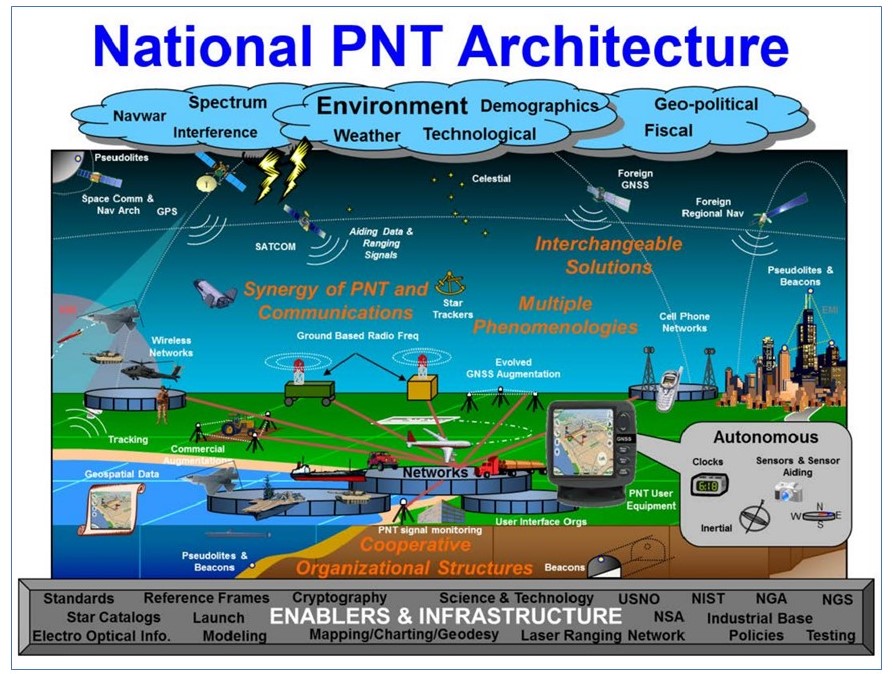
GPS receivers that use the L5 band can pinpoint to within 30 centimeters or 11.8 inches. The GPS concept is based on time and the known position of GPS specialized satellites. The satellites carry very stable atomic clocks that are synchronized with one another and with the ground clocks. Any drift from time maintained on the ground is corrected daily. In the same manner, the satellite locations are known with great precision. GPS receivers have clocks as well, but they are less stable and less precise. Each GPS satellite continuously transmits a radio signal containing the current time and data about its position. Since the speed of radio waves is constant and independent of the satellite speed, the time delay between when the satellite transmits a signal and the receiver receives it is proportional to the distance from the satellite to the receiver. A GPS receiver monitors multiple satellites and solves equations to determine the precise position of the receiver and its deviation from true time. At a minimum, four satellites must be in view of the receiver for it to compute four unknown quantities (three position coordinates and clock deviation from satellite time). Global Positioning System | Wikipedia
|
|
|
|
|
|
|
|
Deep-Space Positioning System (DPS)
YouTube search... ...Google search
- Space-based Data Centers
- NASA is Making An AI-Based GPS For Space | Kristin Houser
- Frontier Development Lab (FDL) ...Artificial Intelligence Research for Space Science, Exploration & All Humankind
|
Jamming and Spoofing
YouTube search... ...Google search
- The Resilient Navigation and Timing Foundation
- Department of Homeland Security (DHS) Science and Technology (S&T) Resilient Positioning, Navigation, and Timing (PNT) Conformance Framework
- The Space Force: A Conversation With United States Secretary Of The Air Force Barbara Barrett | Steve Forbes - Forbes ... We are vulnerable. For example, the U.S. and the global economy are totally dependent on satellites, most especially the GPS, which is operated by the Space Force.
|