Difference between revisions of "Math for Intelligence"
(→Dot Product) |
|||
| Line 9: | Line 9: | ||
* [[Causation vs. Correlation]] | * [[Causation vs. Correlation]] | ||
| + | * [[Dot Product]] | ||
* [http://www.3blue1brown.com/ Animated Math | Grant Sanderson @ 3blue1brown.com] | * [http://www.3blue1brown.com/ Animated Math | Grant Sanderson @ 3blue1brown.com] | ||
* [http://developers.google.com/machine-learning/crash-course/prereqs-and-prework Google's Crash Course] | * [http://developers.google.com/machine-learning/crash-course/prereqs-and-prework Google's Crash Course] | ||
Revision as of 12:05, 22 June 2019
YouTube search... ...Google search
- Causation vs. Correlation
- Dot Product
- Animated Math | Grant Sanderson @ 3blue1brown.com
- Google's Crash Course
- Introduction to Matrices and Matrix Arithmetic for Machine Learning | Jason Brownlee
- Brilliant.org
- Varient: Limits
- Probability Cheatsheet
- Neural Networks and Deep Learning - online book | Michael A. Nielsen
- Bloomberg Lectures
- Statistical Learning | T. Hastie, R. Tibshirani - Stanford
- Essential Math for Data Science: ‘Why’ and ‘How’ | Tirthajyoti Sarkar
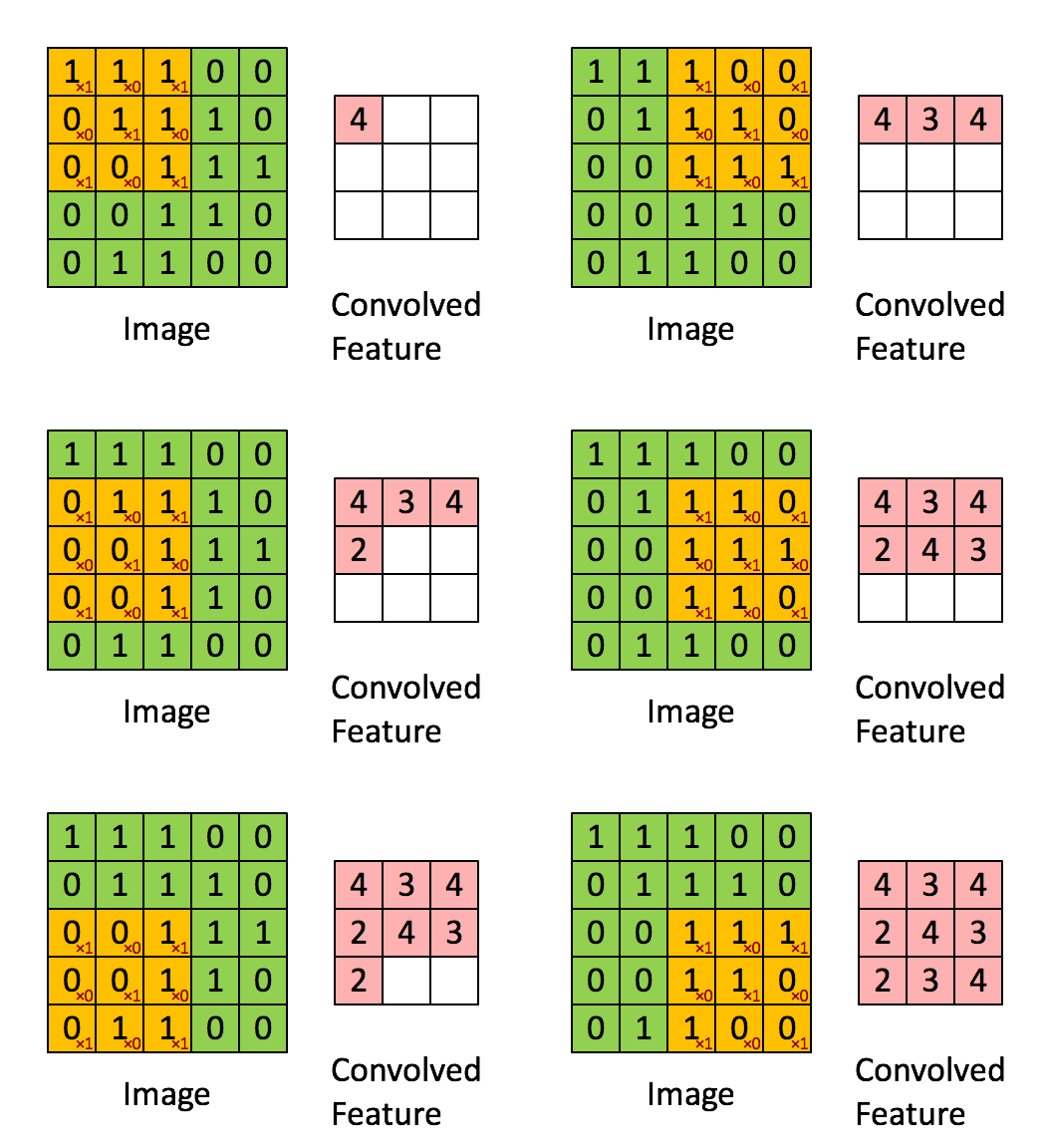
- Gentle Dive into Math Behind Convolutional Neural Networks | Piotr Skalski - Towards Data Science
- Fundamental Statistics Jupyter Notebook | Jon Tupitza
- Fundamentals:
Contents
Getting Started
3blue1brown
Explained
Dot Product
- Kernel Trick
- [1] Dot Product | Wikipedia]
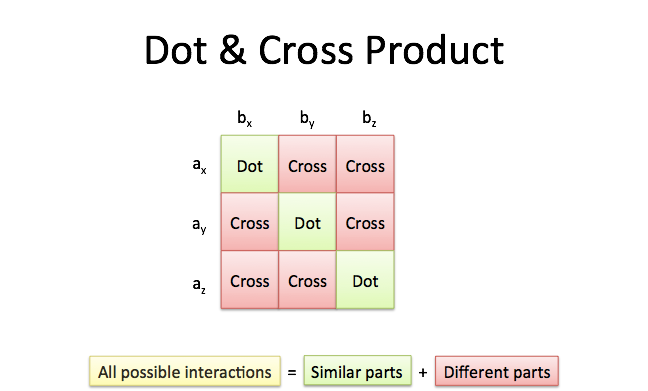
Dot Product =
- Algebraically, the dot product is the sum of the products of the corresponding entries of the two sequences of numbers.
- Geometrically, it is the product of the Euclidean magnitudes of the two vectors and the cosine of the angle between them.

Siraj Raval
Josh Starmer - StatQuest
Gilbert Strang (MIT) - Linear Algebra
Quantum Algorithm
Statistics
