Difference between revisions of "Association Rule Learning"
m |
m |
||
| Line 17: | Line 17: | ||
[https://www.google.com/search?q=Association+Rule+Learning+machine+learning+ML ...Google search] | [https://www.google.com/search?q=Association+Rule+Learning+machine+learning+ML ...Google search] | ||
| − | * [[AI Solver]] | + | * [[AI Solver]] ... [[Algorithms]] ... [[Algorithm Administration|Administration]] ... [[Model Search]] ... [[Discriminative vs. Generative]] ... [[Optimizer]] ... [[Train, Validate, and Test]] |
** [[...cluster]] | ** [[...cluster]] | ||
* [[Embedding]]: [[Agents#AI-Powered Search|Search]] ... [[Clustering]] ... [[Recommendation]] ... [[Anomaly Detection]] ... [[Classification]] ... [[Dimensional Reduction]] ... [[...find outliers]] | * [[Embedding]]: [[Agents#AI-Powered Search|Search]] ... [[Clustering]] ... [[Recommendation]] ... [[Anomaly Detection]] ... [[Classification]] ... [[Dimensional Reduction]] ... [[...find outliers]] | ||
Revision as of 21:35, 12 July 2023
YouTube search... ...Google search
- AI Solver ... Algorithms ... Administration ... Model Search ... Discriminative vs. Generative ... Optimizer ... Train, Validate, and Test
- Embedding: Search ... Clustering ... Recommendation ... Anomaly Detection ... Classification ... Dimensional Reduction ... ...find outliers
- Association Rule Learning | Wikipedia
a rule-based machine learning method for discovering interesting relations between variables in large databases. It is intended to identify strong rules discovered in databases using some measures of interestingness. This rule-based approach also generates new rules as it analyzes more data. The ultimate goal, assuming a large enough dataset, is to help a machine mimic the human brain’s feature extraction and abstract association capabilities from new uncategorized data.
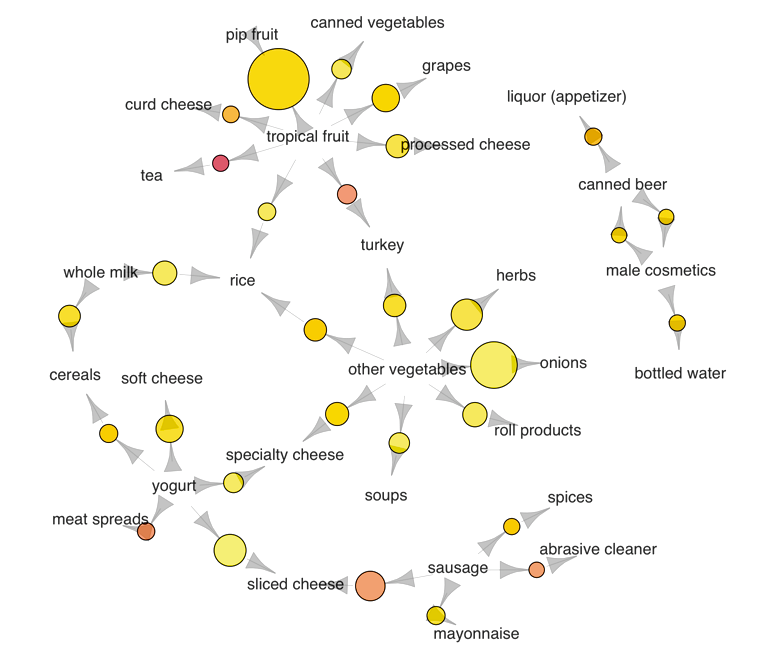
Market Basket Analysis
Apriori
