Difference between revisions of "AI Solver"
m (→Scikit Machine Learning Map) |
|||
| (63 intermediate revisions by the same user not shown) | |||
| Line 1: | Line 1: | ||
| − | + | __NOTOC__ | |
| + | {{#seo: | ||
| + | |title=AI Solver | ||
| + | |titlemode=append | ||
| + | |keywords=AI Solver, Machine Learning, Algorithm Selection, Discriminative AI, Generative AI, Agentic Workflows, SLM, LLM, Model Evaluation, Train Validate Test, Data Science, AI Strategy | ||
| + | |description=A guide to selecting the right AI algorithm for your specific task, featuring decision frameworks for discriminative vs. generative models and modern model selection criteria. | ||
| + | }} | ||
| + | [https://www.youtube.com/results?search_query=AI+model+selection+guide+2026 YouTube] | ||
| + | [https://www.quora.com/search?q=how+to+choose+the+right+AI+model ... Quora] | ||
| + | [https://www.google.com/search?q=AI+algorithm+selection+decision+tree ...Google search] | ||
| + | [https://news.google.com/search?q=AI+model+selection+trends+2026 ...Google News] | ||
| + | [https://www.bing.com/news/search?q=AI+model+selection+trends+2026&qft=interval%3d%228%22 ...Bing News] | ||
| − | + | * [[AI Solver]] ... [[Algorithms]] ... [[Algorithm Administration|Administration]] ... [[Model Search]] ... [[Discriminative vs. Generative]] ... [[Train, Validate, and Test]] | |
| − | + | <i>Aids in selecting a starting algorithm for your solution; at that point discover similar algorithms to see which works best for your task (and data) at hand.</i> | |
| − | * [[...predict values]] | + | == Lets get going? == |
| − | * [[...predict categories]] so I can classify each data point into a specific groups | + | I want to... |
| − | * [[...cluster]] data points to discover structure | + | |
| + | === Decision Framework: Discriminative vs. Generative === | ||
| + | To determine your path, follow this logic: | ||
| + | * **Is the goal to classify or predict based on existing patterns?** → Use **Discriminative AI** (e.g., Classification, Regression, Anomaly Detection). | ||
| + | * **Is the goal to create new content or simulate data distributions?** → Use **Generative AI** (e.g., Text Generation, Image Synthesis, Data Augmentation). | ||
| + | * **Are you building an autonomous system?** → Evaluate **Agentic Workflow Selection**: | ||
| + | ** If the task requires high-precision, low-latency, or structured tool-calling: Use **Small Language Models (SLMs)**. | ||
| + | ** If the task requires broad reasoning, cross-domain abstraction, or multi-step planning: Use **Large Language Models (LLMs)** or a hybrid architecture. | ||
| + | |||
| + | === Recommended Algorithm Families === | ||
| + | {| class="wikitable" | ||
| + | ! Task Type !! Recommended Algorithm Families | ||
| + | |- | ||
| + | | Clustering || K-Means, DBSCAN, Hierarchical Clustering | ||
| + | |- | ||
| + | | Forecasting || ARIMA, Prophet, LSTM, Transformer-based Time Series | ||
| + | |- | ||
| + | | Classification || Logistic Regression, SVM, Random Forest, Gradient Boosted Trees | ||
| + | |- | ||
| + | | Anomaly Detection || Isolation Forest, One-Class SVM, Autoencoders | ||
| + | |- | ||
| + | | Generative Tasks || GANs, Diffusion Models, Autoregressive Transformers (LLMs) | ||
| + | |- | ||
| + | | Pathfinding/Control || Q-Learning, Deep Q-Network (DQN), PPO (Reinforcement Learning) | ||
| + | |} | ||
| + | |||
| + | * ...detect patterns or relationships ... [[Causation vs. Correlation|Correlation analysis]] or [[Forecasting|Time series analysis]] | ||
| + | ** [[...predict values]]/quantity/outcomes | ||
| + | ** [[...predict categories]] so I can classify each data point into a specific groups | ||
| + | ** [[...cluster]] data points to discover relationships and structure; find hidden structure | ||
| + | ** ...make a [[Recommendation]] | ||
| + | * ...identify the most important features (attributes) or perform [[Dimensional Reduction]] | ||
* [[...find outliers]]; unusual points, anomaly detection | * [[...find outliers]]; unusual points, anomaly detection | ||
| + | * ...find a [[Generative AI]]-type solution to identify the most plausible theory among competing explanations | ||
| + | ** [https://hbr.org/2023/03/a-framework-for-picking-the-right-generative-ai-project A Framework for Picking the Right Generative AI Project | A Framework for Picking the Right Generative AI Project | M. Zao-Sanders & M. Ramos - Harvard Business Review] | ||
| + | * ... automate processes; understand (semantic parsing) complete sentences, understanding synonyms of matching words, [[Sentiment Analysis]], or [[Speech Recognition]], (speech) translation ...[[Natural Language Processing (NLP)]] | ||
| + | * ... [[Reinforcement Learning (RL) |pathfinding]]; learn a series of actions; find the best/shortest route to an objective; win a game, traveling salesman problem ... [[Q Learning]], [[Deep Q Network (DQN)]] | ||
| + | * ... train [[Agents/Assistants]] or [[Personal Companions]] | ||
| + | |||
| + | == Model Evaluation Metrics == | ||
| + | To verify if your chosen algorithm is performing optimally, you must implement a rigorous evaluation strategy linked to [[Train, Validate, and Test]] workflows: | ||
| + | * **Holdout Validation:** Split data into training and testing sets to measure generalization. | ||
| + | * **Cross-Validation:** Use K-Fold techniques to ensure performance stability across different data subsets. | ||
| + | * **Task-Specific Metrics:** | ||
| + | ** Classification: Accuracy, Precision, Recall, F1-Score, Confusion Matrix. | ||
| + | ** Regression: Mean Squared Error (MSE), R-Squared. | ||
| + | ** Agentic/Generative: Instruction-following rate, Tool-call correctness, Groundedness, and LLM-as-a-judge scores. | ||
| + | |||
| + | _____________________________________________________________________________________ | ||
| + | |||
| + | * [[Algorithms]] & Neural Network Models to learn about approaches used to solve specific AI-related problems | ||
| + | * [[Model Search]] | ||
| + | * [https://www.mindmeister.com/app/map/927441936?fullscreen=1&v=public How to pick an algorithm | Willem Meints] | ||
| + | * [https://www.mindmeister.com/app/map/927441936?fullscreen=1&v=public Model Mindmap | Mindmeister] | ||
| + | * [https://www.kdnuggets.com/2020/05/guide-choose-right-machine-learning-algorithm.html An easy guide to choose the right Machine Learning algorithm | Yogita Kinha - KDnuggets] | ||
| + | * [https://dataconomy.com/2023/04/04/best-ai-models-types-how-to-choose-what-is/ Everything you should know about AI models | Eray Eliaçık - Dataconomy] | ||
| + | * [https://www.mckinsey.com/capabilities/quantumblack/our-insights/the-state-of-ai-2024-gen-ai-adoption-surges | McKinsey & Company] ... A comprehensive guide on selecting AI use cases and matching them to the right model architecture for enterprise scaling. | ||
| + | |||
| + | https://cdn-images-1.medium.com/max/600/1*iPIGiJIcQjzZheEgTzOnhA.png | ||
| + | |||
| + | == [https://learn.microsoft.com/en-us/azure/machine-learning/studio/algorithm-cheat-sheet Microsoft Azure Studio Cheatsheet] == | ||
| + | *[https://learn.microsoft.com/en-us/azure/machine-learning/studio/algorithm-choice How to choose algorithms for Microsoft Azure Machine Learning | Microsoft] | ||
| + | * [https://huggingface.co/models Models | Hugging Face] ... click on Sort: Trending | ||
| + | |||
| + | <img src="https://docs.microsoft.com/en-us/azure/machine-learning/studio/media/studio-overview-diagram/ml_studio_overview_v1.1.png" width="1225" height="900"> | ||
| + | |||
| + | https://msdnshared.blob.core.windows.net/media/TNBlogsFS/prod.evol.blogs.technet.com/CommunityServer.Blogs.Components.WeblogFiles/00/00/01/02/52/AlgoDecisionTree-2.png | ||
| + | |||
| + | == [https://blogs.sas.com/content/subconsciousmusings/2020/12/09/machine-learning-algorithm-use/ SAS] == | ||
| + | * [https://www.sas.com/en_us/solutions/ai.html AI] | ||
| + | https://blogs.sas.com/content/subconsciousmusings/files/2017/04/machine-learning-cheet-sheet.png | ||
| + | |||
| + | == Notes == | ||
| + | |||
| + | https://cdn-images-1.medium.com/max/800/1*PzeV89iMXPxGMShh6bhwHQ.png | ||
| + | https://cdn-images-1.medium.com/max/800/1*xlLV8XBECmBTv0dBZKFoyg.png | ||
| + | https://cdn-images-1.medium.com/max/800/1*qhp867ZtHsO2nPeMdDh4Gw.png | ||
| + | https://cdn-images-1.medium.com/max/600/1*dgd9vqD96NhUoxUZLMnF_A.png | ||
Latest revision as of 13:59, 19 September 2026
YouTube ... Quora ...Google search ...Google News ...Bing News
- AI Solver ... Algorithms ... Administration ... Model Search ... Discriminative vs. Generative ... Train, Validate, and Test
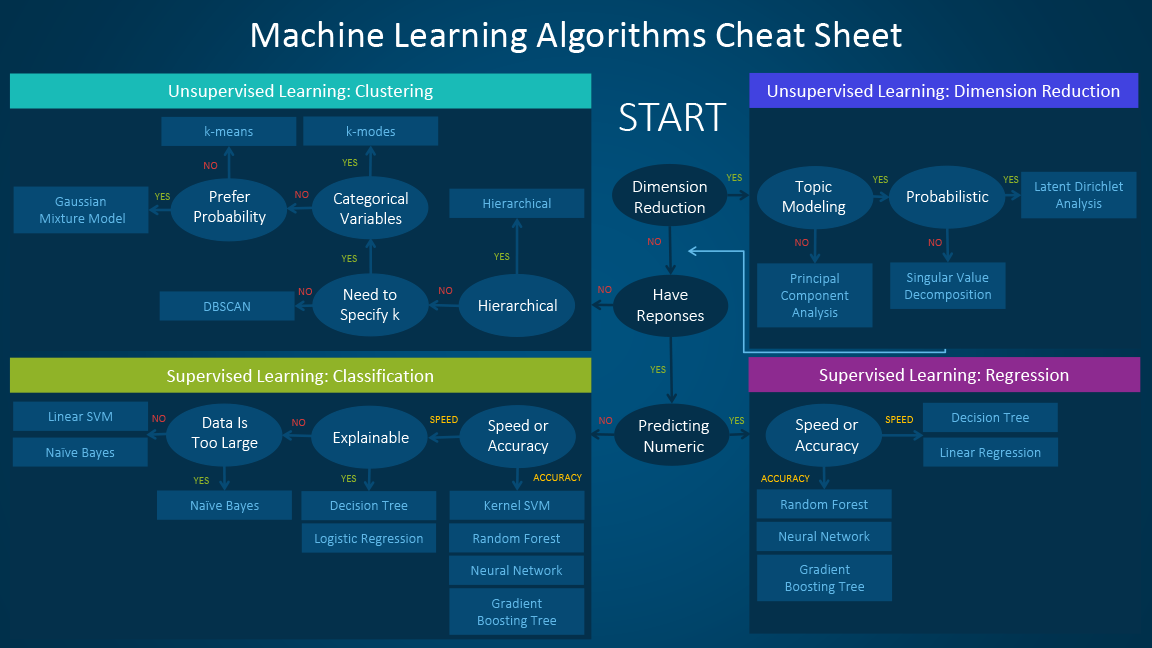
Aids in selecting a starting algorithm for your solution; at that point discover similar algorithms to see which works best for your task (and data) at hand.
Lets get going?
I want to...
Decision Framework: Discriminative vs. Generative
To determine your path, follow this logic:
- **Is the goal to classify or predict based on existing patterns?** → Use **Discriminative AI** (e.g., Classification, Regression, Anomaly Detection).
- **Is the goal to create new content or simulate data distributions?** → Use **Generative AI** (e.g., Text Generation, Image Synthesis, Data Augmentation).
- **Are you building an autonomous system?** → Evaluate **Agentic Workflow Selection**:
- If the task requires high-precision, low-latency, or structured tool-calling: Use **Small Language Models (SLMs)**.
- If the task requires broad reasoning, cross-domain abstraction, or multi-step planning: Use **Large Language Models (LLMs)** or a hybrid architecture.
Recommended Algorithm Families
| Task Type | Recommended Algorithm Families |
|---|---|
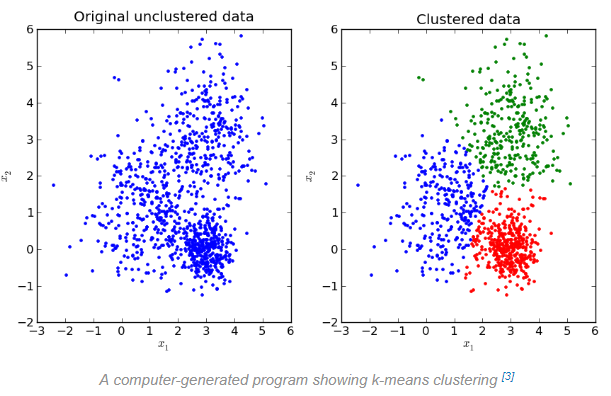
| Clustering | K-Means, DBSCAN, Hierarchical Clustering |
| Forecasting | ARIMA, Prophet, LSTM, Transformer-based Time Series |
| Classification | Logistic Regression, SVM, Random Forest, Gradient Boosted Trees |
| Anomaly Detection | Isolation Forest, One-Class SVM, Autoencoders |
| Generative Tasks | GANs, Diffusion Models, Autoregressive Transformers (LLMs) |
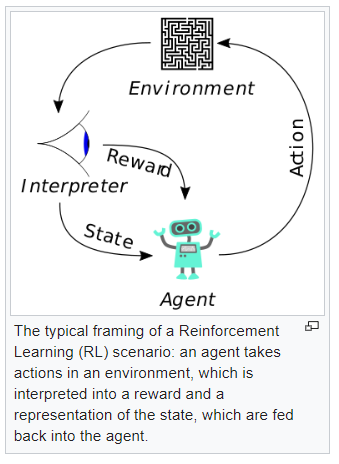
| Pathfinding/Control | Q-Learning, Deep Q-Network (DQN), PPO (Reinforcement Learning) |
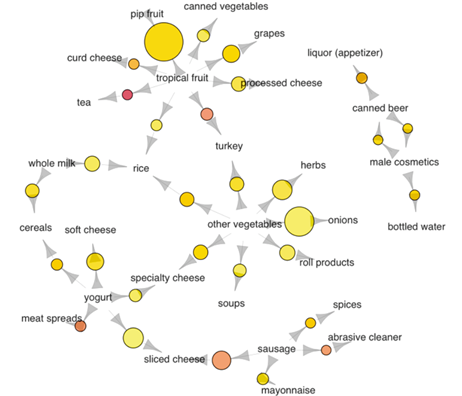
- ...detect patterns or relationships ... Correlation analysis or Time series analysis
- ...predict values/quantity/outcomes
- ...predict categories so I can classify each data point into a specific groups
- ...cluster data points to discover relationships and structure; find hidden structure
- ...make a Recommendation
- ...identify the most important features (attributes) or perform Dimensional Reduction
- ...find outliers; unusual points, anomaly detection
- ...find a Generative AI-type solution to identify the most plausible theory among competing explanations
- ... automate processes; understand (semantic parsing) complete sentences, understanding synonyms of matching words, Sentiment Analysis, or Speech Recognition, (speech) translation ...Natural Language Processing (NLP)
- ... pathfinding; learn a series of actions; find the best/shortest route to an objective; win a game, traveling salesman problem ... Q Learning, Deep Q Network (DQN)
- ... train Agents/Assistants or Personal Companions
Model Evaluation Metrics
To verify if your chosen algorithm is performing optimally, you must implement a rigorous evaluation strategy linked to Train, Validate, and Test workflows:
- **Holdout Validation:** Split data into training and testing sets to measure generalization.
- **Cross-Validation:** Use K-Fold techniques to ensure performance stability across different data subsets.
- **Task-Specific Metrics:**
- Classification: Accuracy, Precision, Recall, F1-Score, Confusion Matrix.
- Regression: Mean Squared Error (MSE), R-Squared.
- Agentic/Generative: Instruction-following rate, Tool-call correctness, Groundedness, and LLM-as-a-judge scores.
_____________________________________________________________________________________
- Algorithms & Neural Network Models to learn about approaches used to solve specific AI-related problems
- Model Search
- How to pick an algorithm | Willem Meints
- Model Mindmap | Mindmeister
- An easy guide to choose the right Machine Learning algorithm | Yogita Kinha - KDnuggets
- Everything you should know about AI models | Eray Eliaçık - Dataconomy
- | McKinsey & Company ... A comprehensive guide on selecting AI use cases and matching them to the right model architecture for enterprise scaling.
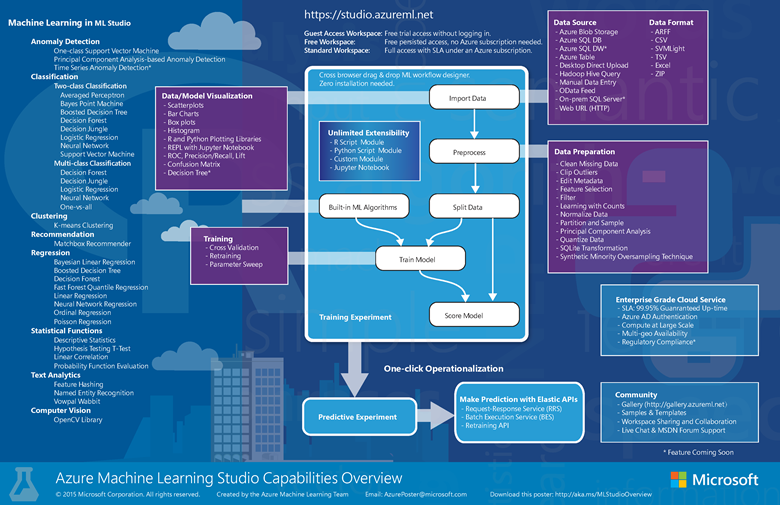
Microsoft Azure Studio Cheatsheet
- How to choose algorithms for Microsoft Azure Machine Learning | Microsoft
- Models | Hugging Face ... click on Sort: Trending

SAS
Notes