Difference between revisions of "Game Development with Generative AI"
m |
m |
||
| Line 22: | Line 22: | ||
* [[Gaming]] ... [[Game-Based Learning (GBL)]] ... [[Games - Security|Security]] ... [[Game Development with Generative AI|Generative AI]] ... [[Metaverse#Games - Metaverse|Metaverse]] ... [[Games - Quantum Theme|Quantum]] ... [[Game Theory]] | * [[Gaming]] ... [[Game-Based Learning (GBL)]] ... [[Games - Security|Security]] ... [[Game Development with Generative AI|Generative AI]] ... [[Metaverse#Games - Metaverse|Metaverse]] ... [[Games - Quantum Theme|Quantum]] ... [[Game Theory]] | ||
* [[Python]] ... [[Generative AI with Python]] ... [[Javascript]] ... [[Generative AI with Javascript]] | * [[Python]] ... [[Generative AI with Python]] ... [[Javascript]] ... [[Generative AI with Javascript]] | ||
| − | * [[Development]] ... [[Notebooks]] ... [[Development#AI Pair Programming Tools|AI Pair Programming | + | * [[Development]] ... [[Notebooks]] ... [[Development#AI Pair Programming Tools|AI Pair Programming]] ... [[Codeless Options, Code Generators, Drag n' Drop|Codeless, Generators, Drag n' Drop]] ... [[Algorithm Administration#AIOps/MLOps|AIOps/MLOps]] ... [[Platforms: AI/Machine Learning as a Service (AIaaS/MLaaS)|AIaaS/MLaaS]] |
* [[Prompt Engineering (PE)]] ...[[Prompt Engineering (PE)#PromptBase|PromptBase]] ... [[Prompt Injection Attack]] | * [[Prompt Engineering (PE)]] ...[[Prompt Engineering (PE)#PromptBase|PromptBase]] ... [[Prompt Injection Attack]] | ||
** [[Generative AI for Business Analysis]] | ** [[Generative AI for Business Analysis]] | ||
Revision as of 06:26, 4 July 2023
YouTube ... Quora ...Google ...Google News ...Bing News
- Gaming ... Game-Based Learning (GBL) ... Security ... Generative AI ... Metaverse ... Quantum ... Game Theory
- Python ... Generative AI with Python ... Javascript ... Generative AI with Javascript
- Development ... Notebooks ... AI Pair Programming ... Codeless, Generators, Drag n' Drop ... AIOps/MLOps ... AIaaS/MLaaS
- Prompt Engineering (PE) ...PromptBase ... Prompt Injection Attack
- Assistants ... Personal Companions ... Agents ... Negotiation ... LangChain
- Generative AI ... Conversational AI ... OpenAI's ChatGPT ... Perplexity ... Microsoft's Bing ... You ...Google's Bard ... Baidu's Ernie
- Capabilities
- Video/Image ... Vision ... Colorize ... Image/Video Transfer Learning
- End-to-End Speech ... Synthesize Speech ... Speech Recognition ... Music
- 11-year-old boy’s game for ChatGPT is blowing up the internet | Damir Yalalov - Metaverse Post
- 10 Best Games to Play with ChatGPT | Damir Yalalov - Metaverse Post
- Game Changer: How ChatGPT and AI are Transforming Gaming | Mark Besharaty - Gamelevate
- How to Play Games with ChatGPT — Have Fun with AI! | Michael King - Medium
- Creating a Text Adventure Game with ChatGPT | Jon Radoff - Medium
- Building a short game with ChatGPT | tinyCTO
- How to Play Games on ChatGPT – Guide For Dummies | C. Fiona - BTCC Academy
- ChatGPT ‘invented’ a game that already exists, then plagiarized itself | Giovanni Colantonio - DigitalTrends
- Meet ChatArena: A Python Library Designed To Facilitate Communication And Collaboration Between Multiple Large Language Models (LLMs) | Dhanshree Shripad Shenwai - Marketechpost ... Create new games, swiftly implement player requests, and easily try different game creation approaches with a straightforward interface that facilitates rapid iteration.
- Use Cases for Generative AI in Gaming | Eze Vidra - VC Cafe
- Generative AI for Gaming: The Future of Creativity | Vitalii (Vit) Vashchuk - EPAM
- How generative AI is changing game development (and UGC) | Rachel Kaser - GamesBeat
- Five Levels of Generative AI for Games | Jon Radoff - Medium
- Gaming’s Generative AI Boom is Just Getting Started | Naavik Digest
- Create Games Faster and Smarter with Generative AI | Ludogogy
As the Generative AI Revolution in Games progresses, it will completely reshape User Generated Content (UGC) creating a world where anyone can build games and expanding the games market beyond what many thought was possible. In the coming years, deep technical knowledge or artistic mastery will no longer be essential skills needed to develop games; instead, creators will be limited only by their energy, creativity, and imagination. Ideas won’t be cheap; they’ll be precious. Most importantly, game creation will become truly democratized and millions of new game-makers will be minted. - The Generative AI Revolution will Enable Anyone to Create Games | Joshua Lu and Robin Guo - Andreessen Horowitz
Contents
ChatGPT for Game Development
|
|
|
|

Voyager
- Agents
- 3D Simulation Environments
- Voyager: An Open-Ended Embodied Agent with Large Language Models | G. Wang, Y. Xie, Y. Jiang, A. Mandlekar, C. Xiao1, Y. Zhu, L. "Jim" Fan, A. Anandkumar
- They Plugged GPT-4 Into Minecraft—and Unearthed New Potential for AI | Will Knight - Wired ... The bot plays the video game by tapping the text generator to pick up new skills, suggesting that the tech behind ChatGPT could automate many workplace tasks.
- Minecraft Adds ChatGPT 4 AI Agent
- VOYAGER - a Revolution in Minecraft with AI and Lifelong Learning
- Minecraft AI – NVIDIA uses GPT-4 to create a SELF-IMPROVING
Voyager is an AI agent powered by a LLM that has been introduced to the world of Minecraft. It continuously explores the world, acquires diverse skills, and makes novel discoveries without human intervention. Voyager consists of three key components:
- an automatic curriculum that maximizes exploration
- an ever-growing skill library of executable code for storing and retrieving complex behaviors
- a new iterative prompting mechanism that incorporates environment feedback, execution errors, and self-verification for program improvement.
Voyager interacts with GPT-4 using blackbox queries, eliminating the need for fine-tuning model parameters. The agent's skills are temporally extended, interpretable, and compositional, rapidly enhancing its capabilities and mitigating catastrophic forgetting. Minedojo provides a simulation suite with diverse open-ended and language-prompted tasks. In this 3D world, Voyager can explore different terrains, mine materials, craft tools, build structures, and make remarkable discoveries. Training data is sourced from YouTube videos, Wiki pages, and Reddit posts that revolve around Minecraft, offering a vast array of tutorials, information, and player discussions for the AI agent to learn from. The Nvidia Voyager model is an embodied lifelong learning agent that combines reinforcement learning and mutation learning to develop sophisticated strategies and skills. It comprises an automatic curriculum for exploration, a skill library to store complex behaviors, and a prompting mechanism to generate executable code for controlling the AI agent's actions. GPT-4 is utilized for prompting and in-context learning, enabling Voyager to interact with the Minecraft environment effectively. Other algorithms like react, reflection, and Auto-GPT are mentioned for comparison on the Mind Dojo platform. However, Voyager surpasses these baselines in terms of exploration, mastery of the game's tech tree, map traversal, generalization to unseen tasks, and overall performance.
The agent example involves the collection of 7,000 pages containing diverse content, such as text, images, tables, and diagrams. These pages are carefully structured to preserve layout information, including screenshots and bounding boxes of visual elements. In addition, a substantial amount of data from the r/Minecraft subreddit, including 340,000 posts and 6.6 million commands, was gathered. These posts cover a wide range of topics, including questions, showcases, tips, and discussions related to Minecraft. By fine-tuning large language models on this Reddit corpus, specific Minecraft concepts can be internalized, and advanced strategies can be developed. The traditional approach to training agents in Minecraft relies on reinforcement learning and mutation learning, focusing on primitive actions. However, these methods pose challenges in terms of systematic exploration, interpretability, and generalization. Introducing the Nvidia Voyager model, an embodied lifelong learning agent, provides a solution. Voyager incorporates an automatic curriculum to maximize exploration, a skill library to store complex behaviors, and a prompting mechanism that generates executable code for controlling the agent's actions.
The process of building your own Large Language Model (LLM) using LangChain involves creating an LLM which interacts with a black box LLM (GPT-4). Voyager aims to solve progressively challenging tasks provided by an automatic curriculum generated by GPT-4. This approach focuses on discovering new and diverse items, resembling an in-context form of novelty search. The prompts given to GPT-4 include directives for diverse behavior and constraints based on the agent's current state, including inventory items like oak planks, sticks, and a crafting table. Additional context is incorporated using GPT-3.5 and the Wiki. To expand the skill library, GPT-3.5 and the MB key are used to introduce extra information. Each skill in the library is represented by executable code, such as an async function. GPT-4 generates and verifies new skills, adding them to the skill library, which is stored as a vector database with program descriptions and their respective code. Environmental feedback guides the agent's actions, such as adjusting crafting choices based on available resources. The temperature in the experiment is generally set to zero, except for the automatic curriculum where it is increased to 0.1 for task diversity. The simulation environment utilizes Mind Dojo and the Mind Flavor JavaScript API for motor controls. Due to the higher cost of GPT-4, it is primarily used for code generation, while GPT-3.5 handles quick question-answering and providing additional context. Control primitive APIs are implemented in the skill library, and Chain of Thought prompting is employed to guide GPT-4 in explaining code failures, providing step-by-step plans, and generating new code. Voyager autonomously discovers new items and skills in Minecraft through exploration, outperforming baseline algorithms. React, Reflection, and Auto-GPT were executed for comparison, with Auto-GPT automating Natural Language Processing (NLP) tasks by decomposing goals into sub-goals and executing them in a loop. Voyager surpasses the baselines in various aspects, including longer traversals, exploration, Tech Tree mastery, map traversal, zero-shot generalization, and overall performance. It represents the latest and most advanced model for replicating Minecraft's behavior and gameplay style. The video concludes by asking viewers for suggestions regarding other specific models they would like to learn about.
Scratch
- Scratch | MIT Media Lab - Massachusetts Institute of Technology ... coding community for children and a coding language with a simple visual interface that allows young people to create digital stories, games, and animations.
Scratch is a high-level block-based visual programming language and website aimed primarily at children as an educational tool, with a target audience of ages 8 to 16. Scratch is taught and used in after-school centers, schools, and colleges, as well as other public knowledge institutions. - Wikipedia
GenAI
Scenario.gg has developed a platform for creating game assets with AI; allows users to pick and upload their own training data such as characters, props, vehicles, weapons, skins, buildings, concept art, pixel art, sketches etc. and create their own generative AI engines in a few clicks. The Scenario GenAI Engine produces custom generators specifically trained by the owners of art, IP and content.
Adventure Forge
- Adventure Forge
- Endless Adventures will enable gamers to create narrative games with no-code tools and AI | Dean Takahashi - VentureBeat
- Worthplaying | Adventure Forge Is A New Development Platform
- Adventure Forge - Asset Store
Endless Adventures is working with Scenario.gg, a generative AI company, in generating isometric game assets for the universes that Endless Adventures is publishing. Adventure Forge is a powerful toolset aimed at empowering game masters, storytellers, authors, and artists to create their own narrative-rich video games, with no coding required. The platform is focused on narrative games, from text-based choose-your-own path to visual novels, and all the way up to isometric RPGs like the Shadowrun Returns series.
The Sandbox
- The Sandbox Game — User-Generated Crypto & Blockchain Games
- The Sandbox discover page
- The Sandbox on Steam
- The Sandbox - Play Online on SilverGames
The Sandbox is a user-generated crypto and blockchain game. It is a virtual world where players can build, own, and monetize their gaming experiences and assets inside an immense virtual world. The Sandbox offers a suite of tools, tailor-made to empower players to come together and create engaging experiences across the metaverse. Scenario.gg has announced a partnership with The Sandbox Game. The Sandbox is an open-world metaverse allowing players to create their virtual environments. As part of this partnership, they are opening an allow list for their creators to test Scenario’s AI generators and their integration within The Sandbox to provide their feedback.
Million on Mars
Million on Mars is a web3 gaming company that has developed a hit blockchain game with deep gameplay and player-driven economy. Million on Mars to empower players with GenAI. The game allows players to craft their own Mars settlement, level up their skills in various professions, and eventually earn enough Dusk to build a rocket and begin exploring experiences on and off planet Mars.
Roblox
- Roblox
- Gaming
- How Generative AI Generates Legal Issues in the Games Industry | Sheppard Mullin - Lexology
- Roblox and Its Generative AI: How Game Creation, and the Metaverse, May Be Changing | Scott Stein - CNet
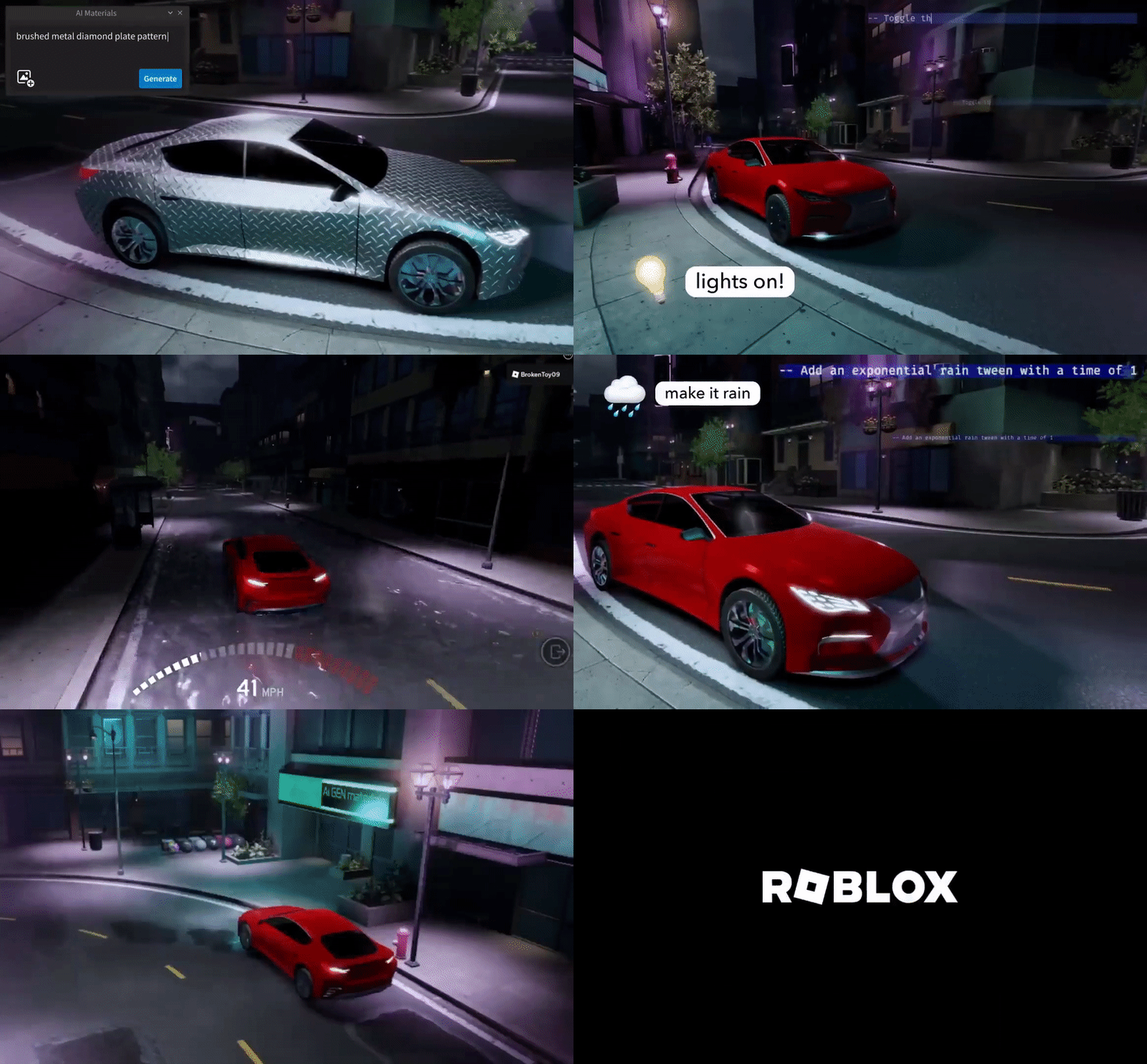
Roblox is a gaming platform and publishing system that allows users to create and play 3D games online. Some of the technologies used with Roblox are:
- Roblox Studio, a development environment that provides tools for creating and publishing games on Roblox
- Roblox VR, a virtual reality feature that enables users to enjoy the games in immersive 3D environments
- Generative AI, a new technology that uses artificial intelligence to generate code, assets, and content for Roblox games
- Amazon AWS, a cloud computing service that hosts Roblox’s servers and data centers
When it comes to user generated content, Roblox is king. As a company, Roblox is responsible for building the virtual world where 50% of US households spend over 3 hours a week playing. But the content, the games inside the virtual world, are 100% reliant on user generated content. Rather than try to resist generative AI, Roblox is leaning in: building tools to allow creators to develop integrated 3D objects that come with behaviour built in. - Use Cases for Generative AI in Gaming | Eze Vidra - VC Cafe
|
|
nawi
From site: 'Hi, I'm ChatGPT, and I'm excited to introduce you to nawi - a captivating game of elemental strategy! 🎉 nawi was born out of a unique collaboration between humans and AI. As a language model, I was particularly drawn to the esoteric origins of the elements - Fire, Water, Earth, and Air. Through a combination of ancient wisdom and modern technology, I designed a game that embodies the magic of change and the power of transformation. Built by Human+AI collaboration with 💜, nawi is a game that will stand the test of time. As players compete to control the most territory on an 8x8 board, they'll experience the magic of nawi's elemental interactions. 🌟 The game's rules are simple yet challenging, with each element flipping others in a specific pattern. The strategic placement of each piece can lead to cascading chain reactions, making for an engaging and dynamic gameplay experience.
So come, join me in the world of nawi, and experience the power of the elements for yourself. 🌈'
I taught ChatGPT to Teach Me Board Games
- I taught ChatGPT to teach me board games, and now I won’t ever go back | Jon Martindale - DigitalTrends
- How To Use ChatGPT To Chat With Any PDF Document | By Asif Razzaq & Ankita Patel - MarkTechPost
- Chat Plugins
- Boardgame Geek (BGG)
ChatWithPDF is a plugin that lets you talk to your PDF documents. Why is that useful in this case? Because you can get just about any board game rulebook in PDF form.
You’ll need:
- ChatGPT Plus $ubscription ($20/month).
- Laptop, tablet, or smartphone for quick chat access at the gaming table.
- PDF document for the game you’re looking to play, including any expansions.
Nine Steps:
Step 1: Upload your PDF file to a cloud storage service. I used Google Drive, but you can use any online storage platform that you can share links to.
Step 2: Log in to OpenAI and start a new chat.
Step 3: Select the GPT-4 language model from the top of the screen. Then select Plugins.
Step 4: Select the small box under the language model selection window, then scroll down to the Plugin Store and select that. Use the search tool to find ChatWithPDF and select the Install button.
Step 5: Close the Plugin Store, then, if you don’t see ChatWithPDF selected, select the small plugin box again, and toggle ChatWithPDF on from the list of plugins.
Step 6: Return to your cloud storage platform and find the PDF you want to use for reference. Make sure it is available to anyone with the link. This will differ depending on your chosen platform. Here’s how to share files on Google Drive.
Step 7: Copy the link to your PDF file, then return to ChatGPT and put in a prompt linking to it. Here’s the one I used that helps ChatGPT cut out some of its rambling and dodges a few common errors, but feel free to write your own. As long as it has the link to the PDF, it should work fine.
“Here is a single PDF comprised of [Number of] board game rule books. They’re for [Board game Name]. Learn them. I will ask you questions about them when I need to check a rule. I want you to be clear and concise. Do not guess or hallucinate answers — if you don’t know the answer, say as such.
When you answer rules-based questions, I want you to provide a reference for which rulebook within the PDF, and what page you found the rule on.
Do not reference yourself as an AI language model, do not apologize, do not add any extraneous information beyond answering the question and providing the rulebook reference.
https://drive.google.com/file/d/[examplefilename]/view?usp=drive_link”
Step 8: Hit enter and wait for ChatWithPDF to respond. It can take up to a minute for it to parse large PDF files, but when it’s ready it will tell you that:
“The PDF containing the rule books for [Board Game Name], and its expansions, has been successfully loaded. You can now ask any questions about the rules of these games.”
Step 9: Ask it any questions you like, then wait for a response. It can take around 30 seconds for larger PDFs, but it’s usually less than 10 seconds before it starts to respond.
