Difference between revisions of "Bias and Variances"
m |
m |
||
| Line 39: | Line 39: | ||
|| | || | ||
<youtube>SjQyLhQIXSM</youtube> | <youtube>SjQyLhQIXSM</youtube> | ||
| − | <b> | + | <b>Bias/Variance (C2W1L02) |
| − | </b><br> | + | </b><br>Deeplearning.ai Take the Deep Learning Specialization: http://bit.ly/3amgU4n Check out all our courses: http://www.deeplearning.ai |
|} | |} | ||
|<!-- M --> | |<!-- M --> | ||
| Line 47: | Line 47: | ||
|| | || | ||
<youtube>ewogYw5oCAI</youtube> | <youtube>ewogYw5oCAI</youtube> | ||
| − | <b> | + | <b>Diagnosing Bias vs Variance |
| − | </b><br> | + | </b><br>Advice for Applying Machine Learning |
|} | |} | ||
|}<!-- B --> | |}<!-- B --> | ||
| Line 56: | Line 56: | ||
|| | || | ||
<youtube>C1N_PDHuJ6Q</youtube> | <youtube>C1N_PDHuJ6Q</youtube> | ||
| − | <b> | + | <b>Basic Recipe for Machine Learning (C2W1L03) |
| − | </b><br> | + | </b><br>Deeplearning.ai Take the Deep Learning Specialization: http://bit.ly/3cpg1K9 Check out all our courses: http://www.deeplearning.ai |
|} | |} | ||
|<!-- M --> | |<!-- M --> | ||
| Line 64: | Line 64: | ||
|| | || | ||
<youtube>yLwZEuybaqE</youtube> | <youtube>yLwZEuybaqE</youtube> | ||
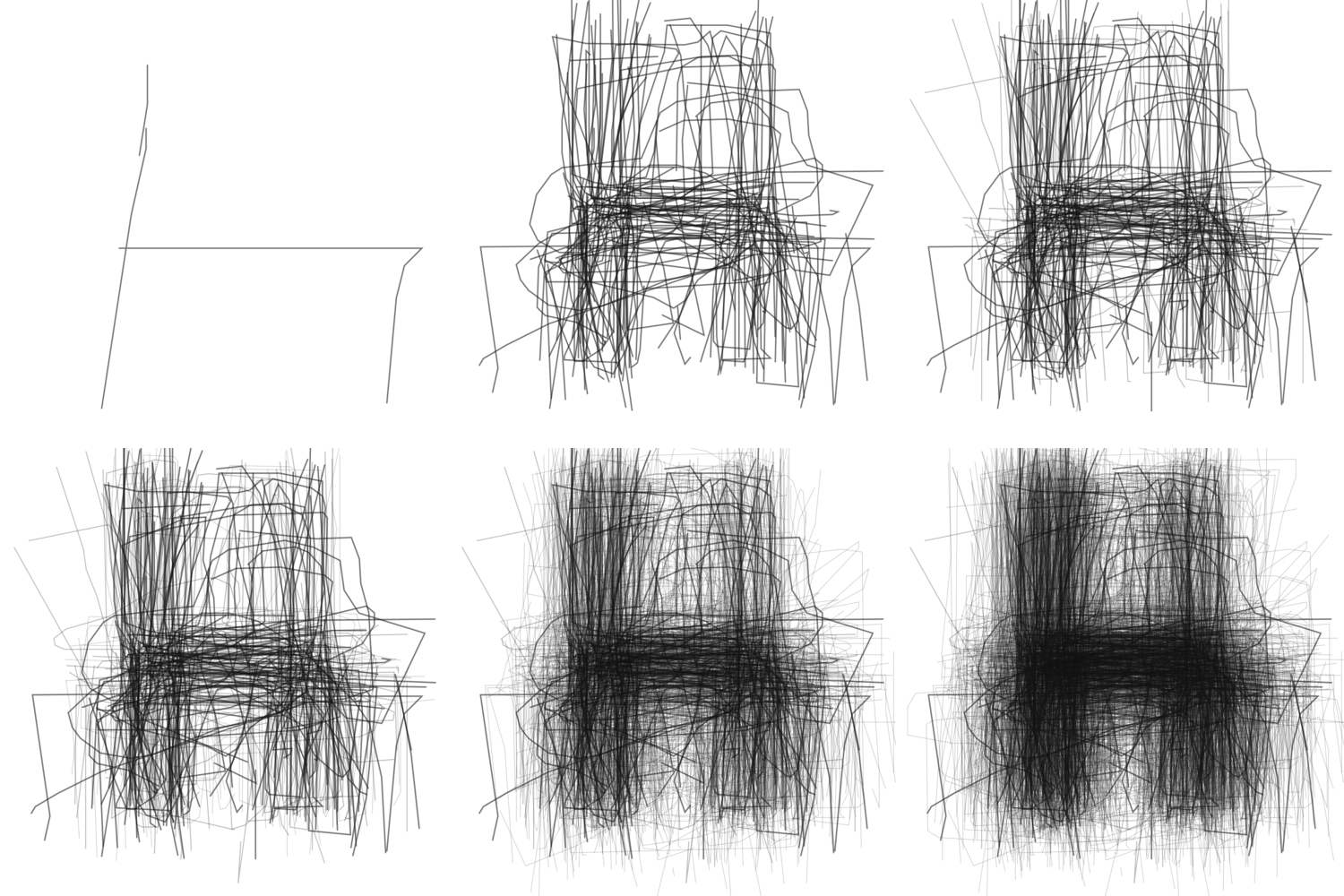
| − | <b> | + | <b>Learning To See [Part 9: Bias Variance Throwdown] |
| − | </b><br> | + | </b><br>In this series, we'll explore the complex landscape of machine learning and artificial intelligence through one example from the field of computer vision: using a decision tree to count the number of fingers in an image. It's gonna be crazy. |
|} | |} | ||
|}<!-- B --> | |}<!-- B --> | ||
| Line 73: | Line 73: | ||
|| | || | ||
<youtube>HetFihsXSys</youtube> | <youtube>HetFihsXSys</youtube> | ||
| − | <b> | + | <b>Bias in an Artificial Neural Network explained | How bias impacts training |
| − | </b><br> | + | </b><br>When reading up on artificial neural networks, you may have come across the term “bias.” It’s sometimes just referred to as bias. Other times you may see it referenced as bias nodes, bias neurons, or bias units within a neural network. We’re going to break this bias down and see what it’s all about. We’ll first start out by discussing the most obvious question of, well, what is bias in an artificial neural network? We’ll then see, within a network, how bias is implemented. Then, to hit the point home, we’ll explore a simple example to illustrate the impact that bias has when introduced to a neural network. |
|} | |} | ||
|<!-- M --> | |<!-- M --> | ||
| Line 81: | Line 81: | ||
|| | || | ||
<youtube>lpkSGTT8uMg</youtube> | <youtube>lpkSGTT8uMg</youtube> | ||
| − | <b> | + | <b>Bias Variance Trade off |
| − | </b><br> | + | </b><br>Bias Variance Trade off is an important concept when it comes to choosing a machine learning algorithm for you problem. Bias is the expectation in error and variance is the variability in the model. In this tutorial we look at why we need bias variance trade off, how it effects the accuracy and how to optimally select bias and variance and avoid over fitting and under fitting conditions. |
|} | |} | ||
|}<!-- B --> | |}<!-- B --> | ||
| Line 90: | Line 90: | ||
|| | || | ||
<youtube>PWCtoVt1CJM</youtube> | <youtube>PWCtoVt1CJM</youtube> | ||
| − | <b> | + | <b>How To Stop Artificial Intelligence From Marginalizing Communities? | Timnit Gebru | TEDxCollegePark |
| − | </b><br> | + | </b><br>Timnit Gebru, Stanford Alum and Co-Founder of Black in AI, shares remarkable insights to show how artificial intelligence is influencing thinking and decision-making in ways we didn't imagine and must counter before it further marginalizes people. Timnit works at Microsoft, New York in the Fairness Accountability Transparency and Ethics (FATE) Group where her team works on the complex social implications of AI, machine learning, data science, large-scale experimentation, and increasing automation. She previously worked at Stanford’s Artificial Intelligence Lab where she received her PhD, and is Co-Founder of Black in AI, an organization that aims to foster collaborations and discuss initiatives to increase the presence of Black people in the field of Artificial Intelligence. This talk was given at a TEDx event using the TED conference format but independently organized by a local community. Learn more at http://www.ted.com/tedx |
|} | |} | ||
|<!-- M --> | |<!-- M --> | ||
| Line 98: | Line 98: | ||
|| | || | ||
<youtube>g-z84_nRQhw</youtube> | <youtube>g-z84_nRQhw</youtube> | ||
| − | <b> | + | <b>The Emerging Theory of Algorithmic Fairness |
| − | </b><br> | + | </b><br>As algorithms reach ever more deeply into our daily lives, increasing concern that they be “fair” has resulted in an explosion of research in the theory and machine learning communities. This talk surveys key results in both areas and traces the arc of the emerging theory of algorithmic fairness. |
|} | |} | ||
|}<!-- B --> | |}<!-- B --> | ||
Revision as of 14:15, 7 September 2020
Youtube search... ...Google search
- Evaluation
- A Basic Recipe for Machine Learning | Hafidz Zulkifli
- Inductive Bias | Wikipedia
- Overfitting Challenge
- Data Science
- This is how AI bias really happens—and why it’s so hard to fix | Karen Hao
- Top 6 most common statistical errors made by data scientists | Richa Bhatia - Analytics India
- Data Science Concepts Explained to a Five-year-old | Megan Dibble - Toward Data Science
- Machine learning and bias | IBM AI Fairness 360 Open Source Toolkit extensible open source toolkit can help you examine, report, and mitigate discrimination and bias in machine learning models throughout the AI application lifecycle. Containing over 70 fairness metrics and 10 state-of-the-art bias mitigation algorithms
- Was your Uber, Lyft fare high because of algorithm bias? | Coral Murphy - USA TODAY
- Attacking discrimination with smarter machine learning | Martin Wattenberg, Fernanda Viegas, and Moritz Hardt
|
|
|
|
|
|
|
|