H2O
YouTube search... ...Google search
- Natural Language Processing (NLP)
- Driverless AI - Intro + Interactive Hands-on Lab:
- Pricing on AWS
- Natural Language Processing (NLP) in H2O Driverless AI
- Catch-up with the latest in Driverless AI
- H2O.ai Expands Driverless AI to New Class of Use Cases with Natural Language Processing
- Automatic Feature Engineering for Text Analytics – The Latest Addition to Our Kaggle Grandmasters’ Recipes
- The Making of a Real-World Moneyball
- Graphical Tools for Modeling AI Components
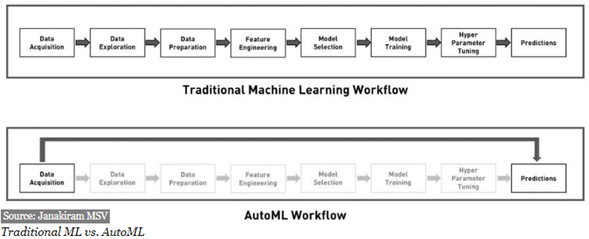
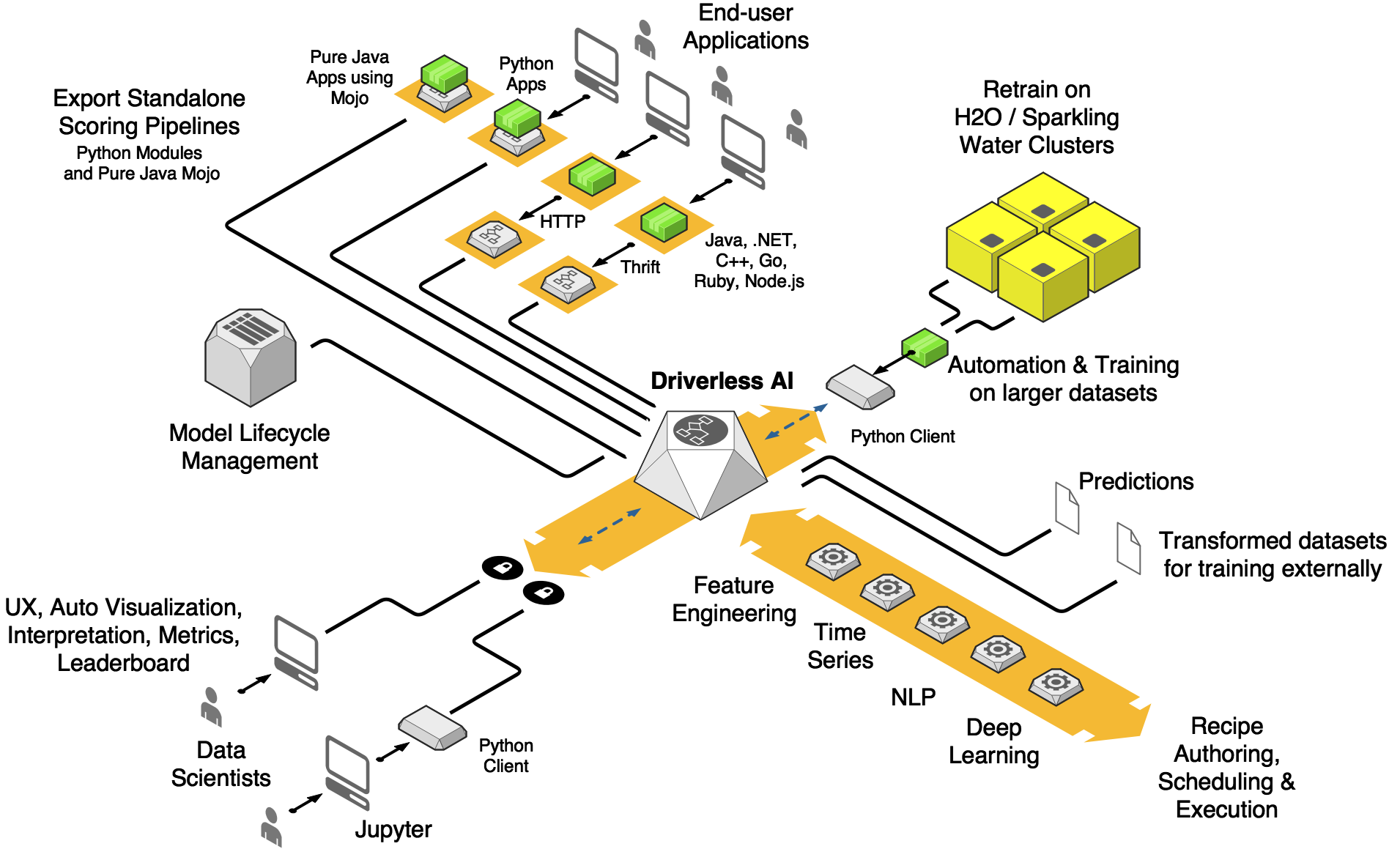
Driverless AI speeds up data science workflows by automating feature engineering, model tuning, ensembling, and model deployment. Driverless AI turns Kaggle-winning recipes into production-ready code and is specifically designed to avoid common mistakes such as under or overfitting, data leakage or improper model validation. Avoiding these pitfalls alone can save weeks or more for each model, and is necessary to achieve high modeling accuracy. With Driverless AI, everyone can now train and deploy modeling pipelines with just a few clicks from the GUI. Advanced users can use the client/server API through a variety of languages such as Python, Java, C++, go, C# and many more. To speed up training, Driverless AI uses highly optimized C++/CUDA algorithms to take full advantage of the latest compute hardware. For example, Driverless AI runs orders of magnitudes faster on the latest Nvidia GPU supercomputers on Intel and IBM platforms, both in the cloud or on-premise. There are two more product innovations in Driverless AI: statistically rigorous automatic data visualization and interactive model interpretation with reason codes and explanations in plain English. Both help data scientists and analysts to quickly validate the data and models.


Additional Driverless AI Overview and Resources
H2O DriverlessAI is an automatic machine learning platform which delivers unique and advanced functionality for data visualisation, feature engineering, model interpretability and low-latency deployment. There is no mandatory need of a data scientist to use this platform and can be used by everyone including junior data scientists, domain scientists, data engineers, etc. This platform works in such a way that the Driverless AI takes a raw dataset and automatically visualises interesting patterns for data exploration. It then applies automatic feature engineering to increase accuracy. Next, it auto-tunes model parameters and provides the user with the model that yields the best results. Lastly, it gives easy explanations of model results. 7 Machine Learning Tools For Non-Data Scientists | Ambika Choudhury
Related topics: