Quantum
YouTube search... ...Google search
- News
- Quantum Generative Adversarial Learning (QuGAN - QGAN)
- Processing Units - CPU, GPU, APU, TPU, VPU, FPGA, QPU
- Quirk a drag-and-drop quantum circuit simulator
- Wolfram Demonstrations Project - Quantum
- Math for Intelligence
- Quantum Computing for English Majors | John Horgan - Scientific American
- Quantum Algorithm Implementations for Beginners | P. Coles, S. Eidenbenz, S. Pakin, A. Adedoyin, J. Ambrosiano, P. Anisimov, W. Casper, G. Chennupati, C. Coffrin, H. Djidjev, D. Gunter, S. Karra, N. Lemons, S. Lin, A. Lokhov, A. Malyzhenkov, D. Mascarenas, S. Mniszewski, B. Nadiga, D. O'Malley, D. Oyen, L. Prasad, R. Roberts, P. Romero, N. Santhi, N. Sinitsyn, P. Swart, M. Vuffray, J. Wendelberger, B. Yoon, R. Zamora, and W. Zhu
- Simulating quantum systems with neural networks | Ecole Polytechnique Federale de Lausanne - PHYS.ORG
- Exploring Quantum Programming from "Hello World" to "Hello Quantum World" | Rahul Kumar - Hackernoon
- A Universal Training Algorithm for Quantum Deep Learning | G. Verdon, J. Pye, & M. Broughton
- ZapataComputing

Every quantum computer is fundamentally a sampler that starts with a simple probability distribution over all possible measurement outcomes, computes a more complicated distribution, and samples an outcome via a measurement. Quantum Machine Learning 1.0 | Maria Schuld - Xanadu - Medium
Quantum computing is a type of non-classical computing based on the quantum state of subatomic particles. It differs fundamentally from classic computers, which operate using binary bits. Basic properties of quantum world:
- Superposition - quantum computing uses quantum bits, or qubits. One qubit can represent a range of values, which is known as ‘superpositioning’; in addition the two states, 0 and 1, a quantum system can be in the two states at a time; the power to be a wave and a particle, at the same time.
- Entanglement - Qubits can also be linked together (known as “entanglement”). Each entangled qubit adds two additional dimensions to the system; the correlation of two or more system in a ensemble. Which means even if two two system are spatially separated the measurement of any observable will be effected by the other. Like having a twin where if one is affected then simultaneously so is the other. "Spooky action at a distance", Albert Einstein
- Quantum tunneling - able to bypass any barriers i.e move through walls
Contents
What Will We Do With Quantum Computing?
A large-scale quantum computer would be able to solve problems that existing classical computers would take much longer than the age of the universe to solve. This would have dramatic implications for cryptography, chemistry, material science, nuclear physics and probably other areas that are still un- known. But what about quantum computers that will be available in the next few years? What Will We Do With Quantum Computing?
Quantum computing could enable breakthroughs in:
- Machine learning: Improved ML through faster structured prediction. Examples include Boltzmann machines, quantum Boltzmann machines, semi-supervised learning, unsupervised learning and deep learning;
- Artificial intelligence: Faster calculations could improve perception, comprehension, and circuit fault diagnosis/binary classifiers;
- Chemistry: New fertilizers, catalysts, battery chemistry will all drive improvements in resource utilization;
- Biochemistry: New drugs, tailored drugs, and maybe even hair restorer;
- Finance: Quantum computing could enable faster, more complex Monte Carlo simulations; for example, trading, trajectory optimization, market instability, price optimization and hedging strategies;
- Healthcare: DNA gene sequencing, such as radiotherapy treatment optimization/brain tumor detection, could be performed in seconds instead of hours or weeks;
- Materials: super strong materials; corrosion proof paints; lubricants and semiconductors;
- Computer science: Faster multidimensional search functions; for example, query optimization, mathematics and simulations.
List source: The CIO’s guide to quantum computing | TechRadar Pro
Quantum Machine Learning (QML)
Quantum machine learning is an emerging interdisciplinary research area at the intersection of quantum physics and machine learning. The most common use of the term refers to machine learning algorithms for the analysis of classical data executed on a quantum computer, i.e. quantum-enhanced machine learning. While machine learning algorithms are used to compute immense quantities of data, quantum machine learning increases such capabilities intelligently, by creating opportunities to conduct analysis on quantum states and systems. This includes hybrid methods that involve both classical and quantum processing, where computationally difficult subroutines are outsourced to a quantum device. These routines can be more complex in nature and executed faster with the assistance of quantum devices. Furthermore, quantum algorithms can be used to analyze quantum states instead of classical data. Quantum machine learning | Wikipedia
Quantum Neural Network (QNN)
Quantum neural networks (QNNs) are neural network models which are based on the principles of quantum mechanics. There are two different approaches to QNN research, one exploiting quantum information processing to improve existing neural network models (sometimes also vice versa), and the other one searching for potential quantum effects in the brain. Quantum Neural Network (QNN) | Wikipedia
Quantum Convolutional Neural Network (QCNN)
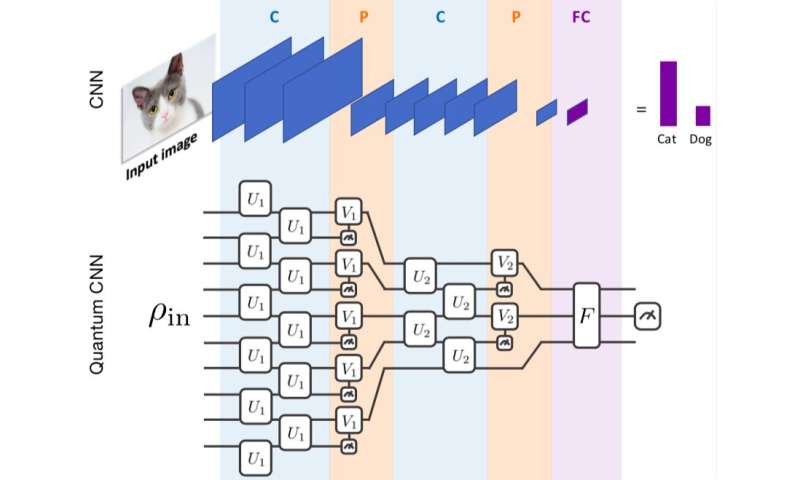
Machine learning techniques have so far proved to be very promising for the analysis of data in several fields, with many potential applications. However, researchers have found that applying these methods to quantum physics problems is far more challenging due to the exponential complexity of many-body systems.... "One of the objectives of the present work was to generalize a specific, well-known machine learning architecture called convolutional neural network (CNN) for a compact quantum circuit, and demonstrate its capabilities with simplistic but meaningful examples." In their study, Choi and his colleagues assumed that CNNs owe their great success to two important features. Firstly, the fact that they are made out of smaller local units (i.e., multiple layers of quasi-local quantum gates). Secondly, their ability to process input data in a hierarchical fashion. The researchers found a connection between these two characteristics and two renowned physics concepts known as locality and renormalization. "Locality is natural in physics because we believe that the law of nature is fundamentally local," Choi said. "Renormalization, on the other hand, is a very interesting concept. In physics, certain universal features of a quantum many-body system, such as the phase (e.g., liquid, gas, solid, etc.) of materials do not depend on (or are not sensitive to) microscopically detailed information of the system, but rather governed by only a few important hidden parameters. Renormalization is a theory technique to identify those important parameters starting from microscopic description of a quantum system." The researchers observed that renormalization processes share some similarities with pattern recognition applications, particularly those in which machine learning is used to identify objects in pictures. For instance, when a CNN trained for pattern recognition tasks analyzes pictures of animals, it focuses on a universal feature (i.e., trying to identify what animal is portrayed in the image), regardless of whether individual animals of the same type (e.g., cats) look slightly different. This process is somewhat similar to renormalization techniques in theoretical physics, which can also help to distill universal information....quantum convolutional neural network (QCNN), on a quantum physics-specific problem that involved recognizing quantum states associated with a 1-D symmetry protected topological phase. Remarkably, their technique was able to recognize these quantum states, outperforming existing approaches. As it is fairly compact, the QCNN could also potentially be implemented in small quantum computers. Introducing Quantum Convolutional Neural Networks (QCNN) | Ingrid Fadelli
Getting Started with Quantum Programming
Quantum Development Algorithms & Kits
Qiskit
Youtube search... ...Google search
- Qiskit is an open-source quantum computing software development framework for leveraging today's quantum processors;
- Learn Quantum Computation using Qiskit A university quantum algorithms/computation course supplement based on Qiskit
- How to program a quantum computer | James Wootton
- A developer’s guide to using the Quantum QISKit SDK | IBM
- Open Quantum Assembly Language (OpenQASM) an intermediate representation for quantum instructions.
- IBM Q 16 Rueschlikon V1.x.x The connectivity on the device is provided by total 22 coplanar waveguide (CPW) "bus" resonators, each of which connects two qubits. The connectivity configuration is shown in the figure below; the colored dots indicate qubits, and the colored bars indicate CPW bus resonators. Three different resonant frequencies are used for the bus resonators. The white bars indicate the buses with a resonant frequency of 6.25 GHz, the grey bars 6.45 GHz, and the black bars 6.65 GHz.
- Use a minute of a quantum computer: To access this chipset you will need an account on IBM Quantum Experience. And then generate the token from here.


Microsoft Quantum Development Kit
Youtube search... ...Google search
- Quantum Development Kit | Microsoft
- The Q# Programming Language | Microsoft
- Quantum Development Kit Update brings Q# to Jupyter Notebooks | Microsoft
- Teleport Juypter Notebook Quantum teleportation provides a way of moving a quantum state from one location to another without having to move physical particle(s) along with it. This is done with the help of previously shared quantum entanglement between the sending and the receiving locations and classical communication. To see how to implement this in Q#, we first define a Teleport Q# operation that transfers the state of one qubit into another.
Cirq
Youtube search... ...Google search
- Cirq - a Python library for writing, manipulating, and optimizing quantum circuits and running them against quantum computers and simulators. | Google]
A python framework for creating, editing, and invoking Noisy Intermediate Scale Quantum (NISQ) circuits.
Strawberry Fields
Youtube search... ...Google search
- Strawberry Fields - is a full-stack Python library for designing, simulating, and optimizing continuous variable quantum optical circuits. | Xanadu
- Quantum Machine Learning 1.0 | Maria Schuld - Xanadu - Medium
- An open-source software architecture for photonic quantum computing
- A full-stack quantum software platform, implemented in Python specifically targeted to the CV model
- Quantum circuits are written using the easy-to-use and intuitive Blackbird quantum programming language
- Powers the Strawberry Fields Interactive web app, which allows anyone to run a quantum computing simulation via drag and drop
- Includes quantum computer simulators implemented using NumPy and Tensorflow - these built-in quantum compiler tools convert and optimize Blackbird code for classical simulation
- Future releases will aim to target experimental backends, including photonic quantum computing chips


PennyLane
Youtube search... ...Google search
- PennyLane | Xanadu
- Training quantum neural networks with PennyLane, PyTorch, and TensorFlow | Medium
- PennyLane documentation | Xanadu
- pennylane-pq
Contains the PennyLane ProjectQ plugin. This plugin provides three devices to work with PennyLane - the ProjectQ IBM device, the ProjectQ quantum simulator, and the ProjectQ classical simulator.
- PennyLane ProjectQ Plugin | Xanadu This PennyLane plugin allows to use both the software and hardware backends of ProjectQ as devices for PennyLane.
PennyLane is a cross-platform Python library for quantum machine learning, automatic differentiation, and optimization of hybrid quantum-classical computations.
ProjectQ
Youtube search... ...Google search
ProjectQ is an open-source compilation framework capable of targeting various types of hardware and a high-performance quantum computer simulator with emulation capabilities, and various compiler plug-ins.
Forest - PyQuil
Youtube search... ...Google search
- Forest SDK - ightweight, downloadable SDK includes a powerful QVM that runs locally. It's the perfect place to start quantum programming | Rigetti Computing
- PyQuil Python library for quantum programming using Quil | Rigetti Computing
- [http://medium.com/rigetti/how-to-write-a-quantum-program-in-10-lines-of-code-for-beginners-540224ac6b45 How to write a quantum program in 10 lines of code (for beginners); Build an 8-sided dice that runs on a quantum computer | Dave Yen - Rigetti Computing
PyQuil serves three main functions:
- Easily generating Quil programs from quantum gates and classical operations
- Compiling and simulating Quil programs using the Quil Compiler (quilc) and the Quantum Virtual Machine (QVM)
- Executing Quil programs on real quantum processors (QPUs) using Quantum Cloud Services (QCS)
Qilimanjaro
Youtube search... ...Google search
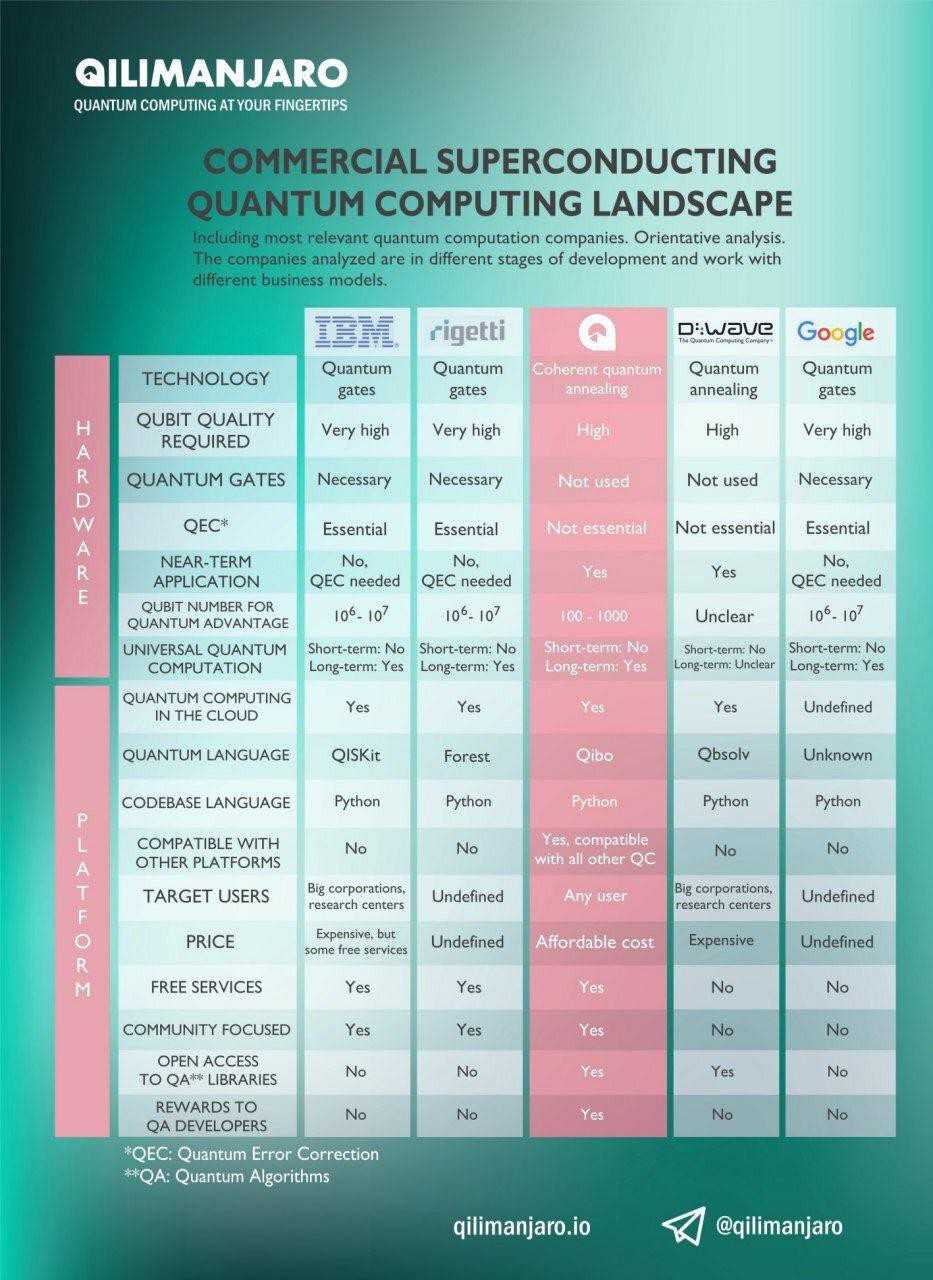
- Qilimanjaro build a unique first-to-market full-stack coherent quantum annealing computer with an easy-to-use advanced algorithmic toolset to effectively address complex optimization problems in multiple real-world industry use cases.
- Address existing quantum hardware platforms
- Development of HPC quantum simulators
- Cloud access to quantum computing resources
- Long qubit coherence, low-system noise
- High connectivity qubit architecture
- Cost-effective solutions
- Quantum annealing programming: mapping mathematical models to device hardware
- For hard combinatorial optimization problems
D-Wave
Youtube search... ...Google search
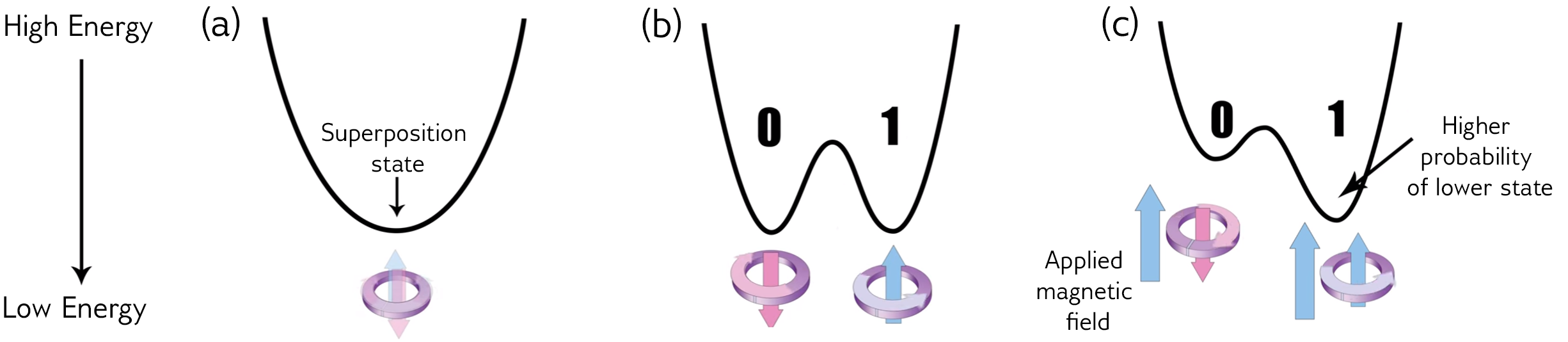
The quantum bits—also known as qubits—are the lowest energy states of the superconducting loops that make up the D-Wave QPU. These states have a circulating current and a corresponding magnetic field. As with classical bits, a qubit can be in state of 0 or 1. But because the qubit is a quantum object, it can also be in a superposition of the 0 state and the 1 state at the same time. At the end of the quantum annealing process, each qubit collapses from a superposition state into either 0 or 1 (a classical state). The physics of this process can be shown (visualized) with an energy diagram. This diagram changes over time, as we can see in (a), (b), and (c). To begin, there is just one valley (a), with a single minimum. The quantum annealing process runs, the barrier is raised, and this turns the energy diagram into what is known as a double-well potential (b). Here, the low point of the left valley corresponds to the 0 state, and the low point of the right valley corresponds to the 1 state. The qubit ends up in one of these valleys at the end of the anneal. Introduction to Quantum Annealing | D-Wave
- D-Wave
- Leap Hands-on coding: interactive examples and Jupyter notebooks with live code, equations, visualizations, and narrative text. Learning resources: comprehensive live demos and educational resources. Community support: community and technical forums for developer collaboration
- Ocean software development kit (SDK) with suite of open source Python tools and templates
- Use a minute of a quantum computer: Submitting a Problem to the D-Wave System free, immediate access to a D-Wave 2000Q quantum computer
Simulating and Graphing
QuTIP
Youtube search... ...Google search
QuTiP is open-source software for simulating the dynamics of open quantum systems. The QuTiP library depends on the excellent Numpy, SciPy, and Cython numerical packages. In addition, graphical output is provided by Matplotlib. QuTiP aims to provide user-friendly and efficient numerical simulations of a wide variety of Hamiltonians, including those with arbitrary time-dependence, commonly found in a wide range of physics applications such as quantum optics, trapped ions, superconducting circuits, and quantum nanomechanical resonators. QuTiP is freely available for use and/or modification on all major platforms such as Linux, Mac OSX, and Windows*. Being free of any licensing fees, QuTiP is ideal for exploring quantum mechanics and dynamics in the classroom.
Quantum Algorithms
- Quantum Computing for English Majors | John Horgan - Scientific American
- Quantum Algorithm Implementations for Beginners | P. Coles, S. Eidenbenz, S. Pakin, A. Adedoyin, J. Ambrosiano, P. Anisimov, W. Casper, G. Chennupati, C. Coffrin, H. Djidjev, D. Gunter, S. Karra, N. Lemons, S. Lin, A. Lokhov, A. Malyzhenkov, D. Mascarenas, S. Mniszewski, B. Nadiga, D. O'Malley, D. Oyen, L. Prasad, R. Roberts, P. Romero, N. Santhi, N. Sinitsyn, P. Swart, M. Vuffray, J. Wendelberger, B. Yoon, R. Zamora, and W. Zhu
Grover's Search
Shor's Period Finding Algorithm
Courses
Learn Quantum Computation using Qiskit
- Qiskit Textbook: Learn Quantum Computation using Qiskit A university quantum algorithms/computation course supplement based on Qiskit
- Qiskit Education | IBM
University of Toronto
In this course we will introduce several quantum machine learning algorithms and implement them in Python. This massively open online online course (MOOC) on edX is offered by the University of Toronto on edX with an emphasis on what benefits current and near-future quantum technologies may bring to machine learning. These notebooks contain the lecture notes and the code for the course. The content is organized in four modules, with an additional introductory module to the course itself. Since the course is hands-on, we found it important that you can try the code on actual quantum computers if you want to. There isn't a single, unified programming framework that would allow to address all available quantum hardware. For this reason, the notebooks are available in two versions: one in Qiskit targeting the IBM Q hardware and the Forest SDK targetting the Rigetti quantum computer. The notebooks also cover quantum annealing -- for that, the D-Wave Ocean Suite is used. For more details on setting up your computational environment locally, refer to the notebooks in Module 0.
QuTech Academy
"QuTech gives students a large perspective of what is happening in the field of quantum!" Discover quantum computers and the quantum internet. Learn the principles and promises behind these developments and how they will impact our future in 2 new online courses. The course Quantum Computers and Quantum Internet: How can they change the world? will dive into the potential impact of a quantum computer and a quantum internet. The course Building Blocks of a Quantum Computer will give you insight in the several layers of a quantum computer, ranging from qubits to software. Both courses are available on EdX.org.
Quantum Supremacy
Quantum supremacy is the potential ability of quantum computing devices to solve problems that classical computers practically cannot. Experts forecast that quantum supremacy will become a reality within a matter of years for a limited number of computing problems.
Exploring Quantum History
Albert Einstein was not a fan of quantum mechanics. He was annoyed by the uncertain, random nature of the universe it implied (hence the famous quote "God does not play dice with the universe"). So, Einstein tried to develop a unified theory that would circumvent what he saw as quantum mechanics' flaws; the "unruly child" of quantum mechanics, and how the famed physicist came up with the Special Theory of Relativity.
Quantum Double Slit Experiment
One of the deepest mysteries in quantum physics is the wave-particle duality: every quantum object has properties of both a wave and a particle. Nowhere is this effect more beautifully demonstrated than in the double-slit experiment: streams of particles, photons and electrons are directed at a barrier with two narrow openings. While each particle shows up at the detector individually, the population as a whole creates an interference pattern as though they are waves. Neither a pure wave nor a pure particle description has proven successful in explaining these experiments.
Quantum laser pointers brings you the infamous double slit experiment right in the palm of your hand. In 1801 English physicist Thomas Young performed this experiment to determine if light was a particle or a wave. A laser shines a coherent beam of light through a film disc containing two parallel slits. Light striking the wall behind the slits producers a classic interference pattern. This surprising result means light passes through the parallel slits not as particles but as waves. When the peaks of two waves overlap it creates a band of light. When the peak of one wave meets the valley of another, light is cancelled out. Variations of this experiment spurred public debates between Albert Einstein and Neils Bohr on the true nature of reality. It’s been called the granddaddy of all quantum weirdness.
