Difference between revisions of "Hierarchical Reinforcement Learning (HRL)"
(→HIerarchical Reinforcement learning with Off-policy correction (HIRO)) |
|||
| Line 35: | Line 35: | ||
== HIerarchical Reinforcement learning with Off-policy correction (HIRO) == | == HIerarchical Reinforcement learning with Off-policy correction (HIRO) == | ||
| + | * [http://towardsdatascience.com/advanced-reinforcement-learning-6d769f529eb3 Beyond DQN/A3C: A Survey in Advanced Reinforcement Learning | Joyce Xu - Towards Data Science] | ||
| + | * [http://arxiv.org/pdf/1805.08296.pdf Data-Efficient Hierarchical Reinforcement Learning | O. Nachum, S. Gu, H. Lee, and S. Levine - Google Brain] | ||
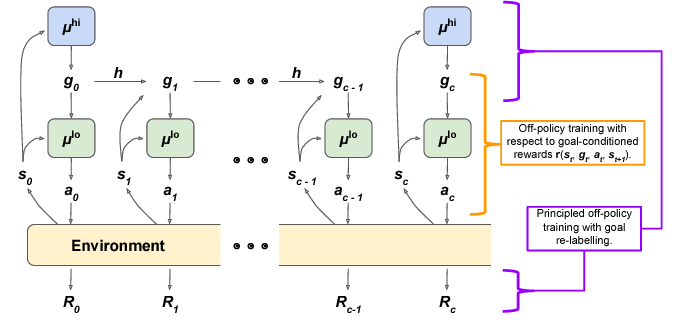
| + | HIRO can be used to learn highly complex behaviors for simulated robots, such | ||
| + | as pushing objects and utilizing them to reach target locations, learning from only a few million samples, equivalent to a few days of real-time interaction. In comparisons with a number of prior HRL methods. | ||
http://miro.medium.com/max/678/1*Fq-TQ7Mu2XDOIZ6R7dkRjw.png | http://miro.medium.com/max/678/1*Fq-TQ7Mu2XDOIZ6R7dkRjw.png | ||
Revision as of 16:41, 1 September 2019
Youtube search... ...Google search
- HIerarchical Reinforcement learning with Off-policy correction (HIRO)
- The Promise of Hierarchical Reinforcement Learning | Yannis Flet-Berliac - The Gradient
- Hierarchical Reinforcement Learning | David Jardim
- Reinforcement Learning (RL):
- Monte Carlo (MC) Method - Model Free Reinforcement Learning
- Markov Decision Process (MDP)
- Q Learning
- State-Action-Reward-State-Action (SARSA)
- Deep Reinforcement Learning (DRL) DeepRL
- Distributed Deep Reinforcement Learning (DDRL)
- Deep Q Network (DQN)
- Evolutionary Computation / Genetic Algorithms
- Asynchronous Advantage Actor Critic (A3C)
- MERLIN
HIerarchical Reinforcement learning with Off-policy correction (HIRO)
- Beyond DQN/A3C: A Survey in Advanced Reinforcement Learning | Joyce Xu - Towards Data Science
- Data-Efficient Hierarchical Reinforcement Learning | O. Nachum, S. Gu, H. Lee, and S. Levine - Google Brain
HIRO can be used to learn highly complex behaviors for simulated robots, such as pushing objects and utilizing them to reach target locations, learning from only a few million samples, equivalent to a few days of real-time interaction. In comparisons with a number of prior HRL methods.