Difference between revisions of "Math for Intelligence"
(→Gilbert Strang (MIT) - Linear Algebra) |
m |
||
| Line 1: | Line 1: | ||
[http://www.youtube.com/results?search_query=mathematics+machine+artificial+intelligence+deep+learning+simple YouTube search...] | [http://www.youtube.com/results?search_query=mathematics+machine+artificial+intelligence+deep+learning+simple YouTube search...] | ||
| + | [http://www.google.com/search?q=mathematics+deep+machine+learning+ML ...Google search] | ||
* [http://www.3blue1brown.com/ Animated Math | Grant Sanderson @ 3blue1brown.com] | * [http://www.3blue1brown.com/ Animated Math | Grant Sanderson @ 3blue1brown.com] | ||
Revision as of 05:09, 13 December 2018
YouTube search... ...Google search
- Animated Math | Grant Sanderson @ 3blue1brown.com
- Introduction to Matrices and Matrix Arithmetic for Machine Learning | Jason Brownlee
- Brilliant.org
- Varient: Limits
- Probability Cheatsheet
Contents
Getting Started
3blue1brown
Explained
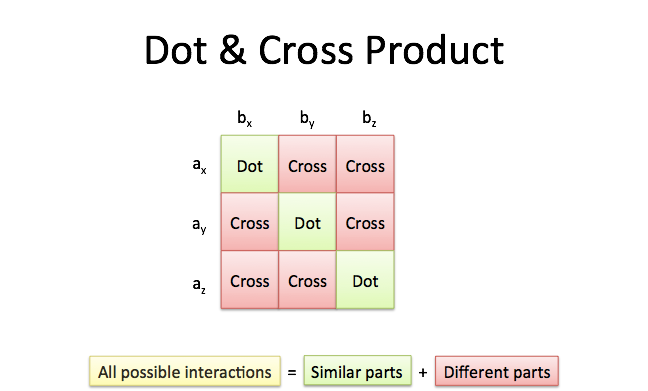
Dot Product
- http://en.wikipedia.org/wiki/Dot_product Dot Product | Wikipedia]
Dot Product =
- Algebraically, the dot product is the sum of the products of the corresponding entries of the two sequences of numbers.
- Geometrically, it is the product of the Euclidean magnitudes of the two vectors and the cosine of the angle between them.

Siraj Raval
Josh Starmer - StatQuest
Gilbert Strang (MIT) - Linear Algebra
Quantum Algorithm
