Difference between revisions of "Math for Intelligence"
(→Dot Product Explained) |
m |
||
| Line 54: | Line 54: | ||
<youtube>pYxNSUDSFH4</youtube> | <youtube>pYxNSUDSFH4</youtube> | ||
| − | |||
| − | |||
== Dot Product == | == Dot Product == | ||
| Line 71: | Line 69: | ||
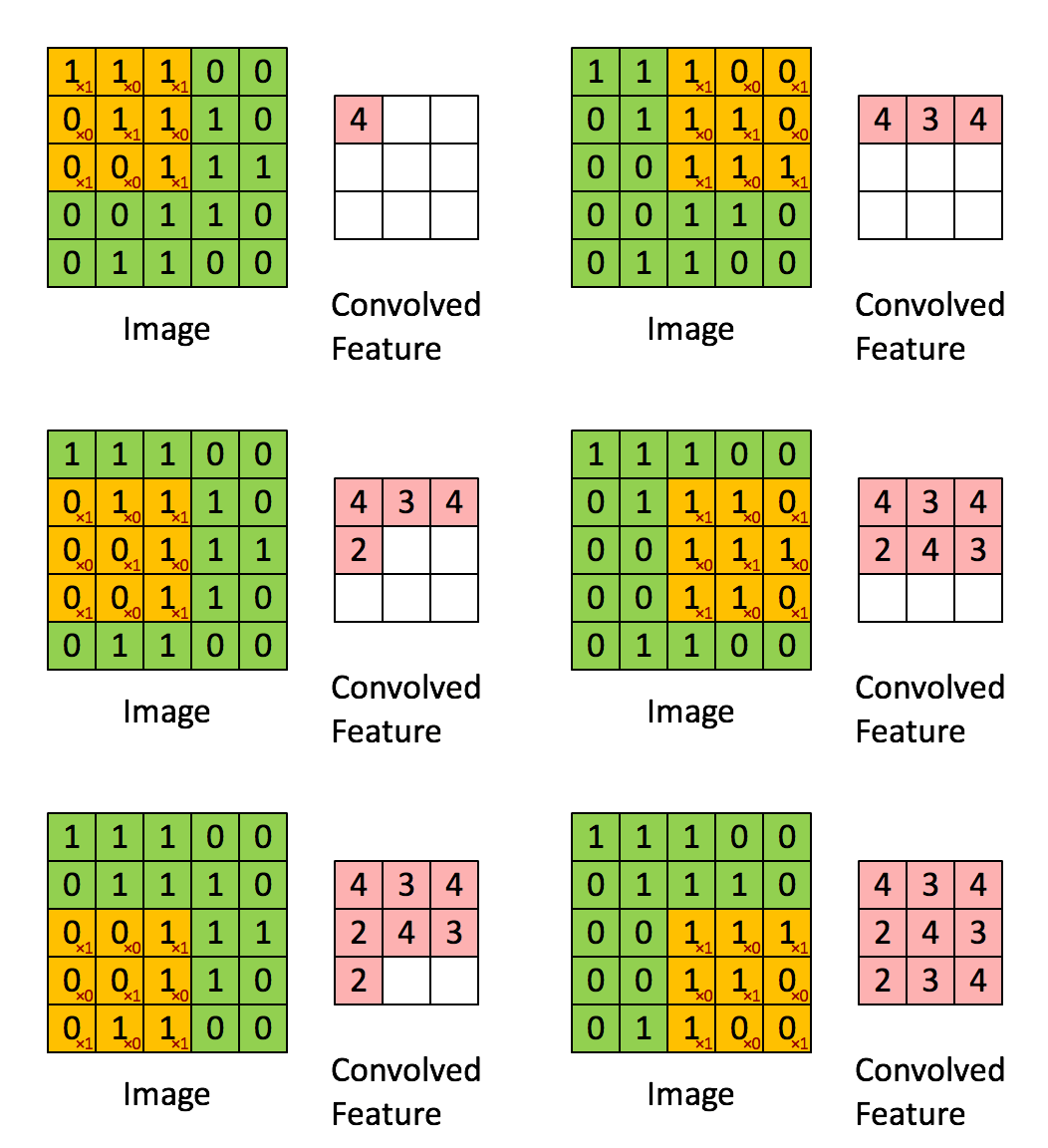
http://3qeqpr26caki16dnhd19sv6by6v-wpengine.netdna-ssl.com/wp-content/uploads/2017/12/Depection-of-Matrix-Multiplication.png | http://3qeqpr26caki16dnhd19sv6by6v-wpengine.netdna-ssl.com/wp-content/uploads/2017/12/Depection-of-Matrix-Multiplication.png | ||
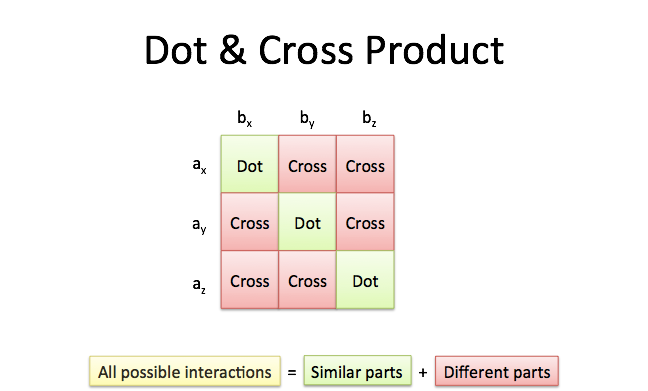
http://betterexplained.com/wp-content/uploads/crossproduct/cross-product-grid.png | http://betterexplained.com/wp-content/uploads/crossproduct/cross-product-grid.png | ||
| + | |||
| + | == Quantum Algorithm == | ||
| + | <youtube>LhtnECml-KI</youtube> | ||
Revision as of 08:45, 9 December 2018
- Animated Math | Grant Sanderson @ 3blue1brown.com
- Introduction to Matrices and Matrix Arithmetic for Machine Learning | Jason Brownlee
- Brilliant.org
- Varient: Limits
- Probability Cheatsheet
Contents
3blue1brown
Explained
Siraj Raval
Josh Starmer - StatQuest
Dot Product
- http://en.wikipedia.org/wiki/Dot_product Dot Product | Wikipedia]
Dot Product =
- Algebraically, the dot product is the sum of the products of the corresponding entries of the two sequences of numbers.
- Geometrically, it is the product of the Euclidean magnitudes of the two vectors and the cosine of the angle between them.

Quantum Algorithm
