Difference between revisions of "Manifold Hypothesis"
m (→Manifold Learning) |
m (→Manifold Learning) |
||
| Line 62: | Line 62: | ||
Manifold learning is an approach to non-linear dimensionality reduction. Algorithms for this task are based on the idea that the dimensionality of many data sets is only artificially high. [http://scikit-learn.org/stable/modules/manifold.html#:~:text=Manifold%20learning%20is%20an%20approach,sets%20is%20only%20artificially%20high. Manifold learning | SciKitLearn] | Manifold learning is an approach to non-linear dimensionality reduction. Algorithms for this task are based on the idea that the dimensionality of many data sets is only artificially high. [http://scikit-learn.org/stable/modules/manifold.html#:~:text=Manifold%20learning%20is%20an%20approach,sets%20is%20only%20artificially%20high. Manifold learning | SciKitLearn] | ||
| + | |||
| + | <youtube>MnRskV3NY1k</youtube> | ||
| + | <youtube>K6UCnJzIfY0</youtube> | ||
= Manifold Alignment = | = Manifold Alignment = | ||
Revision as of 15:22, 16 September 2023
Youtube search... ...Google search
- Backpropagation ... FFNN ... Forward-Forward ... Activation Functions ...Softmax ... Loss ... Boosting ... Gradient Descent ... Hyperparameter ... Manifold Hypothesis ... PCA
- Embedding ... Fine-tuning ... RAG ... Search ... Clustering ... Recommendation ... Anomaly Detection ... Classification ... Dimensional Reduction. ...find outliers
- Objective vs. Cost vs. Loss vs. Error Function
- Optimization Methods
- Embedding ... Fine-tuning ... RAG ... Search ... Clustering ... Recommendation ... Anomaly Detection ... Classification ... Dimensional Reduction. ...find outliers
- Manifold Wikipedia
- Manifolds and Neural Activity: An Introduction | Kevin Luxem - Towards Data Science
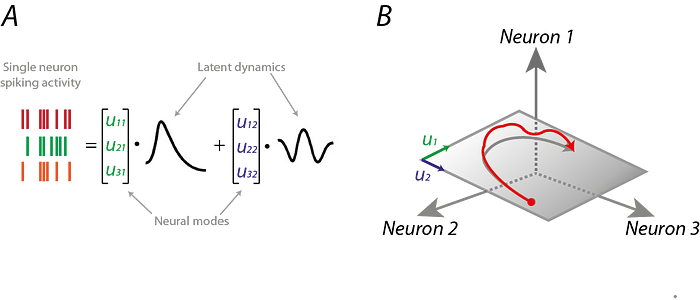
The Manifold Hypothesis states that real-world high-dimensional data (images, neural activity) lie on low-dimensional manifolds
manifolds embedded within the high-dimensional space. ...manifolds are topological spaces that look locally like Euclidean spaces.
The Manifold Hypothesis explains (heuristically) why machine learning techniques are able to find useful features and produce accurate predictions from datasets that have a potentially large number of dimensions ( variables). The fact that the actual data set of interest actually lives on in a space of low dimension, means that a given machine learning model only needs to learn to focus on a few key features of the dataset to make decisions. However these key features may turn out to be complicated functions of the original variables. Many of the algorithms behind machine learning techniques focus on ways to determine these (embedding) functions. What is the Manifold Hypothesis? | DeepAI
|
|
Manifold Learning
Manifold learning is an approach to non-linear dimensionality reduction. Algorithms for this task are based on the idea that the dimensionality of many data sets is only artificially high. Manifold learning | SciKitLearn
Manifold Alignment
Manifold - Defenses Against Adversarial Attacks
The reformer network moves adversarial examples towards the manifold of normal examples, which is effective for correctly classifying adversarial examples with small perturbation.
