Difference between revisions of "Hierarchical Clustering; Agglomerative (HAC) & Divisive (HDC)"
m |
m |
||
| Line 26: | Line 26: | ||
http://i1.wp.com/r-posts.com/wp-content/uploads/2017/12/Agnes.png | http://i1.wp.com/r-posts.com/wp-content/uploads/2017/12/Agnes.png | ||
| − | + | {|<!-- T --> | |
| + | | valign="top" | | ||
| + | {| class="wikitable" style="width: 550px;" | ||
| + | || | ||
<youtube>2z5wwyv0Zk4</youtube> | <youtube>2z5wwyv0Zk4</youtube> | ||
| − | < | + | <b>Hierarchical Clustering (Agglomerative and Divisive Clustering) |
| + | </b><br>Noureddin Sadawi www.imperial.ac.uk/people/n.sadawi | ||
| + | |} | ||
== Agglomerative Clustering - Bottom Up == | == Agglomerative Clustering - Bottom Up == | ||
Revision as of 07:09, 15 September 2020
Youtube search... ...Google search
- AI Solver
- Capabilities
- Clustering
- Hierarchical Cluster Analysis (HCA)
- Hierarchical Temporal Memory (HTM)
- K-Means
- How to Perform Hierarchical Clustering using R | Perceptive Analytics
- Exploreing K-Means with Internal Validity Indexes for Data Clustering in Traffic Management System | S. Nawrin, S. Akhter and M. Rahatur
Hierarchical clustering algorithms actually fall into 2 categories:
- Agglomerative (HAC - AGNES); bottom-up, first assigns every example to its own cluster, and iteratively merges the closest clusters to create a hierarchical tree.
- Divisive (HDC - DIANA); top-down, first groups all examples into one cluster and then iteratively divides the cluster into a hierarchical tree.

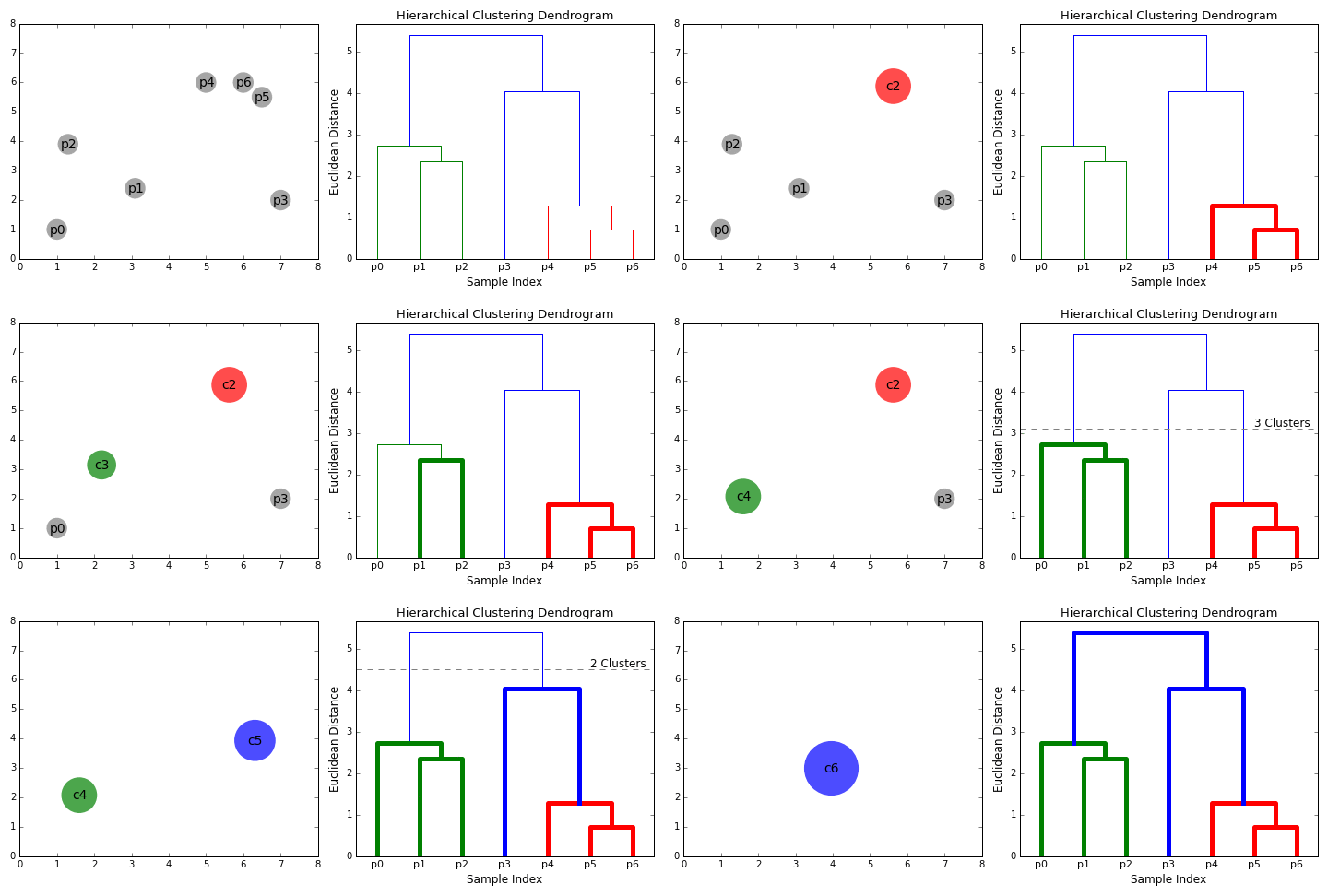
Agglomerative Clustering - Bottom UpBottom-up algorithms treat each data point as a single cluster at the outset and then successively merge (or agglomerate) pairs of clusters until all clusters have been merged into a single cluster that contains all data points. Bottom-up hierarchical clustering is therefore called hierarchical agglomerative clustering or HAC. This hierarchy of clusters is represented as a tree (or dendrogram). The root of the tree is the unique cluster that gathers all the samples, the leaves being the clusters with only one sample. The 5 Clustering Algorithms Data Scientists Need to Know | Towards Data Science Hierarchical clustering does not require us to specify the number of clusters and we can even select which number of clusters looks best since we are building a tree. Additionally, the algorithm is not sensitive to the choice of distance metric; all of them tend to work equally well whereas with other clustering algorithms, the choice of distance metric is critical. A particularly good use case of hierarchical clustering methods is when the underlying data has a hierarchical structure and you want to recover the hierarchy; other clustering algorithms can’t do this. These advantages of hierarchical clustering come at the cost of lower efficiency, as it has a time complexity of O(n³), unlike the linear complexity of K-Means and GMM.
Divisive Clustering = Top Down
|