|
|
| Line 38: |
Line 38: |
| | {| class="wikitable" style="width: 550px;" | | {| class="wikitable" style="width: 550px;" |
| | || | | || |
| − | <youtube>V7xvqfIEDXk</youtube> | + | <youtube>ZQElzjCsl9o</youtube> |
| − | <b>Love and Math an interview with Edward Frenkel | + | <b>Math is the hidden secret to understanding the world | Roger Antonsen |
| − | </b><br>UC Professor of mathematics Edward Frenkel describes the relationship of Love and Mathematics, calls for a more modern way of teaching math in schools, and talks of the principles and people that have advanced our understanding of Math as a window onto reality. Edward Frenkel is a professor of mathematics at the University of California, Berkeley, which he joined in 1997 after being on the faculty at Harvard University. He is a member of the American Academy of Arts and Sciences, a Fellow of the American Mathematical Society, and the winner of the Hermann Weyl Prize in mathematical physics. Frenkel has authored three books and over eighty scholarly articles in academic journals, and he has lectured on his work around the world. His YouTube videos have garnered over 4 million views combined. Frenkel’s latest book Love and Math was a New York Times bestseller and has been named one of the Best Books of the year by both [[Amazon]] and iBooks. It is being translated into 16 languages. Frenkel has also co-produced, co-directed and played the lead in the film Rites of Love and Math (2010). | + | </b><br>Unlock the mysteries and inner workings of the world through one of the most imaginative art forms ever -- mathematics -- with [http://rantonse.no/en Roger Antonsen], as he explains how a slight change in perspective can reveal patterns, numbers and formulas as the gateways to empathy and understanding. I am a logician, mathematician, computer scientist, author, public speaker, science communicator, and artist. You can find me at the University of Oslo, where I teach Logical Methods as an Associate Professor at the Department of Informatics in the research group Analytical Solutions and Reasoning (ASR), otherwise at UC Berkeley, California and ICERM at Brown University, where I am a Visiting Scholar. I am also engaged in various forms of science communication and outreach, which you may read about below. My academic interests are logical calculi, proof theory, mathematical logic, complexity theory, automata, combinatorics, philosophy of mathematics, visualizations, and mathematical art, but I am interested in most topics related to mathematics, computer science, art, and philosophy. |
| | |} | | |} |
| | |<!-- M --> | | |<!-- M --> |
| Line 63: |
Line 63: |
| | {| class="wikitable" style="width: 550px;" | | {| class="wikitable" style="width: 550px;" |
| | || | | || |
| − | <youtube>s_L-fp8gDzY</youtube> | + | <youtube>V7xvqfIEDXk</youtube> |
| − | <b>What Makes People Engage With Math | Grant Sanderson | TEDxBerkeley | + | <b>Love and Math an interview with Edward Frenkel |
| − | </b><br>Grant Sanderson (@3blue1brown) is the founder of the math outreach and education YouTube channel 3blue1brown, which has over two million subscribers and over 85 million total views. He’s collaborated with many other online educators, such as MinutePhysics, Smarter Every day, Ben Eater and more. The topics covered on the channel range from pure math, like prime numbers and strange occurrences of pi, to more applied topics, like neural networks, physics, and how cryptocurrencies work, and from topics commonly seen in school, like calculus, to ones outside a traditional curriculum, like fractal dimension. Grant Sanderson (@3blue1brown) is the founder of the math outreach and education YouTube channel 3blue1brown, which has over two million subscribers and over 85 million total views. He’s collaborated with many other online educators, such as MinutePhysics, Smarter Every day, Ben Eater and more. The topics covered on the channel range from pure math, like prime numbers and strange occurrences of pi, to more applied topics, like neural networks, physics, and how cryptocurrencies work, and from topics commonly seen in school, like calculus, to ones outside a traditional curriculum, like fractal dimension. This talk was given at a TEDx event using the TED conference format but independently organized by a local community. Learn more at https://www.ted.com/tedx | + | </b><br>UC Professor of mathematics Edward Frenkel describes the relationship of Love and Mathematics, calls for a more modern way of teaching math in schools, and talks of the principles and people that have advanced our understanding of Math as a window onto reality. Edward Frenkel is a professor of mathematics at the University of California, Berkeley, which he joined in 1997 after being on the faculty at Harvard University. He is a member of the American Academy of Arts and Sciences, a Fellow of the American Mathematical Society, and the winner of the Hermann Weyl Prize in mathematical physics. Frenkel has authored three books and over eighty scholarly articles in academic journals, and he has lectured on his work around the world. His YouTube videos have garnered over 4 million views combined. Frenkel’s latest book Love and Math was a New York Times bestseller and has been named one of the Best Books of the year by both [[Amazon]] and iBooks. It is being translated into 16 languages. Frenkel has also co-produced, co-directed and played the lead in the film Rites of Love and Math (2010). |
| − | | |
| | |} | | |} |
| | |}<!-- B --> | | |}<!-- B --> |
YouTube search...
...Google search
Getting Started
|
Math is the hidden secret to understanding the world | Roger Antonsen
Unlock the mysteries and inner workings of the world through one of the most imaginative art forms ever -- mathematics -- with Roger Antonsen, as he explains how a slight change in perspective can reveal patterns, numbers and formulas as the gateways to empathy and understanding. I am a logician, mathematician, computer scientist, author, public speaker, science communicator, and artist. You can find me at the University of Oslo, where I teach Logical Methods as an Associate Professor at the Department of Informatics in the research group Analytical Solutions and Reasoning (ASR), otherwise at UC Berkeley, California and ICERM at Brown University, where I am a Visiting Scholar. I am also engaged in various forms of science communication and outreach, which you may read about below. My academic interests are logical calculi, proof theory, mathematical logic, complexity theory, automata, combinatorics, philosophy of mathematics, visualizations, and mathematical art, but I am interested in most topics related to mathematics, computer science, art, and philosophy.
|
|
|
|
Mathematics is the sense you never knew you had | Eddie Woo | TEDxSydney
In this illuminating talk, high school mathematics teacher and YouTube star Eddie Woo shares his passion for mathematics, declaring that "mathematics is a sense, just like sight and touch" and one we can all embrace. Using surprising examples of geometry, he encourages everyone to seek out the patterns around us, for "a whole new way to see the world". A public high school teacher for more than 10 years, Eddie Woo gained international attention when he posted videos of his classroom lessons online, to assist an ill student. His YouTube channel, WooTube, has more than 200,000 subscribers and over 13 million views. Eddie believe that mathematics can be embraced and even enjoyed by absolutely everybody. He was named Australia's Local Hero and was a Top 10 Finalist in the Global Teacher Prize for his love of teaching mathematics. This talk was given at a TEDx event using the TED conference format but independently organized by a local community. Learn more at https://www.ted.com/tedx
|
|
|
How you can be good at math, and other surprising facts about learning | Jo Boaler | TEDxStanford
You have probably heard people say they are just bad at math, or perhaps you yourself feel like you are not “a math person.” Not so, says Stanford mathematics education professor Jo Boaler, who shares the brain research showing that with the right teaching and messages, we can all be good at math. Not only that, our brains operate differently when we believe in ourselves. Boaler gives hope to the the mathematically fearful or challenged, shows a pathway to success, and brings into question the very basics of how our teachers approach what should be a rewarding experience for all children and adults. Jo Boaler is a professor of mathematics education at Stanford and the co-founder of YouCubed, which provides resources and ideas to inspire and excite students about mathematics. She is also the author of the first massive open online course on mathematics teaching and learning. Her book Experiencing School Mathematics won the Outstanding Book of the Year award for education in Britain. A recipient of a National Science Foundation "early career award"' she was recently named by BBC as one of the eight educators changing the face of education. This talk was given at a TEDx event using the TED conference format but independently organized by a local community. Learn more at http://ted.com/tedx
|
|
|
|
Love and Math an interview with Edward Frenkel
UC Professor of mathematics Edward Frenkel describes the relationship of Love and Mathematics, calls for a more modern way of teaching math in schools, and talks of the principles and people that have advanced our understanding of Math as a window onto reality. Edward Frenkel is a professor of mathematics at the University of California, Berkeley, which he joined in 1997 after being on the faculty at Harvard University. He is a member of the American Academy of Arts and Sciences, a Fellow of the American Mathematical Society, and the winner of the Hermann Weyl Prize in mathematical physics. Frenkel has authored three books and over eighty scholarly articles in academic journals, and he has lectured on his work around the world. His YouTube videos have garnered over 4 million views combined. Frenkel’s latest book Love and Math was a New York Times bestseller and has been named one of the Best Books of the year by both Amazon and iBooks. It is being translated into 16 languages. Frenkel has also co-produced, co-directed and played the lead in the film Rites of Love and Math (2010).
|
|
Mathematics Ontology
|
The Map of Mathematics
The entire field of mathematics summarised in a single map! This shows how pure mathematics and applied mathematics relate to each other and all of the sub-topics they are made from.
|
|
|
|
Mind Map of Maths
LarryLemonMaths
|
|
Mathematics for Machine Learning | M. Deisenroth, A Faisal, and C. Ong .. Companion webpage ...
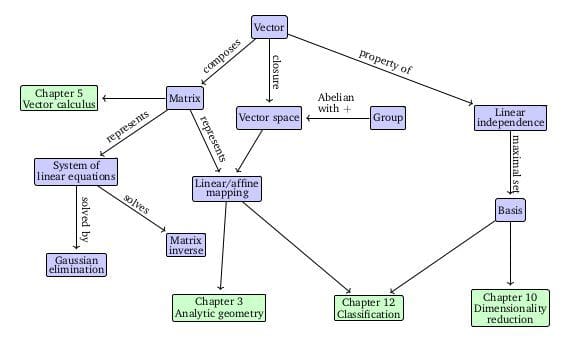
Scalar, Vector, Matrix & Tensor

Scalars
a single number. For example weight, which is denoted by just one number.
Vectors
are an array of numbers. The numbers are arranged in order and we can identify each individual number by its index in that ordering. We can think of vectors as identifying points in space, with each element giving the coordinate along a different axis. In simple terms, a vector is an arrow representing a quantity that has both magnitude and direction wherein the length of the arrow represents the magnitude and the orientation tells you the direction. For example wind, which has a direction and magnitude.
Matrices
A matrix is a 2D-array of numbers, so each element is identified by two indices instead of just one. If a real valued matrix A has a height of m and a width of n, then we say that A in Rm x n. We identify the elements of the matrix as A_(m,n) where m represents the row and n represents the column.
Tensors
In mathematics, a tensor is an algebraic object that describes a (multilinear) relationship between sets of algebraic objects related to a vector space. Objects that tensors may map between include vectors and scalars, and, recursively, even other tensors. Tensors can take several different forms – for example: scalars and vectors (which are the simplest tensors), dual vectors, multi-linear maps between vector spaces, and even some operations such as the dot product. Tensors are defined independent of any basis, although they are often referred to by their components in a basis related to a particular coordinate system. Wikipedia
3blue1brown
Explained
Siraj Raval
Gilbert Strang (MIT) - Linear Algebra
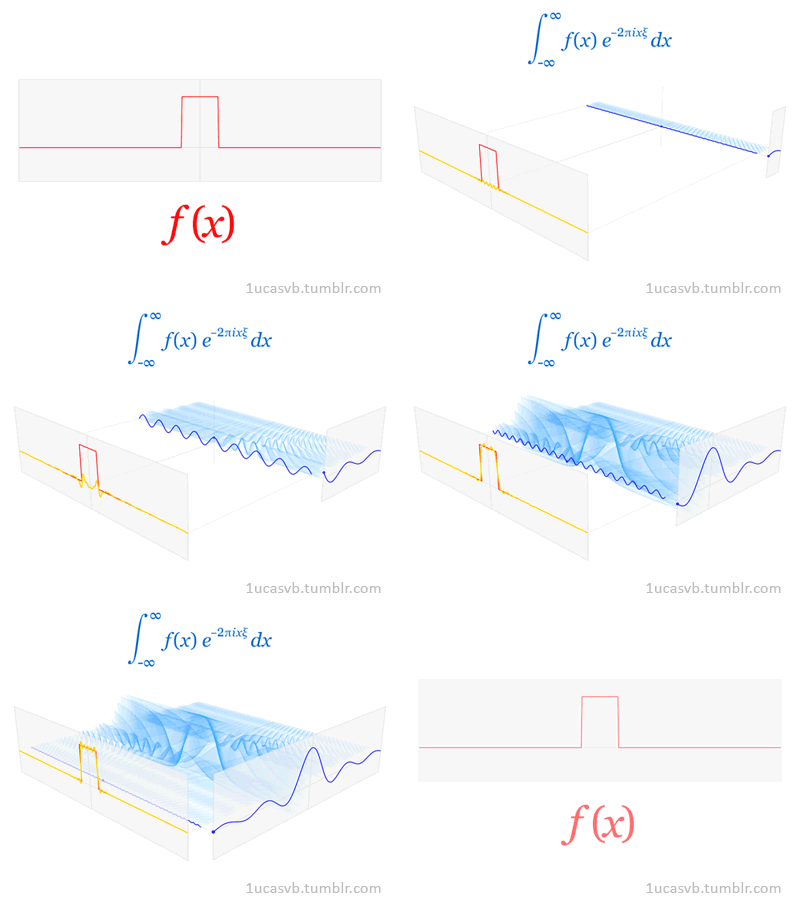
Fourier Transform (FT), Fourier Series, and Fourier Analysis
Joseph Fourier showed that representing a function as a sum of trigonometric functions greatly simplifies the study of heat transfer. Joseph was a French mathematician and physicist born in Auxerre and best known for initiating the investigation of Fourier series, which eventually developed into Fourier analysis and harmonic analysis, and their applications to problems of heat transfer and vibrations. The Fourier transform and Fourier's law of conduction are also named in his honor. Fourier is also generally credited with the discovery of the greenhouse effect.
- Fourier Transform (FT) decomposes a function of time (a signal) into its constituent frequencies. This is similar to the way a musical chord can be expressed in terms of the volumes and frequencies of its constituent notes. Fourier Transform | Wikipedia
- Fourier Series is a periodic function composed of harmonically related sinusoids, combined by a weighted summation. The discrete-time Fourier transform is an example of Fourier series. For functions on unbounded intervals, the analysis and synthesis analogies are Fourier Transform and inverse transform. Fourier Series | Wikipedia
- Fourier Analysis the study of the way general functions may be represented or approximated by sums of simpler trigonometric functions. Fourier Analysis | Wikipedia
Math Mistakes | Matt Parker
|
The Greatest Maths Mistakes | Matt Parker | Talks at Google
When math goes wrong, things can get expensive. Or absolutely hilarious. For this talk we invited YouTube personality (Numberphile, standupmaths), math communicator, comedian, and one third of the Festival of the Spoken Nerd, Matt Parker, to share his favorite math mistakes from his new UK #1 bestseller, "Humble Pi - A Comedy of Maths Errors". Matt exposes errors on the Two Pound Coin, very specific rules for trains operating in Switzerland, and how simple unit conversion slip ups can cost billions of dollars. He also discusses the infamous 256th level of Pac-Man and answers audience questions about more hilarious mathematical failures. Get the book here: http://goo.gl/G4kqw6
|
|
|
|
What Happens When Maths Goes Wrong? - with Matt Parker
Most of the time, the maths in our everyday lives works quietly behind the scenes, until someone forgets to carry a '1' and a bridge collapses or a plane drops out of the sky.
Subscribe for regular science videos: http://bit.ly/RiSubscRibe Matt's book "Humble Pi" available now: https://geni.us/9nPhpn3 Matt Parker is a stand-up comedian and mathematician. He appears regularly on TV and online: as well as being a presenter on the Discovery Channel. His YouTube videos have been viewed over 37 million times. Previously a high-school mathematics teacher, Matt visits schools to talk to students about maths as part of Think Maths and he is involved in the Maths Inspiration shows. In his remaining free time, Matt wrote the books Things To Make and Do in the Fourth Dimension and Humble Pi: A Comedy of Maths Errors. He is also the Public Engagement in Mathematics Fellow at Queen Mary University of London. This talk was filmed in the Ri on 1 March 2019.
|
|
