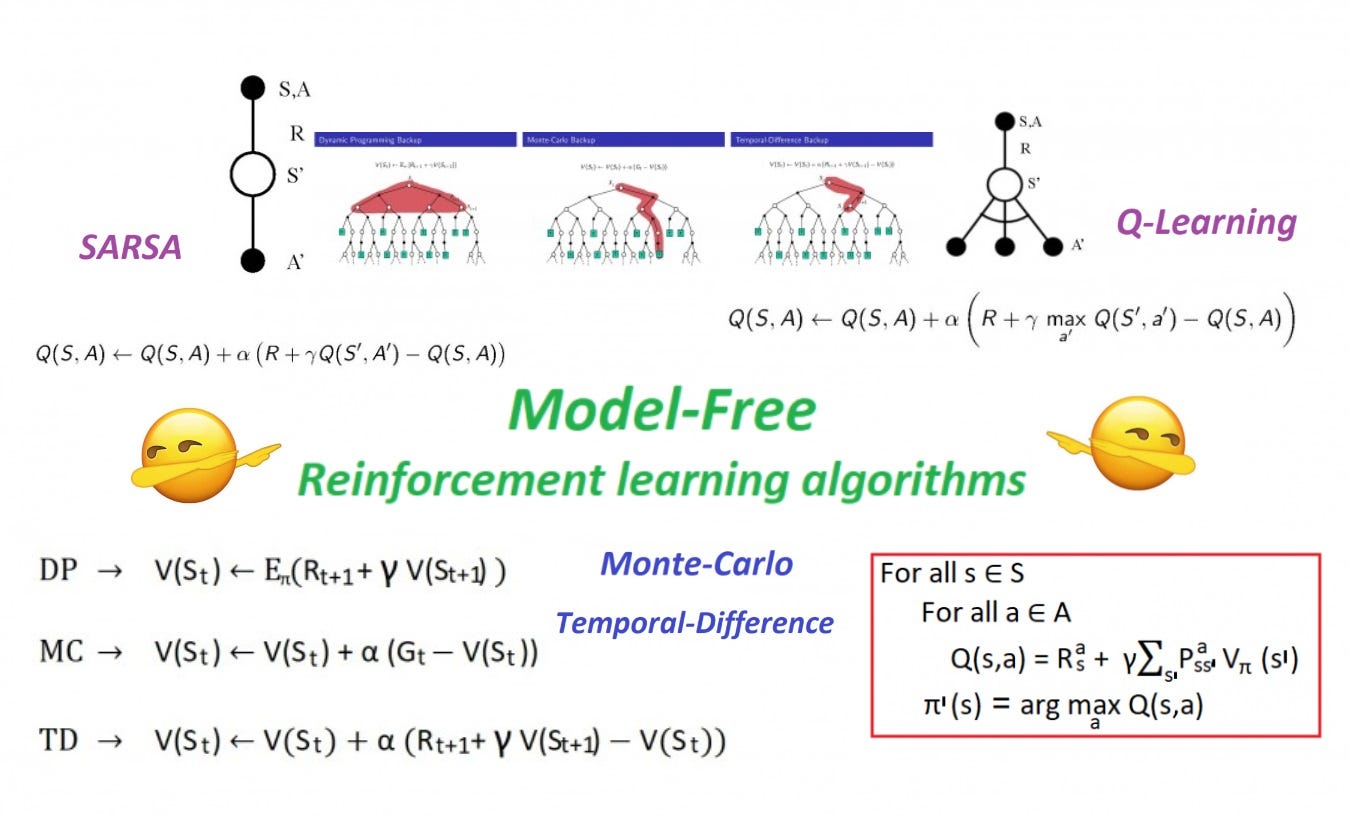
Difference between revisions of "Monte Carlo"
| Line 4: | Line 4: | ||
* [[Google DeepMind AlphaGo Zero]] | * [[Google DeepMind AlphaGo Zero]] | ||
* [http://modelai.gettysburg.edu/2014/mc1/index.html An Introduction to Monte Carlo Techniques in Artificial Intelligence | Todd W. Neller] | * [http://modelai.gettysburg.edu/2014/mc1/index.html An Introduction to Monte Carlo Techniques in Artificial Intelligence | Todd W. Neller] | ||
| + | |||
* [[Reinforcement Learning (RL)]] | * [[Reinforcement Learning (RL)]] | ||
** Monte Carlo (MC) Method - Model Free Reinforcement Learning | ** Monte Carlo (MC) Method - Model Free Reinforcement Learning | ||
| Line 14: | Line 15: | ||
** [[Evolutionary Computation / Genetic Algorithms]] | ** [[Evolutionary Computation / Genetic Algorithms]] | ||
** [[Actor Critic]] | ** [[Actor Critic]] | ||
| + | *** [[Asynchronous Advantage Actor Critic (A3C)]] | ||
*** [[Advanced Actor Critic (A2C)]] | *** [[Advanced Actor Critic (A2C)]] | ||
| − | |||
*** [[Lifelong Latent Actor-Critic (LILAC)]] | *** [[Lifelong Latent Actor-Critic (LILAC)]] | ||
** [[Hierarchical Reinforcement Learning (HRL)]] | ** [[Hierarchical Reinforcement Learning (HRL)]] | ||
| + | |||
| + | |||
Revision as of 07:23, 6 July 2020
- Model Free Reinforcement learning algorithms (Monte Carlo, SARSA, Q-learning) | Madhu Sanjeevi (Mady) - Medium
- Google DeepMind AlphaGo Zero
- An Introduction to Monte Carlo Techniques in Artificial Intelligence | Todd W. Neller
- Reinforcement Learning (RL)
- Monte Carlo (MC) Method - Model Free Reinforcement Learning
- Markov Decision Process (MDP)
- State-Action-Reward-State-Action (SARSA)
- Q Learning
- Deep Reinforcement Learning (DRL) DeepRL
- Distributed Deep Reinforcement Learning (DDRL)
- Evolutionary Computation / Genetic Algorithms
- Actor Critic
- Hierarchical Reinforcement Learning (HRL)
A broad class of computational algorithms that rely on repeated random sampling to obtain numerical results. Their essential idea is using randomness to solve problems that might be deterministic in principle. They are often used in physical and mathematical problems and are most useful when it is difficult or impossible to use other approaches. Monte Carlo methods are mainly used in three problem classes:[1] optimization, numerical integration, and generating draws from a probability distribution.
Monte Carlo Tree Search (MCTS)
Youtube search... ...Google search
Monte Carlo Simulation
Youtube search... ...Google search