Difference between revisions of "Math for Intelligence"
| Line 37: | Line 37: | ||
<youtube>PXwStduNw14</youtube> | <youtube>PXwStduNw14</youtube> | ||
<youtube>3icoSeGqQtY</youtube> | <youtube>3icoSeGqQtY</youtube> | ||
| + | |||
| + | == Mathematics Ontology == | ||
<youtube>OmJ-4B-mS-Y</youtube> | <youtube>OmJ-4B-mS-Y</youtube> | ||
| Line 49: | Line 51: | ||
<youtube>tUsrLNHZXvc</youtube> | <youtube>tUsrLNHZXvc</youtube> | ||
| + | <youtube>NDq_VaZ3iSQ</youtube> | ||
<youtube>NNxHOtPUnzg</youtube> | <youtube>NNxHOtPUnzg</youtube> | ||
<youtube>lEIyGJru3Uk</youtube> | <youtube>lEIyGJru3Uk</youtube> | ||
| − | + | ||
=== Vectors === | === Vectors === | ||
Revision as of 11:34, 14 June 2020
YouTube search... ...Google search
- Statistics for Intelligence
- Finding Paul Revere
- Causation vs. Correlation
- Dot Product
- Animated Math | Grant Sanderson @ 3blue1brown.com
- Courses & Certifications
- Introduction to Matrices and Matrix Arithmetic for Machine Learning | Jason Brownlee
- Essential Math for Data Science: ‘Why’ and ‘How’ | Tirthajyoti Sarkar - KDnuggets
- Gentle Dive into Math Behind Convolutional Neural Networks | Piotr Skalski - Towards Data Science
- Varient: Limits
- Neural Networks and Deep Learning - online book | Michael A. Nielsen
- Convolution vs. Cross-Correlation (Autocorrelation)
- Quantum algorithms
- Fundamentals:
Contents
Getting Started
Mathematics Ontology
Mathematics for Machine Learning | M. Deisenroth, A Faisal, and C. Ong .. Companion webpage ...
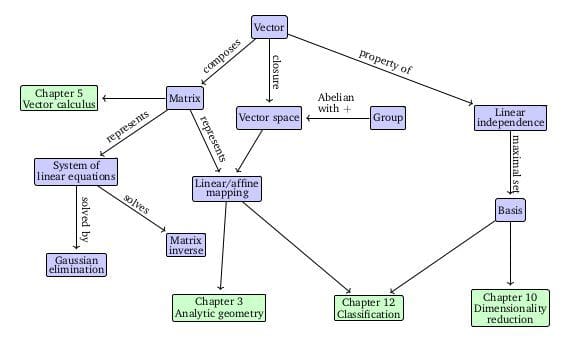
Scalar, Vector, Matrix & Tensor

Vectors
are an array of numbers. The numbers are arranged in order and we can identify each individual number by its index in that ordering. We can think of vectors as identifying points in space, with each element giving the coordinate along a different axis. In simple terms, a vector is an arrow representing a quantity that has both magnitude and direction wherein the length of the arrow represents the magnitude and the orientation tells you the direction. For example wind, which has a direction and magnitude.
Scalars
are just a single number. For example weight, which is denoted by just one number.
Matrices
- Eigenvalues and eigenvectors | Wikipedia
- Markov Matrix, also known as a stochastic matrix | DeepAI
- Kernels | Wikipedia
- Adjacency matrix | Wikipedia
A matrix is a 2D-array of numbers, so each element is identified by two indices instead of just one. If a real valued matrix A has a height of m and a width of n, then we say that A in Rm x n. We identify the elements of the matrix as A_(m,n) where m represents the row and n represents the column.
Tensors
3blue1brown
Explained
Siraj Raval
Gilbert Strang (MIT) - Linear Algebra
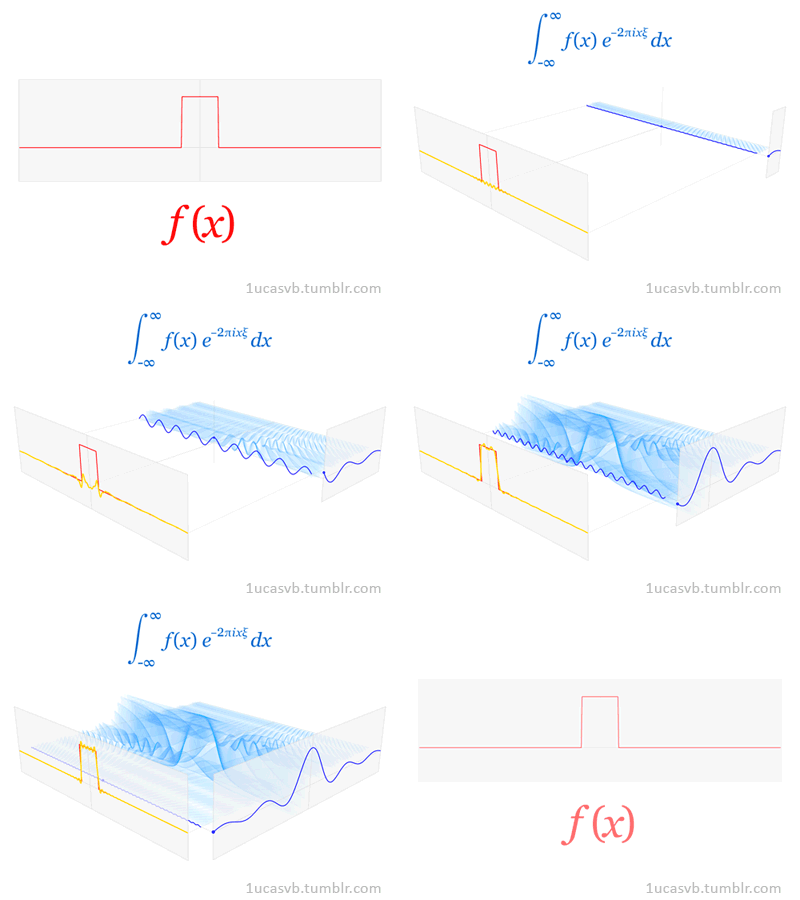
Fourier Transform (FT), Fourier Series, and Fourier Analysis
- Quantum Fourier transform (QFT)
- Engineers solve 50-year-old puzzle in signal processing - Vladimir Sukhoy and Alexander Stoytchev | Mike Krapfl - TechXplore
Joseph Fourier showed that representing a function as a sum of trigonometric functions greatly simplifies the study of heat transfer. Joseph was a French mathematician and physicist born in Auxerre and best known for initiating the investigation of Fourier series, which eventually developed into Fourier analysis and harmonic analysis, and their applications to problems of heat transfer and vibrations. The Fourier transform and Fourier's law of conduction are also named in his honor. Fourier is also generally credited with the discovery of the greenhouse effect.
- Fourier Transform (FT) decomposes a function of time (a signal) into its constituent frequencies. This is similar to the way a musical chord can be expressed in terms of the volumes and frequencies of its constituent notes. Fourier Transform | Wikipedia
- Fourier Series is a periodic function composed of harmonically related sinusoids, combined by a weighted summation. The discrete-time Fourier transform is an example of Fourier series. For functions on unbounded intervals, the analysis and synthesis analogies are Fourier Transform and inverse transform. Fourier Series | Wikipedia
- Fourier Analysis the study of the way general functions may be represented or approximated by sums of simpler trigonometric functions. Fourier Analysis | Wikipedia