Difference between revisions of "Quantum"
(→Quantum Development Algorithms & Kits) |
|||
| Line 63: | Line 63: | ||
<img src="http://github.com/Qiskit/ibmq-device-information/raw/master/backends/rueschlikon/images/ibmqx3-labeled.png" width="200" height="200"> | <img src="http://github.com/Qiskit/ibmq-device-information/raw/master/backends/rueschlikon/images/ibmqx3-labeled.png" width="200" height="200"> | ||
| + | <youtube>pYD6bvKLI_c</youtube> | ||
<youtube>v8Ujo27Rx0s</youtube> | <youtube>v8Ujo27Rx0s</youtube> | ||
<youtube>v7b4J2INq9c</youtube> | <youtube>v7b4J2INq9c</youtube> | ||
Revision as of 21:03, 12 September 2019
YouTube search... ...Google search
- Math for Intelligence
- Quantum Generative Adversarial Learning (QuGAN - QGAN)
- Processing Units - CPU, GPU, APU, TPU, VPU, FPGA, QPU
- Strawberry Fields - a full-stack Python library for designing, simulating, and optimizing continuous variable quantum optical circuits. | Xanadu
- Quantum Machine Learning 1.0 | Maria Schuld - Xanadu - Medium
- Training quantum neural networks with PennyLane, PyTorch, and TensorFlow | Medium
- ZapataComputing - Quantum Superstore
- D Wave - Quantum Computing Company
- Quantum Computing for English Majors | John Horgan - Scientific American
- Quantum Algorithm Implementations for Beginners | P. Coles, S. Eidenbenz, S. Pakin, A. Adedoyin, J. Ambrosiano, P. Anisimov, W. Casper, G. Chennupati, C. Coffrin, H. Djidjev, D. Gunter, S. Karra, N. Lemons, S. Lin, A. Lokhov, A. Malyzhenkov, D. Mascarenas, S. Mniszewski, B. Nadiga, D. O'Malley, D. Oyen, L. Prasad, R. Roberts, P. Romero, N. Santhi, N. Sinitsyn, P. Swart, M. Vuffray, J. Wendelberger, B. Yoon, R. Zamora, and W. Zhu
- Simulating quantum systems with neural networks | Ecole Polytechnique Federale de Lausanne - PHYS.ORG
- Exploring Quantum Programming from "Hello World" to "Hello Quantum World" | Rahul Kumar - Hackernoon
- A Universal Training Algorithm for Quantum Deep Learning | G. Verdon, J. Pye, & M. Broughton
- Quantum Tech tracking the development of quantum technologies — quantum computing and beyond | Nathan Shammah]
- How to program a quantum computer | James Wootton

Every quantum computer is fundamentally a sampler that starts with a simple probability distribution over all possible measurement outcomes, computes a more complicated distribution, and samples an outcome via a measurement. Quantum Machine Learning 1.0 | Maria Schuld - Xanadu - Medium
Two basic properties of quantum world:
- Superposition
- Entanglement
Contents
Quantum Machine Learning
Quantum machine learning is an emerging interdisciplinary research area at the intersection of quantum physics and machine learning. The most common use of the term refers to machine learning algorithms for the analysis of classical data executed on a quantum computer, i.e. quantum-enhanced machine learning. While machine learning algorithms are used to compute immense quantities of data, quantum machine learning increases such capabilities intelligently, by creating opportunities to conduct analysis on quantum states and systems. This includes hybrid methods that involve both classical and quantum processing, where computationally difficult subroutines are outsourced to a quantum device. These routines can be more complex in nature and executed faster with the assistance of quantum devices. Furthermore, quantum algorithms can be used to analyze quantum states instead of classical data. Quantum machine learning | Wikipedia
Quantum Neural Network (QNN)
Quantum neural networks (QNNs) are neural network models which are based on the principles of quantum mechanics. There are two different approaches to QNN research, one exploiting quantum information processing to improve existing neural network models (sometimes also vice versa), and the other one searching for potential quantum effects in the brain. Quantum Neural Network (QNN) | Wikipedia
Quantum Convolutional Neural Network (QCNN)
Machine learning techniques have so far proved to be very promising for the analysis of data in several fields, with many potential applications. However, researchers have found that applying these methods to quantum physics problems is far more challenging due to the exponential complexity of many-body systems.... "One of the objectives of the present work was to generalize a specific, well-known machine learning architecture called convolutional neural network (CNN) for a compact quantum circuit, and demonstrate its capabilities with simplistic but meaningful examples." In their study, Choi and his colleagues assumed that CNNs owe their great success to two important features. Firstly, the fact that they are made out of smaller local units (i.e., multiple layers of quasi-local quantum gates). Secondly, their ability to process input data in a hierarchical fashion. The researchers found a connection between these two characteristics and two renowned physics concepts known as locality and renormalization. "Locality is natural in physics because we believe that the law of nature is fundamentally local," Choi said. "Renormalization, on the other hand, is a very interesting concept. In physics, certain universal features of a quantum many-body system, such as the phase (e.g., liquid, gas, solid, etc.) of materials do not depend on (or are not sensitive to) microscopically detailed information of the system, but rather governed by only a few important hidden parameters. Renormalization is a theory technique to identify those important parameters starting from microscopic description of a quantum system." The researchers observed that renormalization processes share some similarities with pattern recognition applications, particularly those in which machine learning is used to identify objects in pictures. For instance, when a CNN trained for pattern recognition tasks analyzes pictures of animals, it focuses on a universal feature (i.e., trying to identify what animal is portrayed in the image), regardless of whether individual animals of the same type (e.g., cats) look slightly different. This process is somewhat similar to renormalization techniques in theoretical physics, which can also help to distill universal information....quantum convolutional neural network (QCNN), on a quantum physics-specific problem that involved recognizing quantum states associated with a 1-D symmetry protected topological phase. Remarkably, their technique was able to recognize these quantum states, outperforming existing approaches. As it is fairly compact, the QCNN could also potentially be implemented in small quantum computers. Introducing Quantum Convolutional Neural Networks (QCNN) | Ingrid Fadelli
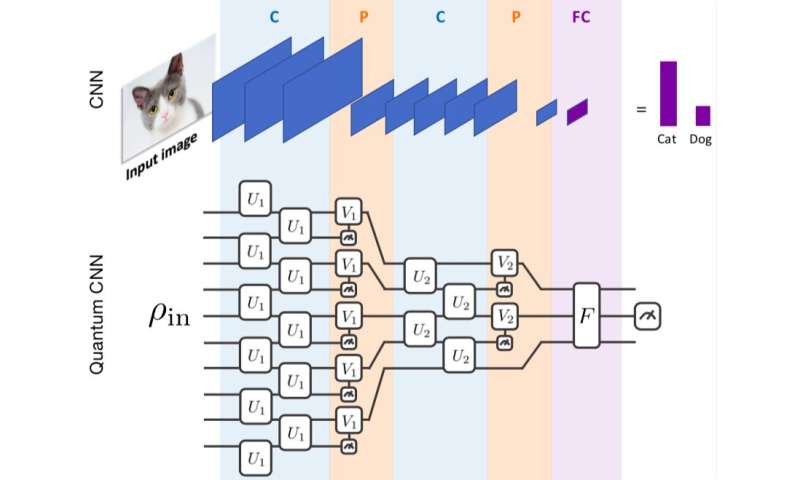
Quantum Development Algorithms & Kits
- Quantum Development Kit | Microsoft
- Cirq - a Python library for writing, manipulating, and optimizing quantum circuits and running them against quantum computers and simulators. | Google
- A developer’s guide to using the Quantum QISKit SDK | IBM
- IBM Q 16 Rueschlikon V1.x.x The connectivity on the device is provided by total 22 coplanar waveguide (CPW) "bus" resonators, each of which connects two qubits. The connectivity configuration is shown in the figure below; the colored dots indicate qubits, and the colored bars indicate CPW bus resonators. Three different resonant frequencies are used for the bus resonators. The white bars indicate the buses with a resonant frequency of 6.25 GHz, the grey bars 6.45 GHz, and the black bars 6.65 GHz.
- To access this chipset you will need an account on IBM Quantum Experience. And then generate the token from here.


