Difference between revisions of "Astronomy"
m |
m |
||
| Line 4: | Line 4: | ||
|keywords=ChatGPT, artificial, intelligence, machine, learning, GPT-4, GPT-5, NLP, NLG, NLC, NLU, models, data, singularity, moonshot, Sentience, AGI, Emergence, Moonshot, Explainable, TensorFlow, Google, Nvidia, Microsoft, Azure, Amazon, AWS, Hugging Face, OpenAI, Tensorflow, OpenAI, Google, Nvidia, Microsoft, Azure, Amazon, AWS, Meta, LLM, metaverse, assistants, agents, digital twin, IoT, Transhumanism, Immersive Reality, Generative AI, Conversational AI, Perplexity, Bing, You, Bard, Ernie, prompt Engineering LangChain, Video/Image, Vision, End-to-End Speech, Synthesize Speech, Speech Recognition, Stanford, MIT |description=Helpful resources for your journey with artificial intelligence; videos, articles, techniques, courses, profiles, and tools | |keywords=ChatGPT, artificial, intelligence, machine, learning, GPT-4, GPT-5, NLP, NLG, NLC, NLU, models, data, singularity, moonshot, Sentience, AGI, Emergence, Moonshot, Explainable, TensorFlow, Google, Nvidia, Microsoft, Azure, Amazon, AWS, Hugging Face, OpenAI, Tensorflow, OpenAI, Google, Nvidia, Microsoft, Azure, Amazon, AWS, Meta, LLM, metaverse, assistants, agents, digital twin, IoT, Transhumanism, Immersive Reality, Generative AI, Conversational AI, Perplexity, Bing, You, Bard, Ernie, prompt Engineering LangChain, Video/Image, Vision, End-to-End Speech, Synthesize Speech, Speech Recognition, Stanford, MIT |description=Helpful resources for your journey with artificial intelligence; videos, articles, techniques, courses, profiles, and tools | ||
| − | |||
| − | |||
| − | |||
| − | |||
| − | |||
| − | |||
| − | |||
| − | |||
| − | |||
}} | }} | ||
[https://www.youtube.com/results?search_query=NASA+SpaceX+spaceflight+planet+galaxy+space+asteroid+satellite+Dark+Matter+earth+moon+mars+sun+universe+artificial+intelligence+deep+machine+learning Youtube search...] | [https://www.youtube.com/results?search_query=NASA+SpaceX+spaceflight+planet+galaxy+space+asteroid+satellite+Dark+Matter+earth+moon+mars+sun+universe+artificial+intelligence+deep+machine+learning Youtube search...] | ||
| Line 27: | Line 18: | ||
* [[Time#Deep-Space Positioning System (DPS)|Deep-Space Positioning System (DPS)]] | * [[Time#Deep-Space Positioning System (DPS)|Deep-Space Positioning System (DPS)]] | ||
* [[Video/Image]] ... [[Vision]] ... [[Enhancement]] ... [[Fake]] ... [[Reconstruction]] ... [[Colorize]] ... [[Occlusions]] ... [[Predict image]] ... [[Image/Video Transfer Learning]] | * [[Video/Image]] ... [[Vision]] ... [[Enhancement]] ... [[Fake]] ... [[Reconstruction]] ... [[Colorize]] ... [[Occlusions]] ... [[Predict image]] ... [[Image/Video Transfer Learning]] | ||
| + | * [[Telecommunications]] ... [[Computer Networks]] ... [[Telecommunications#5G|5G]] ... [[Satellite#Satellite Communications|Satellite Communications]] ... [[Quantum Communications]] ... [[Smart Cities]] ... [[Digital Twin]] ... [[Internet of Things (IoT)]] ... [[Computer_Networks#Space-based Data Centers|Space-based Data Centers]] | ||
* [https://www.nasa.gov/ National Aeronautics and Space Administration (NASA)] | * [https://www.nasa.gov/ National Aeronautics and Space Administration (NASA)] | ||
* [https://python4astronomers.github.io/ Practical Python for Astronomers | GitHub] | * [https://python4astronomers.github.io/ Practical Python for Astronomers | GitHub] | ||
Revision as of 11:21, 16 September 2026
Youtube search... ...Google search ...News search
- Case Studies
- Image Classification
- Space-based Data Centers
- Time ... PNT ... GPS ... Retrocausality ... Delayed Choice Quantum Eraser ... Quantum
- Deep-Space Positioning System (DPS)
- Video/Image ... Vision ... Enhancement ... Fake ... Reconstruction ... Colorize ... Occlusions ... Predict image ... Image/Video Transfer Learning
- Telecommunications ... Computer Networks ... 5G ... Satellite Communications ... Quantum Communications ... Smart Cities ... Digital Twin ... Internet of Things (IoT) ... Space-based Data Centers
- National Aeronautics and Space Administration (NASA)
- Practical Python for Astronomers | GitHub
- OpenNASA
- Artificial Intelligence at NASA – Current Projects and Applications - Millicent Abadicio
- International Space Station Launches AI Program to Test Astronaut Gloves | Brandi Vincent - Nextgov ...Spaceborne Computer-2 (SBC-2) is providing insights in real-time, an HPE-built edge computing system explicitly for in-space, commercial AI and real-time data processing. The machine taps Microsoft’s Azure Space service.
- How artificial intelligence is changing astronomy | Ashley Spindler - Astronomy ... Machine learning has become an essential piece of astronomers’ toolkits
- The Image of the M87 Black Hole Reconstructed with PRIMO | L. Medeiros, D. Psaltis, T. Lauer, & F. Özel - The Astrophysical Journal Letters ... use of principal-component interferometric modeling (PRIMO), a novel image-reconstruction algorithm that addresses the challenges of millimeter-wave interferometry with sparse arrays by training the algorithm on an extensive suite of simulated images of accreting black holes (Medeiros et al. 2023)
- AI Software May Have Just Discovered Aliens and It's Scary | Allison Blair - TurboFuture ... ended up with 8 signals that could be a sign alien life
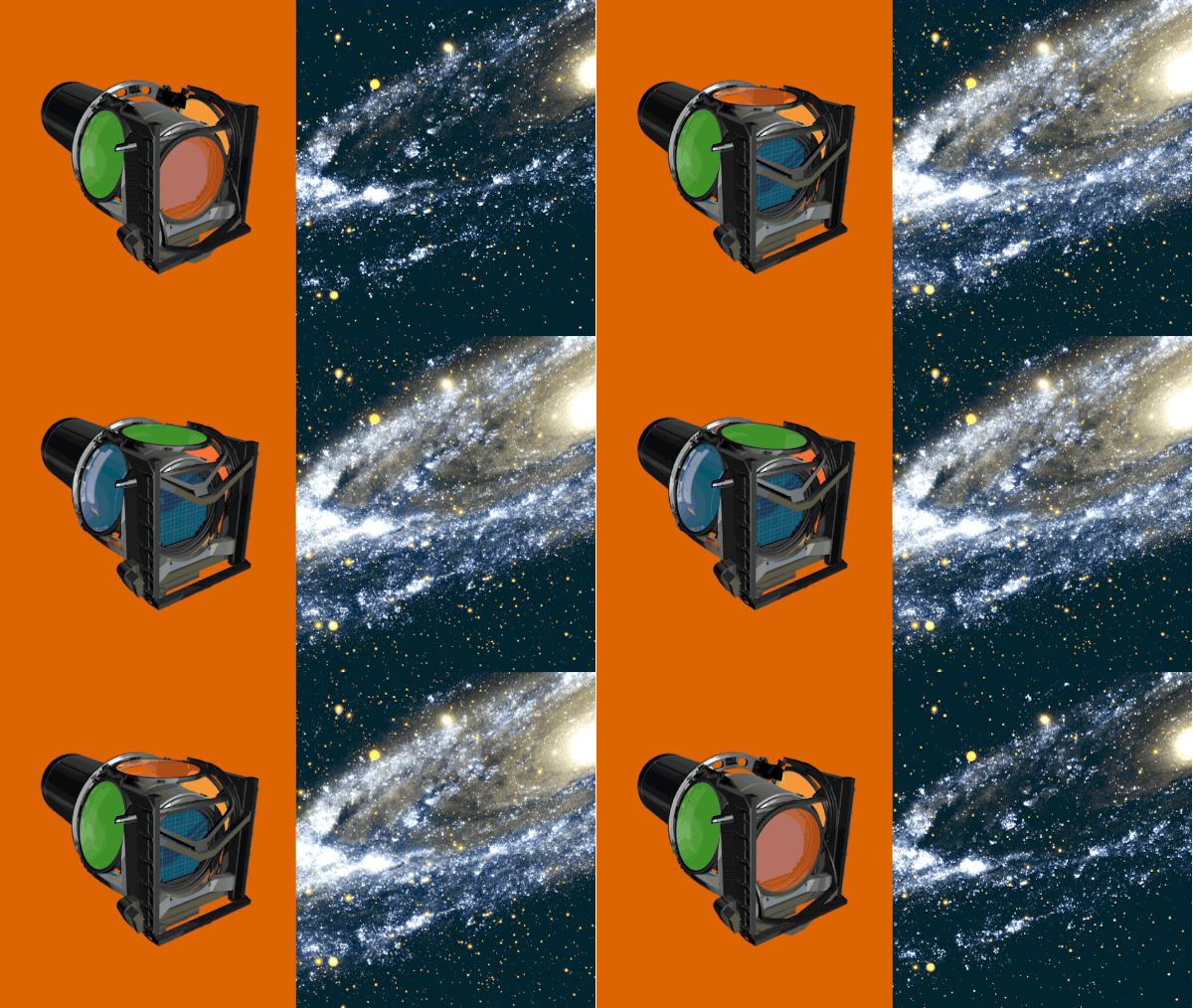
Astronomy is the study of celestial objects and phenomena beyond Earth's atmosphere. It encompasses everything from the smallest particles in space to the largest structures in the universe. In recent years, artificial intelligence (AI) has become an increasingly important tool in astronomy, helping scientists to make sense of the vast amounts of data generated by telescopes and other instruments. One area where AI is being applied in astronomy is in the analysis of star data. By training algorithms to identify patterns in the light emitted by stars, astronomers can use AI to more accurately classify stars and better understand their properties. AI is also being used to search for exoplanets, or planets outside of our solar system. By analyzing data from telescopes like NASA's Kepler and TESS, AI algorithms can detect the subtle changes in starlight that indicate the presence of an orbiting planet. Satellites and spacecraft are another area where AI is proving useful in astronomy. For example, NASA's Mars rovers are equipped with AI algorithms that help them navigate the Martian terrain and avoid obstacles. Similarly, the upcoming James Webb Space Telescope (JWST) will use AI to help optimize its observations, allowing it to detect more distant and faint objects than ever before. The sun and its behavior is also of great interest to astronomers, as its activity can have significant impacts on Earth's climate and technological infrastructure. AI is being used to analyze data from spacecraft like NASA's Solar Dynamics Observatory (SDO) to better understand the sun's magnetic fields and the processes that drive solar flares and other phenomena. In addition to studying celestial objects and phenomena, AI is also being used to detect and analyze gravitational waves, ripples in the fabric of spacetime caused by the acceleration of massive objects like black holes. The Laser Interferometer Gravitational-Wave Observatory (LIGO) uses AI algorithms to sift through the vast amounts of data generated by its detectors, looking for the telltale signals of gravitational waves.
Finding: Autonomy needs to evolve at a systems level to integrate and harmonize subsystems to make decisions and execute planned operations on remote yet complex planetary science and astrobiology missions. Machine learning/artificial intelligence can support the implementation of autonomy in such environments. Origins, Worlds, and Life, A Decadal Strategy for Planetary Science and Astrobiology 2023-2032, (2022) | National Academies of Sciences ... ~ 780 pages see General Technology Areas; Autonomy, Quantum Computing and Artificial Intelligence/Machine Learning
- Using Artificial Intelligence to Support Science Prioritization by the Decadal Surveys | Thronson, H., B. Thomas, L. Barbier, and A. Buonomo
- “By harnessing our collective passion, we can change the course of history.” - Bill Nye, CEO of The Planetary Society
|
|
|
|
|
|
|
|
Contents
Dark Matter
Youtube search... ...Google search ...News search
|
|
|
|
Galaxy Evolution
Youtube search... ...Google search ...News search
|
|
Galaxies / Stars
Youtube search... ...Google search ...News search
|
|
Object Classification
Youtube search... ...Google search ...News search
- Machine Learning Just Classified Over Half a Million Galaxies | Andy Tomaswick - Universe Today ...scientists trained the algorithm using images of spiral-patterned galaxies similar to the Milky Way. When used on the test set, the algorithm accurately classified 95.7 percent of galaxies.
|
|
|
|
|
|
Black Holes
Youtube search... ...Google search ...News search
|
|
Sun / Solar
Youtube search... ...Google search ...News search
|
|
Planets
Youtube search... ...Google search ...News search
- Breakthrough AI identifies 50 new planets from old NASA data | Jessie Yeung - CNN Business
- NASA Exoplanet Archive ...A Service of NASA Exoplanet Science Institute
- Exoplanet Validation with Machine Learning: 50 new validated Kepler planets | D. Armstrong, J. Gamper, and T. Damoulas - Oxford Academic
|
|
|
|
|
|
Earth
Youtube search... ...Google search ...News search
|
|
|
|
Mars
Youtube search... ...Google search ...News search
|
|
Moon
Youtube search... ...Google search ...News search
|
|
|
|
Man-made (artificial) Satellites
Youtube search... ...Google search ...News search
|
|
|
|
Asteroids
Youtube search... ...Google search ...News search
|
|
Collision Avoidance in Space
Youtube search... ...Google search ...News search
- Artificial Intelligence Solutions to Track and Map Space Debris | Seer Tracking
- Spacecraft Collision Avoidance Challenge | European Space Agency (ESA)
- Data: Close encounters between two objects |European Space Agency (ESA)
- Kessler_Syndrome | Wikipedia ... a theoretical scenario in which the density of objects in low Earth orbit (LEO) due to space pollution is high enough that collisions between objects could cause a cascade in which each collision generates space debris that increases the likelihood of further collisions.
- Genetic Programming using random forest
- LightGBM ...Microsoft's gradient boosting framework that uses tree based learning algorithms
- Manhattan LSTM (MaLSTM) a Siamese architecture based on recurrent neural network
- Monte Carlo Cross-Validation
Challenge:
Today, active collision avoidance among orbiting satellites has become a routine task in space operations, relying on validated, accurate and timely space surveillance data. For a typical satellite in Low Earth Orbit, hundreds of alerts are issued every week corresponding to possible close encounters between a satellite and another space object (in the form of conjunction data messages CDMs). After automatic processing and filtering, there remain about 2 actionable alerts per spacecraft and week, requiring detailed follow-up by an analyst. On average, at the European Space Agency, more than one collision avoidance manoeuvre is performed per satellite and year. In this challenge, you are tasked to build a model to predict the final collision risk estimate between a given satellite and a space object (e.g. another satellite, space debris, etc). To do so, you will have access to a database of real-world conjunction data messages (CDMs) carefully prepared at ESA. Learn more about the challenge and the data.
Results:
Spacecraft collision avoidance procedures have become an essential part of satellite operations. Complex and constantly updated estimates of the collision risk between orbiting objects inform the various operators who can then plan risk mitigation measures. Such measures could be aided by the development of suitable machine learning models predicting, for example, the evolution of the collision risk in time. ...This paper describes the design and results of the competition and discusses the challenges and lessons learned when applying machine learning methods to this problem domain. Spacecraft Collision Avoidance Challenge: design and results of a machine learning competition | T. Uriot, D. Izzo, L. Simoes, R. Abay, N. Einecke, S. Rebhan, J. Martinez-Heras, F. Letizia, J. Siminski, and K. Merz
|
|

Astropy Project
Youtube search... ...Google search ...News search
- Astropy Project ...a community effort to develop a common core package for Astronomy in Python and foster an ecosystem of interoperable astronomy packages.
|
|
|
|
Simulation
Youtube search... ...Google search ...News search
- Using generative modeling to investigate the physical changes that galaxies undergo as they evolve. (The software they used treats the latent space somewhat differently from the way a generative adversarial network treats it, so it is not technically a GAN, though similar.) . How Artificial Intelligence Is Changing Science | Dan Falk - Quanta Magazine
- Worlds’s first AI universe simulator knows things it shouldn’t | Thomas Frey
- Immersive Reality ... Metaverse ... Omniverse ... Transhumanism ... Religion
|
|
|
|
|
|
Apollo Computers
The Apollo 11 mission utilized several onboard computers for navigation, guidance, and control:
- Apollo Guidance Computer (AGC): The AGC was the main computer system responsible for guiding and controlling the spacecraft. It was designed by MIT Instrumentation Laboratory and built by Raytheon. The AGC was one of the earliest digital computers and used core rope memory for its software.
- Apollo Command Module (CM) Computer: The command module, where the astronauts lived during the mission, was equipped with its own computer. This computer was responsible for various functions related to navigation, guidance, and communication.
- Lunar Module (LM) Computer: The lunar module, used for landing on the moon, also had its own computer. The LM computer played a critical role in the descent and landing phase of the mission.
1201 1202 Error
The "Apollo 1202 Error" refers to a critical error that occurred during the Apollo 11 moon landing mission on July 20, 1969. The error code "1202" was a program alarm that appeared on the guidance computer of the lunar module just seconds before Neil Armstrong was about to touch down on the lunar surface. The error was triggered by an overloaded guidance computer, which was receiving more data than it could process due to a radar switch being in the wrong position. Despite the error, the mission controllers at NASA's Mission Control Center in Houston, Texas, and the astronauts aboard the lunar module proceeded with the landing. The guidance computer's software and the quick thinking of the mission controllers allowed them to resolve the issue and continue with the descent. Armstrong manually piloted the lunar module to a safe landing spot with only about 30 seconds of fuel remaining. He famously radioed back to Mission Control, "Houston, Tranquility Base here. The Eagle has landed." The Apollo 11 mission was a historic achievement, as it marked the first time humans successfully landed on the moon and returned safely to Earth. The 1202 Error is a reminder of the challenges and ingenuity involved in such complex and pioneering endeavors. Margaret Hamilton was the Director of the Software Engineering Division of MIT Instrumentation Laboratory, which was responsible for developing the software for the Apollo guidance and navigation systems. Margaret Hamilton's team had designed the software with a priority system that allowed the computer to handle essential tasks first and manage the overload gracefully. The software's ability to prioritize critical functions and manage non-essential tasks helped prevent a mission abort. Margaret Hamilton's innovative approach to software development, which included concepts like error recovery and priority-based processing, played a crucial role in the success of the Apollo 11 landing. Her work and the efforts of her team demonstrated the importance of robust software engineering in complex and high-stakes missions.
