Difference between revisions of "Graph"
m (→Cybersecurity - Visualization) |
m (→Cybersecurity - Visualization) |
||
| Line 330: | Line 330: | ||
* [[Cybersecurity]] | * [[Cybersecurity]] | ||
* [http://www.graphistry.com/use-cases/threat-hunting Threat Hunting | Graphistry] | * [http://www.graphistry.com/use-cases/threat-hunting Threat Hunting | Graphistry] | ||
| + | |||
| + | {|<!-- T --> | ||
| + | | valign="top" | | ||
| + | {| class="wikitable" style="width: 550px;" | ||
| + | || | ||
| + | <youtube>Dhh1Dfm9Eao</youtube> | ||
| + | <b>Supercharged graph visualization for cyber security | ||
| + | </b><br>Cyber security analysts face data overload. They work with information on a massive scale, generated at millisecond levels of resolution detailing increasingly complex attacks. To make sense of this data, analysts need an intuitive and engaging way to explore it: that’s where graph visualization plays a role. Using KeyLines 3.0 to visualize your cyber data at scale During this session, Corey will show examples of how graph visualization can help users explore, understand and derive insight from real-world cyber security datasets. You will learn: - How graph visualization can help you extract insight from cyber data - How to visualize your cyber security graph data at scale using WebGL - Why KeyLines 3.0 is the go-to tool for large-scale cyber graph visualization. This session is suitable for a non-technical audience. | ||
| + | |} | ||
| + | |<!-- M --> | ||
| + | | valign="top" | | ||
| + | {| class="wikitable" style="width: 550px;" | ||
| + | || | ||
| + | <youtube>narU7ej4yjE</youtube> | ||
| + | <b>Finding Needles in a Needlestack with Graph Analytics and Predictive Models | ||
| + | </b><br>RSA Conference Kevin Mahaffey, Chief Technology Officer, Lookout Tim Wyatt, Director, Security Engineering, Lookout Good or bad? Security systems answer this question daily: good code vs. malware, legit clients vs. API abuse, etc. In the past, preset rules and heuristics have often been the first (and only) line of defense. In this talk, we'll share learnings you can take home from our experience using big datasets, graph analytics, and predictive models to secure millions of mobile devices around the world. | ||
| + | |} | ||
| + | |}<!-- B --> | ||
| + | {|<!-- T --> | ||
| + | | valign="top" | | ||
| + | {| class="wikitable" style="width: 550px;" | ||
| + | || | ||
| + | <youtube>Z2tuadJQMow</youtube> | ||
| + | <b>Applying graph visualization to cyber-security analysis | ||
| + | </b><br>Security information and event management/log management (SIEM/LM) evolve continuously to match new security threats. Nevertheless, these solutions often lack appropriate forensics tools to investigate the massive volumes of data they generate. This makes it difficult for security analysts to quickly and efficiently extract the information they need. Modeling this data into a graph database and adding a graph visualization solution like Linkurious on top of the company’s security dashboard can solve this problem. In this webinar, based on a real-world example, you will learn how Linkurious can help: | ||
| + | detect and investigate visually suspicious patterns using the power of graph; perform advanced post attack forensics analysis and locate vulnerabilities; | ||
| + | work collaboratively and locate suspicious IP’s using the geospatial localization feature. | ||
| + | |} | ||
| + | |<!-- M --> | ||
| + | | valign="top" | | ||
| + | {| class="wikitable" style="width: 550px;" | ||
| + | || | ||
| + | <youtube>LBfRnVVdKWo</youtube> | ||
| + | <b>RAPIDS Academy | ||
| + | </b><br>Graphistry Home | ||
| + | |} | ||
| + | |}<!-- B --> | ||
Revision as of 15:52, 6 October 2020
Youtube search... ...Google search
- Framing Context
- Enterprise Architecture (EA)
- Explainable / Interpretable AI
- Graph Convolutional Network (GCN), Graph Neural Networks (Graph Nets), Geometric Deep Learning
- A Beginner's Guide to Graph Analytics and Deep Learning | Chris Nicholson - A.I. Wiki pathmind
- 7 Ways Your Data Is Telling You It’s a Graph | Karen Lopez - InfoAdvisors - Neo4j
Adding Context Will Take AI to the Next Level | Neo4j
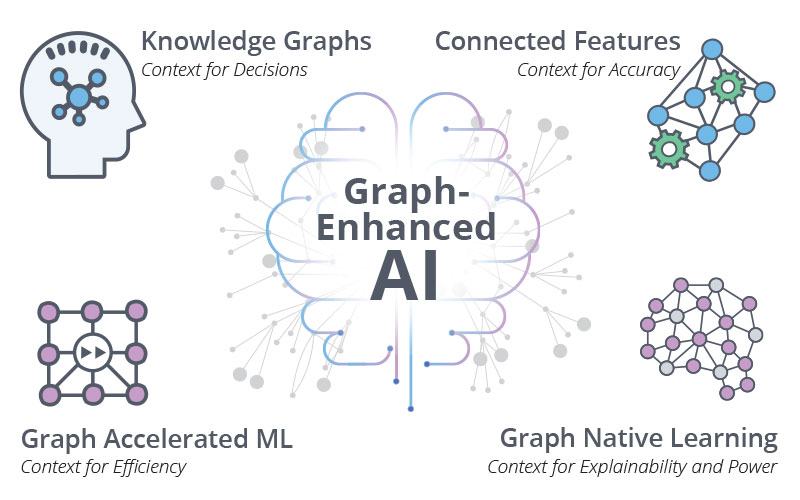
|
|
|
|
|
|
|
|
|
|
|
|
|
Contents
- 1 Graph Data Models
- 2 Graph Use Cases
- 3 Graph query-programming languages
- 4 Graph Databases (GDB)
- 5 Graph Algorithms
- 5.1 Breadth First Search (BFS)
- 5.2 Depth-First Search Algorithm (DFS)
- 5.3 Dijkstras Algorithm for Single-Source Shortest Path
- 5.4 Prims Algorithm for Minimum Spanning Trees
- 5.5 Kruskals Algorithm for Minimum Spanning Trees
- 5.6 Bellman-Ford Single-Source Shortest-Path Algorithm
- 5.7 Floyd Warshall Algorithm
- 6 Semantic Knowledge Graph
- 7 Cybersecurity - Visualization
Graph Data Models
- Graph Fundamentals | Kevin Feeney TerminusDB - Medium
- RDF Triple Stores vs. Labeled Property Graphs: What’s the Difference? | Jesús Barrasa - Neo4j
- Labeled Property Graph (LPG)
- Resource Description Framework (RDF) Graph
- Others
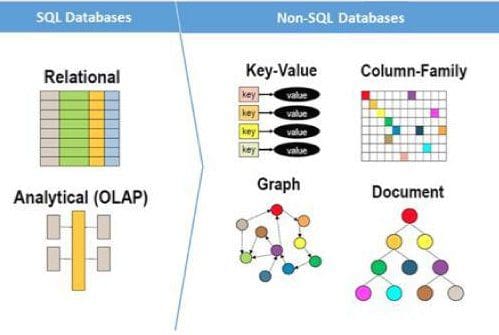

Graph Use Cases
- A Taxonomy of Graph Use Cases | Dan McCreary - Medium
- Graph database Use Cases | Max De Marzi - Slideshare

- Machine Learning
- Portfolio Analytics (Asset Management)
- Master Data Management
- Data Integration
- Social Networks
- Genomics (Gene Sequencing) BioInformatics
- Epidemiology
- Web Browsing
- Semantic Web
- Communication Networks (Network Cell Analysis)
- Internet of Things (Sensor Networks)
- Recommendations
- Fraud Detection (Money Laundering)
- Geo Routing (Public Transport)
- Customer 360
- Insurance Risk Analysis
- Content Management & Access Control
- Privacy, Risk and Compliance
Graph query-programming languages
GraphQL
Youtube search... ...Google search
- GraphQL
- GraphiQL is the reference implementation of GraphQL IDE, an official project under the GraphQL Foundation
- GitHub GraphQL API
- Graph Convolutional Network (GCN), Graph Neural Networks (Graph Nets), Geometric Deep Learning
GraphQL is a query language for APIs and a runtime for fulfilling those queries with your existing data. GraphQL provides a complete and understandable description of the data in your API, gives clients the power to ask for exactly what they need and nothing more, makes it easier to evolve APIs over time, and enables powerful developer tools. GraphQL queries access not just the properties of one resource but also smoothly follow references between them. While typical REST APIs require loading from multiple URLs, GraphQL APIs get all the data your app needs in a single request. Apps using GraphQL can be quick even on slow mobile network connections.
With Python
Cypher
Youtube search... ...Google search
- openCypher.org - Originally contributed by Neo4j; transition planning from openCypher implementations to the developing graph query language standard, GQL
Graph Query Language (GQL)
Youtube search... ...Google search
Will enable SQL users to use property graph style queries on top of SQL tables. GQL draws heavily on existing languages. The main inspirations have been Cypher (now with over ten implementations, including six commercial products), Oracle's PGQL and SQL itself, as well as new extensions for read-only property graph querying to SQL. SQL ... and now GQL | Alastair Green
Gremlin
Youtube search... ...Google search
- Wikipedia
- Intro to Graph Databases Using Tinkerpop, TitanDB, and Gremlin | Caleb Jones
- Gremlin Graph Traversal Machine and Language
- TinkerPop
is a graph traversal language and virtual machine developed by Apache TinkerPop of the Apache Software Foundation. Gremlin works for both OLTP-based graph databases as well as OLAP-based graph processors. As an explanatory analogy, Apache TinkerPop and Gremlin are to graph databases what the JDBC and SQL are to relational databases. Likewise, the Gremlin traversal machine is to graph computing as what the Java virtual machine is to general purpose computing.
Oracle Property Graph (PGQL)
Youtube search... ...Google search
- Property Graph Query Language is a query language built on top of SQL, bringing graph pattern matching capabilities to existing SQL users as well as to new users who are interested in graph technology but who do not have an SQL background.
SPARQL
Youtube search... ...Google search
Graph Databases (GDB)
...offer a more efficient way to model relationships and networks than relational (SQL) databases or other kinds of NoSQL databases (document, wide column, and so on).
Offering:
Neo4J
Amazon Neptune
...from Blazegraph
JanusGraph
TitanDB
OrientDB
Giraph
TigerGraph
AnzoGraph
Dgraph
- written in Go
Dato GraphLab
Graph Algorithms
Breadth First Search (BFS)
Depth-First Search Algorithm (DFS)
Dijkstras Algorithm for Single-Source Shortest Path
Prims Algorithm for Minimum Spanning Trees
Kruskals Algorithm for Minimum Spanning Trees
Bellman-Ford Single-Source Shortest-Path Algorithm
Floyd Warshall Algorithm
Semantic Knowledge Graph
- AI Powered Search | Trey Grainger
- Apache Solr ...open source enterprise search platform built on [https://www.w3schools.com/js/js_json_http.asp Apache Lucene™. Solr is highly scalable, providing fully fault tolerant distributed indexing, search and analytics. It exposes Lucene's features through easy to use JSON/HTTP interfaces or native clients for Java and other languages. The PyLucene sub project provides Python bindings for Lucene.
- Relevant Search: With applications for Solr and Elasticsearch | Doug Turnbull and John Berryman
- Changing Bits and Lucene in Action | Michael McCandless
- Wikis
Cybersecurity - Visualization
YouTube search... ...Google search
|
|
|
|
